Museums and the digital environment Lynda Kelly, Head of Audience Research & A/Web Manager
Web 2.0 / social media is about connections: Sharing content : blogs, wikis, podcasts, vlogs Self-publishing content : YouTube, Flickr Adding to established content : user-tagging, Wikipedia Discussing issues : forums, blogs, chat Tailoring information : RSS feeds, email alerts Bringing people together :  Facebook, MySpace, SecondLife This means that museums will have increasingly complex relationships with their users Conversation    collaboration
“ Web 2.0 puts users and not the organisation at the centre of the equation. This is threatening, but also exciting in that it has the potential to lead to richer content, a more personal experience.” Mike Ellis and Brian Kelly,  Web 2.0: How to Stop Thinking and Start Doing: Addressing Organisational Barriers,  April 2007 ? How will Web 2.0 force us to work differently?
“ VCN (Victoria Cultural Network) members recognise that they are part of an international marketplace and that what happens in places like the Getty, Smithsonian, Tate and the V&A, shapes what users will expect [online] from the VCN.” Martin Hallett & Eleanor Whitworth, November 2006  ? How will the Museum maintain a world-class online presence?
“ 36% of online Americans consult Wikipedia ... [it is] is far more popular among the well-educated than among those with lower levels of education ... 50% of those with at least a college degree consult the site, compared to 22% of those with high school diploma.” Pew Internet Report  Wikipedia Users , April 2007 ? Who will be providing content in the future?
“ Young people are spending their time in a space which adults find difficult to supervise or understand.” DEMOS Report  Their Space: Education for a digital age , January 2007 ? How will we understand and engage future visitors/users in our programs?
“ Political campaigns as we know them are dead ... There is no telling where it will go from here ... Stumbles and blunders aren’t just played once or twice on the evening news then forgotten; they shoot straight to YouTube, enjoyed again and again.” Annabel Crabb  The YouTube election,  Sydney Morning Herald, July 14 2007 ? Authors will be developing & publishing their own content in future: what does this mean for us?
“ Rather than people using technology to adapt to their own needs, they are now using the capacity and functionality of technology to create and shape new potential.” DEMOS Report  Logging on: Culture, participation and the web , June 2007 ? Are we comfortable with users creating their own experiences?
 
 
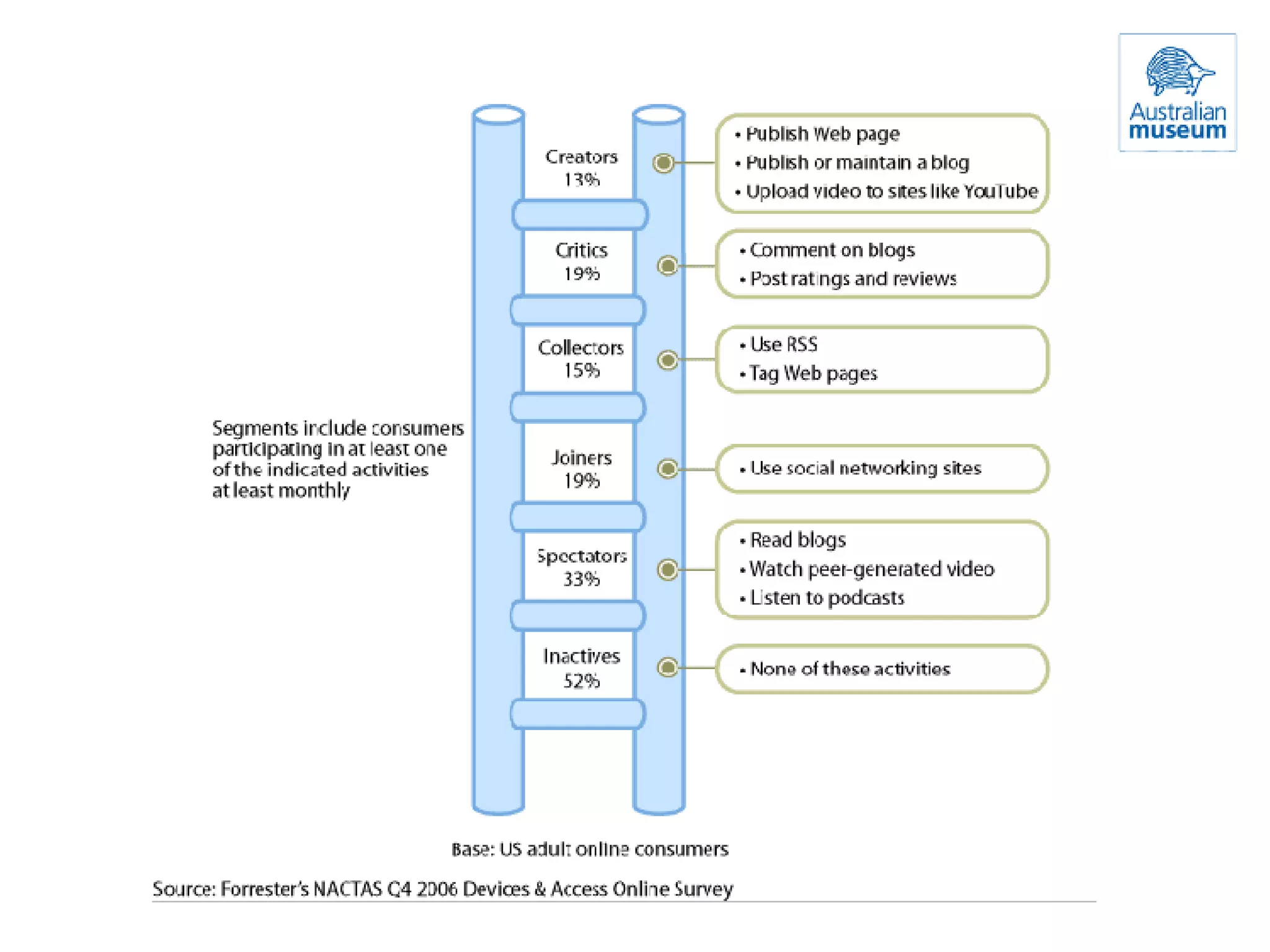
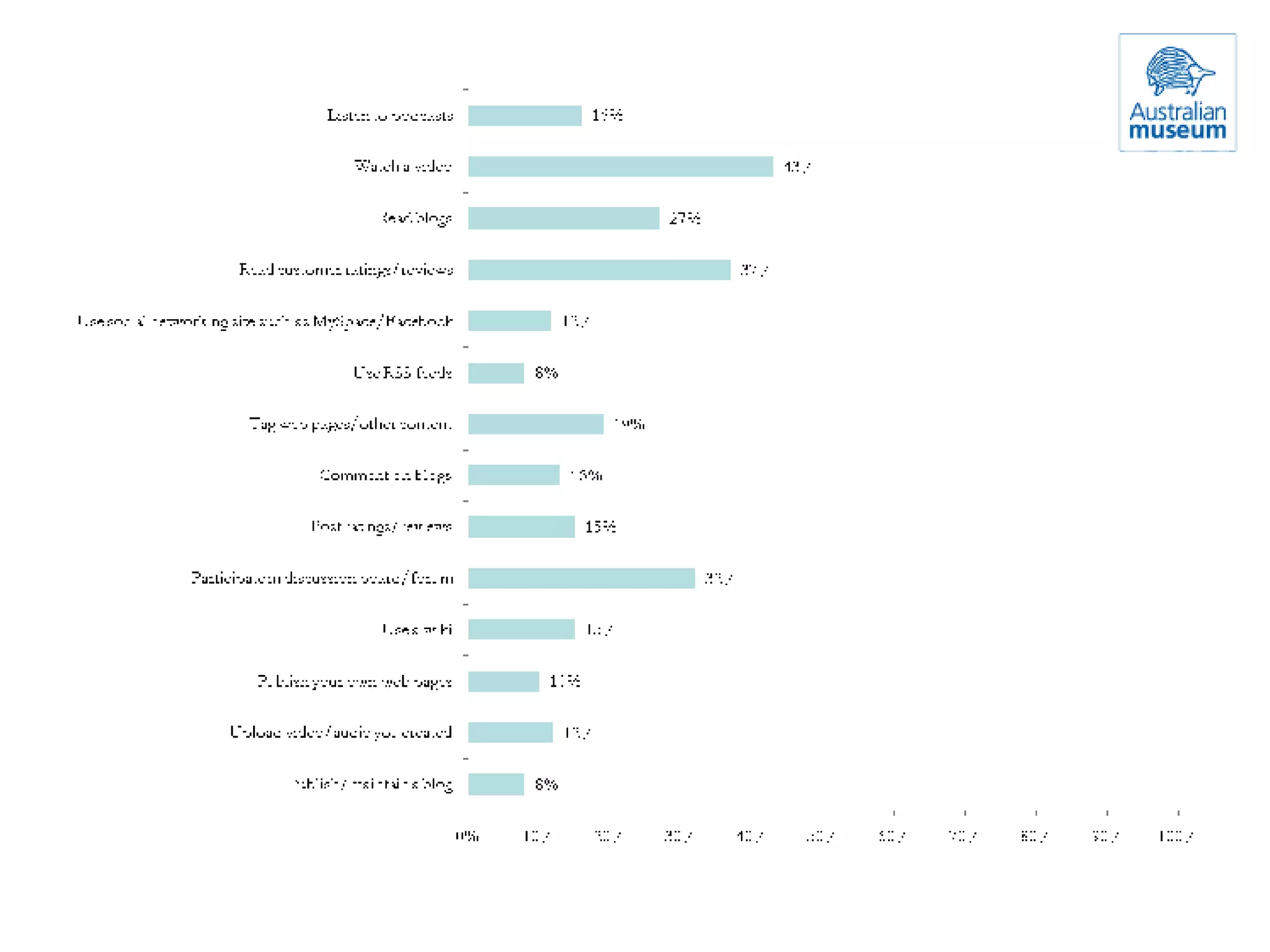
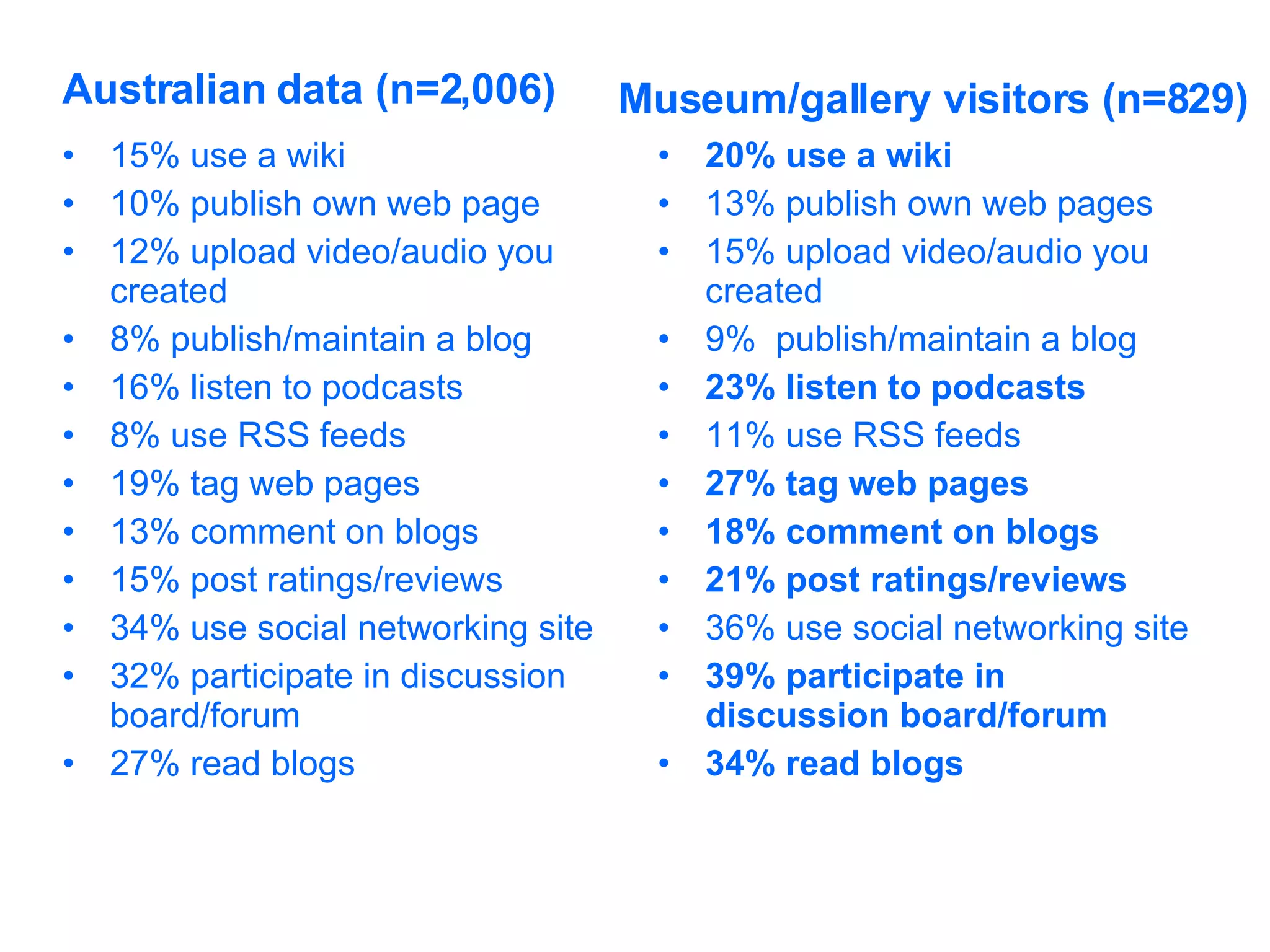
Australian data (n=2,006) 15% use a wiki 10% publish own web page 12% upload video/audio you created 8% publish/maintain a blog 16% listen to podcasts 8% use RSS feeds 19% tag web pages 13% comment on blogs 15% post ratings/reviews 34% use social networking site 32% participate in discussion board/forum 27% read blogs Museum/gallery visitors (n=829) 20% use a wiki 13% publish own web pages 15% upload video/audio you created 9%  publish/maintain a blog 23% listen to podcasts 11% use RSS feeds 27% tag web pages 18% comment on blogs 21% post ratings/reviews 36% use social networking site 39% participate in discussion board/forum 34% read blogs
 
http.//www.australianmuseum.net.au/amarc/ http://amarclk.blogspot.com/ http.//www.audience-research.wikispaces.com/

Museums and the digital environment

  • 1.
    Museums and thedigital environment Lynda Kelly, Head of Audience Research & A/Web Manager
  • 2.
    Web 2.0 /social media is about connections: Sharing content : blogs, wikis, podcasts, vlogs Self-publishing content : YouTube, Flickr Adding to established content : user-tagging, Wikipedia Discussing issues : forums, blogs, chat Tailoring information : RSS feeds, email alerts Bringing people together : Facebook, MySpace, SecondLife This means that museums will have increasingly complex relationships with their users Conversation  collaboration
  • 3.
    “ Web 2.0puts users and not the organisation at the centre of the equation. This is threatening, but also exciting in that it has the potential to lead to richer content, a more personal experience.” Mike Ellis and Brian Kelly, Web 2.0: How to Stop Thinking and Start Doing: Addressing Organisational Barriers, April 2007 ? How will Web 2.0 force us to work differently?
  • 4.
    “ VCN (VictoriaCultural Network) members recognise that they are part of an international marketplace and that what happens in places like the Getty, Smithsonian, Tate and the V&A, shapes what users will expect [online] from the VCN.” Martin Hallett & Eleanor Whitworth, November 2006 ? How will the Museum maintain a world-class online presence?
  • 5.
    “ 36% ofonline Americans consult Wikipedia ... [it is] is far more popular among the well-educated than among those with lower levels of education ... 50% of those with at least a college degree consult the site, compared to 22% of those with high school diploma.” Pew Internet Report Wikipedia Users , April 2007 ? Who will be providing content in the future?
  • 6.
    “ Young peopleare spending their time in a space which adults find difficult to supervise or understand.” DEMOS Report Their Space: Education for a digital age , January 2007 ? How will we understand and engage future visitors/users in our programs?
  • 7.
    “ Political campaignsas we know them are dead ... There is no telling where it will go from here ... Stumbles and blunders aren’t just played once or twice on the evening news then forgotten; they shoot straight to YouTube, enjoyed again and again.” Annabel Crabb The YouTube election, Sydney Morning Herald, July 14 2007 ? Authors will be developing & publishing their own content in future: what does this mean for us?
  • 8.
    “ Rather thanpeople using technology to adapt to their own needs, they are now using the capacity and functionality of technology to create and shape new potential.” DEMOS Report Logging on: Culture, participation and the web , June 2007 ? Are we comfortable with users creating their own experiences?
  • 9.
  • 10.
  • 11.
    Australian data (n=2,006)15% use a wiki 10% publish own web page 12% upload video/audio you created 8% publish/maintain a blog 16% listen to podcasts 8% use RSS feeds 19% tag web pages 13% comment on blogs 15% post ratings/reviews 34% use social networking site 32% participate in discussion board/forum 27% read blogs Museum/gallery visitors (n=829) 20% use a wiki 13% publish own web pages 15% upload video/audio you created 9% publish/maintain a blog 23% listen to podcasts 11% use RSS feeds 27% tag web pages 18% comment on blogs 21% post ratings/reviews 36% use social networking site 39% participate in discussion board/forum 34% read blogs
  • 12.
  • 13.