RMIT MUSIC INDUSTRY  2010 Concept Development Week #5: Media and Meaning on the Web Image from Flickr.com © Mr. Greenjeans
The Web A universe of network-accessible  information, the  embodiment of human knowledge  Began as a ‘networked information project’ where Tim Berners-Lee (Director of W3C) developed a  vision The Web has a body of software, and a set of  protocols and  conventions. Through the use hypertext and  multimedia  techniques, the web is easy for anyone to roam,  browse,  and contribute to. An early  talk  about the Web  gives some  more background on how the Web was originally  conceived - from World Wide Web Consortium  http://www.w3.org/WWW/
The Web 2.0 Concepts Emergent technologies, fluid,  continuous  improvement, greater opportunity for  social  collaboration/sharing and user-generated content. Social software Microcontent Openness Folksonomy
Social Software blogs, wikis, trackback, podcasting, videoblogs, social networking tools like MySpace, Facebook, Twitter
Microcontent Content is not static, but  fluid .  Blogs  are about  posts, not pages.  Wikis  are streams of conversation, revision, amendment, and truncation.  Podcasts  are shuttled between Web sites, RSS feeds, and diverse players. These smaller content blocks can be saved, summarized, addressed, copied,  quoted, and  built into new projects  (eg. Educause 2006, para 4)
Openness The flow of microcontent  between domains,  servers, and machines depends  on two-way  access. User communicates with their  viewer  who can communicate back via posts, comments and conversation. (eg. Educause Review, 2006, para 6)
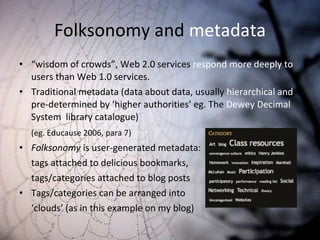
Folksonomy and  metadata “ wisdom of crowds”, Web 2.0 services  respond more deeply to  users than Web 1.0 services.  Traditional metadata (data about data, usually  hierarchical and  pre-determined by ‘higher authorities’ eg. The  Dewey Decimal  System  library catalogue)  (eg. Educause 2006, para 7) Folksonomy  is user-generated metadata:  tags attached to delicious bookmarks,  tags/categories attached to blog posts Tags/categories can be arranged into  ‘ clouds’ (as in this example on my blog)
Web 2.0 Practices Networked interactivity, including: Social bookmarking Social Networking  (eg. Facebook, Twitter) Blogging RSS updates
Social Bookmarking Users can store, describe, share  bookmarks as  well as discover bookmarked sites which relate to their interests/research areas.  Sites  like del.icio.us are ‘folksonomic’. Subscribe to this class’ del.icio.us bookmarks tagged ‘rmitmusic’: http://delicious.com/tag/rmitmusic
Blogging The read/write notion:  barrier between author and  reader is pushed. Ongoing  possibilities for comment and conversation (eg. Educause 2006, para 14) Demonstrated connectivity :  by hyperlinking (linking to other sites), listing blogrolls, del.icio.us bookmarks, RSS feeds, bloggers can offer greater context/insight into their point of view Reverse-chronological posts  (eg. The most recent post appears  at top of the page Timely, current :  because of reverse-chronology, blogs are based  around  current   news (in politics, gossip, sport, music, art, current affairs, an individual’s life) A diary/journal-style website :  generally conversational tone,  updated on ongoing  basis Hyperlinks and hypermedia:  usually contain multiple links to  other blogs/websites  as well as embedded videos, audio etc. Multiple media:  audio, video, photos, text all present
RSS  How to research content in the ‘blogosphere’  which is ever- -changing, timely, microcontent-based, interactive  and largely  personal opinion-based (eg. How to filter out crap?)  RSS subscriptions:  like a junk-mail filter, subscribe  to the RSS  feeds of websites/blogs you choose and get ‘curated news’ delivered to your RSS reader or RSS widget on your blog Subscribe to class feed to get blog updates:  http://pipes.yahoo.com/pipes/pipe.run?_id=0cf8d0d829eb4d7c391fdcd0aa867acd& _render=rss
Website Vs Blog? Website  n . ‘ A set of interconnected webpages, usually including a homepage, generally located on the same server, prepared/maintained by a person/group/organisation’  http://www.answers.com/topic/website   Blog  n . ‘ A weblog is, literally, a "log" of the web -  a diary-style site,  in which the author (a "blogger") links to other  web pages  he or she finds interesting using entries  posted in reverse  chronological order (eg. Most recent post first)  http://www.guardian.co.uk/weblog/special/0,10627,744914,00.html
Active Vs. Passive Douglas Rushkoff ‘ Ten Commands for a Digital Age: Program or be Programmed ’ (watch video) http://www.youtube.com/watch?v=imV3pPIUy1k Dan Mackinlay (UTS) The web as a contested landscape: http://netcultures.wordpress.com/2009/10/24/the-web-as-a-contested-landscape/#more-69
Hypertext and Hypermedia Websites are built on hypertext and hypermedia Hypertext is text which is not constrained to be linear.  Hypertext is text  which contains  links  to other texts. The term was coined by  Ted Nelson  around 1965 (see  History  ). HyperMedia is a term used for hypertext which is not constrained to be text: it can include graphics, video and  sound  , for example.  Apparently  Ted Nelson was the first to use this term too. Hypertext and HyperMedia are concepts, not products.  (eg. W3, 1995 para 1-4)
Content and Context Why link? Why use a blog? Why  subscribe to RSS?  Why social bookmark? Why  publish and share  your RSS, bookmarks and favourite sites? Arguably, context is as important as content Context:  verifies and curates what’s  online Context:  gives greater insight/ background and  deeper meaning to a blog/website Context:  creates community
Intertextuality, layering,  composition In designing our websites, what can  we learn  from other media? Look at: Print (newspapers, books, magazines, comics) Radio Television Cinema Visual art Music and live performance
Editing, juxtaposition,  storytelling What can we learn from the following  audio-  visual concepts when designing our  websites? Lev Kuleshov (editing and context) Juxtaposition Digital storytelling and narrative
Audio-visual relationships As sound designers, musicians and music enthusiasts,  consider how audio  and image connect in: Film sound Music video Video Art Text and sound Image and sound Sound Installation Live audio-visual performance DJ and VJ set
References Educause Review, 2006,  Web 2.0: A New Wave of Innovation for Teaching  and Learning? , Educause, viewed  8 April 2010 http://www.educause.edu/EDUCAUSE+Review/EDUCAUSEReviewMagazineVolume41/Web20ANewWaveofInnovationforTe/158042 URSULA K. HEISE  Columbia University, 1996, Columbia University, viewed 7 April 2010  http://www.columbia.edu/cu/21stC/issue-3.2/heise.html World Wide Web Consortium, 1997,  What is Hypertext,  viewed   April 2010  http://www.w3.org/WhatIs.html Dan Mackinley, 2009,  The Web as a Contested  Landscape, Netcultures blog, viewed April 2010  http://netcultures.wordpress.com/2009/10/24/the-web-as-a-contested-landscape/#more-69

Week5 Media Meaning

  • 1.
    RMIT MUSIC INDUSTRY 2010 Concept Development Week #5: Media and Meaning on the Web Image from Flickr.com © Mr. Greenjeans
  • 2.
    The Web Auniverse of network-accessible information, the embodiment of human knowledge Began as a ‘networked information project’ where Tim Berners-Lee (Director of W3C) developed a vision The Web has a body of software, and a set of protocols and conventions. Through the use hypertext and multimedia techniques, the web is easy for anyone to roam, browse, and contribute to. An early talk about the Web gives some more background on how the Web was originally conceived - from World Wide Web Consortium http://www.w3.org/WWW/
  • 3.
    The Web 2.0Concepts Emergent technologies, fluid, continuous improvement, greater opportunity for social collaboration/sharing and user-generated content. Social software Microcontent Openness Folksonomy
  • 4.
    Social Software blogs,wikis, trackback, podcasting, videoblogs, social networking tools like MySpace, Facebook, Twitter
  • 5.
    Microcontent Content isnot static, but fluid . Blogs are about posts, not pages. Wikis are streams of conversation, revision, amendment, and truncation. Podcasts are shuttled between Web sites, RSS feeds, and diverse players. These smaller content blocks can be saved, summarized, addressed, copied, quoted, and built into new projects (eg. Educause 2006, para 4)
  • 6.
    Openness The flowof microcontent between domains, servers, and machines depends on two-way access. User communicates with their viewer who can communicate back via posts, comments and conversation. (eg. Educause Review, 2006, para 6)
  • 7.
    Folksonomy and metadata “ wisdom of crowds”, Web 2.0 services respond more deeply to users than Web 1.0 services. Traditional metadata (data about data, usually hierarchical and pre-determined by ‘higher authorities’ eg. The Dewey Decimal System library catalogue) (eg. Educause 2006, para 7) Folksonomy is user-generated metadata: tags attached to delicious bookmarks, tags/categories attached to blog posts Tags/categories can be arranged into ‘ clouds’ (as in this example on my blog)
  • 8.
    Web 2.0 PracticesNetworked interactivity, including: Social bookmarking Social Networking (eg. Facebook, Twitter) Blogging RSS updates
  • 9.
    Social Bookmarking Userscan store, describe, share bookmarks as well as discover bookmarked sites which relate to their interests/research areas. Sites like del.icio.us are ‘folksonomic’. Subscribe to this class’ del.icio.us bookmarks tagged ‘rmitmusic’: http://delicious.com/tag/rmitmusic
  • 10.
    Blogging The read/writenotion: barrier between author and reader is pushed. Ongoing possibilities for comment and conversation (eg. Educause 2006, para 14) Demonstrated connectivity : by hyperlinking (linking to other sites), listing blogrolls, del.icio.us bookmarks, RSS feeds, bloggers can offer greater context/insight into their point of view Reverse-chronological posts (eg. The most recent post appears at top of the page Timely, current : because of reverse-chronology, blogs are based around current news (in politics, gossip, sport, music, art, current affairs, an individual’s life) A diary/journal-style website : generally conversational tone, updated on ongoing basis Hyperlinks and hypermedia: usually contain multiple links to other blogs/websites as well as embedded videos, audio etc. Multiple media: audio, video, photos, text all present
  • 11.
    RSS Howto research content in the ‘blogosphere’ which is ever- -changing, timely, microcontent-based, interactive and largely personal opinion-based (eg. How to filter out crap?) RSS subscriptions: like a junk-mail filter, subscribe to the RSS feeds of websites/blogs you choose and get ‘curated news’ delivered to your RSS reader or RSS widget on your blog Subscribe to class feed to get blog updates: http://pipes.yahoo.com/pipes/pipe.run?_id=0cf8d0d829eb4d7c391fdcd0aa867acd& _render=rss
  • 12.
    Website Vs Blog?Website n . ‘ A set of interconnected webpages, usually including a homepage, generally located on the same server, prepared/maintained by a person/group/organisation’ http://www.answers.com/topic/website Blog n . ‘ A weblog is, literally, a "log" of the web - a diary-style site, in which the author (a "blogger") links to other web pages he or she finds interesting using entries posted in reverse chronological order (eg. Most recent post first) http://www.guardian.co.uk/weblog/special/0,10627,744914,00.html
  • 13.
    Active Vs. PassiveDouglas Rushkoff ‘ Ten Commands for a Digital Age: Program or be Programmed ’ (watch video) http://www.youtube.com/watch?v=imV3pPIUy1k Dan Mackinlay (UTS) The web as a contested landscape: http://netcultures.wordpress.com/2009/10/24/the-web-as-a-contested-landscape/#more-69
  • 14.
    Hypertext and HypermediaWebsites are built on hypertext and hypermedia Hypertext is text which is not constrained to be linear. Hypertext is text which contains links to other texts. The term was coined by Ted Nelson around 1965 (see History ). HyperMedia is a term used for hypertext which is not constrained to be text: it can include graphics, video and sound , for example. Apparently Ted Nelson was the first to use this term too. Hypertext and HyperMedia are concepts, not products. (eg. W3, 1995 para 1-4)
  • 15.
    Content and ContextWhy link? Why use a blog? Why subscribe to RSS? Why social bookmark? Why publish and share your RSS, bookmarks and favourite sites? Arguably, context is as important as content Context: verifies and curates what’s online Context: gives greater insight/ background and deeper meaning to a blog/website Context: creates community
  • 16.
    Intertextuality, layering, composition In designing our websites, what can we learn from other media? Look at: Print (newspapers, books, magazines, comics) Radio Television Cinema Visual art Music and live performance
  • 17.
    Editing, juxtaposition, storytelling What can we learn from the following audio- visual concepts when designing our websites? Lev Kuleshov (editing and context) Juxtaposition Digital storytelling and narrative
  • 18.
    Audio-visual relationships Assound designers, musicians and music enthusiasts, consider how audio and image connect in: Film sound Music video Video Art Text and sound Image and sound Sound Installation Live audio-visual performance DJ and VJ set
  • 19.
    References Educause Review,2006, Web 2.0: A New Wave of Innovation for Teaching and Learning? , Educause, viewed 8 April 2010 http://www.educause.edu/EDUCAUSE+Review/EDUCAUSEReviewMagazineVolume41/Web20ANewWaveofInnovationforTe/158042 URSULA K. HEISE Columbia University, 1996, Columbia University, viewed 7 April 2010 http://www.columbia.edu/cu/21stC/issue-3.2/heise.html World Wide Web Consortium, 1997, What is Hypertext, viewed April 2010 http://www.w3.org/WhatIs.html Dan Mackinley, 2009, The Web as a Contested Landscape, Netcultures blog, viewed April 2010 http://netcultures.wordpress.com/2009/10/24/the-web-as-a-contested-landscape/#more-69