Consolidating collections  of  learning resources  using APML http:// www. eun .org http://melt-project.eu Riina Vuorikari, European Schoolnet
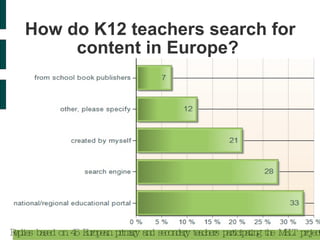
How do K12 teachers search for content in Europe?  Replies based on 45 European primary and secondary teachers participating the MELT project
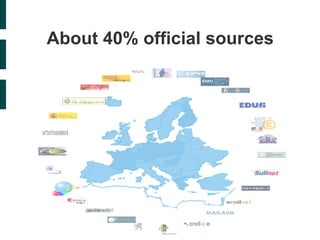
About 40% official sources
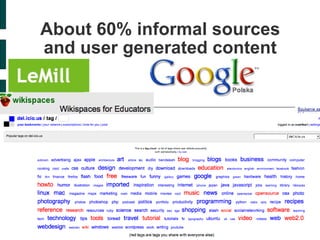
About 60% informal sources and user generated content
Is there any interplay  between official  and  informal  sources of learning content?
Should there be? Margaryan& Littlejohn (2008) on barriers: curators’ repository-centric perspective leads to introduction of repositories as  stand alone tools  to users.  However, repositories are not used in isolation! Margaryan, A., & Littlejohn, A.: Repositories and communities at cross-purposes:  Issues in sharing and reuse of digital learning resources. Journal of Computer Assisted Learning (JCAL), 24(4), 333-347 (2008)
 
 
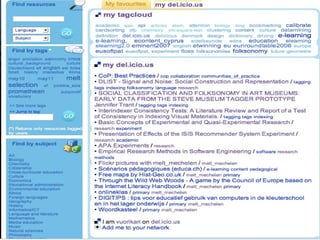
How do we know? Exploratory case study on del.icio.us:  How do teachers use it?  What kind of content is there?  From what sources does the content come from?
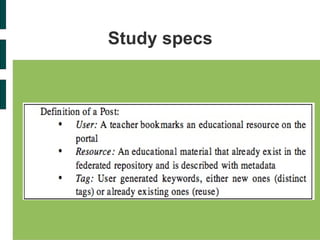
Study specs 16 teachers who have both MELT and del.icio.us account  Primary and secondary teachers  In science, languages, ICTs Fi, Et, Hu and Be  7 are females and 9 males 1  < 30 years, 8  30-40 years 5  40-50 years,  2  50-60 years
Study specs MELT portal profile information:   Country Languages spoken Main areas of interest Resources bookmarked and tags Delicious: 100 last bookmarks and tags Number of bookmarks, tags, network
Study specs
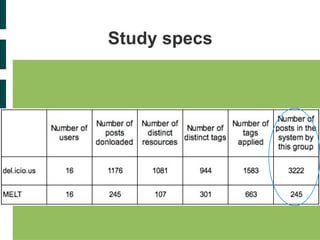
Study specs
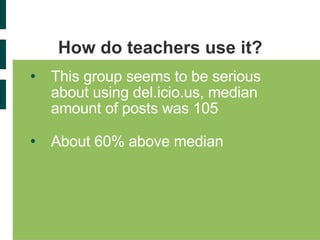
  How do teachers use it?  This group seems to be serious about using del.icio.us, median amount of posts was 105 About 60% above median
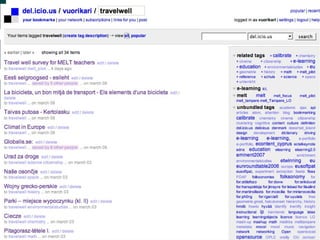
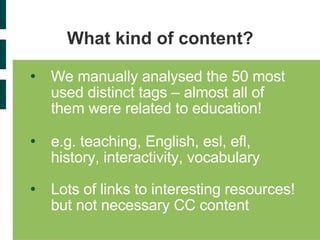
What kind of content? We manually analysed the 50 most used distinct tags – almost all of them were related to education! e.g. teaching, English, esl, efl, history, interactivity, vocabulary Lots of links to interesting resources! but not necessary CC content
Why consolidate? Make the MELT portal more central to teachers every day life – make other resources available too! (i.e. web 2.0 fatigue) Make resources available from other sources too, e.g. user generated content, interesting links found via Google...
 
User Labor Markup Language (ULML) User labor is the work that people put in to create, improve, and maintain their existence in social web generating assets (e.g. user profiles, images, videos, blog posts), creating metadata (e.g. tagging, voting, commenting etc.), attracting traffic (e.g. incoming views, comments, favourites) socialising with other people (e.g. number of friends, social influence)
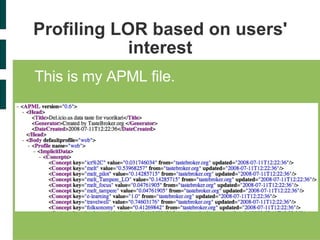
Profiling LOR based on users' interest This is my APML file.
 
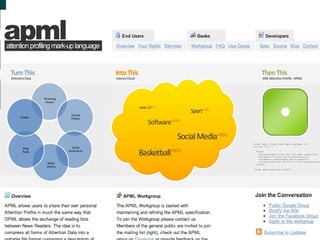
Got issues? Interoperability of user-generated metadata (e.g. tags, ratings, annotations, …) Data-portability   Attention Profile Markup Language (ampl)
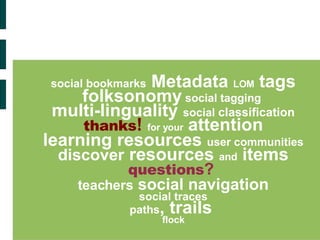
social bookmarks  Metadata  LOM  tags folksonomy  social tagging  multi-linguality  social  classification thanks !  for your  attention learning resources  user communities discover  resources  and  items questions ?  teachers   social navigation social traces paths , trails  flock

Mupple08_melicious_vuorikari

  • 1.
    Consolidating collections of learning resources using APML http:// www. eun .org http://melt-project.eu Riina Vuorikari, European Schoolnet
  • 2.
    How do K12teachers search for content in Europe? Replies based on 45 European primary and secondary teachers participating the MELT project
  • 3.
  • 4.
    About 60% informalsources and user generated content
  • 5.
    Is there anyinterplay between official and informal sources of learning content?
  • 6.
    Should there be?Margaryan& Littlejohn (2008) on barriers: curators’ repository-centric perspective leads to introduction of repositories as stand alone tools to users. However, repositories are not used in isolation! Margaryan, A., & Littlejohn, A.: Repositories and communities at cross-purposes: Issues in sharing and reuse of digital learning resources. Journal of Computer Assisted Learning (JCAL), 24(4), 333-347 (2008)
  • 7.
  • 8.
  • 9.
    How do weknow? Exploratory case study on del.icio.us: How do teachers use it? What kind of content is there? From what sources does the content come from?
  • 10.
    Study specs 16teachers who have both MELT and del.icio.us account Primary and secondary teachers In science, languages, ICTs Fi, Et, Hu and Be 7 are females and 9 males 1 < 30 years, 8 30-40 years 5 40-50 years, 2 50-60 years
  • 11.
    Study specs MELTportal profile information: Country Languages spoken Main areas of interest Resources bookmarked and tags Delicious: 100 last bookmarks and tags Number of bookmarks, tags, network
  • 12.
  • 13.
  • 14.
    Howdo teachers use it? This group seems to be serious about using del.icio.us, median amount of posts was 105 About 60% above median
  • 15.
    What kind ofcontent? We manually analysed the 50 most used distinct tags – almost all of them were related to education! e.g. teaching, English, esl, efl, history, interactivity, vocabulary Lots of links to interesting resources! but not necessary CC content
  • 16.
    Why consolidate? Makethe MELT portal more central to teachers every day life – make other resources available too! (i.e. web 2.0 fatigue) Make resources available from other sources too, e.g. user generated content, interesting links found via Google...
  • 17.
  • 18.
    User Labor MarkupLanguage (ULML) User labor is the work that people put in to create, improve, and maintain their existence in social web generating assets (e.g. user profiles, images, videos, blog posts), creating metadata (e.g. tagging, voting, commenting etc.), attracting traffic (e.g. incoming views, comments, favourites) socialising with other people (e.g. number of friends, social influence)
  • 19.
    Profiling LOR basedon users' interest This is my APML file.
  • 20.
  • 21.
    Got issues? Interoperabilityof user-generated metadata (e.g. tags, ratings, annotations, …) Data-portability Attention Profile Markup Language (ampl)
  • 22.
    social bookmarks Metadata LOM tags folksonomy social tagging multi-linguality social classification thanks ! for your attention learning resources user communities discover resources and items questions ? teachers social navigation social traces paths , trails flock