The DigComp 2.2 update
ALL DIGITAL Summit 2021
Dr. Riina Vuorikari, EC,
DG Joint Research Centre
Dr. Stefano Kluzer,
Independent Expert
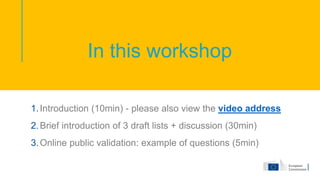
In this workshop
1.Introduction (10min) - please also view the video address
2.Brief introduction of 3 draft lists + discussion (30min)
3.Online public validation: example of questions (5min)
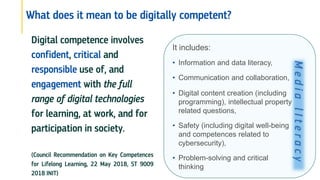
What does it mean to be digitally competent?
Digital competence involves
confident, critical and
responsible use of, and
engagement with the full
range of digital technologies
for learning, at work, and for
participation in society.
(Council Recommendation on Key Competences
for Lifelong Learning, 22 May 2018, ST 9009
2018 INIT)
M
e
d
i
a
l
I
t
e
r
a
c
y
It includes:
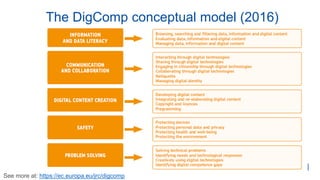
• Information and data literacy,
• Communication and collaboration,
• Digital content creation (including
programming), intellectual property
related questions,
• Safety (including digital well-being
and competences related to
cybersecurity),
• Problem-solving and critical
thinking
The DigComp conceptual model (2016)
See more at: https://ec.europa.eu/jrc/digcomp
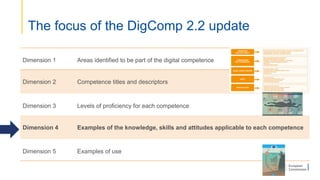
Dimension 1 Areas identified to be part of the digital competence
Dimension 2 Competence titles and descriptors
Dimension 3 Levels of proficiency for each competence
Dimension 4 Examples of the knowledge, skills and attitudes applicable to each competence
Dimension 5 Examples of use
The focus of the DigComp 2.2 update
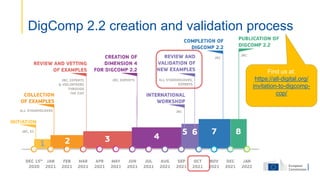
DigComp 2.2 creation and validation process
Find us at:
https://all-digital.org/
invitation-to-digcomp-
cop/
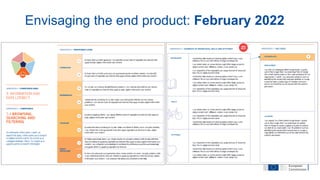
Envisaging the end product: February 2022
In this workshop
1. Introduction
2. Brief introduction of 3 draft lists + discussion
3. Online public validation: example of questions
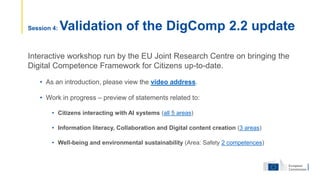
Interactive workshop run by the EU Joint Research Centre on bringing the
Digital Competence Framework for Citizens up-to-date.
• As an introduction, please view the video address.
• Work in progress – preview of statements related to:
• Citizens interacting with AI systems (all 5 areas)
• Information literacy, Collaboration and Digital content creation (3 areas)
• Well-being and environmental sustainability (Area: Safety 2 competences)
Session 4: Validation of the DigComp 2.2 update
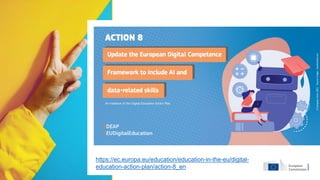
https://ec.europa.eu/education/education-in-the-eu/digital-
education-action-plan/action-8_en
Citizens interacting with AI systems
(all 5 areas)
Turn your camera on if you have already looked at the
statements?
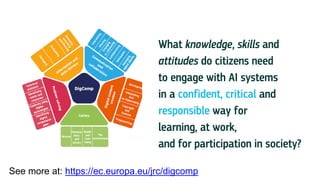
What knowledge, skills and
attitudes do citizens need
to engage with AI systems
in a confident, critical and
responsible way for
learning, at work,
and for participation in society?
See more at: https://ec.europa.eu/jrc/digcomp
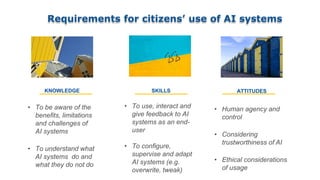
Requirements for citizens’ use of AI systems
KNOWLEDGE
• To be aware of the
benefits, limitations
and challenges of
AI systems
• To understand what
AI systems do and
what they do not do
SKILLS
• To use, interact and
give feedback to AI
systems as an end-
user
• To configure,
supervise and adapt
AI systems (e.g.
overwrite, tweak)
ATTITUDES
• Human agency and
control
• Considering
trustworthiness of AI
• Ethical considerations
of usage
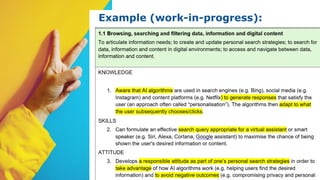
Example (work-in-progress):
Citizens interacting with AI systems
Comments, impressions, opinions, questions about
the draft statements?
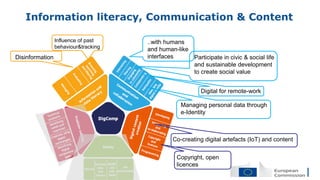
Information literacy, Communication & Content
Disinformation
Influence of past
behaviour&tracking
..with humans
and human-like
interfaces Participate in civic & social life
and sustainable development
to create social value
Digital for remote-work
Managing personal data through
e-Identity
Co-creating digital artefacts (IoT) and content
Copyright, open
licences
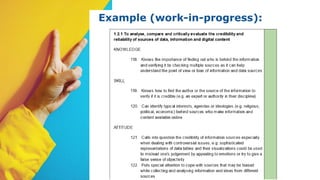
Example (work-in-progress):
Areas of Information literacy,
Communication & Content
Comments, impressions, opinions, questions
about
the draft statements?
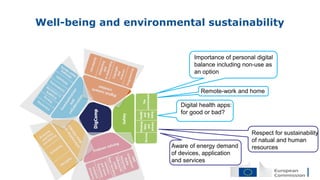
Well-being and environmental sustainability
Importance of personal digital
balance including non-use as
an option
Remote-work and home
Digital health apps:
for good or bad?
Aware of energy demand
of devices, application
and services
Respect for sustainability
of natual and human
resources
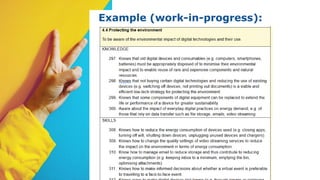
Example (work-in-progress):
Area of Safety:
Well-being;
Environmental sustainability
Comments, impressions, opinions, questions
about
the draft statements?
In this workshop
1.Introduction
2.Brief introduction of 3 draft lists + discussion
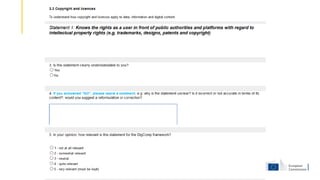
3.Online public validation: example of questions
Timeline:
• Public Online Validation
(Nov 2021)
• Launch of publication
DigComp 2.2 (Feb 2022)
Find us at:
https://all-digital.org/invitation-to-digcomp-cop/
Thank you!
Riina.Vuorikari@ec.europa.eu

DigComp 2.2 update (step6: validation)

  • 1.
    The DigComp 2.2update ALL DIGITAL Summit 2021 Dr. Riina Vuorikari, EC, DG Joint Research Centre Dr. Stefano Kluzer, Independent Expert
  • 2.
    In this workshop 1.Introduction(10min) - please also view the video address 2.Brief introduction of 3 draft lists + discussion (30min) 3.Online public validation: example of questions (5min)
  • 3.
    What does itmean to be digitally competent? Digital competence involves confident, critical and responsible use of, and engagement with the full range of digital technologies for learning, at work, and for participation in society. (Council Recommendation on Key Competences for Lifelong Learning, 22 May 2018, ST 9009 2018 INIT) M e d i a l I t e r a c y It includes: • Information and data literacy, • Communication and collaboration, • Digital content creation (including programming), intellectual property related questions, • Safety (including digital well-being and competences related to cybersecurity), • Problem-solving and critical thinking
  • 4.
    The DigComp conceptualmodel (2016) See more at: https://ec.europa.eu/jrc/digcomp
  • 5.
    Dimension 1 Areasidentified to be part of the digital competence Dimension 2 Competence titles and descriptors Dimension 3 Levels of proficiency for each competence Dimension 4 Examples of the knowledge, skills and attitudes applicable to each competence Dimension 5 Examples of use The focus of the DigComp 2.2 update
  • 6.
    DigComp 2.2 creationand validation process Find us at: https://all-digital.org/ invitation-to-digcomp- cop/
  • 7.
    Envisaging the endproduct: February 2022
  • 8.
    In this workshop 1.Introduction 2. Brief introduction of 3 draft lists + discussion 3. Online public validation: example of questions
  • 9.
    Interactive workshop runby the EU Joint Research Centre on bringing the Digital Competence Framework for Citizens up-to-date. • As an introduction, please view the video address. • Work in progress – preview of statements related to: • Citizens interacting with AI systems (all 5 areas) • Information literacy, Collaboration and Digital content creation (3 areas) • Well-being and environmental sustainability (Area: Safety 2 competences) Session 4: Validation of the DigComp 2.2 update
  • 10.
  • 11.
    Citizens interacting withAI systems (all 5 areas) Turn your camera on if you have already looked at the statements?
  • 12.
    What knowledge, skillsand attitudes do citizens need to engage with AI systems in a confident, critical and responsible way for learning, at work, and for participation in society? See more at: https://ec.europa.eu/jrc/digcomp
  • 13.
    Requirements for citizens’use of AI systems KNOWLEDGE • To be aware of the benefits, limitations and challenges of AI systems • To understand what AI systems do and what they do not do SKILLS • To use, interact and give feedback to AI systems as an end- user • To configure, supervise and adapt AI systems (e.g. overwrite, tweak) ATTITUDES • Human agency and control • Considering trustworthiness of AI • Ethical considerations of usage
  • 14.
  • 15.
    Citizens interacting withAI systems Comments, impressions, opinions, questions about the draft statements?
  • 16.
    Information literacy, Communication& Content Disinformation Influence of past behaviour&tracking ..with humans and human-like interfaces Participate in civic & social life and sustainable development to create social value Digital for remote-work Managing personal data through e-Identity Co-creating digital artefacts (IoT) and content Copyright, open licences
  • 17.
  • 18.
    Areas of Informationliteracy, Communication & Content Comments, impressions, opinions, questions about the draft statements?
  • 19.
    Well-being and environmentalsustainability Importance of personal digital balance including non-use as an option Remote-work and home Digital health apps: for good or bad? Aware of energy demand of devices, application and services Respect for sustainability of natual and human resources
  • 20.
  • 21.
    Area of Safety: Well-being; Environmentalsustainability Comments, impressions, opinions, questions about the draft statements?
  • 22.
    In this workshop 1.Introduction 2.Briefintroduction of 3 draft lists + discussion 3.Online public validation: example of questions
  • 23.
    Timeline: • Public OnlineValidation (Nov 2021) • Launch of publication DigComp 2.2 (Feb 2022) Find us at: https://all-digital.org/invitation-to-digcomp-cop/
  • 25.