Laura Mulvey
Feminist Film Theory and
   ‘The Male Gaze’
Pleasurable Spectatorship
• Laura Mulvey analysed the way mainstream
  films ‘construct an ideal viewer’.
• i.e. she analysed the way men and women were
  represented in films, and speculated about how
  this would appeal to a spectator.
• She mixed psychoanalytic film theory (the ideas
  of Freud and Lacan) for a ‘politically feminist’
  end.
• She said that ‘spectatorship’ and the act of
  looking itself provided a form of sexual
  gratification
Scopophilia and Voyeurism
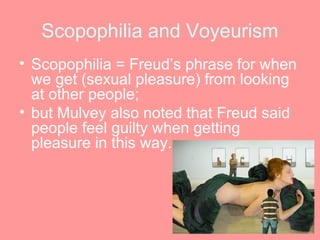
• Scopophilia = Freud’s phrase for when
  we get (sexual pleasure) from looking
  at other people;
• but Mulvey also noted that Freud said
  people feel guilty when getting
  pleasure in this way.
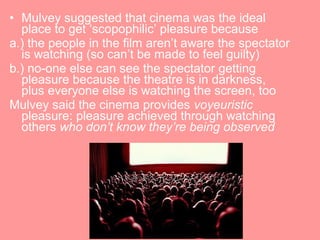
• Mulvey suggested that cinema was the ideal
  place to get ‘scopophilic’ pleasure because
a.) the people in the film aren’t aware the spectator
  is watching (so can’t be made to feel guilty)
b.) no-one else can see the spectator getting
  pleasure because the theatre is in darkness,
  plus everyone else is watching the screen, too
Mulvey said the cinema provides voyeuristic
  pleasure: pleasure achieved through watching
  others who don’t know they’re being observed
Lacan…

• Jacques Lacan was a psychoanalyst who
  expanded and developed Freudian ideas.

• One idea useful for understanding why
  audiences like films (and other media) = the
  ‘mirror stage’
• Lacan said this is a stage in child’s development
  where they recognise themselves in other
  people with similar features.
• Child develops sense of ‘self’ and ‘Other’ that
  influence it’s thinking for the rest of its life.
Mulvey related to Lacan:
• Mulvey used Lacan’s idea about the
  importance of seeing your self ‘visually
  reflected’ to explain why people like films.

• When we see a character on the screen like
  us, we identify with it – and this helps
  reinforce our sense of self.
Mulvey’s Conclusions
• Most mainstream films are made by male
  filmmakers for male spectators
• This results in ACTIVE male characters (they
  are the protagonists i.e. a subject whose actions
  push the narrative forward; so the audience are
  encouraged to identify with them)
• Female characters are usually passive (they are
  often seen as a ‘prize’, an object of desire that
  men fight over; don’t act or think for themselves)
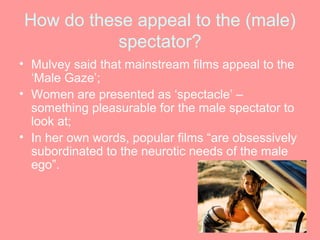
How do these appeal to the (male)
           spectator?
• Mulvey said that mainstream films appeal to the
  ‘Male Gaze’;
• Women are presented as ‘spectacle’ –
  something pleasurable for the male spectator to
  look at;
• In her own words, popular films “are obsessively
  subordinated to the neurotic needs of the male
  ego”.
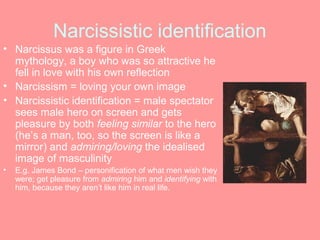
Narcissistic identification
• Narcissus was a figure in Greek
  mythology, a boy who was so attractive he
  fell in love with his own reflection
• Narcissism = loving your own image
• Narcissistic identification = male spectator
  sees male hero on screen and gets
  pleasure by both feeling similar to the hero
  (he’s a man, too, so the screen is like a
  mirror) and admiring/loving the idealised
  image of masculinity
•   E.g. James Bond – personification of what men wish they
    were; get pleasure from admiring him and identifying with
    him, because they aren’t like him in real life.
Voyeuristic Objectification
• Voyeuristic objectification = when the male spectator
  gets pleasure by desiring the female character, and
  feeling he owns her because she is passive (like an
  object) and because he can look at her with out guilt
  (because she doesn’t know she is being watched)

                   Fetishisation
• Mulvey also noted that sometimes there were active
  female characters, especially those portrayed by a
  female star.
• However, she said that these weren’t characters that
  were presented for the female spectator to identify with..
• … instead their power seemed to be based around their
  beauty.
…
• She said that female beauty was fetishised
• A fetish (in her terms) is when a source of fear
  becomes a source of pleasure.
• Humans don’t like feeling scared and anxious –
  so, psychologically, they sometimes turn a
  source of fear into something that gives pleasure
• So… a male spectator, made anxious by a
  female characters empowered actions, can turn
  her into a source of visual pleasure by
  concentrating on her beauty and sexiness. (i.e.
  fetishised or sexualised)
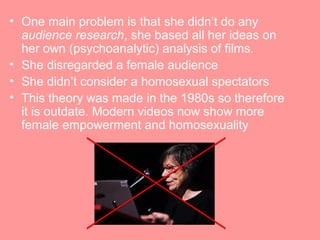
• One main problem is that she didn’t do any
  audience research, she based all her ideas on
  her own (psychoanalytic) analysis of films.
• She disregarded a female audience
• She didn’t consider a homosexual spectators
• This theory was made in the 1980s so therefore
  it is outdate. Modern videos now show more
  female empowerment and homosexuality

Mulvey and the gaze

  • 1.
    Laura Mulvey Feminist FilmTheory and ‘The Male Gaze’
  • 2.
    Pleasurable Spectatorship • LauraMulvey analysed the way mainstream films ‘construct an ideal viewer’. • i.e. she analysed the way men and women were represented in films, and speculated about how this would appeal to a spectator. • She mixed psychoanalytic film theory (the ideas of Freud and Lacan) for a ‘politically feminist’ end. • She said that ‘spectatorship’ and the act of looking itself provided a form of sexual gratification
  • 3.
    Scopophilia and Voyeurism •Scopophilia = Freud’s phrase for when we get (sexual pleasure) from looking at other people; • but Mulvey also noted that Freud said people feel guilty when getting pleasure in this way.
  • 4.
    • Mulvey suggestedthat cinema was the ideal place to get ‘scopophilic’ pleasure because a.) the people in the film aren’t aware the spectator is watching (so can’t be made to feel guilty) b.) no-one else can see the spectator getting pleasure because the theatre is in darkness, plus everyone else is watching the screen, too Mulvey said the cinema provides voyeuristic pleasure: pleasure achieved through watching others who don’t know they’re being observed
  • 5.
    Lacan… • Jacques Lacanwas a psychoanalyst who expanded and developed Freudian ideas. • One idea useful for understanding why audiences like films (and other media) = the ‘mirror stage’ • Lacan said this is a stage in child’s development where they recognise themselves in other people with similar features. • Child develops sense of ‘self’ and ‘Other’ that influence it’s thinking for the rest of its life.
  • 6.
    Mulvey related toLacan: • Mulvey used Lacan’s idea about the importance of seeing your self ‘visually reflected’ to explain why people like films. • When we see a character on the screen like us, we identify with it – and this helps reinforce our sense of self.
  • 7.
    Mulvey’s Conclusions • Mostmainstream films are made by male filmmakers for male spectators • This results in ACTIVE male characters (they are the protagonists i.e. a subject whose actions push the narrative forward; so the audience are encouraged to identify with them) • Female characters are usually passive (they are often seen as a ‘prize’, an object of desire that men fight over; don’t act or think for themselves)
  • 8.
    How do theseappeal to the (male) spectator? • Mulvey said that mainstream films appeal to the ‘Male Gaze’; • Women are presented as ‘spectacle’ – something pleasurable for the male spectator to look at; • In her own words, popular films “are obsessively subordinated to the neurotic needs of the male ego”.
  • 9.
    Narcissistic identification • Narcissuswas a figure in Greek mythology, a boy who was so attractive he fell in love with his own reflection • Narcissism = loving your own image • Narcissistic identification = male spectator sees male hero on screen and gets pleasure by both feeling similar to the hero (he’s a man, too, so the screen is like a mirror) and admiring/loving the idealised image of masculinity • E.g. James Bond – personification of what men wish they were; get pleasure from admiring him and identifying with him, because they aren’t like him in real life.
  • 10.
    Voyeuristic Objectification • Voyeuristicobjectification = when the male spectator gets pleasure by desiring the female character, and feeling he owns her because she is passive (like an object) and because he can look at her with out guilt (because she doesn’t know she is being watched) Fetishisation • Mulvey also noted that sometimes there were active female characters, especially those portrayed by a female star. • However, she said that these weren’t characters that were presented for the female spectator to identify with.. • … instead their power seemed to be based around their beauty.
  • 11.
    … • She saidthat female beauty was fetishised • A fetish (in her terms) is when a source of fear becomes a source of pleasure. • Humans don’t like feeling scared and anxious – so, psychologically, they sometimes turn a source of fear into something that gives pleasure • So… a male spectator, made anxious by a female characters empowered actions, can turn her into a source of visual pleasure by concentrating on her beauty and sexiness. (i.e. fetishised or sexualised)
  • 12.
    • One mainproblem is that she didn’t do any audience research, she based all her ideas on her own (psychoanalytic) analysis of films. • She disregarded a female audience • She didn’t consider a homosexual spectators • This theory was made in the 1980s so therefore it is outdate. Modern videos now show more female empowerment and homosexuality