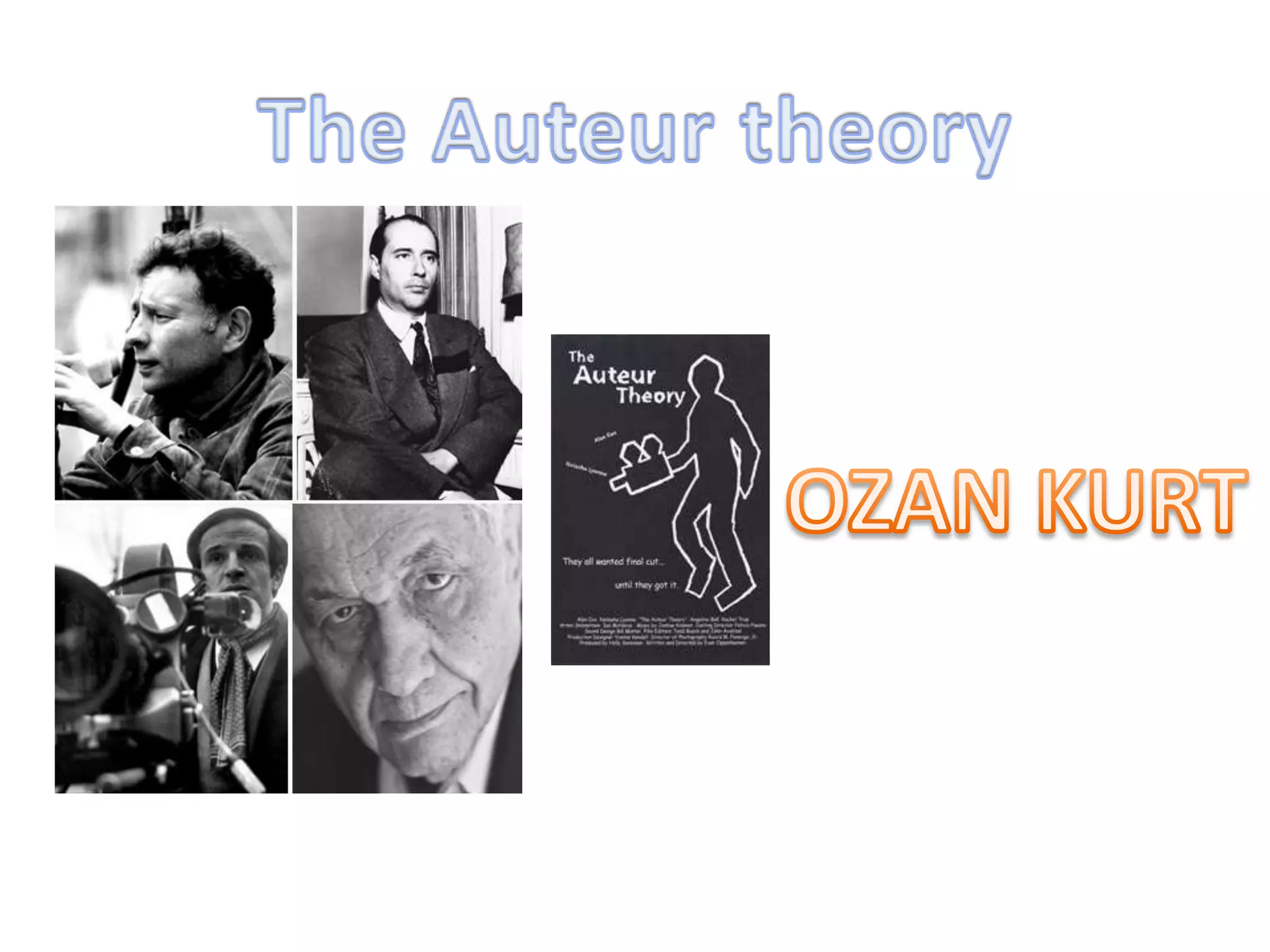
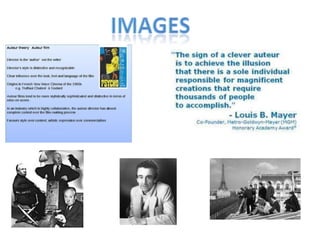
Translated from the French, auteur simply means "author," but
use of the term in relation to cinema—since the 1950s at least—
has caused much controversy and critical debate. The frequent
retention of the French word, as auteur and in the somewhat
ungainly "auteurs," marks the prominent part played in those
critical debates by French film critics.
Auteur theory has influenced film criticism since 1954, when it
was advocated by film director and critic François Truffaut. This
method of film analysis was originally associated with the French
New Wave and the film critics who wrote for the French film
review periodical Cahiers du Cinéma. Auteur theory was
developed a few years later in America through the writings of
The Village Voice critic Andrew Sarris. Sarris used auteur theory
as a way to further the analysis of what defines serious work
through the study of respected directors and their films
Auteur theory draws on the work of a group of cinema enthusiasts
who wrote for Cahiers du Cinéma and argued that films should
reflect a director's personal vision. They championed filmmakers
such as Howard Hawks, Alfred Hitchcock, and Jean Renoir as
absolute 'auteurs' of their films.. Although André Bazin, co-founder
of the Cahiers, provided a forum for Auteurism to flourish, he
explained his concern about its excesses in his article "On the
Auteur Theory. Another element of Auteur theory comes from
Alexandre Astruc's notion of the caméra-stylo or "camera-pen,"
which encourages directors to wield cameras as writers use pens
and to guard against the hindrances of traditional storytelling.
In England, the film magazine most influenced by Cahiers was
Movie which was first published in 1962. In the USA, Andrew
Sarris in his seminal essay Notes on the Auteur Theory, published
in Film Culture , echoing the Cahiers critics, defined as an auteur
the director who pours his personality into his film through his
distinctive visual techniques. However, there was an important
novelty
Starting in the 1960s, some film critics began
criticising auteur theory's focus on the
authorial role of the director. Pauline Kael and
Sarris feuded in the pages of The New Yorker
and various film magazines. One reason for the
backlash is the collaborative aspect of shooting
a film, and in the theory's privileging of the
role of the director
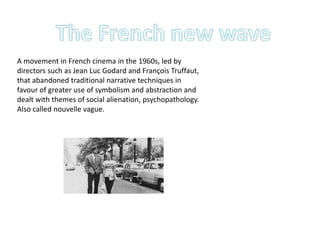
A movement in French cinema in the 1960s, led by
directors such as Jean Luc Godard and François Truffaut,
that abandoned traditional narrative techniques in
favour of greater use of symbolism and abstraction and
dealt with themes of social alienation, psychopathology.
Also called nouvelle vague.
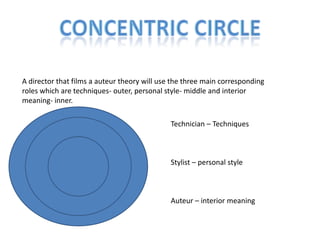
A director that films a auteur theory will use the three main corresponding
roles which are techniques- outer, personal style- middle and interior
meaning- inner.
Technician – Techniques
Stylist – personal style
Auteur – interior meaning
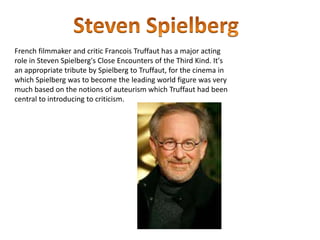
French filmmaker and critic Francois Truffaut has a major acting
role in Steven Spielberg's Close Encounters of the Third Kind. It's
an appropriate tribute by Spielberg to Truffaut, for the cinema in
which Spielberg was to become the leading world figure was very
much based on the notions of auteurism which Truffaut had been
central to introducing to criticism.
Over his lengthy career, Alfred Hitchcock became known for his
distinctive style as a film-maker. Apart from the various themes
he frequently addressed in his films such as
violence, murder, psychology and sexual allure, and the many
symbolic touches that came to be known as "Hitchcockian", he
was also very much concerned with technique - his manipulation
of the elements of cinematography...
* shot size
* framing
* composition
* camera angle
* camera movement
* focus
Hope you enjoyed my powerpoint

Auteur theory

  • 2.
    Translated from theFrench, auteur simply means "author," but use of the term in relation to cinema—since the 1950s at least— has caused much controversy and critical debate. The frequent retention of the French word, as auteur and in the somewhat ungainly "auteurs," marks the prominent part played in those critical debates by French film critics. Auteur theory has influenced film criticism since 1954, when it was advocated by film director and critic François Truffaut. This method of film analysis was originally associated with the French New Wave and the film critics who wrote for the French film review periodical Cahiers du Cinéma. Auteur theory was developed a few years later in America through the writings of The Village Voice critic Andrew Sarris. Sarris used auteur theory as a way to further the analysis of what defines serious work through the study of respected directors and their films
  • 3.
    Auteur theory drawson the work of a group of cinema enthusiasts who wrote for Cahiers du Cinéma and argued that films should reflect a director's personal vision. They championed filmmakers such as Howard Hawks, Alfred Hitchcock, and Jean Renoir as absolute 'auteurs' of their films.. Although André Bazin, co-founder of the Cahiers, provided a forum for Auteurism to flourish, he explained his concern about its excesses in his article "On the Auteur Theory. Another element of Auteur theory comes from Alexandre Astruc's notion of the caméra-stylo or "camera-pen," which encourages directors to wield cameras as writers use pens and to guard against the hindrances of traditional storytelling.
  • 4.
    In England, thefilm magazine most influenced by Cahiers was Movie which was first published in 1962. In the USA, Andrew Sarris in his seminal essay Notes on the Auteur Theory, published in Film Culture , echoing the Cahiers critics, defined as an auteur the director who pours his personality into his film through his distinctive visual techniques. However, there was an important novelty
  • 5.
    Starting in the1960s, some film critics began criticising auteur theory's focus on the authorial role of the director. Pauline Kael and Sarris feuded in the pages of The New Yorker and various film magazines. One reason for the backlash is the collaborative aspect of shooting a film, and in the theory's privileging of the role of the director
  • 6.
    A movement inFrench cinema in the 1960s, led by directors such as Jean Luc Godard and François Truffaut, that abandoned traditional narrative techniques in favour of greater use of symbolism and abstraction and dealt with themes of social alienation, psychopathology. Also called nouvelle vague.
  • 7.
    A director thatfilms a auteur theory will use the three main corresponding roles which are techniques- outer, personal style- middle and interior meaning- inner. Technician – Techniques Stylist – personal style Auteur – interior meaning
  • 8.
    French filmmaker andcritic Francois Truffaut has a major acting role in Steven Spielberg's Close Encounters of the Third Kind. It's an appropriate tribute by Spielberg to Truffaut, for the cinema in which Spielberg was to become the leading world figure was very much based on the notions of auteurism which Truffaut had been central to introducing to criticism.
  • 9.
    Over his lengthycareer, Alfred Hitchcock became known for his distinctive style as a film-maker. Apart from the various themes he frequently addressed in his films such as violence, murder, psychology and sexual allure, and the many symbolic touches that came to be known as "Hitchcockian", he was also very much concerned with technique - his manipulation of the elements of cinematography... * shot size * framing * composition * camera angle * camera movement * focus
  • 11.
    Hope you enjoyedmy powerpoint