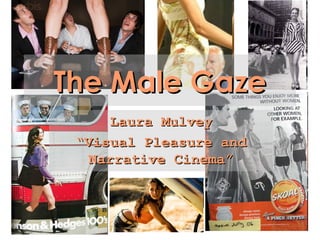
The Male GazeThe Male Gaze
Laura MulveyLaura Mulvey
““Visual Pleasure andVisual Pleasure and
Narrative Cinema”Narrative Cinema”
What is the Gaze?What is the Gaze?
The concept of gaze is one that deals with
how an audience views the people
presented.
For feminists it can be thought of in 3
ways:
• How men look at women,
• How women look at themselves
• How women look at other women.
Gaze and feminist theoryGaze and feminist theory
Laura Mulvey
coined the term
‘Male Gaze’ in
1975. She
believes that in
film audiences
have to ‘view’
characters from
the perspective
of a heterosexual
male.
Features of the Male GazeFeatures of the Male Gaze
The camera lingers on the curves of the
female body, and events which occur to
women are presented largely in the context of
a man's reaction to these events.
Relegates women to the status of objects. The
female viewer must experience the narrative
secondarily, by identification with the male.
The Male Gaze
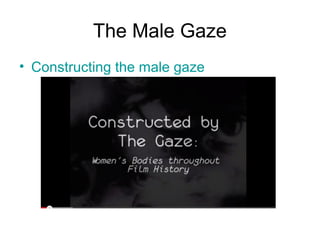
• Constructing the male gaze
“I love the way she
fills her clothes.
She looks just like
them girls in Vogue.”
Watch the video and
then be prepared for
questions
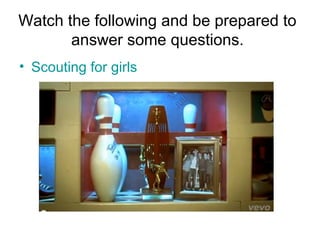
Watch the following and be prepared to
answer some questions.
• Scouting for girls
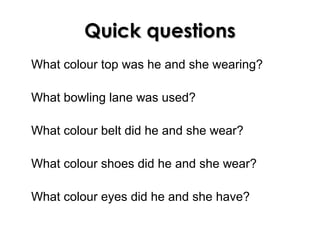
Quick questionsQuick questions
What colour top was he and she wearing?
What bowling lane was used?
What colour belt did he and she wear?
What colour shoes did he and she wear?
What colour eyes did he and she have?
Why some of you might not have known
the answers to all the questions.
You were too busy looking at the woman.
Use of the Male Gaze inUse of the Male Gaze in
everyday lifeeveryday life
Some theorists also have noted the
sexualizing of the female body even in
situations where female sexiness has
nothing to do with the product being
advertised.
Can you think of any examples of this?
Criticism of Mulvey and Gaze theoryCriticism of Mulvey and Gaze theory
Some women enjoy being ‘looked’ at e.g. beauty
pageants.
The gaze can also be directed toward members
of the same gender for several reasons, not all
of which are sexual, such as in comparison of
body image or in clothing.
Are there any ‘flaws’ in these arguments?
Categorising facial expressionsCategorising facial expressions
Women:
• Chocolate box
• Invitational
• Super-smiler
• Romantic or sexual
Marjorie Ferguson
(1980)
MenMen::
•CarefreeCarefree
•PracticalPractical
•SeductiveSeductive
•ComicComic
•CatalogueCatalogue
Trevor Millum (1975)Trevor Millum (1975)
Key theorists beliefs
Jonathan Schroeder (1998), “to gaze
implies more than to look at – it signifies a
psychological relationship of power, in
which the gazer is superior to the object of
the gaze.”
Charlie's Angels femaleCharlie's Angels female
empowerment vs sexualityempowerment vs sexuality
Watch this clip and
note down
examples of female
empowerment and
sexuality.
Are they mutually
exclusive?
Does Shroeder’s
belief apply to this
trailer?
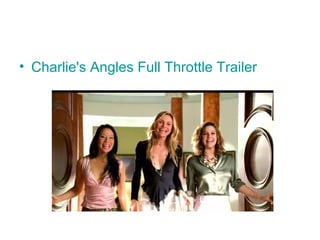
• Charlie's Angles Full Throttle Trailer
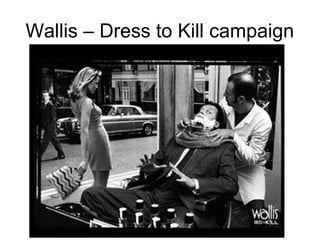
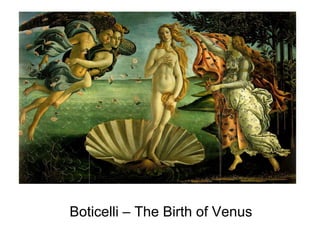
Spot the difference…
Wallis – Dress to Kill campaign
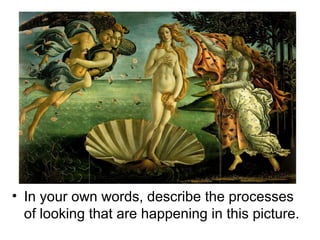
Boticelli – The Birth of Venus
Freud & Lacan
• We construct our identities by looking at
ourselves and at each other. As children we
derive pleasure from looking at other people’s
bodies – scopophilia.
• The first time we fully see ourselves (in a mirror)
is the first time we understand ourselves as
people
• Cinema allows as to look at other people without
being seen ourselves. We enjoy this voyeurism.
Laura Mulvey - 1975
• Feminist argument to make political use of
conventional Hollywood film.
• Film places woman as subordinate,
inactive and limits them to narrow and two
dimensional roles.
• The audience are asked to take a male
‘point of spectatorship’ in most cinema
The Male Gaze
• Identification with the male lead.
– His actions become a surrogate for our own
part in the narrative. We psychologically align
ourselves with his point of view. He is the
ideal ego.
• Objectification of the male lead’s
romantic interest.
– The male lead desires the female form. As we
are aligned with his point of view, the
audience desire the female lead also.
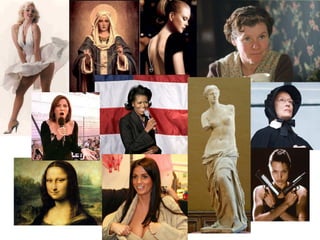
What roles for women?
• The Madonna and the Whore
Madonna Whore
Object of reverence
Purity
‘on a pedestal’
Object of desire
Sexual object
Promiscuous
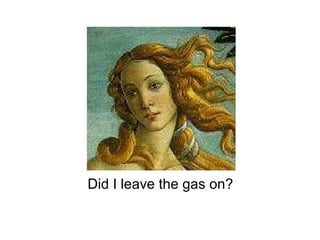
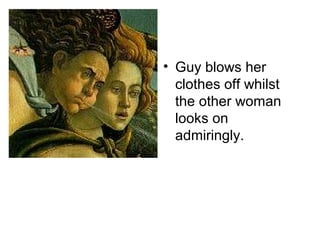
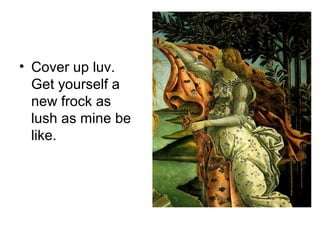
• In your own words, describe the processes
of looking that are happening in this picture.
Did I leave the gas on?
• Guy blows her
clothes off whilst
the other woman
looks on
admiringly.
• Cover up luv.
Get yourself a
new frock as
lush as mine be
like.
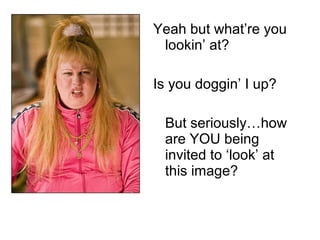
Yeah but what’re you
lookin’ at?
Is you doggin’ I up?
But seriously…how
are YOU being
invited to ‘look’ at
this image?
Evaluate!
• Mulvey was writing in the 1970s with a
political agenda about Hollywood cinema.
But are there still such narrow roles for
women? What’s changed? What hasn’t?

Mulvey lesson 8

  • 1.
    The Male GazeTheMale Gaze Laura MulveyLaura Mulvey ““Visual Pleasure andVisual Pleasure and Narrative Cinema”Narrative Cinema”
  • 2.
    What is theGaze?What is the Gaze? The concept of gaze is one that deals with how an audience views the people presented. For feminists it can be thought of in 3 ways: • How men look at women, • How women look at themselves • How women look at other women.
  • 3.
    Gaze and feministtheoryGaze and feminist theory Laura Mulvey coined the term ‘Male Gaze’ in 1975. She believes that in film audiences have to ‘view’ characters from the perspective of a heterosexual male.
  • 4.
    Features of theMale GazeFeatures of the Male Gaze The camera lingers on the curves of the female body, and events which occur to women are presented largely in the context of a man's reaction to these events. Relegates women to the status of objects. The female viewer must experience the narrative secondarily, by identification with the male.
  • 5.
    The Male Gaze •Constructing the male gaze
  • 6.
    “I love theway she fills her clothes. She looks just like them girls in Vogue.” Watch the video and then be prepared for questions
  • 7.
    Watch the followingand be prepared to answer some questions. • Scouting for girls
  • 8.
    Quick questionsQuick questions Whatcolour top was he and she wearing? What bowling lane was used? What colour belt did he and she wear? What colour shoes did he and she wear? What colour eyes did he and she have?
  • 9.
    Why some ofyou might not have known the answers to all the questions. You were too busy looking at the woman.
  • 10.
    Use of theMale Gaze inUse of the Male Gaze in everyday lifeeveryday life Some theorists also have noted the sexualizing of the female body even in situations where female sexiness has nothing to do with the product being advertised. Can you think of any examples of this?
  • 11.
    Criticism of Mulveyand Gaze theoryCriticism of Mulvey and Gaze theory Some women enjoy being ‘looked’ at e.g. beauty pageants. The gaze can also be directed toward members of the same gender for several reasons, not all of which are sexual, such as in comparison of body image or in clothing. Are there any ‘flaws’ in these arguments?
  • 12.
    Categorising facial expressionsCategorisingfacial expressions Women: • Chocolate box • Invitational • Super-smiler • Romantic or sexual Marjorie Ferguson (1980) MenMen:: •CarefreeCarefree •PracticalPractical •SeductiveSeductive •ComicComic •CatalogueCatalogue Trevor Millum (1975)Trevor Millum (1975)
  • 13.
    Key theorists beliefs JonathanSchroeder (1998), “to gaze implies more than to look at – it signifies a psychological relationship of power, in which the gazer is superior to the object of the gaze.”
  • 14.
    Charlie's Angels femaleCharlie'sAngels female empowerment vs sexualityempowerment vs sexuality Watch this clip and note down examples of female empowerment and sexuality. Are they mutually exclusive? Does Shroeder’s belief apply to this trailer?
  • 15.
    • Charlie's AnglesFull Throttle Trailer
  • 16.
  • 17.
    Wallis – Dressto Kill campaign
  • 18.
    Boticelli – TheBirth of Venus
  • 19.
    Freud & Lacan •We construct our identities by looking at ourselves and at each other. As children we derive pleasure from looking at other people’s bodies – scopophilia. • The first time we fully see ourselves (in a mirror) is the first time we understand ourselves as people • Cinema allows as to look at other people without being seen ourselves. We enjoy this voyeurism.
  • 20.
    Laura Mulvey -1975 • Feminist argument to make political use of conventional Hollywood film. • Film places woman as subordinate, inactive and limits them to narrow and two dimensional roles. • The audience are asked to take a male ‘point of spectatorship’ in most cinema
  • 21.
    The Male Gaze •Identification with the male lead. – His actions become a surrogate for our own part in the narrative. We psychologically align ourselves with his point of view. He is the ideal ego. • Objectification of the male lead’s romantic interest. – The male lead desires the female form. As we are aligned with his point of view, the audience desire the female lead also.
  • 22.
    What roles forwomen? • The Madonna and the Whore Madonna Whore Object of reverence Purity ‘on a pedestal’ Object of desire Sexual object Promiscuous
  • 24.
    • In yourown words, describe the processes of looking that are happening in this picture.
  • 25.
    Did I leavethe gas on?
  • 26.
    • Guy blowsher clothes off whilst the other woman looks on admiringly.
  • 27.
    • Cover upluv. Get yourself a new frock as lush as mine be like.
  • 28.
    Yeah but what’reyou lookin’ at? Is you doggin’ I up? But seriously…how are YOU being invited to ‘look’ at this image?
  • 29.
    Evaluate! • Mulvey waswriting in the 1970s with a political agenda about Hollywood cinema. But are there still such narrow roles for women? What’s changed? What hasn’t?