FR
Add a footer 2
Let’s remember
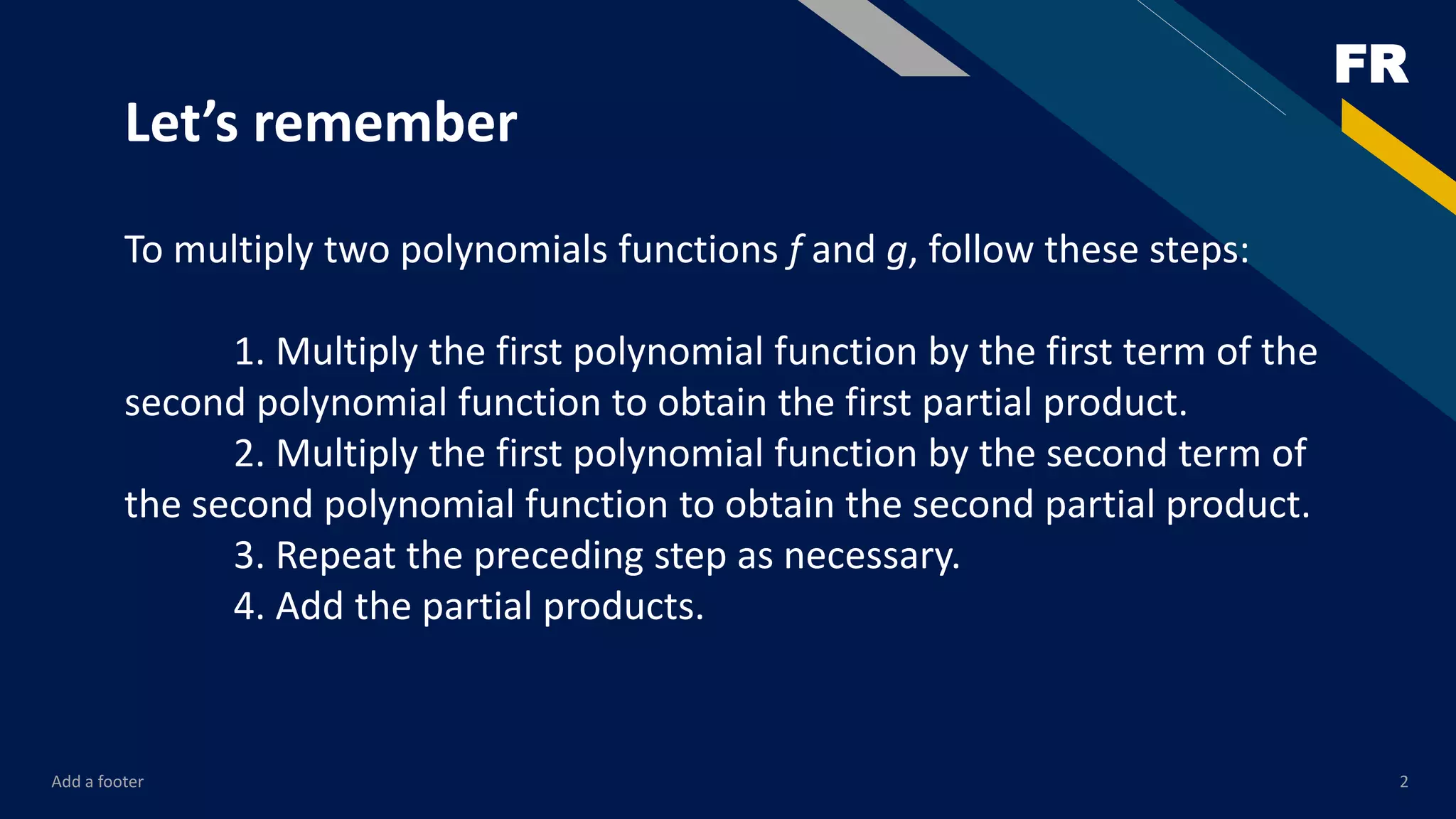
To multiply two polynomials functions f and g, follow these steps:
1. Multiply the first polynomial function by the first term of the
second polynomial function to obtain the first partial product.
2. Multiply the first polynomial function by the second term of
the second polynomial function to obtain the second partial product.
3. Repeat the preceding step as necessary.
4. Add the partial products.
FR
Add a footer 3
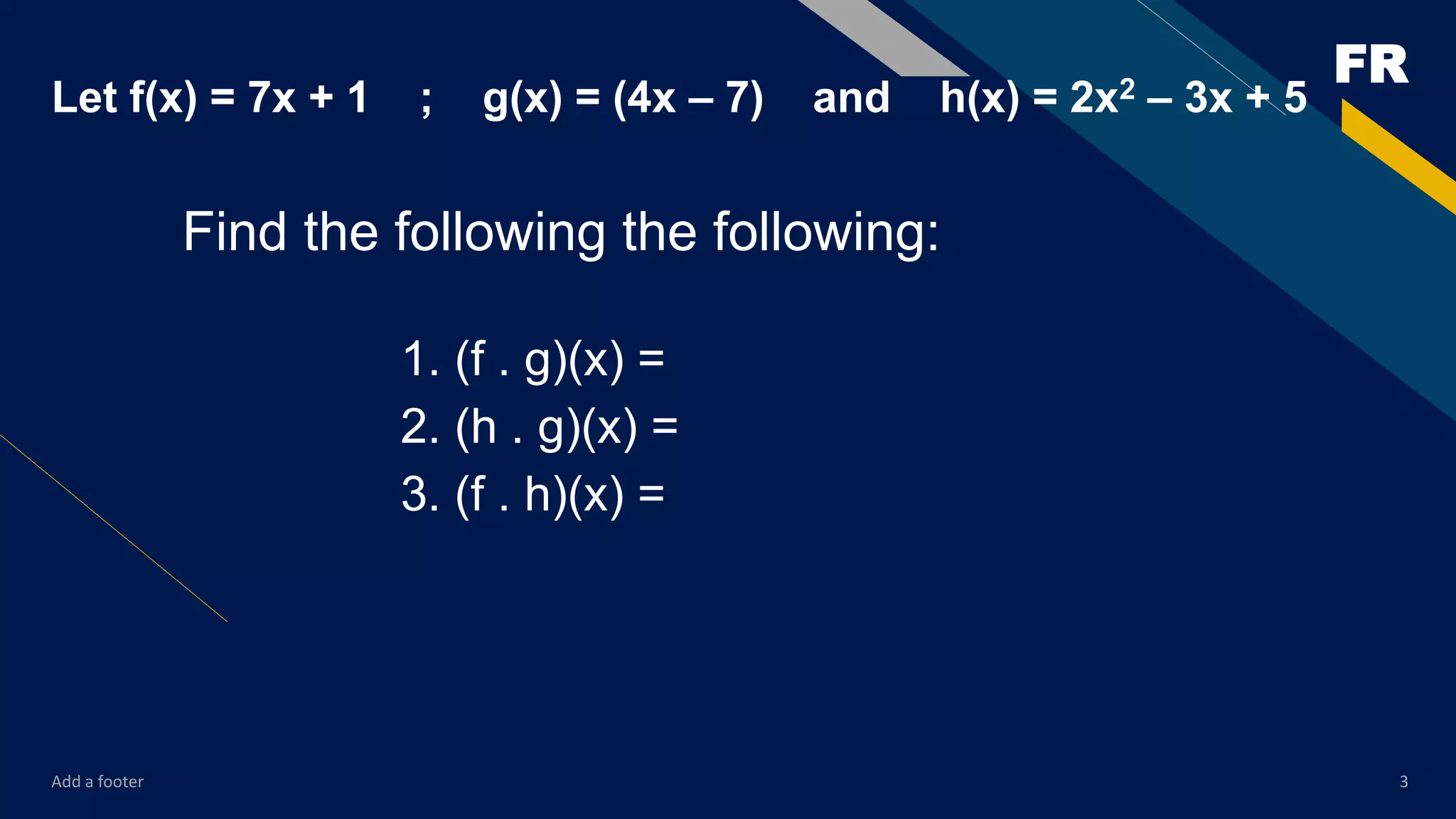
Let f(x) = 7x + 1 ; g(x) = (4x – 7) and h(x) = 2x2 – 3x + 5
Find the following the following:
1. (f . g)(x) =
2. (h . g)(x) =
3. (f . h)(x) =
FR
Add a footer 4
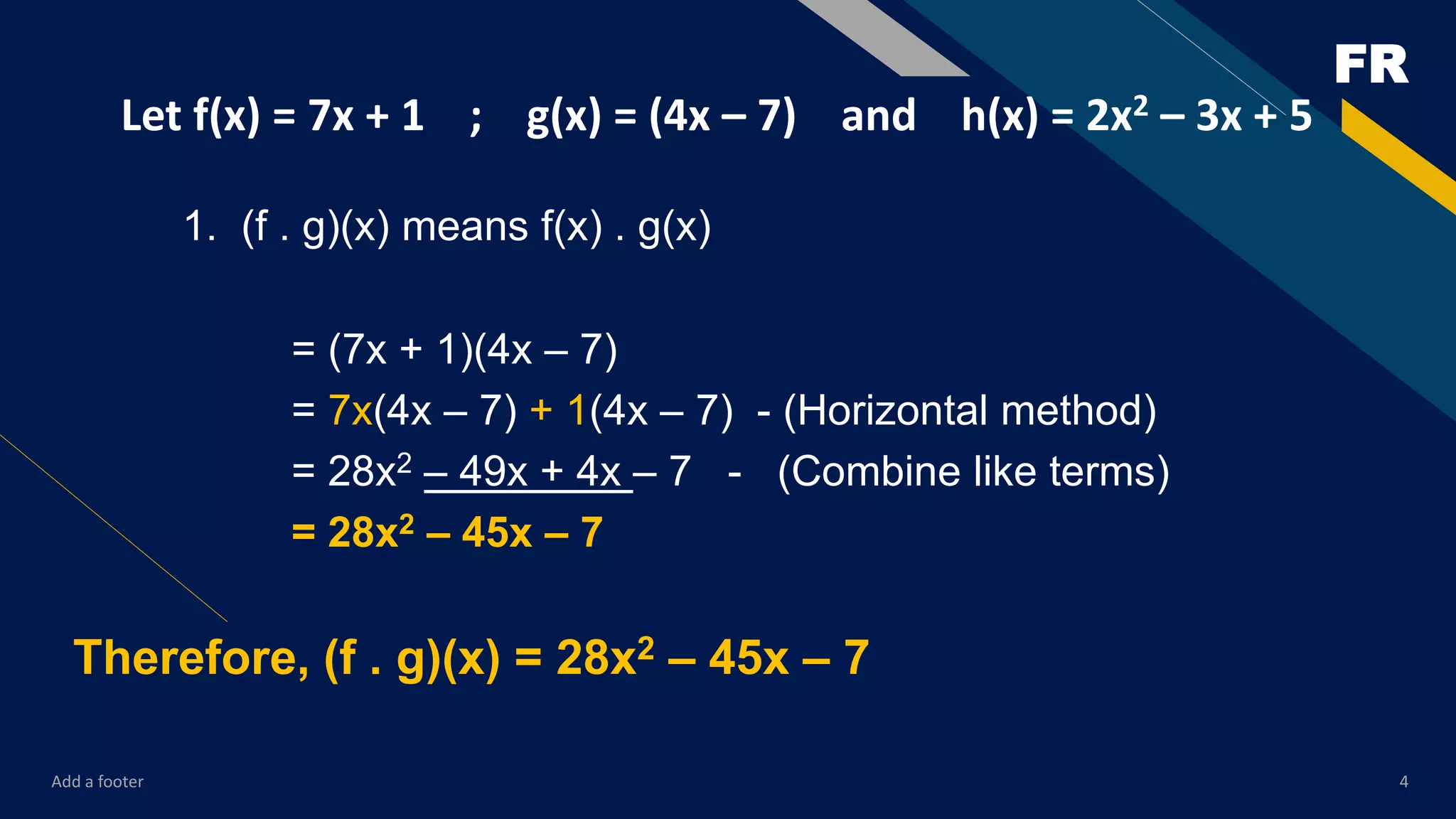
Let f(x) = 7x + 1 ; g(x) = (4x – 7) and h(x) = 2x2 – 3x + 5
1. (f . g)(x) means f(x) . g(x)
= (7x + 1)(4x – 7)
= 7x(4x – 7) + 1(4x – 7) - (Horizontal method)
= 28x2 – 49x + 4x – 7 - (Combine like terms)
= 28x2 – 45x – 7
Therefore, (f . g)(x) = 28x2 – 45x – 7
FR
Add a footer 5
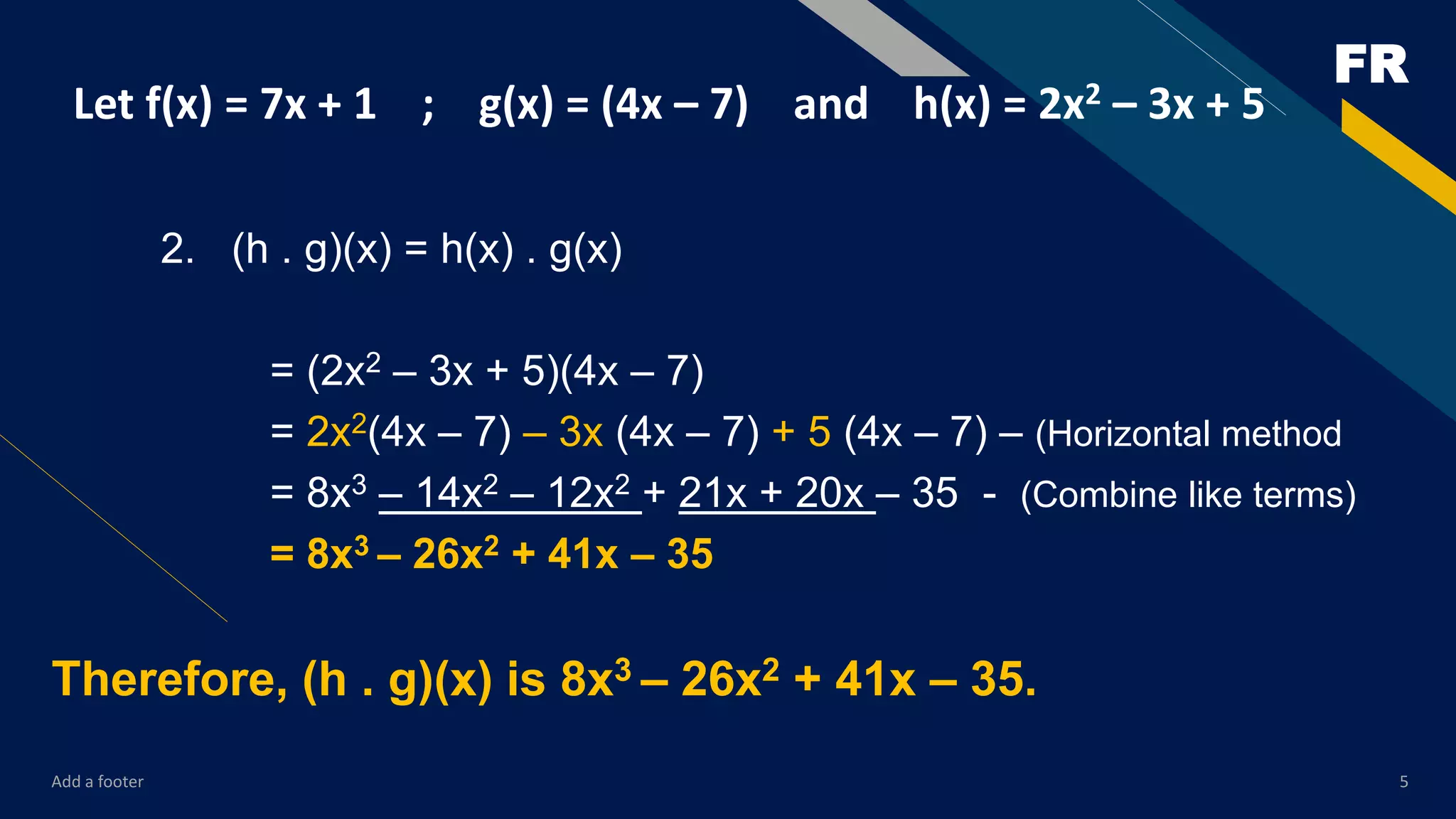
Let f(x) = 7x + 1 ; g(x) = (4x – 7) and h(x) = 2x2 – 3x + 5
2. (h . g)(x) = h(x) . g(x)
= (2x2 – 3x + 5)(4x – 7)
= 2x2(4x – 7) – 3x (4x – 7) + 5 (4x – 7) – (Horizontal method
= 8x3 – 14x2 – 12x2 + 21x + 20x – 35 - (Combine like terms)
= 8x3 – 26x2 + 41x – 35
Therefore, (h . g)(x) is 8x3 – 26x2 + 41x – 35.
FR
Add a footer 6
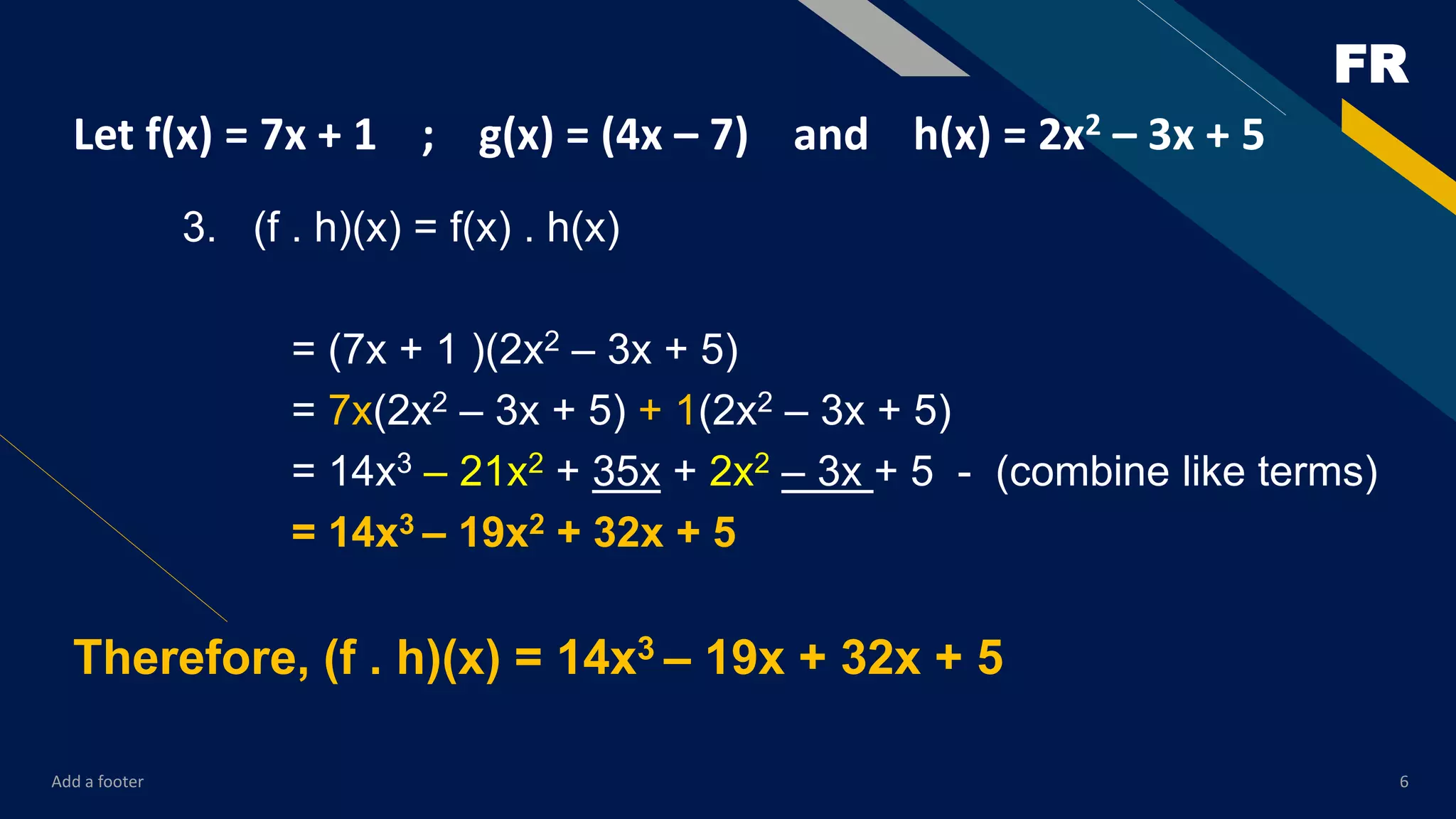
Let f(x) = 7x + 1 ; g(x) = (4x – 7) and h(x) = 2x2 – 3x + 5
3. (f . h)(x) = f(x) . h(x)
= (7x + 1 )(2x2 – 3x + 5)
= 7x(2x2 – 3x + 5) + 1(2x2 – 3x + 5)
= 14x3 – 21x2 + 35x + 2x2 – 3x + 5 - (combine like terms)
= 14x3 – 19x2 + 32x + 5
Therefore, (f . h)(x) = 14x3 – 19x + 32x + 5
FR
Add a footer 7
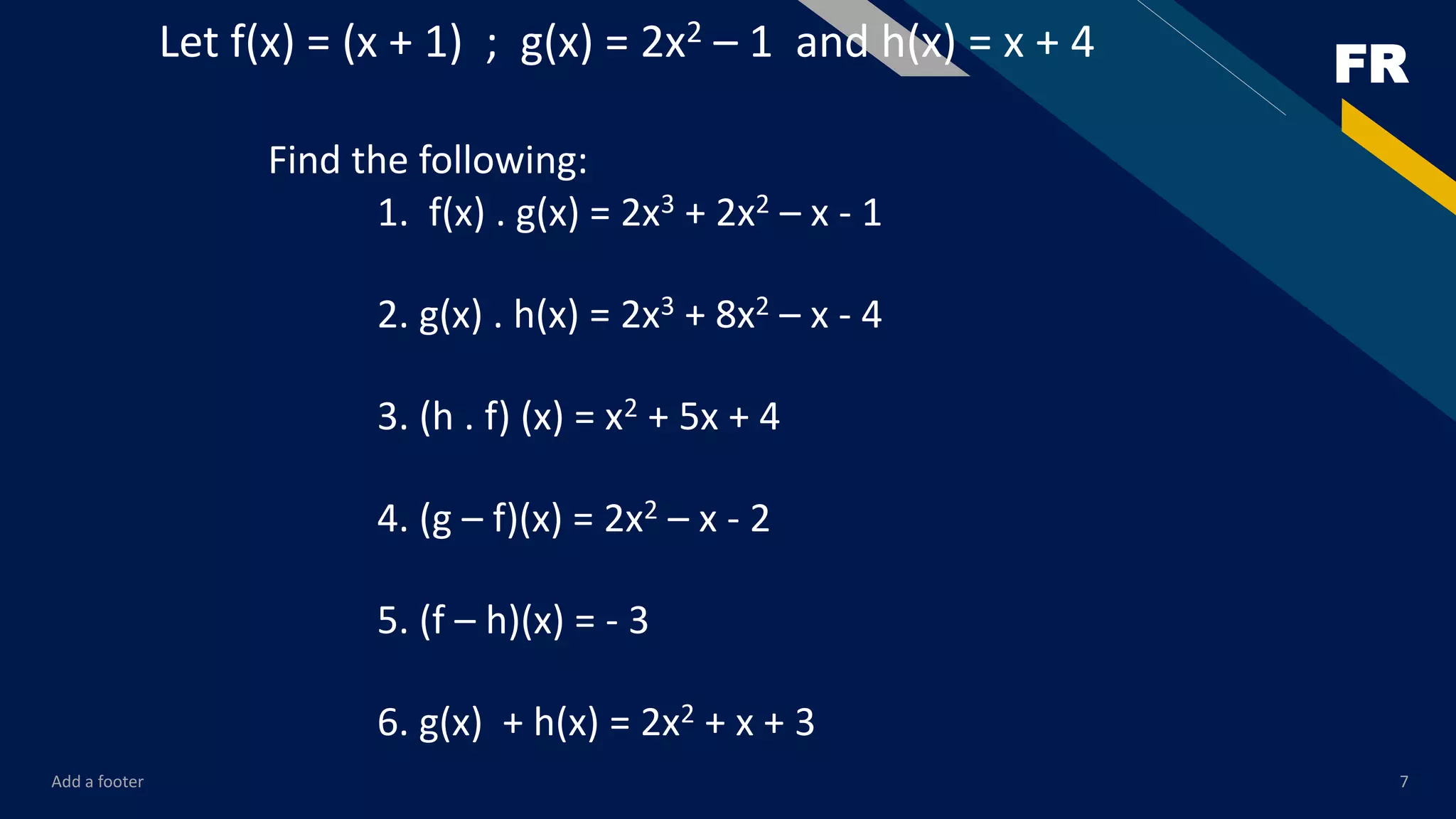
Let f(x) = (x + 1) ; g(x) = 2x2 – 1 and h(x) = x + 4
Find the following:
1. f(x) . g(x) = 2x3 + 2x2 – x - 1
2. g(x) . h(x) = 2x3 + 8x2 – x - 4
3. (h . f) (x) = x2 + 5x + 4
4. (g – f)(x) = 2x2 – x - 2
5. (f – h)(x) = - 3
6. g(x) + h(x) = 2x2 + x + 3
Multipying polynomial functions

Multipying polynomial functions

  • 2.
    FR Add a footer2 Let’s remember To multiply two polynomials functions f and g, follow these steps: 1. Multiply the first polynomial function by the first term of the second polynomial function to obtain the first partial product. 2. Multiply the first polynomial function by the second term of the second polynomial function to obtain the second partial product. 3. Repeat the preceding step as necessary. 4. Add the partial products.
  • 3.
    FR Add a footer3 Let f(x) = 7x + 1 ; g(x) = (4x – 7) and h(x) = 2x2 – 3x + 5 Find the following the following: 1. (f . g)(x) = 2. (h . g)(x) = 3. (f . h)(x) =
  • 4.
    FR Add a footer4 Let f(x) = 7x + 1 ; g(x) = (4x – 7) and h(x) = 2x2 – 3x + 5 1. (f . g)(x) means f(x) . g(x) = (7x + 1)(4x – 7) = 7x(4x – 7) + 1(4x – 7) - (Horizontal method) = 28x2 – 49x + 4x – 7 - (Combine like terms) = 28x2 – 45x – 7 Therefore, (f . g)(x) = 28x2 – 45x – 7
  • 5.
    FR Add a footer5 Let f(x) = 7x + 1 ; g(x) = (4x – 7) and h(x) = 2x2 – 3x + 5 2. (h . g)(x) = h(x) . g(x) = (2x2 – 3x + 5)(4x – 7) = 2x2(4x – 7) – 3x (4x – 7) + 5 (4x – 7) – (Horizontal method = 8x3 – 14x2 – 12x2 + 21x + 20x – 35 - (Combine like terms) = 8x3 – 26x2 + 41x – 35 Therefore, (h . g)(x) is 8x3 – 26x2 + 41x – 35.
  • 6.
    FR Add a footer6 Let f(x) = 7x + 1 ; g(x) = (4x – 7) and h(x) = 2x2 – 3x + 5 3. (f . h)(x) = f(x) . h(x) = (7x + 1 )(2x2 – 3x + 5) = 7x(2x2 – 3x + 5) + 1(2x2 – 3x + 5) = 14x3 – 21x2 + 35x + 2x2 – 3x + 5 - (combine like terms) = 14x3 – 19x2 + 32x + 5 Therefore, (f . h)(x) = 14x3 – 19x + 32x + 5
  • 7.
    FR Add a footer7 Let f(x) = (x + 1) ; g(x) = 2x2 – 1 and h(x) = x + 4 Find the following: 1. f(x) . g(x) = 2x3 + 2x2 – x - 1 2. g(x) . h(x) = 2x3 + 8x2 – x - 4 3. (h . f) (x) = x2 + 5x + 4 4. (g – f)(x) = 2x2 – x - 2 5. (f – h)(x) = - 3 6. g(x) + h(x) = 2x2 + x + 3