WORKSOP ON IDENTIFYING
TEST OBJECTIVES
Objective:
* To ensure alignment among
assessments, learning objectives
and instructional strategies.
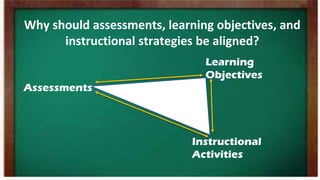
Why should assessments, learning objectives, and
instructional strategies be aligned?
Assessments
Learning
Objectives
Instructional
Activities
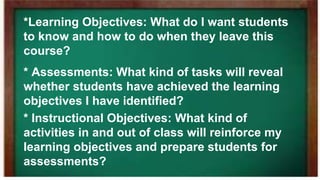
* Assessments: What kind of tasks will reveal
whether students have achieved the learning
objectives I have identified?
*Learning Objectives: What do I want students
to know and how to do when they leave this
course?
* Instructional Objectives: What kind of
activities in and out of class will reinforce my
learning objectives and prepare students for
assessments?
▪ Your objective is for students to learn
to apply analytical skills, but your
assessment measures only factual
recall. Consequently, students honing
their analytical skills are frustrated
that the exam does not measure what
they learned.
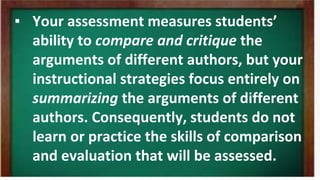
▪ Your assessment measures students’
ability to compare and critique the
arguments of different authors, but your
instructional strategies focus entirely on
summarizing the arguments of different
authors. Consequently, students do not
learn or practice the skills of comparison
and evaluation that will be assessed.
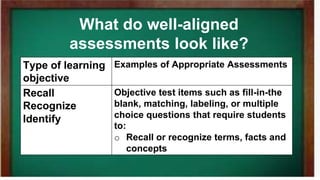
What do well-aligned
assessments look like?
Type of learning
objective
Examples of Appropriate Assessments
Recall
Recognize
Identify
Objective test items such as fill-in-the
blank, matching, labeling, or multiple
choice questions that require students
to:
o Recall or recognize terms, facts and
concepts
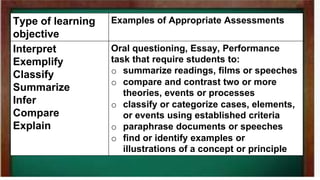
Type of learning
objective
Examples of Appropriate Assessments
Interpret
Exemplify
Classify
Summarize
Infer
Compare
Explain
Oral questioning, Essay, Performance
task that require students to:
o summarize readings, films or speeches
o compare and contrast two or more
theories, events or processes
o classify or categorize cases, elements,
or events using established criteria
o paraphrase documents or speeches
o find or identify examples or
illustrations of a concept or principle
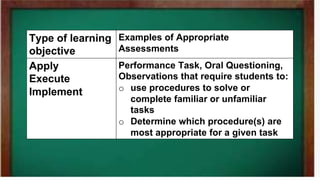
Type of learning
objective
Examples of Appropriate
Assessments
Apply
Execute
Implement
Performance Task, Oral Questioning,
Observations that require students to:
o use procedures to solve or
complete familiar or unfamiliar
tasks
o Determine which procedure(s) are
most appropriate for a given task
Type of learning
objective
Examples of Appropriate Assessments
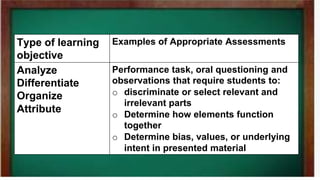
Analyze
Differentiate
Organize
Attribute
Performance task, oral questioning and
observations that require students to:
o discriminate or select relevant and
irrelevant parts
o Determine how elements function
together
o Determine bias, values, or underlying
intent in presented material
Type of learning
objective
Examples of Appropriate Assessments
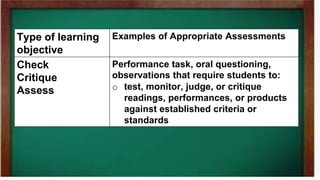
Check
Critique
Assess
Performance task, oral questioning,
observations that require students to:
o test, monitor, judge, or critique
readings, performances, or products
against established criteria or
standards
Type of learning
objective
Examples of Appropriate Assessments
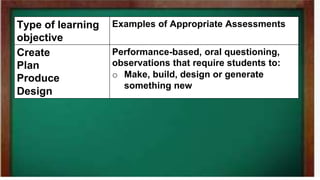
Create
Plan
Produce
Design
Performance-based, oral questioning,
observations that require students to:
o Make, build, design or generate
something new
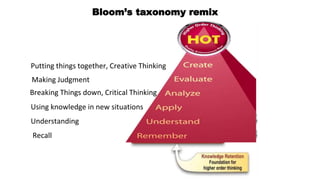
Bloom’s taxonomy remix
Putting things together, Creative Thinking
Making Judgment
Breaking Things down, Critical Thinking
Using knowledge in new situations
Understanding
Recall
HOTS in chemistry 13
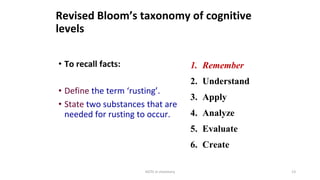
Revised Bloom’s taxonomy of cognitive
levels
• To recall facts:
• Define the term ‘rusting’.
• State two substances that are
needed for rusting to occur.
1. Remember
2. Understand
3. Apply
4. Analyze
5. Evaluate
6. Create
HOTS in chemistry 14
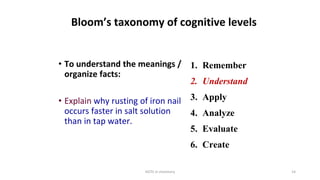
Bloom’s taxonomy of cognitive levels
• To understand the meanings /
organize facts:
• Explain why rusting of iron nail
occurs faster in salt solution
than in tap water.
1. Remember
2. Understand
3. Apply
4. Analyze
5. Evaluate
6. Create
HOTS in chemistry 15
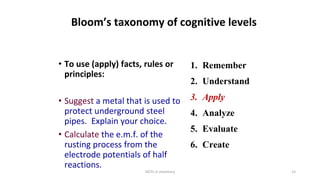
Bloom’s taxonomy of cognitive levels
• To use (apply) facts, rules or
principles:
• Suggest a metal that is used to
protect underground steel
pipes. Explain your choice.
• Calculate the e.m.f. of the
rusting process from the
electrode potentials of half
reactions.
1. Remember
2. Understand
3. Apply
4. Analyze
5. Evaluate
6. Create
HOTS in chemistry 16
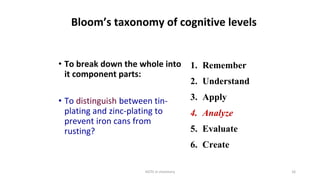
Bloom’s taxonomy of cognitive levels
• To break down the whole into
it component parts:
• To distinguish between tin-
plating and zinc-plating to
prevent iron cans from
rusting?
1. Remember
2. Understand
3. Apply
4. Analyze
5. Evaluate
6. Create
HOTS in chemistry 17
Bloom’s taxonomy of cognitive levels
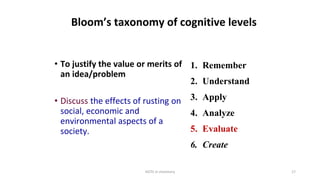
• To justify the value or merits of
an idea/problem
• Discuss the effects of rusting on
social, economic and
environmental aspects of a
society.
1. Remember
2. Understand
3. Apply
4. Analyze
5. Evaluate
6. Create
HOTS in chemistry 18
Bloom’s taxonomy of cognitive levels
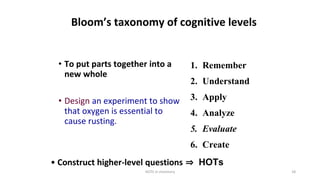
• To put parts together into a
new whole
• Design an experiment to show
that oxygen is essential to
cause rusting.
1. Remember
2. Understand
3. Apply
4. Analyze
5. Evaluate
6. Create
• Construct higher-level questions ⇒ HOTs
WORKSHOP PROPER - Group Activity
Instructions:
Browse your topic report and find for possible
objectives to be measured. List at least two
objectives per level of the revised Bloom’s
Taxonomy.
Present your output.

WKS 1 Identifying Test Objectives.pptx

  • 1.
    WORKSOP ON IDENTIFYING TESTOBJECTIVES Objective: * To ensure alignment among assessments, learning objectives and instructional strategies.
  • 2.
    Why should assessments,learning objectives, and instructional strategies be aligned? Assessments Learning Objectives Instructional Activities
  • 3.
    * Assessments: Whatkind of tasks will reveal whether students have achieved the learning objectives I have identified? *Learning Objectives: What do I want students to know and how to do when they leave this course? * Instructional Objectives: What kind of activities in and out of class will reinforce my learning objectives and prepare students for assessments?
  • 4.
    ▪ Your objectiveis for students to learn to apply analytical skills, but your assessment measures only factual recall. Consequently, students honing their analytical skills are frustrated that the exam does not measure what they learned.
  • 5.
    ▪ Your assessmentmeasures students’ ability to compare and critique the arguments of different authors, but your instructional strategies focus entirely on summarizing the arguments of different authors. Consequently, students do not learn or practice the skills of comparison and evaluation that will be assessed.
  • 6.
    What do well-aligned assessmentslook like? Type of learning objective Examples of Appropriate Assessments Recall Recognize Identify Objective test items such as fill-in-the blank, matching, labeling, or multiple choice questions that require students to: o Recall or recognize terms, facts and concepts
  • 7.
    Type of learning objective Examplesof Appropriate Assessments Interpret Exemplify Classify Summarize Infer Compare Explain Oral questioning, Essay, Performance task that require students to: o summarize readings, films or speeches o compare and contrast two or more theories, events or processes o classify or categorize cases, elements, or events using established criteria o paraphrase documents or speeches o find or identify examples or illustrations of a concept or principle
  • 8.
    Type of learning objective Examplesof Appropriate Assessments Apply Execute Implement Performance Task, Oral Questioning, Observations that require students to: o use procedures to solve or complete familiar or unfamiliar tasks o Determine which procedure(s) are most appropriate for a given task
  • 9.
    Type of learning objective Examplesof Appropriate Assessments Analyze Differentiate Organize Attribute Performance task, oral questioning and observations that require students to: o discriminate or select relevant and irrelevant parts o Determine how elements function together o Determine bias, values, or underlying intent in presented material
  • 10.
    Type of learning objective Examplesof Appropriate Assessments Check Critique Assess Performance task, oral questioning, observations that require students to: o test, monitor, judge, or critique readings, performances, or products against established criteria or standards
  • 11.
    Type of learning objective Examplesof Appropriate Assessments Create Plan Produce Design Performance-based, oral questioning, observations that require students to: o Make, build, design or generate something new
  • 12.
    Bloom’s taxonomy remix Puttingthings together, Creative Thinking Making Judgment Breaking Things down, Critical Thinking Using knowledge in new situations Understanding Recall
  • 13.
    HOTS in chemistry13 Revised Bloom’s taxonomy of cognitive levels • To recall facts: • Define the term ‘rusting’. • State two substances that are needed for rusting to occur. 1. Remember 2. Understand 3. Apply 4. Analyze 5. Evaluate 6. Create
  • 14.
    HOTS in chemistry14 Bloom’s taxonomy of cognitive levels • To understand the meanings / organize facts: • Explain why rusting of iron nail occurs faster in salt solution than in tap water. 1. Remember 2. Understand 3. Apply 4. Analyze 5. Evaluate 6. Create
  • 15.
    HOTS in chemistry15 Bloom’s taxonomy of cognitive levels • To use (apply) facts, rules or principles: • Suggest a metal that is used to protect underground steel pipes. Explain your choice. • Calculate the e.m.f. of the rusting process from the electrode potentials of half reactions. 1. Remember 2. Understand 3. Apply 4. Analyze 5. Evaluate 6. Create
  • 16.
    HOTS in chemistry16 Bloom’s taxonomy of cognitive levels • To break down the whole into it component parts: • To distinguish between tin- plating and zinc-plating to prevent iron cans from rusting? 1. Remember 2. Understand 3. Apply 4. Analyze 5. Evaluate 6. Create
  • 17.
    HOTS in chemistry17 Bloom’s taxonomy of cognitive levels • To justify the value or merits of an idea/problem • Discuss the effects of rusting on social, economic and environmental aspects of a society. 1. Remember 2. Understand 3. Apply 4. Analyze 5. Evaluate 6. Create
  • 18.
    HOTS in chemistry18 Bloom’s taxonomy of cognitive levels • To put parts together into a new whole • Design an experiment to show that oxygen is essential to cause rusting. 1. Remember 2. Understand 3. Apply 4. Analyze 5. Evaluate 6. Create • Construct higher-level questions ⇒ HOTs
  • 19.
    WORKSHOP PROPER -Group Activity Instructions: Browse your topic report and find for possible objectives to be measured. List at least two objectives per level of the revised Bloom’s Taxonomy. Present your output.