Multiple Sclerosis
DMW Dharmakeerthi (MD)
Senior Registrar in clinical
Neurophysiology
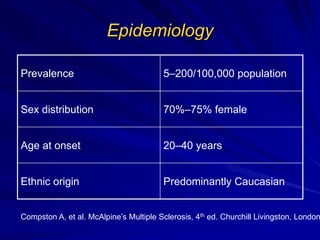
Epidemiology
Compston A, et al. McAlpine‟s Multiple Sclerosis, 4th ed. Churchill Livingston, London
Prevalence 5–200/100,000 population
Sex distribution 70%–75% female
Age at onset 20–40 years
Ethnic origin Predominantly Caucasian
The Basics - Revision
The most common autoimmune
inflammatory demyelinating disease of the
CNS.
Episodes affecting different parts of the
central nervous system at different times.
Inflammation, leading to demyelination
and temporary conduction
block, symptomatic only if it occurs in an
eloquent area.
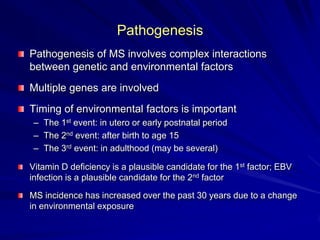
Pathogenesis
Pathogenesis of MS involves complex interactions
between genetic and environmental factors
Multiple genes are involved
Timing of environmental factors is important
– The 1st event: in utero or early postnatal period
– The 2nd event: after birth to age 15
– The 3rd event: in adulthood (may be several)
Vitamin D deficiency is a plausible candidate for the 1st factor; EBV
infection is a plausible candidate for the 2nd factor
MS incidence has increased over the past 30 years due to a change
in environmental exposure
Characterized pathologically by multifocal
areas of demyelination with loss of
oligodendrocytes and astroglial scarring.
Axonal injury is increasingly recognized as
a prominent pathologic feature of MS.
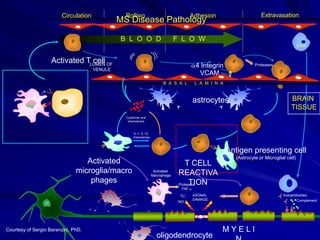
Extravasation
astrocytes BRAIN
TISSUE
M Y E L I
oligodendrocyte
B cell
Rolling Adhesion
4 Integrin
VCAM
B L O O D F L O W
LUMEN OF
VENULE
B A S A L L A M I N A
Circulation
Activated T cell Proteases
Antigen presenting cell
(Astrocyte or Microglial cell)
Activated
microglia/macro
phages
T CELL
REACTIVA
TION
Activated
Macrophage
Autoantibodies
Complement
IL-1, IL-12,
chemokines
Cytokines and
chemokines
Proteases
TNF-
O2
•-
NO•
AXONAL
DAMAGE
Courtesy of Sergio Baranzini, PhD.
MS Disease Pathology
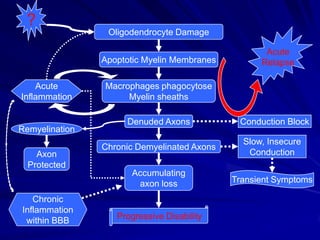
Oligodendrocyte Damage
Apoptotic Myelin Membranes
Macrophages phagocytose
Myelin sheaths
Denuded Axons
Chronic Demyelinated Axons
Accumulating
axon loss
Progressive Disability
Acute
Inflammation
?
Conduction Block
Remyelination
Slow, Insecure
Conduction
Transient Symptoms
Acute
Relapse
Axon
Protected
Chronic
Inflammation
within BBB
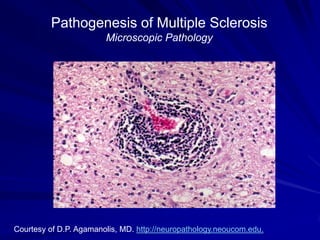
Pathogenesis of Multiple Sclerosis
Microscopic Pathology
Courtesy of D.P. Agamanolis, MD. http://neuropathology.neoucom.edu.
Some Definitions
A Relapse:-
Onset of new neurological symptoms, or a substantial
deterioration of previous symptoms, lasting more than 24
hours, not explicable on the basis of infection or other
process
Clinically Isolated Syndrome:-
Single neurological episode without clinical evidence of
previous episodes, with a normal MRI scan has a ~20%
chance of progressing to MS, with and abnormal scan
fulfilling certain criteria has an 85% chance of developing
MS
Some more definitions
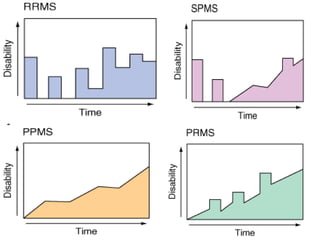
Relapsing Remitting :- disease
characterised by relapses with substantial
regression of symptoms afterwards – 70% start
like this
Primary Progressive :- gradual
progressive disease from onset without
relapses. ~15% of MS cases
Secondary Progressive :- progressive
disease following period or relapsing remitting
disease
2005 McDonald criteria revisions diagnostic criteria for
multiple sclerosis
Clinical presentation Additional data needed for MS diagnosis
Two or more attacks*; objective clinical evidence
of two or more lesions
None•
Two or more attacks*; objective clinical evidence
of one lesion
Dissemination in space, demonstrated by: - MRIΔ
or
- Two or more MRI-detected lesions consistent
with MS plus positive CSF or- Await further
clinical attack* implicating a different site
One attack*; objective clinical evidence of two or
more lesions
Dissemination in time, demonstrated by: - MRI
or- Second clinical attack*
One attack*; objective clinical evidence of one
lesion (monosymptomatic presentation; clinically
isolated syndrome)
Dissemination in space, demonstrated by:- MRIΔ
or- Two or more MRI-detected lesions consistent
with MS plus positive CSF and Dissemination in
time, demonstrated by:- MRI or Second clinical
attack*
Insidious neurological progression suggestive of
MS
One year of disease progression (retrospectively
or prospectively determined) and Two of the
following:
- Positive brain MRI (nine T2 lesions or four or
more T2 lesions with positive VEP)¥- Positive
spinal cord MRI (two focal T2 lesions)
- Positive CSF
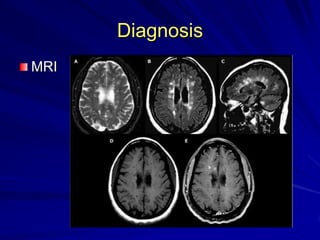
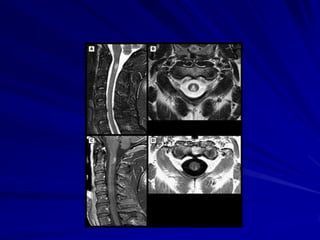
Diagnosis
MRI
CSF
CSF total leukocyte count is normal in two-thirds of
patients
CSF protein (or albumin) level is usually normal
Oligoclonal bands
Antimyelin antibodies - myelin oligodendrocyte
glycoprotein (MOG) and myelin basic protein (MBP)
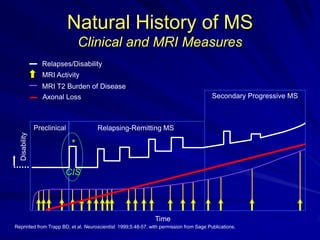
Time
Preclinical
MRI Activity
Relapses/Disability
MRI T2 Burden of Disease
Axonal Loss
Disability
CIS
*
Reprinted from Trapp BD, et al. Neuroscientist. 1999;5:48-57, with permission from Sage Publications.
Relapsing-Remitting MS
Secondary Progressive MS
Natural History of MS
Clinical and MRI Measures
Acute relapses
Indications for treatment of a relapse
include functionally disabling symptoms
with objective evidence of neurologic
impairment.
Steroids in Acute Relapses
Speed recovery from an acute relapse
Do not alter the outcome at 6 months
If relapse severe + not improving in a few days
– Exclude infection
– Need adequate doses (>60mg)
IV methyl pred 1g 3/7 or 500mg po for 5/7
Gastric protection if a risk factors
Avoid oral tail-off unless prev. bad withdrawal
– Avoid long term steroids
– Counsel about long term side effects (inc
weakness, avascular necrosis)
– PE for those not responding to steroids
Treatment of RRMS
Immunomodulatory agents
A decreased relapse rate
A reduced progression of disability
A slower accumulation of lesions on MRI
Interferon beta-1a
Interferon beta-1b
Glatiramer acetate
Current First-Line MS Therapies
Interferon beta-1b
30 mcg Interferon beta-1a once weekly
Glatiramer acetate
Generally very safe and well tolerated
All require self-injection
When to treat?
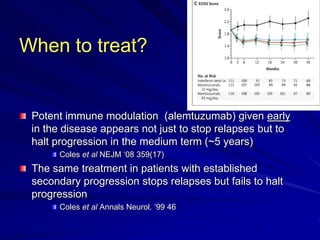
Potent immune modulation (alemtuzumab) given early
in the disease appears not just to stop relapses but to
halt progression in the medium term (~5 years)
Coles et al NEJM „08 359(17)
The same treatment in patients with established
secondary progression stops relapses but fails to halt
progression
Coles et al Annals Neurol. „99 46
Interferon beta-1b & 1a
First medication approved by the US FDA
Administered EOD subcutaneously by self
injection
Injection site necrosis and Flu-like
symptoms
Neutralizing antibodies reduce the
bioavailability of interferon
Glatiramer acetate
Polymers of four amino acids compete
with APC to T cell
Inducer of specific T helper 2 type
suppressor cells
Injection site reactions, chest pain,
flushing, dyspnea, palpitations
No laboratory monitoring is necessary
BEYOND, BECOME and REGARD trials
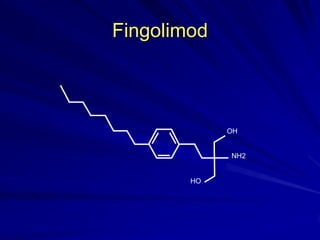
Fingolimod
Sphingosine-1-phosphate receptor modulator
Induces rapid and reversible sequestration of
lymphocytes in lymph nodes
– Prevents activated and autoreactive cells from
migrating to target organs
Lymphocytes remain functional and may still be
activated as part of an immune response
Crosses blood brain barrier and may have
neuroprotective properties
Brinkmann V, et al. J Biol Chem. 2002;277:21453-21457; Pinschewer DD, et al. J Immunol. 2000;164:5761-5770;
Chiba K, et al. J Immunol. 1998;160:5037-5044.
Fingolimod
OH
NH2
HO
Fingolimod
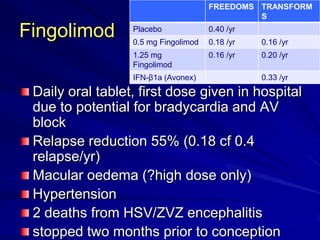
Daily oral tablet, first dose given in hospital
due to potential for bradycardia and AV
block
Relapse reduction 55% (0.18 cf 0.4
relapse/yr)
Macular oedema (?high dose only)
Hypertension
2 deaths from HSV/ZVZ encephalitis
stopped two months prior to conception
FREEDOMS TRANSFORM
S
Placebo 0.40 /yr
0.5 mg Fingolimod 0.18 /yr 0.16 /yr
1.25 mg
Fingolimod
0.16 /yr 0.20 /yr
IFN-β1a (Avonex) 0.33 /yr
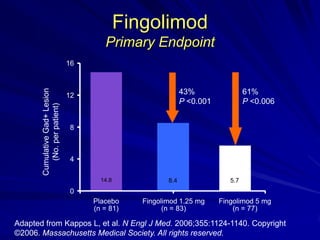
16
12
8
4
0
CumulativeGad+Lesion
(No.perpatient)
14.8 8.4 5.7
Placebo
(n = 81)
Fingolimod 1.25 mg
(n = 83)
Fingolimod 5 mg
(n = 77)
43%
P <0.001
61%
P <0.006
Adapted from Kappos L, et al. N Engl J Med. 2006;355:1124-1140. Copyright
©2006. Massachusetts Medical Society. All rights reserved.
Fingolimod
Primary Endpoint
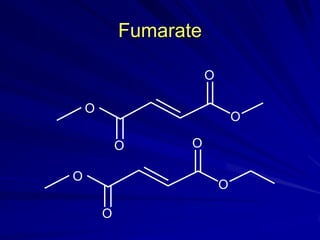
Fumarate
O
O
O
O
O
O
O
O
Fumaric Acid Esters
Derived from common fumitory (Fumaria officinalis), a
plant rich in fumaric acid
Used to treat skin disorders since the 17th century
Fumaric acid esters used in severe psoriasis
– First reported by Schweckendiek in 1959
Inhibits T-cell activity
– Induction of activated lymphocyte apoptosis
– Shift in cytokine profile from Th1 to Th2
Effective in chronic experimental autoimmune
encephalomyelitis
May have neuroprotective properties by activating
antioxidant response genes
Schilling S, et al. Clin Exp Immunol. 2006;145:101-107.
Fumarate
Conclusions
Fumarate reduced the cumulative number of
Gad+ lesions, with a trend toward reduced
relapses
Adverse effects profile favorable with
discontinuations due to nausea, flushing,
headache, nasopharingitis (known effects in
psoriasis)
Phase III trials are actively recruiting, completion
expected in 2011, launch in 2012
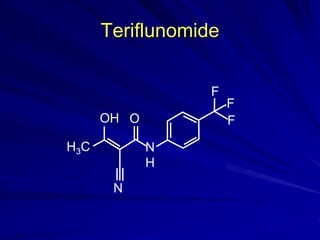
Teriflunomide
O
N
H
N
F
F
F
OH
H3C
Teriflunomide
Leflunomide parent compound used in treatment
of rheumatoid arthritis
Inhibits pyrimidine synthesis
– Binds dihydroorotate dehydrogenase, the fourth
enzyme in de novo pyrimidine synthesis
Inhibits T-cell division
Inhibits murine experimental autoimmune
encephalomyelitis
Zeyda M, et al. Arthritis Rheum. 2005;52:2730-2739.
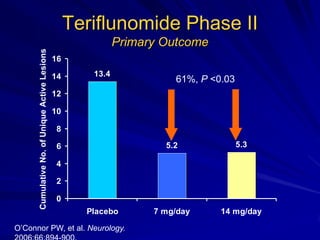
Teriflunomide Phase II
Primary Outcome
13.4
5.2 5.3
0
2
4
6
8
10
12
14
16
Placebo 7 mg/day 14 mg/day
CumulativeNo.ofUniqueActiveLesions
61%, P <0.03
O‟Connor PW, et al. Neurology.
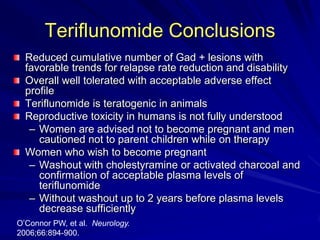
Teriflunomide Conclusions
Reduced cumulative number of Gad + lesions with
favorable trends for relapse rate reduction and disability
Overall well tolerated with acceptable adverse effect
profile
Teriflunomide is teratogenic in animals
Reproductive toxicity in humans is not fully understood
– Women are advised not to become pregnant and men
cautioned not to parent children while on therapy
Women who wish to become pregnant
– Washout with cholestyramine or activated charcoal and
confirmation of acceptable plasma levels of
teriflunomide
– Without washout up to 2 years before plasma levels
decrease sufficiently
O‟Connor PW, et al. Neurology.
2006;66:894-900.
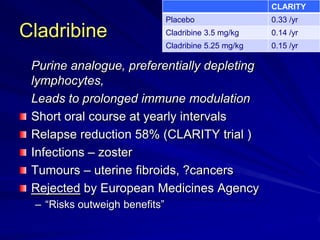
Cladribine
Purine analogue, preferentially depleting
lymphocytes,
Leads to prolonged immune modulation
Short oral course at yearly intervals
Relapse reduction 58% (CLARITY trial )
Infections – zoster
Tumours – uterine fibroids, ?cancers
Rejected by European Medicines Agency
– “Risks outweigh benefits”
CLARITY
Placebo 0.33 /yr
Cladribine 3.5 mg/kg 0.14 /yr
Cladribine 5.25 mg/kg 0.15 /yr
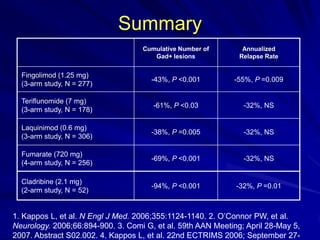
Summary
Cumulative Number of
Gad+ lesions
Annualized
Relapse Rate
Fingolimod (1.25 mg)
(3-arm study, N = 277)
-43%, P <0.001 -55%, P =0.009
Teriflunomide (7 mg)
(3-arm study, N = 178)
-61%, P <0.03 -32%, NS
Laquinimod (0.6 mg)
(3-arm study, N = 306)
-38%, P =0.005 -32%, NS
Fumarate (720 mg)
(4-arm study, N = 256)
-69%, P <0.001 -32%, NS
Cladribine (2.1 mg)
(2-arm study, N = 52)
-94%, P <0.001 -32%, P =0.01
1. Kappos L, et al. N Engl J Med. 2006;355:1124-1140. 2. O‟Connor PW, et al.
Neurology. 2006;66:894-900. 3. Comi G, et al. 59th AAN Meeting; April 28-May 5,
2007. Abstract S02.002. 4. Kappos L, et al. 22nd ECTRIMS 2006; September 27-
Natalizumab Tysabri
Integrin α4 blockade
Stops circulating lymphocytes entering the CNS
Well tolerated monthly infusions
Effective relapse suppression (68% cf placebo)
Risk of PML appears to increase with time on
treatment:-
Very low in first year
By 2 years around 1 in 1000 per year of treatment
Risk of rebound disease activity when stopped
Mitoxantrone
Originally suggested for highly active
RRMS and possibly early progression
50% reduction in relapse rate
Cardiotoxicity, less common with newer
regimes
Risk of Leukaemia – particularly
Promyelocytic leukaemia ?0.3%++
Alemtuzumab Campath
Anti CD52 monoclonal depletes all
lymphocytes,
Prolonged immunomodulation
Highly effective relapse reduction (78% cf
IFNβ1a)
Stops progressive disability when given early
30% risk of Autoimmunity
ITP
Thyroid
Campath (Alemtuzumab)
– Unlicensed, and cheap! (at present)
No effect on established progression
Marked reduction in relapse rate for those
with highly active disease – 74% cf IFN
Most convincing effect on progression of
any drug, when started early enough
25% occurrence of other autoimmune
disease (Graves, ITP etc)
Azathioprine
One small, open-label study found that
azathioprine up to 3 mg/kg per day was
well tolerated and reduced the rate of new
gadolinium-enhancing brain lesions in
patients with RRMS
Cyclophosphamide
Limited observational evidence supports
the use of pulse (eg, monthly) IV
cyclophosphamide for RRMS
Conclusions
To date, treatment has been successful in
suppressing relapses and enhancing MRI
lesions
Early treatment with effective immune
therapy may alter the course of disease,
preventing/ delaying later disability

Multiple sclerosis-basic-principles-and-new-developments596 (1)

  • 1.
    Multiple Sclerosis DMW Dharmakeerthi(MD) Senior Registrar in clinical Neurophysiology
  • 2.
    Epidemiology Compston A, etal. McAlpine‟s Multiple Sclerosis, 4th ed. Churchill Livingston, London Prevalence 5–200/100,000 population Sex distribution 70%–75% female Age at onset 20–40 years Ethnic origin Predominantly Caucasian
  • 3.
    The Basics -Revision The most common autoimmune inflammatory demyelinating disease of the CNS. Episodes affecting different parts of the central nervous system at different times. Inflammation, leading to demyelination and temporary conduction block, symptomatic only if it occurs in an eloquent area.
  • 4.
    Pathogenesis Pathogenesis of MSinvolves complex interactions between genetic and environmental factors Multiple genes are involved Timing of environmental factors is important – The 1st event: in utero or early postnatal period – The 2nd event: after birth to age 15 – The 3rd event: in adulthood (may be several) Vitamin D deficiency is a plausible candidate for the 1st factor; EBV infection is a plausible candidate for the 2nd factor MS incidence has increased over the past 30 years due to a change in environmental exposure
  • 5.
    Characterized pathologically bymultifocal areas of demyelination with loss of oligodendrocytes and astroglial scarring. Axonal injury is increasingly recognized as a prominent pathologic feature of MS.
  • 6.
    Extravasation astrocytes BRAIN TISSUE M YE L I oligodendrocyte B cell Rolling Adhesion 4 Integrin VCAM B L O O D F L O W LUMEN OF VENULE B A S A L L A M I N A Circulation Activated T cell Proteases Antigen presenting cell (Astrocyte or Microglial cell) Activated microglia/macro phages T CELL REACTIVA TION Activated Macrophage Autoantibodies Complement IL-1, IL-12, chemokines Cytokines and chemokines Proteases TNF- O2 •- NO• AXONAL DAMAGE Courtesy of Sergio Baranzini, PhD. MS Disease Pathology
  • 7.
    Oligodendrocyte Damage Apoptotic MyelinMembranes Macrophages phagocytose Myelin sheaths Denuded Axons Chronic Demyelinated Axons Accumulating axon loss Progressive Disability Acute Inflammation ? Conduction Block Remyelination Slow, Insecure Conduction Transient Symptoms Acute Relapse Axon Protected Chronic Inflammation within BBB
  • 8.
    Pathogenesis of MultipleSclerosis Microscopic Pathology Courtesy of D.P. Agamanolis, MD. http://neuropathology.neoucom.edu.
  • 10.
    Some Definitions A Relapse:- Onsetof new neurological symptoms, or a substantial deterioration of previous symptoms, lasting more than 24 hours, not explicable on the basis of infection or other process Clinically Isolated Syndrome:- Single neurological episode without clinical evidence of previous episodes, with a normal MRI scan has a ~20% chance of progressing to MS, with and abnormal scan fulfilling certain criteria has an 85% chance of developing MS
  • 11.
    Some more definitions RelapsingRemitting :- disease characterised by relapses with substantial regression of symptoms afterwards – 70% start like this Primary Progressive :- gradual progressive disease from onset without relapses. ~15% of MS cases Secondary Progressive :- progressive disease following period or relapsing remitting disease
  • 12.
    2005 McDonald criteriarevisions diagnostic criteria for multiple sclerosis Clinical presentation Additional data needed for MS diagnosis Two or more attacks*; objective clinical evidence of two or more lesions None• Two or more attacks*; objective clinical evidence of one lesion Dissemination in space, demonstrated by: - MRIΔ or - Two or more MRI-detected lesions consistent with MS plus positive CSF or- Await further clinical attack* implicating a different site One attack*; objective clinical evidence of two or more lesions Dissemination in time, demonstrated by: - MRI or- Second clinical attack* One attack*; objective clinical evidence of one lesion (monosymptomatic presentation; clinically isolated syndrome) Dissemination in space, demonstrated by:- MRIΔ or- Two or more MRI-detected lesions consistent with MS plus positive CSF and Dissemination in time, demonstrated by:- MRI or Second clinical attack* Insidious neurological progression suggestive of MS One year of disease progression (retrospectively or prospectively determined) and Two of the following: - Positive brain MRI (nine T2 lesions or four or more T2 lesions with positive VEP)¥- Positive spinal cord MRI (two focal T2 lesions) - Positive CSF
  • 13.
  • 15.
    CSF CSF total leukocytecount is normal in two-thirds of patients CSF protein (or albumin) level is usually normal Oligoclonal bands Antimyelin antibodies - myelin oligodendrocyte glycoprotein (MOG) and myelin basic protein (MBP)
  • 16.
    Time Preclinical MRI Activity Relapses/Disability MRI T2Burden of Disease Axonal Loss Disability CIS * Reprinted from Trapp BD, et al. Neuroscientist. 1999;5:48-57, with permission from Sage Publications. Relapsing-Remitting MS Secondary Progressive MS Natural History of MS Clinical and MRI Measures
  • 17.
    Acute relapses Indications fortreatment of a relapse include functionally disabling symptoms with objective evidence of neurologic impairment.
  • 18.
    Steroids in AcuteRelapses Speed recovery from an acute relapse Do not alter the outcome at 6 months If relapse severe + not improving in a few days – Exclude infection – Need adequate doses (>60mg) IV methyl pred 1g 3/7 or 500mg po for 5/7 Gastric protection if a risk factors Avoid oral tail-off unless prev. bad withdrawal – Avoid long term steroids – Counsel about long term side effects (inc weakness, avascular necrosis) – PE for those not responding to steroids
  • 19.
    Treatment of RRMS Immunomodulatoryagents A decreased relapse rate A reduced progression of disability A slower accumulation of lesions on MRI Interferon beta-1a Interferon beta-1b Glatiramer acetate
  • 20.
    Current First-Line MSTherapies Interferon beta-1b 30 mcg Interferon beta-1a once weekly Glatiramer acetate Generally very safe and well tolerated All require self-injection
  • 21.
    When to treat? Potentimmune modulation (alemtuzumab) given early in the disease appears not just to stop relapses but to halt progression in the medium term (~5 years) Coles et al NEJM „08 359(17) The same treatment in patients with established secondary progression stops relapses but fails to halt progression Coles et al Annals Neurol. „99 46
  • 22.
    Interferon beta-1b &1a First medication approved by the US FDA Administered EOD subcutaneously by self injection Injection site necrosis and Flu-like symptoms Neutralizing antibodies reduce the bioavailability of interferon
  • 23.
    Glatiramer acetate Polymers offour amino acids compete with APC to T cell Inducer of specific T helper 2 type suppressor cells Injection site reactions, chest pain, flushing, dyspnea, palpitations No laboratory monitoring is necessary BEYOND, BECOME and REGARD trials
  • 24.
    Fingolimod Sphingosine-1-phosphate receptor modulator Inducesrapid and reversible sequestration of lymphocytes in lymph nodes – Prevents activated and autoreactive cells from migrating to target organs Lymphocytes remain functional and may still be activated as part of an immune response Crosses blood brain barrier and may have neuroprotective properties Brinkmann V, et al. J Biol Chem. 2002;277:21453-21457; Pinschewer DD, et al. J Immunol. 2000;164:5761-5770; Chiba K, et al. J Immunol. 1998;160:5037-5044.
  • 25.
  • 26.
    Fingolimod Daily oral tablet,first dose given in hospital due to potential for bradycardia and AV block Relapse reduction 55% (0.18 cf 0.4 relapse/yr) Macular oedema (?high dose only) Hypertension 2 deaths from HSV/ZVZ encephalitis stopped two months prior to conception FREEDOMS TRANSFORM S Placebo 0.40 /yr 0.5 mg Fingolimod 0.18 /yr 0.16 /yr 1.25 mg Fingolimod 0.16 /yr 0.20 /yr IFN-β1a (Avonex) 0.33 /yr
  • 27.
    16 12 8 4 0 CumulativeGad+Lesion (No.perpatient) 14.8 8.4 5.7 Placebo (n= 81) Fingolimod 1.25 mg (n = 83) Fingolimod 5 mg (n = 77) 43% P <0.001 61% P <0.006 Adapted from Kappos L, et al. N Engl J Med. 2006;355:1124-1140. Copyright ©2006. Massachusetts Medical Society. All rights reserved. Fingolimod Primary Endpoint
  • 28.
  • 29.
    Fumaric Acid Esters Derivedfrom common fumitory (Fumaria officinalis), a plant rich in fumaric acid Used to treat skin disorders since the 17th century Fumaric acid esters used in severe psoriasis – First reported by Schweckendiek in 1959 Inhibits T-cell activity – Induction of activated lymphocyte apoptosis – Shift in cytokine profile from Th1 to Th2 Effective in chronic experimental autoimmune encephalomyelitis May have neuroprotective properties by activating antioxidant response genes Schilling S, et al. Clin Exp Immunol. 2006;145:101-107.
  • 30.
    Fumarate Conclusions Fumarate reduced thecumulative number of Gad+ lesions, with a trend toward reduced relapses Adverse effects profile favorable with discontinuations due to nausea, flushing, headache, nasopharingitis (known effects in psoriasis) Phase III trials are actively recruiting, completion expected in 2011, launch in 2012
  • 31.
  • 32.
    Teriflunomide Leflunomide parent compoundused in treatment of rheumatoid arthritis Inhibits pyrimidine synthesis – Binds dihydroorotate dehydrogenase, the fourth enzyme in de novo pyrimidine synthesis Inhibits T-cell division Inhibits murine experimental autoimmune encephalomyelitis Zeyda M, et al. Arthritis Rheum. 2005;52:2730-2739.
  • 33.
    Teriflunomide Phase II PrimaryOutcome 13.4 5.2 5.3 0 2 4 6 8 10 12 14 16 Placebo 7 mg/day 14 mg/day CumulativeNo.ofUniqueActiveLesions 61%, P <0.03 O‟Connor PW, et al. Neurology.
  • 34.
    Teriflunomide Conclusions Reduced cumulativenumber of Gad + lesions with favorable trends for relapse rate reduction and disability Overall well tolerated with acceptable adverse effect profile Teriflunomide is teratogenic in animals Reproductive toxicity in humans is not fully understood – Women are advised not to become pregnant and men cautioned not to parent children while on therapy Women who wish to become pregnant – Washout with cholestyramine or activated charcoal and confirmation of acceptable plasma levels of teriflunomide – Without washout up to 2 years before plasma levels decrease sufficiently O‟Connor PW, et al. Neurology. 2006;66:894-900.
  • 35.
    Cladribine Purine analogue, preferentiallydepleting lymphocytes, Leads to prolonged immune modulation Short oral course at yearly intervals Relapse reduction 58% (CLARITY trial ) Infections – zoster Tumours – uterine fibroids, ?cancers Rejected by European Medicines Agency – “Risks outweigh benefits” CLARITY Placebo 0.33 /yr Cladribine 3.5 mg/kg 0.14 /yr Cladribine 5.25 mg/kg 0.15 /yr
  • 36.
    Summary Cumulative Number of Gad+lesions Annualized Relapse Rate Fingolimod (1.25 mg) (3-arm study, N = 277) -43%, P <0.001 -55%, P =0.009 Teriflunomide (7 mg) (3-arm study, N = 178) -61%, P <0.03 -32%, NS Laquinimod (0.6 mg) (3-arm study, N = 306) -38%, P =0.005 -32%, NS Fumarate (720 mg) (4-arm study, N = 256) -69%, P <0.001 -32%, NS Cladribine (2.1 mg) (2-arm study, N = 52) -94%, P <0.001 -32%, P =0.01 1. Kappos L, et al. N Engl J Med. 2006;355:1124-1140. 2. O‟Connor PW, et al. Neurology. 2006;66:894-900. 3. Comi G, et al. 59th AAN Meeting; April 28-May 5, 2007. Abstract S02.002. 4. Kappos L, et al. 22nd ECTRIMS 2006; September 27-
  • 37.
    Natalizumab Tysabri Integrin α4blockade Stops circulating lymphocytes entering the CNS Well tolerated monthly infusions Effective relapse suppression (68% cf placebo) Risk of PML appears to increase with time on treatment:- Very low in first year By 2 years around 1 in 1000 per year of treatment Risk of rebound disease activity when stopped
  • 38.
    Mitoxantrone Originally suggested forhighly active RRMS and possibly early progression 50% reduction in relapse rate Cardiotoxicity, less common with newer regimes Risk of Leukaemia – particularly Promyelocytic leukaemia ?0.3%++
  • 39.
    Alemtuzumab Campath Anti CD52monoclonal depletes all lymphocytes, Prolonged immunomodulation Highly effective relapse reduction (78% cf IFNβ1a) Stops progressive disability when given early 30% risk of Autoimmunity ITP Thyroid
  • 40.
    Campath (Alemtuzumab) – Unlicensed,and cheap! (at present) No effect on established progression Marked reduction in relapse rate for those with highly active disease – 74% cf IFN Most convincing effect on progression of any drug, when started early enough 25% occurrence of other autoimmune disease (Graves, ITP etc)
  • 41.
    Azathioprine One small, open-labelstudy found that azathioprine up to 3 mg/kg per day was well tolerated and reduced the rate of new gadolinium-enhancing brain lesions in patients with RRMS
  • 42.
    Cyclophosphamide Limited observational evidencesupports the use of pulse (eg, monthly) IV cyclophosphamide for RRMS
  • 43.
    Conclusions To date, treatmenthas been successful in suppressing relapses and enhancing MRI lesions Early treatment with effective immune therapy may alter the course of disease, preventing/ delaying later disability