
Guillain-Barre Syndrome
DMW Dharmakeerthi (MD)
Senior Registrar in Clinical
Neurophysiology
• 1859, Landry published a report on 10
patients with an ascending paralysis.
• 1916, 3 French physicians (Guillain, Barré, and
Strohl) described 2 French soldiers with
-motor weakness
-areflexia
-albuminocytological dissociation
Clinical features
• Weakness usually starts in the legs
• In about 10 percent it begins in the arms or facial muscles
• Need for ventilatory support develops in 10 to 30 percent
• Facial weakness occurs in more than 50 percent
• Oropharyngeal weakness eventually occurs in 50 percent
• Oculomotor weakness occurs in about 15 percent
• Paresthesias in the hands and feet accompany the
weakness in more than 80 percent of patients, but sensory
abnormalities on examination are frequently mild.
• Pain, typically located in the back and extremities, can be a
presenting feature in 66 % of patients with all forms of GBS
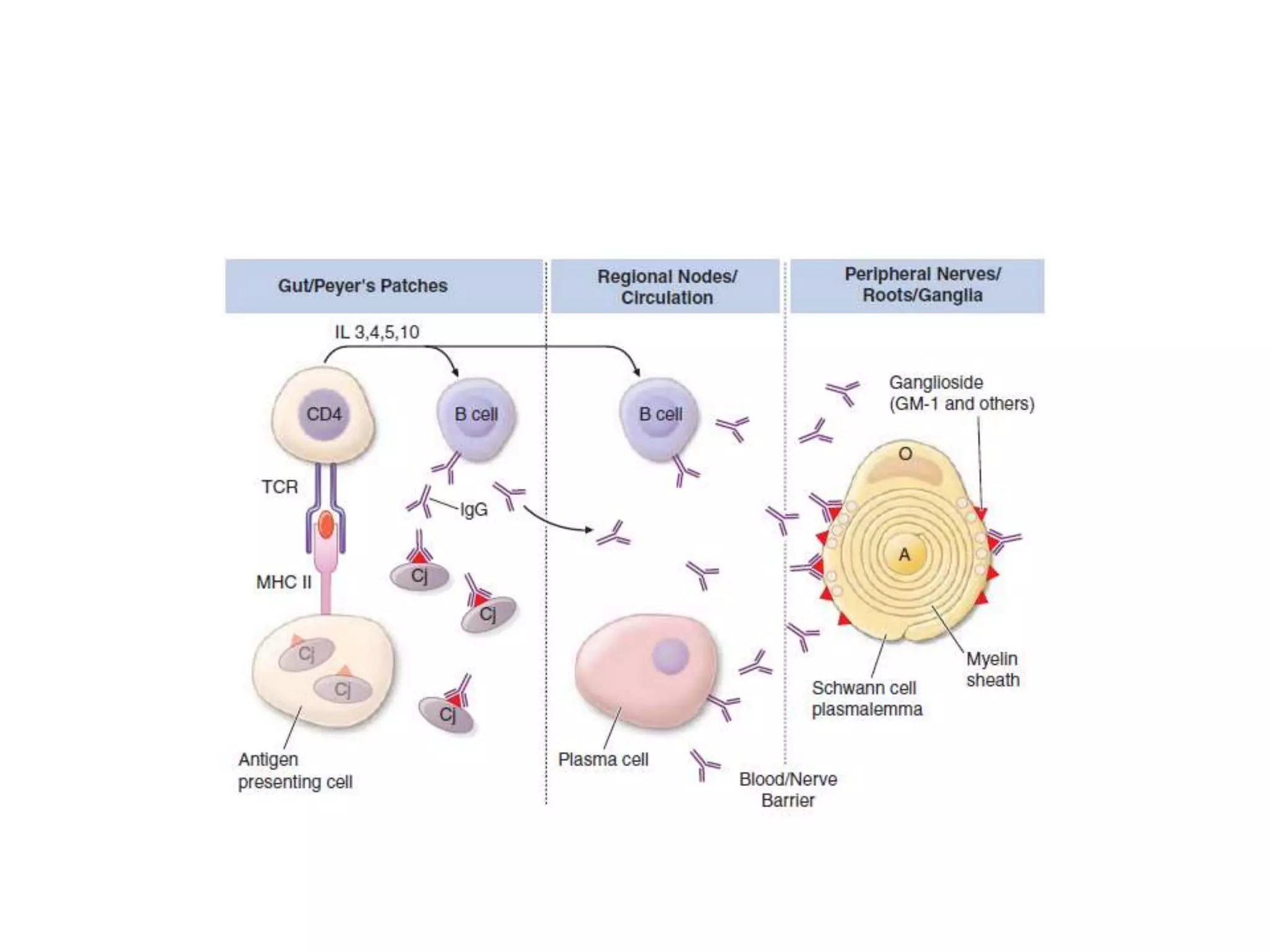
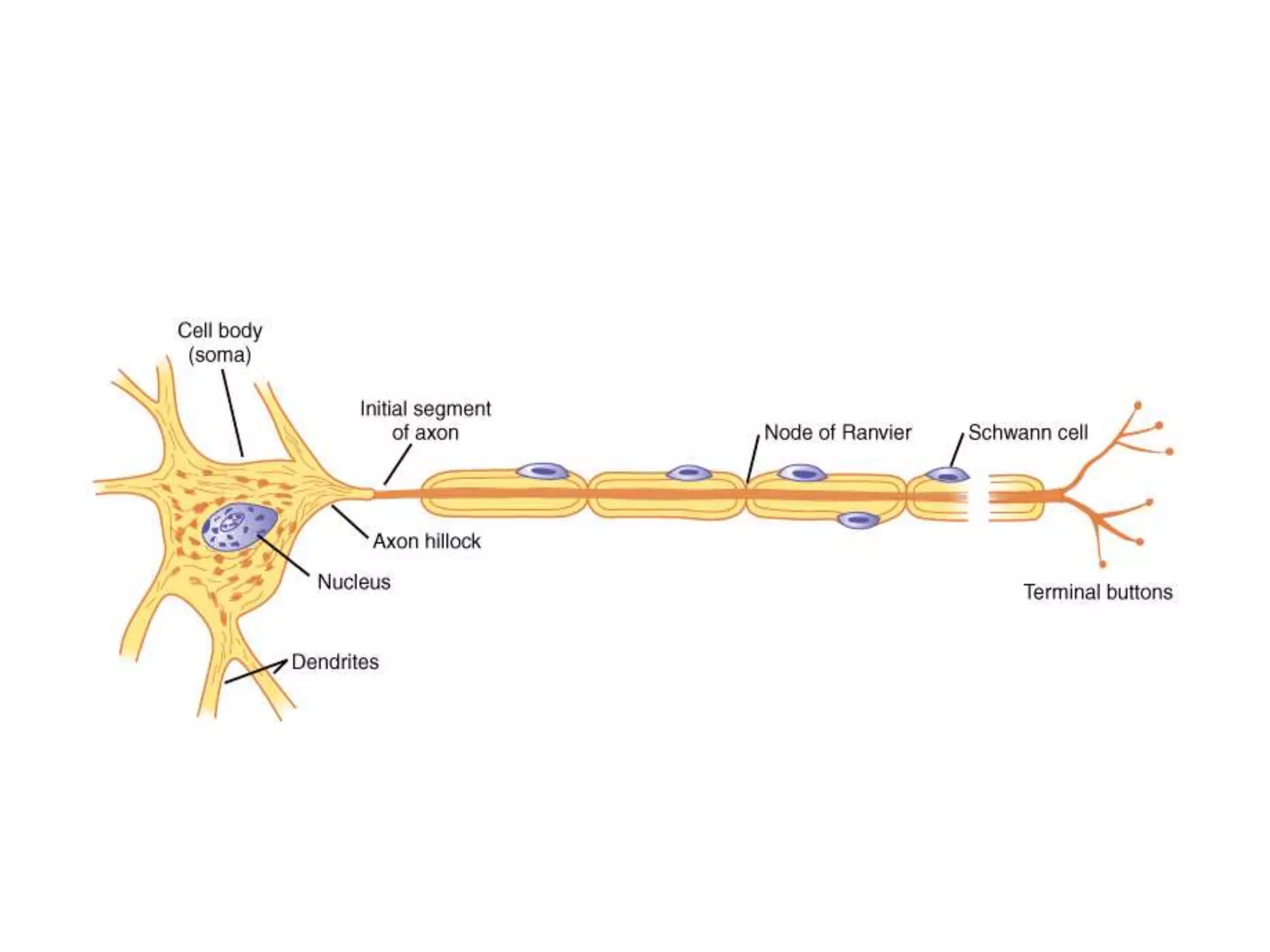
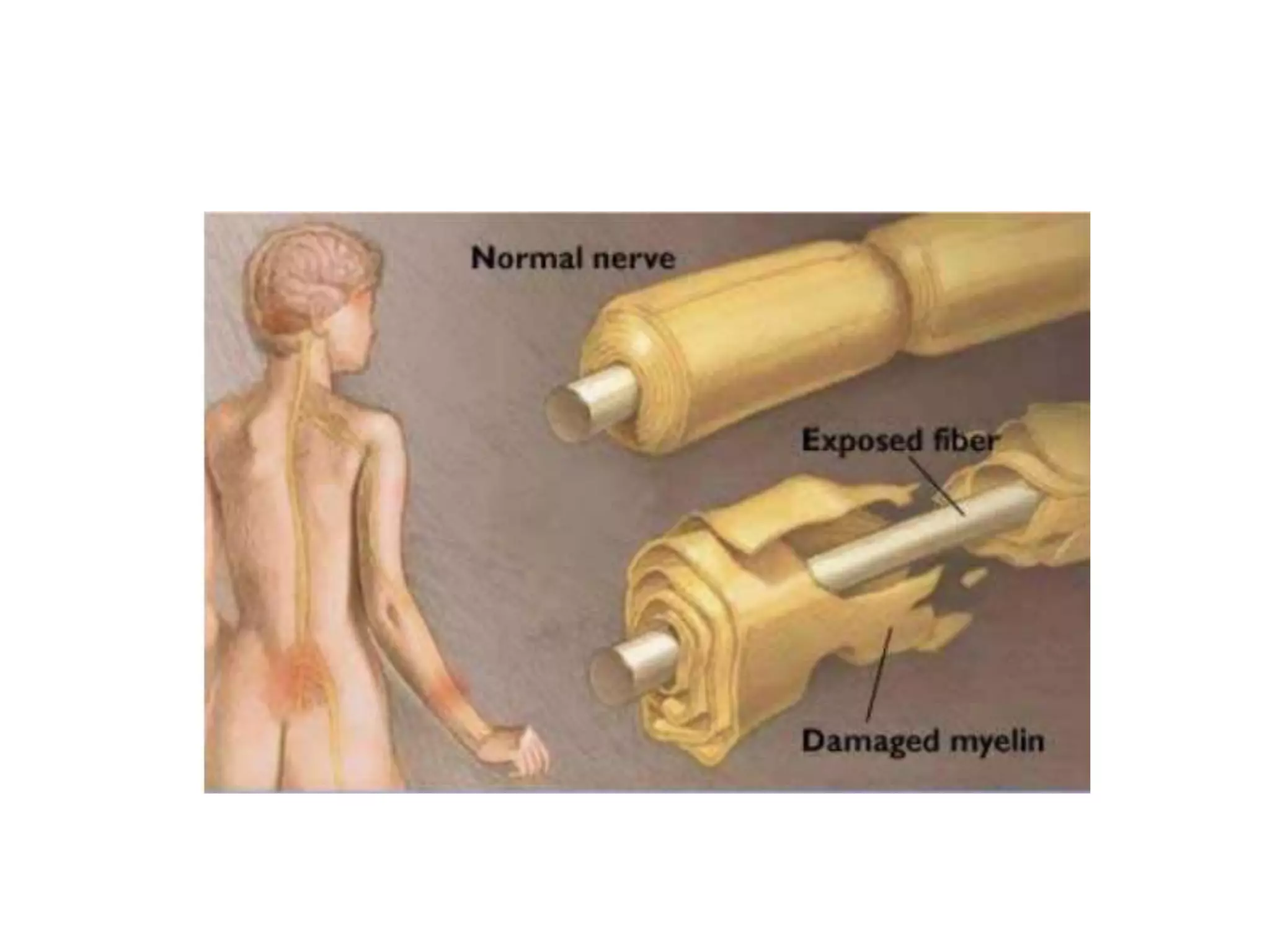
• AIDP and the Miller Fisher -focal inflammatory
response develops against Schwann cells or
peripheral myelin.
• Infiltration of the epineural and endoneural
small vessels (mostly veins) by lymphocytes
and monocytes causes segmental myelin
degeneration throughout the nerve.
• The inflammation is more intense at the
junction of the dorsal and ventral roots.
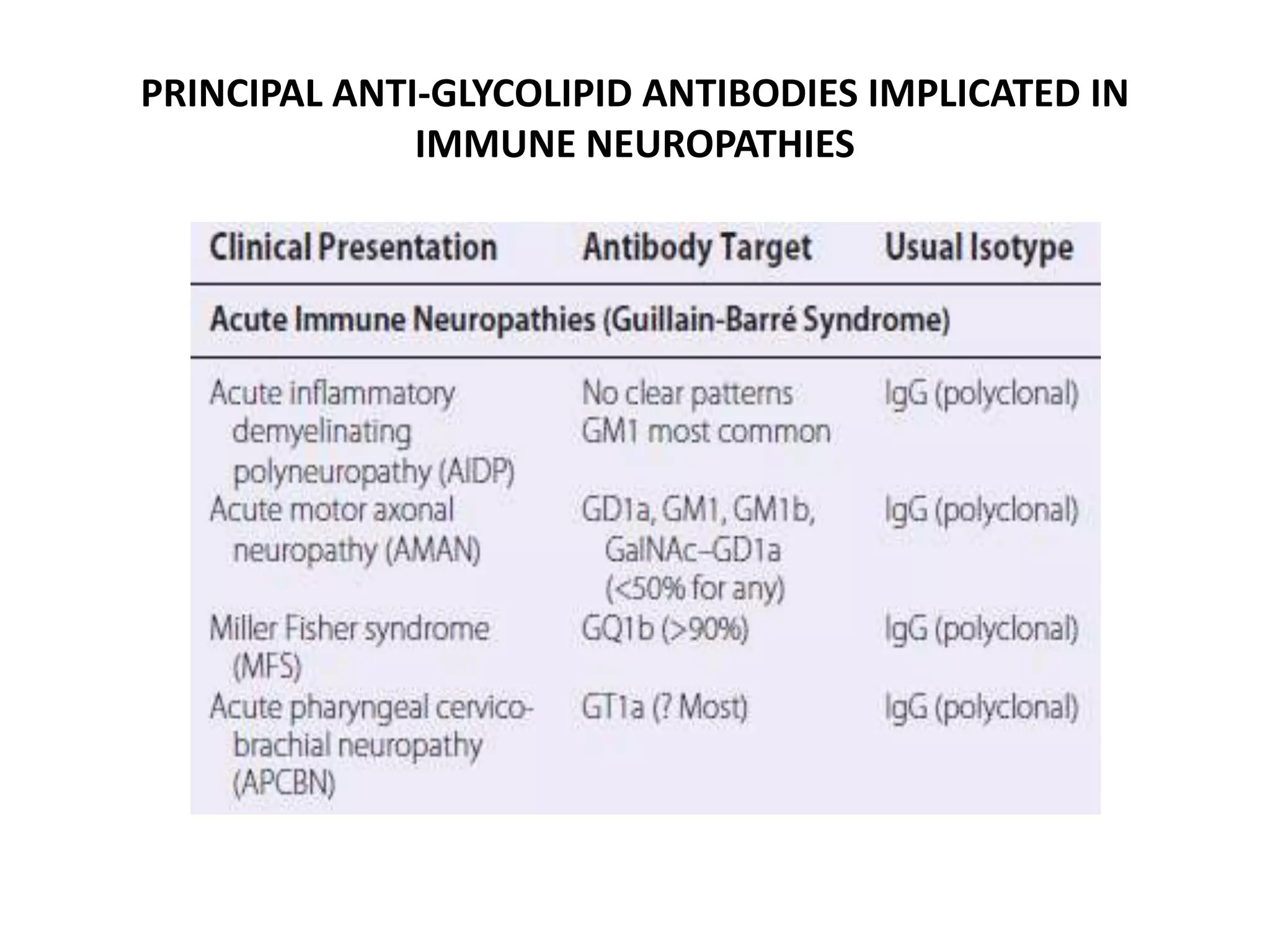
PRINCIPAL ANTI-GLYCOLIPID ANTIBODIES IMPLICATED IN
IMMUNE NEUROPATHIES
Diagnosis
• Clinical
• Supported by- Electrophysiology
CSF study
Immunology
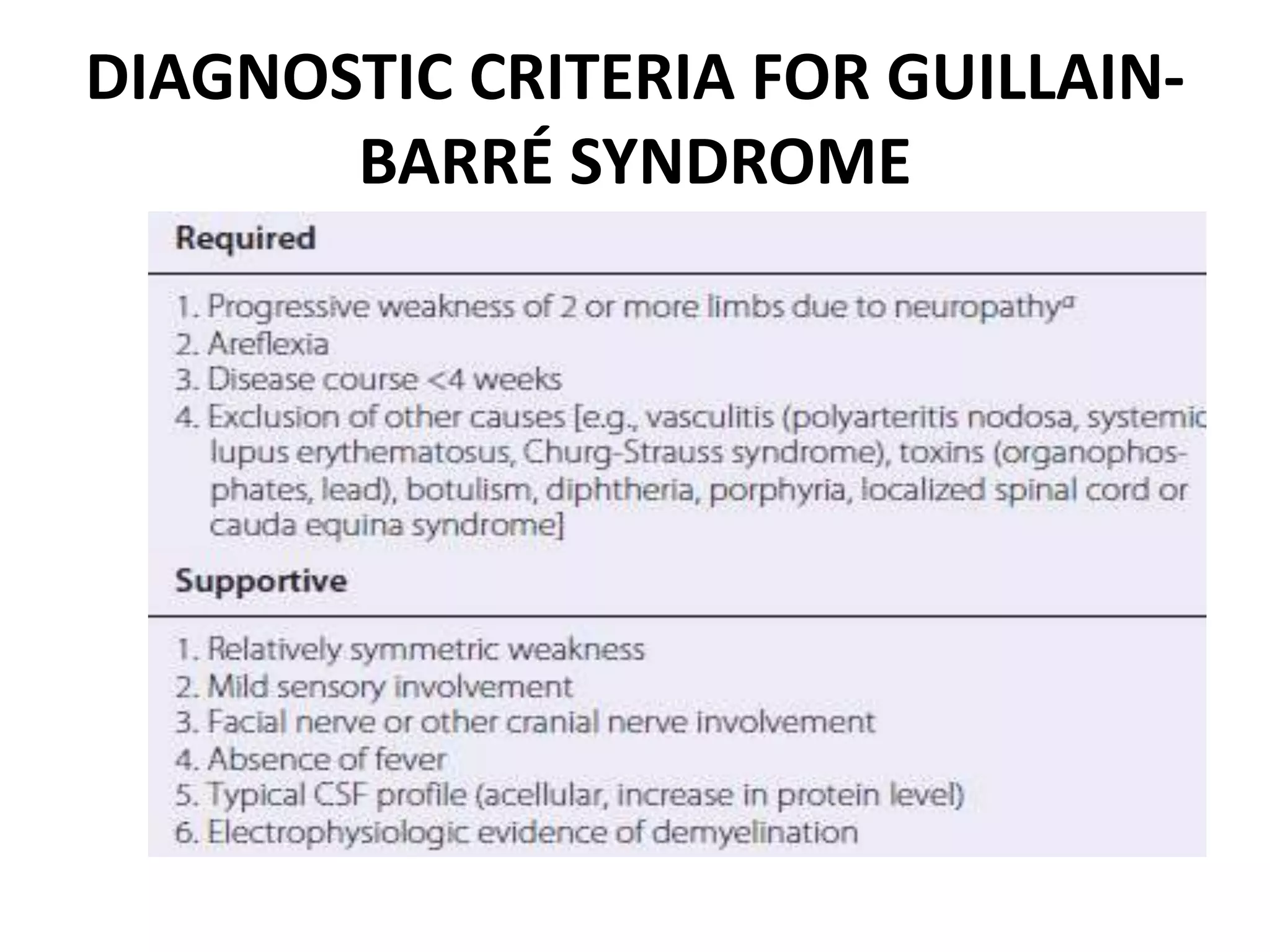
DIAGNOSTIC CRITERIA FOR GUILLAIN-
BARRÉ SYNDROME
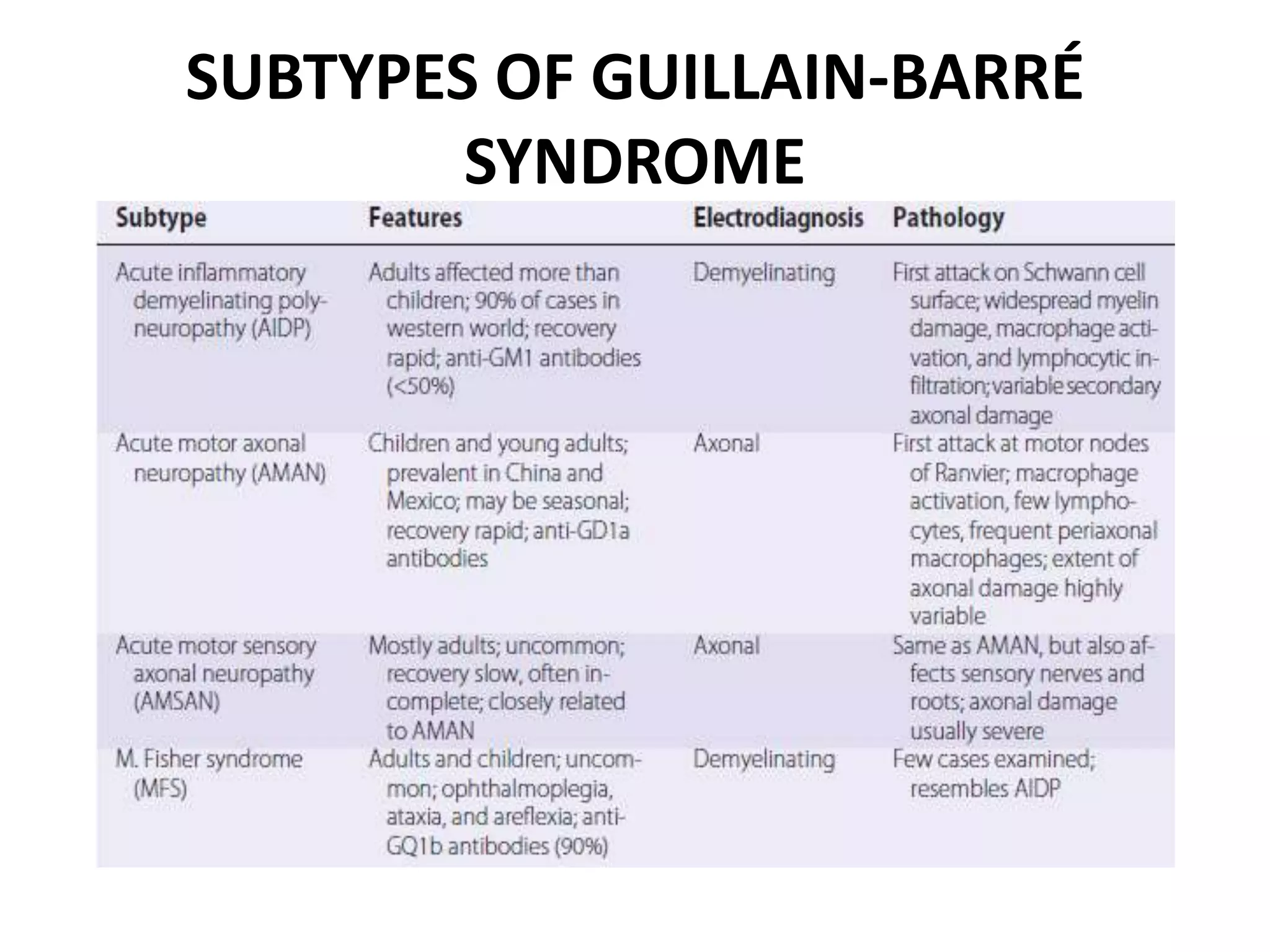
SUBTYPES OF GUILLAIN-BARRÉ
SYNDROME
Electrophysiological tests
• The most specific and sensitive tests for diagnosis of
the disease
 Partial motor conduction block
 Slowed nerve conduction velocities
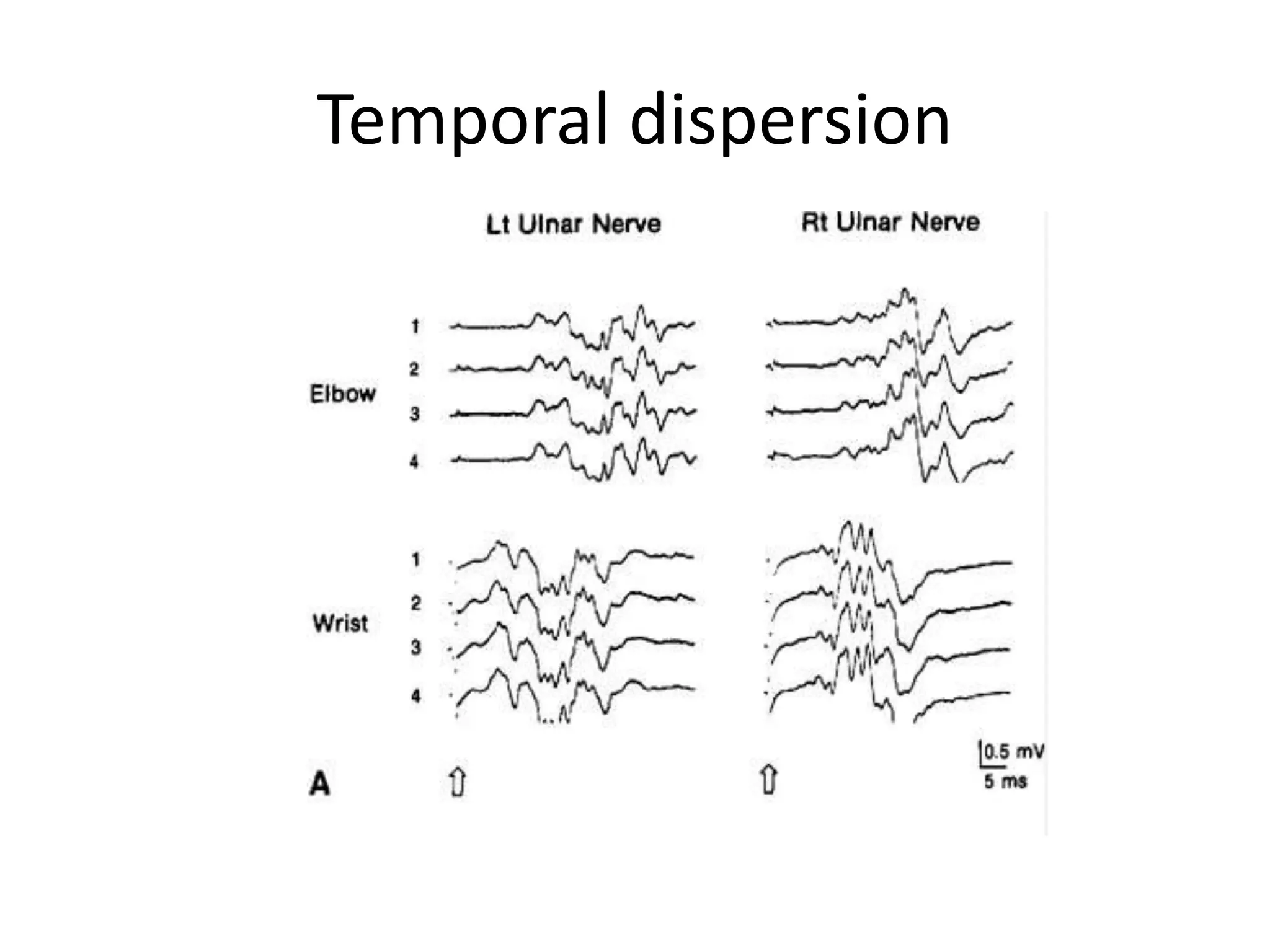
 Abnormal temporal dispersion
 Prolonged distal latencies
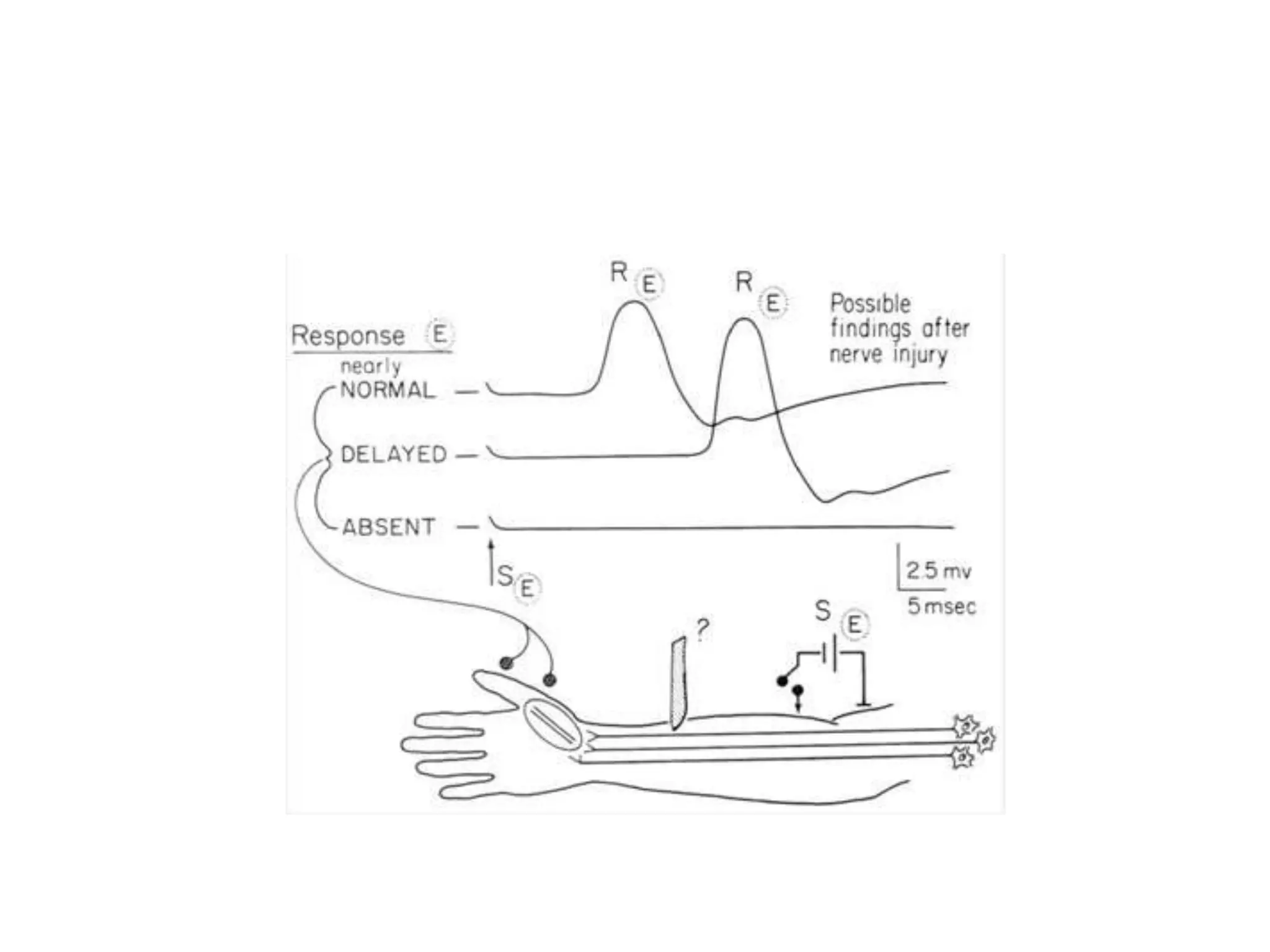
H-reflex
• H-reflex was the single most sensitive test for early GBS,
being absent in 97 percent tested within seven days of the
onset of neurologic symptoms.
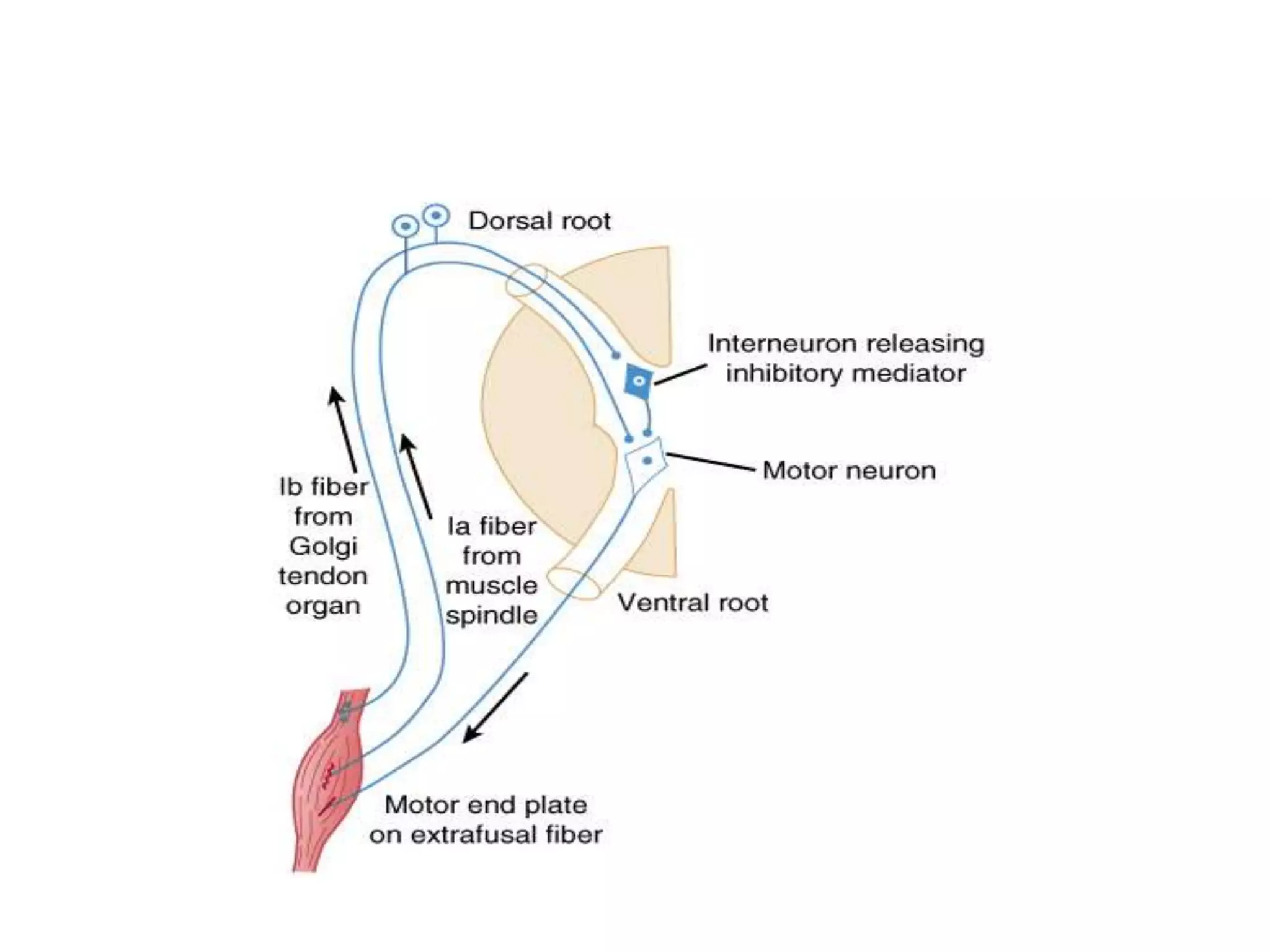
• Monosynaptic reflex response - similar in pathway to the
tendon jerk.
• The electrical stimulus activates the Ia afferents and action
potentials travel orthodromically to the spinal cord.
• Ia afferents make excitatory monosynaptic connections to
the alpha motor neurons and a volley of action potentials is
set up in the motor nerve that runs orthodromically the
entire length of the nerve from the cell bodies to the
muscle.
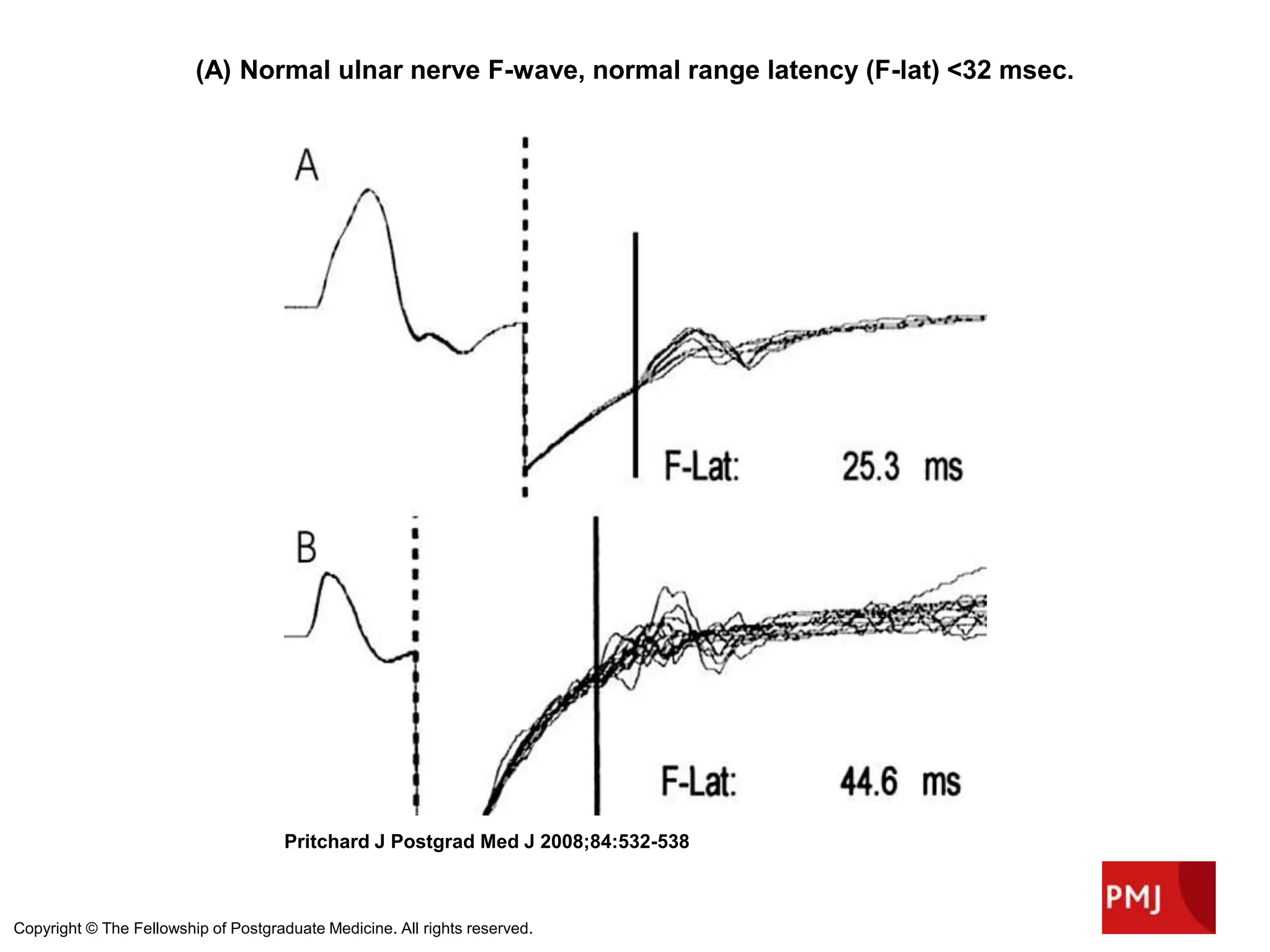
F-response
• Recurrent firing of an anterior horn cell after it
has been invaded by an antidromic action
potential.
• To produce an F-response, an action potential
must travel twice through the proximal
segment of the motor nerve.
(A) Normal ulnar nerve F-wave, normal range latency (F-lat) <32 msec.
Pritchard J Postgrad Med J 2008;84:532-538
Copyright © The Fellowship of Postgraduate Medicine. All rights reserved.
Temporal dispersion
The prognosis and main prognostic indicators of Guillain-Barré
syndrome A multicentre prospective study of 297 patients(Italy)
• The chance of recovery was significantly
affected by- age
- antecedent gastroenteritis
- disability
- electrophysiology of axonopathy
- latency to nadir
- duration of active disease.
prognosis
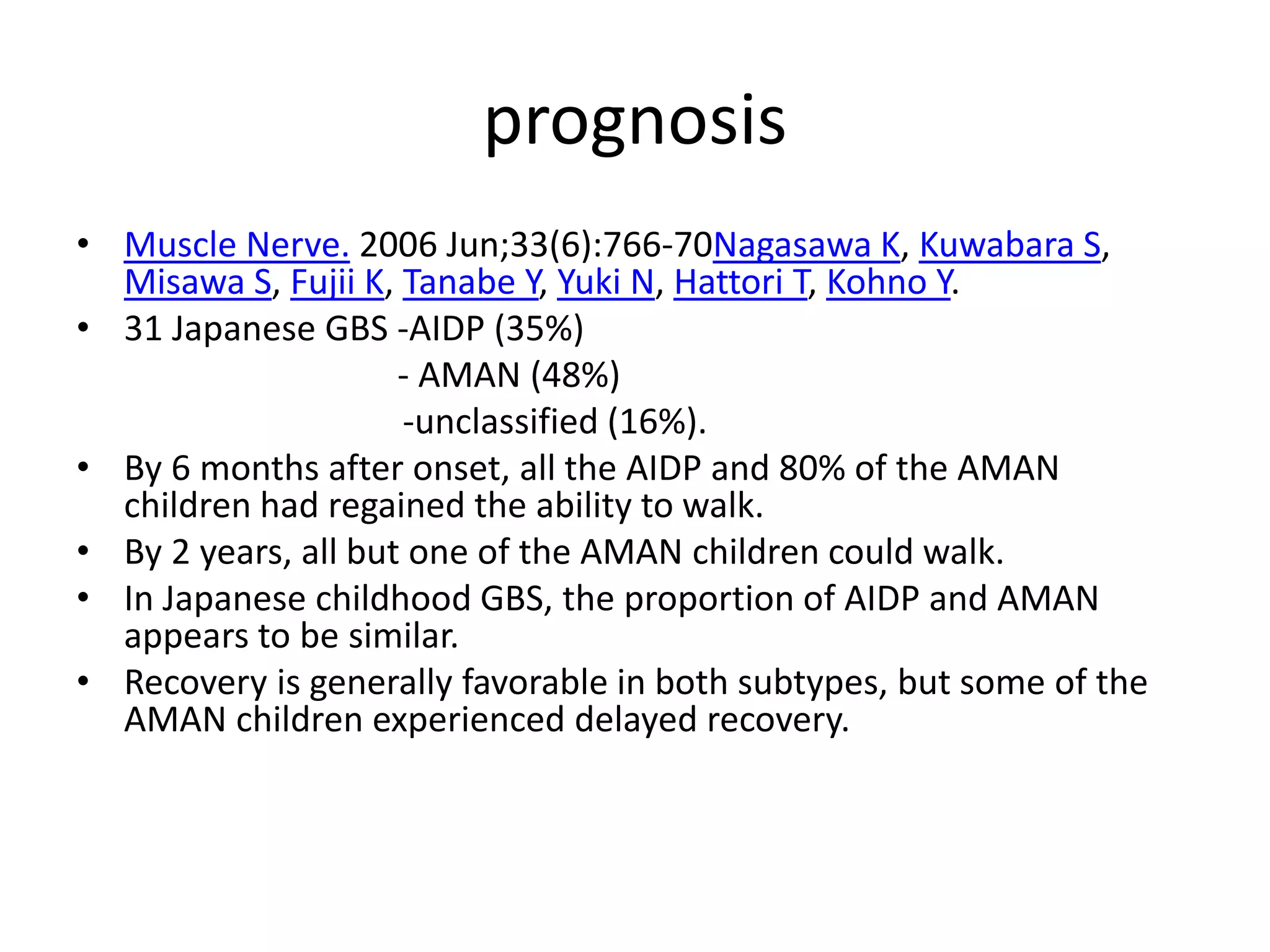
• Muscle Nerve. 2006 Jun;33(6):766-70Nagasawa K, Kuwabara S,
Misawa S, Fujii K, Tanabe Y, Yuki N, Hattori T, Kohno Y.
• 31 Japanese GBS -AIDP (35%)
- AMAN (48%)
-unclassified (16%).
• By 6 months after onset, all the AIDP and 80% of the AMAN
children had regained the ability to walk.
• By 2 years, all but one of the AMAN children could walk.
• In Japanese childhood GBS, the proportion of AIDP and AMAN
appears to be similar.
• Recovery is generally favorable in both subtypes, but some of the
AMAN children experienced delayed recovery.
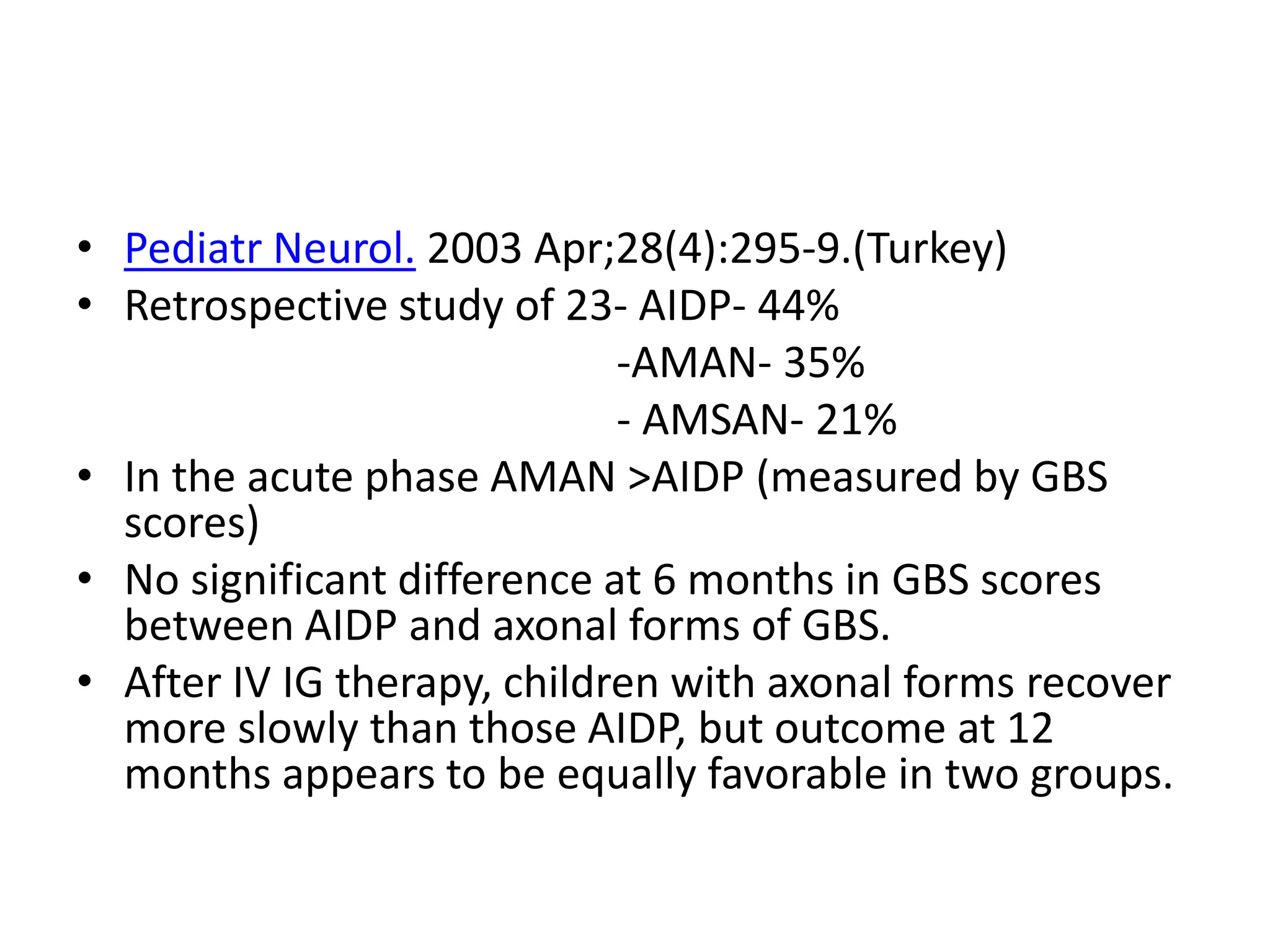
• Pediatr Neurol. 2003 Apr;28(4):295-9.(Turkey)
• Retrospective study of 23- AIDP- 44%
-AMAN- 35%
- AMSAN- 21%
• In the acute phase AMAN >AIDP (measured by GBS
scores)
• No significant difference at 6 months in GBS scores
between AIDP and axonal forms of GBS.
• After IV IG therapy, children with axonal forms recover
more slowly than those AIDP, but outcome at 12
months appears to be equally favorable in two groups.
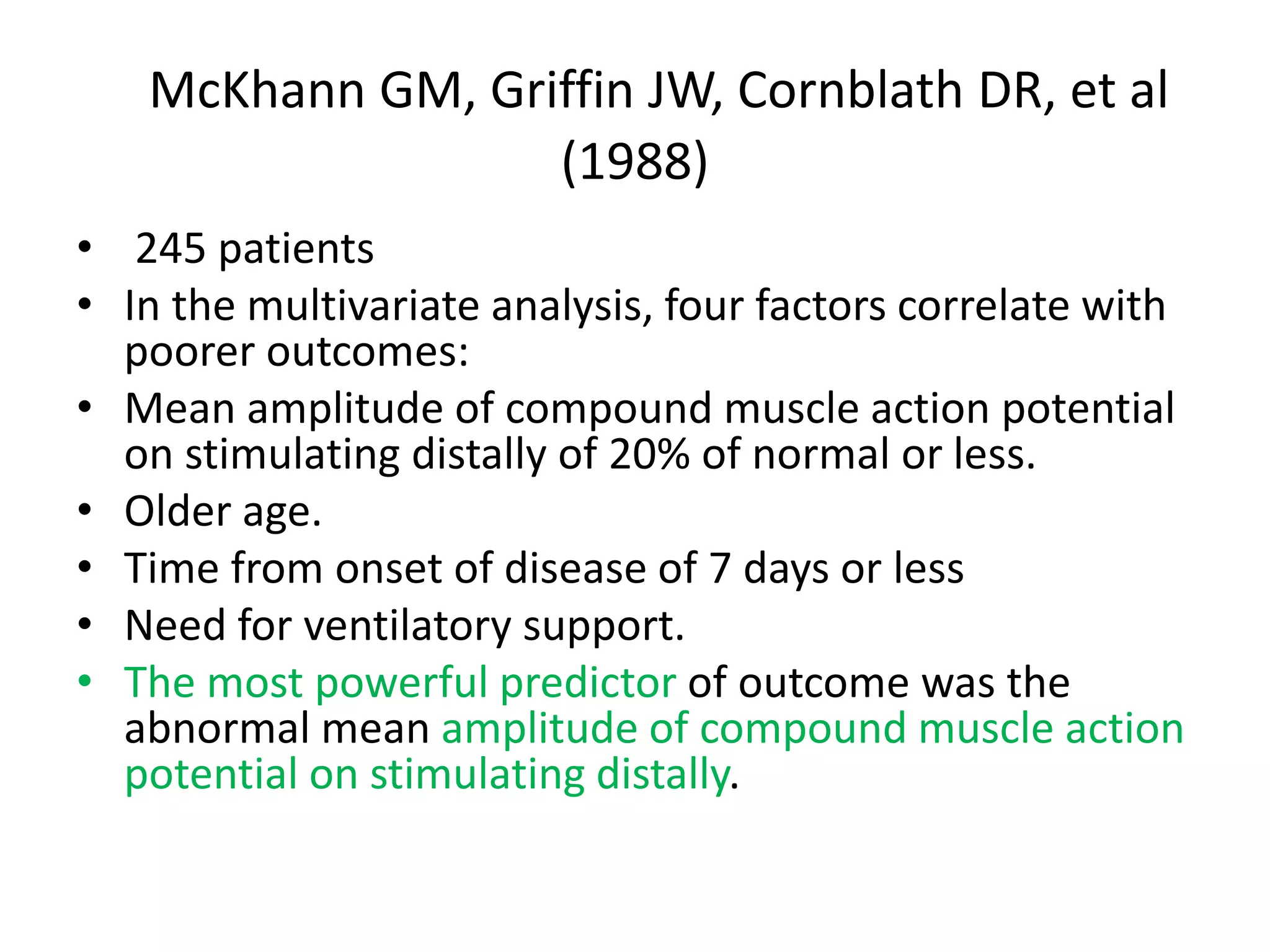
McKhann GM, Griffin JW, Cornblath DR, et al
(1988)
• 245 patients
• In the multivariate analysis, four factors correlate with
poorer outcomes:
• Mean amplitude of compound muscle action potential
on stimulating distally of 20% of normal or less.
• Older age.
• Time from onset of disease of 7 days or less
• Need for ventilatory support.
• The most powerful predictor of outcome was the
abnormal mean amplitude of compound muscle action
potential on stimulating distally.
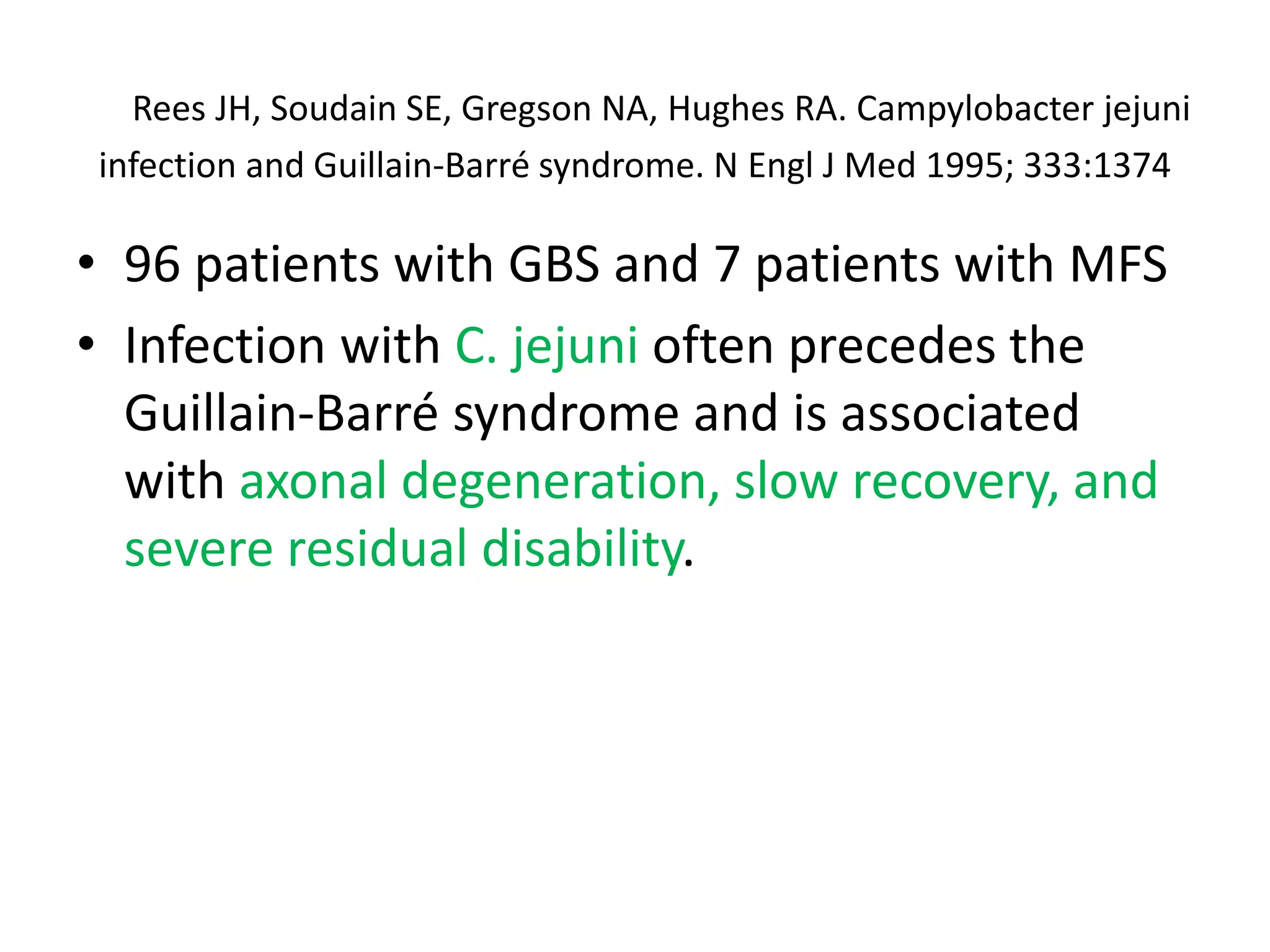
Rees JH, Soudain SE, Gregson NA, Hughes RA. Campylobacter jejuni
infection and Guillain-Barré syndrome. N Engl J Med 1995; 333:1374
• 96 patients with GBS and 7 patients with MFS
• Infection with C. jejuni often precedes the
Guillain-Barré syndrome and is associated
with axonal degeneration, slow recovery, and
severe residual disability.
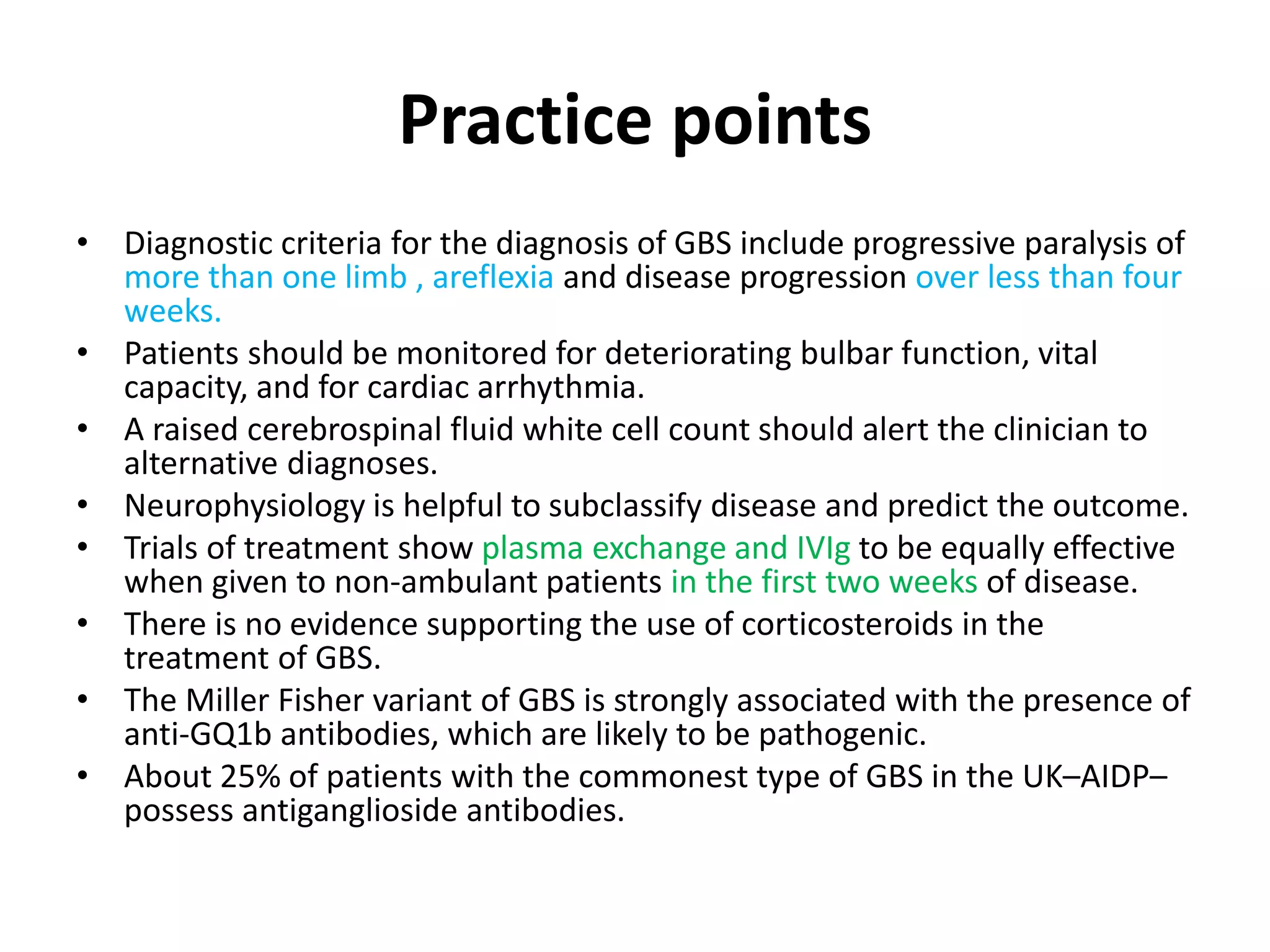
Practice points
• Diagnostic criteria for the diagnosis of GBS include progressive paralysis of
more than one limb , areflexia and disease progression over less than four
weeks.
• Patients should be monitored for deteriorating bulbar function, vital
capacity, and for cardiac arrhythmia.
• A raised cerebrospinal fluid white cell count should alert the clinician to
alternative diagnoses.
• Neurophysiology is helpful to subclassify disease and predict the outcome.
• Trials of treatment show plasma exchange and IVIg to be equally effective
when given to non-ambulant patients in the first two weeks of disease.
• There is no evidence supporting the use of corticosteroids in the
treatment of GBS.
• The Miller Fisher variant of GBS is strongly associated with the presence of
anti-GQ1b antibodies, which are likely to be pathogenic.
• About 25% of patients with the commonest type of GBS in the UK–AIDP–
possess antiganglioside antibodies.
Gbs

Gbs

  • 1.
    Guillain-Barre Syndrome DMW Dharmakeerthi(MD) Senior Registrar in Clinical Neurophysiology
  • 2.
    • 1859, Landrypublished a report on 10 patients with an ascending paralysis. • 1916, 3 French physicians (Guillain, Barré, and Strohl) described 2 French soldiers with -motor weakness -areflexia -albuminocytological dissociation
  • 3.
    Clinical features • Weaknessusually starts in the legs • In about 10 percent it begins in the arms or facial muscles • Need for ventilatory support develops in 10 to 30 percent • Facial weakness occurs in more than 50 percent • Oropharyngeal weakness eventually occurs in 50 percent • Oculomotor weakness occurs in about 15 percent • Paresthesias in the hands and feet accompany the weakness in more than 80 percent of patients, but sensory abnormalities on examination are frequently mild. • Pain, typically located in the back and extremities, can be a presenting feature in 66 % of patients with all forms of GBS
  • 6.
    • AIDP andthe Miller Fisher -focal inflammatory response develops against Schwann cells or peripheral myelin. • Infiltration of the epineural and endoneural small vessels (mostly veins) by lymphocytes and monocytes causes segmental myelin degeneration throughout the nerve. • The inflammation is more intense at the junction of the dorsal and ventral roots.
  • 9.
    PRINCIPAL ANTI-GLYCOLIPID ANTIBODIESIMPLICATED IN IMMUNE NEUROPATHIES
  • 10.
    Diagnosis • Clinical • Supportedby- Electrophysiology CSF study Immunology
  • 11.
    DIAGNOSTIC CRITERIA FORGUILLAIN- BARRÉ SYNDROME
  • 12.
  • 13.
    Electrophysiological tests • Themost specific and sensitive tests for diagnosis of the disease  Partial motor conduction block  Slowed nerve conduction velocities  Abnormal temporal dispersion  Prolonged distal latencies
  • 15.
    H-reflex • H-reflex wasthe single most sensitive test for early GBS, being absent in 97 percent tested within seven days of the onset of neurologic symptoms. • Monosynaptic reflex response - similar in pathway to the tendon jerk. • The electrical stimulus activates the Ia afferents and action potentials travel orthodromically to the spinal cord. • Ia afferents make excitatory monosynaptic connections to the alpha motor neurons and a volley of action potentials is set up in the motor nerve that runs orthodromically the entire length of the nerve from the cell bodies to the muscle.
  • 16.
    F-response • Recurrent firingof an anterior horn cell after it has been invaded by an antidromic action potential. • To produce an F-response, an action potential must travel twice through the proximal segment of the motor nerve.
  • 17.
    (A) Normal ulnarnerve F-wave, normal range latency (F-lat) <32 msec. Pritchard J Postgrad Med J 2008;84:532-538 Copyright © The Fellowship of Postgraduate Medicine. All rights reserved.
  • 19.
  • 20.
    The prognosis andmain prognostic indicators of Guillain-Barré syndrome A multicentre prospective study of 297 patients(Italy) • The chance of recovery was significantly affected by- age - antecedent gastroenteritis - disability - electrophysiology of axonopathy - latency to nadir - duration of active disease.
  • 21.
    prognosis • Muscle Nerve.2006 Jun;33(6):766-70Nagasawa K, Kuwabara S, Misawa S, Fujii K, Tanabe Y, Yuki N, Hattori T, Kohno Y. • 31 Japanese GBS -AIDP (35%) - AMAN (48%) -unclassified (16%). • By 6 months after onset, all the AIDP and 80% of the AMAN children had regained the ability to walk. • By 2 years, all but one of the AMAN children could walk. • In Japanese childhood GBS, the proportion of AIDP and AMAN appears to be similar. • Recovery is generally favorable in both subtypes, but some of the AMAN children experienced delayed recovery.
  • 22.
    • Pediatr Neurol.2003 Apr;28(4):295-9.(Turkey) • Retrospective study of 23- AIDP- 44% -AMAN- 35% - AMSAN- 21% • In the acute phase AMAN >AIDP (measured by GBS scores) • No significant difference at 6 months in GBS scores between AIDP and axonal forms of GBS. • After IV IG therapy, children with axonal forms recover more slowly than those AIDP, but outcome at 12 months appears to be equally favorable in two groups.
  • 23.
    McKhann GM, GriffinJW, Cornblath DR, et al (1988) • 245 patients • In the multivariate analysis, four factors correlate with poorer outcomes: • Mean amplitude of compound muscle action potential on stimulating distally of 20% of normal or less. • Older age. • Time from onset of disease of 7 days or less • Need for ventilatory support. • The most powerful predictor of outcome was the abnormal mean amplitude of compound muscle action potential on stimulating distally.
  • 24.
    Rees JH, SoudainSE, Gregson NA, Hughes RA. Campylobacter jejuni infection and Guillain-Barré syndrome. N Engl J Med 1995; 333:1374 • 96 patients with GBS and 7 patients with MFS • Infection with C. jejuni often precedes the Guillain-Barré syndrome and is associated with axonal degeneration, slow recovery, and severe residual disability.
  • 25.
    Practice points • Diagnosticcriteria for the diagnosis of GBS include progressive paralysis of more than one limb , areflexia and disease progression over less than four weeks. • Patients should be monitored for deteriorating bulbar function, vital capacity, and for cardiac arrhythmia. • A raised cerebrospinal fluid white cell count should alert the clinician to alternative diagnoses. • Neurophysiology is helpful to subclassify disease and predict the outcome. • Trials of treatment show plasma exchange and IVIg to be equally effective when given to non-ambulant patients in the first two weeks of disease. • There is no evidence supporting the use of corticosteroids in the treatment of GBS. • The Miller Fisher variant of GBS is strongly associated with the presence of anti-GQ1b antibodies, which are likely to be pathogenic. • About 25% of patients with the commonest type of GBS in the UK–AIDP– possess antiganglioside antibodies.

Editor's Notes

  • #18 (A) Normal ulnar nerve F-wave, normal range latency (F-lat) <32 msec. (B) Abnormal ulnar nerve F-wave in Guillain-Barré syndrome: F-waves present but latency delayed at 140% upper limit of normal (courtesy of Dr David Allen, The National Hospital for Neurology and Neurosurgery, London, UK).