Multiple pterygium Dr.V.Ravimohan http://www.mrcogexam.net
What is pterygium? Pterygia are soft tissue webs across a joint or across the neck
When does it happen? generalised association-Trisomies,Turner’s,Noonan’ specific syndrome- popliteal pterygium antecubital pterygium syndrome multiple pterygium syndrome
specific syndrome popliteal pterygium -popliteal web + facial anomalies antecubital pterygium syndrome -web extending across the cubital fossa + anomalies of the radial head + radio-ulnar joint multiple pterygium syndrome   webbing of variable degrees involving the neck, axilla, elbow, knee and digits associated with short stature and orofacial anomalies.
multiple pterygium syndromes phenotypically and genetically heterogeneous ( autosomal recessive , autosomal dominant  or sporadic) lethal and nonlethal (Escobar) types
nonlethal multiple pterygium syndrome(Escobar) can be caused by mutation in the CHRNG gene, encoding the gamma subunit of the acetylcholine receptor (AChR). Mutations in this gene can also cause the lethal variant of this phenotype
Escobar Webbing of neck antecubital fossae popliteal fossae  with sternal deformity and male hypogonadism may behave sometimes as a dominant, but there clearly appears to be a recessive type
Escobar multiple joint contractures with crouched stance and cleft palate  Males had small penis and scrotum and cryptorchidism females had aplasia of the labia majora and small clitoris.
Skeletal anomalies fusion of cervical vertebrae scoliosis flexion contraction of fingers 'rocker-bottom' feet with vertical talus
Clinical features intrauterine death congenital respiratory distress short stature faciocranial dysmorphism ptosis low-set ears Arachnodactyly cryptorchism in males
Escobar first diagnostic sign is that of reduced fetal movement detected by ultrasound or reported by mothers.  At birth,  variable joint contractures multiple pterygia facial dysmorphism with long face, high-arched palate, small mouth, and retrognathism.
Escobar Respiratory distress is a frequent life-threatening complication.  Later in life patients frequently are affected by reduced muscular mass but do not show myasthenic symptoms  normal electromyelogram (EMG), except for unspecific indication of chronic myopathy.
Pathogenesis mutations in the gamma, or fetal, subunit of the nicotinergic acetylcholine receptor  reduced fetal movements at sensitive times of development
CHRNG gene encodes the gamma subunit of the AChR expressed before the 33rd week of gestation in humans  replaced by the epsilon subunit in the late fetal and perinatal period, thereby forming the adult AChR.
AChRs have five subunits. Two α, one β, and one δ subunit are always present. By switching γ to  subunits in late fetal development, fetal AChRs are gradually replaced by adult AChRs.
Other reasons for reduced fetal movements Oligohydramnion Drugs metabolic conditions neuromuscular disorders including myasthenia gravis
popliteal pterygium syndrome Autosomal dominant with contractures limited to the knee  Repercussions  that are only functional
popliteal pterygium syndrome least 3 of the following deformities. Cleft lip & palate Popliteal pterygium Paramedian lower lip sinuses Genital anomalies Dr.Sanjay Y.Parashar et al,.Spectrum of features in pterygium syndrome:Asian Journal of Surgery Vol 29:No 2 April 2006
MPS vs PPS MPS -primary pathlogy ptergium Facial and limb anomalies may be secondary to contracture PPS-all the anomalies appear to be part of multisystem involvement Dr.Sanjay Y.Parashar et al,.Spectrum of features in pterygium syndrome:Asian Journal of Surgery Vol 29:No 2 April 2006
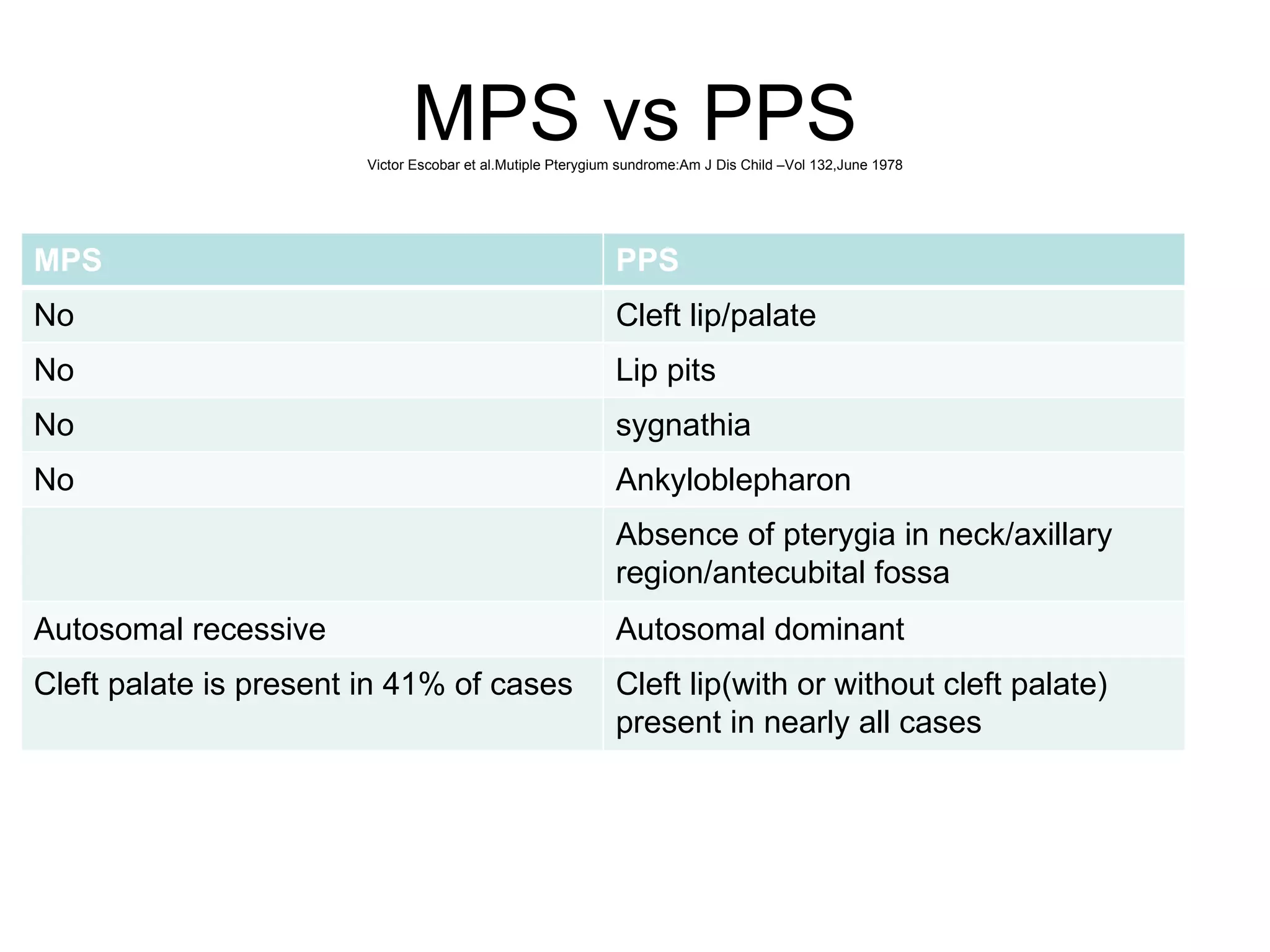
MPS vs PPS Victor Escobar et al.Mutiple Pterygium sundrome:Am J Dis Child –Vol 132,June 1978 MPS PPS No Cleft lip/palate No Lip pits No sygnathia No Ankyloblepharon Absence of pterygia in neck/axillary region/antecubital fossa Autosomal recessive Autosomal dominant Cleft palate is present in 41% of cases Cleft lip(with or without cleft palate) present in nearly all cases
Frias' syndrome Distinct form of the multiple pterygium syndrome with ptosis and skeletal anomalies.  Inheritance is autosomal dominant.  Jaime L. Frias, J. R. Holahan, A. L. Rosenbloom, A. H. Felman: An autosomal dominant syndrome of multiple pterygium, ptosis, and skeletal anomalities.  Fourth International Conference on Birth Defects.  Vienna 1973. Excerpta Medica, 19.
ESCOBAR vs Frias ESCOBAR  Frias Arthrogryposis with pterygia Arthrogryposis with pterygia ptosis ptosis Antimongoloid slant of palperal fissures Antimongoloid slant of palperal fissures Scoliosis Scoliosis Always short stature Malsegmentation of spine
Management Multidisciplinary team Paediatrician Physiotherapist Orthopaedic surgeon

Multiple Pterygium

  • 1.
    Multiple pterygium Dr.V.Ravimohanhttp://www.mrcogexam.net
  • 2.
    What is pterygium?Pterygia are soft tissue webs across a joint or across the neck
  • 3.
    When does ithappen? generalised association-Trisomies,Turner’s,Noonan’ specific syndrome- popliteal pterygium antecubital pterygium syndrome multiple pterygium syndrome
  • 4.
    specific syndrome poplitealpterygium -popliteal web + facial anomalies antecubital pterygium syndrome -web extending across the cubital fossa + anomalies of the radial head + radio-ulnar joint multiple pterygium syndrome webbing of variable degrees involving the neck, axilla, elbow, knee and digits associated with short stature and orofacial anomalies.
  • 5.
    multiple pterygium syndromesphenotypically and genetically heterogeneous ( autosomal recessive , autosomal dominant or sporadic) lethal and nonlethal (Escobar) types
  • 6.
    nonlethal multiple pterygiumsyndrome(Escobar) can be caused by mutation in the CHRNG gene, encoding the gamma subunit of the acetylcholine receptor (AChR). Mutations in this gene can also cause the lethal variant of this phenotype
  • 7.
    Escobar Webbing ofneck antecubital fossae popliteal fossae with sternal deformity and male hypogonadism may behave sometimes as a dominant, but there clearly appears to be a recessive type
  • 8.
    Escobar multiple jointcontractures with crouched stance and cleft palate Males had small penis and scrotum and cryptorchidism females had aplasia of the labia majora and small clitoris.
  • 9.
    Skeletal anomalies fusionof cervical vertebrae scoliosis flexion contraction of fingers 'rocker-bottom' feet with vertical talus
  • 10.
    Clinical features intrauterinedeath congenital respiratory distress short stature faciocranial dysmorphism ptosis low-set ears Arachnodactyly cryptorchism in males
  • 11.
    Escobar first diagnosticsign is that of reduced fetal movement detected by ultrasound or reported by mothers. At birth, variable joint contractures multiple pterygia facial dysmorphism with long face, high-arched palate, small mouth, and retrognathism.
  • 12.
    Escobar Respiratory distressis a frequent life-threatening complication. Later in life patients frequently are affected by reduced muscular mass but do not show myasthenic symptoms normal electromyelogram (EMG), except for unspecific indication of chronic myopathy.
  • 13.
    Pathogenesis mutations inthe gamma, or fetal, subunit of the nicotinergic acetylcholine receptor reduced fetal movements at sensitive times of development
  • 14.
    CHRNG gene encodesthe gamma subunit of the AChR expressed before the 33rd week of gestation in humans replaced by the epsilon subunit in the late fetal and perinatal period, thereby forming the adult AChR.
  • 15.
    AChRs have fivesubunits. Two α, one β, and one δ subunit are always present. By switching γ to subunits in late fetal development, fetal AChRs are gradually replaced by adult AChRs.
  • 16.
    Other reasons forreduced fetal movements Oligohydramnion Drugs metabolic conditions neuromuscular disorders including myasthenia gravis
  • 17.
    popliteal pterygium syndromeAutosomal dominant with contractures limited to the knee Repercussions that are only functional
  • 18.
    popliteal pterygium syndromeleast 3 of the following deformities. Cleft lip & palate Popliteal pterygium Paramedian lower lip sinuses Genital anomalies Dr.Sanjay Y.Parashar et al,.Spectrum of features in pterygium syndrome:Asian Journal of Surgery Vol 29:No 2 April 2006
  • 19.
    MPS vs PPSMPS -primary pathlogy ptergium Facial and limb anomalies may be secondary to contracture PPS-all the anomalies appear to be part of multisystem involvement Dr.Sanjay Y.Parashar et al,.Spectrum of features in pterygium syndrome:Asian Journal of Surgery Vol 29:No 2 April 2006
  • 20.
    MPS vs PPSVictor Escobar et al.Mutiple Pterygium sundrome:Am J Dis Child –Vol 132,June 1978 MPS PPS No Cleft lip/palate No Lip pits No sygnathia No Ankyloblepharon Absence of pterygia in neck/axillary region/antecubital fossa Autosomal recessive Autosomal dominant Cleft palate is present in 41% of cases Cleft lip(with or without cleft palate) present in nearly all cases
  • 21.
    Frias' syndrome Distinctform of the multiple pterygium syndrome with ptosis and skeletal anomalies. Inheritance is autosomal dominant. Jaime L. Frias, J. R. Holahan, A. L. Rosenbloom, A. H. Felman: An autosomal dominant syndrome of multiple pterygium, ptosis, and skeletal anomalities. Fourth International Conference on Birth Defects. Vienna 1973. Excerpta Medica, 19.
  • 22.
    ESCOBAR vs FriasESCOBAR Frias Arthrogryposis with pterygia Arthrogryposis with pterygia ptosis ptosis Antimongoloid slant of palperal fissures Antimongoloid slant of palperal fissures Scoliosis Scoliosis Always short stature Malsegmentation of spine
  • 23.
    Management Multidisciplinary teamPaediatrician Physiotherapist Orthopaedic surgeon