Still birth classification Dr.V.Ravimohan,SpR(obs&gynae) www.mrcogexam.net
Definition Still birth- An in utero death delivering after the 24th week of pregnancy Late fetal loss- An in utero death delivering between 20+0 and 23+6 weeks of gestation
types Wigglesworth classification Aberdeen ReCoDe Fetal neonatal classification
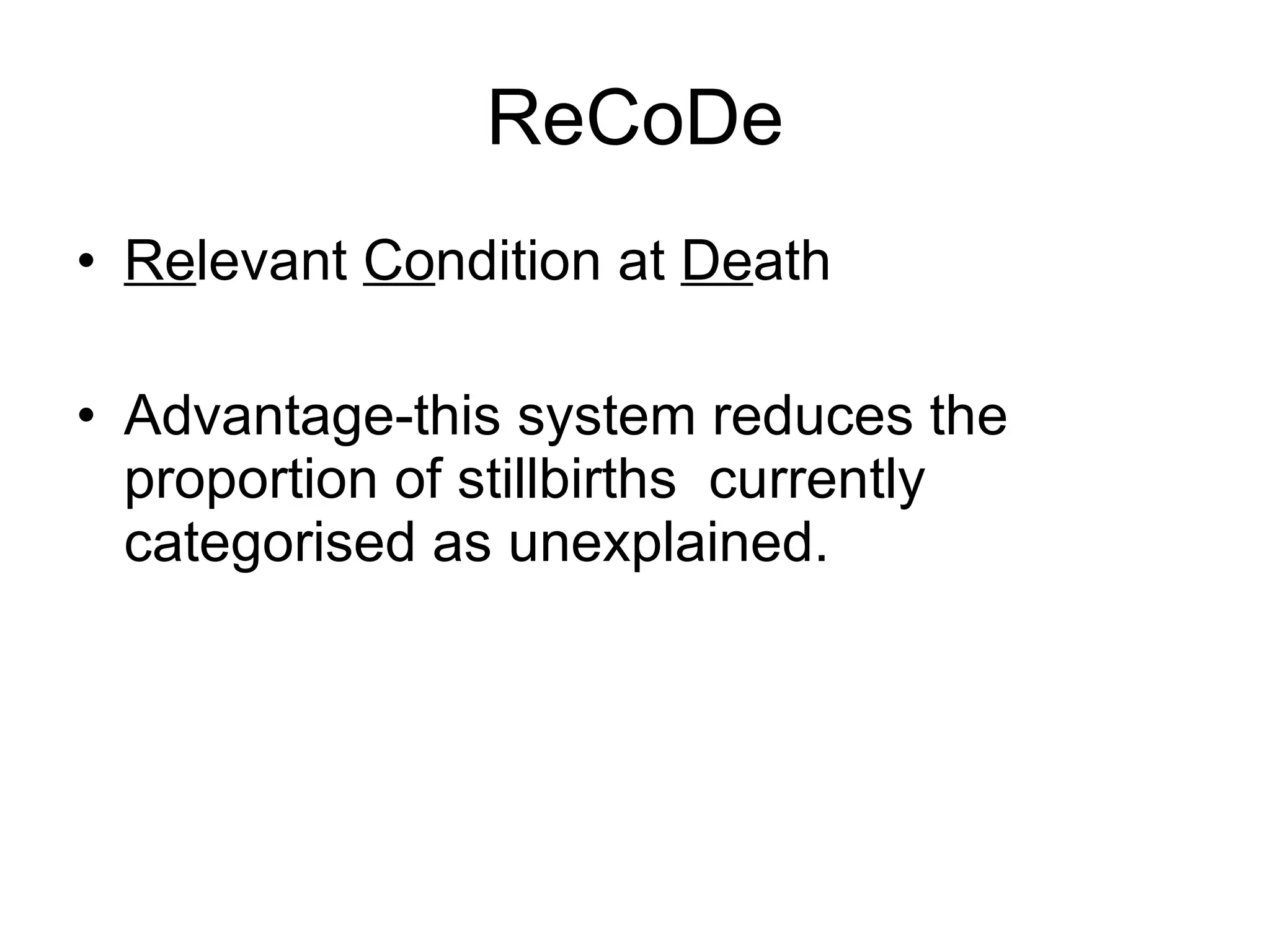
ReCoDe Re levant  Co ndition at  De ath Advantage-this system reduces the proportion of stillbirths  currently categorised as unexplained.
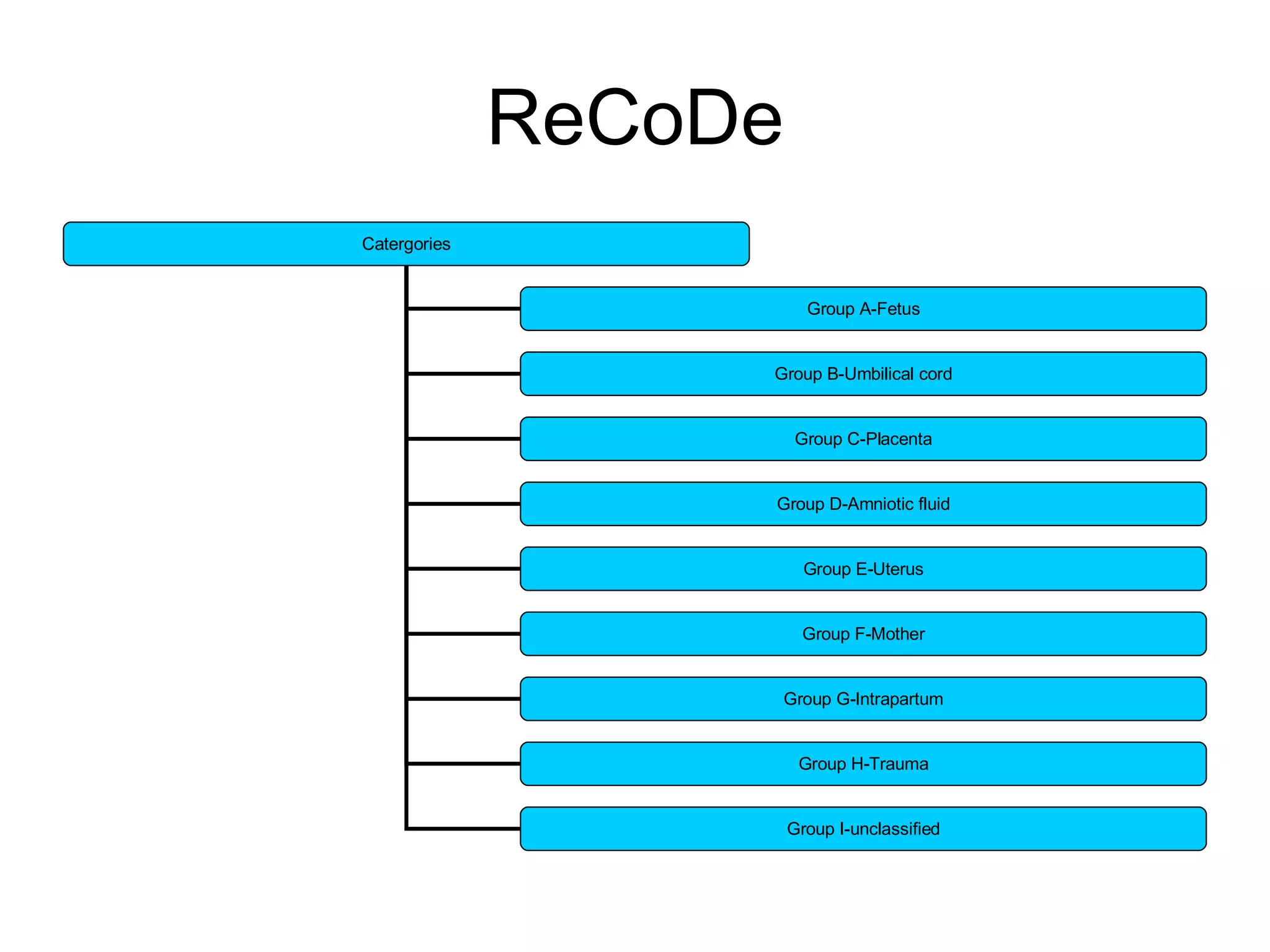
ReCoDe Catergories Group A-Fetus Group B-Umbilical cord Group C-Placenta Group D-Amniotic fluid Group E-Uterus Group F-Mother Group G-Intrapartum Group H-Trauma Group I-unclassified
Group A-Fetus  Group A-Fetus  5.fetomaternal haemorrhage 6.GROWTH RESTRICTION 7.FETAL GROWTH RESTRICTION 1.lethal congenital abnormality 2.infection 2.1 acute 2.2 chronic 3.non-immune hydrops 4.isoimmunisation
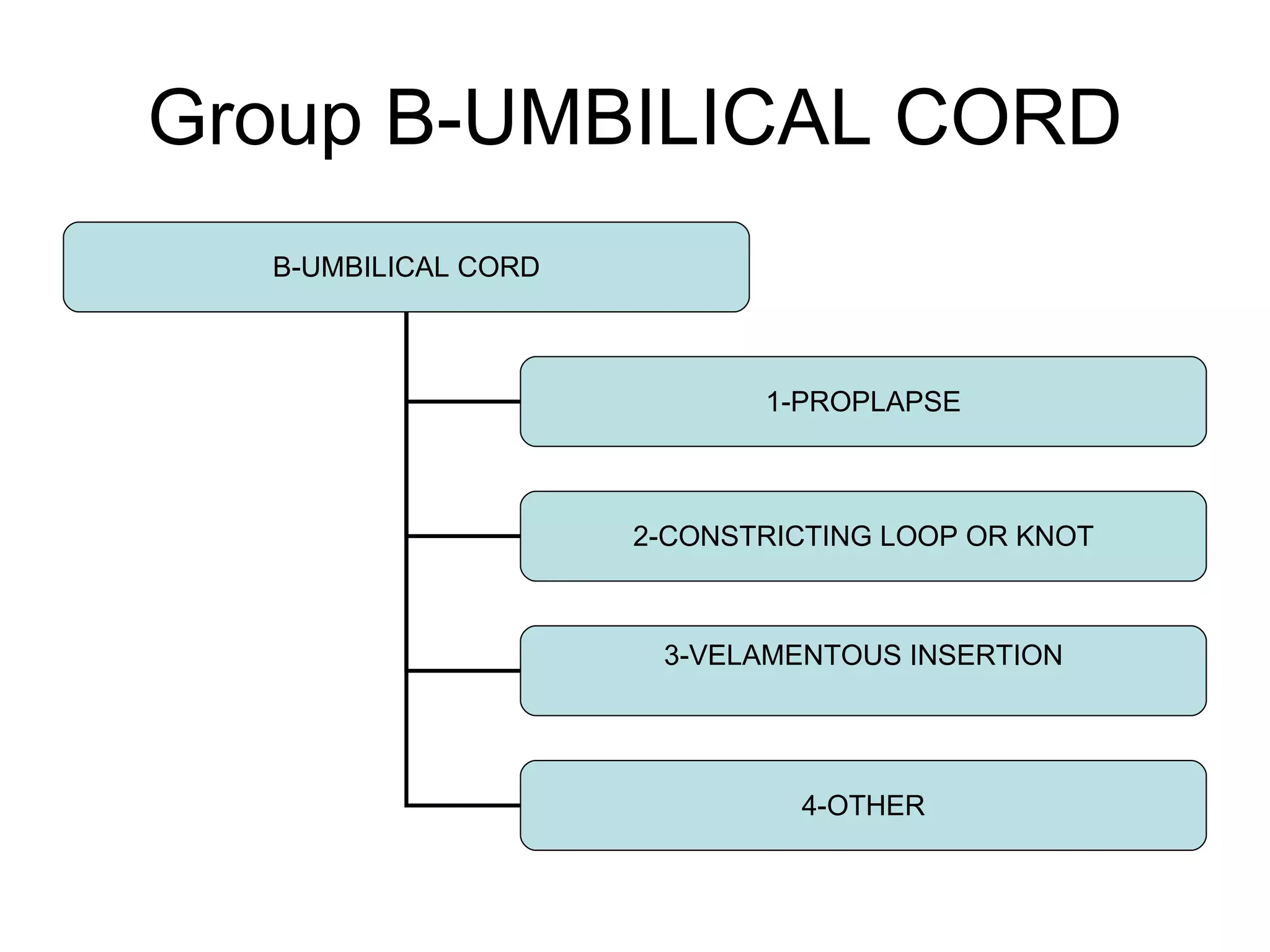
Group B-UMBILICAL CORD B-UMBILICAL CORD 1-PROPLAPSE 2-CONSTRICTING LOOP OR KNOT 3-VELAMENTOUS INSERTION 4-OTHER
Group C-PLACENTA C-PLACENTA 1-ABRUTIO 2-PRAEVIA 3-VASA PRAEAVI 4-Other placental insuffiency 5-Other
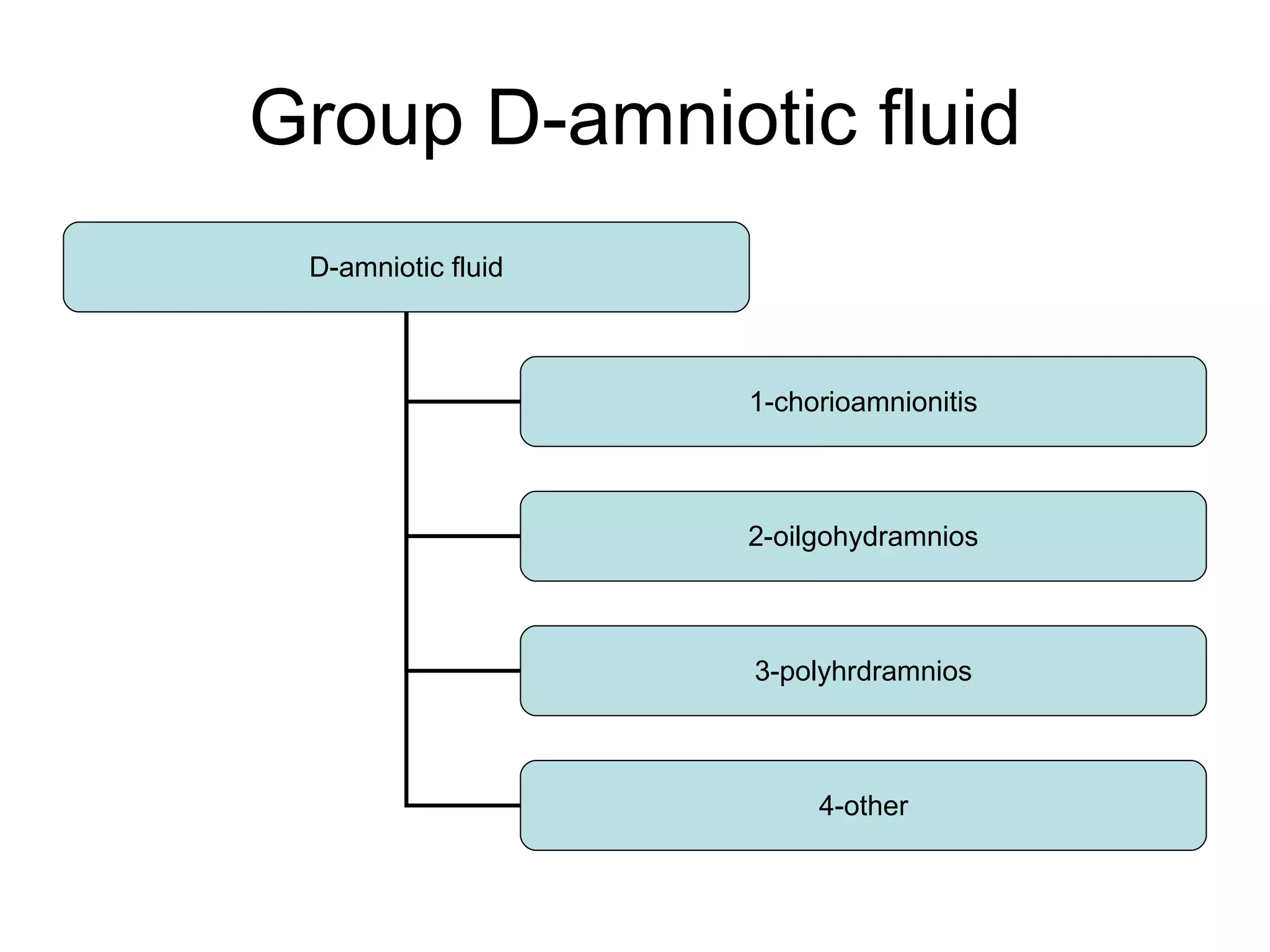
Group D-amniotic fluid D-amniotic fluid 1-chorioamnionitis 2-oilgohydramnios 3-polyhrdramnios 4-other
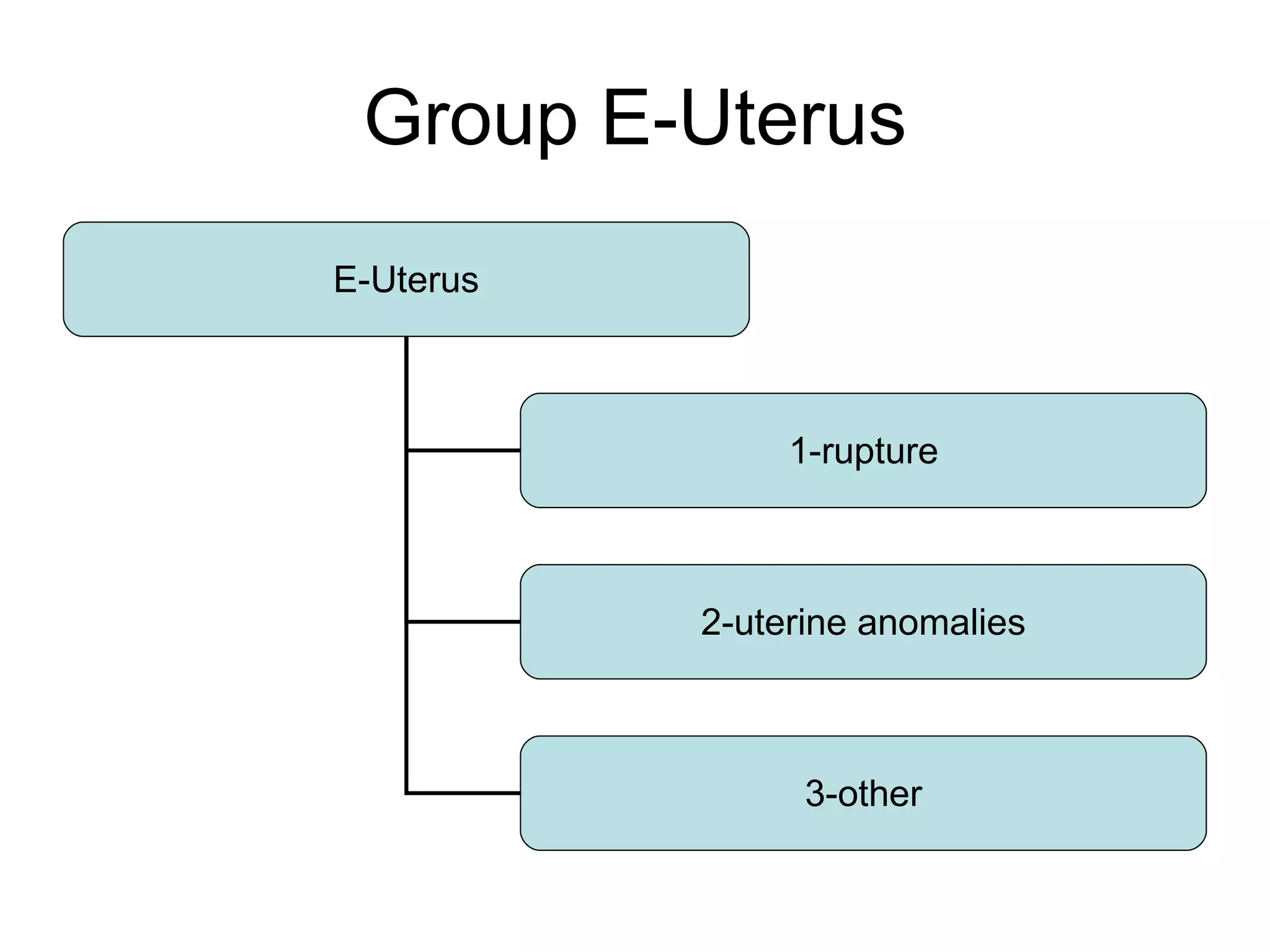
Group E-Uterus E-Uterus 1-rupture 2-uterine anomalies 3-other
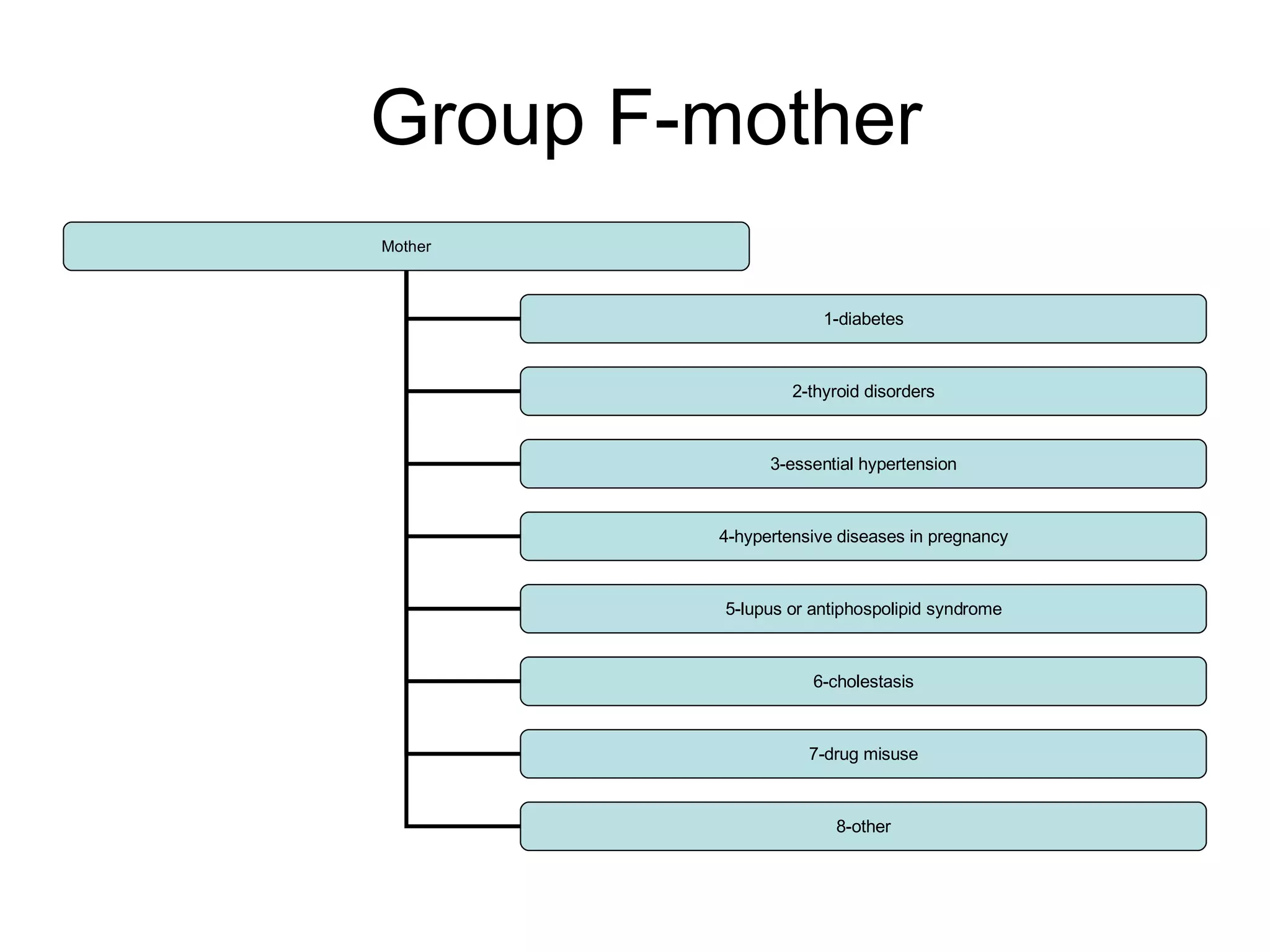
Group F-mother Mother 1-diabetes 2-thyroid disorders 3-essential hypertension 4-hypertensive diseases in pregnancy 5-lupus or antiphospolipid syndrome 6-cholestasis 7-drug misuse 8-other
Group G-Intrapartum G-Intrapartum 1-asphyxia 2-Birth trauma
Group H-trauma H-trauma 1-External 2-iatrogenic
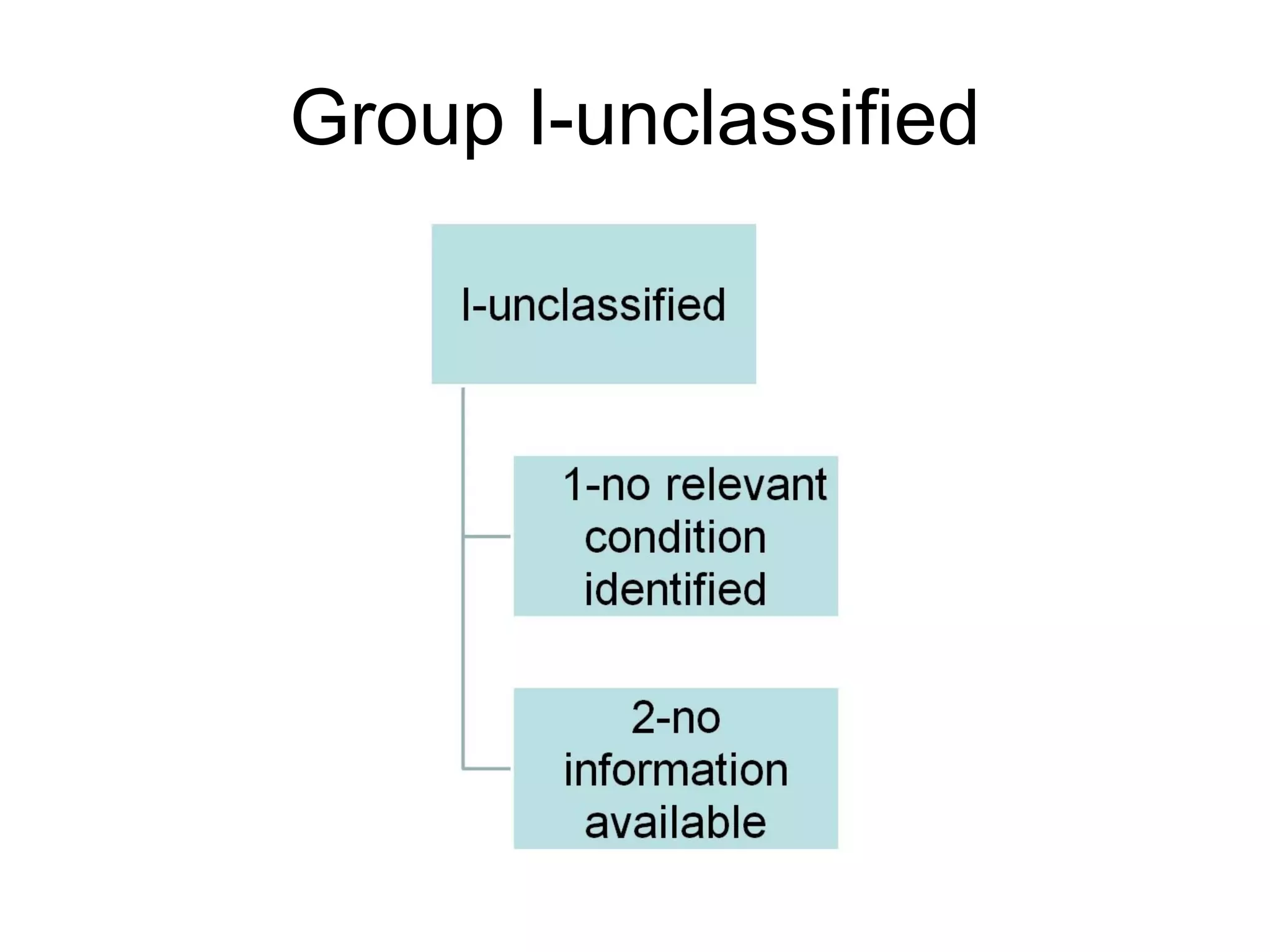
Group I-unclassified
Wigglesworth Classification Pathophysiological approach
EXTENDED WIGGLESWORTH CLASSIFICATION Category 1  Congenital defect/malformation (lethal or severe):  Only lethal or potentially lethal congenital malformation should be included here.  Serious biochemical abnormalities such as Tay Sach’s disease  any known single gene defects known to have a high risk of death should be included. Category 2   Unexplained antepartum fetal death:   Most late fetal losses should be coded here.  Where a live-born baby dies due to problems during the antepartum period, code this as ‘other specific causes’ (category6).
EXTENDED WIGGLESWORTH CLASSIFICATION Category 3  Death from intrapartum ‘asphyxia’, ‘anoxia’ or ‘trauma’: This category covers any baby who would have survived but for some catastrophe occurring during labour.  These babies will tend to be  normally formed, stillborn  or with poor Apgar scores, possible meconium aspiration  or evidence of acidosis.  Very premature infants (those less than 24 weeks gestation) may be asphyxiated at birth, but should not be entered in this category as a rule.
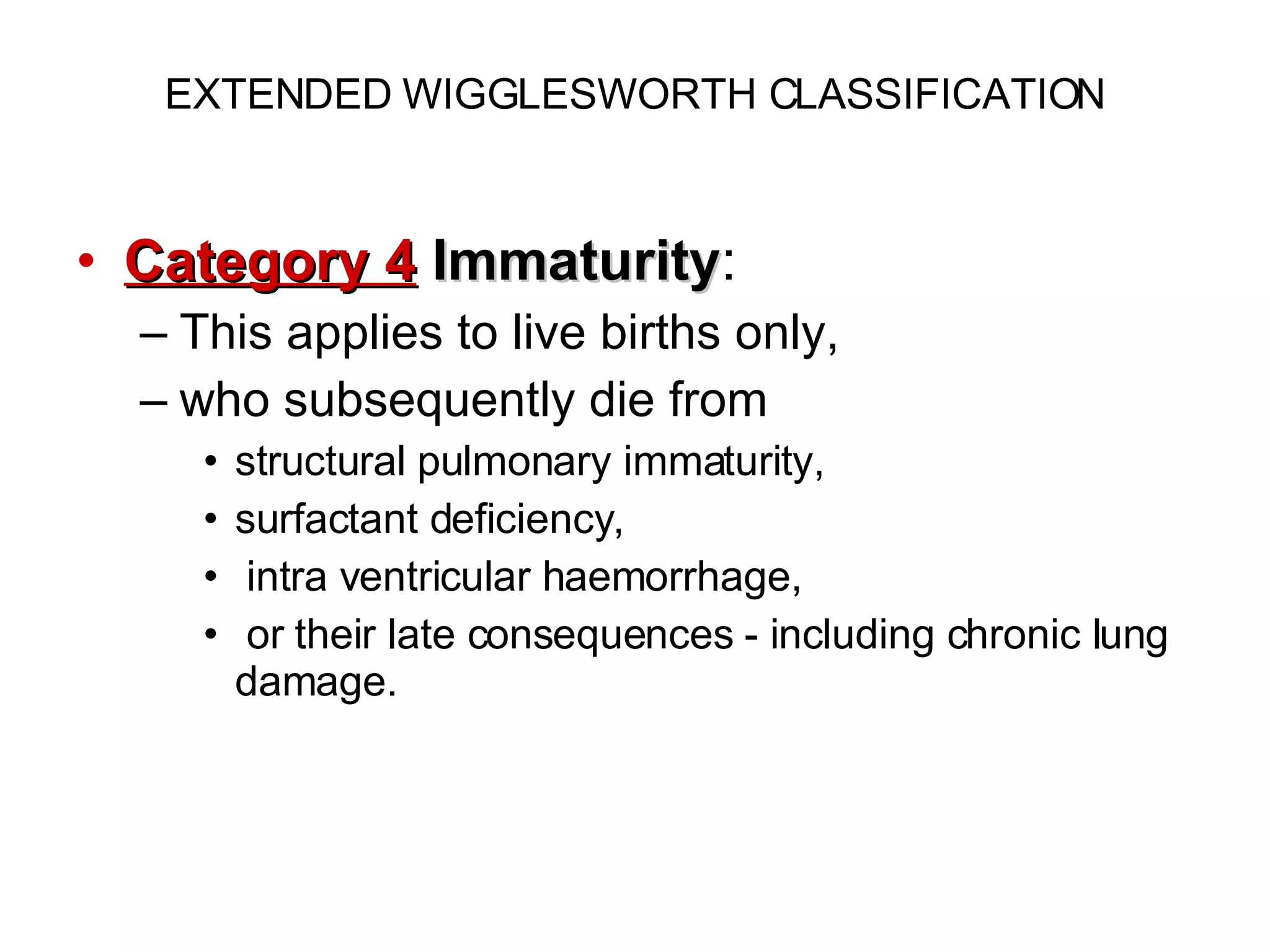
EXTENDED WIGGLESWORTH CLASSIFICATION Category 4   Immaturity :  This applies to live births only,  who subsequently die from  structural pulmonary immaturity,  surfactant deficiency, intra ventricular haemorrhage, or their late consequences - including chronic lung damage.
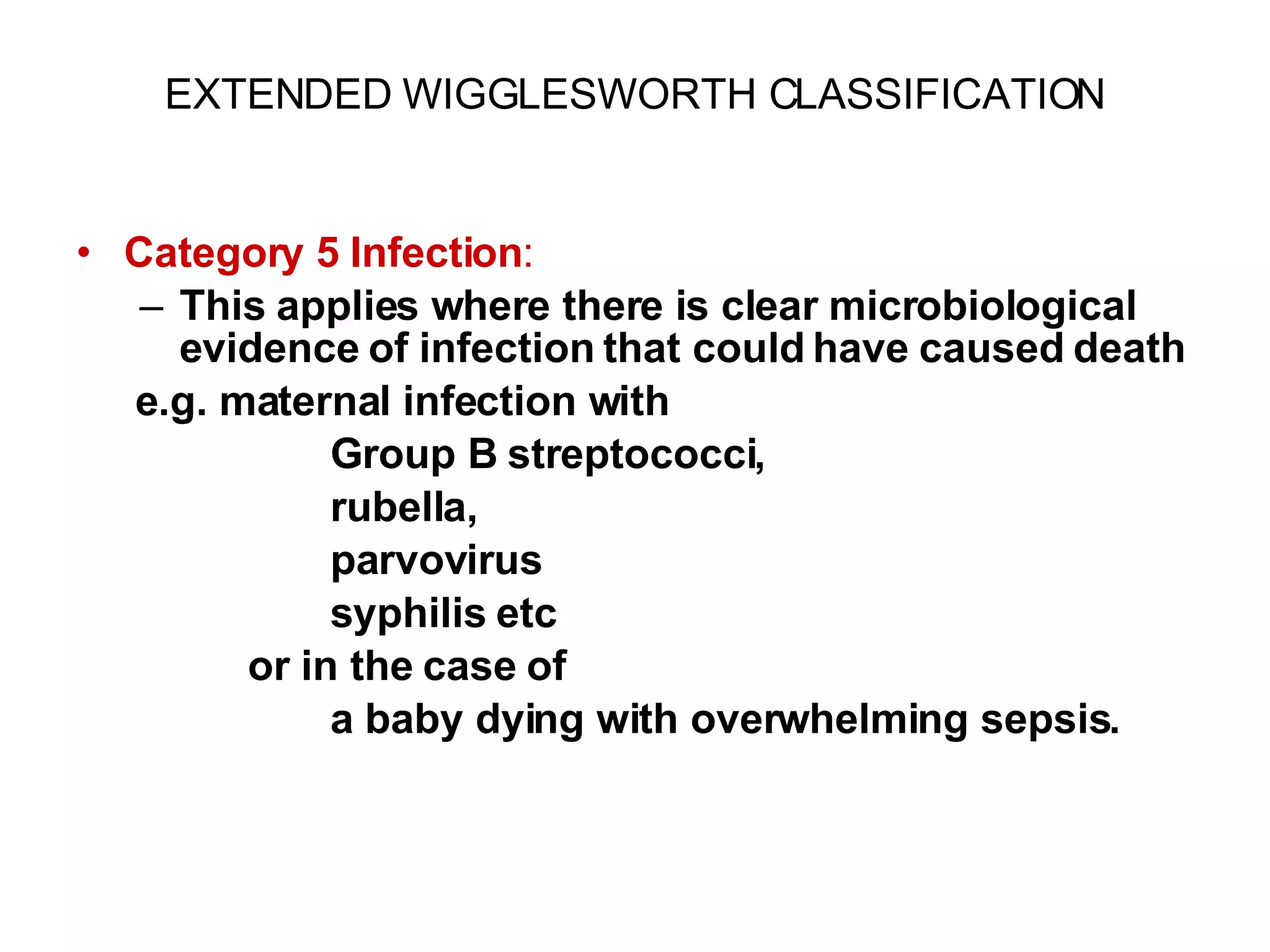
EXTENDED WIGGLESWORTH CLASSIFICATION Category 5 Infection :  This applies where there is clear microbiological evidence of infection that could have caused death   e.g. maternal infection with Group B streptococci,  rubella, parvovirus syphilis etc or in the case of a baby dying with overwhelming sepsis.
EXTENDED WIGGLESWORTH CLASSIFICATION Category 6 Other specific causes :   Use this if there is a specific recognisable fetal,  neonatal or paediatric condition not covered under the earliercategories.  Examples include: (1)  fetal  conditions; twin-to-twin transfusion and hydrops fetalis; (2)  neonatal  conditions;  pulmonary haemorrhage, pulmonaryhypoplasia due to prolonged loss of liquor (primary hypoplasia being classed as a malformation), persistent transitional circulation (in theabsence of infection, aspiration or surfactant deficiency), blood lossunassociated with trauma (e.g. vasa praevia); (3)  paediatric  conditions;  malignancy  acute abdominalcatastrophe (such as volvulus without antecedent congenitalmalrotation).
EXTENDED WIGGLESWORTH CLASSIFICATION Category 7  Accident or non-intrapartum trauma :  Confirmed non-accidental injury should be coded here.  If only suspected, code as a sudden infant death cause unknown (category 8) Category 8  Sudden infant death, cause unknown :  This will include all infants in whom the cause is unknown or unsuspected at the time of death. Modification due to postmortem information should be notified later.
EXTENDED WIGGLESWORTH CLASSIFICATION Category 9  Unclassifiable: To be used as a last resort. Details must be given if this option is ticked.
Nordic-Baltic classification 5 variables 1-lethal malformation 2-time to death in relation to delivery (before, during,after) 3-Birth weight growth retardation (below -2s.d) 4-gestational age 5-Apgar score (below or equal to / above 7 after 5 min)
OBSTETRIC (ABERDEEN) CLASSIFICATION Code Category Congenital anomaly:- any structural or genetic defect incompatible with life or potentially treatable but causing death 1 Neural tube defects 2 Other anomalies
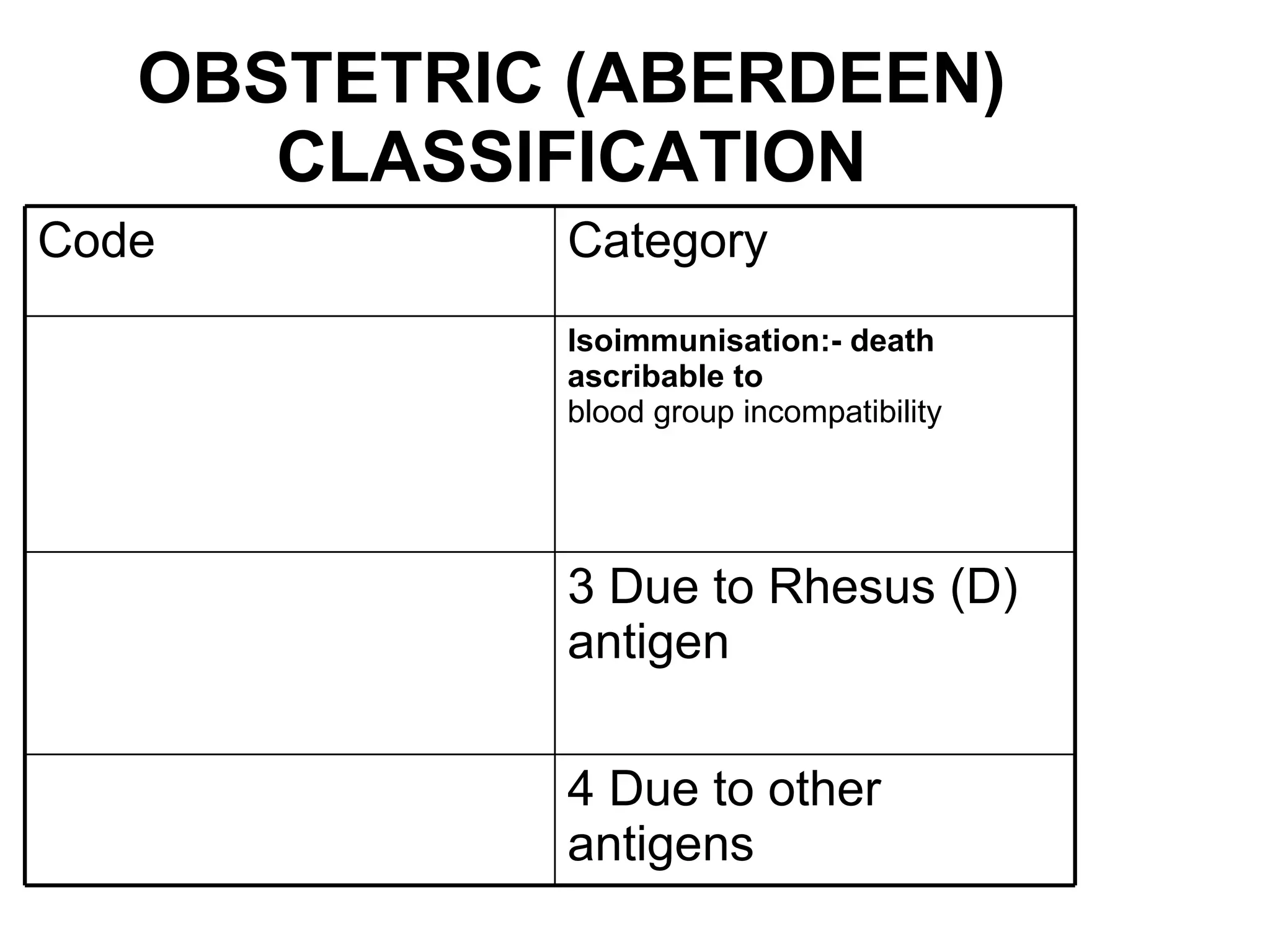
OBSTETRIC (ABERDEEN) CLASSIFICATION Code Category Isoimmunisation:- death ascribable to blood group incompatibility 3 Due to Rhesus (D) antigen 4 Due to other antigens
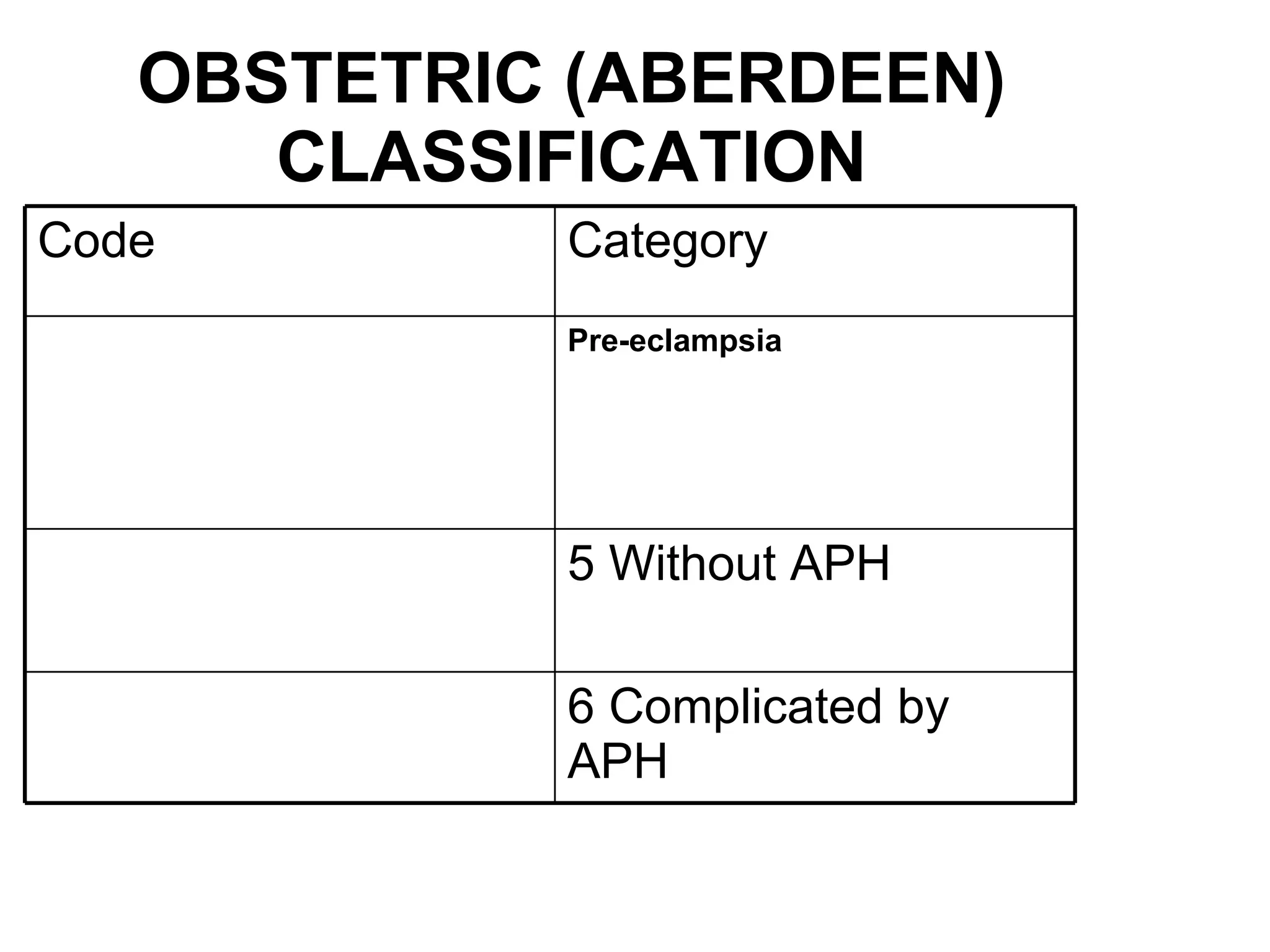
OBSTETRIC (ABERDEEN) CLASSIFICATION Code Category Pre-eclampsia 5 Without APH 6 Complicated by APH
OBSTETRIC (ABERDEEN) CLASSIFICATION code category Antepartum Haemorrhage (APH) 7 With placenta praevia 8 With placental abruption 9 APH of uncertain origin
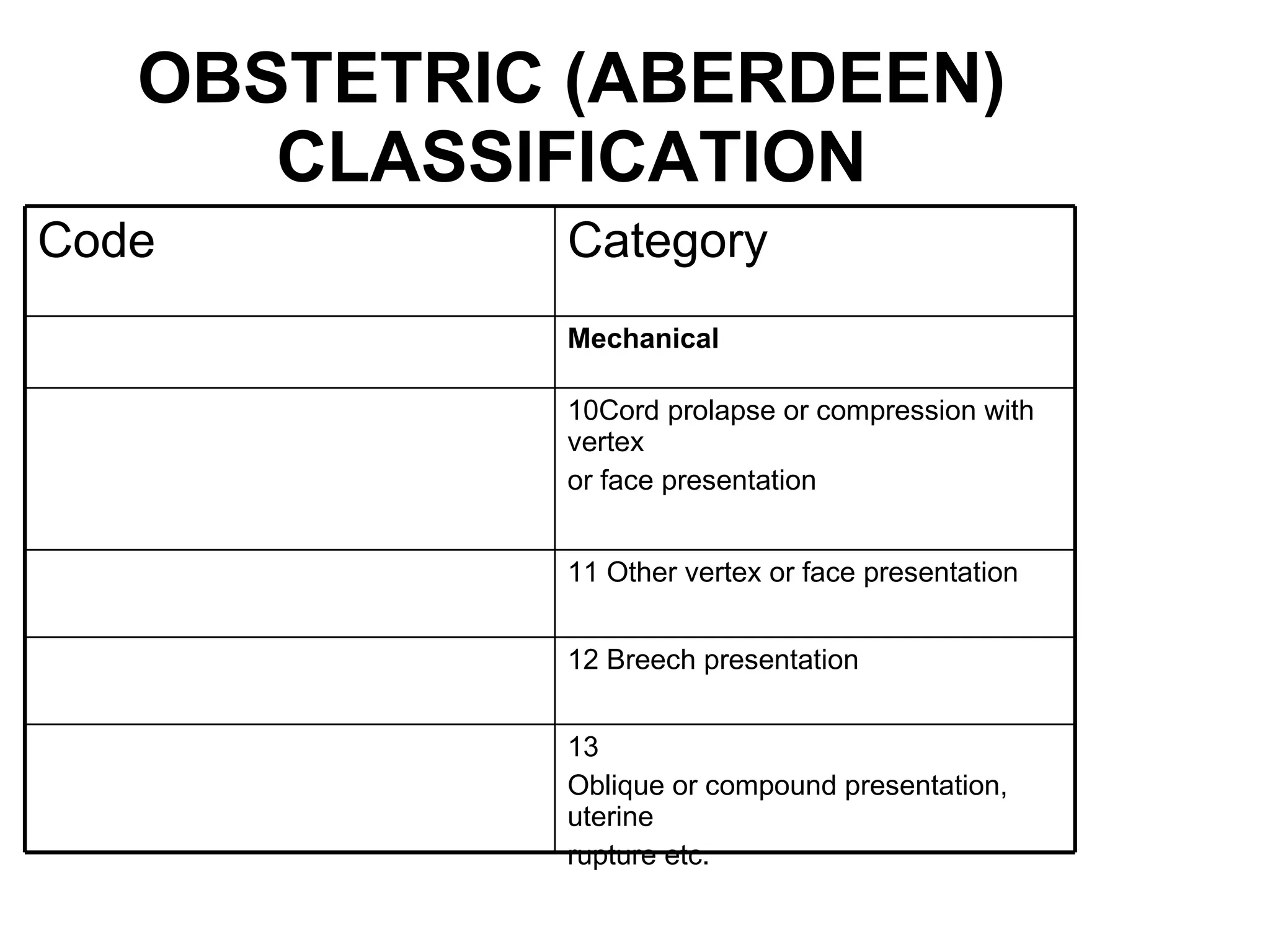
OBSTETRIC (ABERDEEN) CLASSIFICATION 13 Oblique or compound presentation, uterine rupture etc. 12 Breech presentation 11 Other vertex or face presentation 10Cord prolapse or compression with vertex or face presentation Mechanical Category Code
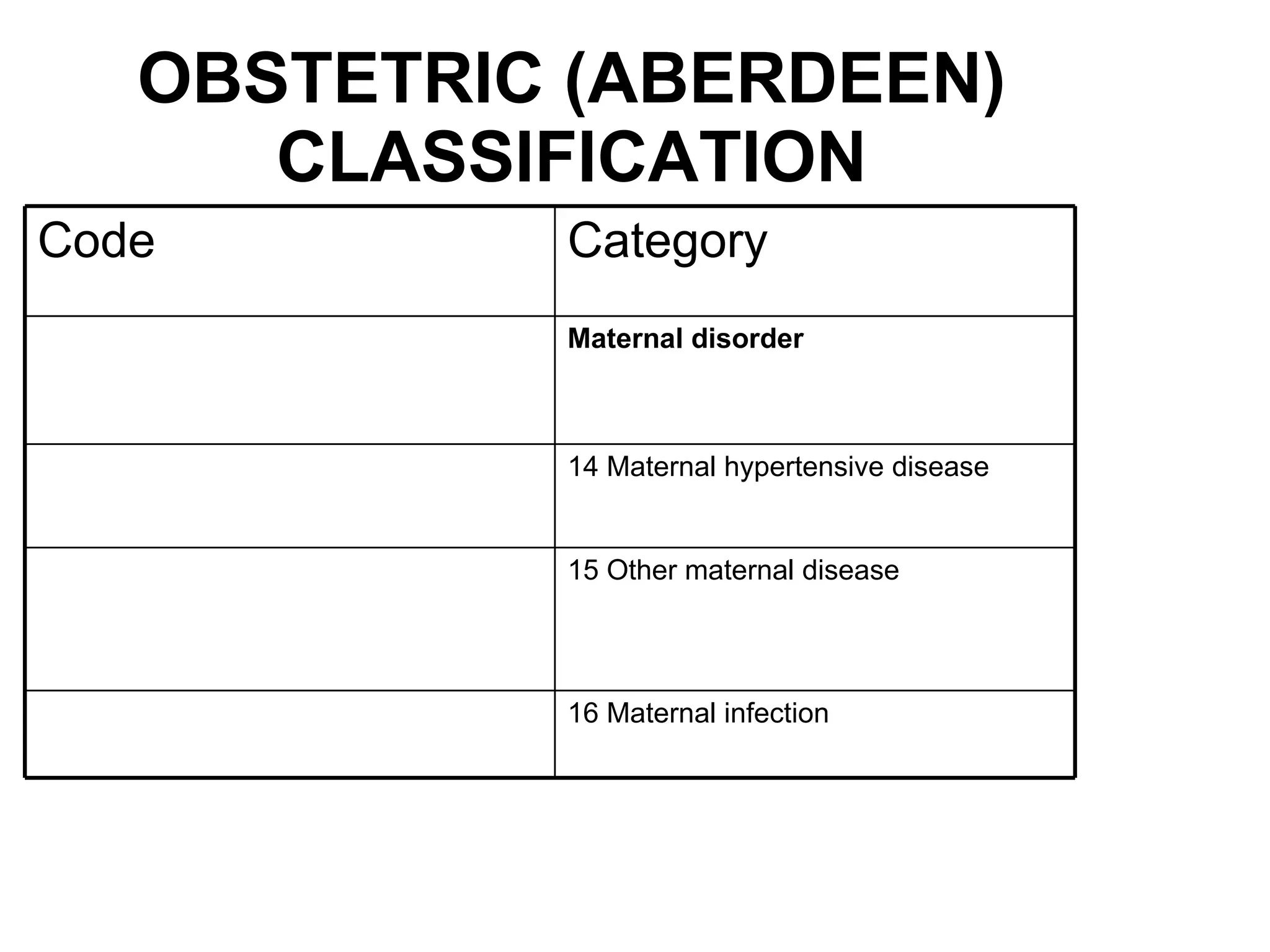
OBSTETRIC (ABERDEEN) CLASSIFICATION 16 Maternal infection 15 Other maternal disease 14 Maternal hypertensive disease Maternal disorder Category Code
OBSTETRIC (ABERDEEN) CLASSIFICATION 19 Specific fetal conditions 18 Other neonatal disease 17 Neonatal infection Miscellaneous Category Code
OBSTETRIC (ABERDEEN) CLASSIFICATION 22 Unclassifiable 21 Less than 2.5kg 20 Equal or greater than 2.5kg Unexplained Category Code
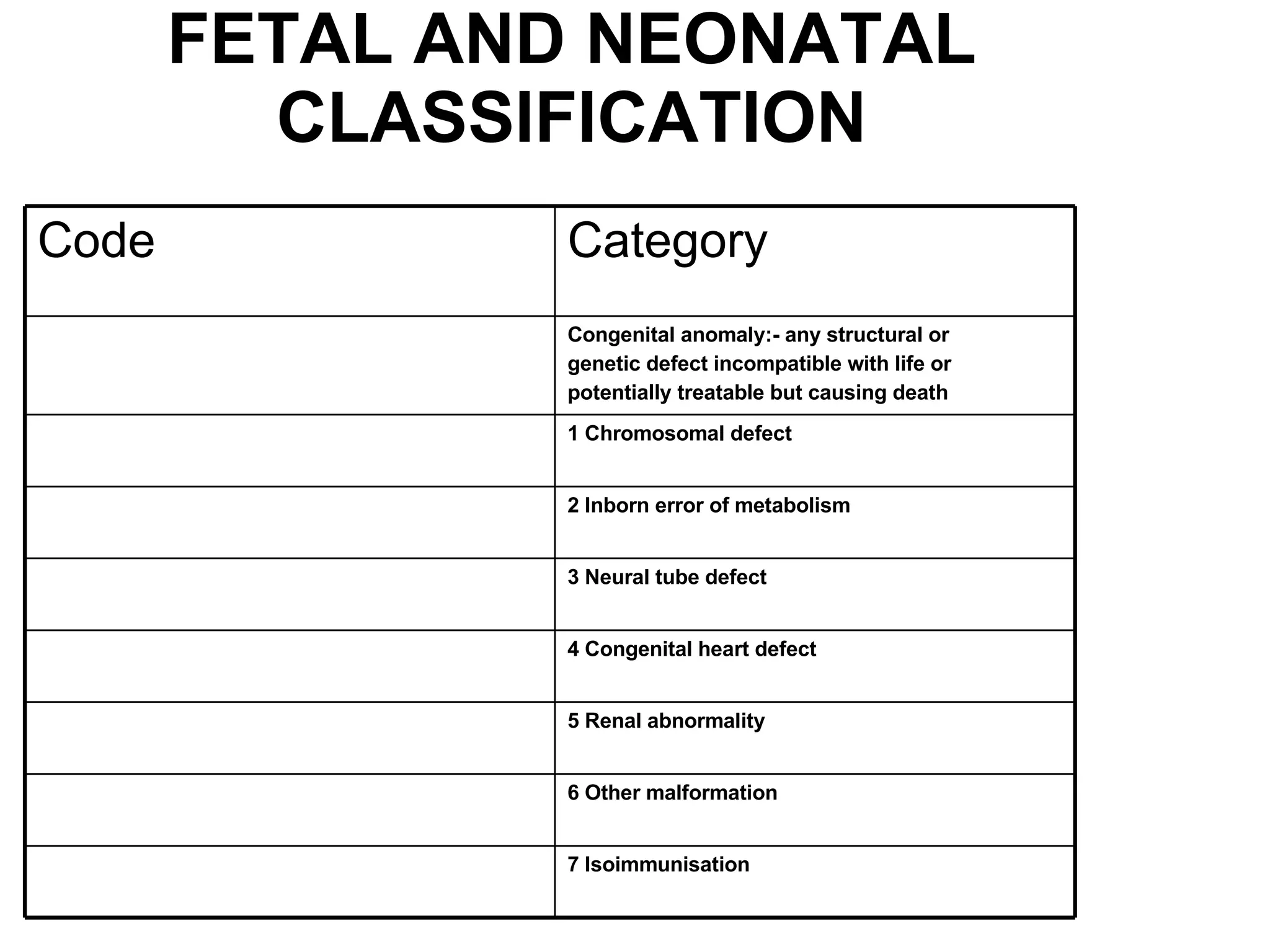
FETAL AND NEONATAL CLASSIFICATION 7 Isoimmunisation 6 Other malformation 5 Renal abnormality 4 Congenital heart defect 3 Neural tube defect 2 Inborn error of metabolism 1 Chromosomal defect Congenital anomaly :- any structural or genetic defect incompatible with life or potentially treatable but causing death Category Code
FETAL AND NEONATAL CLASSIFICATION 11 Severe pulmonary immaturity 10 Birth trauma 9 Intrapartum asphyxia 8 Antepartum asphyxia Asphyxia before birth Category Code
FETAL AND NEONATAL CLASSIFICATION 14 HMD with infection 13 HMD with IVH 12 Hyaline Membrane Disease Hyaline Membrane Disease (HMD) Category Code
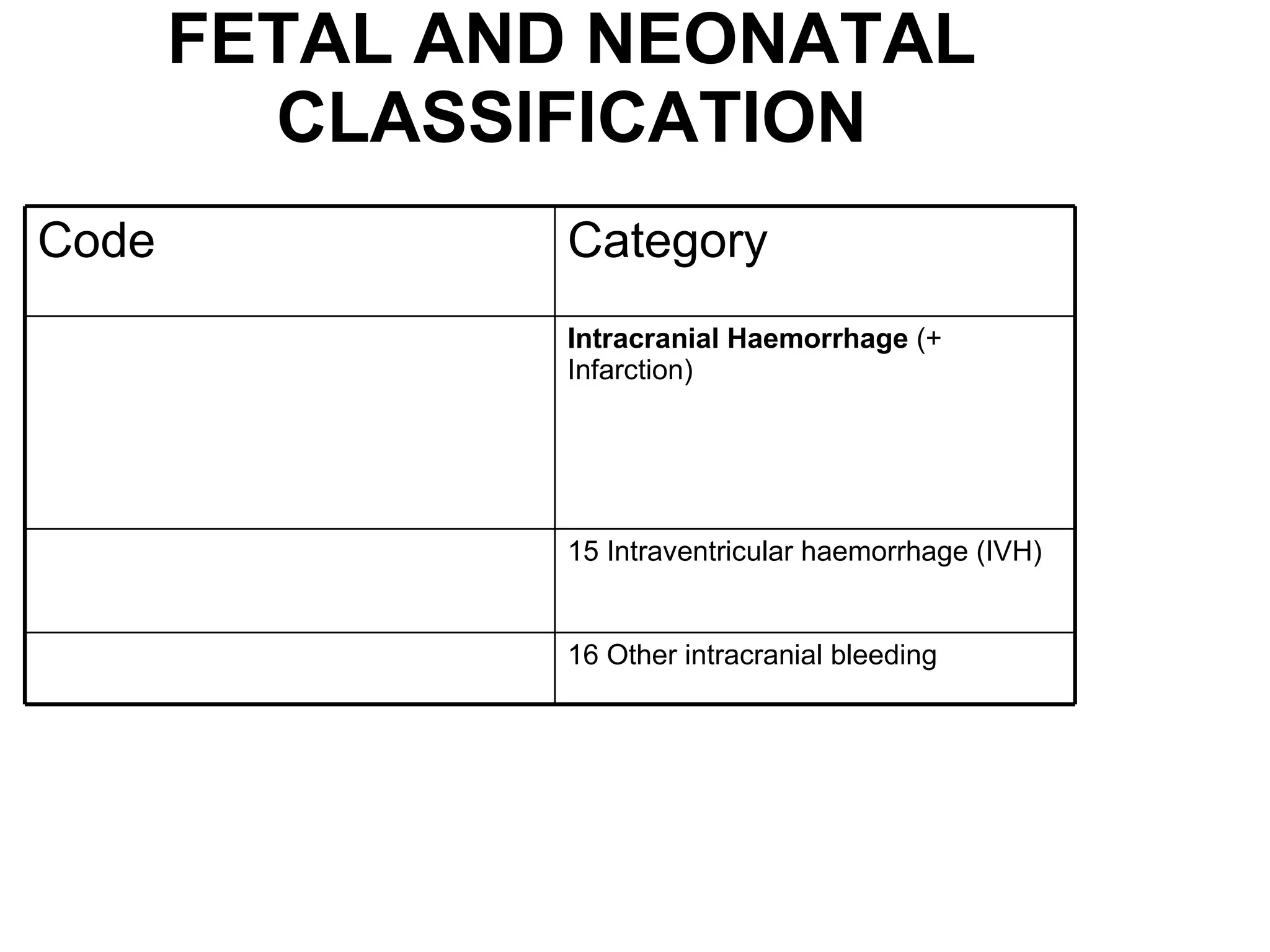
FETAL AND NEONATAL CLASSIFICATION 16 Other intracranial bleeding 15 Intraventricular haemorrhage (IVH) Intracranial Haemorrhage  (+ Infarction) Category Code
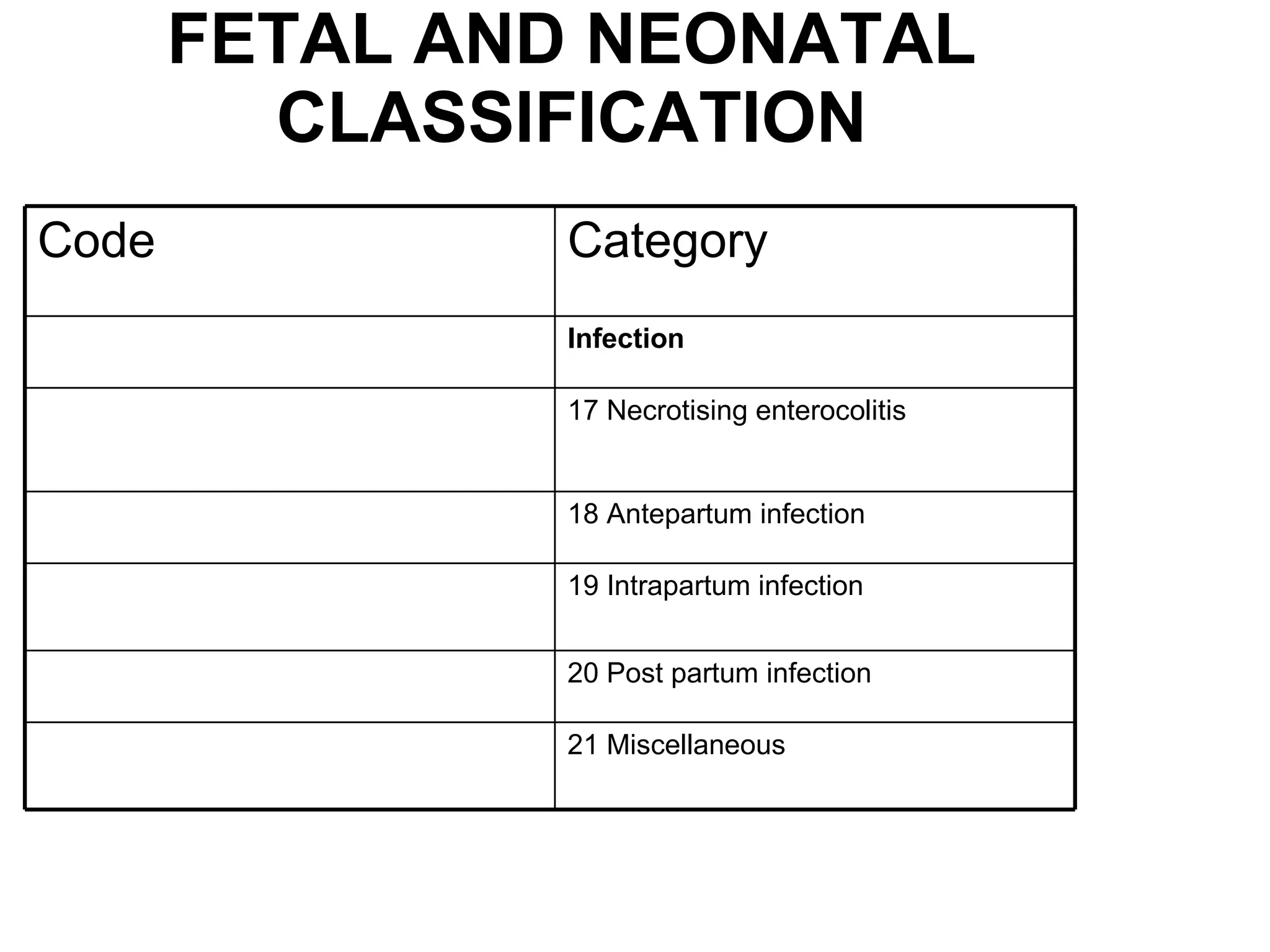
FETAL AND NEONATAL CLASSIFICATION 21 Miscellaneous 20 Post partum infection 19 Intrapartum infection 18 Antepartum infection 17 Necrotising enterocolitis Infection Category Code
FETAL AND NEONATAL CLASSIFICATION 23 Unattended delivery 22 Cot death Unclassifiable or unknown Category Code

Still Birth Classification

  • 1.
    Still birth classificationDr.V.Ravimohan,SpR(obs&gynae) www.mrcogexam.net
  • 2.
    Definition Still birth-An in utero death delivering after the 24th week of pregnancy Late fetal loss- An in utero death delivering between 20+0 and 23+6 weeks of gestation
  • 3.
    types Wigglesworth classificationAberdeen ReCoDe Fetal neonatal classification
  • 4.
    ReCoDe Re levant Co ndition at De ath Advantage-this system reduces the proportion of stillbirths currently categorised as unexplained.
  • 5.
    ReCoDe Catergories GroupA-Fetus Group B-Umbilical cord Group C-Placenta Group D-Amniotic fluid Group E-Uterus Group F-Mother Group G-Intrapartum Group H-Trauma Group I-unclassified
  • 6.
    Group A-Fetus Group A-Fetus 5.fetomaternal haemorrhage 6.GROWTH RESTRICTION 7.FETAL GROWTH RESTRICTION 1.lethal congenital abnormality 2.infection 2.1 acute 2.2 chronic 3.non-immune hydrops 4.isoimmunisation
  • 7.
    Group B-UMBILICAL CORDB-UMBILICAL CORD 1-PROPLAPSE 2-CONSTRICTING LOOP OR KNOT 3-VELAMENTOUS INSERTION 4-OTHER
  • 8.
    Group C-PLACENTA C-PLACENTA1-ABRUTIO 2-PRAEVIA 3-VASA PRAEAVI 4-Other placental insuffiency 5-Other
  • 9.
    Group D-amniotic fluidD-amniotic fluid 1-chorioamnionitis 2-oilgohydramnios 3-polyhrdramnios 4-other
  • 10.
    Group E-Uterus E-Uterus1-rupture 2-uterine anomalies 3-other
  • 11.
    Group F-mother Mother1-diabetes 2-thyroid disorders 3-essential hypertension 4-hypertensive diseases in pregnancy 5-lupus or antiphospolipid syndrome 6-cholestasis 7-drug misuse 8-other
  • 12.
    Group G-Intrapartum G-Intrapartum1-asphyxia 2-Birth trauma
  • 13.
    Group H-trauma H-trauma1-External 2-iatrogenic
  • 14.
  • 15.
  • 16.
    EXTENDED WIGGLESWORTH CLASSIFICATIONCategory 1 Congenital defect/malformation (lethal or severe): Only lethal or potentially lethal congenital malformation should be included here. Serious biochemical abnormalities such as Tay Sach’s disease any known single gene defects known to have a high risk of death should be included. Category 2 Unexplained antepartum fetal death: Most late fetal losses should be coded here. Where a live-born baby dies due to problems during the antepartum period, code this as ‘other specific causes’ (category6).
  • 17.
    EXTENDED WIGGLESWORTH CLASSIFICATIONCategory 3 Death from intrapartum ‘asphyxia’, ‘anoxia’ or ‘trauma’: This category covers any baby who would have survived but for some catastrophe occurring during labour. These babies will tend to be normally formed, stillborn or with poor Apgar scores, possible meconium aspiration or evidence of acidosis. Very premature infants (those less than 24 weeks gestation) may be asphyxiated at birth, but should not be entered in this category as a rule.
  • 18.
    EXTENDED WIGGLESWORTH CLASSIFICATIONCategory 4 Immaturity : This applies to live births only, who subsequently die from structural pulmonary immaturity, surfactant deficiency, intra ventricular haemorrhage, or their late consequences - including chronic lung damage.
  • 19.
    EXTENDED WIGGLESWORTH CLASSIFICATIONCategory 5 Infection : This applies where there is clear microbiological evidence of infection that could have caused death e.g. maternal infection with Group B streptococci, rubella, parvovirus syphilis etc or in the case of a baby dying with overwhelming sepsis.
  • 20.
    EXTENDED WIGGLESWORTH CLASSIFICATIONCategory 6 Other specific causes : Use this if there is a specific recognisable fetal, neonatal or paediatric condition not covered under the earliercategories. Examples include: (1) fetal conditions; twin-to-twin transfusion and hydrops fetalis; (2) neonatal conditions; pulmonary haemorrhage, pulmonaryhypoplasia due to prolonged loss of liquor (primary hypoplasia being classed as a malformation), persistent transitional circulation (in theabsence of infection, aspiration or surfactant deficiency), blood lossunassociated with trauma (e.g. vasa praevia); (3) paediatric conditions; malignancy acute abdominalcatastrophe (such as volvulus without antecedent congenitalmalrotation).
  • 21.
    EXTENDED WIGGLESWORTH CLASSIFICATIONCategory 7 Accident or non-intrapartum trauma : Confirmed non-accidental injury should be coded here. If only suspected, code as a sudden infant death cause unknown (category 8) Category 8 Sudden infant death, cause unknown : This will include all infants in whom the cause is unknown or unsuspected at the time of death. Modification due to postmortem information should be notified later.
  • 22.
    EXTENDED WIGGLESWORTH CLASSIFICATIONCategory 9 Unclassifiable: To be used as a last resort. Details must be given if this option is ticked.
  • 23.
    Nordic-Baltic classification 5variables 1-lethal malformation 2-time to death in relation to delivery (before, during,after) 3-Birth weight growth retardation (below -2s.d) 4-gestational age 5-Apgar score (below or equal to / above 7 after 5 min)
  • 24.
    OBSTETRIC (ABERDEEN) CLASSIFICATIONCode Category Congenital anomaly:- any structural or genetic defect incompatible with life or potentially treatable but causing death 1 Neural tube defects 2 Other anomalies
  • 25.
    OBSTETRIC (ABERDEEN) CLASSIFICATIONCode Category Isoimmunisation:- death ascribable to blood group incompatibility 3 Due to Rhesus (D) antigen 4 Due to other antigens
  • 26.
    OBSTETRIC (ABERDEEN) CLASSIFICATIONCode Category Pre-eclampsia 5 Without APH 6 Complicated by APH
  • 27.
    OBSTETRIC (ABERDEEN) CLASSIFICATIONcode category Antepartum Haemorrhage (APH) 7 With placenta praevia 8 With placental abruption 9 APH of uncertain origin
  • 28.
    OBSTETRIC (ABERDEEN) CLASSIFICATION13 Oblique or compound presentation, uterine rupture etc. 12 Breech presentation 11 Other vertex or face presentation 10Cord prolapse or compression with vertex or face presentation Mechanical Category Code
  • 29.
    OBSTETRIC (ABERDEEN) CLASSIFICATION16 Maternal infection 15 Other maternal disease 14 Maternal hypertensive disease Maternal disorder Category Code
  • 30.
    OBSTETRIC (ABERDEEN) CLASSIFICATION19 Specific fetal conditions 18 Other neonatal disease 17 Neonatal infection Miscellaneous Category Code
  • 31.
    OBSTETRIC (ABERDEEN) CLASSIFICATION22 Unclassifiable 21 Less than 2.5kg 20 Equal or greater than 2.5kg Unexplained Category Code
  • 32.
    FETAL AND NEONATALCLASSIFICATION 7 Isoimmunisation 6 Other malformation 5 Renal abnormality 4 Congenital heart defect 3 Neural tube defect 2 Inborn error of metabolism 1 Chromosomal defect Congenital anomaly :- any structural or genetic defect incompatible with life or potentially treatable but causing death Category Code
  • 33.
    FETAL AND NEONATALCLASSIFICATION 11 Severe pulmonary immaturity 10 Birth trauma 9 Intrapartum asphyxia 8 Antepartum asphyxia Asphyxia before birth Category Code
  • 34.
    FETAL AND NEONATALCLASSIFICATION 14 HMD with infection 13 HMD with IVH 12 Hyaline Membrane Disease Hyaline Membrane Disease (HMD) Category Code
  • 35.
    FETAL AND NEONATALCLASSIFICATION 16 Other intracranial bleeding 15 Intraventricular haemorrhage (IVH) Intracranial Haemorrhage (+ Infarction) Category Code
  • 36.
    FETAL AND NEONATALCLASSIFICATION 21 Miscellaneous 20 Post partum infection 19 Intrapartum infection 18 Antepartum infection 17 Necrotising enterocolitis Infection Category Code
  • 37.
    FETAL AND NEONATALCLASSIFICATION 23 Unattended delivery 22 Cot death Unclassifiable or unknown Category Code