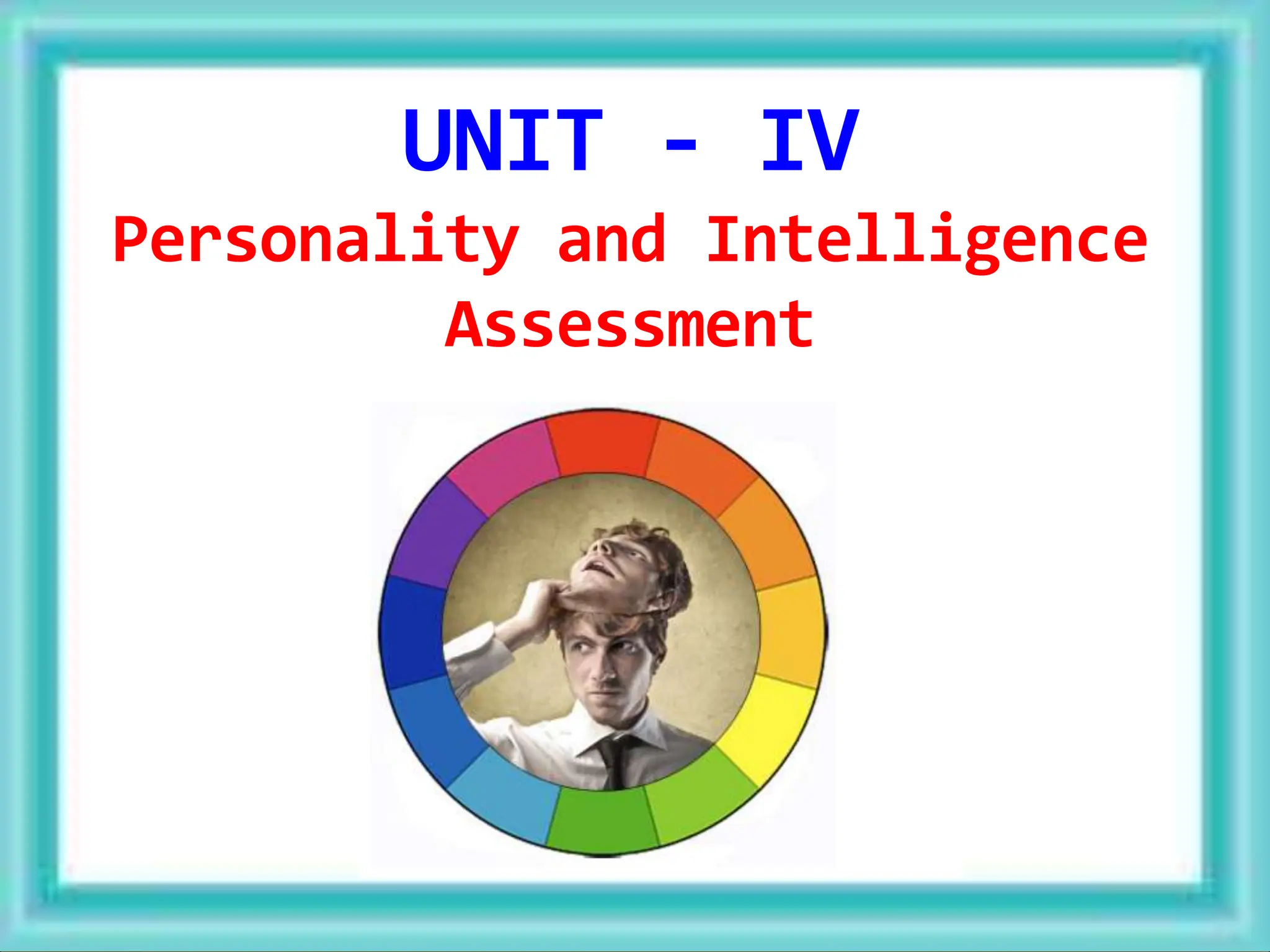
UNIT - IV
Personality and Intelligence
Assessment
Personality – Definition
• He, who reveals
certain commendable
traits, not normally
seen in the others, is a
great personality.
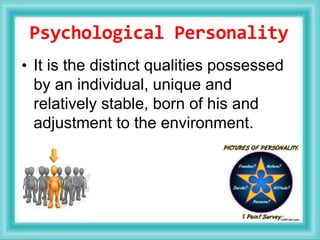
Psychological Personality
• It is the distinct qualities possessed
by an individual, unique and
relatively stable, born of his and
adjustment to the environment.
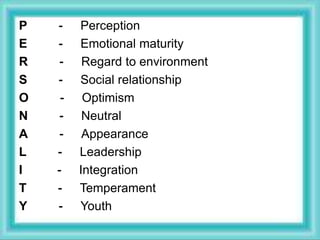
P - Perception
E - Emotional maturity
R - Regard to environment
S - Social relationship
O - Optimism
N - Neutral
A - Appearance
L - Leadership
I - Integration
T - Temperament
Y - Youth
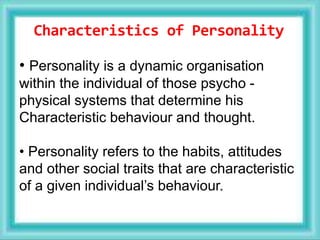
Characteristics of Personality
• Personality is a dynamic organisation
within the individual of those psycho -
physical systems that determine his
Characteristic behaviour and thought.
• Personality refers to the habits, attitudes
and other social traits that are characteristic
of a given individual’s behaviour.
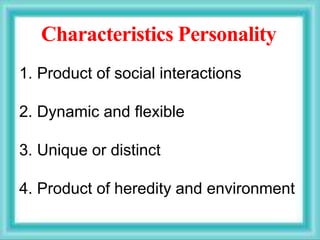
Characteristics Personality
1. Product of social interactions
2. Dynamic and flexible
3. Unique or distinct
4. Product of heredity and environment
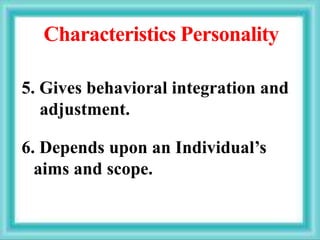
Characteristics Personality
5. Gives behavioral integration and
adjustment.
6. Depends upon an Individual’s
aims and scope.
Three Methods of Classification
1. Psychosomatic Types
2. Traits Approach
3. Type cum Trait Approach
Traits Approach:
Traits are continuing patterns of behaviour
and thoughts that are generally stable over
Time.
Traits Approach:
Traits are the things that people use to
describe, such as intelligence,
Emotional sensitivity, ascendance,
submission, irritability, warm etc.
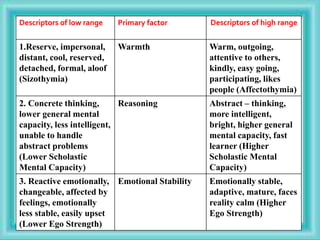
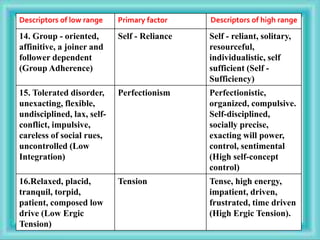
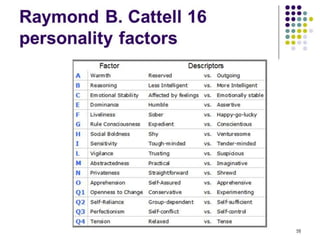
16 Personality Factors
• According to caltell there are 16 major
Personality factors.
• They are classified into:
1. Source Traits
2. Surface Traits
• These traits are bipolar referring to the
opposite or extreme degrees.
Descriptors of low range Primary factor Descriptors of high range
1.Reserve, impersonal,
distant, cool, reserved,
detached, formal, aloof
(Sizothymia)
Warmth Warm, outgoing,
attentive to others,
kindly, easy going,
participating, likes
people (Affectothymia)
2. Concrete thinking,
lower general mental
capacity, less intelligent,
unable to handle
abstract problems
(Lower Scholastic
Mental Capacity)
Reasoning Abstract – thinking,
more intelligent,
bright, higher general
mental capacity, fast
learner (Higher
Scholastic Mental
Capacity)
3. Reactive emotionally,
changeable, affected by
feelings, emotionally
less stable, easily upset
(Lower Ego Strength)
Emotional Stability Emotionally stable,
adaptive, mature, faces
reality calm (Higher
Ego Strength)
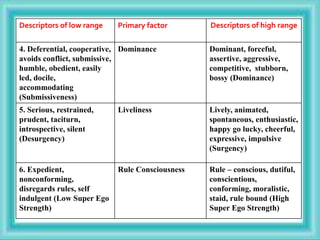
Descriptors of low range Primary factor Descriptors of high range
4. Deferential, cooperative,
avoids conflict, submissive,
humble, obedient, easily
led, docile,
accommodating
(Submissiveness)
Dominance Dominant, forceful,
assertive, aggressive,
competitive, stubborn,
bossy (Dominance)
5. Serious, restrained,
prudent, taciturn,
introspective, silent
(Desurgency)
Liveliness Lively, animated,
spontaneous, enthusiastic,
happy go lucky, cheerful,
expressive, impulsive
(Surgency)
6. Expedient,
nonconforming,
disregards rules, self
indulgent (Low Super Ego
Strength)
Rule Consciousness Rule – conscious, dutiful,
conscientious,
conforming, moralistic,
staid, rule bound (High
Super Ego Strength)
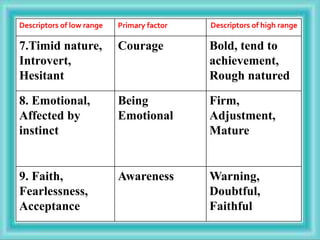
Descriptors of low range Primary factor Descriptors of high range
7.Timid nature,
Introvert,
Hesitant
Courage Bold, tend to
achievement,
Rough natured
8. Emotional,
Affected by
instinct
Being
Emotional
Firm,
Adjustment,
Mature
9. Faith,
Fearlessness,
Acceptance
Awareness Warning,
Doubtful,
Faithful
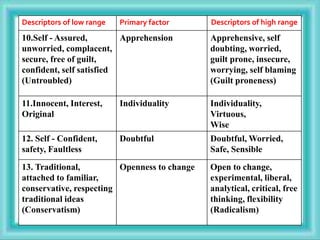
Descriptors of low range Primary factor Descriptors of high range
10.Self - Assured,
unworried, complacent,
secure, free of guilt,
confident, self satisfied
(Untroubled)
Apprehension Apprehensive, self
doubting, worried,
guilt prone, insecure,
worrying, self blaming
(Guilt proneness)
11.Innocent, Interest,
Original
Individuality Individuality,
Virtuous,
Wise
12. Self - Confident,
safety, Faultless
Doubtful Doubtful, Worried,
Safe, Sensible
13. Traditional,
attached to familiar,
conservative, respecting
traditional ideas
(Conservatism)
Openness to change Open to change,
experimental, liberal,
analytical, critical, free
thinking, flexibility
(Radicalism)
Descriptors of low range Primary factor Descriptors of high range
14. Group - oriented,
affinitive, a joiner and
follower dependent
(Group Adherence)
Self - Reliance Self - reliant, solitary,
resourceful,
individualistic, self
sufficient (Self -
Sufficiency)
15. Tolerated disorder,
unexacting, flexible,
undisciplined, lax, self-
conflict, impulsive,
careless of social rues,
uncontrolled (Low
Integration)
Perfectionism Perfectionistic,
organized, compulsive.
Self-disciplined,
socially precise,
exacting will power,
control, sentimental
(High self-concept
control)
16.Relaxed, placid,
tranquil, torpid,
patient, composed low
drive (Low Ergic
Tension)
Tension Tense, high energy,
impatient, driven,
frustrated, time driven
(High Ergic Tension).
Aptitude
•It is certain measure of special or
specific talents possessed by an
individual.
• Example: Numerical skills, the ability
to remember quotes or proverbs,
musical or literary talents etc.
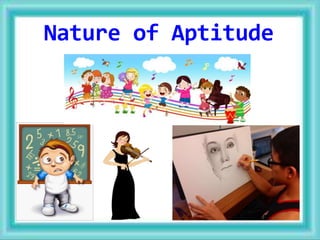
Nature of Aptitude
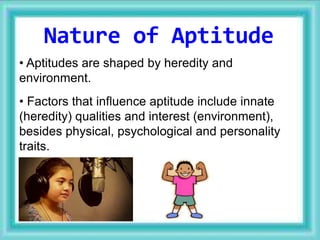
• Aptitudes are shaped by heredity and
environment.
• Factors that influence aptitude include innate
(heredity) qualities and interest (environment),
besides physical, psychological and personality
traits.
Nature of Aptitude
Example: A mellifluous voice, physical
stamina, the ability to discriminate
between tones and a good memory
are the essential attributes of a
Musician.
Nature of Aptitude
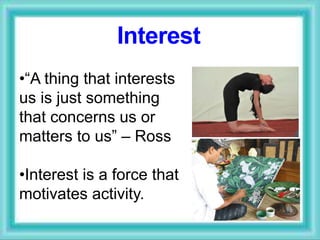
•“A thing that interests
us is just something
that concerns us or
matters to us” – Ross
•Interest is a force that
motivates activity.
Interest
‘Likes’ form the basis of interests.
Interests produce pleasure.
Interests go hand-in-hand with
attention.
Interest
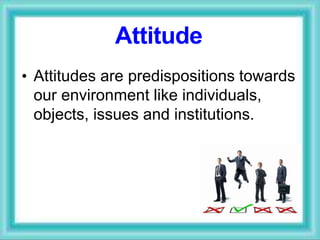
• Attitudes are predispositions towards
our environment like individuals,
objects, issues and institutions.
Attitude
• Object-subject relationship
• They are born of learning /
experience.
• They are not inherent or inborn.
Nature of Attitudes
Three Basic Components of attitude:
Thinking, Feeling, Reacting
They are the result of:
conditioning, imitation and
instruction formed even during
childhood.
• Integration of experiences
• Differentiation of experiences
• Trauma or dramatic experiences
• Adoption of available attitudes
Conditions under Which Attitudes are
Formed
Factors Pertaining to
Development of Attitudes
i. Factors pertaining to individual self
• Physical development
• Intellectual development
• Emotional development
• Social development
• Ethical or moral development
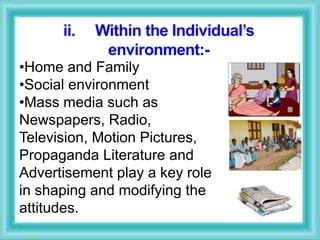
ii. Within the Individual’s
environment:-
•Home and Family
•Social environment
•Mass media such as
Newspapers, Radio,
Television, Motion Pictures,
Propaganda Literature and
Advertisement play a key role
in shaping and modifying the
attitudes.
Multiple Intelligence
•It is the ability -
1. For adjustment or adoptation
2. To learn
3. To carry on abstract thinking
Learning
• Display Adjustment or adaption to
new environment.
•Capable of handling new concepts or
ideas makes for higher learning.
Definition of Intelligence
• “It is the ability to learn fast, display good
adjustment in behaviour, successfully
complete even difficult tasks, act in pursuit
of the welfare of the society, analyse
problems thoroughly and get along with the
others.”
- Stotart
Definition of Intelligence
• “Intelligence is a global capacity
which includes working with a
purpose, thinking intelligently
and managing circumstances
effectively.”
- Wesler
Definition of Intelligence
According to Alfred Binet,
1. Understanding,
2. Originality,
3. Persistence and
4. Self criticism are aspects of
Intelligence.
Qualities of Intelligence
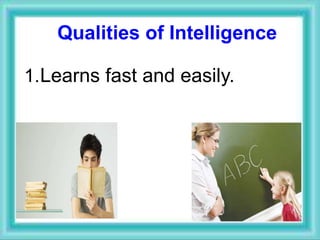
1.Learns fast and easily.
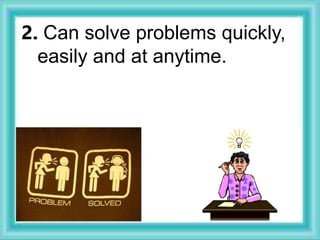
2. Can solve problems quickly,
easily and at anytime.
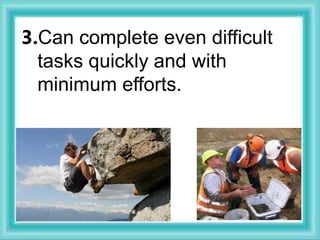
3.Can complete even difficult
tasks quickly and with
minimum efforts.
4. Ability to adopt the behaviour
according to the purpose of interest.
5. Beneficial to the society.
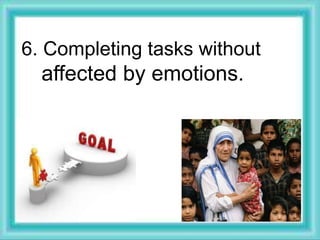
6. Completing tasks without
affected by emotions.
7. Can manage any circumstances.
8. Ability to discriminate
9. Adapting to circumstances
Gardner’s Theory of Multiple Intelligence
Howard Gardner, professor at the
Harvard Graduate school of Education,
outlined 9 varieties of intelligence in his
book “Frames of Mind: The Theory of
Multiple Intelligence” published in 1983.
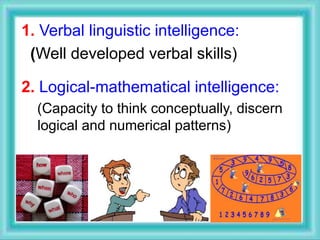
1. Verbal linguistic intelligence:
(Well developed verbal skills)
2. Logical-mathematical intelligence:
(Capacity to think conceptually, discern
logical and numerical patterns)
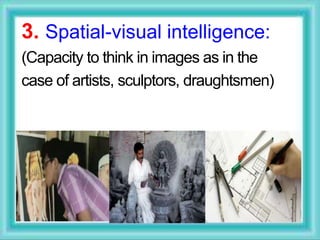
3. Spatial-visual intelligence:
(Capacity to think in images as in the
case of artists, sculptors, draughtsmen)
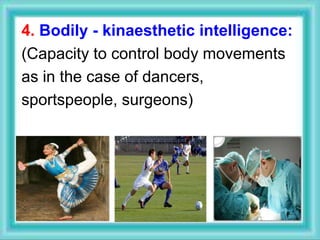
4. Bodily - kinaesthetic intelligence:
(Capacity to control body movements
as in the case of dancers,
sportspeople, surgeons)
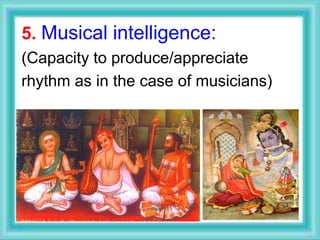
5. Musical intelligence:
(Capacity to produce/appreciate
rhythm as in the case of musicians)
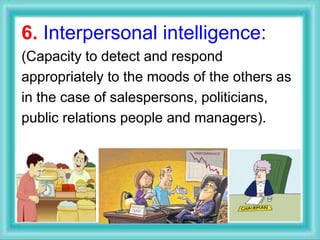
6. Interpersonal intelligence:
(Capacity to detect and respond
appropriately to the moods of the others as
in the case of salespersons, politicians,
public relations people and managers).
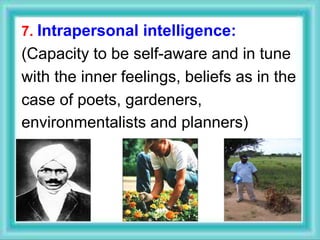
7. Intrapersonal intelligence:
(Capacity to be self-aware and in tune
with the inner feelings, beliefs as in the
case of poets, gardeners,
environmentalists and planners)
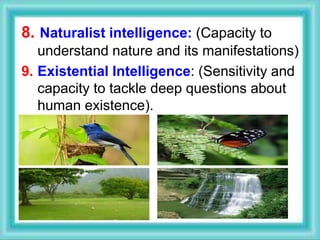
8. Naturalist intelligence: (Capacity to
understand nature and its manifestations)
9. Existential Intelligence: (Sensitivity and
capacity to tackle deep questions about
human existence).
Gardner’s theory of multiple
intelligence advocates major
changes in the present system of
Education.
Standard progressive matrices
Standard Progressive Matrices (SPM)
consists of a group of individually
administered tests that non-verbally
assess intelligence in children and
adults through abstract reasoning
tasks.
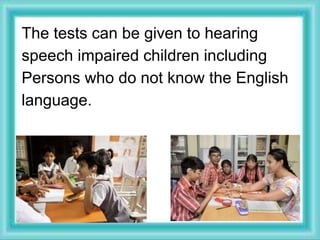
The tests can be given to hearing
speech impaired children including
Persons who do not know the English
language.
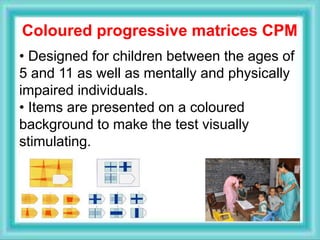
Coloured progressive matrices CPM
• Designed for children between the ages of
5 and 11 as well as mentally and physically
impaired individuals.
• Items are presented on a coloured
background to make the test visually
stimulating.
(APM - Advanced progressive matrices)
• Designed for children over the
age of 11 and adults.
• Contains 36 items appropriate for
adults and adolescents of above-
average intelligence.
Leadership Qualities
General qualities: - Physical
- Emotional
- Intellectual
- Social
Leadership Qualities
• Leadership qualities are the outcome
of personality, sublimation and
circumstances
• Specific situations call for specific
qualities in a leader
1. Identification with the Group
•Integrating the group members
•Enthusiasm
•Think and act towards goal
•Balanced relationship with all
•Loving and affectionate to all
2. Superiority over the Others in
the Group
•Superior qualities
•Willing to shoulder responsibilities
•Complete all tasks efficiently
•Easily accessible
Superiority over the Others in
the Group
• Capable of grasping problems
effortlessly
• Emotionally balanced
• Calm temperament
3. Knowledge of Group Psychology
• Important to understand group
mind or group behaviour
• Should be capable of proper
planning and execution with the
involvement of the others
4. Dynamic and Flexible
• Should be dynamic and flexible
• Should be democratic or
authoritative according to situations
• Should be amenable to changes
when warranted
Coffin’s Traits
1. Planning
2. Organisation
3. Persuasion
Education that Fosters Leadership
• Academic institutions should be the
places where leadership qualities
stand, revealed and fostered
• Opportunities to plan and organise
functions should be provided to the
youth.
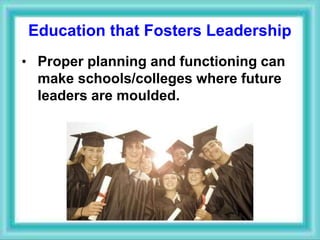
Education that Fosters Leadership
• Proper planning and functioning can
make schools/colleges where future
leaders are moulded.
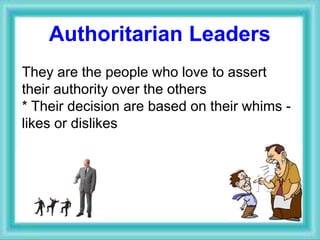
Authoritarian Leaders
They are the people who love to assert
their authority over the others
* Their decision are based on their whims -
likes or dislikes
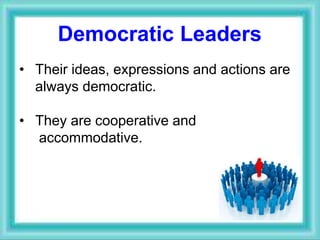
Democratic Leaders
• Their ideas, expressions and actions are
always democratic.
• They are cooperative and
accommodative.
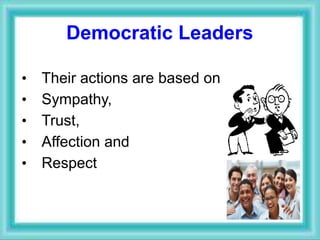
Democratic Leaders
• Their actions are based on
• Sympathy,
• Trust,
• Affection and
• Respect
Laissez-faire (Leaving things to their
own course)
Members are provided maximum freedom
to work.
Group lacks cohesion whereby the
performance of the whole group is well
below average
Unit - 4 Personality.ppt

Unit - 4 Personality.ppt

  • 1.
    UNIT - IV Personalityand Intelligence Assessment
  • 2.
    Personality – Definition •He, who reveals certain commendable traits, not normally seen in the others, is a great personality.
  • 3.
    Psychological Personality • Itis the distinct qualities possessed by an individual, unique and relatively stable, born of his and adjustment to the environment.
  • 4.
    P - Perception E- Emotional maturity R - Regard to environment S - Social relationship O - Optimism N - Neutral A - Appearance L - Leadership I - Integration T - Temperament Y - Youth
  • 5.
    Characteristics of Personality •Personality is a dynamic organisation within the individual of those psycho - physical systems that determine his Characteristic behaviour and thought. • Personality refers to the habits, attitudes and other social traits that are characteristic of a given individual’s behaviour.
  • 6.
    Characteristics Personality 1. Productof social interactions 2. Dynamic and flexible 3. Unique or distinct 4. Product of heredity and environment
  • 7.
    Characteristics Personality 5. Givesbehavioral integration and adjustment. 6. Depends upon an Individual’s aims and scope.
  • 8.
    Three Methods ofClassification 1. Psychosomatic Types 2. Traits Approach 3. Type cum Trait Approach
  • 9.
    Traits Approach: Traits arecontinuing patterns of behaviour and thoughts that are generally stable over Time.
  • 10.
    Traits Approach: Traits arethe things that people use to describe, such as intelligence, Emotional sensitivity, ascendance, submission, irritability, warm etc.
  • 11.
    16 Personality Factors •According to caltell there are 16 major Personality factors. • They are classified into: 1. Source Traits 2. Surface Traits • These traits are bipolar referring to the opposite or extreme degrees.
  • 12.
    Descriptors of lowrange Primary factor Descriptors of high range 1.Reserve, impersonal, distant, cool, reserved, detached, formal, aloof (Sizothymia) Warmth Warm, outgoing, attentive to others, kindly, easy going, participating, likes people (Affectothymia) 2. Concrete thinking, lower general mental capacity, less intelligent, unable to handle abstract problems (Lower Scholastic Mental Capacity) Reasoning Abstract – thinking, more intelligent, bright, higher general mental capacity, fast learner (Higher Scholastic Mental Capacity) 3. Reactive emotionally, changeable, affected by feelings, emotionally less stable, easily upset (Lower Ego Strength) Emotional Stability Emotionally stable, adaptive, mature, faces reality calm (Higher Ego Strength)
  • 13.
    Descriptors of lowrange Primary factor Descriptors of high range 4. Deferential, cooperative, avoids conflict, submissive, humble, obedient, easily led, docile, accommodating (Submissiveness) Dominance Dominant, forceful, assertive, aggressive, competitive, stubborn, bossy (Dominance) 5. Serious, restrained, prudent, taciturn, introspective, silent (Desurgency) Liveliness Lively, animated, spontaneous, enthusiastic, happy go lucky, cheerful, expressive, impulsive (Surgency) 6. Expedient, nonconforming, disregards rules, self indulgent (Low Super Ego Strength) Rule Consciousness Rule – conscious, dutiful, conscientious, conforming, moralistic, staid, rule bound (High Super Ego Strength)
  • 14.
    Descriptors of lowrange Primary factor Descriptors of high range 7.Timid nature, Introvert, Hesitant Courage Bold, tend to achievement, Rough natured 8. Emotional, Affected by instinct Being Emotional Firm, Adjustment, Mature 9. Faith, Fearlessness, Acceptance Awareness Warning, Doubtful, Faithful
  • 15.
    Descriptors of lowrange Primary factor Descriptors of high range 10.Self - Assured, unworried, complacent, secure, free of guilt, confident, self satisfied (Untroubled) Apprehension Apprehensive, self doubting, worried, guilt prone, insecure, worrying, self blaming (Guilt proneness) 11.Innocent, Interest, Original Individuality Individuality, Virtuous, Wise 12. Self - Confident, safety, Faultless Doubtful Doubtful, Worried, Safe, Sensible 13. Traditional, attached to familiar, conservative, respecting traditional ideas (Conservatism) Openness to change Open to change, experimental, liberal, analytical, critical, free thinking, flexibility (Radicalism)
  • 16.
    Descriptors of lowrange Primary factor Descriptors of high range 14. Group - oriented, affinitive, a joiner and follower dependent (Group Adherence) Self - Reliance Self - reliant, solitary, resourceful, individualistic, self sufficient (Self - Sufficiency) 15. Tolerated disorder, unexacting, flexible, undisciplined, lax, self- conflict, impulsive, careless of social rues, uncontrolled (Low Integration) Perfectionism Perfectionistic, organized, compulsive. Self-disciplined, socially precise, exacting will power, control, sentimental (High self-concept control) 16.Relaxed, placid, tranquil, torpid, patient, composed low drive (Low Ergic Tension) Tension Tense, high energy, impatient, driven, frustrated, time driven (High Ergic Tension).
  • 18.
    Aptitude •It is certainmeasure of special or specific talents possessed by an individual. • Example: Numerical skills, the ability to remember quotes or proverbs, musical or literary talents etc.
  • 19.
  • 20.
    • Aptitudes areshaped by heredity and environment. • Factors that influence aptitude include innate (heredity) qualities and interest (environment), besides physical, psychological and personality traits. Nature of Aptitude
  • 21.
    Example: A mellifluousvoice, physical stamina, the ability to discriminate between tones and a good memory are the essential attributes of a Musician. Nature of Aptitude
  • 22.
    •“A thing thatinterests us is just something that concerns us or matters to us” – Ross •Interest is a force that motivates activity. Interest
  • 23.
    ‘Likes’ form thebasis of interests. Interests produce pleasure. Interests go hand-in-hand with attention. Interest
  • 24.
    • Attitudes arepredispositions towards our environment like individuals, objects, issues and institutions. Attitude
  • 25.
    • Object-subject relationship •They are born of learning / experience. • They are not inherent or inborn. Nature of Attitudes
  • 26.
    Three Basic Componentsof attitude: Thinking, Feeling, Reacting They are the result of: conditioning, imitation and instruction formed even during childhood.
  • 27.
    • Integration ofexperiences • Differentiation of experiences • Trauma or dramatic experiences • Adoption of available attitudes Conditions under Which Attitudes are Formed
  • 28.
    Factors Pertaining to Developmentof Attitudes i. Factors pertaining to individual self • Physical development • Intellectual development • Emotional development • Social development • Ethical or moral development
  • 29.
    ii. Within theIndividual’s environment:- •Home and Family •Social environment •Mass media such as Newspapers, Radio, Television, Motion Pictures, Propaganda Literature and Advertisement play a key role in shaping and modifying the attitudes.
  • 30.
    Multiple Intelligence •It isthe ability - 1. For adjustment or adoptation 2. To learn 3. To carry on abstract thinking
  • 31.
    Learning • Display Adjustmentor adaption to new environment. •Capable of handling new concepts or ideas makes for higher learning.
  • 32.
    Definition of Intelligence •“It is the ability to learn fast, display good adjustment in behaviour, successfully complete even difficult tasks, act in pursuit of the welfare of the society, analyse problems thoroughly and get along with the others.” - Stotart
  • 33.
    Definition of Intelligence •“Intelligence is a global capacity which includes working with a purpose, thinking intelligently and managing circumstances effectively.” - Wesler
  • 34.
    Definition of Intelligence Accordingto Alfred Binet, 1. Understanding, 2. Originality, 3. Persistence and 4. Self criticism are aspects of Intelligence.
  • 35.
  • 36.
    2. Can solveproblems quickly, easily and at anytime.
  • 37.
    3.Can complete evendifficult tasks quickly and with minimum efforts.
  • 38.
    4. Ability toadopt the behaviour according to the purpose of interest. 5. Beneficial to the society.
  • 39.
    6. Completing taskswithout affected by emotions.
  • 40.
    7. Can manageany circumstances. 8. Ability to discriminate 9. Adapting to circumstances
  • 41.
    Gardner’s Theory ofMultiple Intelligence Howard Gardner, professor at the Harvard Graduate school of Education, outlined 9 varieties of intelligence in his book “Frames of Mind: The Theory of Multiple Intelligence” published in 1983.
  • 42.
    1. Verbal linguisticintelligence: (Well developed verbal skills) 2. Logical-mathematical intelligence: (Capacity to think conceptually, discern logical and numerical patterns)
  • 43.
    3. Spatial-visual intelligence: (Capacityto think in images as in the case of artists, sculptors, draughtsmen)
  • 44.
    4. Bodily -kinaesthetic intelligence: (Capacity to control body movements as in the case of dancers, sportspeople, surgeons)
  • 45.
    5. Musical intelligence: (Capacityto produce/appreciate rhythm as in the case of musicians)
  • 46.
    6. Interpersonal intelligence: (Capacityto detect and respond appropriately to the moods of the others as in the case of salespersons, politicians, public relations people and managers).
  • 47.
    7. Intrapersonal intelligence: (Capacityto be self-aware and in tune with the inner feelings, beliefs as in the case of poets, gardeners, environmentalists and planners)
  • 48.
    8. Naturalist intelligence:(Capacity to understand nature and its manifestations) 9. Existential Intelligence: (Sensitivity and capacity to tackle deep questions about human existence).
  • 49.
    Gardner’s theory ofmultiple intelligence advocates major changes in the present system of Education.
  • 50.
    Standard progressive matrices StandardProgressive Matrices (SPM) consists of a group of individually administered tests that non-verbally assess intelligence in children and adults through abstract reasoning tasks.
  • 51.
    The tests canbe given to hearing speech impaired children including Persons who do not know the English language.
  • 52.
    Coloured progressive matricesCPM • Designed for children between the ages of 5 and 11 as well as mentally and physically impaired individuals. • Items are presented on a coloured background to make the test visually stimulating.
  • 53.
    (APM - Advancedprogressive matrices) • Designed for children over the age of 11 and adults. • Contains 36 items appropriate for adults and adolescents of above- average intelligence.
  • 54.
    Leadership Qualities General qualities:- Physical - Emotional - Intellectual - Social
  • 55.
    Leadership Qualities • Leadershipqualities are the outcome of personality, sublimation and circumstances • Specific situations call for specific qualities in a leader
  • 56.
    1. Identification withthe Group •Integrating the group members •Enthusiasm •Think and act towards goal •Balanced relationship with all •Loving and affectionate to all
  • 57.
    2. Superiority overthe Others in the Group •Superior qualities •Willing to shoulder responsibilities •Complete all tasks efficiently •Easily accessible
  • 58.
    Superiority over theOthers in the Group • Capable of grasping problems effortlessly • Emotionally balanced • Calm temperament
  • 59.
    3. Knowledge ofGroup Psychology • Important to understand group mind or group behaviour • Should be capable of proper planning and execution with the involvement of the others
  • 60.
    4. Dynamic andFlexible • Should be dynamic and flexible • Should be democratic or authoritative according to situations • Should be amenable to changes when warranted
  • 61.
    Coffin’s Traits 1. Planning 2.Organisation 3. Persuasion
  • 62.
    Education that FostersLeadership • Academic institutions should be the places where leadership qualities stand, revealed and fostered • Opportunities to plan and organise functions should be provided to the youth.
  • 63.
    Education that FostersLeadership • Proper planning and functioning can make schools/colleges where future leaders are moulded.
  • 64.
    Authoritarian Leaders They arethe people who love to assert their authority over the others * Their decision are based on their whims - likes or dislikes
  • 65.
    Democratic Leaders • Theirideas, expressions and actions are always democratic. • They are cooperative and accommodative.
  • 66.
    Democratic Leaders • Theiractions are based on • Sympathy, • Trust, • Affection and • Respect
  • 67.
    Laissez-faire (Leaving thingsto their own course) Members are provided maximum freedom to work. Group lacks cohesion whereby the performance of the whole group is well below average