”We have this myth that the only way to learn something is to read it in a textbook or 
hear a lecture on it. And the only way to show that we've understood something is to 
take a short-answer test or maybe occasionally with an essay question thrown in. But 
that's nonsense. Everything can be taught in more than one way." 
– Howard Gardner, 1997
Howard Gardner’s Brief Biography 
• Howard Gardner was born on July 11, 1943 in Scranton, Pennsylvania. He described 
himself as "a studious child who gained much pleasure from playing the piano." He 
completed his post-secondary education at Harvard, earning his undergraduate 
degree in 1965 and his Ph.D. In 1971. 
•While he had originally planned to study law, he was inspired by the works of Jean 
Piaget to study developmental psychology. He also cited the mentoring he received 
from the famous psychoanalyst Erik Erikson as part of the reason why he set his sights 
on psychology.
Howard Gardner’s Brief Biography 
Career: 
•After spending time working with two very different groups, normal 
and gifted children and brain-damaged adults, Gardner began 
developing a theory designed to synthesize his research and 
observations. In 1983, he publishedFrames of Mind which outlined 
his theory of Multiple Intelligences.
•According to this theory, people have many different ways of 
learning. Unlike traditional theories of intelligence that focus on 
one, single general intelligence, Gardner believed that people 
instead have multiple different ways of thinking and learning. 
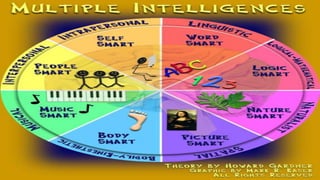
•Gardner proposed that there are eight intelligences, and has 
suggested the possible addition of a ninth known as "existentialist 
intelligence". 
•While a person might be particularly strong in a specific area, such 
as musical intelligence, they most likely possess a range of abilities.
Visual-Spatial Intelligence 
•Strengths: Visual and spatial judgment 
•People who are strong in visual-spatial intelligence are 
good a visualizing things. These individuals are often good 
with directions as well as maps, charts, videos and pictures.
Characteristics Of Visual-Spatial 
Intelligence 
• Enjoys reading and writing 
• Good at putting puzzles together 
• Good at interpreting pictures, graphs 
and charts 
• Enjoys drawing, painting and the 
visual arts 
• Recognizes patterns easily 
Potential Career Choices: 
•Architect 
•Artist 
•Engineer
Linguistic-Verbal Intelligence 
•Strengths: words, language and writing 
•People who are strong in linguistic-verbal intelligence are able to 
use words well, both when writing and speaking. These individuals 
are typically very good at writing stories, memorizing information 
and reading.
Characteristics Of Linguistic- 
Verbal Intelligence 
• Good at remembering written and 
spoken information 
• Enjoys reading and writing 
• Good at debating or giving persuasive 
speeches 
• Able to explain things well 
• Often uses humor when telling stories 
Potential Career Choices: 
•Writer / journalist 
•Lawyer 
•Teacher
Logical-Mathematical Intelligence 
•Strengths: analyzing problems and mathematical operations 
•People who are strong in logical-mathematical intelligence are good 
at reasoning, recognizing patterns and logically analyze problems. 
These individuals tend to think conceptually about numbers, 
relationships and patterns.
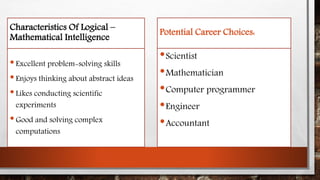
Characteristics Of Logical – 
Mathematical Intelligence 
• Excellent problem-solving skills 
• Enjoys thinking about abstract ideas 
• Likes conducting scientific 
experiments 
• Good and solving complex 
computations 
Potential Career Choices: 
•Scientist 
•Mathematician 
•Computer programmer 
•Engineer 
•Accountant
Bodily-Kinesthetic Intelligence 
•Strengths: physical movement, motor control 
•Those who have high bodily-kinesthetic intelligence are said to be 
good at body movement, performing actions and physical control. 
People who are strong in this area tend to have excellent hand-eye 
coordination and dexterity.
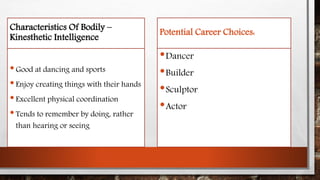
Characteristics Of Bodily – 
Kinesthetic Intelligence 
• Good at dancing and sports 
• Enjoy creating things with their hands 
• Excellent physical coordination 
• Tends to remember by doing, rather 
than hearing or seeing 
Potential Career Choices: 
•Dancer 
•Builder 
•Sculptor 
•Actor
Musical Intelligence 
•Strengths: rhythm and music 
•People who have strong musical intelligence are good at thinking in 
patterns, rhythms and sounds. They have a strong appreciation for 
music and are often good at musical composition and performance.
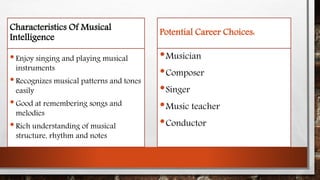
Characteristics Of Musical 
Intelligence 
• Enjoy singing and playing musical 
instruments 
• Recognizes musical patterns and tones 
easily 
• Good at remembering songs and 
melodies 
• Rich understanding of musical 
structure, rhythm and notes 
Potential Career Choices: 
•Musician 
•Composer 
•Singer 
•Music teacher 
•Conductor
Interpersonal Intelligence 
•Strengths: understanding and relating to other people 
•Those who have strong interpersonal intelligence are good at 
understanding and interacting with other people. These individuals 
are skilled at assessing the emotions, motivations, desires and 
intentions of those around them.
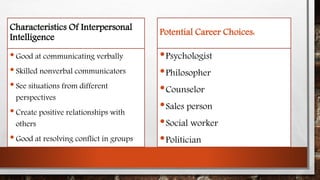
Characteristics Of Interpersonal 
Intelligence 
• Good at communicating verbally 
• Skilled nonverbal communicators 
• See situations from different 
perspectives 
• Create positive relationships with 
others 
• Good at resolving conflict in groups 
Potential Career Choices: 
•Psychologist 
•Philosopher 
•Counselor 
•Sales person 
•Social worker 
•Politician
Intrapersonal Intelligence 
•Strengths: introspection and self-reflection 
•Individuals who are strong in intrapersonal intelligence are good at 
being aware of their own emotional states, feelings and motivations. 
They tend to enjoy self-reflection and analysis, including day-dreaming, 
exploring relationships with others and assessing their 
personal strengths.
Characteristics Of Intrapersonal 
Intelligence 
• Good at analyzing their strengths and 
weaknesses 
• Enjoys analyzing theories and ideas 
• Excellent self-awareness 
• Clearly understands the basis for their 
own motivations and feelings 
Potential Career Choices: 
•Philosopher 
•Writer 
•Theorist 
•Scientist
Naturalistic Intelligence 
• Strengths: finding patterns and relationships to nature 
•Naturalistic is the most recent addition to Gardner’s theory and has been 
met with more resistance than his original seven intelligences. According 
to Gardner, individuals who are high in this type of intelligence are more 
in tune with nature and are often interested in nurturing, exploring the 
environment and learning about other species. These individuals are said 
to be highly aware of even subtle changes to their environments.
Characteristics Of Naturalistic 
Intelligence 
• Interested in subjects such as botany, 
biology and zoology 
• Good at categorizing and cataloging 
information easily 
• May enjoy camping, gardening, 
hiking and exploring the outdoors 
• Doesn’t enjoy learning unfamiliar 
topics that have no connection to 
nature 
Potential Career Choices: 
•Biologist 
•Conservationist 
•Gardener 
•Farmer
Existential Intelligence 
• Existential Intelligence is the ability to understand religious and spiritual ideals. 
They have a strong understanding of things that are not visual to the eye but 
through faith and belief. 
• Those with existential intelligence see their role in the big picture more easily 
than others and this is very important to them. They question the meaning of 
life and seek the answers; most of the time this is done through some form of 
religion. 
• They see art work as it was meant to be seen with the meanings clearer than 
those testing low in existential intelligence. Those with existential intelligence 
find meditation and relaxation easy and rewarding.

Howard Gardner’s Multiple Intelligences

  • 2.
    ”We have thismyth that the only way to learn something is to read it in a textbook or hear a lecture on it. And the only way to show that we've understood something is to take a short-answer test or maybe occasionally with an essay question thrown in. But that's nonsense. Everything can be taught in more than one way." – Howard Gardner, 1997
  • 3.
    Howard Gardner’s BriefBiography • Howard Gardner was born on July 11, 1943 in Scranton, Pennsylvania. He described himself as "a studious child who gained much pleasure from playing the piano." He completed his post-secondary education at Harvard, earning his undergraduate degree in 1965 and his Ph.D. In 1971. •While he had originally planned to study law, he was inspired by the works of Jean Piaget to study developmental psychology. He also cited the mentoring he received from the famous psychoanalyst Erik Erikson as part of the reason why he set his sights on psychology.
  • 4.
    Howard Gardner’s BriefBiography Career: •After spending time working with two very different groups, normal and gifted children and brain-damaged adults, Gardner began developing a theory designed to synthesize his research and observations. In 1983, he publishedFrames of Mind which outlined his theory of Multiple Intelligences.
  • 5.
    •According to thistheory, people have many different ways of learning. Unlike traditional theories of intelligence that focus on one, single general intelligence, Gardner believed that people instead have multiple different ways of thinking and learning. •Gardner proposed that there are eight intelligences, and has suggested the possible addition of a ninth known as "existentialist intelligence". •While a person might be particularly strong in a specific area, such as musical intelligence, they most likely possess a range of abilities.
  • 7.
    Visual-Spatial Intelligence •Strengths:Visual and spatial judgment •People who are strong in visual-spatial intelligence are good a visualizing things. These individuals are often good with directions as well as maps, charts, videos and pictures.
  • 8.
    Characteristics Of Visual-Spatial Intelligence • Enjoys reading and writing • Good at putting puzzles together • Good at interpreting pictures, graphs and charts • Enjoys drawing, painting and the visual arts • Recognizes patterns easily Potential Career Choices: •Architect •Artist •Engineer
  • 9.
    Linguistic-Verbal Intelligence •Strengths:words, language and writing •People who are strong in linguistic-verbal intelligence are able to use words well, both when writing and speaking. These individuals are typically very good at writing stories, memorizing information and reading.
  • 10.
    Characteristics Of Linguistic- Verbal Intelligence • Good at remembering written and spoken information • Enjoys reading and writing • Good at debating or giving persuasive speeches • Able to explain things well • Often uses humor when telling stories Potential Career Choices: •Writer / journalist •Lawyer •Teacher
  • 11.
    Logical-Mathematical Intelligence •Strengths:analyzing problems and mathematical operations •People who are strong in logical-mathematical intelligence are good at reasoning, recognizing patterns and logically analyze problems. These individuals tend to think conceptually about numbers, relationships and patterns.
  • 12.
    Characteristics Of Logical– Mathematical Intelligence • Excellent problem-solving skills • Enjoys thinking about abstract ideas • Likes conducting scientific experiments • Good and solving complex computations Potential Career Choices: •Scientist •Mathematician •Computer programmer •Engineer •Accountant
  • 13.
    Bodily-Kinesthetic Intelligence •Strengths:physical movement, motor control •Those who have high bodily-kinesthetic intelligence are said to be good at body movement, performing actions and physical control. People who are strong in this area tend to have excellent hand-eye coordination and dexterity.
  • 14.
    Characteristics Of Bodily– Kinesthetic Intelligence • Good at dancing and sports • Enjoy creating things with their hands • Excellent physical coordination • Tends to remember by doing, rather than hearing or seeing Potential Career Choices: •Dancer •Builder •Sculptor •Actor
  • 15.
    Musical Intelligence •Strengths:rhythm and music •People who have strong musical intelligence are good at thinking in patterns, rhythms and sounds. They have a strong appreciation for music and are often good at musical composition and performance.
  • 16.
    Characteristics Of Musical Intelligence • Enjoy singing and playing musical instruments • Recognizes musical patterns and tones easily • Good at remembering songs and melodies • Rich understanding of musical structure, rhythm and notes Potential Career Choices: •Musician •Composer •Singer •Music teacher •Conductor
  • 17.
    Interpersonal Intelligence •Strengths:understanding and relating to other people •Those who have strong interpersonal intelligence are good at understanding and interacting with other people. These individuals are skilled at assessing the emotions, motivations, desires and intentions of those around them.
  • 18.
    Characteristics Of Interpersonal Intelligence • Good at communicating verbally • Skilled nonverbal communicators • See situations from different perspectives • Create positive relationships with others • Good at resolving conflict in groups Potential Career Choices: •Psychologist •Philosopher •Counselor •Sales person •Social worker •Politician
  • 19.
    Intrapersonal Intelligence •Strengths:introspection and self-reflection •Individuals who are strong in intrapersonal intelligence are good at being aware of their own emotional states, feelings and motivations. They tend to enjoy self-reflection and analysis, including day-dreaming, exploring relationships with others and assessing their personal strengths.
  • 20.
    Characteristics Of Intrapersonal Intelligence • Good at analyzing their strengths and weaknesses • Enjoys analyzing theories and ideas • Excellent self-awareness • Clearly understands the basis for their own motivations and feelings Potential Career Choices: •Philosopher •Writer •Theorist •Scientist
  • 21.
    Naturalistic Intelligence •Strengths: finding patterns and relationships to nature •Naturalistic is the most recent addition to Gardner’s theory and has been met with more resistance than his original seven intelligences. According to Gardner, individuals who are high in this type of intelligence are more in tune with nature and are often interested in nurturing, exploring the environment and learning about other species. These individuals are said to be highly aware of even subtle changes to their environments.
  • 22.
    Characteristics Of Naturalistic Intelligence • Interested in subjects such as botany, biology and zoology • Good at categorizing and cataloging information easily • May enjoy camping, gardening, hiking and exploring the outdoors • Doesn’t enjoy learning unfamiliar topics that have no connection to nature Potential Career Choices: •Biologist •Conservationist •Gardener •Farmer
  • 23.
    Existential Intelligence •Existential Intelligence is the ability to understand religious and spiritual ideals. They have a strong understanding of things that are not visual to the eye but through faith and belief. • Those with existential intelligence see their role in the big picture more easily than others and this is very important to them. They question the meaning of life and seek the answers; most of the time this is done through some form of religion. • They see art work as it was meant to be seen with the meanings clearer than those testing low in existential intelligence. Those with existential intelligence find meditation and relaxation easy and rewarding.