Multimedia Design Principles
Things to Consider
 Your audience
 Age level
 Grade level
 Reading level
 Ethnicity
 The equipment
 What equipment do you have for:
 Creating
 Displaying
 Transporting
 What will the cost be?
 What is your skill level?
 How much time do you have?
Organization
 Make detailed outline before you turn the computer on.
 Refine each section and subsection according to a consistent
pattern.
 Order the information:
 Chronologically
 By development
 According to topics
 From general to specific
 From problem to solution
Story Board
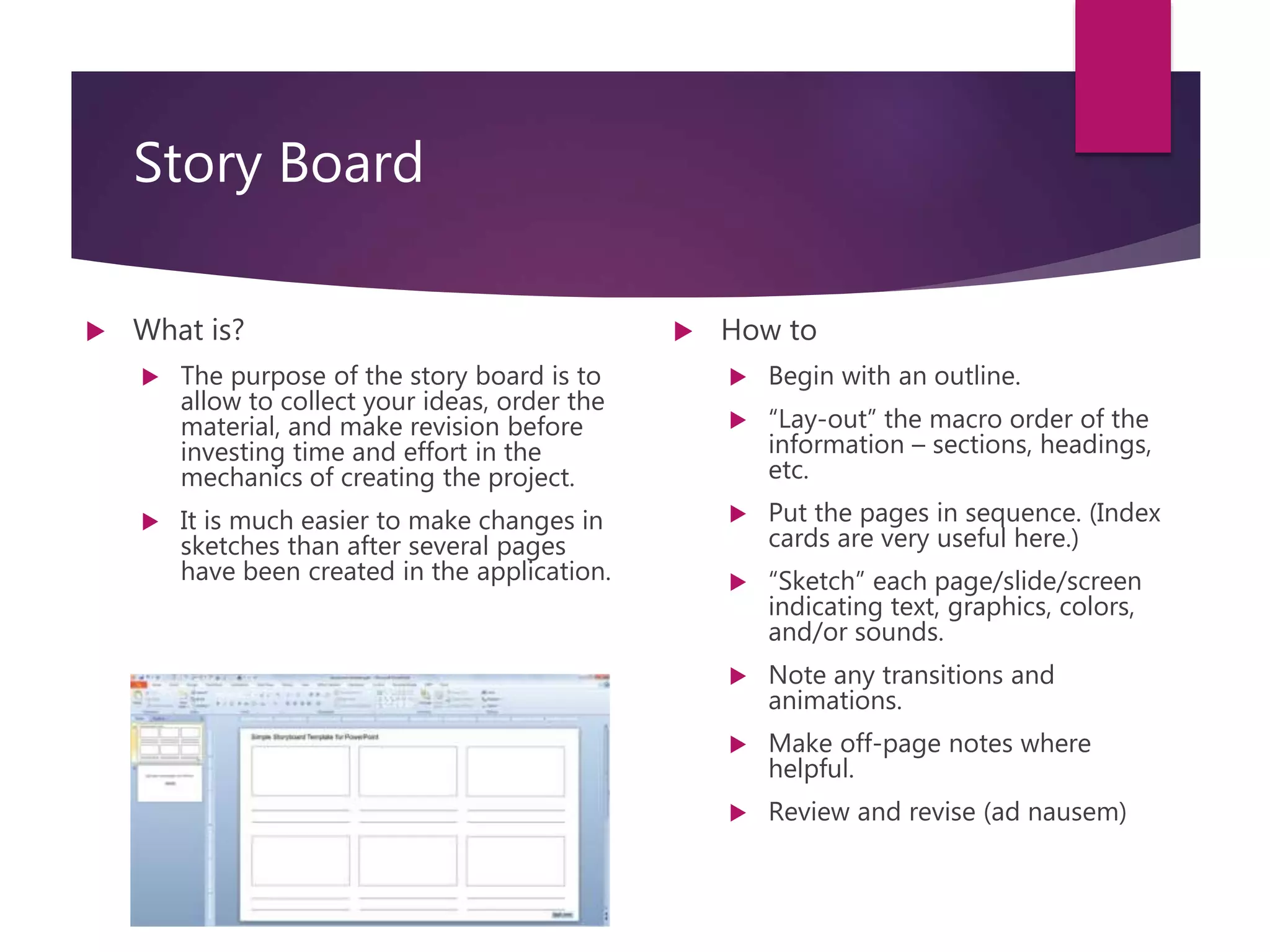
 What is?
 The purpose of the story board is to
allow to collect your ideas, order the
material, and make revision before
investing time and effort in the
mechanics of creating the project.
 It is much easier to make changes in
sketches than after several pages
have been created in the application.
 How to
 Begin with an outline.
 “Lay-out” the macro order of the
information – sections, headings,
etc.
 Put the pages in sequence. (Index
cards are very useful here.)
 “Sketch” each page/slide/screen
indicating text, graphics, colors,
and/or sounds.
 Note any transitions and
animations.
 Make off-page notes where
helpful.
 Review and revise (ad nausem)
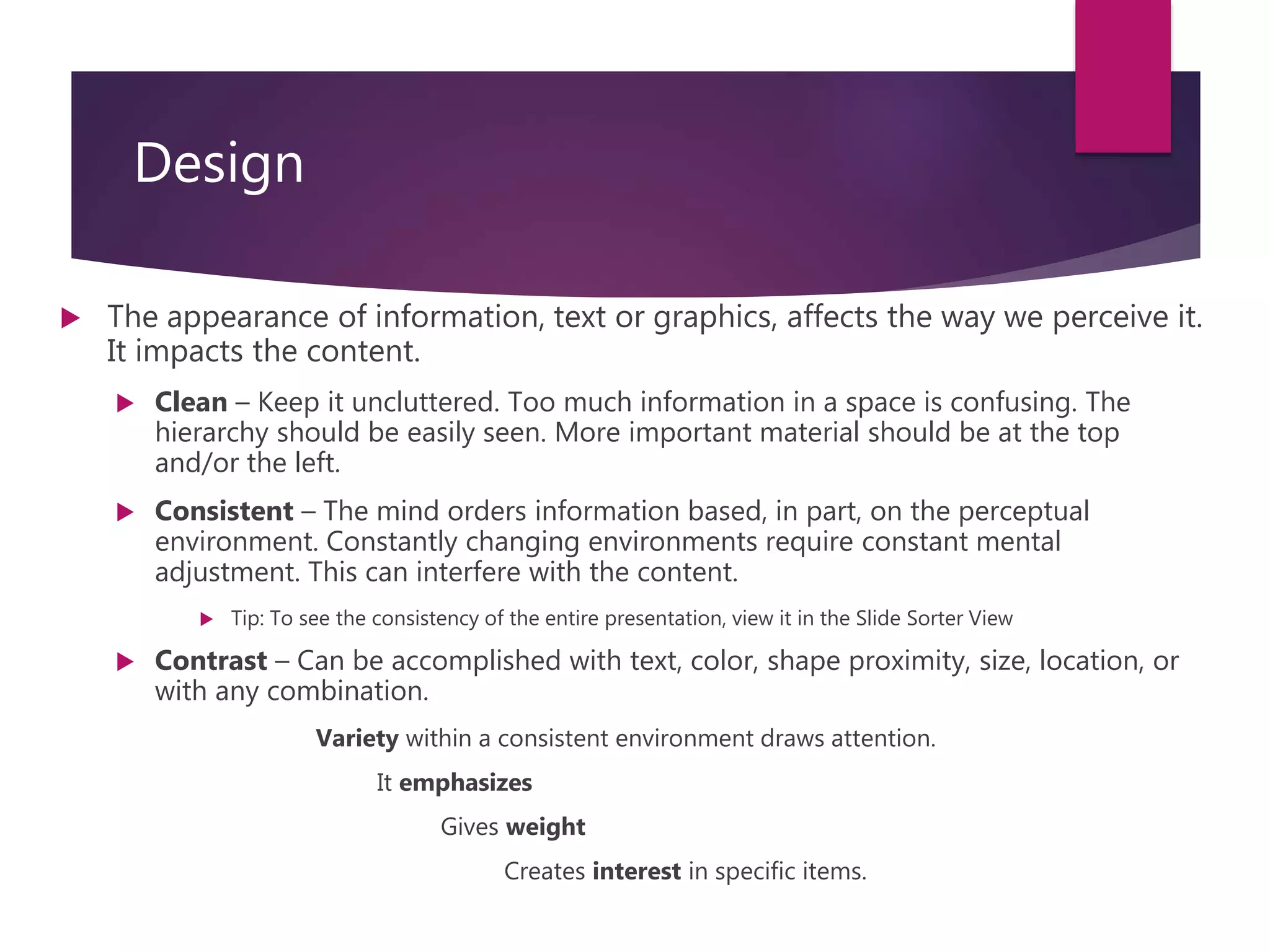
Design
 The appearance of information, text or graphics, affects the way we perceive it.
It impacts the content.
 Clean – Keep it uncluttered. Too much information in a space is confusing. The
hierarchy should be easily seen. More important material should be at the top
and/or the left.
 Consistent – The mind orders information based, in part, on the perceptual
environment. Constantly changing environments require constant mental
adjustment. This can interfere with the content.
 Tip: To see the consistency of the entire presentation, view it in the Slide Sorter View
 Contrast – Can be accomplished with text, color, shape proximity, size, location, or
with any combination.
Variety within a consistent environment draws attention.
It emphasizes
Gives weight
Creates interest in specific items.
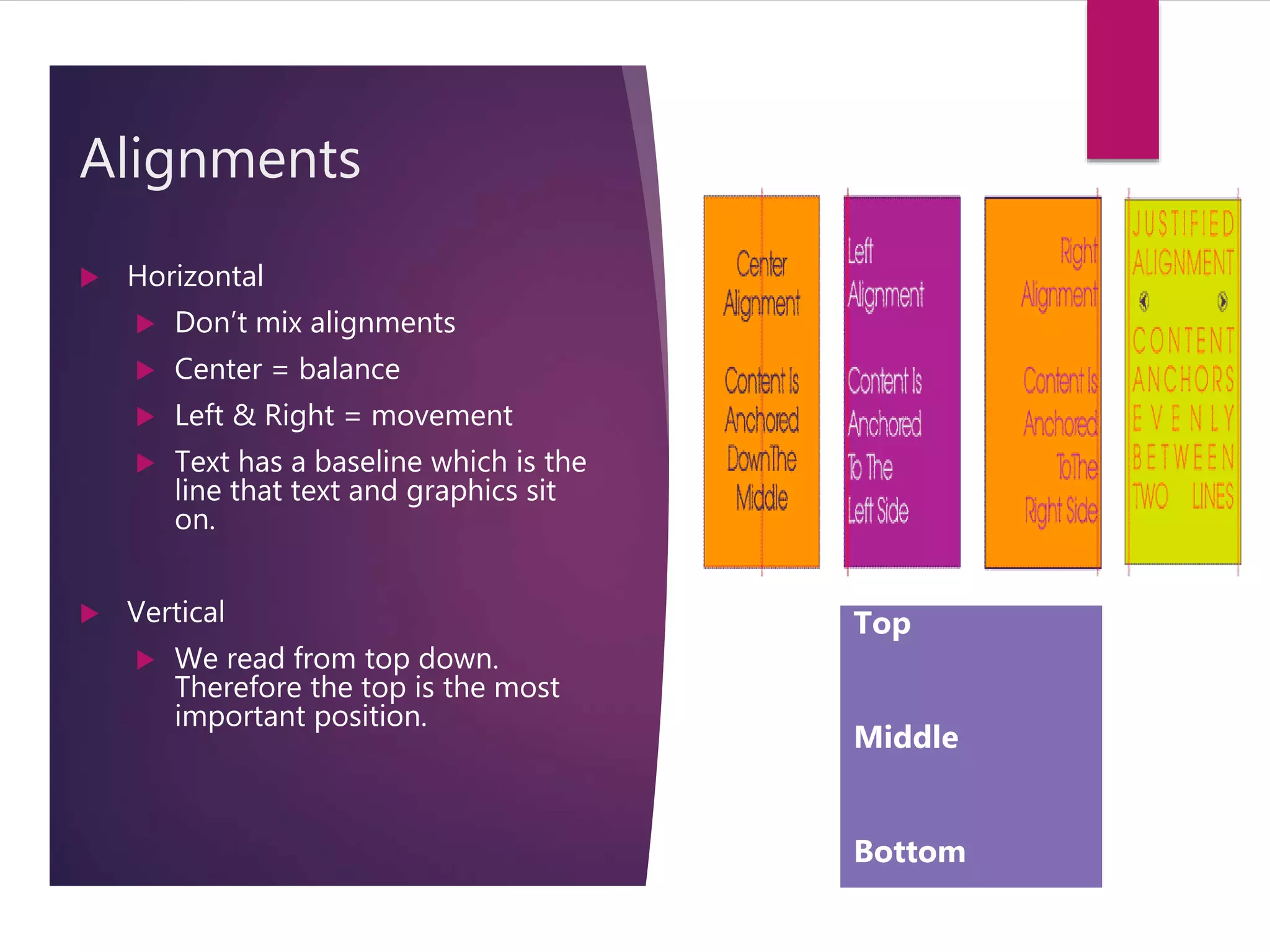
Alignments
 Horizontal
 Don’t mix alignments
 Center = balance
 Left & Right = movement
 Text has a baseline which is the
line that text and graphics sit
on.
 Vertical
 We read from top down.
Therefore the top is the most
important position.
Top
Middle
Bottom
Proximity
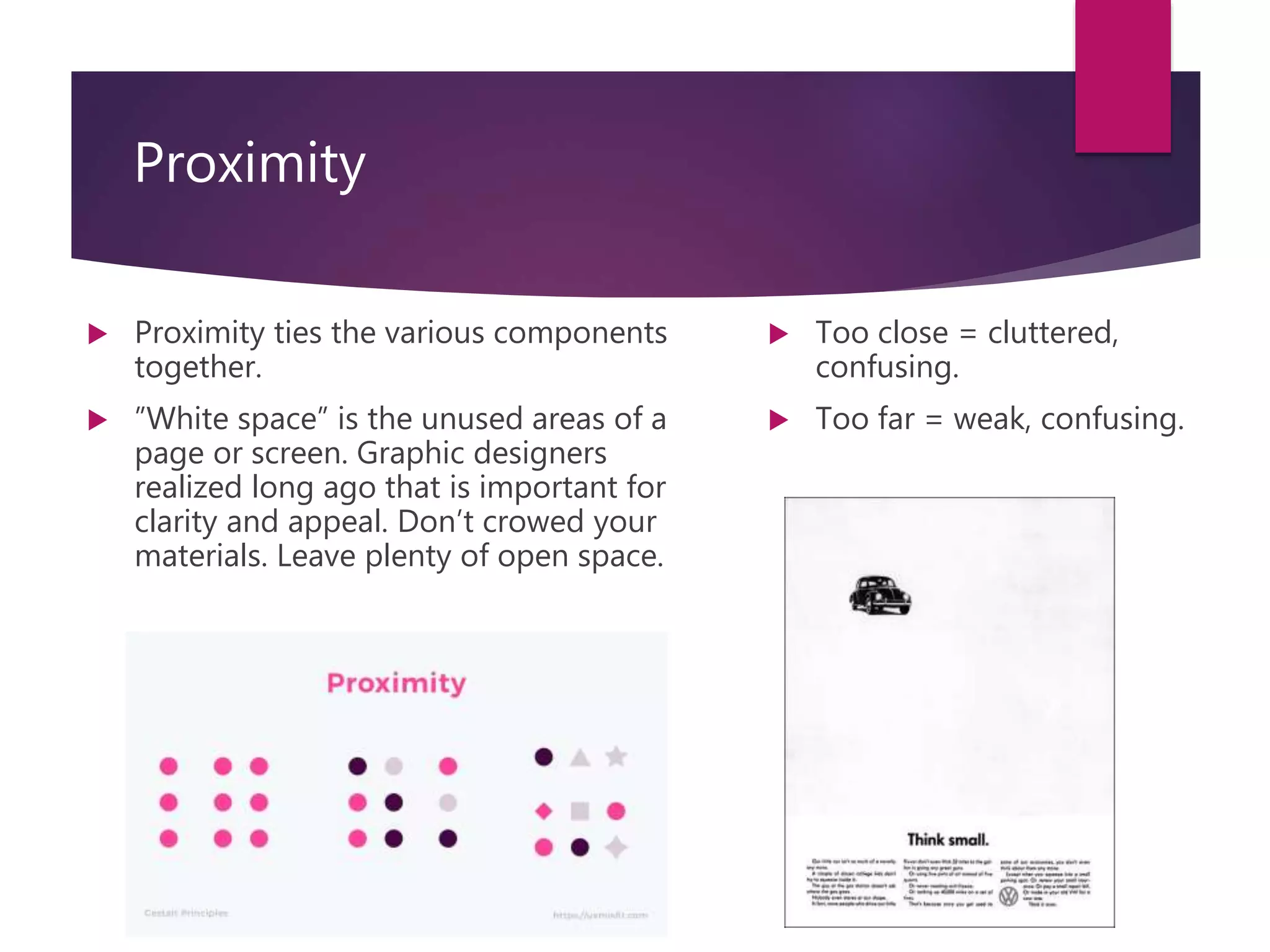
 Proximity ties the various components
together.
 ”White space” is the unused areas of a
page or screen. Graphic designers
realized long ago that is important for
clarity and appeal. Don’t crowed your
materials. Leave plenty of open space.
 Too close = cluttered,
confusing.
 Too far = weak, confusing.
Typography
Tips:
 Use only 2 (3 at the very most) fonts
in any document.
 Let size and style (bold, italic,
underline) create contrast.
 Avoid the use of all caps. All
capitalized texts have no variety in
shape. Therefore, they are more
difficult to read.
 Avoid all bold. Constant emphasis is
no emphasis. Connect the style to
the meaning of the text.
{Fonts}
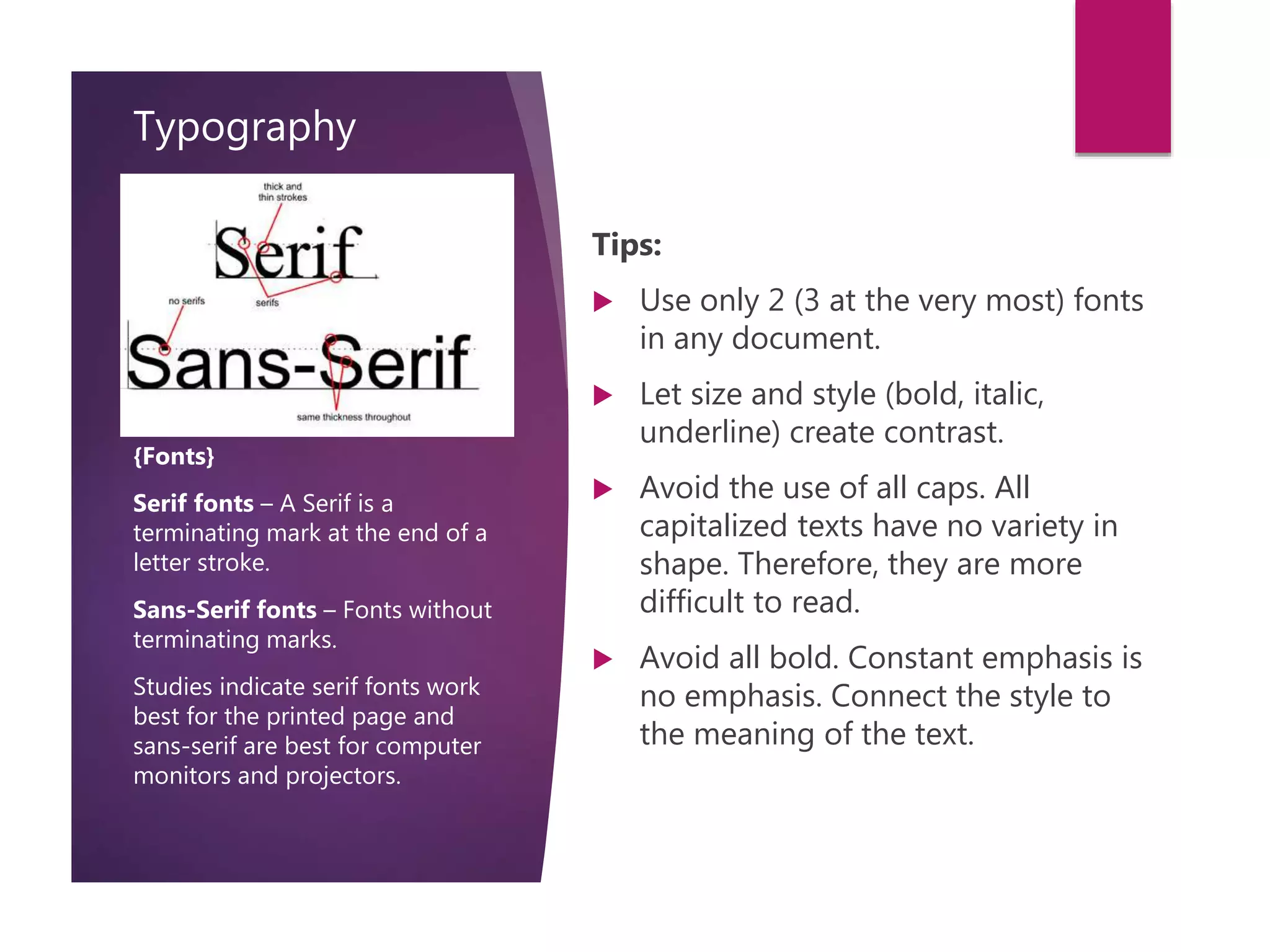
Serif fonts – A Serif is a
terminating mark at the end of a
letter stroke.
Sans-Serif fonts – Fonts without
terminating marks.
Studies indicate serif fonts work
best for the printed page and
sans-serif are best for computer
monitors and projectors.
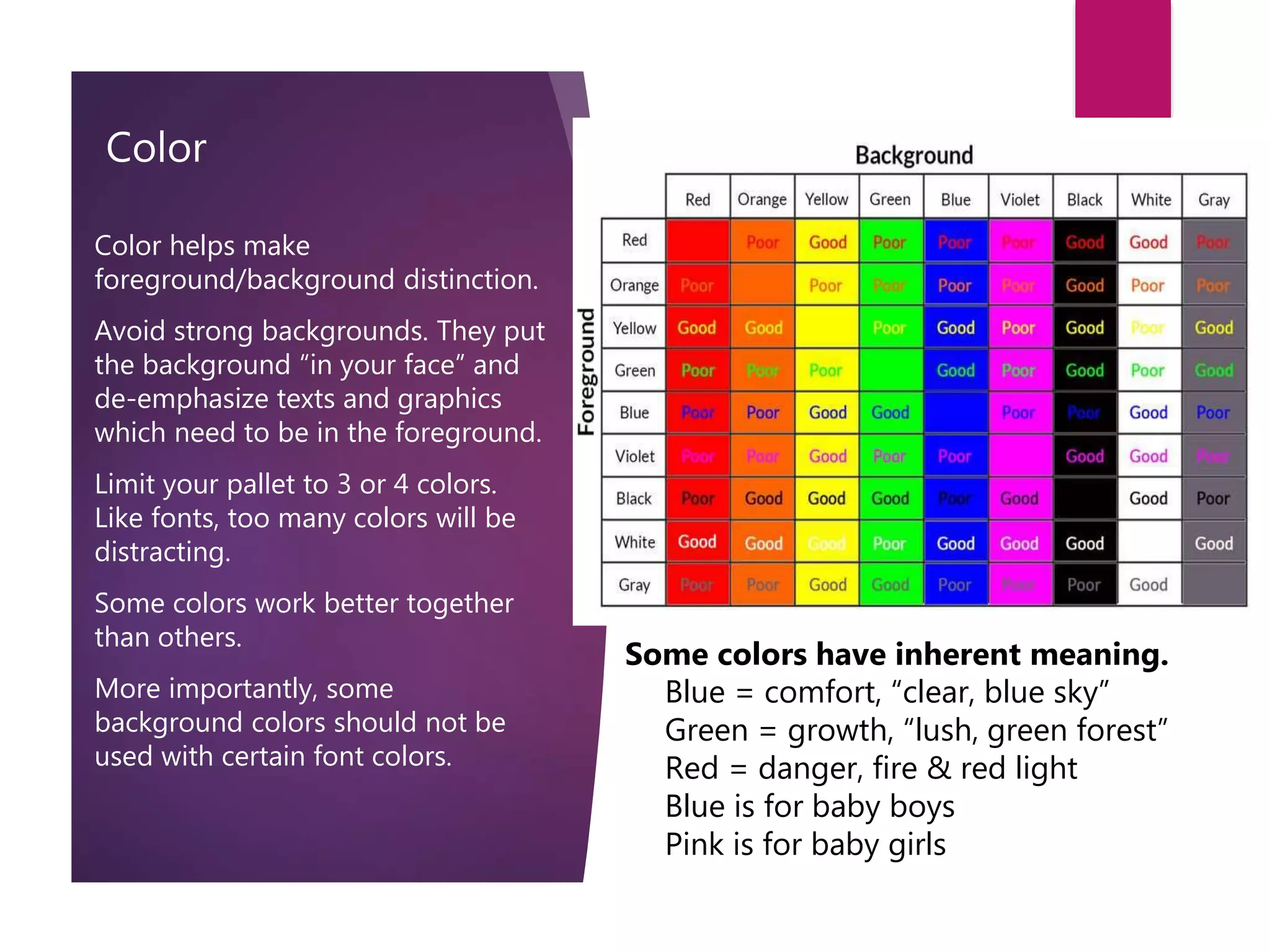
Color
Color helps make
foreground/background distinction.
Avoid strong backgrounds. They put
the background “in your face” and
de-emphasize texts and graphics
which need to be in the foreground.
Limit your pallet to 3 or 4 colors.
Like fonts, too many colors will be
distracting.
Some colors work better together
than others.
More importantly, some
background colors should not be
used with certain font colors.
Some colors have inherent meaning.
• Blue = comfort, “clear, blue sky”
• Green = growth, “lush, green forest”
• Red = danger, fire & red light
• Blue is for baby boys
• Pink is for baby girls
Form and content
 The balance between form and content is an age-old issue in art and in
communication.
 Content is the material to be learned. Content must have some form, but there
needs to be a a balance that allows the form to focus attention on the content.
 Form is the way in which that material is presented. Form should enable the
content but not detract from it. Form can engage learners but it must not
distract them from the content.
 Objects – too many graphics can be confusing.
 They are inherently more attractive than text.
 Movement is even stronger.
 Balance objects on the page.
 Objects require much more computer memory than text.
Tips and Techniques
Tips and
Techniques
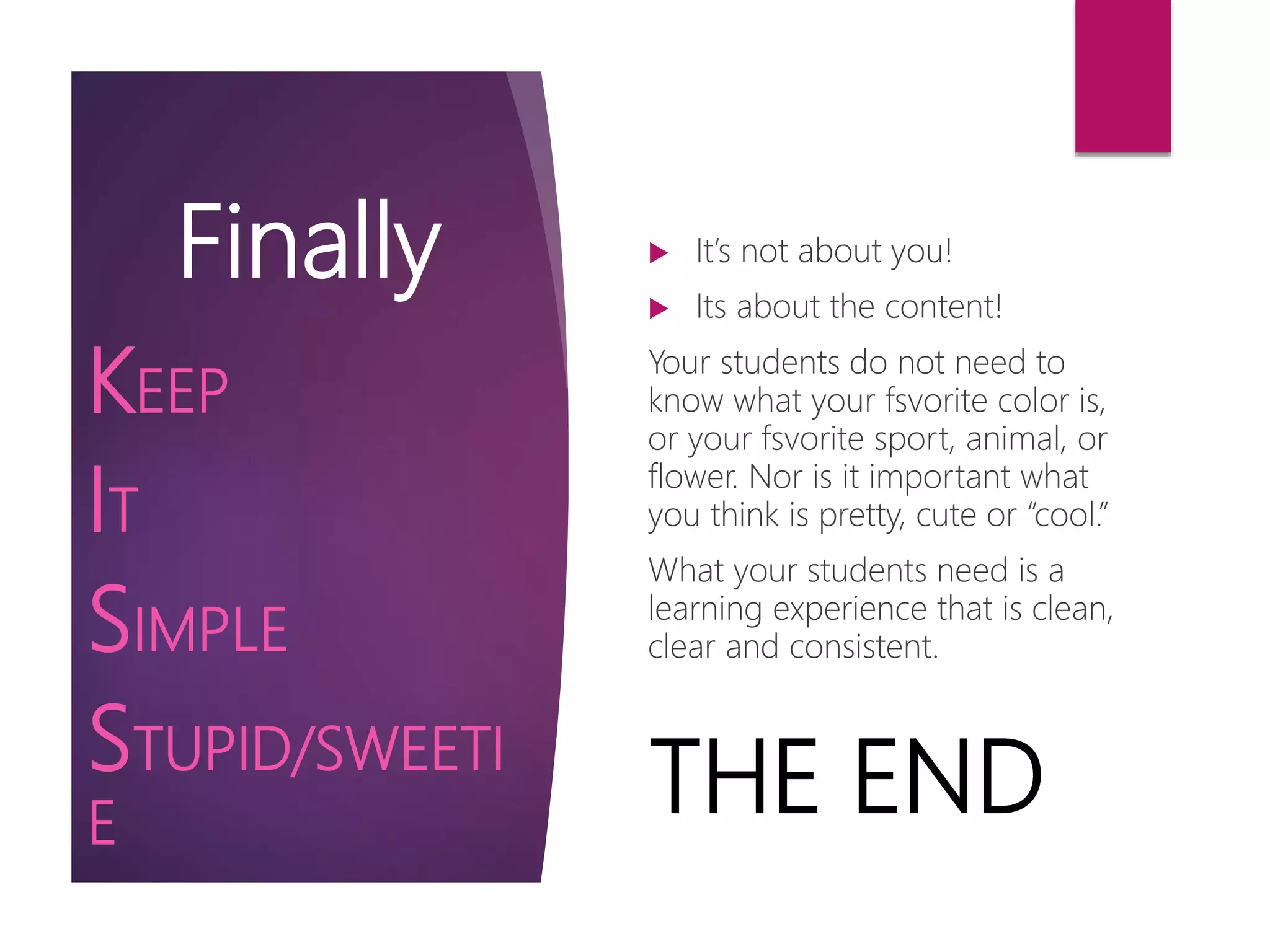
Finally  It’s not about you!
 Its about the content!
Your students do not need to
know what your fsvorite color is,
or your fsvorite sport, animal, or
flower. Nor is it important what
you think is pretty, cute or “cool.”
What your students need is a
learning experience that is clean,
clear and consistent.
KEEP
IT
SIMPLE
STUPID/SWEETI
E
THE END

Multimedia design principles

  • 1.
  • 2.
    Things to Consider Your audience  Age level  Grade level  Reading level  Ethnicity  The equipment  What equipment do you have for:  Creating  Displaying  Transporting  What will the cost be?  What is your skill level?  How much time do you have?
  • 3.
    Organization  Make detailedoutline before you turn the computer on.  Refine each section and subsection according to a consistent pattern.  Order the information:  Chronologically  By development  According to topics  From general to specific  From problem to solution
  • 4.
    Story Board  Whatis?  The purpose of the story board is to allow to collect your ideas, order the material, and make revision before investing time and effort in the mechanics of creating the project.  It is much easier to make changes in sketches than after several pages have been created in the application.  How to  Begin with an outline.  “Lay-out” the macro order of the information – sections, headings, etc.  Put the pages in sequence. (Index cards are very useful here.)  “Sketch” each page/slide/screen indicating text, graphics, colors, and/or sounds.  Note any transitions and animations.  Make off-page notes where helpful.  Review and revise (ad nausem)
  • 5.
    Design  The appearanceof information, text or graphics, affects the way we perceive it. It impacts the content.  Clean – Keep it uncluttered. Too much information in a space is confusing. The hierarchy should be easily seen. More important material should be at the top and/or the left.  Consistent – The mind orders information based, in part, on the perceptual environment. Constantly changing environments require constant mental adjustment. This can interfere with the content.  Tip: To see the consistency of the entire presentation, view it in the Slide Sorter View  Contrast – Can be accomplished with text, color, shape proximity, size, location, or with any combination. Variety within a consistent environment draws attention. It emphasizes Gives weight Creates interest in specific items.
  • 6.
    Alignments  Horizontal  Don’tmix alignments  Center = balance  Left & Right = movement  Text has a baseline which is the line that text and graphics sit on.  Vertical  We read from top down. Therefore the top is the most important position. Top Middle Bottom
  • 7.
    Proximity  Proximity tiesthe various components together.  ”White space” is the unused areas of a page or screen. Graphic designers realized long ago that is important for clarity and appeal. Don’t crowed your materials. Leave plenty of open space.  Too close = cluttered, confusing.  Too far = weak, confusing.
  • 8.
    Typography Tips:  Use only2 (3 at the very most) fonts in any document.  Let size and style (bold, italic, underline) create contrast.  Avoid the use of all caps. All capitalized texts have no variety in shape. Therefore, they are more difficult to read.  Avoid all bold. Constant emphasis is no emphasis. Connect the style to the meaning of the text. {Fonts} Serif fonts – A Serif is a terminating mark at the end of a letter stroke. Sans-Serif fonts – Fonts without terminating marks. Studies indicate serif fonts work best for the printed page and sans-serif are best for computer monitors and projectors.
  • 9.
    Color Color helps make foreground/backgrounddistinction. Avoid strong backgrounds. They put the background “in your face” and de-emphasize texts and graphics which need to be in the foreground. Limit your pallet to 3 or 4 colors. Like fonts, too many colors will be distracting. Some colors work better together than others. More importantly, some background colors should not be used with certain font colors. Some colors have inherent meaning. • Blue = comfort, “clear, blue sky” • Green = growth, “lush, green forest” • Red = danger, fire & red light • Blue is for baby boys • Pink is for baby girls
  • 10.
    Form and content The balance between form and content is an age-old issue in art and in communication.  Content is the material to be learned. Content must have some form, but there needs to be a a balance that allows the form to focus attention on the content.  Form is the way in which that material is presented. Form should enable the content but not detract from it. Form can engage learners but it must not distract them from the content.  Objects – too many graphics can be confusing.  They are inherently more attractive than text.  Movement is even stronger.  Balance objects on the page.  Objects require much more computer memory than text.
  • 11.
  • 12.
  • 13.
    Finally  It’snot about you!  Its about the content! Your students do not need to know what your fsvorite color is, or your fsvorite sport, animal, or flower. Nor is it important what you think is pretty, cute or “cool.” What your students need is a learning experience that is clean, clear and consistent. KEEP IT SIMPLE STUPID/SWEETI E THE END