GTC 2019
Slide 1 of 28Distribution A: This is approved for public release; distribution is unlimited
Unclassified
Distribution A: This is approved for public release; distribution is unlimited
Unclassified
Kevin Roe
GTC 2019, San Jose
Multi-GPU FFT Performance on
Different Hardware Configurations
Kevin Roe
Maui High Performance
Computing Center
Ken Hester
Nvidia
Raphael Pascual
Pacific Defense Solutions
GTC 2019
Slide 2 of 28Distribution A: This is approved for public release; distribution is unlimited
Unclassified
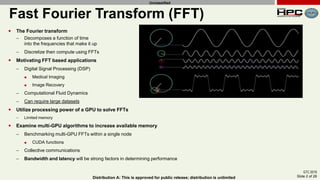
 The Fourier transform
– Decomposes a function of time
into the frequencies that make it up
– Discretize then compute using FFTs
 Motivating FFT based applications
– Digital Signal Processing (DSP)
 Medical Imaging
 Image Recovery
– Computational Fluid Dynamics
– Can require large datasets
 Utilize processing power of a GPU to solve FFTs
– Limited memory
 Examine multi-GPU algorithms to increase available memory
– Benchmarking multi-GPU FFTs within a single node
 CUDA functions
– Collective communications
– Bandwidth and latency will be strong factors in determining performance
Fast Fourier Transform (FFT)
GTC 2019
Slide 3 of 28Distribution A: This is approved for public release; distribution is unlimited
Unclassified
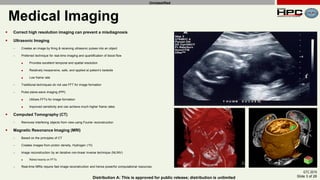
Medical Imaging
 Correct high resolution imaging can prevent a misdiagnosis
 Ultrasonic Imaging
– Creates an image by firing & receiving ultrasonic pulses into an object
– Preferred technique for real-time imaging and quantification of blood flow
 Provides excellent temporal and spatial resolution
 Relatively inexpensive, safe, and applied at patient’s bedside
 Low frame rate
– Traditional techniques do not use FFT for image formation
– Pulse plane-wave imaging (PPI)
 Utilizes FFTs for image formation
 Improved sensitivity and can achieve much higher frame rates
 Computed Tomography (CT)
– Removes interfering objects from view using Fourier reconstruction
 Magnetic Resonance Imaging (MRI)
– Based on the principles of CT
– Creates images from proton density, Hydrogen (1H)
– Image reconstruction by an iterative non-linear inverse technique (NLINV)
 Relies heavily on FFTs
– Real-time MRIs require fast image reconstruction and hence powerful computational resources
GTC 2019
Slide 4 of 28Distribution A: This is approved for public release; distribution is unlimited
Unclassified
Medical Imaging (continued)
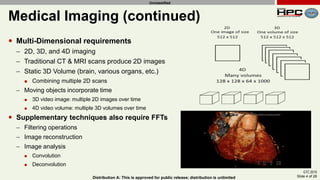
 Multi-Dimensional requirements
– 2D, 3D, and 4D imaging
– Traditional CT & MRI scans produce 2D images
– Static 3D Volume (brain, various organs, etc.)
 Combining multiple 2D scans
– Moving objects incorporate time
 3D video image: multiple 2D images over time
 4D video volume: multiple 3D volumes over time
 Supplementary techniques also require FFTs
– Filtering operations
– Image reconstruction
– Image analysis
 Convolution
 Deconvolution
GTC 2019
Slide 5 of 28Distribution A: This is approved for public release; distribution is unlimited
Unclassified
Image Recovery
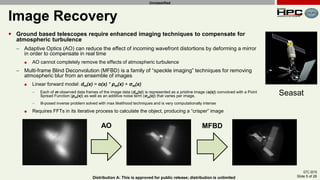
 Ground based telescopes require enhanced imaging techniques to compensate for
atmospheric turbulence
– Adaptive Optics (AO) can reduce the effect of incoming wavefront distortions by deforming a mirror
in order to compensate in real time
 AO cannot completely remove the effects of atmospheric turbulence
– Multi-frame Blind Deconvolution (MFBD) is a family of “speckle imaging” techniques for removing
atmospheric blur from an ensemble of images
 Linear forward model: dm(x) = o(x) * pm(x) + σm(x)
– Each of m observed data frames of the image data (dm(x)) is represented as a pristine image (o(x)) convolved with a Point
Spread Function (pm(x)) as well as an additive noise term (σm(x)) that varies per image.
– Ill-posed inverse problem solved with max likelihood techniques and is very computationally intense
 Requires FFTs in its iterative process to calculate the object, producing a “crisper” image
AO MFBD
Seasat
GTC 2019
Slide 6 of 28Distribution A: This is approved for public release; distribution is unlimited
Unclassified
Image Recovery (continued)
 Physically Constrained Image Deconvolution (PCID)
 A highly effective MFBD has been parallelized to produce restorations quickly
 A GPU version of the code is in development
 Fermi Gamma-ray Space Telescope: NASA satellite (2008)
 Study astrophysical and cosmological phenomena
 Galactic, pulsar, other high-energy sources, and dark matter
GTC 2019
Slide 7 of 28Distribution A: This is approved for public release; distribution is unlimited
Unclassified
Computational Fluid Dynamics
 Direct Numerical Simulation (DNS)
– Finite Difference, Finite Element, & Finite Volume methods
– Pseudo Spectral method: effectively solving in spectral space using
FFTs
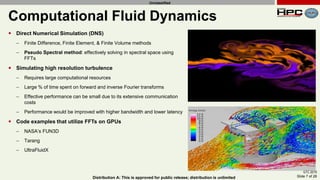
 Simulating high resolution turbulence
– Requires large computational resources
– Large % of time spent on forward and inverse Fourier transforms
– Effective performance can be small due to its extensive communication
costs
– Performance would be improved with higher bandwidth and lower latency
 Code examples that utilize FFTs on GPUs
– NASA’s FUN3D
– Tarang
– UltraFluidX
GTC 2019
Slide 8 of 28Distribution A: This is approved for public release; distribution is unlimited
Unclassified
Benchmarking Multi-GPU FFTs
 Represent large 3D FFTs problems that cannot fit on a single GPU
– Single precision Complex to Complex (C2C) in-place transformations
 C2C considered more performant than the Real to Complex (R2C) transform
 In-place – reduces memory footprint and requires less bandwidth
 Distributing large FFTs across multiple GPUs
– Communication is required when spreading and returning data
– Significant amount collective communications
 Bandwidth and latency will be strong factors in determining performance
 Primary CUDA functions (used v9.1 for consistency across platforms)
– cufftXtSetGPUs – identifies the GPUs to be used with the plan
– cufftMakePlanMany64 - Create a plan that also considers the number of GPUs available. The “64” means
argument sizes and strides to be 64 bit integers to allow for very large transforms
– cufftXtExecDescriptorC2C – executes C2C transforms for single precision
GTC 2019
Slide 9 of 28Distribution A: This is approved for public release; distribution is unlimited
Unclassified
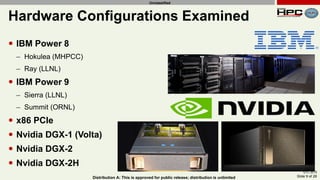
Hardware Configurations Examined
 IBM Power 8
– Hokulea (MHPCC)
– Ray (LLNL)
 IBM Power 9
– Sierra (LLNL)
– Summit (ORNL)
 x86 PCIe
 Nvidia DGX-1 (Volta)
 Nvidia DGX-2
 Nvidia DGX-2H
GTC 2019
Slide 10 of 28Distribution A: This is approved for public release; distribution is unlimited
Unclassified
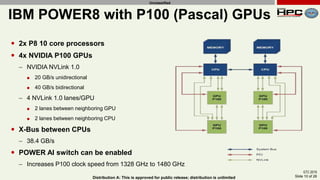
 2x P8 10 core processors
 4x NVIDIA P100 GPUs
– NVIDIA NVLink 1.0
 20 GB/s unidirectional
 40 GB/s bidirectional
– 4 NVLink 1.0 lanes/GPU
 2 lanes between neighboring GPU
 2 lanes between neighboring CPU
 X-Bus between CPUs
– 38.4 GB/s
 POWER AI switch can be enabled
– Increases P100 clock speed from 1328 GHz to 1480 GHz
IBM POWER8 with P100 (Pascal) GPUs
GTC 2019
Slide 11 of 28Distribution A: This is approved for public release; distribution is unlimited
Unclassified
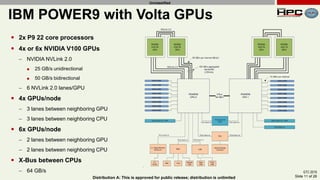
 2x P9 22 core processors
 4x or 6x NVIDIA V100 GPUs
– NVIDIA NVLink 2.0
 25 GB/s unidirectional
 50 GB/s bidirectional
– 6 NVLink 2.0 lanes/GPU
 4x GPUs/node
– 3 lanes between neighboring GPU
– 3 lanes between neighboring CPU
 6x GPUs/node
– 2 lanes between neighboring GPU
– 2 lanes between neighboring CPU
 X-Bus between CPUs
– 64 GB/s
IBM POWER9 with Volta GPUs
GTC 2019
Slide 12 of 28Distribution A: This is approved for public release; distribution is unlimited
Unclassified
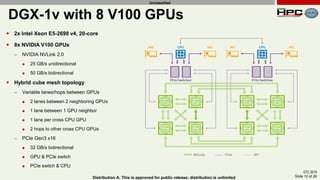
 2x Intel Xeon E5-2698 v4, 20-core
 8x NVIDIA V100 GPUs
– NVIDIA NVLink 2.0
 25 GB/s unidirectional
 50 GB/s bidirectional
 Hybrid cube mesh topology
– Variable lanes/hops between GPUs
 2 lanes between 2 neighboring GPUs
 1 lane between 1 GPU neighbor
 1 lane per cross CPU GPU
 2 hops to other cross CPU GPUs
– PCIe Gen3 x16
 32 GB/s bidirectional
 GPU & PCIe switch
 PCIe switch & CPU
DGX-1v with 8 V100 GPUs
GTC 2019
Slide 13 of 28Distribution A: This is approved for public release; distribution is unlimited
Unclassified
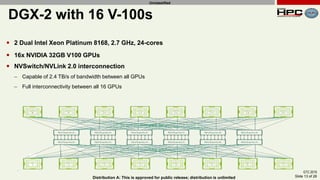
DGX-2 with 16 V-100s
 2 Dual Intel Xeon Platinum 8168, 2.7 GHz, 24-cores
 16x NVIDIA 32GB V100 GPUs
 NVSwitch/NVLink 2.0 interconnection
– Capable of 2.4 TB/s of bandwidth between all GPUs
– Full interconnectivity between all 16 GPUs
GTC 2019
Slide 14 of 28Distribution A: This is approved for public release; distribution is unlimited
Unclassified
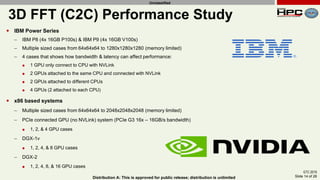
 IBM Power Series
– IBM P8 (4x 16GB P100s) & IBM P9 (4x 16GB V100s)
– Multiple sized cases from 64x64x64 to 1280x1280x1280 (memory limited)
– 4 cases that shows how bandwidth & latency can affect performance:
 1 GPU only connect to CPU with NVLink
 2 GPUs attached to the same CPU and connected with NVLink
 2 GPUs attached to different CPUs
 4 GPUs (2 attached to each CPU)
 x86 based systems
– Multiple sized cases from 64x64x64 to 2048x2048x2048 (memory limited)
– PCIe connected GPU (no NVLink) system (PCIe G3 16x – 16GB/s bandwidth)
 1, 2, & 4 GPU cases
– DGX-1v
 1, 2, 4, & 8 GPU cases
– DGX-2
 1, 2, 4, 8, & 16 GPU cases
3D FFT (C2C) Performance Study
GTC 2019
Slide 15 of 28Distribution A: This is approved for public release; distribution is unlimited
Unclassified
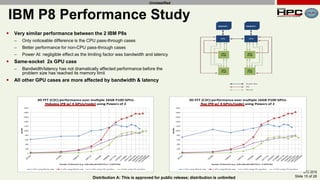
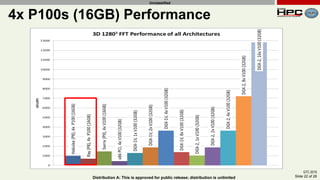
IBM P8 Performance Study
 Very similar performance between the 2 IBM P8s
– Only noticeable difference is the CPU pass-through cases
– Better performance for non-CPU pass-through cases
– Power AI: negligible effect as the limiting factor was bandwidth and latency
 Same-socket 2x GPU case
– Bandwidth/latency has not dramatically affected performance before the
problem size has reached its memory limit
 All other GPU cases are more affected by bandwidth & latency
GTC 2019
Slide 16 of 28Distribution A: This is approved for public release; distribution is unlimited
Unclassified
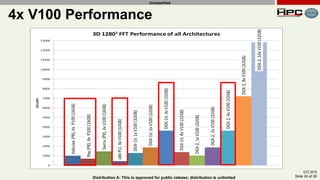
IBM P9 Performance Study
 P9 with 4x 16GB V100s performed better than the P8
– Similar trends in performance as P8 b/c of architecture
– Better overall performance b/c of V100 and 6 NVLink 2.0 lanes
– Additional bandwidth of NVLink 2.0 allowed for better scaling
 2x & 4x GPU CPU pass-through cases
– Bandwidth & latency limit performance gain
 Summit performance expectation w/ 6 GPUs/node
– Less available lanes per GPU ≡ less bandwidth
– Greater Memory (6x16GB) ≡ greater number of elements
GTC 2019
Slide 17 of 28Distribution A: This is approved for public release; distribution is unlimited
Unclassified
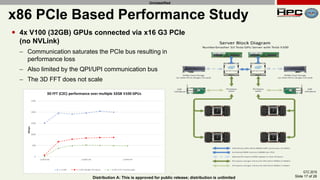
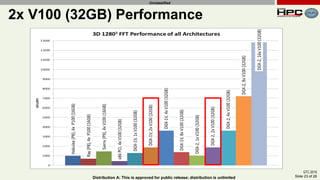
x86 PCIe Based Performance Study
 4x V100 (32GB) GPUs connected via x16 G3 PCIe
(no NVLink)
– Communication saturates the PCIe bus resulting in
performance loss
– Also limited by the QPI/UPI communication bus
– The 3D FFT does not scale
GTC 2019
Slide 18 of 28Distribution A: This is approved for public release; distribution is unlimited
Unclassified
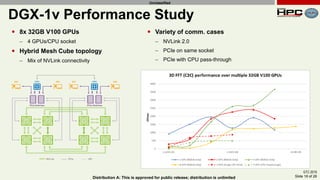
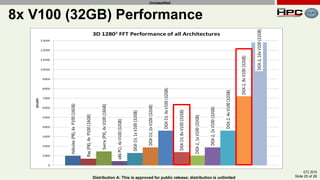
DGX-1v Performance Study
 8x 32GB V100 GPUs
– 4 GPUs/CPU socket
 Hybrid Mesh Cube topology
– Mix of NVLink connectivity
 Variety of comm. cases
– NVLink 2.0
– PCIe on same socket
– PCIe with CPU pass-through
GTC 2019
Slide 19 of 28Distribution A: This is approved for public release; distribution is unlimited
Unclassified
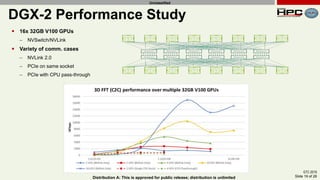
DGX-2 Performance Study
 16x 32GB V100 GPUs
– NVSwitch/NVLink
 Variety of comm. cases
– NVLink 2.0
– PCIe on same socket
– PCIe with CPU pass-through
GTC 2019
Slide 20 of 28Distribution A: This is approved for public release; distribution is unlimited
Unclassified
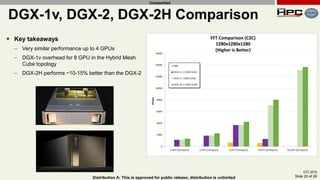
DGX-1v, DGX-2, DGX-2H Comparison
 Key takeaways
– Very similar performance up to 4 GPUs
– DGX-1v overhead for 8 GPU in the Hybrid Mesh
Cube topology
– DGX-2H performs ~10-15% better than the DGX-2
GTC 2019
Slide 21 of 28Distribution A: This is approved for public release; distribution is unlimited
Unclassified
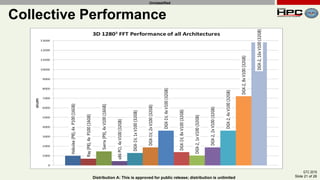
Collective Performance
GTC 2019
Slide 22 of 28Distribution A: This is approved for public release; distribution is unlimited
Unclassified
4x P100s (16GB) Performance
GTC 2019
Slide 23 of 28Distribution A: This is approved for public release; distribution is unlimited
Unclassified
2x V100 (32GB) Performance
GTC 2019
Slide 24 of 28Distribution A: This is approved for public release; distribution is unlimited
Unclassified
4x V100 Performance
GTC 2019
Slide 25 of 28Distribution A: This is approved for public release; distribution is unlimited
Unclassified
8x V100 (32GB) Performance
GTC 2019
Slide 26 of 28Distribution A: This is approved for public release; distribution is unlimited
Unclassified
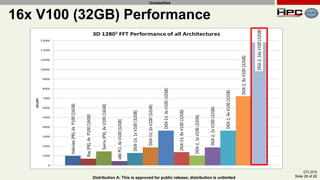
16x V100 (32GB) Performance
GTC 2019
Slide 27 of 28Distribution A: This is approved for public release; distribution is unlimited
Unclassified
Conclusions
 Collective communication operations dominate performance when large FFTs are spread over multiple GPUs
– Highly dependent on underlying architecture’s bandwidth and latency
 x86 PCIe based systems
– Lower bandwidth and higher latency restrict scaling of multi-GPU FFTs
 IBM Power Series
– Overhead associated when needed to handle communication between GPUs on different sockets limit performance
 NVIDIA DGX-1v
– Hybrid Mesh Cube topology lowers communication overhead between GPUs
 NVIDIA DGX-2
– NVSwitch technology has the lowest communication overhead between GPUs
 NVIDIA DGX-2H
– Low communication overhead combined with faster GPUs
GTC 2019
Slide 28 of 28Distribution A: This is approved for public release; distribution is unlimited
Unclassified
 Future Work
– Examine Unified Memory FFT implementations
– Multi-node Multi-GPU FFT implementations
– Deeper analysis of the DGX-2H
 Thank & acknowledge support by
– The U.S. DoD High Performance Computing Modernization Program
– The U.S. DoE at Lawrence Livermore National Laboratory
– NVIDIA
Future Work

Multi-GPU FFT Performance on Different Hardware

  • 1.
    GTC 2019 Slide 1of 28Distribution A: This is approved for public release; distribution is unlimited Unclassified Distribution A: This is approved for public release; distribution is unlimited Unclassified Kevin Roe GTC 2019, San Jose Multi-GPU FFT Performance on Different Hardware Configurations Kevin Roe Maui High Performance Computing Center Ken Hester Nvidia Raphael Pascual Pacific Defense Solutions
  • 2.
    GTC 2019 Slide 2of 28Distribution A: This is approved for public release; distribution is unlimited Unclassified  The Fourier transform – Decomposes a function of time into the frequencies that make it up – Discretize then compute using FFTs  Motivating FFT based applications – Digital Signal Processing (DSP)  Medical Imaging  Image Recovery – Computational Fluid Dynamics – Can require large datasets  Utilize processing power of a GPU to solve FFTs – Limited memory  Examine multi-GPU algorithms to increase available memory – Benchmarking multi-GPU FFTs within a single node  CUDA functions – Collective communications – Bandwidth and latency will be strong factors in determining performance Fast Fourier Transform (FFT)
  • 3.
    GTC 2019 Slide 3of 28Distribution A: This is approved for public release; distribution is unlimited Unclassified Medical Imaging  Correct high resolution imaging can prevent a misdiagnosis  Ultrasonic Imaging – Creates an image by firing & receiving ultrasonic pulses into an object – Preferred technique for real-time imaging and quantification of blood flow  Provides excellent temporal and spatial resolution  Relatively inexpensive, safe, and applied at patient’s bedside  Low frame rate – Traditional techniques do not use FFT for image formation – Pulse plane-wave imaging (PPI)  Utilizes FFTs for image formation  Improved sensitivity and can achieve much higher frame rates  Computed Tomography (CT) – Removes interfering objects from view using Fourier reconstruction  Magnetic Resonance Imaging (MRI) – Based on the principles of CT – Creates images from proton density, Hydrogen (1H) – Image reconstruction by an iterative non-linear inverse technique (NLINV)  Relies heavily on FFTs – Real-time MRIs require fast image reconstruction and hence powerful computational resources
  • 4.
    GTC 2019 Slide 4of 28Distribution A: This is approved for public release; distribution is unlimited Unclassified Medical Imaging (continued)  Multi-Dimensional requirements – 2D, 3D, and 4D imaging – Traditional CT & MRI scans produce 2D images – Static 3D Volume (brain, various organs, etc.)  Combining multiple 2D scans – Moving objects incorporate time  3D video image: multiple 2D images over time  4D video volume: multiple 3D volumes over time  Supplementary techniques also require FFTs – Filtering operations – Image reconstruction – Image analysis  Convolution  Deconvolution
  • 5.
    GTC 2019 Slide 5of 28Distribution A: This is approved for public release; distribution is unlimited Unclassified Image Recovery  Ground based telescopes require enhanced imaging techniques to compensate for atmospheric turbulence – Adaptive Optics (AO) can reduce the effect of incoming wavefront distortions by deforming a mirror in order to compensate in real time  AO cannot completely remove the effects of atmospheric turbulence – Multi-frame Blind Deconvolution (MFBD) is a family of “speckle imaging” techniques for removing atmospheric blur from an ensemble of images  Linear forward model: dm(x) = o(x) * pm(x) + σm(x) – Each of m observed data frames of the image data (dm(x)) is represented as a pristine image (o(x)) convolved with a Point Spread Function (pm(x)) as well as an additive noise term (σm(x)) that varies per image. – Ill-posed inverse problem solved with max likelihood techniques and is very computationally intense  Requires FFTs in its iterative process to calculate the object, producing a “crisper” image AO MFBD Seasat
  • 6.
    GTC 2019 Slide 6of 28Distribution A: This is approved for public release; distribution is unlimited Unclassified Image Recovery (continued)  Physically Constrained Image Deconvolution (PCID)  A highly effective MFBD has been parallelized to produce restorations quickly  A GPU version of the code is in development  Fermi Gamma-ray Space Telescope: NASA satellite (2008)  Study astrophysical and cosmological phenomena  Galactic, pulsar, other high-energy sources, and dark matter
  • 7.
    GTC 2019 Slide 7of 28Distribution A: This is approved for public release; distribution is unlimited Unclassified Computational Fluid Dynamics  Direct Numerical Simulation (DNS) – Finite Difference, Finite Element, & Finite Volume methods – Pseudo Spectral method: effectively solving in spectral space using FFTs  Simulating high resolution turbulence – Requires large computational resources – Large % of time spent on forward and inverse Fourier transforms – Effective performance can be small due to its extensive communication costs – Performance would be improved with higher bandwidth and lower latency  Code examples that utilize FFTs on GPUs – NASA’s FUN3D – Tarang – UltraFluidX
  • 8.
    GTC 2019 Slide 8of 28Distribution A: This is approved for public release; distribution is unlimited Unclassified Benchmarking Multi-GPU FFTs  Represent large 3D FFTs problems that cannot fit on a single GPU – Single precision Complex to Complex (C2C) in-place transformations  C2C considered more performant than the Real to Complex (R2C) transform  In-place – reduces memory footprint and requires less bandwidth  Distributing large FFTs across multiple GPUs – Communication is required when spreading and returning data – Significant amount collective communications  Bandwidth and latency will be strong factors in determining performance  Primary CUDA functions (used v9.1 for consistency across platforms) – cufftXtSetGPUs – identifies the GPUs to be used with the plan – cufftMakePlanMany64 - Create a plan that also considers the number of GPUs available. The “64” means argument sizes and strides to be 64 bit integers to allow for very large transforms – cufftXtExecDescriptorC2C – executes C2C transforms for single precision
  • 9.
    GTC 2019 Slide 9of 28Distribution A: This is approved for public release; distribution is unlimited Unclassified Hardware Configurations Examined  IBM Power 8 – Hokulea (MHPCC) – Ray (LLNL)  IBM Power 9 – Sierra (LLNL) – Summit (ORNL)  x86 PCIe  Nvidia DGX-1 (Volta)  Nvidia DGX-2  Nvidia DGX-2H
  • 10.
    GTC 2019 Slide 10of 28Distribution A: This is approved for public release; distribution is unlimited Unclassified  2x P8 10 core processors  4x NVIDIA P100 GPUs – NVIDIA NVLink 1.0  20 GB/s unidirectional  40 GB/s bidirectional – 4 NVLink 1.0 lanes/GPU  2 lanes between neighboring GPU  2 lanes between neighboring CPU  X-Bus between CPUs – 38.4 GB/s  POWER AI switch can be enabled – Increases P100 clock speed from 1328 GHz to 1480 GHz IBM POWER8 with P100 (Pascal) GPUs
  • 11.
    GTC 2019 Slide 11of 28Distribution A: This is approved for public release; distribution is unlimited Unclassified  2x P9 22 core processors  4x or 6x NVIDIA V100 GPUs – NVIDIA NVLink 2.0  25 GB/s unidirectional  50 GB/s bidirectional – 6 NVLink 2.0 lanes/GPU  4x GPUs/node – 3 lanes between neighboring GPU – 3 lanes between neighboring CPU  6x GPUs/node – 2 lanes between neighboring GPU – 2 lanes between neighboring CPU  X-Bus between CPUs – 64 GB/s IBM POWER9 with Volta GPUs
  • 12.
    GTC 2019 Slide 12of 28Distribution A: This is approved for public release; distribution is unlimited Unclassified  2x Intel Xeon E5-2698 v4, 20-core  8x NVIDIA V100 GPUs – NVIDIA NVLink 2.0  25 GB/s unidirectional  50 GB/s bidirectional  Hybrid cube mesh topology – Variable lanes/hops between GPUs  2 lanes between 2 neighboring GPUs  1 lane between 1 GPU neighbor  1 lane per cross CPU GPU  2 hops to other cross CPU GPUs – PCIe Gen3 x16  32 GB/s bidirectional  GPU & PCIe switch  PCIe switch & CPU DGX-1v with 8 V100 GPUs
  • 13.
    GTC 2019 Slide 13of 28Distribution A: This is approved for public release; distribution is unlimited Unclassified DGX-2 with 16 V-100s  2 Dual Intel Xeon Platinum 8168, 2.7 GHz, 24-cores  16x NVIDIA 32GB V100 GPUs  NVSwitch/NVLink 2.0 interconnection – Capable of 2.4 TB/s of bandwidth between all GPUs – Full interconnectivity between all 16 GPUs
  • 14.
    GTC 2019 Slide 14of 28Distribution A: This is approved for public release; distribution is unlimited Unclassified  IBM Power Series – IBM P8 (4x 16GB P100s) & IBM P9 (4x 16GB V100s) – Multiple sized cases from 64x64x64 to 1280x1280x1280 (memory limited) – 4 cases that shows how bandwidth & latency can affect performance:  1 GPU only connect to CPU with NVLink  2 GPUs attached to the same CPU and connected with NVLink  2 GPUs attached to different CPUs  4 GPUs (2 attached to each CPU)  x86 based systems – Multiple sized cases from 64x64x64 to 2048x2048x2048 (memory limited) – PCIe connected GPU (no NVLink) system (PCIe G3 16x – 16GB/s bandwidth)  1, 2, & 4 GPU cases – DGX-1v  1, 2, 4, & 8 GPU cases – DGX-2  1, 2, 4, 8, & 16 GPU cases 3D FFT (C2C) Performance Study
  • 15.
    GTC 2019 Slide 15of 28Distribution A: This is approved for public release; distribution is unlimited Unclassified IBM P8 Performance Study  Very similar performance between the 2 IBM P8s – Only noticeable difference is the CPU pass-through cases – Better performance for non-CPU pass-through cases – Power AI: negligible effect as the limiting factor was bandwidth and latency  Same-socket 2x GPU case – Bandwidth/latency has not dramatically affected performance before the problem size has reached its memory limit  All other GPU cases are more affected by bandwidth & latency
  • 16.
    GTC 2019 Slide 16of 28Distribution A: This is approved for public release; distribution is unlimited Unclassified IBM P9 Performance Study  P9 with 4x 16GB V100s performed better than the P8 – Similar trends in performance as P8 b/c of architecture – Better overall performance b/c of V100 and 6 NVLink 2.0 lanes – Additional bandwidth of NVLink 2.0 allowed for better scaling  2x & 4x GPU CPU pass-through cases – Bandwidth & latency limit performance gain  Summit performance expectation w/ 6 GPUs/node – Less available lanes per GPU ≡ less bandwidth – Greater Memory (6x16GB) ≡ greater number of elements
  • 17.
    GTC 2019 Slide 17of 28Distribution A: This is approved for public release; distribution is unlimited Unclassified x86 PCIe Based Performance Study  4x V100 (32GB) GPUs connected via x16 G3 PCIe (no NVLink) – Communication saturates the PCIe bus resulting in performance loss – Also limited by the QPI/UPI communication bus – The 3D FFT does not scale
  • 18.
    GTC 2019 Slide 18of 28Distribution A: This is approved for public release; distribution is unlimited Unclassified DGX-1v Performance Study  8x 32GB V100 GPUs – 4 GPUs/CPU socket  Hybrid Mesh Cube topology – Mix of NVLink connectivity  Variety of comm. cases – NVLink 2.0 – PCIe on same socket – PCIe with CPU pass-through
  • 19.
    GTC 2019 Slide 19of 28Distribution A: This is approved for public release; distribution is unlimited Unclassified DGX-2 Performance Study  16x 32GB V100 GPUs – NVSwitch/NVLink  Variety of comm. cases – NVLink 2.0 – PCIe on same socket – PCIe with CPU pass-through
  • 20.
    GTC 2019 Slide 20of 28Distribution A: This is approved for public release; distribution is unlimited Unclassified DGX-1v, DGX-2, DGX-2H Comparison  Key takeaways – Very similar performance up to 4 GPUs – DGX-1v overhead for 8 GPU in the Hybrid Mesh Cube topology – DGX-2H performs ~10-15% better than the DGX-2
  • 21.
    GTC 2019 Slide 21of 28Distribution A: This is approved for public release; distribution is unlimited Unclassified Collective Performance
  • 22.
    GTC 2019 Slide 22of 28Distribution A: This is approved for public release; distribution is unlimited Unclassified 4x P100s (16GB) Performance
  • 23.
    GTC 2019 Slide 23of 28Distribution A: This is approved for public release; distribution is unlimited Unclassified 2x V100 (32GB) Performance
  • 24.
    GTC 2019 Slide 24of 28Distribution A: This is approved for public release; distribution is unlimited Unclassified 4x V100 Performance
  • 25.
    GTC 2019 Slide 25of 28Distribution A: This is approved for public release; distribution is unlimited Unclassified 8x V100 (32GB) Performance
  • 26.
    GTC 2019 Slide 26of 28Distribution A: This is approved for public release; distribution is unlimited Unclassified 16x V100 (32GB) Performance
  • 27.
    GTC 2019 Slide 27of 28Distribution A: This is approved for public release; distribution is unlimited Unclassified Conclusions  Collective communication operations dominate performance when large FFTs are spread over multiple GPUs – Highly dependent on underlying architecture’s bandwidth and latency  x86 PCIe based systems – Lower bandwidth and higher latency restrict scaling of multi-GPU FFTs  IBM Power Series – Overhead associated when needed to handle communication between GPUs on different sockets limit performance  NVIDIA DGX-1v – Hybrid Mesh Cube topology lowers communication overhead between GPUs  NVIDIA DGX-2 – NVSwitch technology has the lowest communication overhead between GPUs  NVIDIA DGX-2H – Low communication overhead combined with faster GPUs
  • 28.
    GTC 2019 Slide 28of 28Distribution A: This is approved for public release; distribution is unlimited Unclassified  Future Work – Examine Unified Memory FFT implementations – Multi-node Multi-GPU FFT implementations – Deeper analysis of the DGX-2H  Thank & acknowledge support by – The U.S. DoD High Performance Computing Modernization Program – The U.S. DoE at Lawrence Livermore National Laboratory – NVIDIA Future Work