“How to Terminate the GLIF
by Building a Campus Big Data Freeway System”

                        Keynote Lecture
            12th Annual Global LambdaGrid Workshop
                           Chicago, IL
                        October 11, 2012


                               Dr. Larry Smarr
  Director, California Institute for Telecommunications and Information
                                  Technology
                         Harry E. Gruber Professor,
               Dept. of Computer Science and Engineering
                                                                          1
                   Jacobs School of Engineering, UCSD
The White House Announcement
Has Galvanized U.S. Campus CI Innovations
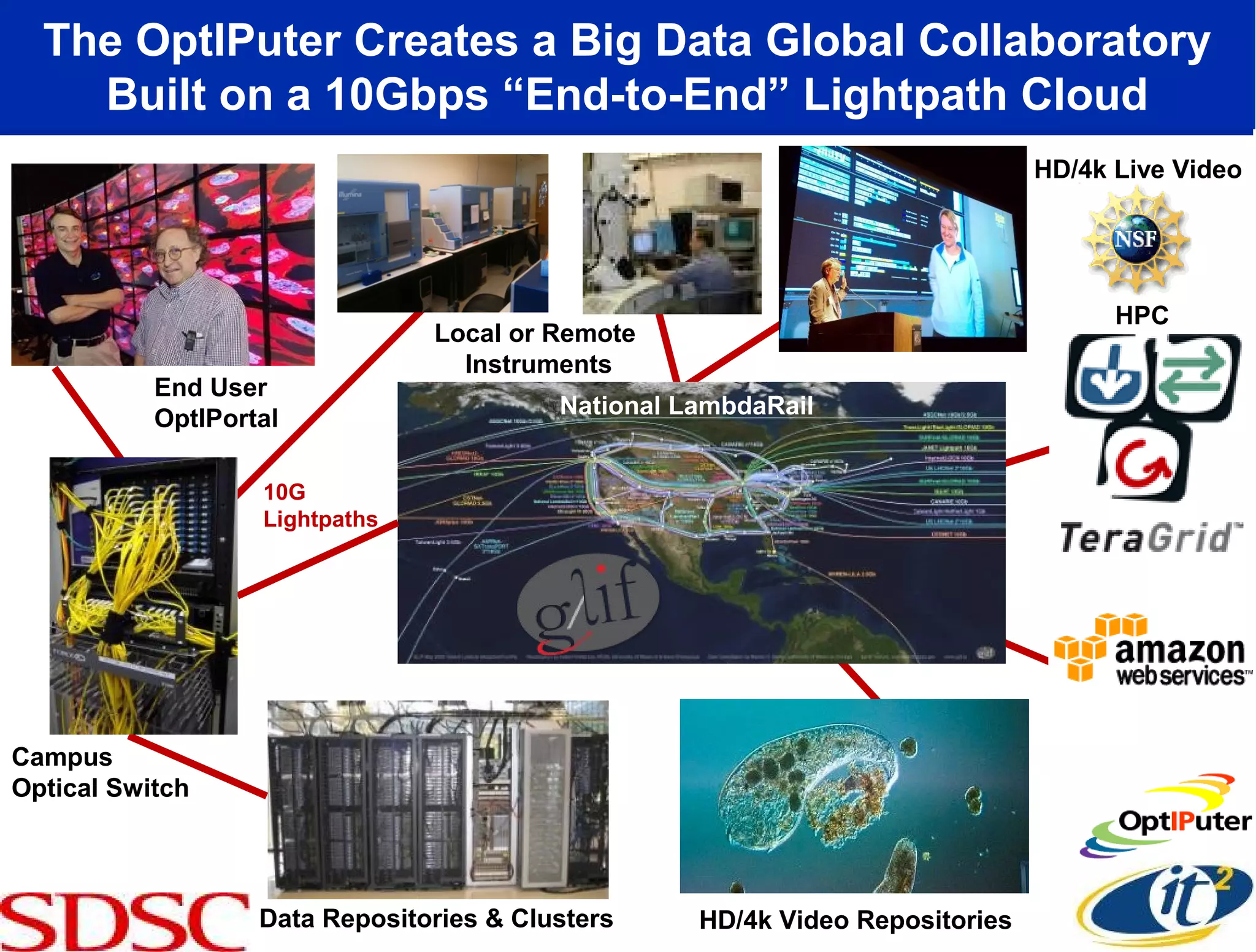
The OptIPuter Creates a Big Data Global Collaboratory
    Built on a 10Gbps “End-to-End” Lightpath Cloud
                                                                               HD/4k Live Video


                                                                                     HPC
                                Local or Remote
                                  Instruments
           End User
           OptIPortal                     National LambdaRail


                   10G
                   Lightpaths


Campus
Optical Switch


                   Data Repositories & Clusters     HD/4k Video Repositories
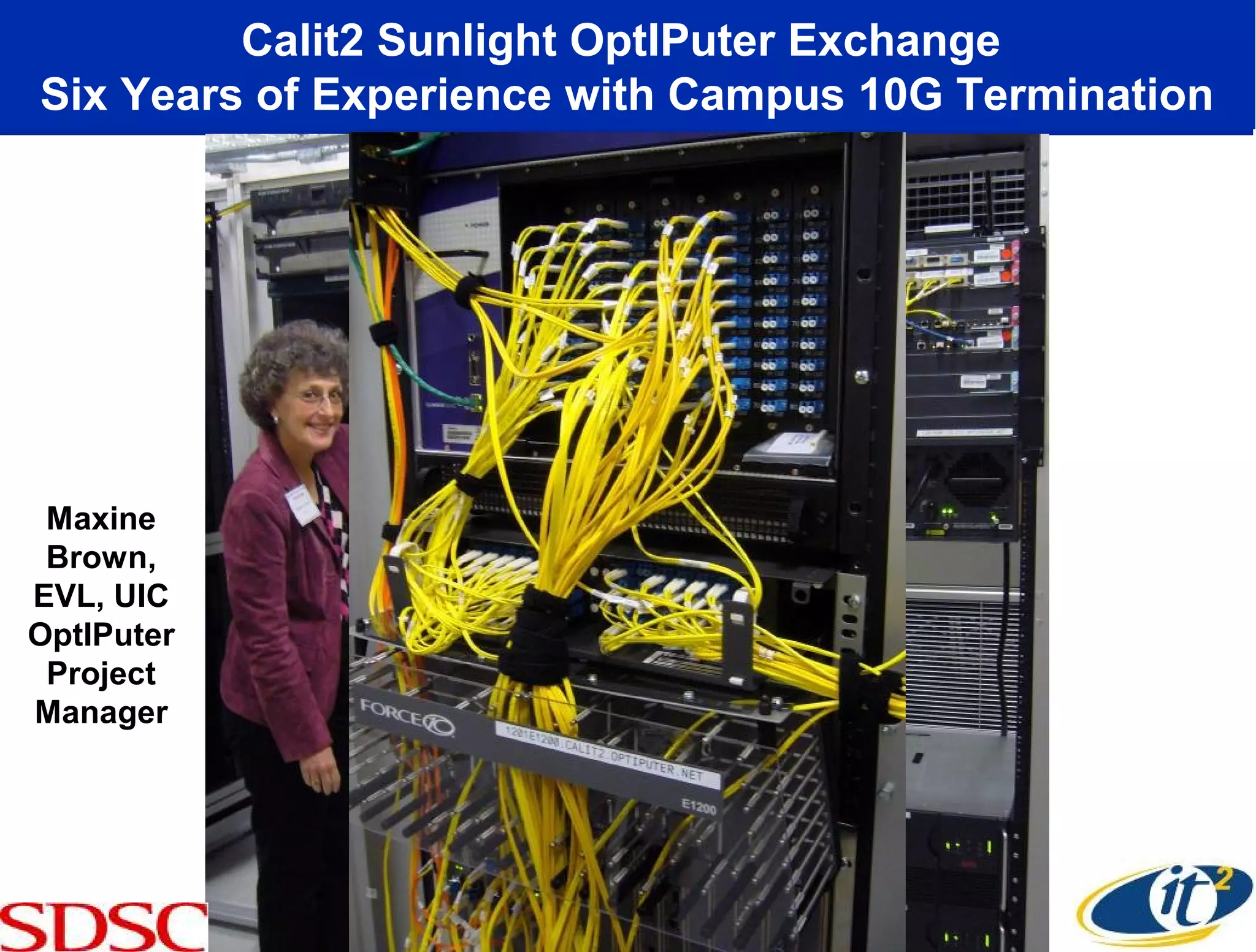
Calit2 Sunlight OptIPuter Exchange
Six Years of Experience with Campus 10G Termination


 Maxine
 Brown,
EVL, UIC
OptIPuter
 Project
Manager
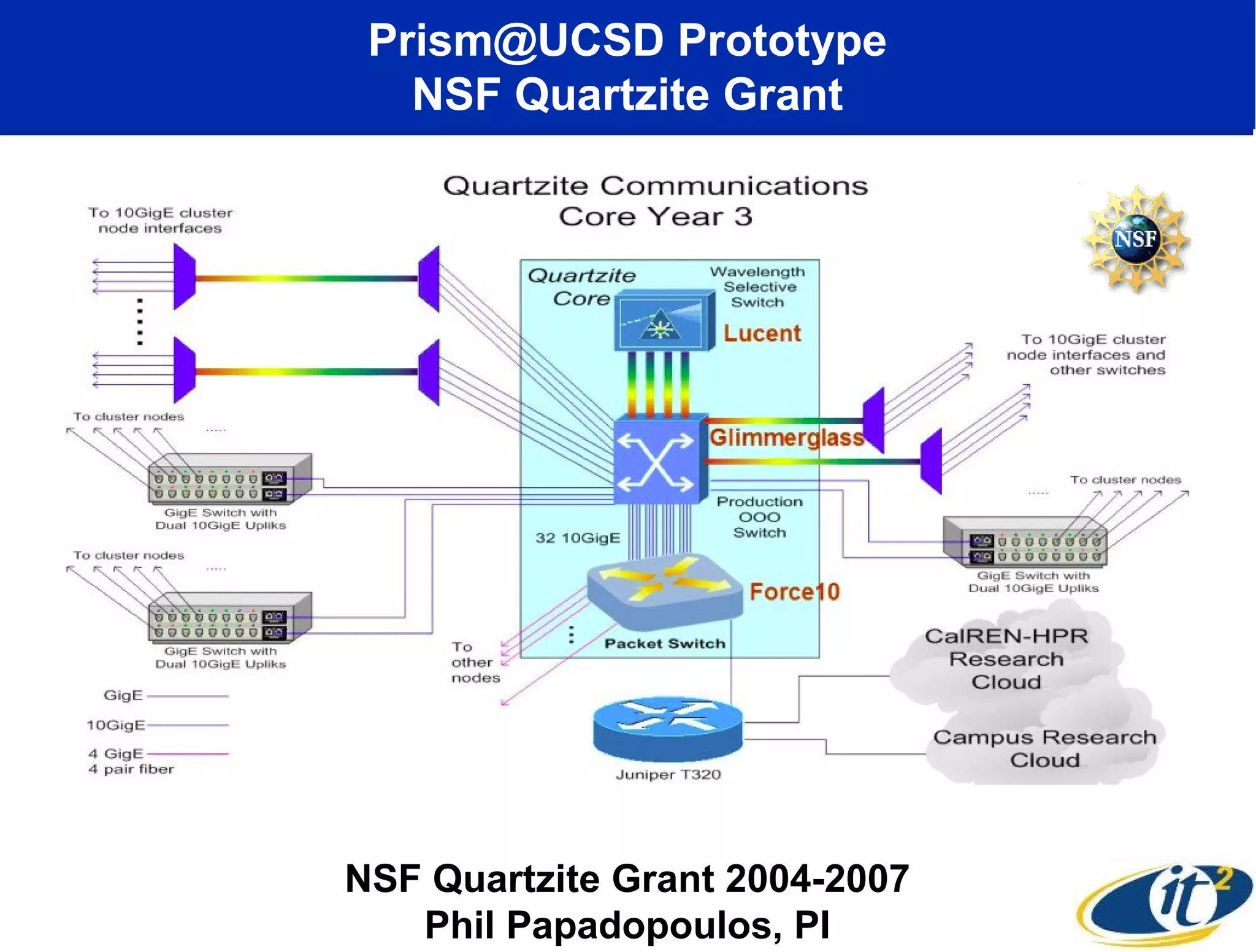
Prism@UCSD Prototype
   NSF Quartzite Grant


NSF Quartzite Grant 2004-2007
   Phil Papadopoulos, PI
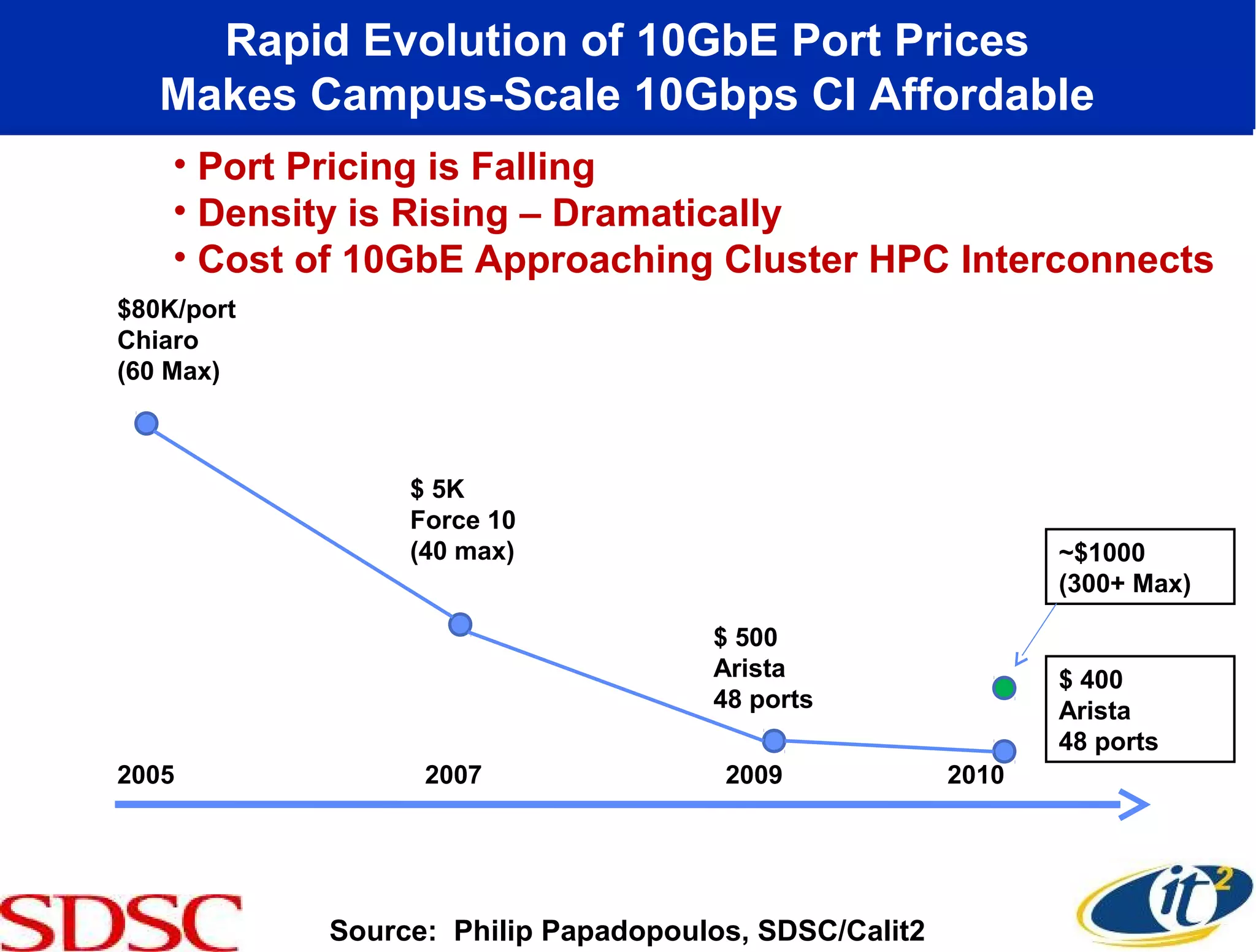
Rapid Evolution of 10GbE Port Prices
   Makes Campus-Scale 10Gbps CI Affordable
    • Port Pricing is Falling
    • Density is Rising – Dramatically
    • Cost of 10GbE Approaching Cluster HPC Interconnects
$80K/port
Chiaro
(60 Max)


                 $ 5K
                 Force 10
                 (40 max)                                     ~$1000
                                                              (300+ Max)

                                     $ 500
                                     Arista                   $ 400
                                     48 ports                 Arista
                                                              48 ports
2005              2007                2009             2010


            Source: Philip Papadopoulos, SDSC/Calit2
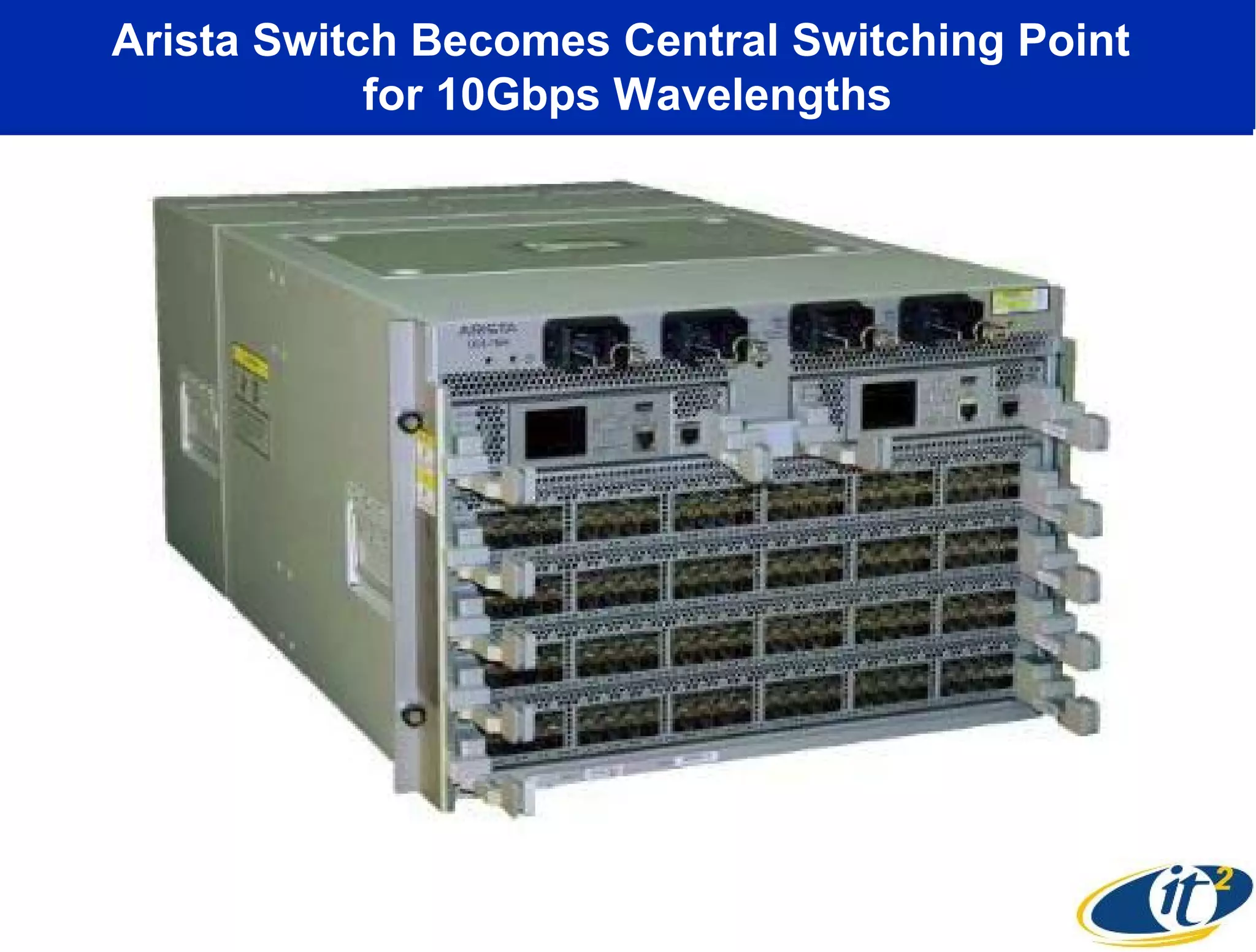
Arista Switch Becomes Central Switching Point
            for 10Gbps Wavelengths
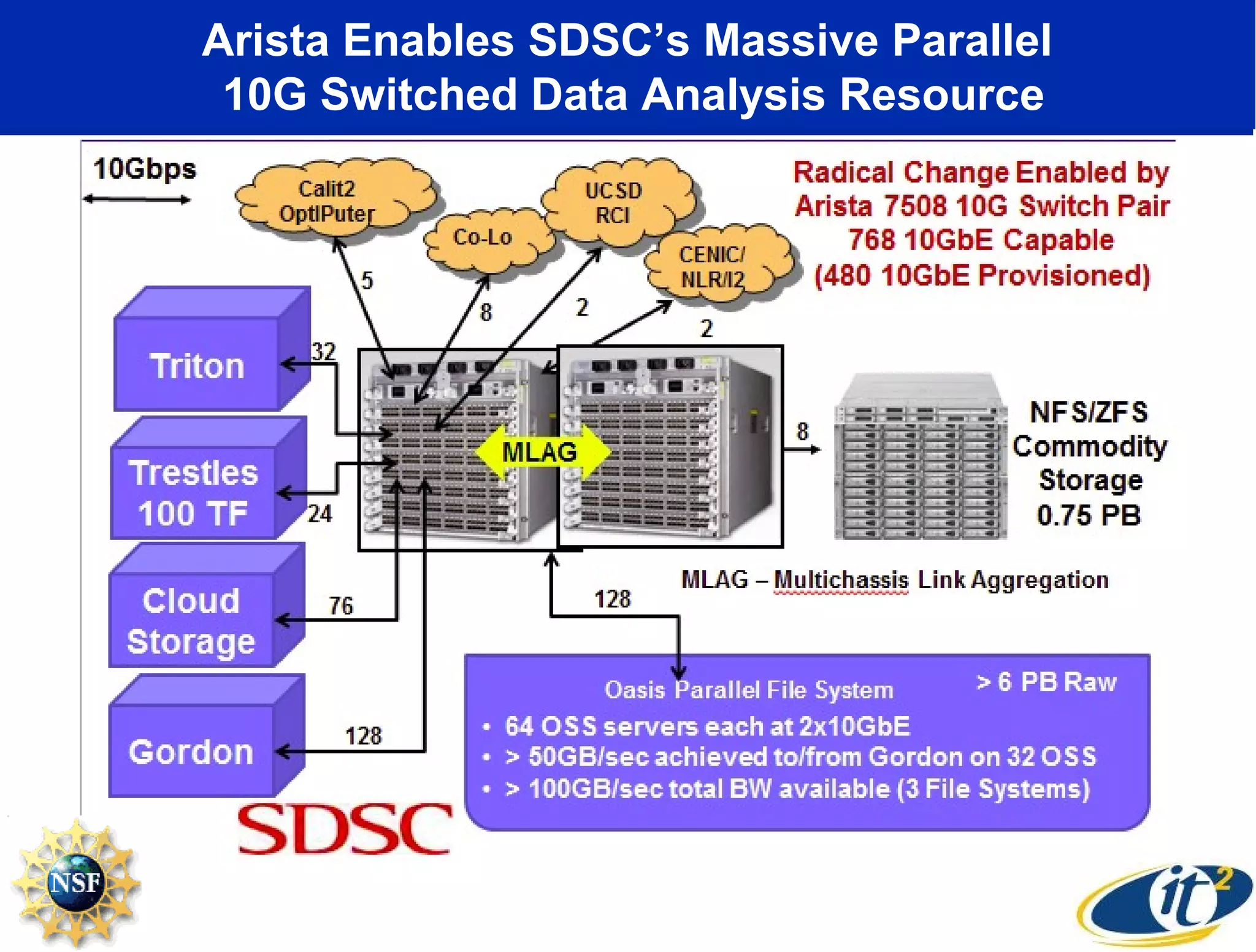
Arista Enables SDSC’s Massive Parallel
 10G Switched Data Analysis Resource
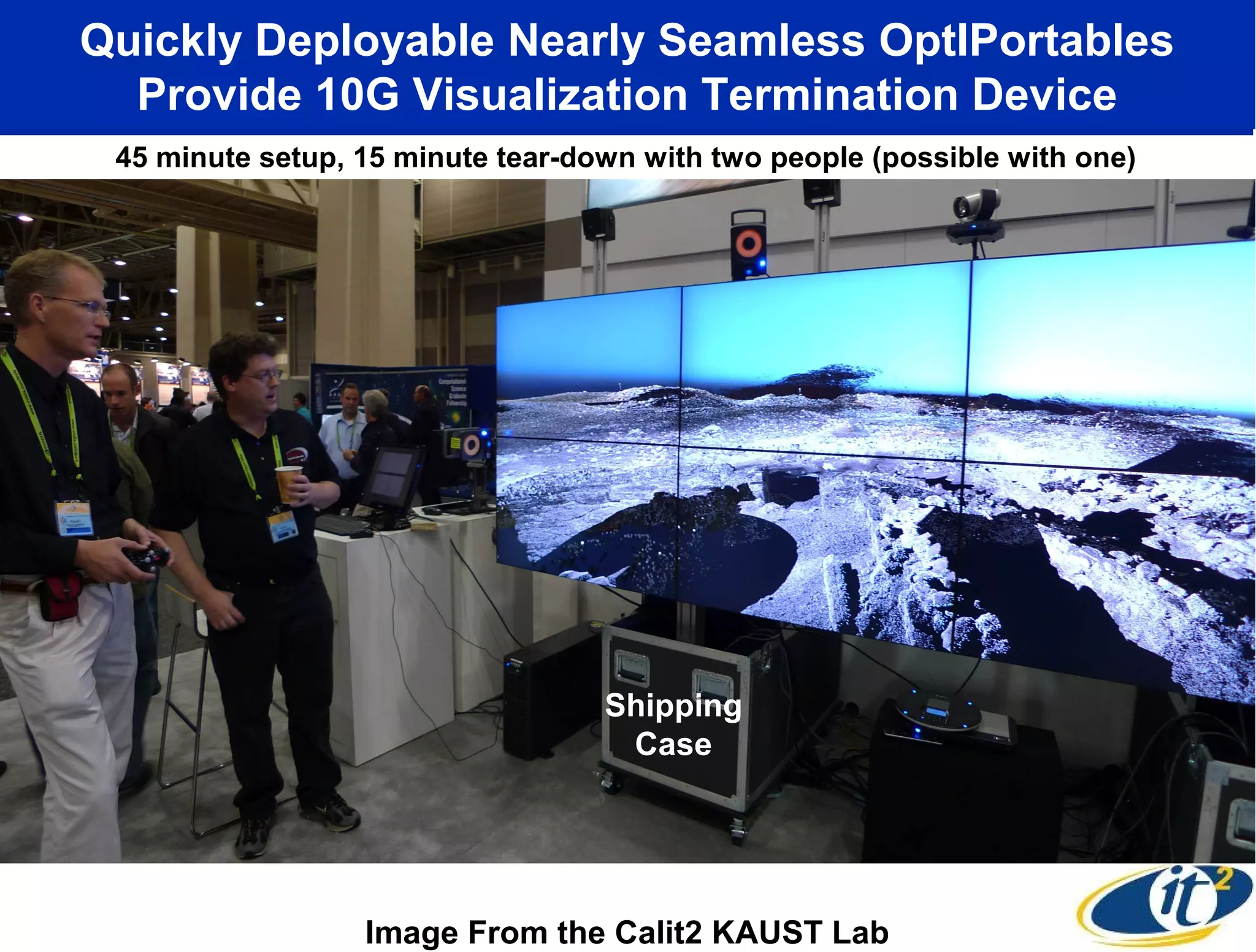
Quickly Deployable Nearly Seamless OptIPortables
  Provide 10G Visualization Termination Device
 45 minute setup, 15 minute tear-down with two people (possible with one)


                                   Shipping
                                    Case


                  Image From the Calit2 KAUST Lab
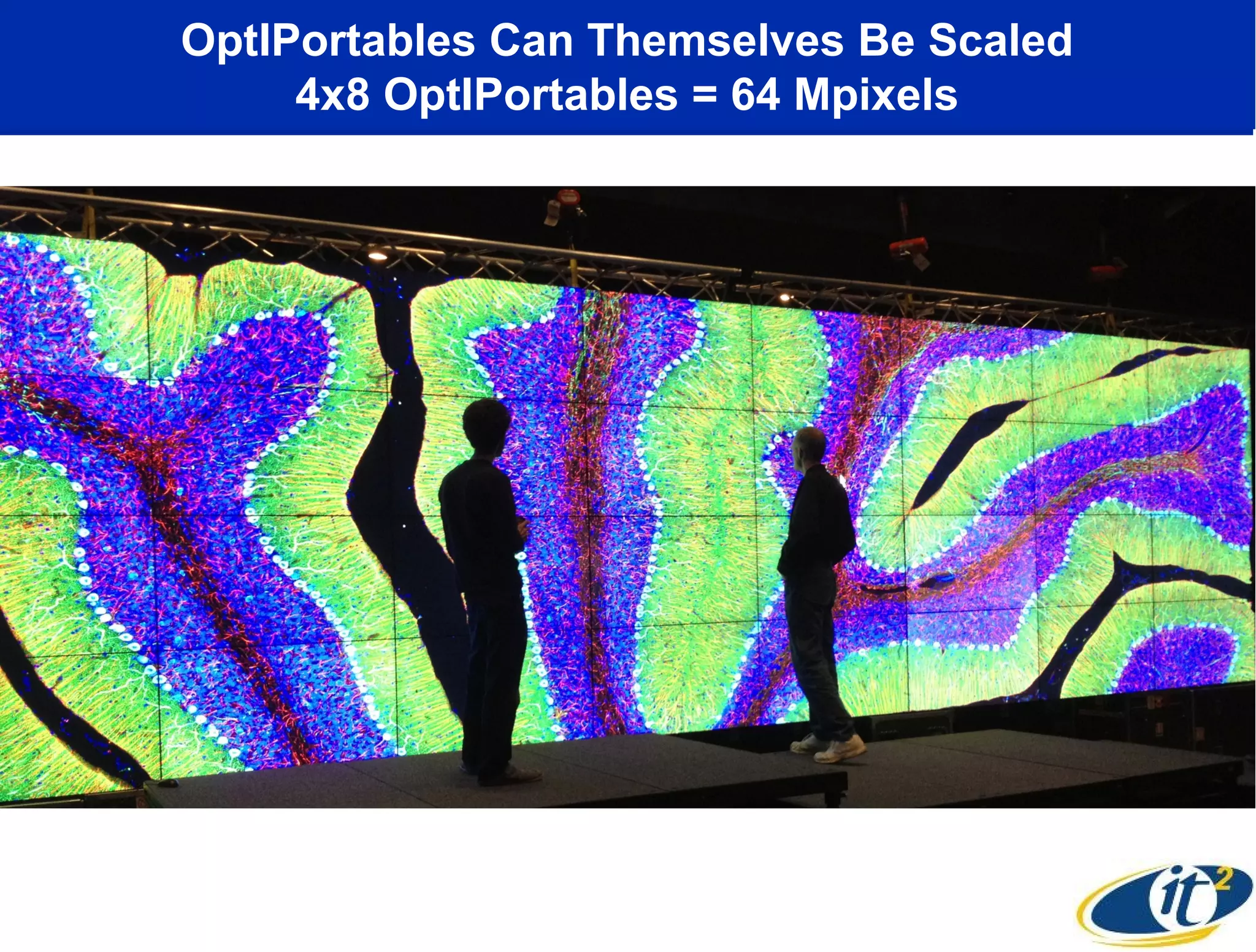
OptIPortables Can Themselves Be Scaled
     4x8 OptIPortables = 64 Mpixels
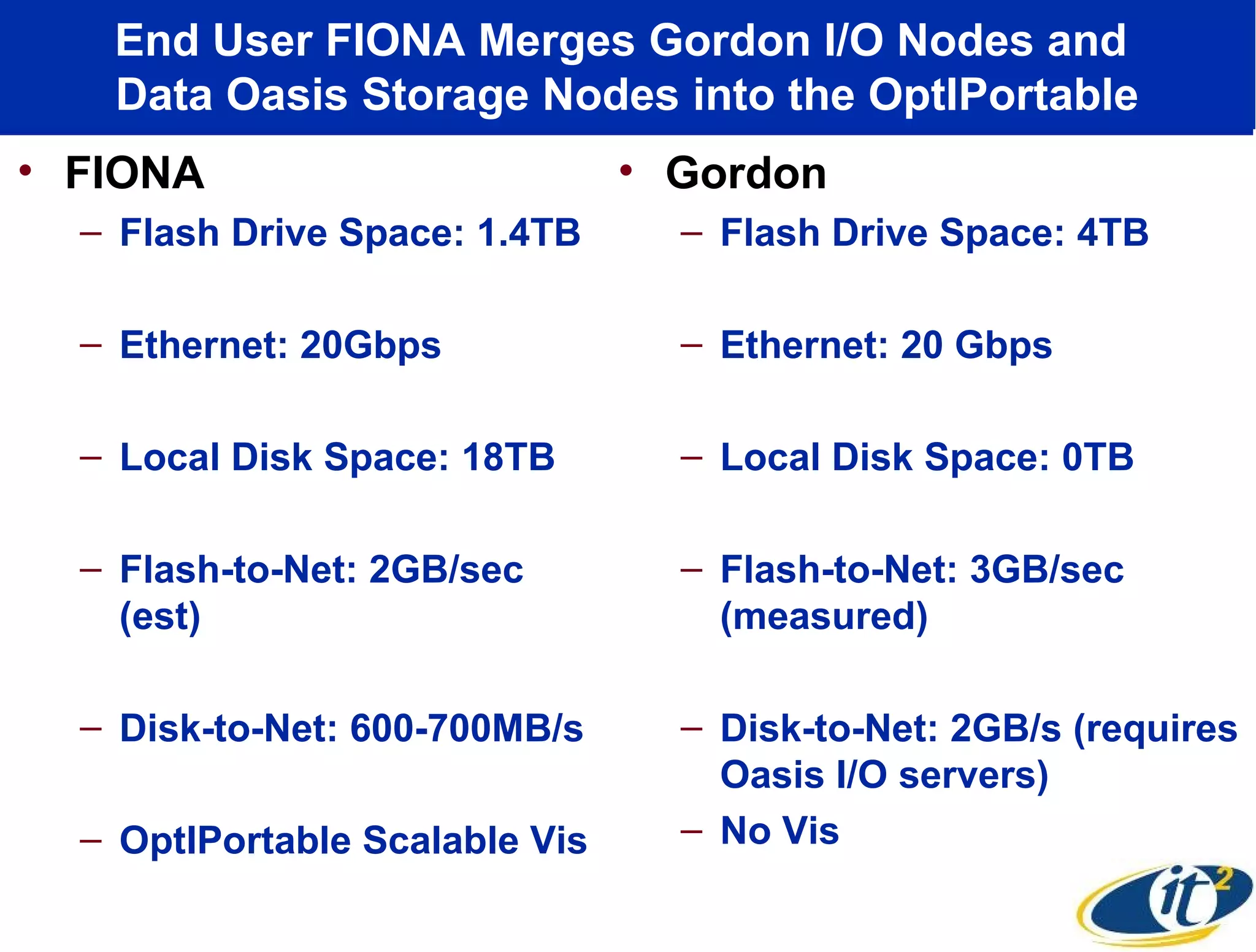
End User FIONA Merges Gordon I/O Nodes and
   Data Oasis Storage Nodes into the OptIPortable
• FIONA                         • Gordon
  – Flash Drive Space: 1.4TB      – Flash Drive Space: 4TB

  – Ethernet: 20Gbps              – Ethernet: 20 Gbps

  – Local Disk Space: 18TB        – Local Disk Space: 0TB

  – Flash-to-Net: 2GB/sec         – Flash-to-Net: 3GB/sec
    (est)                           (measured)

  – Disk-to-Net: 600-700MB/s      – Disk-to-Net: 2GB/s (requires
                                    Oasis I/O servers)
  – OptIPortable Scalable Vis     – No Vis
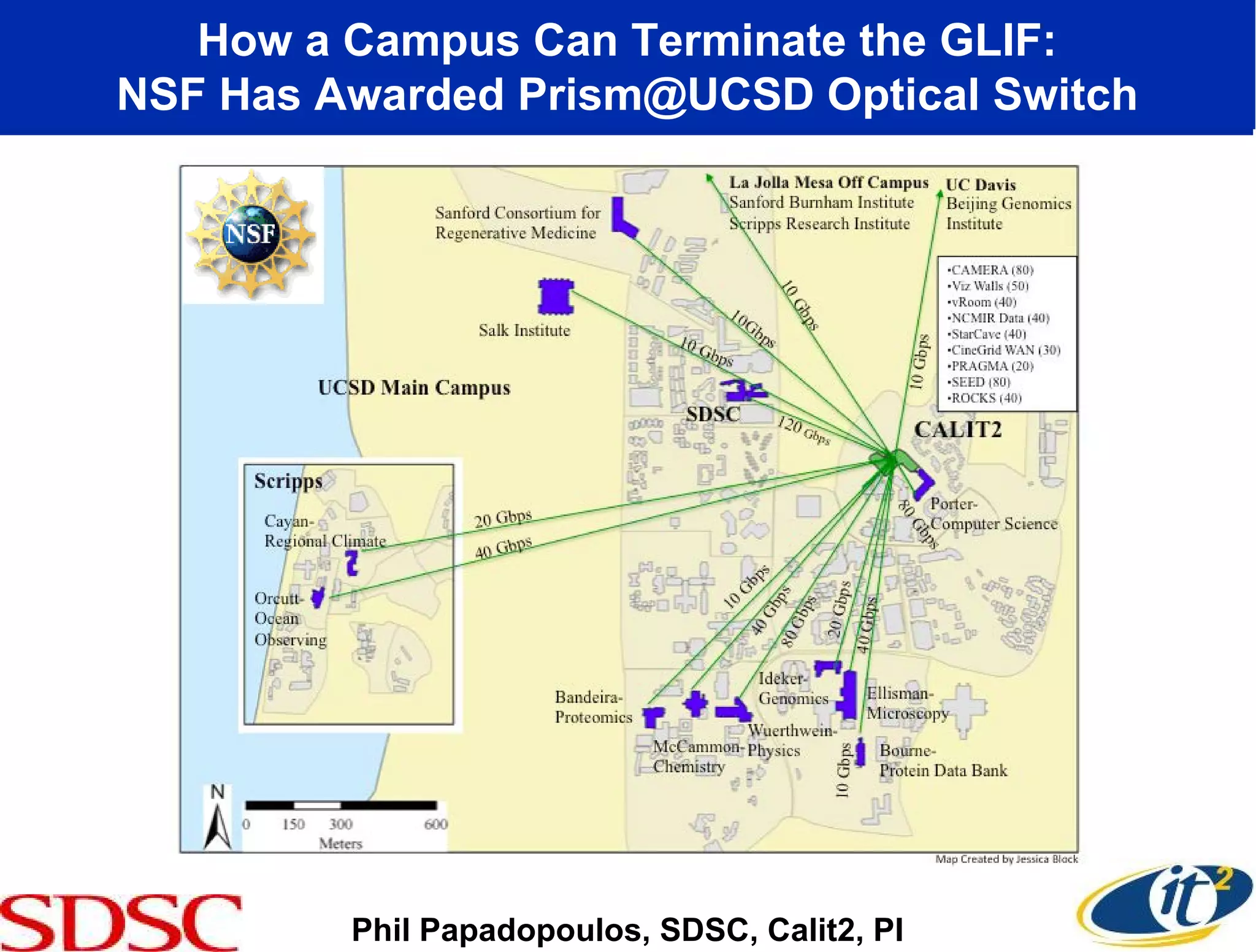
How a Campus Can Terminate the GLIF:
NSF Has Awarded Prism@UCSD Optical Switch


         Phil Papadopoulos, SDSC, Calit2, PI
Global Access
                to On-Campus Resources
• Protein Data Bank
• Center for Computational Mass Spectrometry
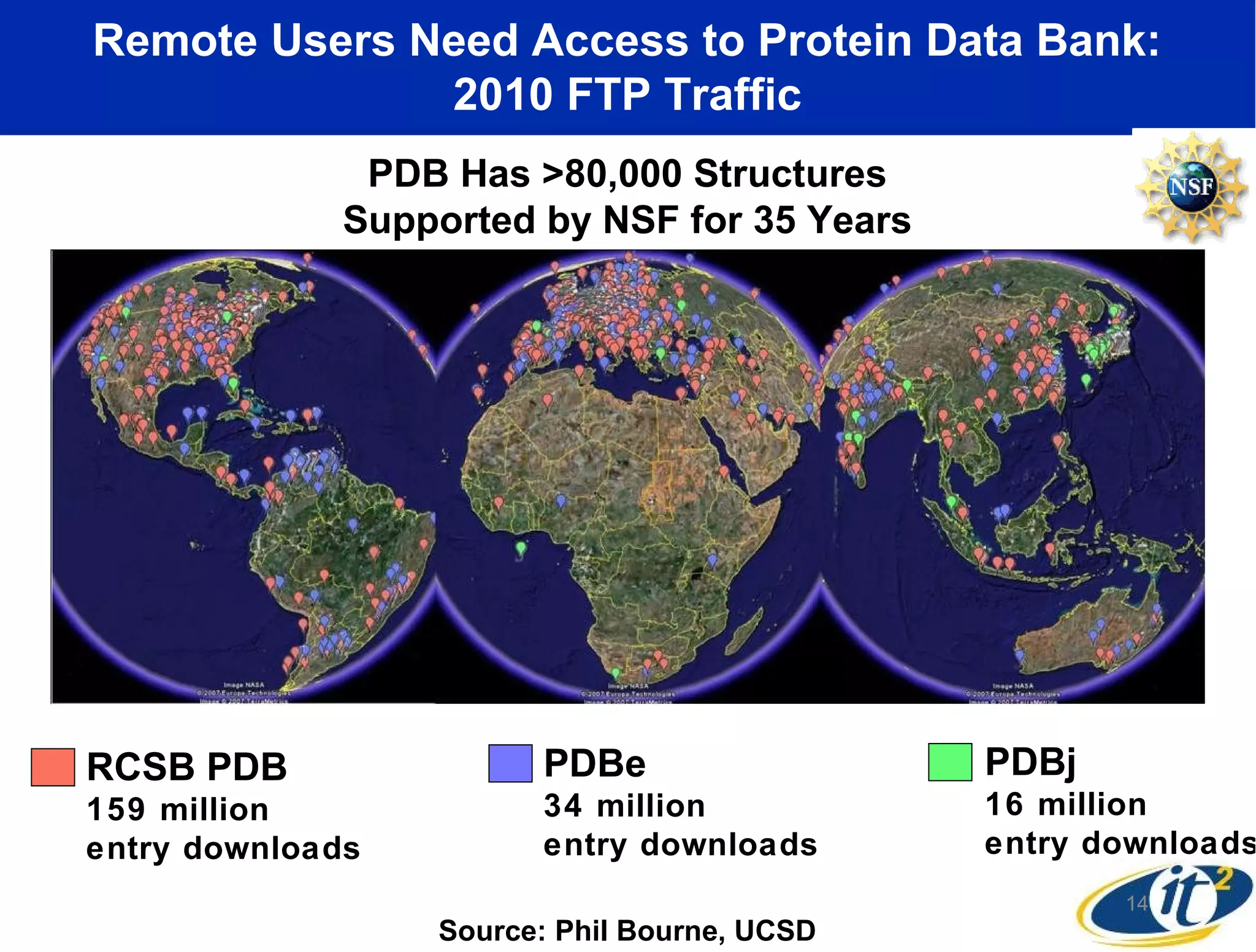
Remote Users Need Access to Protein Data Bank:
              2010 FTP Traffic
               PDB Has >80,000 Structures
              Supported by NSF for 35 Years


RCSB PDB                PDBe                  PDBj
159 million             34 million            16 million
entry downloads         entry downloads       entry downloads
                                                     14
                  Source: Phil Bourne, UCSD
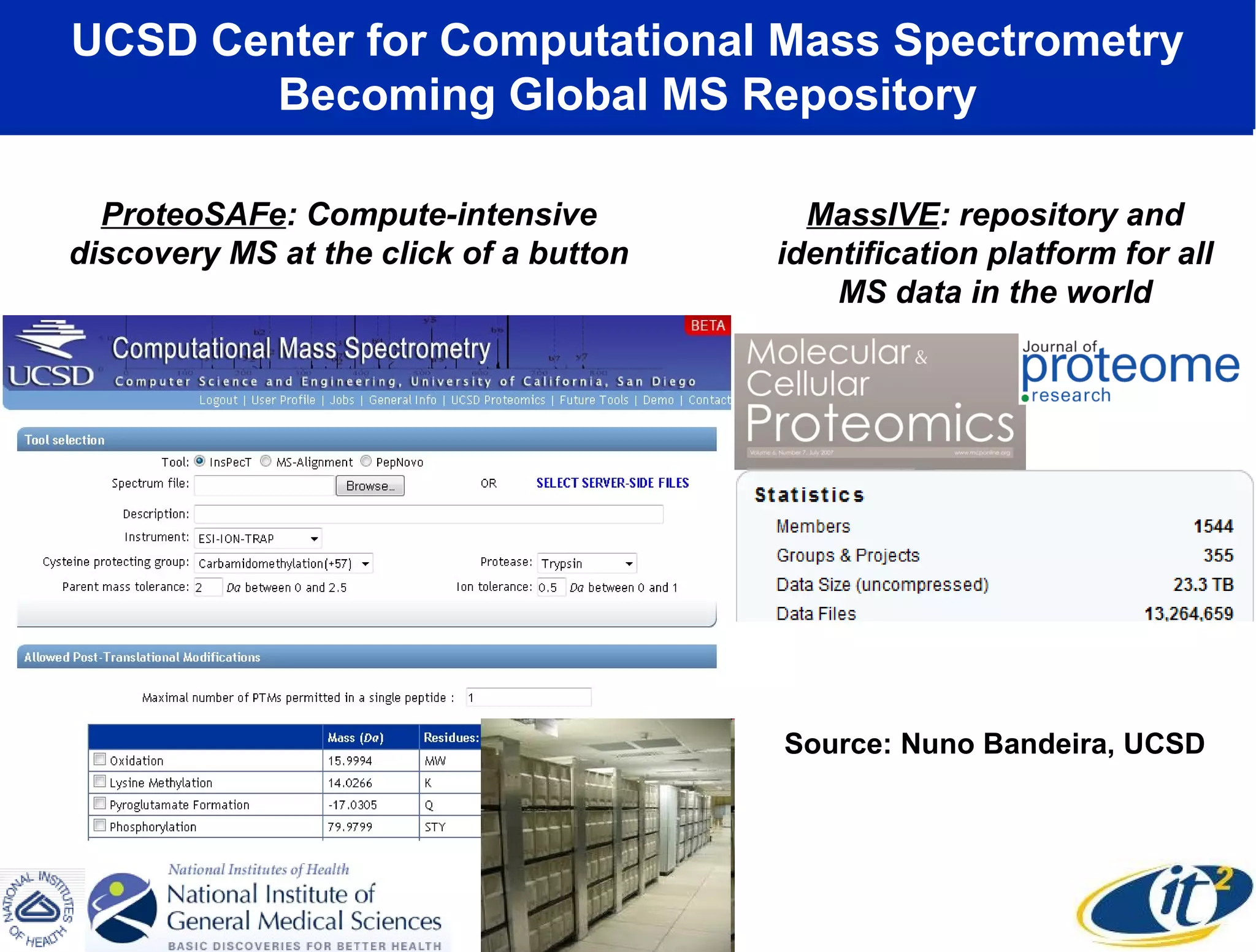
UCSD Center for Computational Mass Spectrometry
       Becoming Global MS Repository

  ProteoSAFe: Compute-intensive           MassIVE: repository and
discovery MS at the click of a button   identification platform for all
                                            MS data in the world


                                        Source: Nuno Bandeira, UCSD
Campus User Access
                     to Remote Resources
•   GLIF
•   Experimental Particle Physics
•   Ocean Observatory Initiative
•   Remote Supercomputing
•   Creating Regional Climate Forecasts
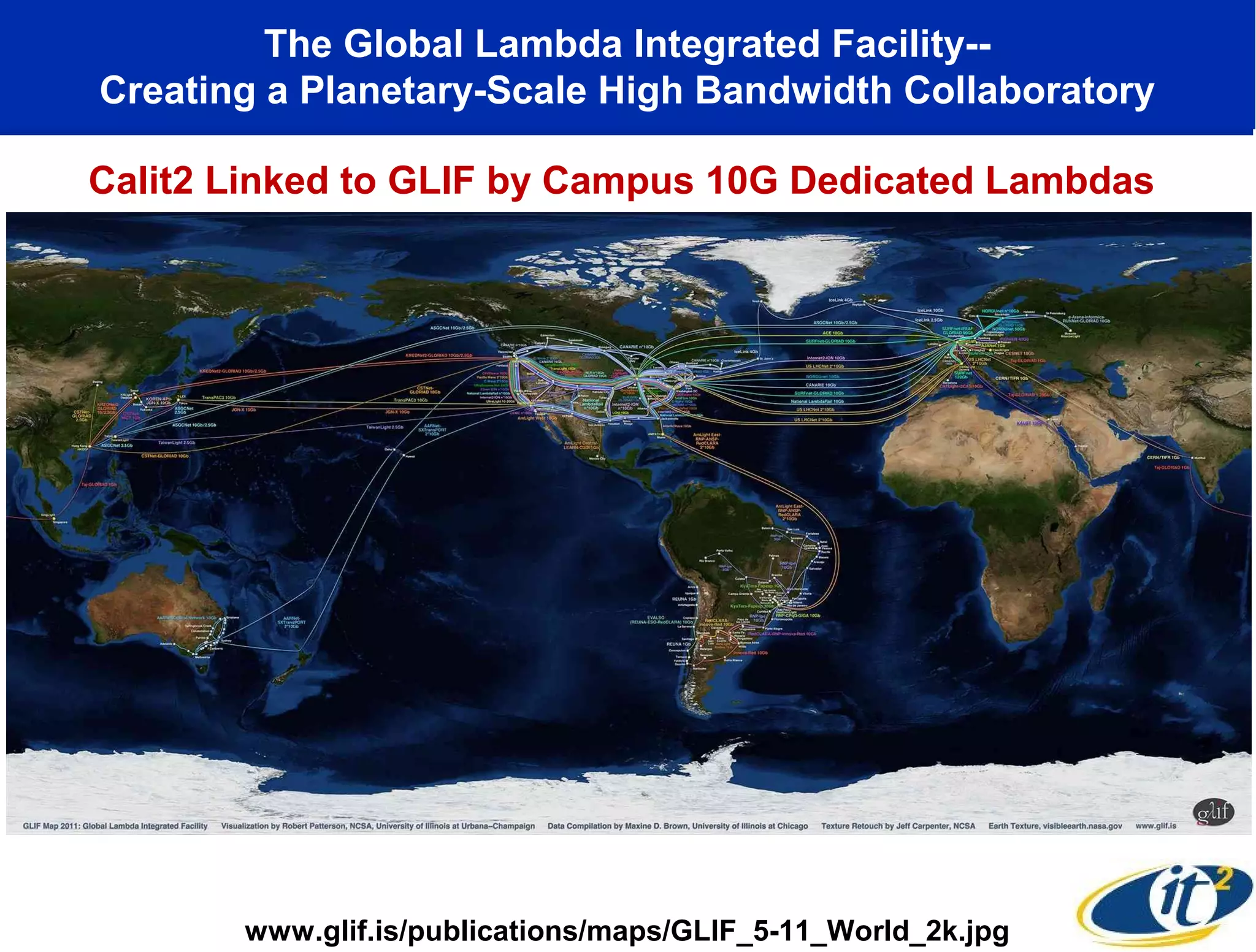
The Global Lambda Integrated Facility--
Creating a Planetary-Scale High Bandwidth Collaboratory

Calit2 Linked to GLIF by Campus 10G Dedicated Lambdas


       www.glif.is/publications/maps/GLIF_5-11_World_2k.jpg
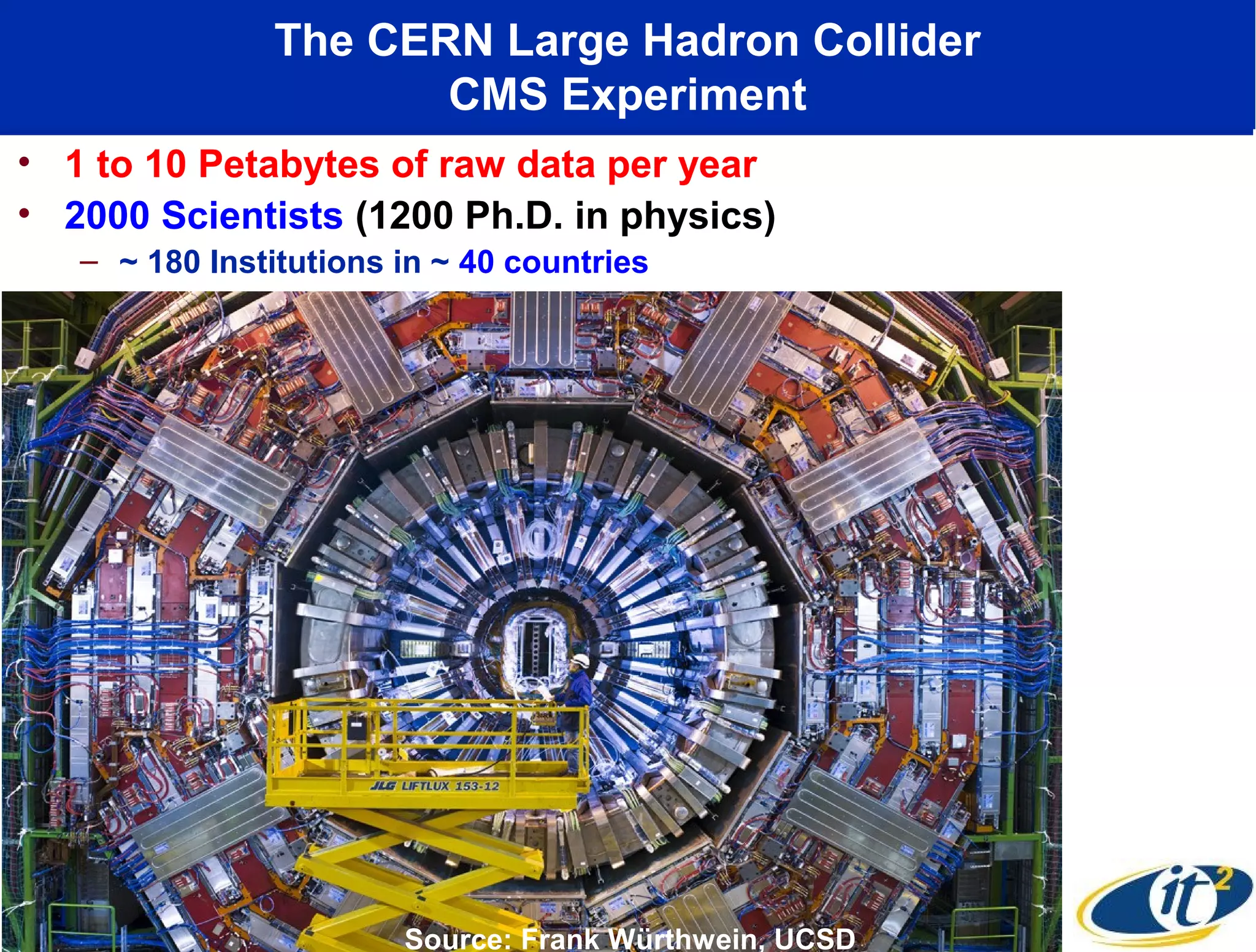
The CERN Large Hadron Collider
                      CMS Experiment
• 1 to 10 Petabytes of raw data per year
• 2000 Scientists (1200 Ph.D. in physics)
   – ~ 180 Institutions in ~ 40 countries


                        Source: Frank Würthwein, UCSD
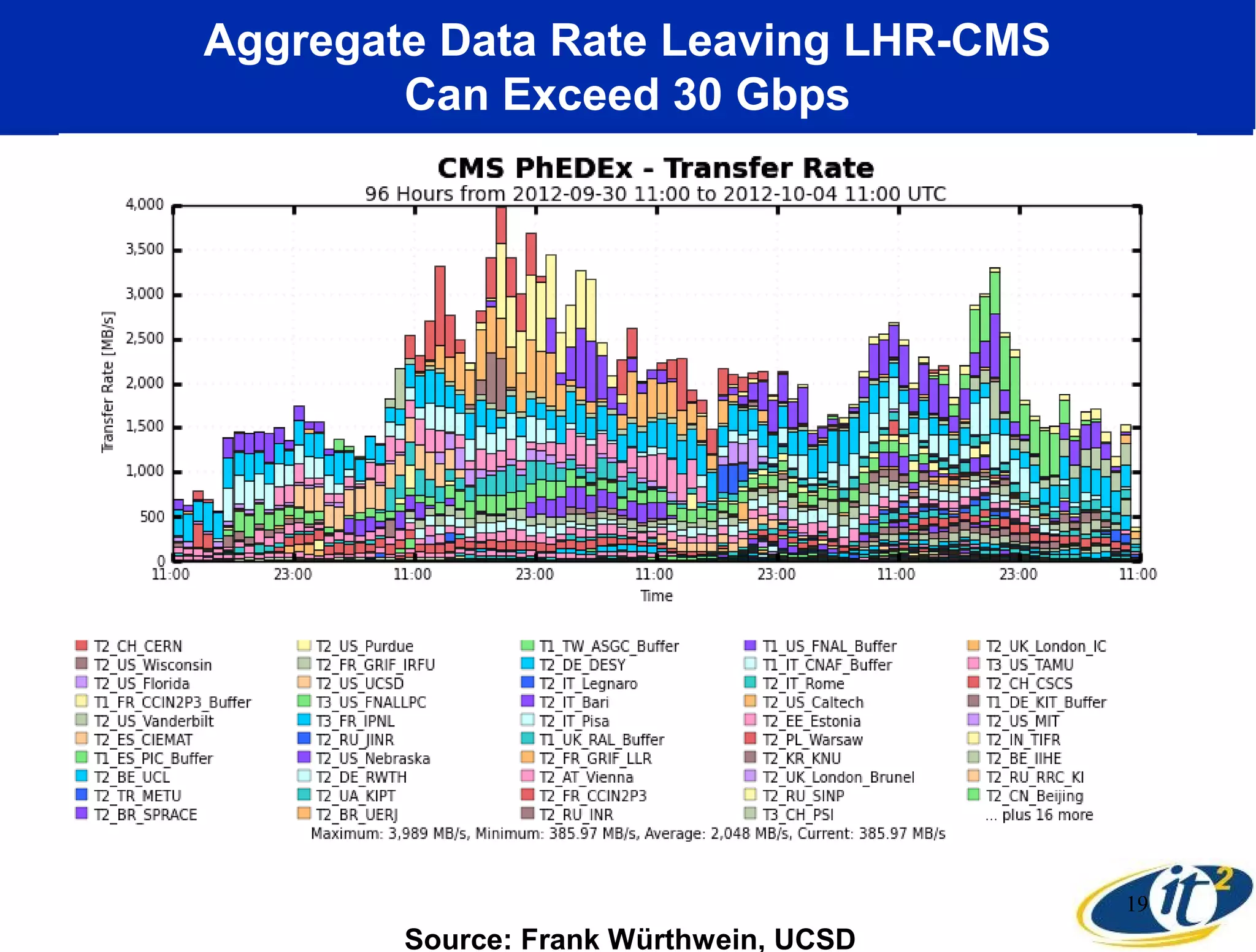
Aggregate Data Rate Leaving LHR-CMS
        Can Exceed 30 Gbps


                                        19
        Source: Frank Würthwein, UCSD
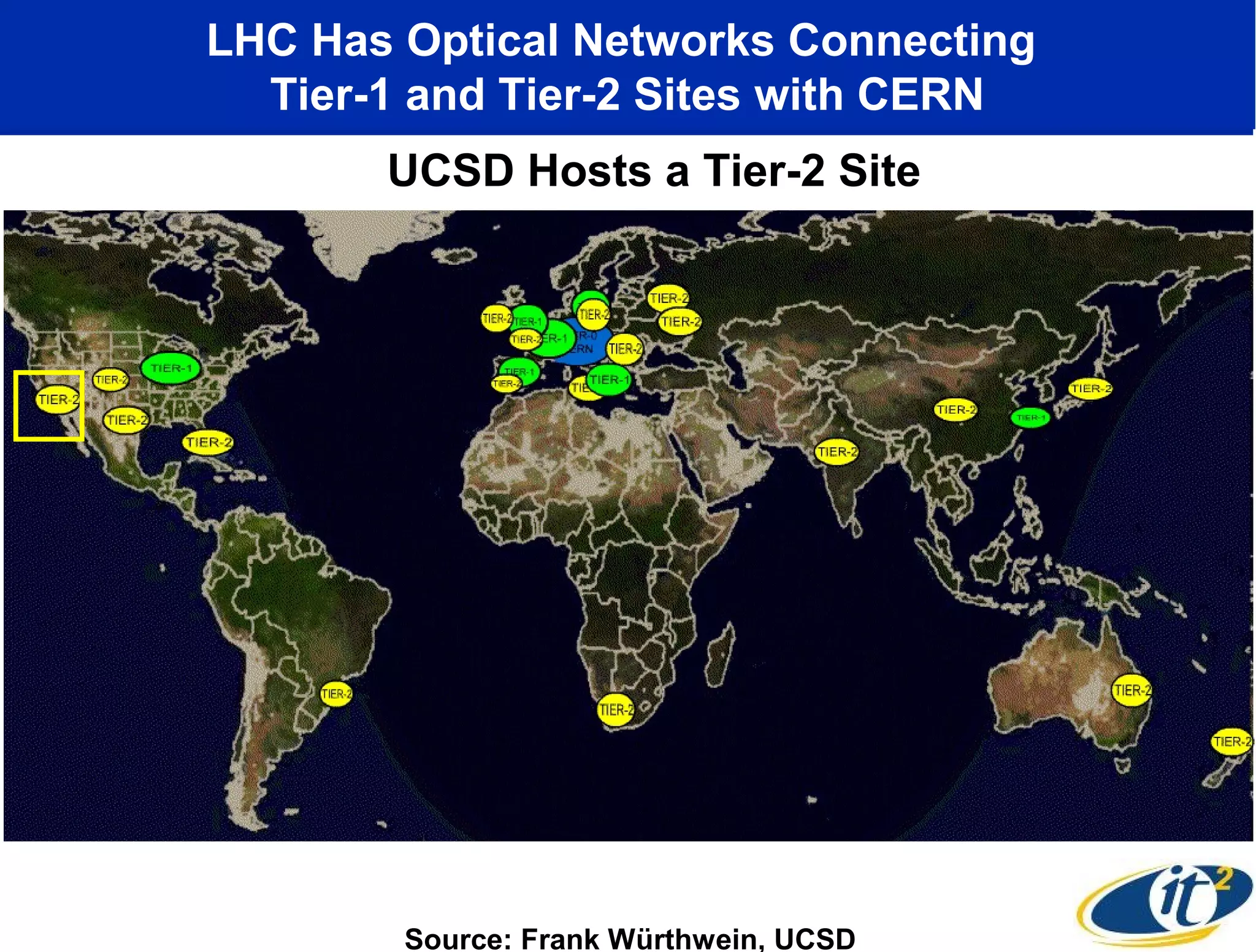
LHC Has Optical Networks Connecting
  Tier-1 and Tier-2 Sites with CERN
       UCSD Hosts a Tier-2 Site


        Source: Frank Würthwein, UCSD
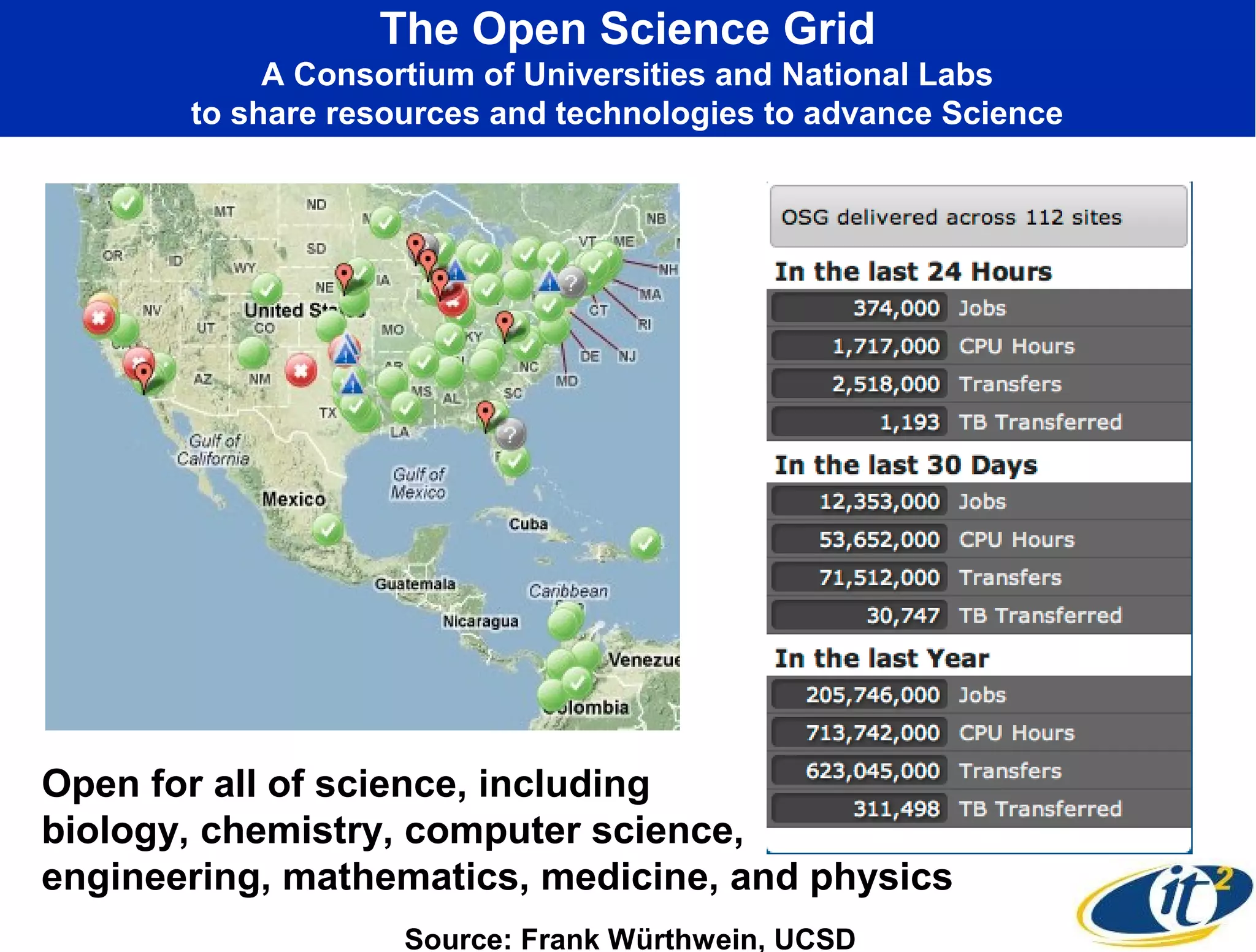
The Open Science Grid
            A Consortium of Universities and National Labs
       to share resources and technologies to advance Science


Open for all of science, including
biology, chemistry, computer science,
engineering, mathematics, medicine, and physics
                    Source: Frank Würthwein, UCSD
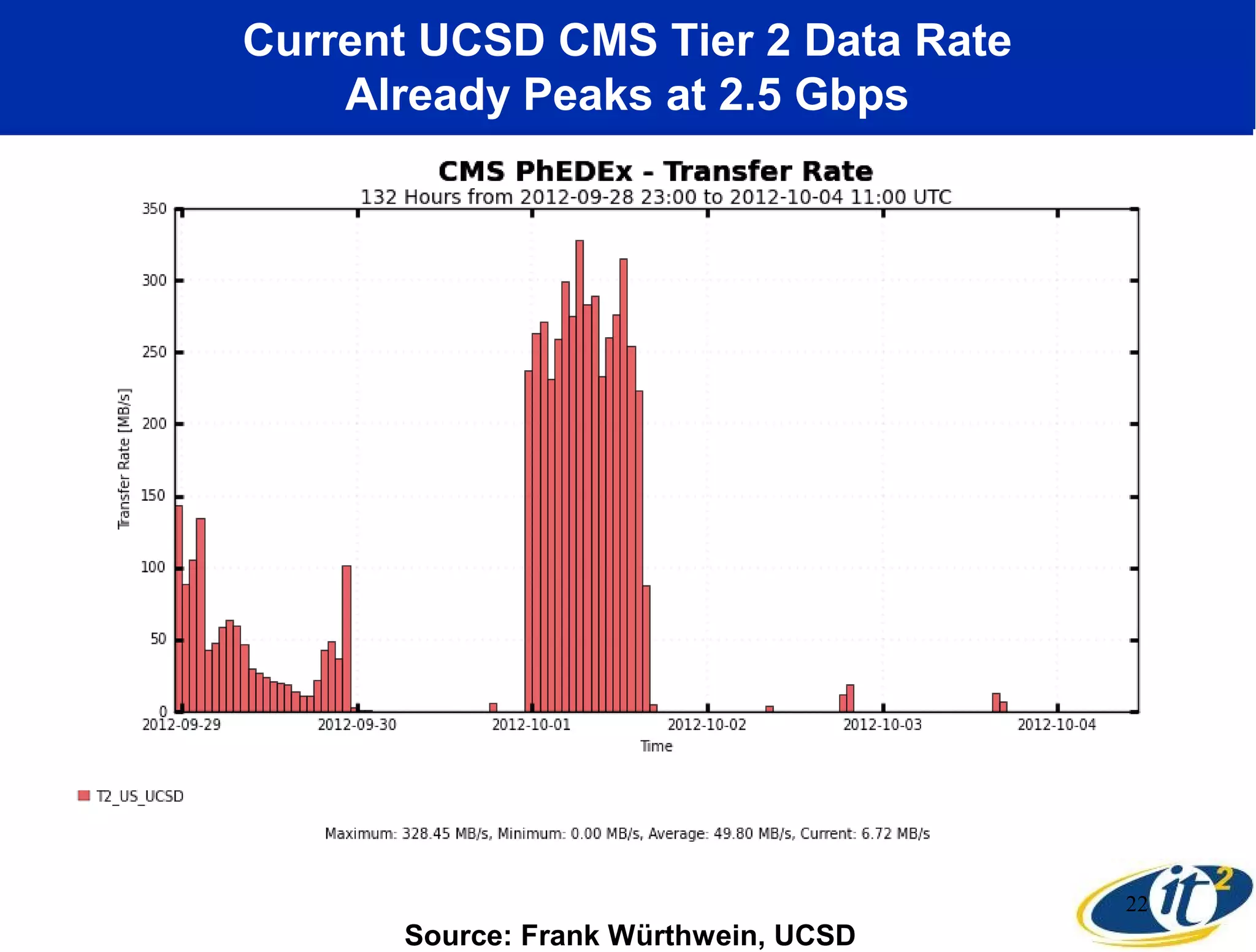
Current UCSD CMS Tier 2 Data Rate
    Already Peaks at 2.5 Gbps


                                      22
      Source: Frank Würthwein, UCSD
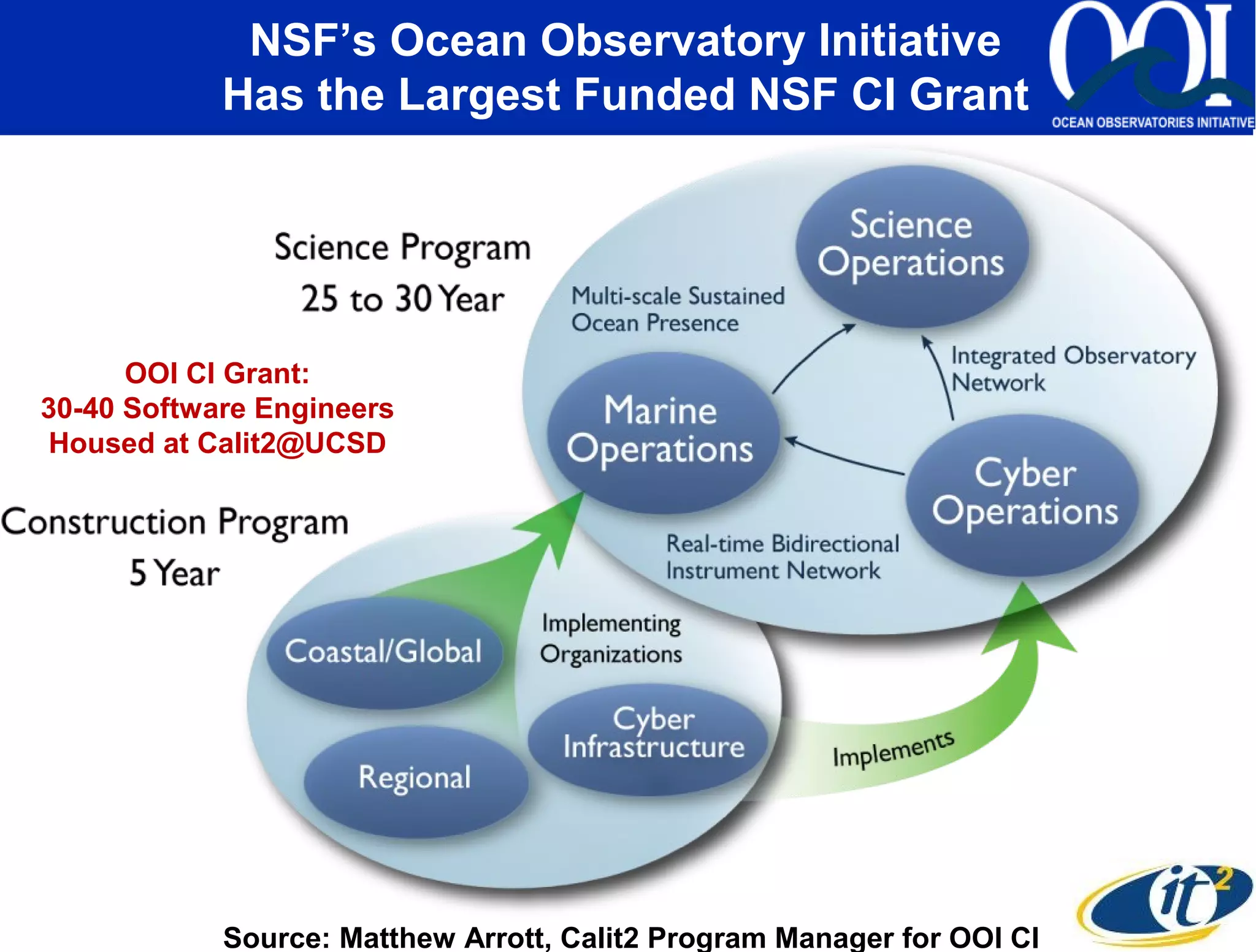
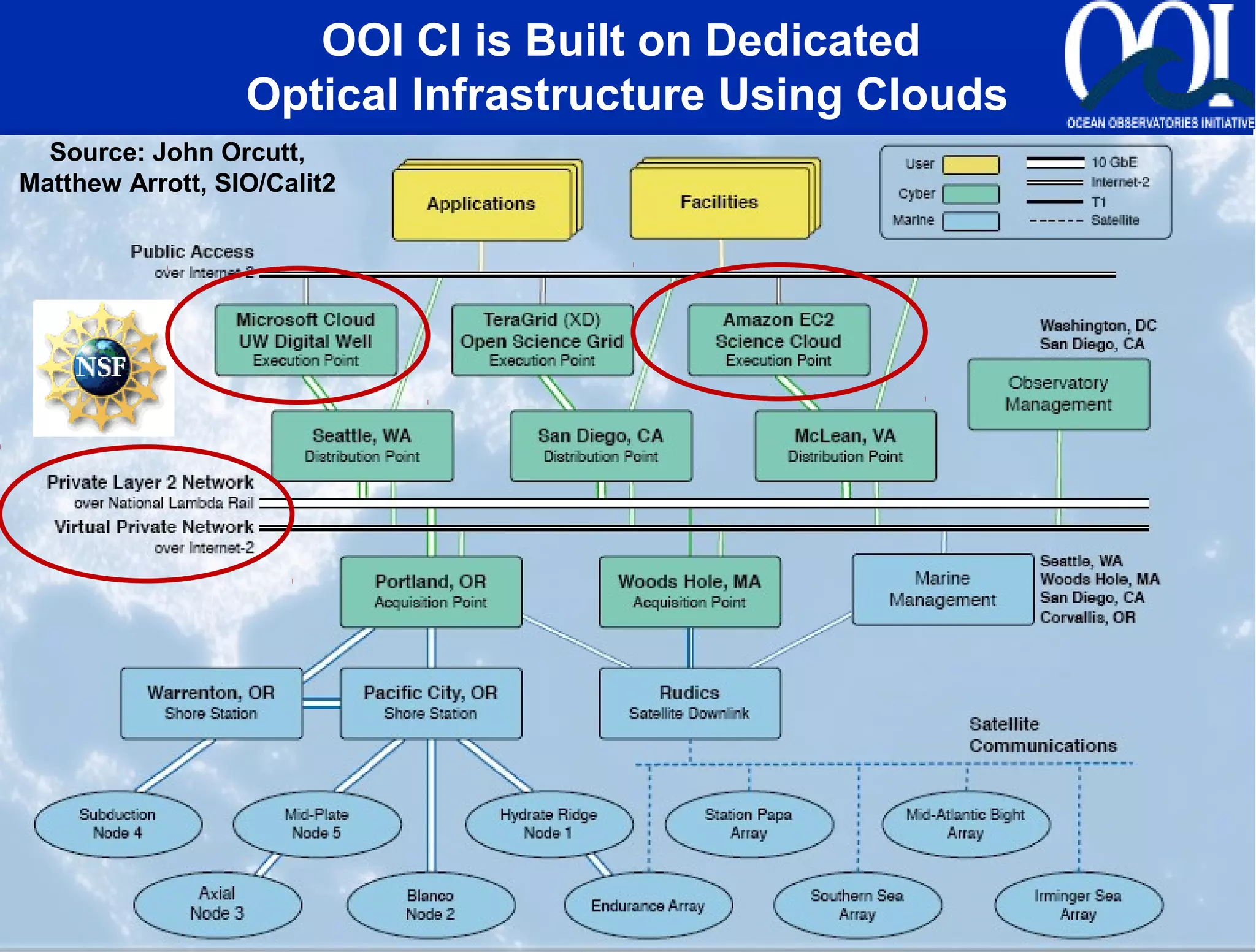
NSF’s Ocean Observatory Initiative
            Has the Largest Funded NSF CI Grant


      OOI CI Grant:
30-40 Software Engineers
Housed at Calit2@UCSD


            Source: Matthew Arrott, Calit2 Program Manager for OOI CI
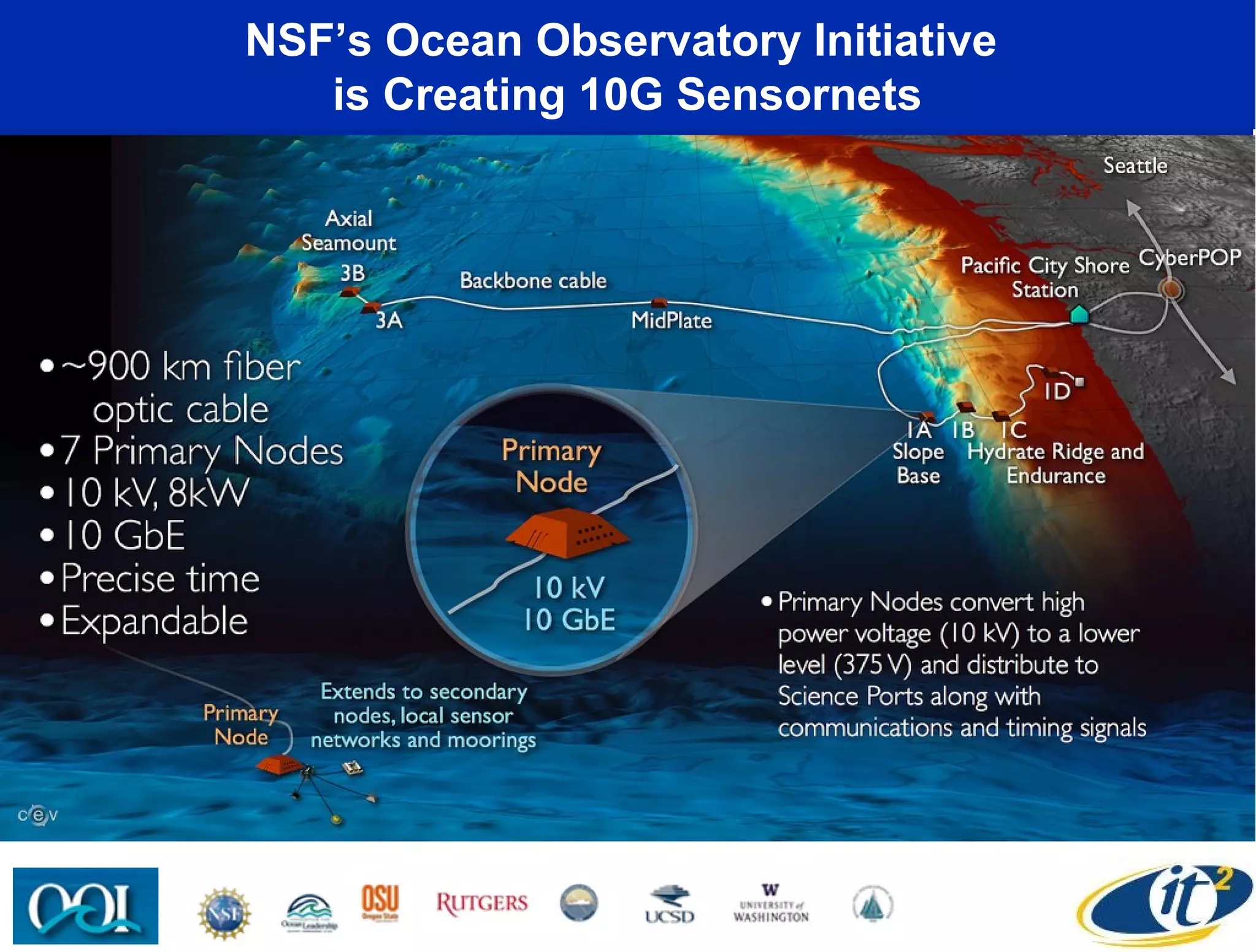
NSF’s Ocean Observatory Initiative
   is Creating 10G Sensornets
OOI CI is Built on Dedicated
                                 OOI CI
                  Optical Infrastructure Using Clouds
                   Physical Network Implementation
  Source: John Orcutt,
Matthew Arrott, SIO/Calit2
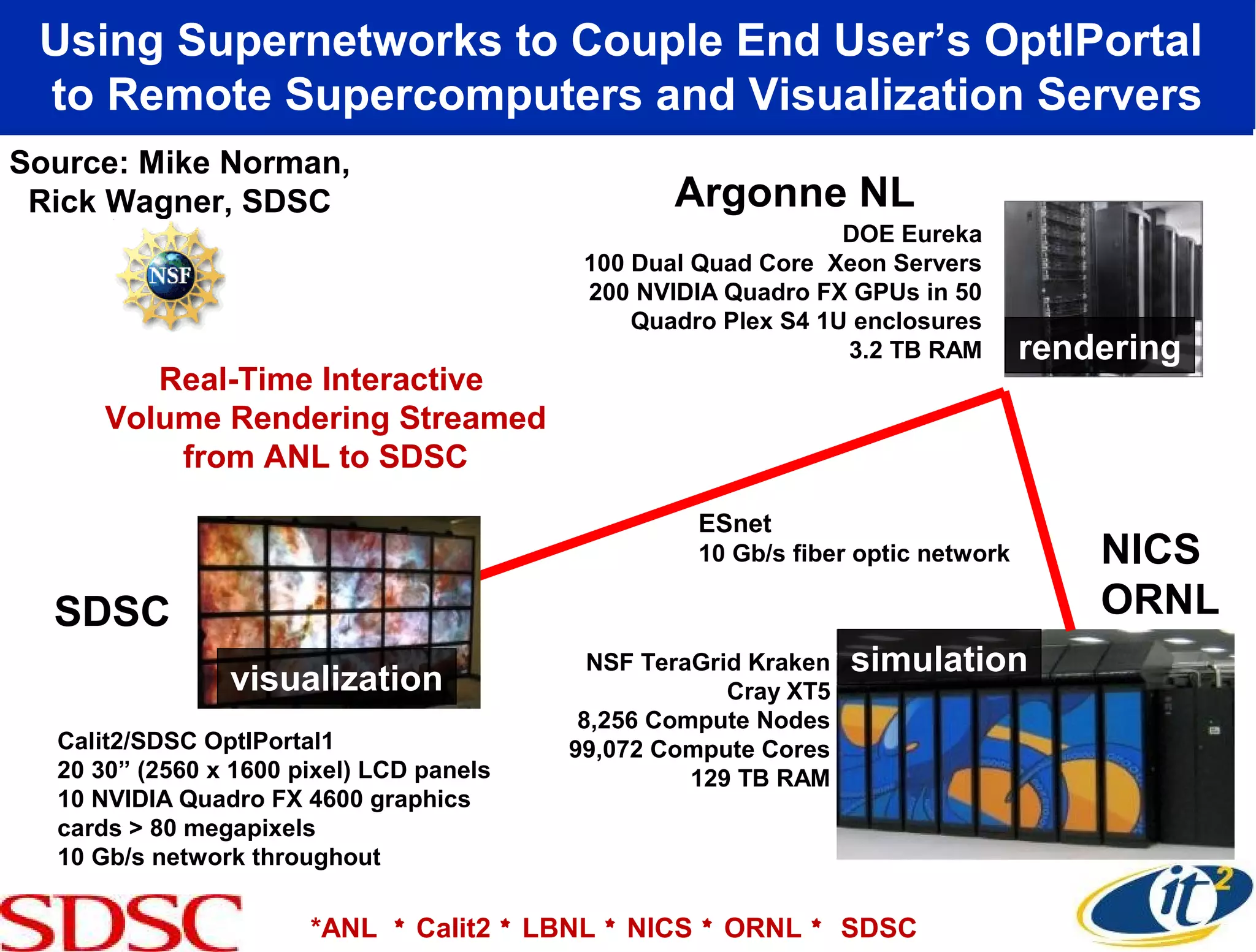
Using Supernetworks to Couple End User’s OptIPortal
 to Remote Supercomputers and Visualization Servers
Source: Mike Norman,
 Rick Wagner, SDSC                                Argonne NL
                                                                DOE Eureka
                                           100 Dual Quad Core Xeon Servers
                                           200 NVIDIA Quadro FX GPUs in 50
                                               Quadro Plex S4 1U enclosures
                                                                3.2 TB RAM        rendering
         Real-Time Interactive
      Volume Rendering Streamed
          from ANL to SDSC

                                                    ESnet
                                                    10 Gb/s fiber optic network       NICS
  SDSC                                                                                ORNL
                                            NSF TeraGrid Kraken   simulation
                visualization                          Cray XT5
                                           8,256 Compute Nodes
  Calit2/SDSC OptIPortal1                 99,072 Compute Cores
  20 30” (2560 x 1600 pixel) LCD panels             129 TB RAM
  10 NVIDIA Quadro FX 4600 graphics
  cards > 80 megapixels
  10 Gb/s network throughout

                       *ANL * Calit2 * LBNL * NICS * ORNL * SDSC
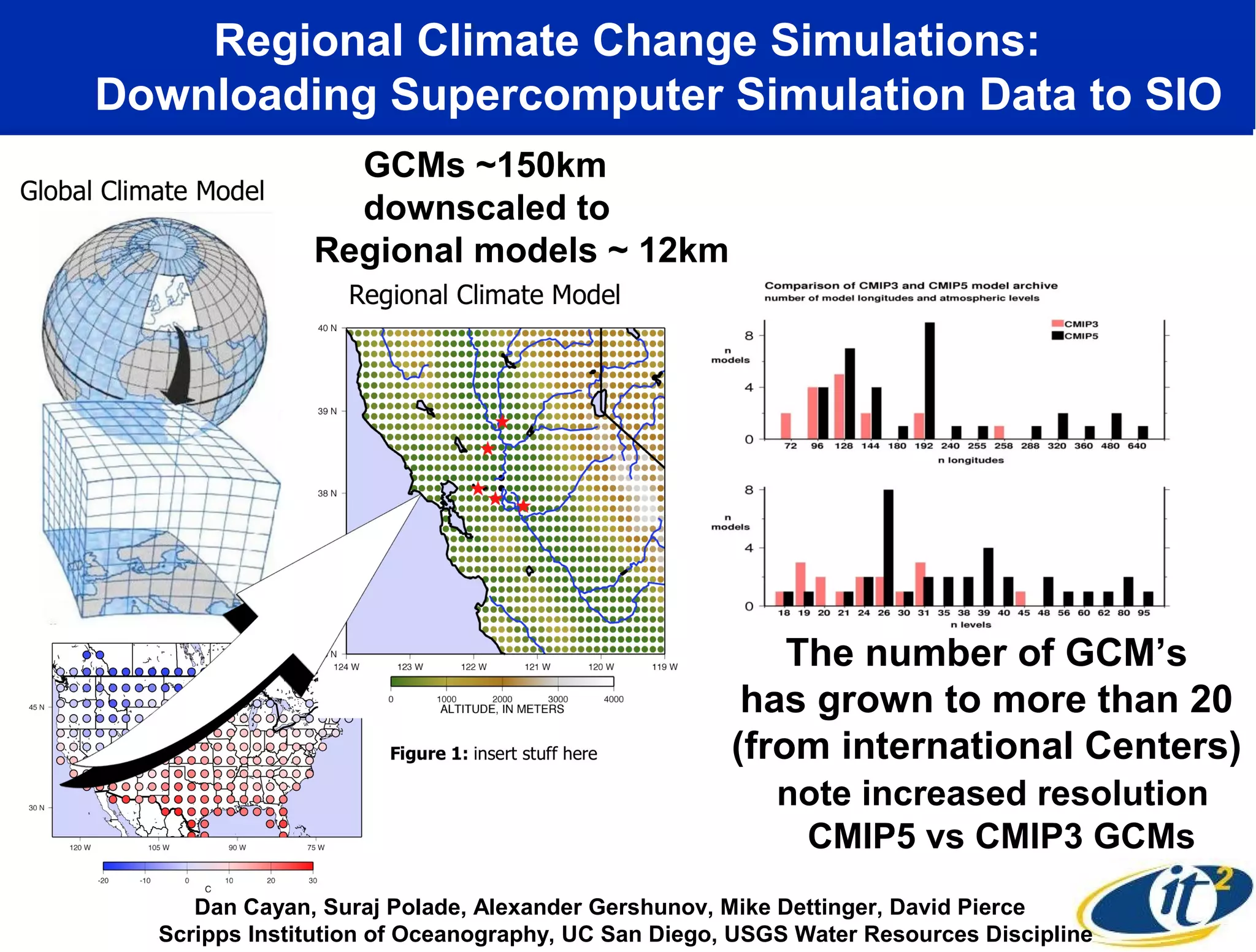
Regional Climate Change Simulations:
Downloading Supercomputer Simulation Data to SIO
                 GCMs ~150km
                 downscaled to
               Regional models ~ 12km


                                                        The number of GCM’s
                                                     has grown to more than 20
                                                    (from international Centers)
                                                        note increased resolution
                                                         CMIP5 vs CMIP3 GCMs
     Dan Cayan, Suraj Polade, Alexander Gershunov, Mike Dettinger, David Pierce
  Scripps Institution of Oceanography, UC San Diego, USGS Water Resources Discipline
High Performance Connection
                Among On-Campus Resources
•   Optically Connected Clusters
•   Connecting to Cross-Campus Clusters
•   Connecting Clusters to Supercomputers and Clouds
•   Connecting Scientific Instruments to Data Centers and Vis
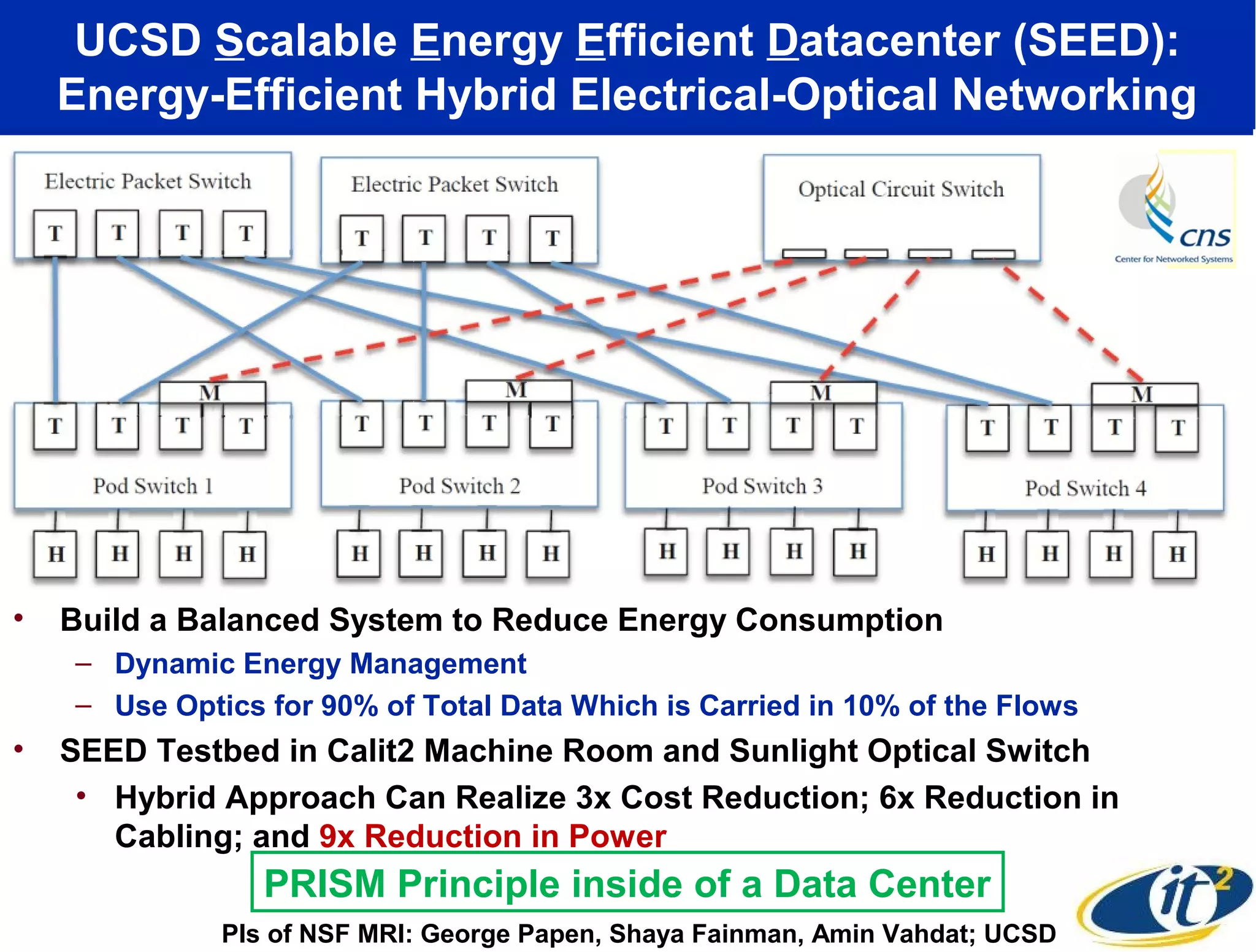
UCSD Scalable Energy Efficient Datacenter (SEED):
    Energy-Efficient Hybrid Electrical-Optical Networking


•   Build a Balanced System to Reduce Energy Consumption
    – Dynamic Energy Management
    – Use Optics for 90% of Total Data Which is Carried in 10% of the Flows
•   SEED Testbed in Calit2 Machine Room and Sunlight Optical Switch
     • Hybrid Approach Can Realize 3x Cost Reduction; 6x Reduction in
       Cabling; and 9x Reduction in Power
                 PRISM Principle inside of a Data Center
              PIs of NSF MRI: George Papen, Shaya Fainman, Amin Vahdat; UCSD
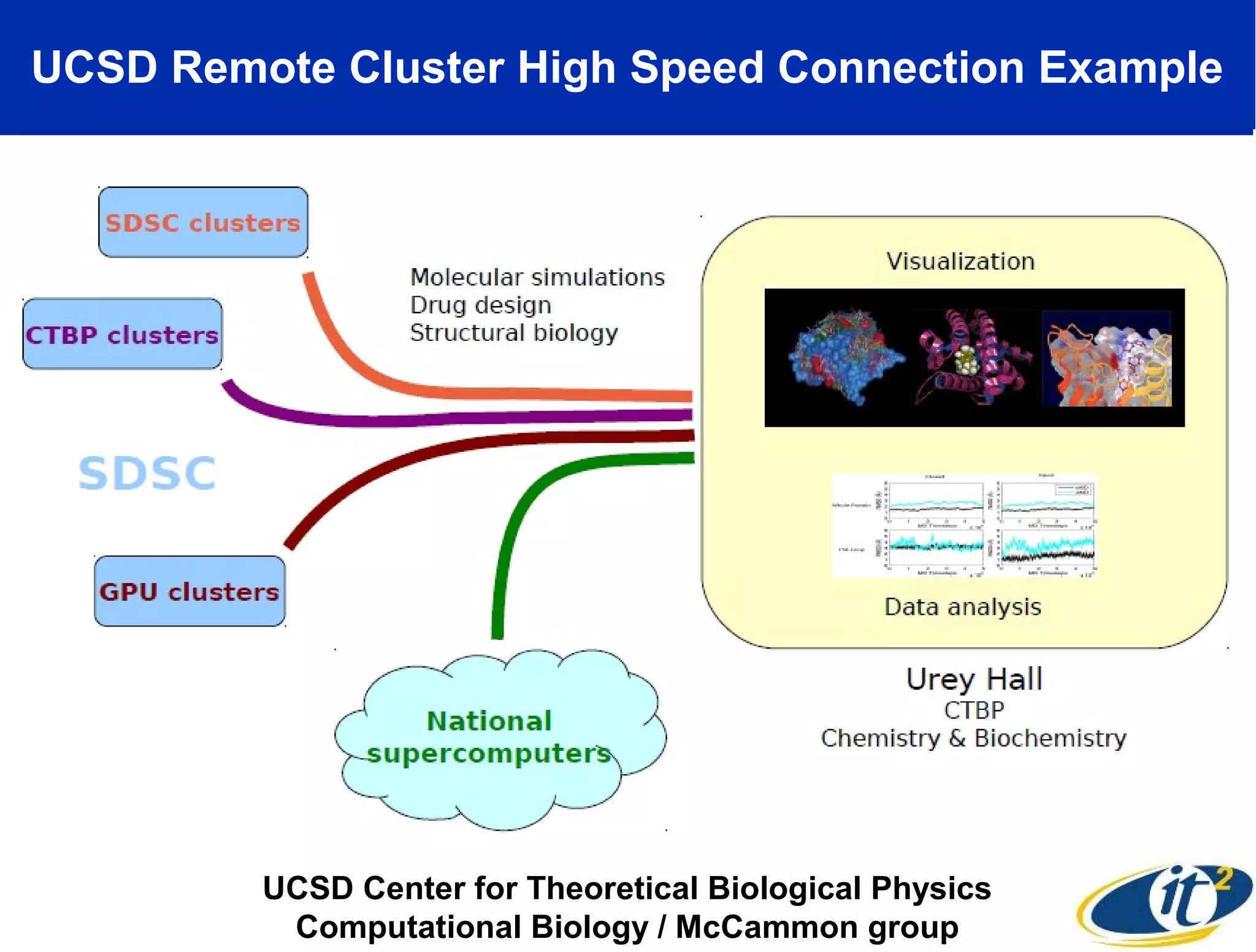
UCSD Remote Cluster High Speed Connection Example


         UCSD Center for Theoretical Biological Physics
          Computational Biology / McCammon group
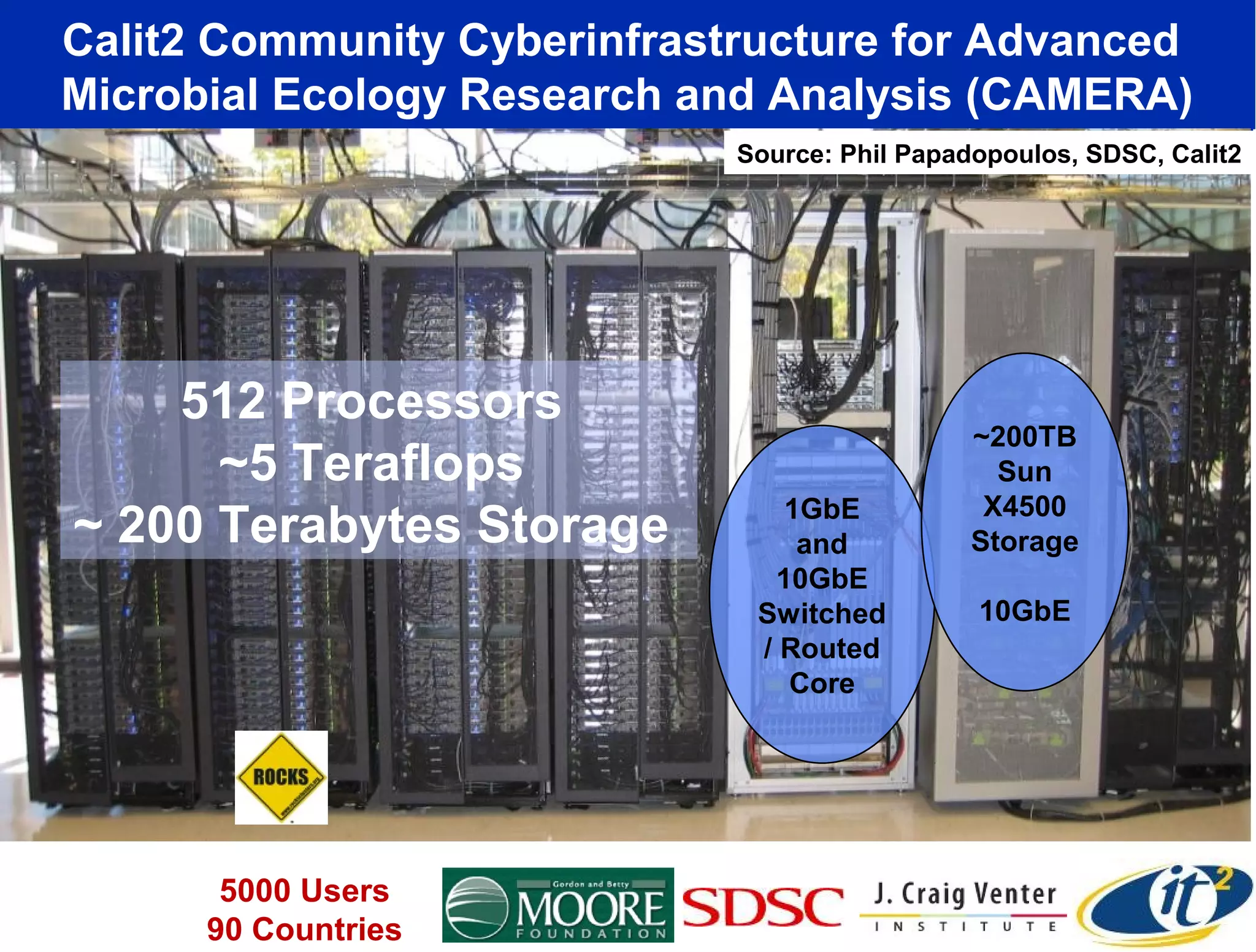
Calit2 Community Cyberinfrastructure for Advanced
Microbial Ecology Research and Analysis (CAMERA)
                             Source: Phil Papadopoulos, SDSC, Calit2


    512 Processors
                                               ~200TB
      ~5 Teraflops                               Sun
                                1GbE            X4500
~ 200 Terabytes Storage          and           Storage
                               10GbE
                              Switched         10GbE
                              / Routed
                                Core


       5000 Users
      90 Countries
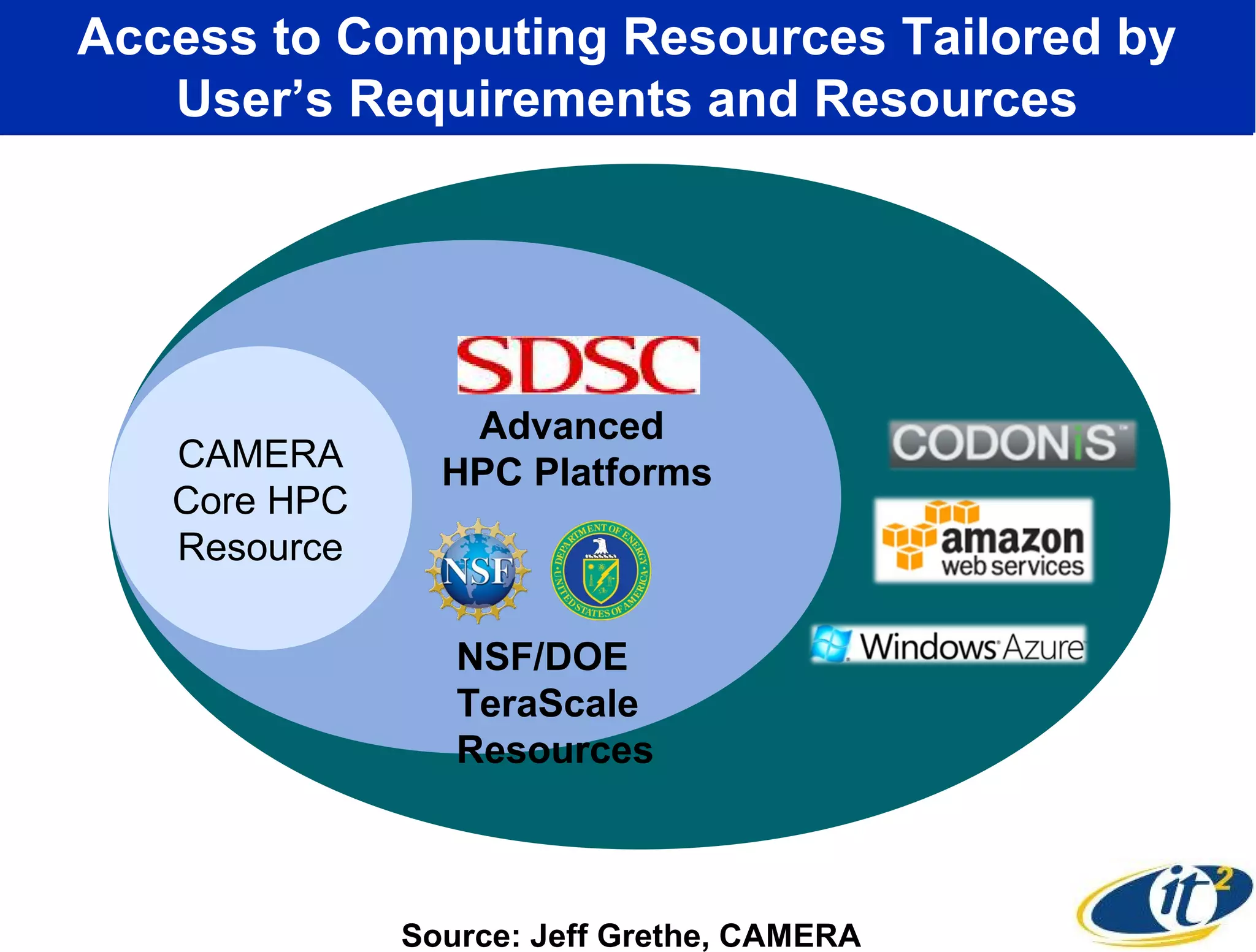
Access to Computing Resources Tailored by
   User’s Requirements and Resources


                 Advanced
   CAMERA       HPC Platforms
   Core HPC
   Resource

                 NSF/DOE
                 TeraScale
                 Resources


              Source: Jeff Grethe, CAMERA
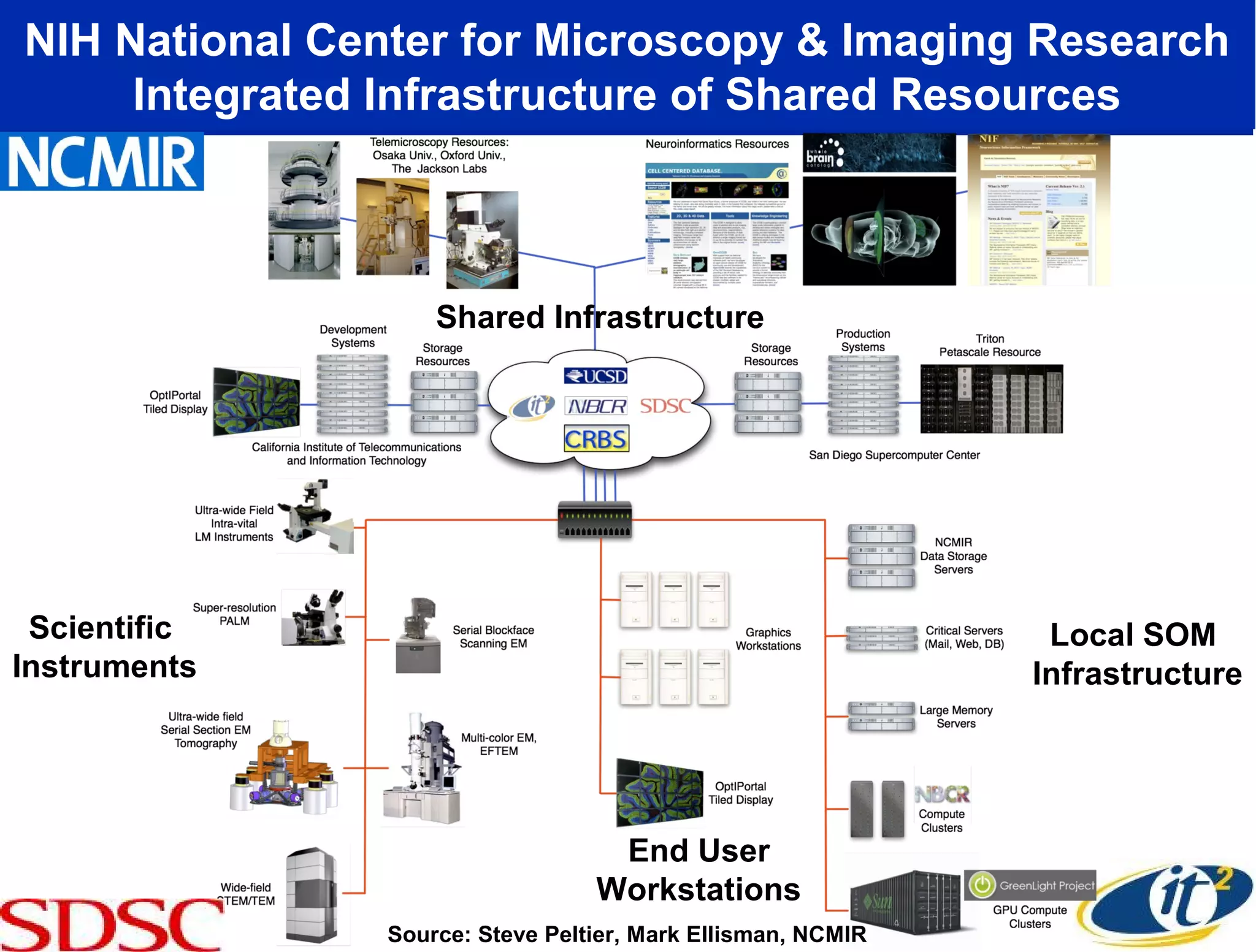
NIH National Center for Microscopy & Imaging Research
     Integrated Infrastructure of Shared Resources


                   Shared Infrastructure


 Scientific                                                   Local SOM
Instruments                                                  Infrastructure


                                  End User
                                 Workstations
               Source: Steve Peltier, Mark Ellisman, NCMIR
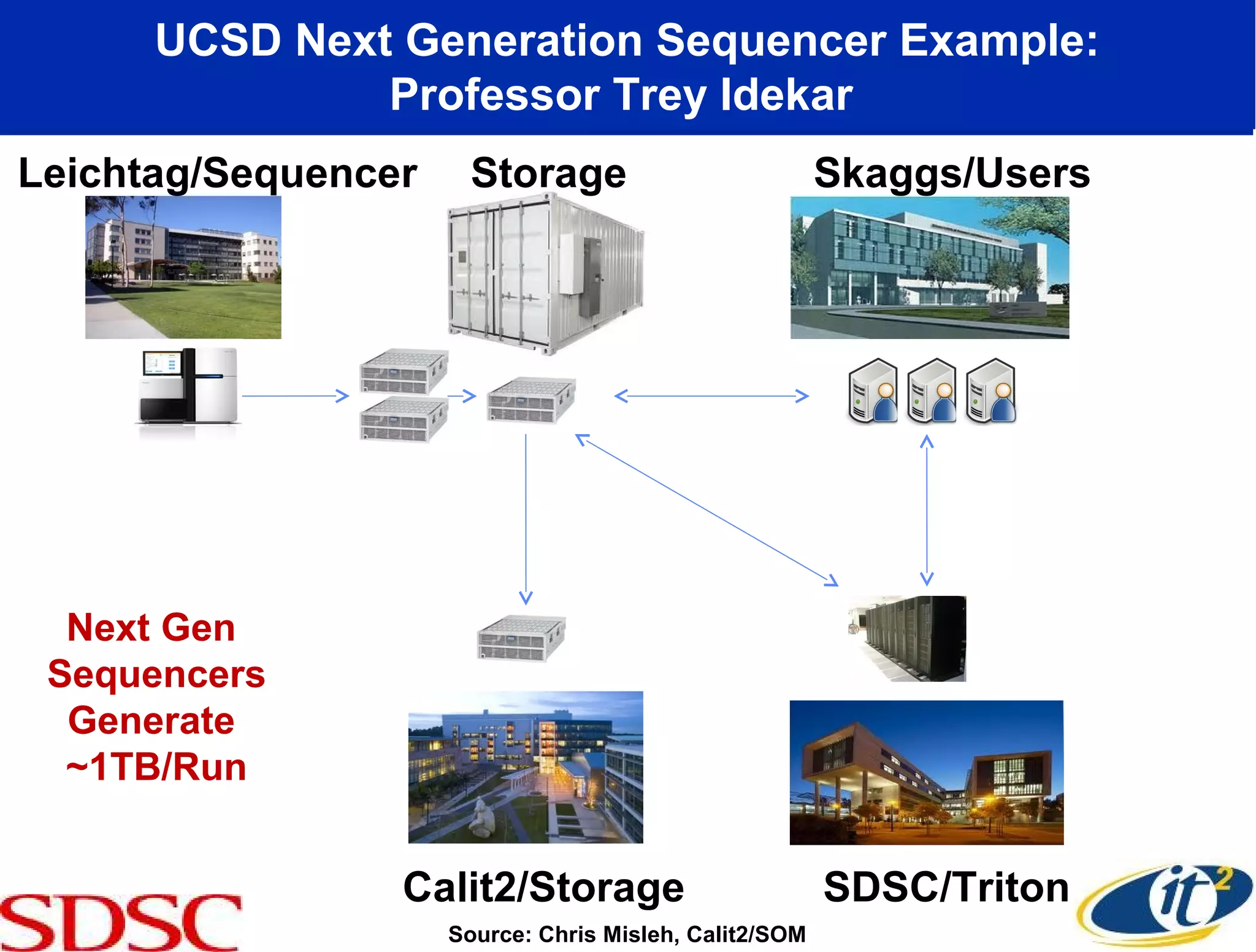
UCSD Next Generation Sequencer Example:
               Professor Trey Idekar
Leichtag/Sequencer     Storage                          Skaggs/Users


  Next Gen
 Sequencers
  Generate
  ~1TB/Run


                 Calit2/Storage                         SDSC/Triton
                     Source: Chris Misleh, Calit2/SOM
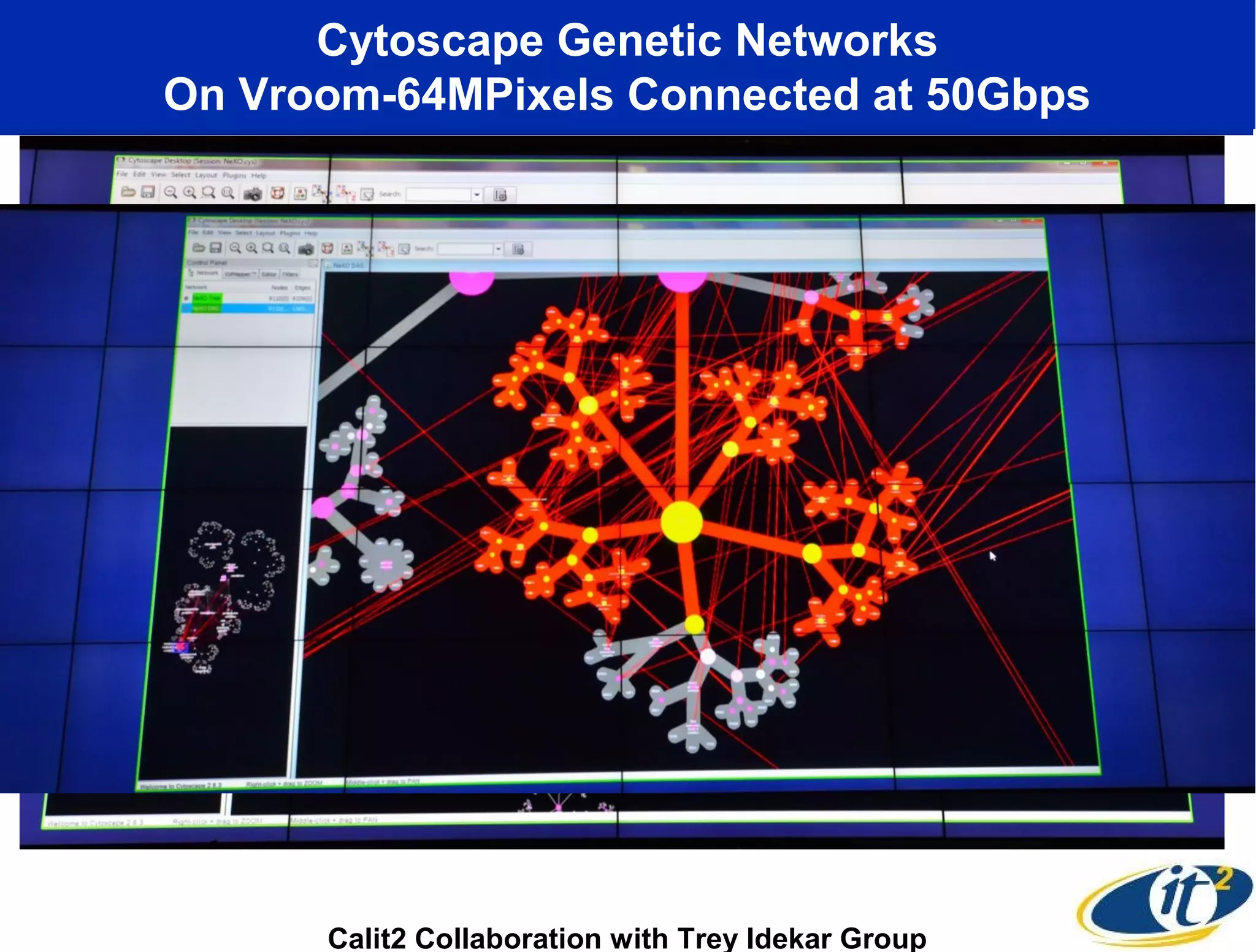
Cytoscape Genetic Networks
On Vroom-64MPixels Connected at 50Gbps


      Calit2 Collaboration with Trey Idekar Group
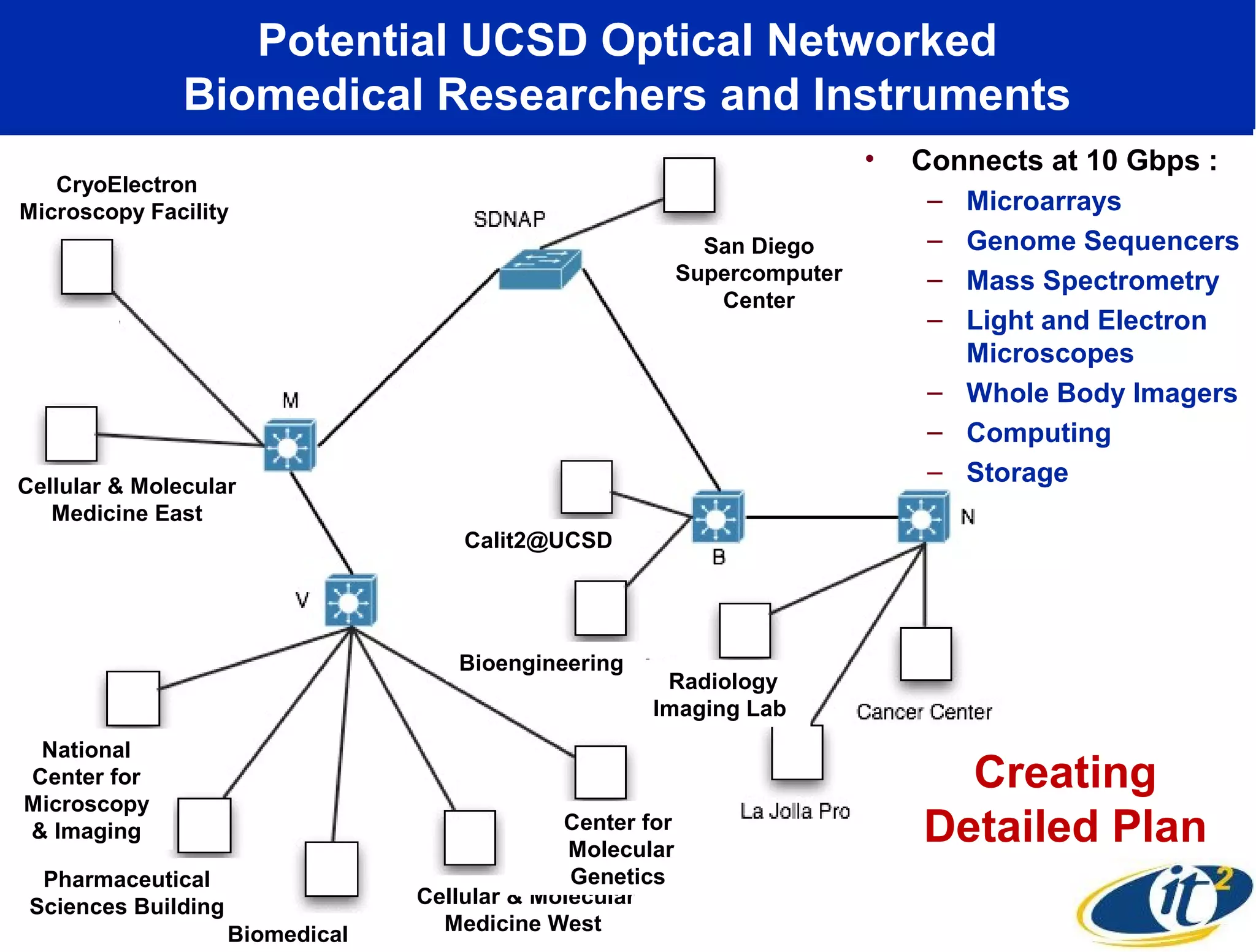
Potential UCSD Optical Networked
               Biomedical Researchers and Instruments
                                                                            •   Connects at 10 Gbps :
   CryoElectron
Microscopy Facility                                                              – Microarrays
                                                              San Diego          – Genome Sequencers
                                                            Supercomputer        – Mass Spectrometry
                                                               Center
                                                                                 – Light and Electron
                                                                                   Microscopes
                                                                                 – Whole Body Imagers
                                                                                 – Computing
Cellular & Molecular
                                                                                 – Storage
   Medicine East
                                      Calit2@UCSD


                                     Bioengineering
                                                        Radiology
                                                       Imaging Lab
 National
Center for                                                                        Creating
Microscopy
& Imaging                                      Center for
                                                Molecular
                                                                                Detailed Plan
  Pharmaceutical                                Genetics
 Sciences Building                Cellular & Molecular
                     Biomedical     Medicine West
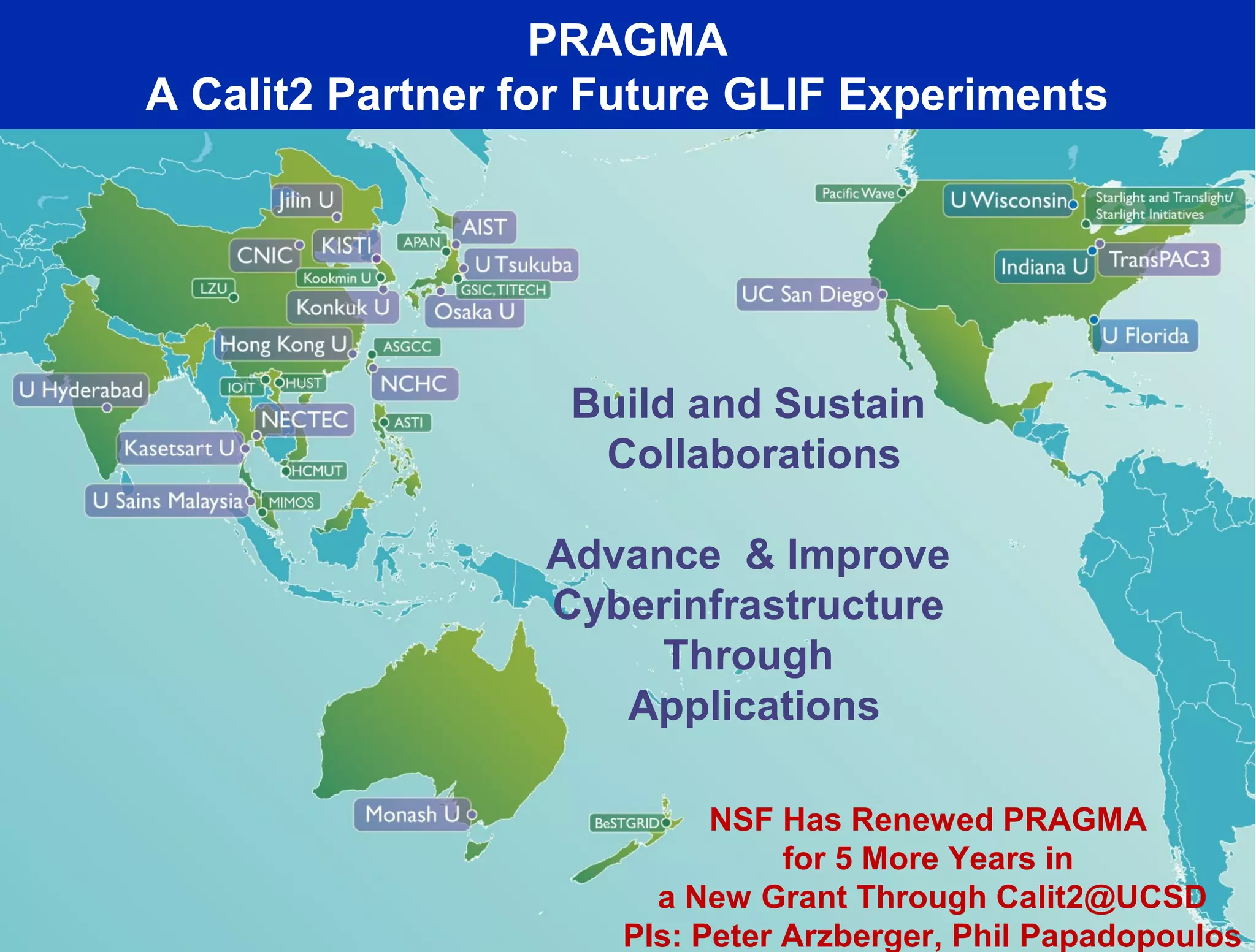
PRAGMA
A Calit2 Partner for Future GLIF Experiments


                   Build and Sustain
                    Collaborations

                  Advance & Improve
                  Cyberinfrastructure
                       Through
                     Applications

                           NSF Has Renewed PRAGMA
                                for 5 More Years in
                       a New Grant Through Calit2@UCSD
                     PIs: Peter Arzberger, Phil Papadopoulos

How to Terminate the GLIF by Building a Campus Big Data Freeway System

  • 1.
    “How to Terminatethe GLIF by Building a Campus Big Data Freeway System” Keynote Lecture 12th Annual Global LambdaGrid Workshop Chicago, IL October 11, 2012 Dr. Larry Smarr Director, California Institute for Telecommunications and Information Technology Harry E. Gruber Professor, Dept. of Computer Science and Engineering 1 Jacobs School of Engineering, UCSD
  • 2.
    The White HouseAnnouncement Has Galvanized U.S. Campus CI Innovations
  • 3.
    The OptIPuter Createsa Big Data Global Collaboratory Built on a 10Gbps “End-to-End” Lightpath Cloud HD/4k Live Video HPC Local or Remote Instruments End User OptIPortal National LambdaRail 10G Lightpaths Campus Optical Switch Data Repositories & Clusters HD/4k Video Repositories
  • 4.
    Calit2 Sunlight OptIPuterExchange Six Years of Experience with Campus 10G Termination Maxine Brown, EVL, UIC OptIPuter Project Manager
  • 5.
    Prism@UCSD Prototype NSF Quartzite Grant NSF Quartzite Grant 2004-2007 Phil Papadopoulos, PI
  • 6.
    Rapid Evolution of10GbE Port Prices Makes Campus-Scale 10Gbps CI Affordable • Port Pricing is Falling • Density is Rising – Dramatically • Cost of 10GbE Approaching Cluster HPC Interconnects $80K/port Chiaro (60 Max) $ 5K Force 10 (40 max) ~$1000 (300+ Max) $ 500 Arista $ 400 48 ports Arista 48 ports 2005 2007 2009 2010 Source: Philip Papadopoulos, SDSC/Calit2
  • 7.
    Arista Switch BecomesCentral Switching Point for 10Gbps Wavelengths
  • 8.
    Arista Enables SDSC’sMassive Parallel 10G Switched Data Analysis Resource
  • 9.
    Quickly Deployable NearlySeamless OptIPortables Provide 10G Visualization Termination Device 45 minute setup, 15 minute tear-down with two people (possible with one) Shipping Case Image From the Calit2 KAUST Lab
  • 10.
    OptIPortables Can ThemselvesBe Scaled 4x8 OptIPortables = 64 Mpixels
  • 11.
    End User FIONAMerges Gordon I/O Nodes and Data Oasis Storage Nodes into the OptIPortable • FIONA • Gordon – Flash Drive Space: 1.4TB – Flash Drive Space: 4TB – Ethernet: 20Gbps – Ethernet: 20 Gbps – Local Disk Space: 18TB – Local Disk Space: 0TB – Flash-to-Net: 2GB/sec – Flash-to-Net: 3GB/sec (est) (measured) – Disk-to-Net: 600-700MB/s – Disk-to-Net: 2GB/s (requires Oasis I/O servers) – OptIPortable Scalable Vis – No Vis
  • 12.
    How a CampusCan Terminate the GLIF: NSF Has Awarded Prism@UCSD Optical Switch Phil Papadopoulos, SDSC, Calit2, PI
  • 13.
    Global Access to On-Campus Resources • Protein Data Bank • Center for Computational Mass Spectrometry
  • 14.
    Remote Users NeedAccess to Protein Data Bank: 2010 FTP Traffic PDB Has >80,000 Structures Supported by NSF for 35 Years RCSB PDB PDBe PDBj 159 million 34 million 16 million entry downloads entry downloads entry downloads 14 Source: Phil Bourne, UCSD
  • 15.
    UCSD Center forComputational Mass Spectrometry Becoming Global MS Repository ProteoSAFe: Compute-intensive MassIVE: repository and discovery MS at the click of a button identification platform for all MS data in the world Source: Nuno Bandeira, UCSD
  • 16.
    Campus User Access to Remote Resources • GLIF • Experimental Particle Physics • Ocean Observatory Initiative • Remote Supercomputing • Creating Regional Climate Forecasts
  • 17.
    The Global LambdaIntegrated Facility-- Creating a Planetary-Scale High Bandwidth Collaboratory Calit2 Linked to GLIF by Campus 10G Dedicated Lambdas www.glif.is/publications/maps/GLIF_5-11_World_2k.jpg
  • 18.
    The CERN LargeHadron Collider CMS Experiment • 1 to 10 Petabytes of raw data per year • 2000 Scientists (1200 Ph.D. in physics) – ~ 180 Institutions in ~ 40 countries Source: Frank Würthwein, UCSD
  • 19.
    Aggregate Data RateLeaving LHR-CMS Can Exceed 30 Gbps 19 Source: Frank Würthwein, UCSD
  • 20.
    LHC Has OpticalNetworks Connecting Tier-1 and Tier-2 Sites with CERN UCSD Hosts a Tier-2 Site Source: Frank Würthwein, UCSD
  • 21.
    The Open ScienceGrid A Consortium of Universities and National Labs to share resources and technologies to advance Science Open for all of science, including biology, chemistry, computer science, engineering, mathematics, medicine, and physics Source: Frank Würthwein, UCSD
  • 22.
    Current UCSD CMSTier 2 Data Rate Already Peaks at 2.5 Gbps 22 Source: Frank Würthwein, UCSD
  • 23.
    NSF’s Ocean ObservatoryInitiative Has the Largest Funded NSF CI Grant OOI CI Grant: 30-40 Software Engineers Housed at Calit2@UCSD Source: Matthew Arrott, Calit2 Program Manager for OOI CI
  • 24.
    NSF’s Ocean ObservatoryInitiative is Creating 10G Sensornets
  • 25.
    OOI CI isBuilt on Dedicated OOI CI Optical Infrastructure Using Clouds Physical Network Implementation Source: John Orcutt, Matthew Arrott, SIO/Calit2
  • 26.
    Using Supernetworks toCouple End User’s OptIPortal to Remote Supercomputers and Visualization Servers Source: Mike Norman, Rick Wagner, SDSC Argonne NL DOE Eureka 100 Dual Quad Core Xeon Servers 200 NVIDIA Quadro FX GPUs in 50 Quadro Plex S4 1U enclosures 3.2 TB RAM rendering Real-Time Interactive Volume Rendering Streamed from ANL to SDSC ESnet 10 Gb/s fiber optic network NICS SDSC ORNL NSF TeraGrid Kraken simulation visualization Cray XT5 8,256 Compute Nodes Calit2/SDSC OptIPortal1 99,072 Compute Cores 20 30” (2560 x 1600 pixel) LCD panels 129 TB RAM 10 NVIDIA Quadro FX 4600 graphics cards > 80 megapixels 10 Gb/s network throughout *ANL * Calit2 * LBNL * NICS * ORNL * SDSC
  • 27.
    Regional Climate ChangeSimulations: Downloading Supercomputer Simulation Data to SIO GCMs ~150km downscaled to Regional models ~ 12km The number of GCM’s has grown to more than 20 (from international Centers) note increased resolution CMIP5 vs CMIP3 GCMs Dan Cayan, Suraj Polade, Alexander Gershunov, Mike Dettinger, David Pierce Scripps Institution of Oceanography, UC San Diego, USGS Water Resources Discipline
  • 28.
    High Performance Connection Among On-Campus Resources • Optically Connected Clusters • Connecting to Cross-Campus Clusters • Connecting Clusters to Supercomputers and Clouds • Connecting Scientific Instruments to Data Centers and Vis
  • 29.
    UCSD Scalable EnergyEfficient Datacenter (SEED): Energy-Efficient Hybrid Electrical-Optical Networking • Build a Balanced System to Reduce Energy Consumption – Dynamic Energy Management – Use Optics for 90% of Total Data Which is Carried in 10% of the Flows • SEED Testbed in Calit2 Machine Room and Sunlight Optical Switch • Hybrid Approach Can Realize 3x Cost Reduction; 6x Reduction in Cabling; and 9x Reduction in Power PRISM Principle inside of a Data Center PIs of NSF MRI: George Papen, Shaya Fainman, Amin Vahdat; UCSD
  • 30.
    UCSD Remote ClusterHigh Speed Connection Example UCSD Center for Theoretical Biological Physics Computational Biology / McCammon group
  • 31.
    Calit2 Community Cyberinfrastructurefor Advanced Microbial Ecology Research and Analysis (CAMERA) Source: Phil Papadopoulos, SDSC, Calit2 512 Processors ~200TB ~5 Teraflops Sun 1GbE X4500 ~ 200 Terabytes Storage and Storage 10GbE Switched 10GbE / Routed Core 5000 Users 90 Countries
  • 32.
    Access to ComputingResources Tailored by User’s Requirements and Resources Advanced CAMERA HPC Platforms Core HPC Resource NSF/DOE TeraScale Resources Source: Jeff Grethe, CAMERA
  • 33.
    NIH National Centerfor Microscopy & Imaging Research Integrated Infrastructure of Shared Resources Shared Infrastructure Scientific Local SOM Instruments Infrastructure End User Workstations Source: Steve Peltier, Mark Ellisman, NCMIR
  • 34.
    UCSD Next GenerationSequencer Example: Professor Trey Idekar Leichtag/Sequencer Storage Skaggs/Users Next Gen Sequencers Generate ~1TB/Run Calit2/Storage SDSC/Triton Source: Chris Misleh, Calit2/SOM
  • 35.
    Cytoscape Genetic Networks OnVroom-64MPixels Connected at 50Gbps Calit2 Collaboration with Trey Idekar Group
  • 36.
    Potential UCSD OpticalNetworked Biomedical Researchers and Instruments • Connects at 10 Gbps : CryoElectron Microscopy Facility – Microarrays San Diego – Genome Sequencers Supercomputer – Mass Spectrometry Center – Light and Electron Microscopes – Whole Body Imagers – Computing Cellular & Molecular – Storage Medicine East Calit2@UCSD Bioengineering Radiology Imaging Lab National Center for Creating Microscopy & Imaging Center for Molecular Detailed Plan Pharmaceutical Genetics Sciences Building Cellular & Molecular Biomedical Medicine West
  • 37.
    PRAGMA A Calit2 Partnerfor Future GLIF Experiments Build and Sustain Collaborations Advance & Improve Cyberinfrastructure Through Applications NSF Has Renewed PRAGMA for 5 More Years in a New Grant Through Calit2@UCSD PIs: Peter Arzberger, Phil Papadopoulos

Editor's Notes

  • #32 This is a production cluster with it’s own Force10 e1200 switch. It is connected to quartzite and is labeled as the “CAMERA Force10 E1200”. We built CAMERA this way because of technology deployed successfully in Quartzite