Download to read offline
![Proceedings of the 2nd International Conference on Current Trends in Engineering and Management ICCTEM -2014
INTERNATIONAL JOURNAL OF COMPUTER ENGINEERING &
17 – 19, July 2014, Mysore, Karnataka, India
TECHNOLOGY (IJCET)
ISSN 0976 – 6367(Print)
ISSN 0976 – 6375(Online)
Volume 5, Issue 9, September (2014), pp. 20-26
© IAEME: www.iaeme.com/IJCET.asp
Journal Impact Factor (2014): 8.5328 (Calculated by GISI)
www.jifactor.com
20
IJCET
© I A E M E
PROPERTY BASED FUSION FOR MULTIFOCUS IMAGES
Pradeep kumar H S1, Shruthi2, Vaishnavi N L3, Ranjini M G4
1Asst. professor, Dept of CSE, MIT Mysore/VTU Belgaum, India
2, 3, 4Student –UG, Dept of CSE, MIT Mysore/VTU Belgaum, India
ABSTRACT
Here we concentrated on multifocus image fusion by adopting discrete wavelet transform
(DWT) technique. This paper highlights on pixel based image fusion, which yields highly focused
image as outcome. This paper aims to implement pixel-level image fusion based on mathematical
and wavelet transform fusion methods and find out their capacity to improve spatial and spectral
information. For this purpose different methods such as Averaging method, Minimum method,
Maximum method are used. Pixel level methods are affected by blurring effect which directly affects
the quality of the image; hence in order to overcome blurring effect, we are measuring the quality of
the image. Based on that value, quality of the image can be improved. Before applying any of the
fusion methods the primary task is to register the images.
Keywords: Image Registration, Image fusion, Contrast, Entropy, Visibility.
I. INTRODUCTION
The images that are already captured at different focus levels are fused to produce an image
that appears sharp everywhere. The fusion of image requires registration of the image prior to fusion.
Image fusion means the combining of two images into a single image that has the maximum
information content without producing details that are non-existent in the given images. Image
Fusion provides a mechanism to improve the quality of information from a set of images. Important
applications of the fusion of images include medical imaging, microscopic imaging, remote sensing,
computer vision, and robotics [1].
Image registration is the process of spatially aligning two or more images of a scene. The
process brings into correspondence individual pixels in the images. Therefore, given a point in one
image, the registration process will determine the positions of the same point in all the images. For
the image registration we are considering two geometric transformations like rotation and scaling.](https://image.slidesharecdn.com/propertybasedfusionformultifocusimages-141016084552-conversion-gate01/85/Property-based-fusion-for-multifocus-images-1-320.jpg)
![Proceedings of the 2nd International Conference on Current Trends in Engineering and Management ICCTEM -2014
INTERNATIONAL JOURNAL OF COMPUTER ENGINEERING &
17 – 19, July 2014, Mysore, Karnataka, India
TECHNOLOGY (IJCET)
ISSN 0976 – 6367(Print)
ISSN 0976 – 6375(Online)
Volume 5, Issue 9, September (2014), pp. 20-26
© IAEME: www.iaeme.com/IJCET.asp
Journal Impact Factor (2014): 8.5328 (Calculated by GISI)
www.jifactor.com
20
IJCET
© I A E M E
PROPERTY BASED FUSION FOR MULTIFOCUS IMAGES
Pradeep kumar H S1, Shruthi2, Vaishnavi N L3, Ranjini M G4
1Asst. professor, Dept of CSE, MIT Mysore/VTU Belgaum, India
2, 3, 4Student –UG, Dept of CSE, MIT Mysore/VTU Belgaum, India
ABSTRACT
Here we concentrated on multifocus image fusion by adopting discrete wavelet transform
(DWT) technique. This paper highlights on pixel based image fusion, which yields highly focused
image as outcome. This paper aims to implement pixel-level image fusion based on mathematical
and wavelet transform fusion methods and find out their capacity to improve spatial and spectral
information. For this purpose different methods such as Averaging method, Minimum method,
Maximum method are used. Pixel level methods are affected by blurring effect which directly affects
the quality of the image; hence in order to overcome blurring effect, we are measuring the quality of
the image. Based on that value, quality of the image can be improved. Before applying any of the
fusion methods the primary task is to register the images.
Keywords: Image Registration, Image fusion, Contrast, Entropy, Visibility.
I. INTRODUCTION
The images that are already captured at different focus levels are fused to produce an image
that appears sharp everywhere. The fusion of image requires registration of the image prior to fusion.
Image fusion means the combining of two images into a single image that has the maximum
information content without producing details that are non-existent in the given images. Image
Fusion provides a mechanism to improve the quality of information from a set of images. Important
applications of the fusion of images include medical imaging, microscopic imaging, remote sensing,
computer vision, and robotics [1].
Image registration is the process of spatially aligning two or more images of a scene. The
process brings into correspondence individual pixels in the images. Therefore, given a point in one
image, the registration process will determine the positions of the same point in all the images. For
the image registration we are considering two geometric transformations like rotation and scaling.](https://image.slidesharecdn.com/propertybasedfusionformultifocusimages-141016084552-conversion-gate01/75/Property-based-fusion-for-multifocus-images-1-2048.jpg)
![Proceedings of the 2nd International Conference on Current Trends in Engineering and Management ICCTEM -2014
17 – 19, July 2014, Mysore, Karnataka, India
Registration used here is landmark based image fusion which is concerned with the concept called as
spatial transformation.
21
The actual fusion process can take place at different levels of information representation, a
generic categorization of these levels are signal, pixel, feature and symbolic level. In order to achieve
pixel level image fusion we are considering simple minimum, simple maximum, simple average
method. For property measurements we are considering image properties like entropy, contrast,
kurtosis, visibility in ordered to increase the information that is particular application.
Combination of registration and image fusion technique improves the performance as
compared to use of individual fusion method as a result the partially blurred image can be converted
into a highly detailed image, facilitating automated processes that rely on image details to understand
a scene.
II. RELATED WORK
The lowest possible technique in image fusion is the pixel level, is also called as non linear
method, in which intensity values of sources image are used for merging the images. The next level
is feature level, which operates on characteristics such as size, shape, edge etc. At further level,
called decision level fusion, deals with symbolic representation of images[3].
An efficient pixel level Multifocus image fusion algorithm based on artificial neural networks
is proposed. The fusion method originated from human visual perception principle is suitable to
merge images with diverse focuses. Two spatially registered images with different focuses are
decomposed into several blocks. Then three features reflecting the clear level of every block are
calculated. Finally artificial neural networks are used to recognize the clear level of corresponding
block to decide which blocks should be used to construct the fusion result[4].
III. PROPOSED METHOD
Fusion process consists of two basic steps:
1. Image Registration
2. Image Fusion
Image registration, which brings the input images to spatial alignment, and image fusion
combines the image features (intensities, colors, etc) in the area of frame overlap. Image registration
works in four steps.
Feature detection
Attention is paid on the effect of fusion on corners, line intersections, edges, contours, closed
boundary, regions, etc. whether they are clearly detected. For further processing, these features can
be represented by their point representatives (distinctive points, line endings, centers of gravity),
called in the literature control points.
Feature matching
Features detected in the image that is to be registered are compared with those detected in the
reference image. Various feature descriptors and similarity measures along with spatial relationships
among the features are used here.](https://image.slidesharecdn.com/propertybasedfusionformultifocusimages-141016084552-conversion-gate01/85/Property-based-fusion-for-multifocus-images-2-320.jpg)
![Proceedings of the 2nd International Conference on Current Trends in Engineering and Management ICCTEM -2014
17 – 19, July 2014, Mysore, Karnataka, India
22
Transform model estimation
The type and parameters of the so-called mapping functions, aligning the sensed image with
the reference image, are estimated. The parameters of the mapping functions are computed by means
of the established feature correspondence.
Image re-sampling transformation
The sensed image is transformed by means of the mapping functions. Image values in non-integer
coordinates are estimated by an appropriate interpolation technique.
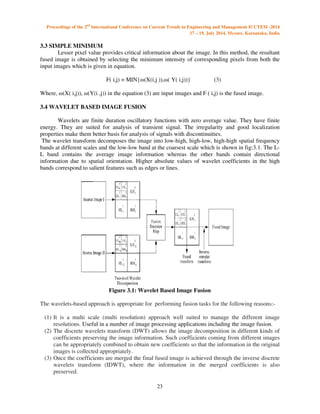
The problem faced in spatial domain method can be very well handled by Transform domain
image fusion methods. The fusion methods that can be used are discrete wavelet transform, complex
wavelet transform, curvelet transform and Laplacian pyramid based methods[6], in this paper we
mainly focus on DWT based fusion method.
Pixel-level image fusion means fusion at the lowest processing level referring to the merging
of measured physical parameters. It generates a fused image in which each pixel is determined from
a set of pixels of various images, and serves to increase the useful information content of an image.
Pixel Level Image fusion method can be divided into two groups:
1. Spatial domain fusion method
2. Transform domain fusion
Spatial domain fusion method directly deals with pixels of input images. We assume the
input images are spatially and temporally aligned, semantically equivalent and radio metrically
calibrated. The fusion methods such as simple maximum, simple minimum and averaging based
methods fall under spatial domain approaches. In transform domain method image is first transferred
into frequency domain. The fusion method such as DWT falls under transform domain method.
3.1 SIMPLE AVERAGE
It is a well-documented fact that regions of images that are in focus tend to be of higher pixel
intensity. This algorithm is a simple way of obtaining an output image with all regions in focus. In
this method the resultant fused image is obtained by taking the value of the pixel P(i, j) of each
image and the values are added. This sum is then divided by 2 to obtain the average. The average
value is assigned to the corresponding pixel of the output image which is given in equation. This is
repeated for all pixel values.
F (i, j) = {(X (i, j)) + (Y (i, j))}/2 (1)
Where, ( X (i , j)) and ( Y ( i, j) ) in the equation (1) are two registered input images and F (i, j) is
fused image.
3.2 SIMPLE MAXIMUM
Greater the pixel value more is the focus of the image. Thus this algorithm chooses the in-focus
regions from each input image by choosing the greatest value for each pixel, resulting in highly
focused output. The value of the pixel P (i, j) of each image is taken and compared with each other.
The greatest pixel value is assigned to the corresponding pixel of the output image which is given in
equation.
F( i ,j) = MAX{(X( I ,j )),( Y(i,j))} (2)
Where, (X(i,j)), (Y(i,j)) in the equation (2) are input images and F(i,j) is fused image.](https://image.slidesharecdn.com/propertybasedfusionformultifocusimages-141016084552-conversion-gate01/85/Property-based-fusion-for-multifocus-images-3-320.jpg)
![Proceedings of the 2nd International Conference on Current Trends in Engineering and Management ICCTEM -2014
17 – 19, July 2014, Mysore, Karnataka, India
= − ( ) log P i
(4)
F m n μ N
− a μ
s (7)
= −
24
IV. PERFORMANCE EVALUATION
The main goal of any image fusing process is that it should preserve all valid and useful
pattern information from the source images and must provide the most detailed and reliable
information possible, while at the same time it should not introduce any artifacts that could interfere
with subsequent analysis. Thus output of fused image will be evaluated in terms of Entropy,
Visibility, Kurtosis, and Contrast
4.1 ENTROPY
The contrast-enhancement performance is measured by calculating the second-order entropy.
Entropy is an index to evaluate the information quantity contained in an image. If the value of
entropy becomes higher after fusing, it indicates that the information increases and the fusion
performances are improved.
[ ( ) ]
255
E P i
0 2
i
=
Where, p in the equation (4) is the probability distribution of each level of image, and its
value are {p0, p1. . . p−1}[1][3][7].
4.2 VISIBILITY
This feature is inspired from the human visual system, and is defined as
VI= 1
1 1
| ( , ) |
+
= n
=
M
m
(5)
Where, μ in the equation (5) is the mean intensity value of the image and µ is a visual
constant ranging from 0.6 to 0.7[4][5].
4.3 KURTOSIS
Kurtosis is a measure of the degree of peakness of a histogram and is represented by K.It is
calculated as follows.
s2
T = S i ( i - μT )2p (6)
Where,s2
T in the equation (6) is the total variance of levels
K= (μ4/s4)-3
K = 0, the curve is normal.
If K is positive, the curve is more peaked. If K is negative, the curve is more flat topped.
4.4 CONTRAST
A measure of the clarity with which objects or regions in the image can be identified
estimated by the value of the standard deviation of pixel intensities in the image.
2
[ ( ) ]
1 1
,
1
=
=
m
i
n
j
f i j M
mn
Where, M in the equation (7) is the mean of the image.[5].](https://image.slidesharecdn.com/propertybasedfusionformultifocusimages-141016084552-conversion-gate01/85/Property-based-fusion-for-multifocus-images-5-320.jpg)
![Proceedings of the 2nd International Conference on Current Trends in Engineering and Management ICCTEM -2014
17 – 19, July 2014, Mysore, Karnataka, India
26
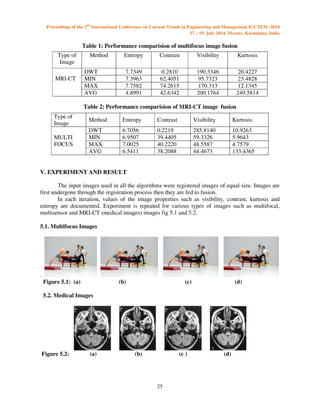
CONCLUSION
Although selection of fusion algorithm is problem dependent but this review results that
spatial domain provide high spatial resolution. But spatial domain have image blurring problem. The
wavelet transforms is the very good technique for the image fusion provide a high quality spectral
content. But a good fused image have both quality so the combination of DWT spatial domain
fusion method (like avg, min, max) fusion algorithm improves the performance as compared to use
of individual DWT and pixel level fusion algorithm.
REFERENCES
[1]. Deepak Kumar Sahu and M.P.Parsai, Different Image Fusion Techniques –A Critical
Review,International Journal of Modern Engineering Research (IJMER) www.ijmer.com
Vol. 2, Issue. 5, Sep.-Oct. 2012.
[2]. Wang Anna, Wu Jie, Li Dan and Chen Yu, Research on Medical Image Fusion Based on
Orthogonal Wavelet Packets Transformation Combined with 2v-SVM, IEEE/ICME
International Conference on Complex Medical Engineering 2007.
[3]. S.Chithra, J.B.Bhattacharjee and B.Thilakavathi, Image Fusion using Re-modified SPIHT for
fused image.
[4]. Shutao LI, Yaonan WANG and Boris Lohmann, Multi-focus Image Fusion using Artificial
Neural Networks.
[5]. Amina Saleem, Azeddine Beghdadi and Boualem Boashash. Image fusion-based contrast
enhancement. EURASIP Journal on Image and Video Processing 2012.
[6]. R.Maruthi and Dr.K.Sankarasubramanian, Multi Focus Image Fusion Based on the
Information Level in the Regions of the Images. Journal of Theoretical and Applied
Information Technology (JATIT).
[7]. Kusum Rani and ReechaSharma, Study of Different Image fusion Algorithm,International
Journal of Emerging Technology and Advanced Engineering (ISSN 2250-2459,
ISO 9001:2008 Certified Journal, Volume 3, Issue 5, May 2013).
[8]. Dr.S.S.Bedi, Mrs.JyotiAgarwal and PankajAgarwal, Image Fusion Techniques and Quality
AssessmentParameters for Clinical Diagnosis: A ReviewInternational Journal of Advanced
Research in Computer and Communication Engineering Vol. 2, Issue 2, February 2013.
[9]. Shaveta Mahajan and Arpinder Singh, A Comparative Analysis of Different Image Fusion
Techniques, IPASJ International Journal of Computer Science (IIJCS) Volume 2, Issue 1,
January 2014.](https://image.slidesharecdn.com/propertybasedfusionformultifocusimages-141016084552-conversion-gate01/85/Property-based-fusion-for-multifocus-images-7-320.jpg)

This document summarizes a paper presented at the 2nd International Conference on Current Trends in Engineering and Management. The paper proposes using discrete wavelet transform techniques for pixel-based fusion of multi-focus images. It discusses registering the images and then applying pixel-level fusion methods like average, minimum and maximum approaches. It also introduces a wavelet-based fusion method that decomposes images into different frequency bands for fusion. The goal is to produce a single fused image that has the maximum information and focus from the input images.


