International Research Journal of Engineering and Technology (IRJET) e-ISSN: 2395-0056
Volume: 05 Issue: 09 | Sep 2018 www.irjet.net p-ISSN: 2395-0072
© 2019, IRJET | Impact Factor value: 7.211 | ISO 9001:2008 Certified Journal | Page 6743
An Improvised Multi Focus Image Fusion Algorithm Through Quadtree
Rubeena Parveen1, Prof.Neelesh Shrivastava2, Prof.Pradeep Tripathi3
M.Tech Scholar, Department of Computer Science & Engineering, Vindhya Institute of Technology & Science, Satna
(M.P), India, Email: rp01061990@gmail.com
Assistant Professor, Department of CSE, Vindhya Institute of Technology & Science, Satna (M.P), India2
Associate Professor & Head , Department of CSE, Vindhya Institute of Technology & Science , Satna (M.P), India3
----------------------------------------------------------------------------------------------------------------------------------------------------------------------------------------
Abstract:The main motto of multi-focus image is to
combined different partially focused image in single one
throughout the image (means in fused image). Here
Authors are proposing a new concept i.e quadtree-based
algorithm where we divide the image into 4 equal parts
for further processing. Here we will divide image into
small block size for further process. The region can be
detected with the help of focus-measured using
weighted value. Finally, we will add all the small block
which we processed previously with the help of
modified Laplacian Mechanism. For comparison with
previous fusion algorithm we compare with two
important values i.e. SSIM & ESSIM value. After looking
these values, we can say that proposed algorithm has
better value.
Keyword: Multi-focus image fusion, Quadtree
decomposition strategy, Quadtree structure, modified
Laplacian, SSIM, ESSIM
I. INTRODUCTION
In scientific microscopic imaging or in a general
photograph, a single image usually cannot represent all
objects of interest, since an optical system is limited by
depth of field [1]. Multi-focus image fusion is considered a
good solution to this problem as it is suitable for
generating a single image from multiple source images and
is aimed at providing a more accurate description of
certain objects, or a combination of information, to meet a
particular human or machine perception requirement [2].
Meanwhile, multi-focus image fusion is also a hot research
topic since many proposed multi-focus image
fusion methods have been efficiently applied in various
fields such as remote sensing and medical imaging. During
the last few decades, a large number of image fusion
methods with various fusion frames have been proposed
[3] that can be applied to multi-focus image fusion.
BASIC METHODS OF IMAGE DATA FUSION
The images get in the environment of ubiquitous
computing, because of the complexity and their stronger
relationship of image information itself, incomplete and
inaccuracy, unstructured as well as difficulties in
modelling will occur at all layers of the process of image
fusion. Artificial intelligence applies to image pervasive
fusion, with the better results than traditional methods of
calculation (that is, the use of precise, fixed and
unchanging algorithm to express and solve the problem),
can integrated with their respective advantages, compose
intelligent fusion system, expand their original function.
Therefore, it is a pervasive image fusion method with huge
potential, the main intelligent methods as follows:
NEURAL NETWORK
In recent years, neural network theory is a cutting-edge
research field in artificial intelligence, suitable for non-
linear modelling, with self-learning, self-organization,
adaptive capacity, and higher accuracy, have good
generality and flexibility for different object modelling, but
the structure is complicated, not suitable as the steady-
state model of optimization method for complex systems.
FUZZY THEORY
In recent years, fuzzy theory has begun to apply to the field
of data fusion, because fuzzy theory provides an effective
methods to express uncertainty and inaccuracy of in-
formation, thus can establish the corresponding
mathematical model to a lot of uncertainty data in data
fusion issues; Meanwhile, fuzzy set theory can deal with
knowledge digitally, with a way similar to the thinking of
people to construct knowledge, therefore, it has a
advantage of computing with clear and easy to understand.
ROUGH SET THEORY
Rough set theory has not only provided new scientific logic
and research methods for the information science and
cognitive science, but also provided an effective treatment
technology to intelligent information processing. Rough set
theory has abilities of analyzing, reasoning for incomplete
data, and finding the intrinsic relationship between the
data extracting useful features and simplifying the
information processing, so the using of rough set theory on
the image fusion is a subject worth exploring.
IMAGE FUSION CATEGORIES
Image fusion can be grouped into following categories:
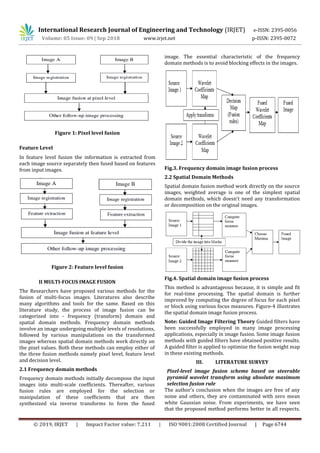
Pixel Level
In pixel level fusion the source images are fused pixel-by-
pixel followed by the information/feature extraction.
International Research Journal of Engineering and Technology (IRJET) e-ISSN: 2395-0056
Volume: 05 Issue: 09 | Sep 2018 www.irjet.net p-ISSN: 2395-0072
© 2019, IRJET | Impact Factor value: 7.211 | ISO 9001:2008 Certified Journal | Page 6744
Figure 1: Pixel level fusion
Feature Level
In feature level fusion the information is extracted from
each image source separately then fused based on features
from input images.
Figure 2: Feature level fusion
II MULTI-FOCUS IMAGE FUSION
The Researchers have proposed various methods for the
fusion of multi-focus images. Literatures also describe
many algorithms and tools for the same. Based on this
literature study, the process of image fusion can be
categorized into - frequency (transform) domain and
spatial domain methods. Frequency domain methods
involve an image undergoing multiple levels of resolutions,
followed by various manipulations on the transformed
images whereas spatial domain methods work directly on
the pixel values. Both these methods can employ either of
the three fusion methods namely pixel level, feature level
and decision level.
2.1 Frequency domain methods
Frequency domain methods initially decompose the input
images into multi-scale coefficients. Thereafter, various
fusion rules are employed for the selection or
manipulation of these coefficients that are then
synthesized via inverse transforms to form the fused
image. The essential characteristic of the frequency
domain methods is to avoid blocking effects in the images.
Fig.3. Frequency domain image fusion process
2.2 Spatial Domain Methods
Spatial domain fusion method work directly on the source
images, weighted average is one of the simplest spatial
domain methods, which doesn’t need any transformation
or decomposition on the original images.
Fig.4. Spatial domain image fusion process
This method is advantageous because, it is simple and fit
for real-time processing. The spatial domain is further
improved by computing the degree of focus for each pixel
or block using various focus measures. Figure-4 illustrates
the spatial domain image fusion process.
Note: Guided Image Filtering Theory Guided filters have
been successfully employed in many image processing
applications, especially in image fusion. Some image fusion
methods with guided filters have obtained positive results.
A guided filter is applied to optimize the fusion weight map
in these existing methods.
III. LITERATURE SURVEY
Pixel-level image fusion scheme based on steerable
pyramid wavelet transform using absolute maximum
selection fusion rule
The author's conclusion when the images are free of any
noise and others, they are contaminated with zero mean
white Gaussian noise. From experiments, we have seen
that the proposed method performs better in all respects.
International Research Journal of Engineering and Technology (IRJET) e-ISSN: 2395-0056
Volume: 05 Issue: 09 | Sep 2018 www.irjet.net p-ISSN: 2395-0072
© 2019, IRJET | Impact Factor value: 7.211 | ISO 9001:2008 Certified Journal | Page 6745
Performance is evaluated on the basis of qualitative and
quantitative criteria. The main reason for using steady
pyramid wavelet transforms in image fusion is its shift
inversion and rotation inversion nature.
Optimization of Image Fusion Using Genetic Algorithms
and Discrete Wavelet Transform
Here author concludes that a pair of "original" solutions is
selected for reproduction from the previous selection pool.
A new solution is created by producing "child" solutions
using crossover and / or mutations. New candidate
solutions are selected and the process continues until a
new population of suitable size solutions is produced. The
given technique is more accurate and improves the aspect
of loss of information which is the fault of many other
techniques. When incorporating efficiency from the
Extraction Extraction technology and PLGA_IF from
DWT_IF, the results improve the accuracy of the fused
image, which can be beneficial for weather forecasts.
Multispectral and panchromatic image fusion Based on
Genetic Algorithm and Data Assimilation
Here author concludes that most fusion algorithms for
multispectral and punch chromatic images such as: major
component analysis, contrast pyramid decomposition, IHS
method, brow method, PCA method, waveform, Gaussian-
Laplace pyramid, and so on, their Fusion rules cannot be
adjusted favourably according to the purpose of the fusion
image. In order to solve this problem, assimilation
assimilation has been introduced in the meteorological
area. This means that observational data and numerical
simulation data are more integrated in nature to achieve
analysis results. Fusion based on data assimilation and
genetic algorithm was introduced for multispectral and
pancreatic image.
IV. PROPOSED METHOD
The main requirement of the fusion process is to identify
the most significant features in the input images and to
transfer them without loss of detail into the fused image.
1. Take Image 1 using imread function
2. Take Image 2 using imread function
3. Combine those images
(a) Take dimension of images using size (img)function
NormDim = align(p1, p2);
(b) Check if the maxDim == 2048, exit the program
4. Initialize the step, threshold and block
size(Proposed parameters)
step = 1; T = 5; bsz = 17;
5. Compute the modified laplacian gradients of
the images
Grads = zeros(p1, p2, num);
for kk = 1 : num
img = mImg( : , : , kk);
Grad = mlap(img, step, T, bsz);
6.First, compute the modified Laplacian
gradients(Proposed Technique)
7. Image Fusion initialize the fusion image
fimg = zeros(p1,p2);
8. Extend images
(a)Extend mImgs and Grads to maxDim( 2 ^
(a) (b)
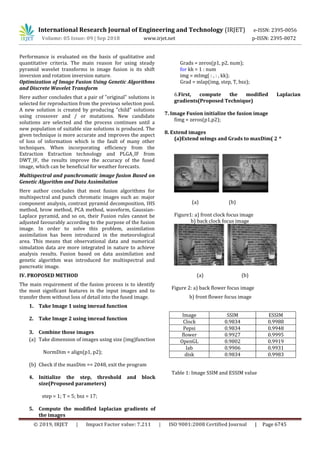
Figure1: a) front clock focus image
b) back clock focus image
(a) (b)
Figure 2: a) back flower focus image
b) front flower focus image
Image SSIM ESSIM
Clock 0.9834 0.9988
Pepsi 0.9834 0.9948
flower 0.9927 0.9995
OpenGL 0.9802 0.9919
lab 0.9906 0.9931
disk 0.9834 0.9983
Table 1: Image SSIM and ESSIM value
International Research Journal of Engineering and Technology (IRJET) e-ISSN: 2395-0056
Volume: 05 Issue: 09 | Sep 2018 www.irjet.net p-ISSN: 2395-0072
© 2019, IRJET | Impact Factor value: 7.211 | ISO 9001:2008 Certified Journal | Page 6746
Image
sets
Contr
ast
pyram
id
DWT SID
WT
De’s
algorit
hm
QT
Base
d
Propos
ed
Metho
d
Clock 0.973
5
0.97
51
0.98
19
0.9778 0.97
62
0.9834
Disk 0.972
5
0.97
55
0.97
57
0.9725 0.97
74
0.9834
Flowe
r
0.964
8
0.96
69
0.96
45
0.9607 0.96
71
0.9927
Lab 0.980
7
0.98
18
0.98
31
0.9813 0.98
34
0.9906
Open
GL
0.955
6
0.96
42
0.96
62
0.9592 0.96
08
0.9802
Pepsi 0.985
2
0.98
54
0.98
22
0.9860 0.98
62
0.9834
Table 2: - Gradient similarity metrics
Image
sets
Contr
ast
pyram
id
DWT SID
WT
De’s
algorit
hm
QT
Base
d
Propos
ed
Metho
d
Clock 0.688
0
0.66
19
0.70
03
0.7384 0.73
73
0.9988
Disk 0.684
9
0.65
03
0.68
22
0.7340 0.73
83
0.9983
Flowe
r
0.644
4
0.62
22
0.65
83
0.6821 0.69
62
0.9995
Lab 0.691
0
0.66
16
0.68
39
0.7442 0.74
70
0.9931
Open
GL
0.694
6
0.67
84
0.70
58
0.7289 0.73
08
0.9919
Pepsi 0.754
8
0.72
93
0.74
45
0.7847 0.78
47
0.9948
Table 3: - Edge base similarity matrices
V. CONCLUSION
Authors Concluded, that a new multi-focus image fusion
method with a guided filter. In the proposed algorithm, use
of guided filters is used to first identify the main feature
maps of the source images, and then the initial decision
map is defined with mixed measurements combined with
two efficient focus measurement descriptors. Experimental
results show that the proposed fusion method can be
competitive with some sophisticated methods or even
better performance. Quadtree also offers a deplete strategy
and a new weighted focus-measure, thus in an effective IV
structure, areas focused from source images can be
detected, effective and properly. And the detected areas
can be extracted well from the source images and can be
reconstituted to create the fusion image.
REFERENCES
[1] J. Alonso, A. Fernández, G. Ayubi, and J. Ferrari, “All-in-
focus image reconstruction under severe defocus,” Opt.
Lett. 40, 1671–1674 (2015).
[2] R. Van de Plas, J. Yang, J. Spraggins, and R. Caprioli,
“Image fusion of mass spectrometry and microscopy: a
multimodality paradigm for molecular tissue mapping,”
Nat. Methods 12, 366–372 (2015).
[3] P. Burt and E. Adelson, “The Laplacian pyramid as a
compact image code,” IEEE Trans. Commun. 31, 532-540
(1983).
[4]Y. Jiang and M. Wang, “Image fusion with morphological
component analysis,” Inf. Fusion 18, 107–118 (2014).
[5] C. Mi, L. IDe-ren, Q. Qian-qing, and J. Yong-hong,
"Remote Sensing Image Fusion Based on Contourlet
Transform," MINI-MICRO SYSTEMS, vol. 27, pp. 2052-2055,
2006.
[6] D. Batchelder, J. Blackbird, P. Henry, and G. MacDonald,
“Microsoft Security Intelligence Report -Volume 17,”
Microsoft Secur. Intell. Rep., vol. 16, pp. 1–19, 2014.
[7] Li, J. T. Kwok, and Y. Wang. (2010, April) Using the
Discrete Wavelet Frame Transform to Merge Landsat TM
and SPOT Panchromatic Images.[Online].Available:
http://www.cs.ust.hk/~jamesk/papers/if02.pdf, 2002
[8] Z. Yunfeng, Y. Yixin, F. Dongmei, "Decision-level fusion
of infrared and visible images for face recognition," Control
and Decision Conference (CCDC), pp. 2411 - 2414, 2008.
[9] W. Huang, Z. Jing, Evaluation of focus measures in
multi-focus image fusion,
Pattern Recogn. Lett. 28 (4) (2007) 493–500.
[10] W. Huang, Z. Jing, Multi-focus image fusion using pulse
coupled neural
network, Pattern Recogn. Lett. 28 (9) (2007) 1123–1132.

IRJET- An Improvised Multi Focus Image Fusion Algorithm through Quadtree

  • 1.
    International Research Journalof Engineering and Technology (IRJET) e-ISSN: 2395-0056 Volume: 05 Issue: 09 | Sep 2018 www.irjet.net p-ISSN: 2395-0072 © 2019, IRJET | Impact Factor value: 7.211 | ISO 9001:2008 Certified Journal | Page 6743 An Improvised Multi Focus Image Fusion Algorithm Through Quadtree Rubeena Parveen1, Prof.Neelesh Shrivastava2, Prof.Pradeep Tripathi3 M.Tech Scholar, Department of Computer Science & Engineering, Vindhya Institute of Technology & Science, Satna (M.P), India, Email: rp01061990@gmail.com Assistant Professor, Department of CSE, Vindhya Institute of Technology & Science, Satna (M.P), India2 Associate Professor & Head , Department of CSE, Vindhya Institute of Technology & Science , Satna (M.P), India3 ---------------------------------------------------------------------------------------------------------------------------------------------------------------------------------------- Abstract:The main motto of multi-focus image is to combined different partially focused image in single one throughout the image (means in fused image). Here Authors are proposing a new concept i.e quadtree-based algorithm where we divide the image into 4 equal parts for further processing. Here we will divide image into small block size for further process. The region can be detected with the help of focus-measured using weighted value. Finally, we will add all the small block which we processed previously with the help of modified Laplacian Mechanism. For comparison with previous fusion algorithm we compare with two important values i.e. SSIM & ESSIM value. After looking these values, we can say that proposed algorithm has better value. Keyword: Multi-focus image fusion, Quadtree decomposition strategy, Quadtree structure, modified Laplacian, SSIM, ESSIM I. INTRODUCTION In scientific microscopic imaging or in a general photograph, a single image usually cannot represent all objects of interest, since an optical system is limited by depth of field [1]. Multi-focus image fusion is considered a good solution to this problem as it is suitable for generating a single image from multiple source images and is aimed at providing a more accurate description of certain objects, or a combination of information, to meet a particular human or machine perception requirement [2]. Meanwhile, multi-focus image fusion is also a hot research topic since many proposed multi-focus image fusion methods have been efficiently applied in various fields such as remote sensing and medical imaging. During the last few decades, a large number of image fusion methods with various fusion frames have been proposed [3] that can be applied to multi-focus image fusion. BASIC METHODS OF IMAGE DATA FUSION The images get in the environment of ubiquitous computing, because of the complexity and their stronger relationship of image information itself, incomplete and inaccuracy, unstructured as well as difficulties in modelling will occur at all layers of the process of image fusion. Artificial intelligence applies to image pervasive fusion, with the better results than traditional methods of calculation (that is, the use of precise, fixed and unchanging algorithm to express and solve the problem), can integrated with their respective advantages, compose intelligent fusion system, expand their original function. Therefore, it is a pervasive image fusion method with huge potential, the main intelligent methods as follows: NEURAL NETWORK In recent years, neural network theory is a cutting-edge research field in artificial intelligence, suitable for non- linear modelling, with self-learning, self-organization, adaptive capacity, and higher accuracy, have good generality and flexibility for different object modelling, but the structure is complicated, not suitable as the steady- state model of optimization method for complex systems. FUZZY THEORY In recent years, fuzzy theory has begun to apply to the field of data fusion, because fuzzy theory provides an effective methods to express uncertainty and inaccuracy of in- formation, thus can establish the corresponding mathematical model to a lot of uncertainty data in data fusion issues; Meanwhile, fuzzy set theory can deal with knowledge digitally, with a way similar to the thinking of people to construct knowledge, therefore, it has a advantage of computing with clear and easy to understand. ROUGH SET THEORY Rough set theory has not only provided new scientific logic and research methods for the information science and cognitive science, but also provided an effective treatment technology to intelligent information processing. Rough set theory has abilities of analyzing, reasoning for incomplete data, and finding the intrinsic relationship between the data extracting useful features and simplifying the information processing, so the using of rough set theory on the image fusion is a subject worth exploring. IMAGE FUSION CATEGORIES Image fusion can be grouped into following categories: Pixel Level In pixel level fusion the source images are fused pixel-by- pixel followed by the information/feature extraction.
  • 2.
    International Research Journalof Engineering and Technology (IRJET) e-ISSN: 2395-0056 Volume: 05 Issue: 09 | Sep 2018 www.irjet.net p-ISSN: 2395-0072 © 2019, IRJET | Impact Factor value: 7.211 | ISO 9001:2008 Certified Journal | Page 6744 Figure 1: Pixel level fusion Feature Level In feature level fusion the information is extracted from each image source separately then fused based on features from input images. Figure 2: Feature level fusion II MULTI-FOCUS IMAGE FUSION The Researchers have proposed various methods for the fusion of multi-focus images. Literatures also describe many algorithms and tools for the same. Based on this literature study, the process of image fusion can be categorized into - frequency (transform) domain and spatial domain methods. Frequency domain methods involve an image undergoing multiple levels of resolutions, followed by various manipulations on the transformed images whereas spatial domain methods work directly on the pixel values. Both these methods can employ either of the three fusion methods namely pixel level, feature level and decision level. 2.1 Frequency domain methods Frequency domain methods initially decompose the input images into multi-scale coefficients. Thereafter, various fusion rules are employed for the selection or manipulation of these coefficients that are then synthesized via inverse transforms to form the fused image. The essential characteristic of the frequency domain methods is to avoid blocking effects in the images. Fig.3. Frequency domain image fusion process 2.2 Spatial Domain Methods Spatial domain fusion method work directly on the source images, weighted average is one of the simplest spatial domain methods, which doesn’t need any transformation or decomposition on the original images. Fig.4. Spatial domain image fusion process This method is advantageous because, it is simple and fit for real-time processing. The spatial domain is further improved by computing the degree of focus for each pixel or block using various focus measures. Figure-4 illustrates the spatial domain image fusion process. Note: Guided Image Filtering Theory Guided filters have been successfully employed in many image processing applications, especially in image fusion. Some image fusion methods with guided filters have obtained positive results. A guided filter is applied to optimize the fusion weight map in these existing methods. III. LITERATURE SURVEY Pixel-level image fusion scheme based on steerable pyramid wavelet transform using absolute maximum selection fusion rule The author's conclusion when the images are free of any noise and others, they are contaminated with zero mean white Gaussian noise. From experiments, we have seen that the proposed method performs better in all respects.
  • 3.
    International Research Journalof Engineering and Technology (IRJET) e-ISSN: 2395-0056 Volume: 05 Issue: 09 | Sep 2018 www.irjet.net p-ISSN: 2395-0072 © 2019, IRJET | Impact Factor value: 7.211 | ISO 9001:2008 Certified Journal | Page 6745 Performance is evaluated on the basis of qualitative and quantitative criteria. The main reason for using steady pyramid wavelet transforms in image fusion is its shift inversion and rotation inversion nature. Optimization of Image Fusion Using Genetic Algorithms and Discrete Wavelet Transform Here author concludes that a pair of "original" solutions is selected for reproduction from the previous selection pool. A new solution is created by producing "child" solutions using crossover and / or mutations. New candidate solutions are selected and the process continues until a new population of suitable size solutions is produced. The given technique is more accurate and improves the aspect of loss of information which is the fault of many other techniques. When incorporating efficiency from the Extraction Extraction technology and PLGA_IF from DWT_IF, the results improve the accuracy of the fused image, which can be beneficial for weather forecasts. Multispectral and panchromatic image fusion Based on Genetic Algorithm and Data Assimilation Here author concludes that most fusion algorithms for multispectral and punch chromatic images such as: major component analysis, contrast pyramid decomposition, IHS method, brow method, PCA method, waveform, Gaussian- Laplace pyramid, and so on, their Fusion rules cannot be adjusted favourably according to the purpose of the fusion image. In order to solve this problem, assimilation assimilation has been introduced in the meteorological area. This means that observational data and numerical simulation data are more integrated in nature to achieve analysis results. Fusion based on data assimilation and genetic algorithm was introduced for multispectral and pancreatic image. IV. PROPOSED METHOD The main requirement of the fusion process is to identify the most significant features in the input images and to transfer them without loss of detail into the fused image. 1. Take Image 1 using imread function 2. Take Image 2 using imread function 3. Combine those images (a) Take dimension of images using size (img)function NormDim = align(p1, p2); (b) Check if the maxDim == 2048, exit the program 4. Initialize the step, threshold and block size(Proposed parameters) step = 1; T = 5; bsz = 17; 5. Compute the modified laplacian gradients of the images Grads = zeros(p1, p2, num); for kk = 1 : num img = mImg( : , : , kk); Grad = mlap(img, step, T, bsz); 6.First, compute the modified Laplacian gradients(Proposed Technique) 7. Image Fusion initialize the fusion image fimg = zeros(p1,p2); 8. Extend images (a)Extend mImgs and Grads to maxDim( 2 ^ (a) (b) Figure1: a) front clock focus image b) back clock focus image (a) (b) Figure 2: a) back flower focus image b) front flower focus image Image SSIM ESSIM Clock 0.9834 0.9988 Pepsi 0.9834 0.9948 flower 0.9927 0.9995 OpenGL 0.9802 0.9919 lab 0.9906 0.9931 disk 0.9834 0.9983 Table 1: Image SSIM and ESSIM value
  • 4.
    International Research Journalof Engineering and Technology (IRJET) e-ISSN: 2395-0056 Volume: 05 Issue: 09 | Sep 2018 www.irjet.net p-ISSN: 2395-0072 © 2019, IRJET | Impact Factor value: 7.211 | ISO 9001:2008 Certified Journal | Page 6746 Image sets Contr ast pyram id DWT SID WT De’s algorit hm QT Base d Propos ed Metho d Clock 0.973 5 0.97 51 0.98 19 0.9778 0.97 62 0.9834 Disk 0.972 5 0.97 55 0.97 57 0.9725 0.97 74 0.9834 Flowe r 0.964 8 0.96 69 0.96 45 0.9607 0.96 71 0.9927 Lab 0.980 7 0.98 18 0.98 31 0.9813 0.98 34 0.9906 Open GL 0.955 6 0.96 42 0.96 62 0.9592 0.96 08 0.9802 Pepsi 0.985 2 0.98 54 0.98 22 0.9860 0.98 62 0.9834 Table 2: - Gradient similarity metrics Image sets Contr ast pyram id DWT SID WT De’s algorit hm QT Base d Propos ed Metho d Clock 0.688 0 0.66 19 0.70 03 0.7384 0.73 73 0.9988 Disk 0.684 9 0.65 03 0.68 22 0.7340 0.73 83 0.9983 Flowe r 0.644 4 0.62 22 0.65 83 0.6821 0.69 62 0.9995 Lab 0.691 0 0.66 16 0.68 39 0.7442 0.74 70 0.9931 Open GL 0.694 6 0.67 84 0.70 58 0.7289 0.73 08 0.9919 Pepsi 0.754 8 0.72 93 0.74 45 0.7847 0.78 47 0.9948 Table 3: - Edge base similarity matrices V. CONCLUSION Authors Concluded, that a new multi-focus image fusion method with a guided filter. In the proposed algorithm, use of guided filters is used to first identify the main feature maps of the source images, and then the initial decision map is defined with mixed measurements combined with two efficient focus measurement descriptors. Experimental results show that the proposed fusion method can be competitive with some sophisticated methods or even better performance. Quadtree also offers a deplete strategy and a new weighted focus-measure, thus in an effective IV structure, areas focused from source images can be detected, effective and properly. And the detected areas can be extracted well from the source images and can be reconstituted to create the fusion image. REFERENCES [1] J. Alonso, A. Fernández, G. Ayubi, and J. Ferrari, “All-in- focus image reconstruction under severe defocus,” Opt. Lett. 40, 1671–1674 (2015). [2] R. Van de Plas, J. Yang, J. Spraggins, and R. Caprioli, “Image fusion of mass spectrometry and microscopy: a multimodality paradigm for molecular tissue mapping,” Nat. Methods 12, 366–372 (2015). [3] P. Burt and E. Adelson, “The Laplacian pyramid as a compact image code,” IEEE Trans. Commun. 31, 532-540 (1983). [4]Y. Jiang and M. Wang, “Image fusion with morphological component analysis,” Inf. Fusion 18, 107–118 (2014). [5] C. Mi, L. IDe-ren, Q. Qian-qing, and J. Yong-hong, "Remote Sensing Image Fusion Based on Contourlet Transform," MINI-MICRO SYSTEMS, vol. 27, pp. 2052-2055, 2006. [6] D. Batchelder, J. Blackbird, P. Henry, and G. MacDonald, “Microsoft Security Intelligence Report -Volume 17,” Microsoft Secur. Intell. Rep., vol. 16, pp. 1–19, 2014. [7] Li, J. T. Kwok, and Y. Wang. (2010, April) Using the Discrete Wavelet Frame Transform to Merge Landsat TM and SPOT Panchromatic Images.[Online].Available: http://www.cs.ust.hk/~jamesk/papers/if02.pdf, 2002 [8] Z. Yunfeng, Y. Yixin, F. Dongmei, "Decision-level fusion of infrared and visible images for face recognition," Control and Decision Conference (CCDC), pp. 2411 - 2414, 2008. [9] W. Huang, Z. Jing, Evaluation of focus measures in multi-focus image fusion, Pattern Recogn. Lett. 28 (4) (2007) 493–500. [10] W. Huang, Z. Jing, Multi-focus image fusion using pulse coupled neural network, Pattern Recogn. Lett. 28 (9) (2007) 1123–1132.