
AN EFFECTIVE SEGMENTATION ON
GRAY SCALE IMAGES BY USING
OTSU METHOD
PRESENTED BY GUIDED BY
A.AFZAL MEERAN Ms. R.JANNATHUL FIRDOUS,
S. MAHARAJA AP/ECE,
T. DEVADELSON NCE.
CONTENT
 Abstract
 Existing Methods
 Drawbacks
 Proposed System
 Block Diagram
 PCA
 Thresholding
 OTSU
 Morphological Processing
 Image Filling
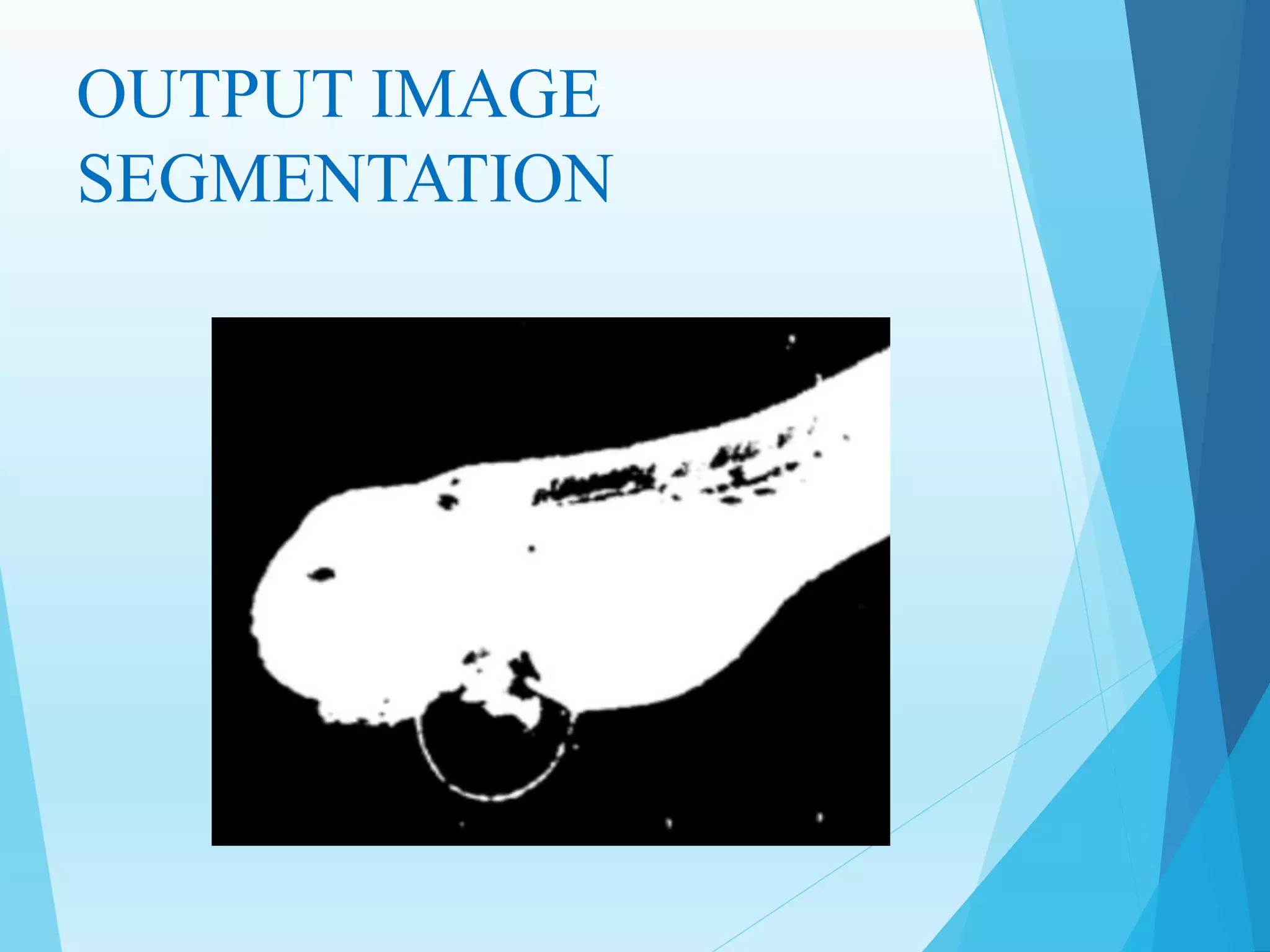
 Output Image Segmentation
 Application
 Advantages
ABSTRACT
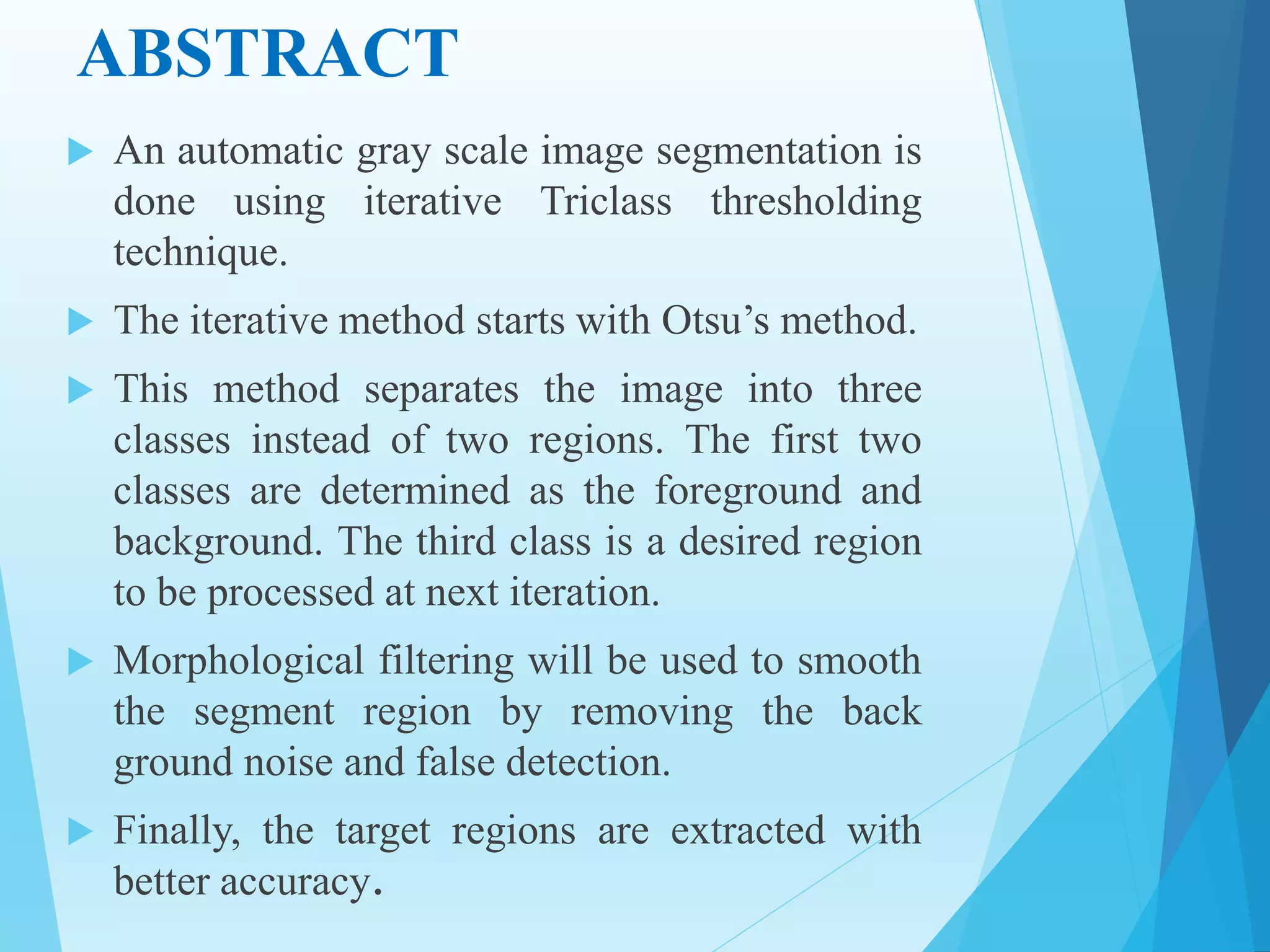
 An automatic gray scale image segmentation is
done using iterative Triclass thresholding
technique.
 The iterative method starts with Otsu’s method.
 This method separates the image into three
classes instead of two regions. The first two
classes are determined as the foreground and
background. The third class is a desired region
to be processed at next iteration.
 Morphological filtering will be used to smooth
the segment region by removing the back
ground noise and false detection.
 Finally, the target regions are extracted with
better accuracy.
EXISTING METHOD
 Local thresholding
 ROI Method
 Gray level based Histogram thresholding
 Multi level thresholding method
DRAWBACKS
 Low performance accuracy in foreground
detection.
 It is not provide a desired result in all lighting
conditions.
 Presence of background noise in image having
poor contrast.
PROPOSED SYSTEM
A Gray scale image segmentation for object recognition by using
 Iterative Triclass thresholding under Otsu Method .
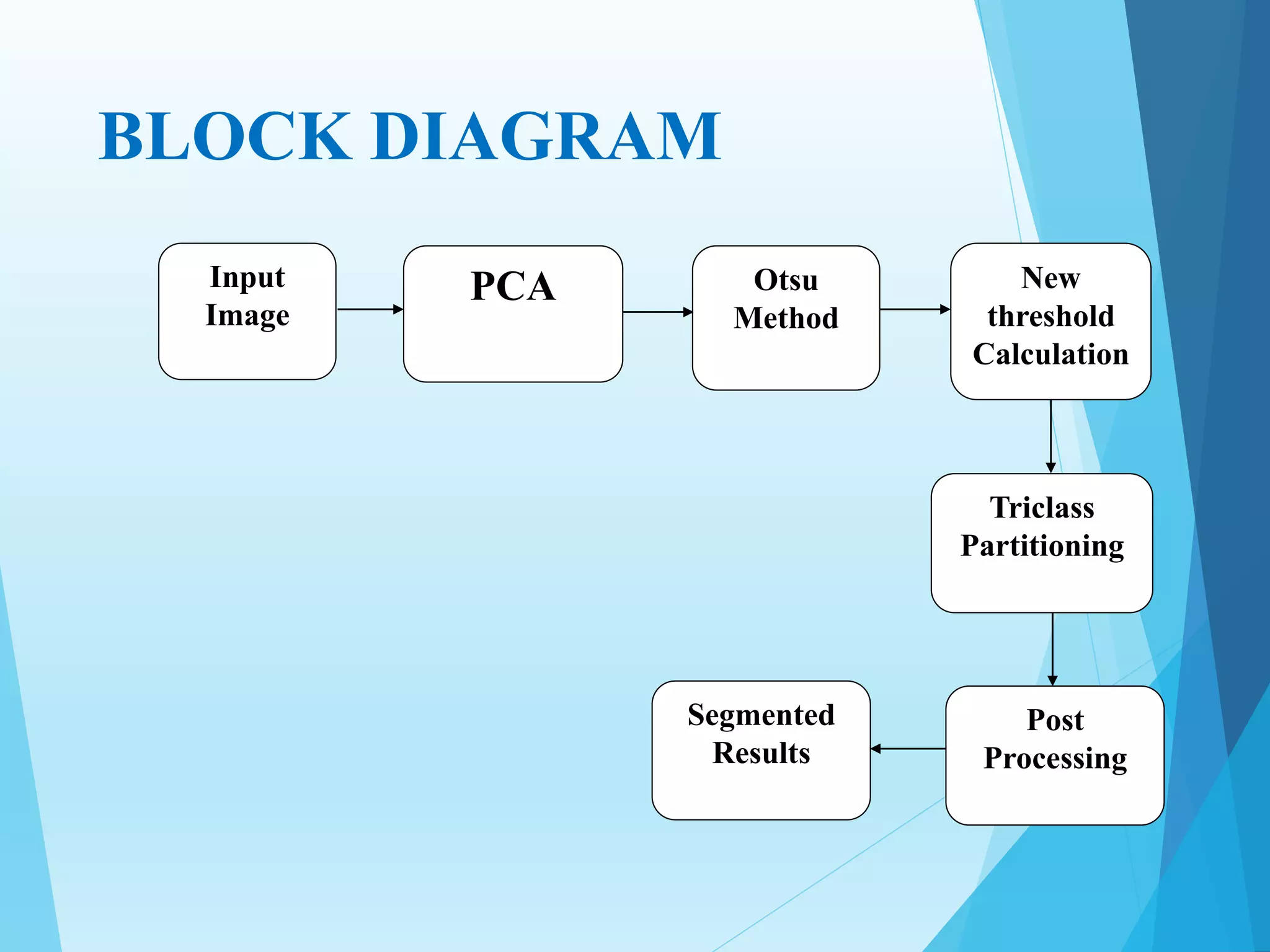
BLOCK DIAGRAM
Input
Image
PCA Otsu
Method
New
threshold
Calculation
Triclass
Partitioning
Post
Processing
Segmented
Results
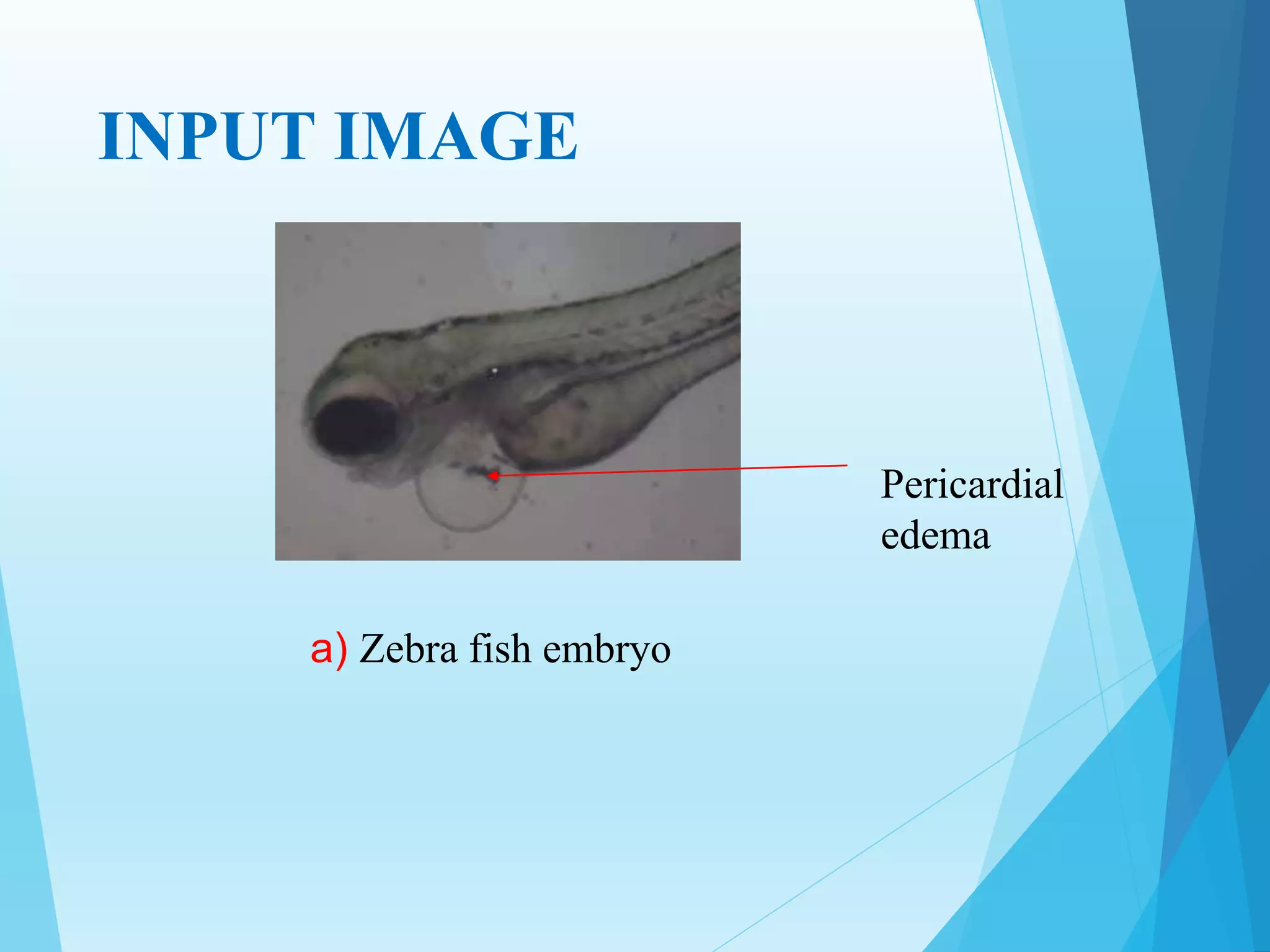
INPUT IMAGE
a) Zebra fish embryo
Pericardial
edema
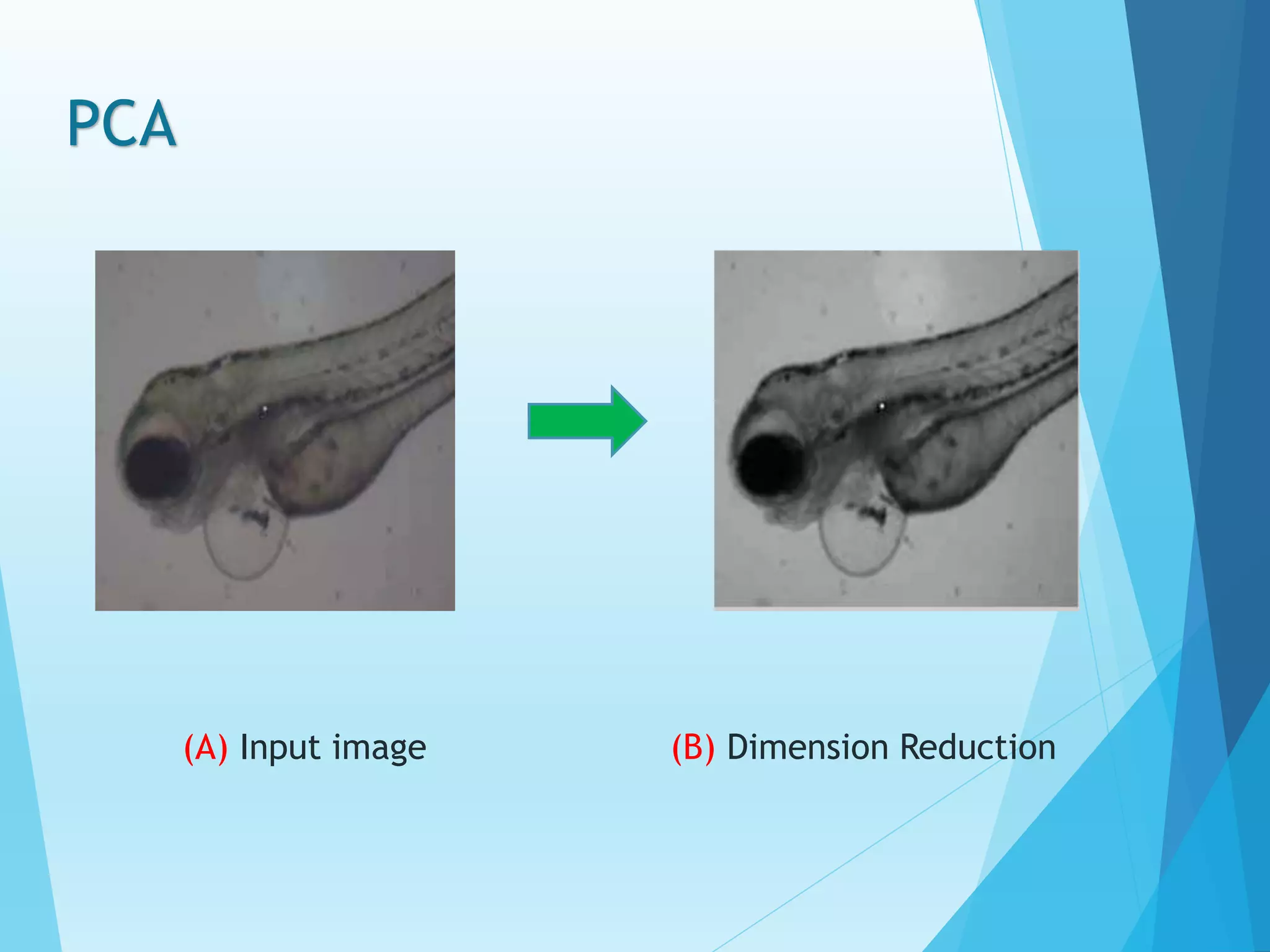
PCA
 To convert multi band to single band image using PCA.
 The image in single band is used to explain the majority of image
variability compared to multiband features.
 It gives the better single band features for the image restoration
or segmentation process.
 PCA is also known as Karhunen-loeve transform.
 KLT is used to reduce the large dimensionality of the data and
multi spectral band reduction through extracting features like
covariance, eigen values and vectors.
Continued….
 Eigen vector of maximum eigen value is chosen for
multiplying with input to obtain the single band image.
 Principle Component Analysis (PCA) on hyperspectral
images reduce the data dimensionality, suppress undesired or
interfering spectral signature, and classify the spectral
signature of interest.
 This approach is applicable to both spectrally pure as well as
pixels.
(A) Input image (B) Dimension Reduction
PCA
THRESHOLDING
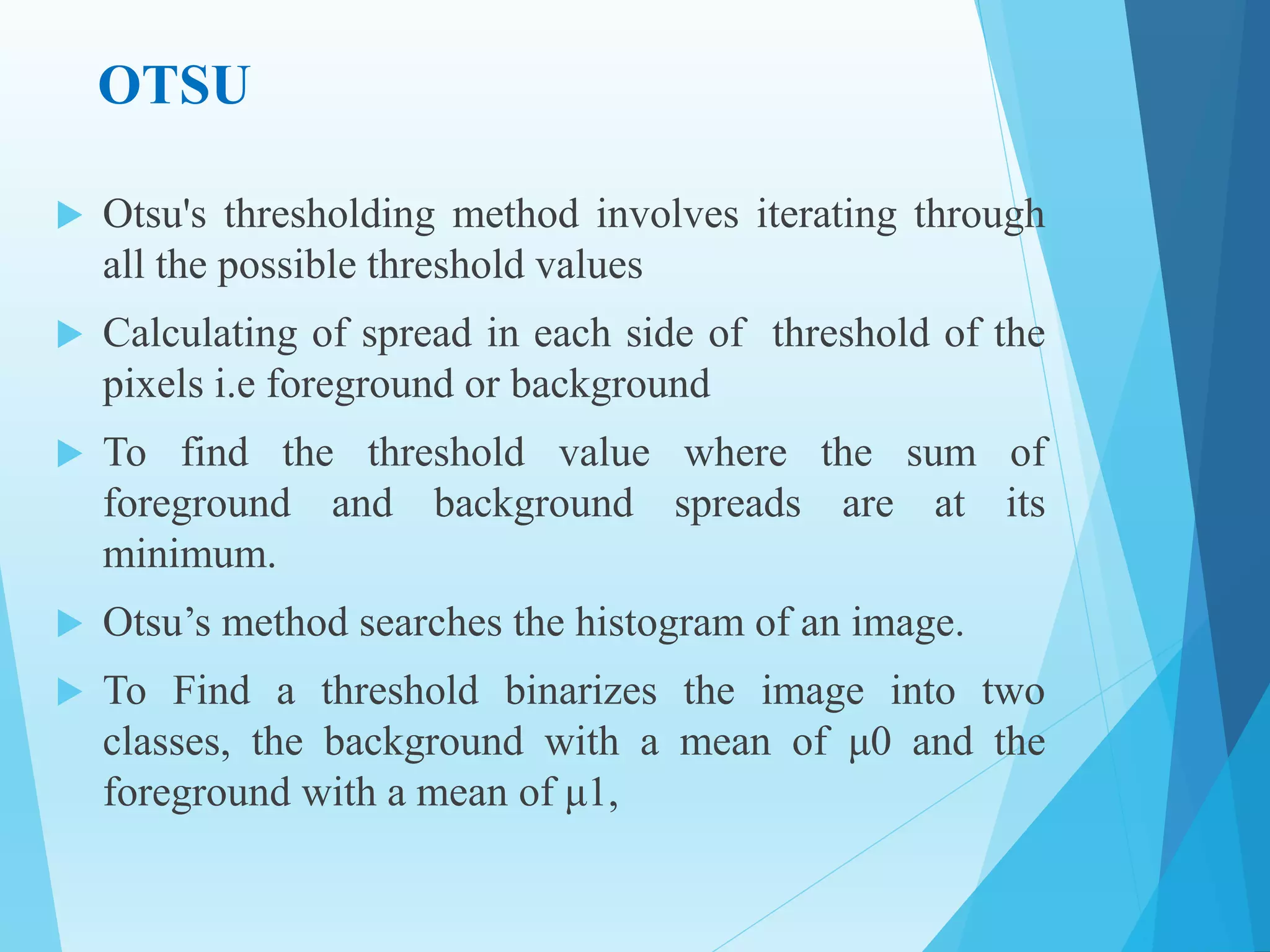
 Thresholding is used to extract an object from its
background by assigning an intensity value T(threshold)
for each pixel such that each pixel is either classified as an
object point or a background point. In general
 If T is a function of f(x, y) only Global thresholding is
applied.
 If T is a function of both f(x, y) and local properties p(x, y)
Local thresholding is used.
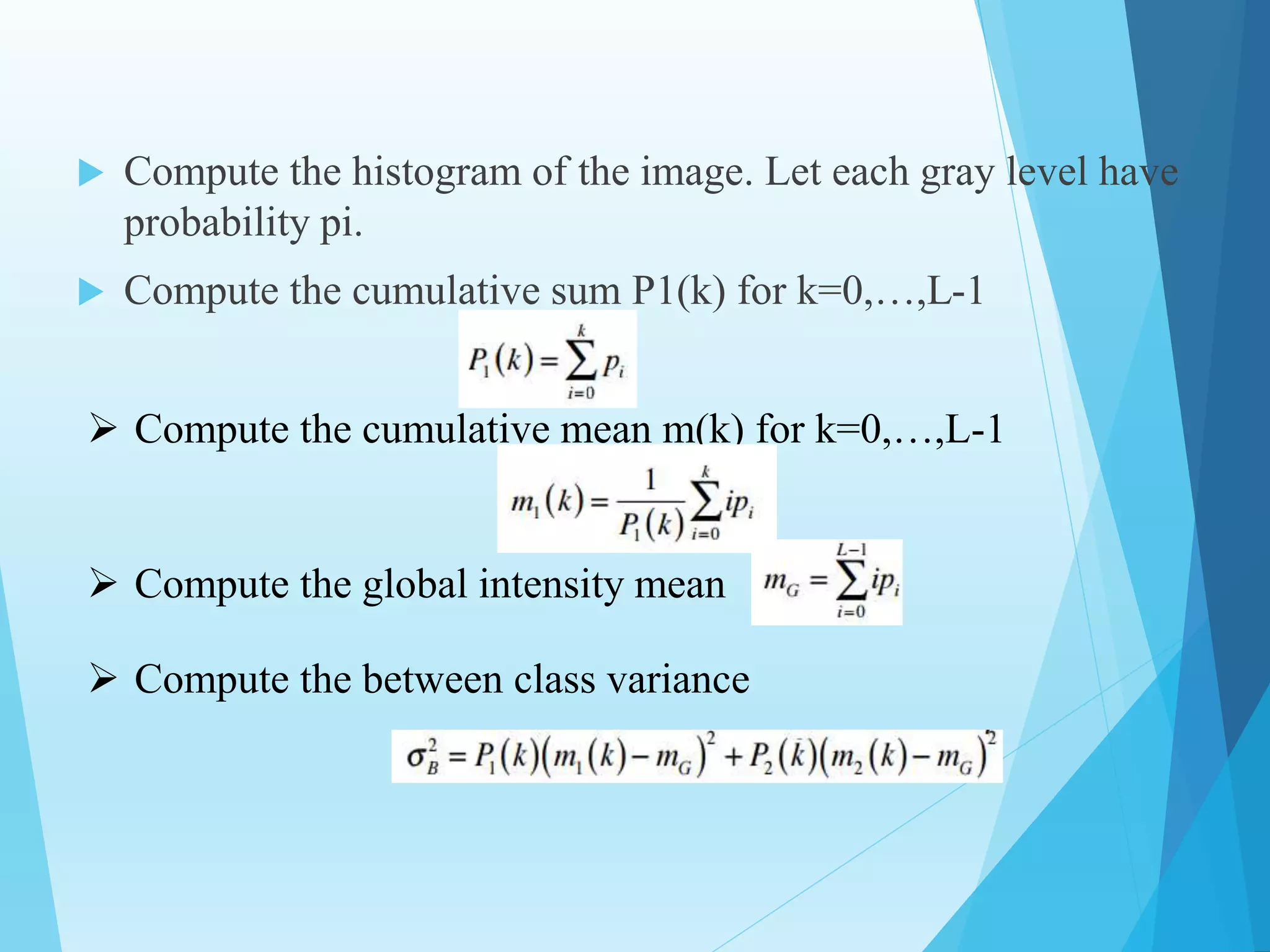
 Set the initial threshold T= (the maximum
value of the image brightness + the minimum
value of the image brightness)/2.
 Using T segment the image to get two sets of
pixels B (all the pixel values are less than T)
and N (all the pixel values are greater than T);
 Calculate the average value of B and N
separately, mean ub and un.
 Calculate the new threshold: T= (ub+un)/2
OTSU
 Otsu's thresholding method involves iterating through
all the possible threshold values
 Calculating of spread in each side of threshold of the
pixels i.e foreground or background
 To find the threshold value where the sum of
foreground and background spreads are at its
minimum.
 Otsu’s method searches the histogram of an image.
 To Find a threshold binarizes the image into two
classes, the background with a mean of μ0 and the
foreground with a mean of μ1,
 Compute the histogram of the image. Let each gray level have
probability pi.
 Compute the cumulative sum P1(k) for k=0,…,L-1
 Compute the cumulative mean m(k) for k=0,…,L-1
 Compute the global intensity mean
 Compute the between class variance
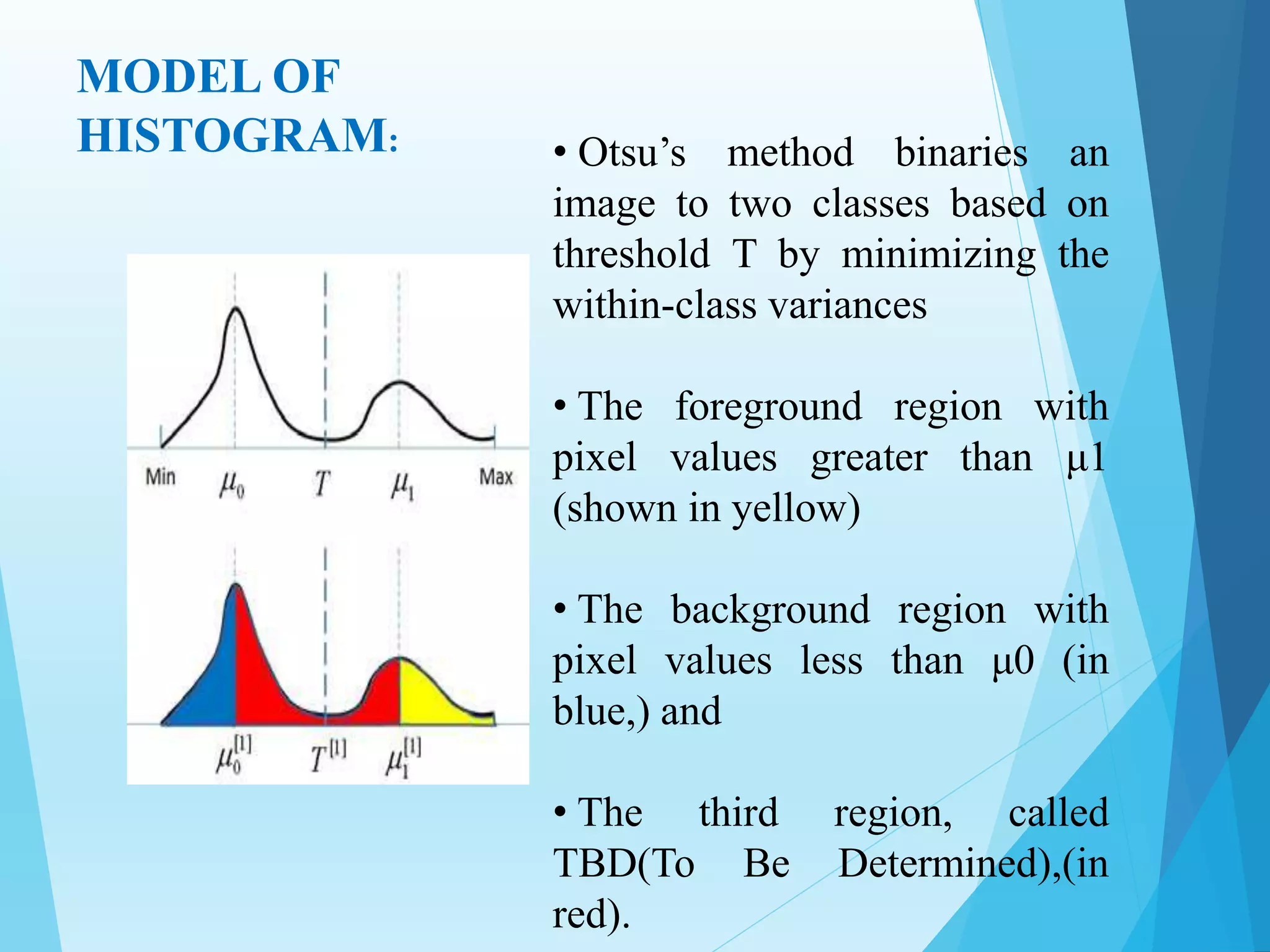
MODEL OF
HISTOGRAM: • Otsu’s method binaries an
image to two classes based on
threshold T by minimizing the
within-class variances
• The foreground region with
pixel values greater than μ1
(shown in yellow)
• The background region with
pixel values less than μ0 (in
blue,) and
• The third region, called
TBD(To Be Determined),(in
red).
Morphological process
 Morphological operations are applied to the input image
for smoothening.
 It processes the image based on shapes and it performs
on image using structuring element.
 The morphological opening and closing operations are
applied to an image based on multi structure elements
to enhance the edges.
 Dilation and erosion process will be used to enhance
(smoothening)the optic disc region by removing the
unwanted pixels from outside region of tumor part.
Dilation and Erosion
 These morphological operations are performed on
images based on shapes.
 It is formed by structuring element. It is a matrix
containing 1’s and 0’s where 1’s are called
neighbourhood pixels.
 The output pixel is determined by using these
processing pixel neighbours.
 Here, the ‘line’ structuring element is used to
dilate and erosion the image for smoothing.
 Dilation: It is the process of adding a pixel at
object boundary based on structuring element.
 Erosion: It is the process of removing a pixel at
object boundary based on structuring element.
IMAGE FILLING
 The image filling performs a flood-
fill operation on binary and grayscale images.
 For binary images, it changes connected
background pixels (0s) to foreground pixels
(1s), stopping when it reaches object
boundaries.
 For grayscale images, it brings the intensity
values of dark areas that are surrounded by
lighter areas up to the same intensity level as
surrounding pixels.
 This operation can be useful in removing
irrelevant artifacts from images.
OUTPUT IMAGE
SEGMENTATION
ADVANTAGES
 Low Complexity
 Better performance in Object detection
 Presence of noise at background is low
APPLICATIONS
 Industrial vision for inspection system
 Object recognition
 Diagnosis in medical field
Software Requirement
 MATLAB 7.5 or above versions
References
 L. Herta and R. W. Schafer, “Multilevel threshold using
edge matching,” Comput Vis., Graph., Image Process.,
vol. 44, no. 3, pp. 279–295, Mar. 1988.
 R. Kohler, “A segmentation system based on
thresholding,” Comput. Graph. Image Process., vol. 15,
no. 4, pp. 319–338, Apr. 1981.
 X. Xu, “A method based on rank-ordered filter to detect
edges in cellular image,” Pattern Recognit. Lett., vol. 30,
no. 6, pp. 634–640, Jun. 2009.
 S. Baukharouba, J. M. Rebordao, and P. L. Wendel, “An
amplitude segmentation method based on the distribution
function of an image,” Comput Vis., Graph., Image
Process., vol. 29, no. 1, pp. 47–59, Jan. 1985.
 M. J. Carlotto, “Histogram analysis using scale-space
approach,” IEEE Trans. Pattern Anal. Mach. Intell., vol.
9, no. 1, pp. 121–129, Jan. 1987.
Final Review

Final Review

  • 2.
    AN EFFECTIVE SEGMENTATIONON GRAY SCALE IMAGES BY USING OTSU METHOD PRESENTED BY GUIDED BY A.AFZAL MEERAN Ms. R.JANNATHUL FIRDOUS, S. MAHARAJA AP/ECE, T. DEVADELSON NCE.
  • 3.
    CONTENT  Abstract  ExistingMethods  Drawbacks  Proposed System  Block Diagram  PCA  Thresholding  OTSU  Morphological Processing  Image Filling  Output Image Segmentation  Application  Advantages
  • 4.
    ABSTRACT  An automaticgray scale image segmentation is done using iterative Triclass thresholding technique.  The iterative method starts with Otsu’s method.  This method separates the image into three classes instead of two regions. The first two classes are determined as the foreground and background. The third class is a desired region to be processed at next iteration.  Morphological filtering will be used to smooth the segment region by removing the back ground noise and false detection.  Finally, the target regions are extracted with better accuracy.
  • 5.
    EXISTING METHOD  Localthresholding  ROI Method  Gray level based Histogram thresholding  Multi level thresholding method
  • 6.
    DRAWBACKS  Low performanceaccuracy in foreground detection.  It is not provide a desired result in all lighting conditions.  Presence of background noise in image having poor contrast.
  • 7.
    PROPOSED SYSTEM A Grayscale image segmentation for object recognition by using  Iterative Triclass thresholding under Otsu Method .
  • 8.
  • 9.
    INPUT IMAGE a) Zebrafish embryo Pericardial edema
  • 10.
    PCA  To convertmulti band to single band image using PCA.  The image in single band is used to explain the majority of image variability compared to multiband features.  It gives the better single band features for the image restoration or segmentation process.  PCA is also known as Karhunen-loeve transform.  KLT is used to reduce the large dimensionality of the data and multi spectral band reduction through extracting features like covariance, eigen values and vectors.
  • 11.
    Continued….  Eigen vectorof maximum eigen value is chosen for multiplying with input to obtain the single band image.  Principle Component Analysis (PCA) on hyperspectral images reduce the data dimensionality, suppress undesired or interfering spectral signature, and classify the spectral signature of interest.  This approach is applicable to both spectrally pure as well as pixels.
  • 12.
    (A) Input image(B) Dimension Reduction PCA
  • 13.
    THRESHOLDING  Thresholding isused to extract an object from its background by assigning an intensity value T(threshold) for each pixel such that each pixel is either classified as an object point or a background point. In general  If T is a function of f(x, y) only Global thresholding is applied.  If T is a function of both f(x, y) and local properties p(x, y) Local thresholding is used.
  • 14.
     Set theinitial threshold T= (the maximum value of the image brightness + the minimum value of the image brightness)/2.  Using T segment the image to get two sets of pixels B (all the pixel values are less than T) and N (all the pixel values are greater than T);  Calculate the average value of B and N separately, mean ub and un.  Calculate the new threshold: T= (ub+un)/2
  • 15.
    OTSU  Otsu's thresholdingmethod involves iterating through all the possible threshold values  Calculating of spread in each side of threshold of the pixels i.e foreground or background  To find the threshold value where the sum of foreground and background spreads are at its minimum.  Otsu’s method searches the histogram of an image.  To Find a threshold binarizes the image into two classes, the background with a mean of μ0 and the foreground with a mean of μ1,
  • 16.
     Compute thehistogram of the image. Let each gray level have probability pi.  Compute the cumulative sum P1(k) for k=0,…,L-1  Compute the cumulative mean m(k) for k=0,…,L-1  Compute the global intensity mean  Compute the between class variance
  • 17.
    MODEL OF HISTOGRAM: •Otsu’s method binaries an image to two classes based on threshold T by minimizing the within-class variances • The foreground region with pixel values greater than μ1 (shown in yellow) • The background region with pixel values less than μ0 (in blue,) and • The third region, called TBD(To Be Determined),(in red).
  • 18.
    Morphological process  Morphologicaloperations are applied to the input image for smoothening.  It processes the image based on shapes and it performs on image using structuring element.  The morphological opening and closing operations are applied to an image based on multi structure elements to enhance the edges.  Dilation and erosion process will be used to enhance (smoothening)the optic disc region by removing the unwanted pixels from outside region of tumor part.
  • 19.
    Dilation and Erosion These morphological operations are performed on images based on shapes.  It is formed by structuring element. It is a matrix containing 1’s and 0’s where 1’s are called neighbourhood pixels.  The output pixel is determined by using these processing pixel neighbours.  Here, the ‘line’ structuring element is used to dilate and erosion the image for smoothing.  Dilation: It is the process of adding a pixel at object boundary based on structuring element.  Erosion: It is the process of removing a pixel at object boundary based on structuring element.
  • 20.
    IMAGE FILLING  Theimage filling performs a flood- fill operation on binary and grayscale images.  For binary images, it changes connected background pixels (0s) to foreground pixels (1s), stopping when it reaches object boundaries.  For grayscale images, it brings the intensity values of dark areas that are surrounded by lighter areas up to the same intensity level as surrounding pixels.  This operation can be useful in removing irrelevant artifacts from images.
  • 21.
  • 22.
    ADVANTAGES  Low Complexity Better performance in Object detection  Presence of noise at background is low
  • 23.
    APPLICATIONS  Industrial visionfor inspection system  Object recognition  Diagnosis in medical field Software Requirement  MATLAB 7.5 or above versions
  • 24.
    References  L. Hertaand R. W. Schafer, “Multilevel threshold using edge matching,” Comput Vis., Graph., Image Process., vol. 44, no. 3, pp. 279–295, Mar. 1988.  R. Kohler, “A segmentation system based on thresholding,” Comput. Graph. Image Process., vol. 15, no. 4, pp. 319–338, Apr. 1981.  X. Xu, “A method based on rank-ordered filter to detect edges in cellular image,” Pattern Recognit. Lett., vol. 30, no. 6, pp. 634–640, Jun. 2009.  S. Baukharouba, J. M. Rebordao, and P. L. Wendel, “An amplitude segmentation method based on the distribution function of an image,” Comput Vis., Graph., Image Process., vol. 29, no. 1, pp. 47–59, Jan. 1985.  M. J. Carlotto, “Histogram analysis using scale-space approach,” IEEE Trans. Pattern Anal. Mach. Intell., vol. 9, no. 1, pp. 121–129, Jan. 1987.