CIRCUIT IDEAS


MULTIBAND CW TRANSMITTER                                                                                SAN
                                                                                                              I THE
                                                                                                                      O


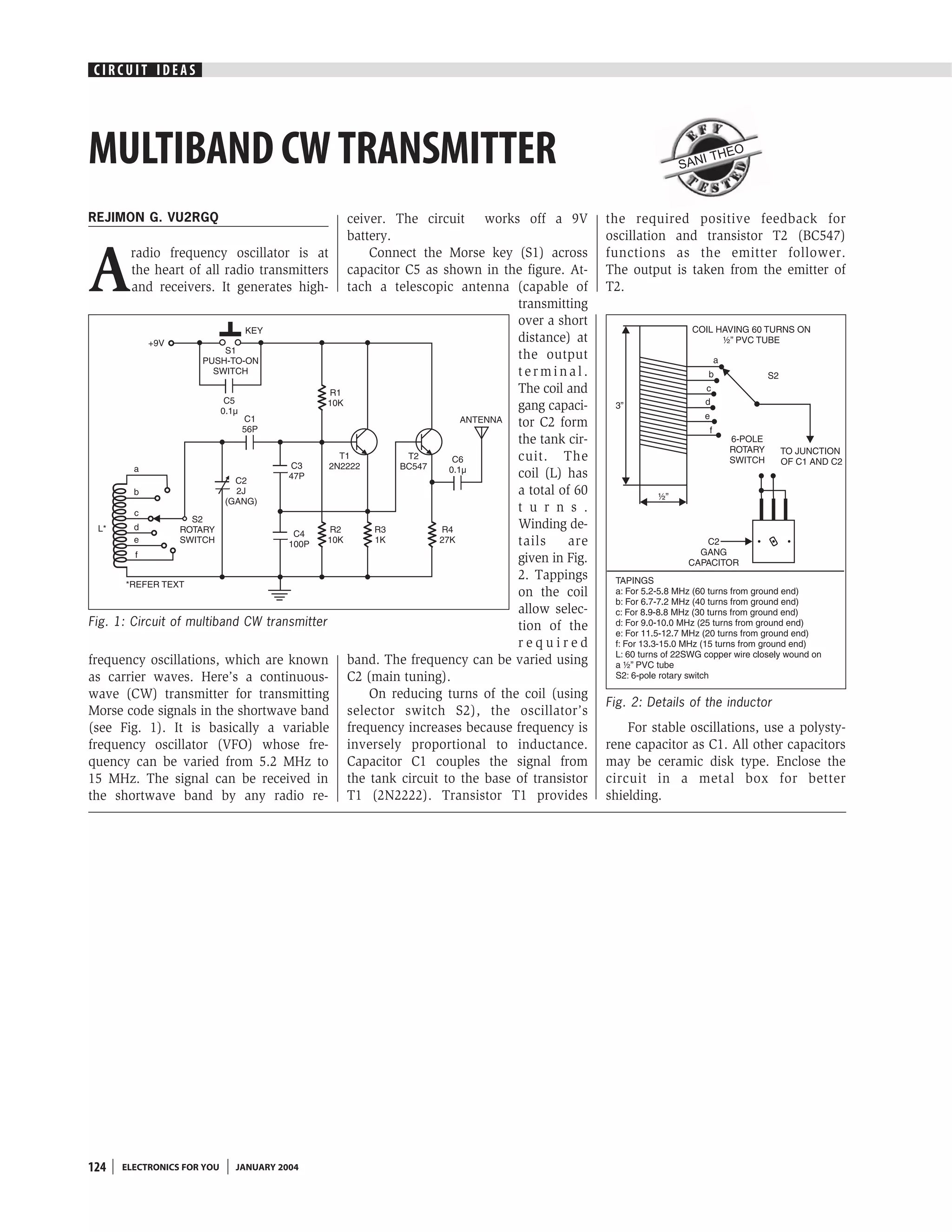
REJIMON G. VU2RGQ                             ceiver. The circuit works off a 9V           the required positive feedback for
                                              battery.                                     oscillation and transistor T2 (BC547)


A
       radio frequency oscillator is at           Connect the Morse key (S1) across        functions as the emitter follower.
       the heart of all radio transmitters    capacitor C5 as shown in the figure. At-     The output is taken from the emitter of
       and receivers. It generates high-      tach a telescopic antenna (capable of        T2.
                                                                           transmitting
                                                                           over a short
                                                                           distance) at
                                                                           the output
                                                                           terminal.
                                                                           The coil and
                                                                           gang capaci-
                                                                           tor C2 form
                                                                           the tank cir-
                                                                           cuit. The
                                                                           coil (L) has
                                                                           a total of 60
                                                                           t u r n s .
                                                                           Winding de-
                                                                           tails     are
                                                                           given in Fig.
                                                                           2. Tappings
                                                                           on the coil
                                                                           allow selec-
Fig. 1: Circuit of multiband CW transmitter                                tion of the
                                                                           required
frequency oscillations, which are known       band. The frequency can be varied using
as carrier waves. Here’s a continuous-        C2 (main tuning).
wave (CW) transmitter for transmitting            On reducing turns of the coil (using
                                                                                           Fig. 2: Details of the inductor
Morse code signals in the shortwave band      selector switch S2), the oscillator’s
(see Fig. 1). It is basically a variable      frequency increases because frequency is         For stable oscillations, use a polysty-
frequency oscillator (VFO) whose fre-         inversely proportional to inductance.        rene capacitor as C1. All other capacitors
quency can be varied from 5.2 MHz to          Capacitor C1 couples the signal from         may be ceramic disk type. Enclose the
15 MHz. The signal can be received in         the tank circuit to the base of transistor   circuit in a metal box for better
the shortwave band by any radio re-           T1 (2N2222). Transistor T1 provides          shielding.


124   ELECTRONICS FOR YOU   JANUARY 2004

Multiband cw transmitter

  • 1.
    CIRCUIT IDEAS MULTIBAND CWTRANSMITTER SAN I THE O REJIMON G. VU2RGQ ceiver. The circuit works off a 9V the required positive feedback for battery. oscillation and transistor T2 (BC547) A radio frequency oscillator is at Connect the Morse key (S1) across functions as the emitter follower. the heart of all radio transmitters capacitor C5 as shown in the figure. At- The output is taken from the emitter of and receivers. It generates high- tach a telescopic antenna (capable of T2. transmitting over a short distance) at the output terminal. The coil and gang capaci- tor C2 form the tank cir- cuit. The coil (L) has a total of 60 t u r n s . Winding de- tails are given in Fig. 2. Tappings on the coil allow selec- Fig. 1: Circuit of multiband CW transmitter tion of the required frequency oscillations, which are known band. The frequency can be varied using as carrier waves. Here’s a continuous- C2 (main tuning). wave (CW) transmitter for transmitting On reducing turns of the coil (using Fig. 2: Details of the inductor Morse code signals in the shortwave band selector switch S2), the oscillator’s (see Fig. 1). It is basically a variable frequency increases because frequency is For stable oscillations, use a polysty- frequency oscillator (VFO) whose fre- inversely proportional to inductance. rene capacitor as C1. All other capacitors quency can be varied from 5.2 MHz to Capacitor C1 couples the signal from may be ceramic disk type. Enclose the 15 MHz. The signal can be received in the tank circuit to the base of transistor circuit in a metal box for better the shortwave band by any radio re- T1 (2N2222). Transistor T1 provides shielding. 124 ELECTRONICS FOR YOU JANUARY 2004