International Journal of Electronics and Communication Engineering Research and Development
(IJECERD), ISSN 2248-9525(Print), ISSN- 2248-9533 (Online) Volume 4, Number 2, April-June (2014)
97
MULTI WAVELET BASED IMAGE COMPRESSION FOR TELE-
MEDICAL APPLICATIONS
K.R.Jayanthi1
Prof. A.Hazrathaiah2
Post-graduate student, Dept.of.ECE, Dept.of.ECE,
SVEW, Tirupathi,A.P SVEW, Tirupathi, A.P
ABSTRACT
Analysis and compression of medical image is an important area of biomedical
engineering. Analysis of medical image and data compression are rapidly evolving field with
growing applications in the teleradiology, Bio-medical, tele-medicine and medical data
analysis. Wavelet based techniques are latest development in the field of medical image
compression. The ROI must be compressed by a Lossless or a near lossless compression
algorithm. Wavelet based techniques are most recent growth in the area of medical image
compression.
Wavelet multi-resolution decomposition of images has shown its efficiency in many
image processing areas and specifically in compression. Transformed coefficients are
obtained by expanding a signal on a wavelet basis. The transformed signal is a different
representation of the same underlying data. Such representation is efficient if a relevant part
of the original information is found in a relative small number of coefficients. In this sense,
wavelets are near optimal bases for a wide class of signals with some smoothness, which is
the reason for compression.
Keywords: Image compression, Integer Multiwavelet Transform.
1. INTRODUCTION
Image Compression is used to reduce the number of bits required to represent an
image or a video sequence. A Compression algorithm takes an input X and generates
compressed information that requires fewer bits. The Decompression algorithm reconstructs
the compressed information and gives the original.
A compression of medical image is an important area of biomedical and telemedicine.
In the medical application image study and data compression are quickly developing field
with rising applications services are teleradiology, Bio-medical, tele-medicine. Medical
IJECERD
© PRJ
PUBLICATION
International Journal of Electronics and Communication
Engineering Research and Development
(IJECERD)
ISSN 2248– 9525 (Print)
ISSN 2248 –9533 (Online)
Volume 4, Number 2, April - June (2014), pp. 97-103
© PRJ Publication, http://www.prjpublication.com/IJECERD.asp
International Journal of Electronics and Communication Engineering Research and Development
(IJECERD), ISSN 2248-9525(Print), ISSN- 2248-9533 (Online) Volume 4, Number 2, April-June (2014)
98
image compression and image analysis of data might be even more helpful and can play a
main task for the diagnosis of more complicated and difficult images through consultation of
experts [2]. In medical image compression diagnosis and analysis are doing well simply when
compression techniques protect all the key image information needed for the storage and
transmission called lossless compression. the other scheme is lossy compression is more
efficient in terms of storage and transmission needs but there is no guarantee to preserve the
information in the characteristics needed in medical diagnosis.
To avoid the above problem diagnostically important is transmission and storage of
the image is lossless compressed. Region of interest (ROI) is segmentation approach which is
very useful for diagnosis purpose. These regions of interest must be compressed by a lossless
are a near-lossless compression algorithms. Wavelet based techniques are most recent growth
in area of medical image compression.
2. EXISTING METHOD
Region of interest is an important feature provided by jpeg 2000 standard. The entire
image is encoded as single entity by different fidelity constraints. This new method reduces
coefficients in a background but high complexity in writing an algorithm, it gives a better
image quality when compared to scalar wavelet.
3. PROPOSED METHOD
In this proposed method, image is transformed using integer multi-wavelet transform
and lossless compression of transform coefficients.
The compressed image is decomposed by the multi-wavelet transform. The encoding
is done based on image pixel maximum value. The original value is reduced based on
neighboring pixel value. Finally, the image is obtained is an encoded bit stream which is a
binary one (‘0’s and ‘1’s).
The receiver decodes incoming bit stream value, decompresses it and reconstructs
original image. The major advantage in this method is the output image contains less Mean
Square Error when compared to images obtained from other transforms; the compression
ratio is significantly increased.
Original image IMWT
Magnit-ude
set and run
Inverse
IMWT
Reconstructed
Image
Magnitude
set and run
Set and run
International Journal of Electronics and Communication Engineering Research and Development
(IJECERD), ISSN 2248-9525(Print), ISSN- 2248-9533 (Online) Volume 4, Number 2, April-June (2014)
99
a. Discrete wavelet transform:
Discrete wavelet transform is used to analyze both numerical and functional
methodologies. Wavelet functions are sampled by other wavelet transforms in DWT. The
major advantage of discrete wavelet transform over fourier tansforms is temporal resolution.
Capturing both frequency and location information (time) is called Temporal
resolution. Two dimensional wavelets are used for image processing applications. The effect
of temporal resolution reduces down when it comes to the design of 2D filters. Image contrast
enhancement is important in the field of medical image processing. The small coefficients are
made smaller and large coefficients are larger. A non-linear mapping function to the
coefficients is then applied.
By applying DWT, the coefficients in finer scales reduce the effect of noise and
enhances the features within a range using non-linear mapping function. The performance of
IDWT is mandatory to reconstruct the image.
The wavelet decomposition method is widely based on two types of filters i.e. low
pass filters and high pass filters. The length of the filter is same in both LPF and HPF. In this
decomposition, DWT image is splitted into several sub bands (LL, LH, HL, HH) for the
further decomposition we consider only LL sub band. This subband only because it has low
frequency and noise when compared to other sub bands. The wavelet transform produces
floating-point coefficients, used to reconstruct an original image by quantization results in a
lossy scheme. Recently, irreversible wavelet transforms have been introduced.
b. Multi wavelet and integer multi wavelet transform:
Multi wavelets are defined by wavelets with scaling functions. In Integer Multi
Wavelet Transform, the transform can be implemented using several wavelet functions and
scaling functions. So it is useful for multilevel decomposition.
These multi wavelets have some advantages such as, orthogonality, symmetry and
approximation in comparison with other multi wavelets.
Multi wavelets have one scaling function and one wavelet function but integer multi
wavelets have two or more several scaling and wavelet functions depending on their
applications. The other advantage is to increase higher order approximation and dynamic
range of coefficients.
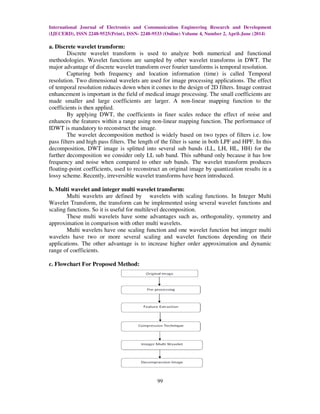
c. Flowchart For Proposed Method:
International Journal of Electronics and Communication Engineering Research and Development
(IJECERD), ISSN 2248-9525(Print), ISSN- 2248-9533 (Online) Volume 4, Number 2, April-June (2014)
100
i) STEPS INVOLVED IN THE PROCESS
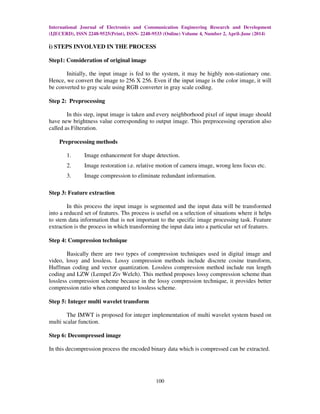
Step1: Consideration of original image
Initially, the input image is fed to the system, it may be highly non-stationary one.
Hence, we convert the image to 256 X 256. Even if the input image is the color image, it will
be converted to gray scale using RGB converter in gray scale coding.
Step 2: Preprocessing
In this step, input image is taken and every neighborhood pixel of input image should
have new brightness value corresponding to output image. This preprocessing operation also
called as Filteration.
Preprocessing methods
1. Image enhancement for shape detection.
2. Image restoration i.e. relative motion of camera image, wrong lens focus etc.
3. Image compression to eliminate redundant information.
Step 3: Feature extraction
In this process the input image is segmented and the input data will be transformed
into a reduced set of features. Ths process is useful on a selection of situations where it helps
to stem data information that is not important to the specific image processing task. Feature
extraction is the process in which transforming the input data into a particular set of features.
Step 4: Compression technique
Basically there are two types of compression techniques used in digital image and
video, lossy and lossless. Lossy compression methods include discrete cosine transform,
Huffman coding and vector quantization. Lossless compression method include run length
coding and LZW (Lempel Ziv Welch). This method proposes lossy compression scheme than
lossless compression scheme because in the lossy compression technique, it provides better
compression ratio when compared to lossless scheme.
Step 5: Integer multi wavelet transform
The IMWT is proposed for integer implementation of multi wavelet system based on
multi scalar function.
Step 6: Decompressed image
In this decompression process the encoded binary data which is compressed can be extracted.
International Journal of Electronics and Communication Engineering Research and Development
(IJECERD), ISSN 2248-9525(Print), ISSN- 2248-9533 (Online) Volume 4, Number 2, April-June (2014)
101
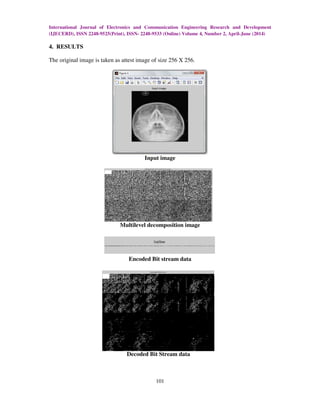
4. RESULTS
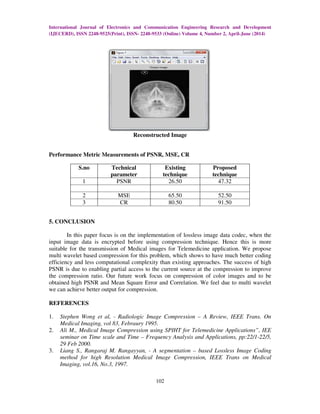
The original image is taken as attest image of size 256 X 256.
Input image
Multilevel decomposition image
Encoded Bit stream data
Decoded Bit Stream data
International Journal of Electronics and Communication Engineering Research and Development
(IJECERD), ISSN 2248-9525(Print), ISSN- 2248-9533 (Online) Volume 4, Number 2, April-June (2014)
102
Reconstructed Image
Performance Metric Measurements of PSNR, MSE, CR
5. CONCLUSION
In this paper focus is on the implementation of lossless image data codec, when the
input image data is encrypted before using compression technique. Hence this is more
suitable for the transmission of Medical images for Telemedicine application. We propose
multi wavelet based compression for this problem, which shows to have much better coding
efficiency and less computational complexity than existing approaches. The success of high
PSNR is due to enabling partial access to the current source at the compression to improve
the compression ratio. Our future work focus on compression of color images and to be
obtained high PSNR and Mean Square Error and Correlation. We feel due to multi wavelet
we can achieve better output for compression.
REFERENCES
1. Stephen Wong et al, - Radiologic Image Compression – A Review, IEEE Trans. On
Medical Imaging, vol 83, Febraury 1995.
2. Ali M., Medical Image Compression using SPIHT for Telemedicine Applications”, IEE
seminar on Time scale and Time – Frequency Analysis and Applications, pp:22/1-22/5,
29 Feb 2000.
3. Liang S., Rangaraj M. Rangayyan, - A segmentation – based Lossless Image Coding
method for high Resolution Medical Image Compression, IEEE Trans on Medical
Imaging, vol.16, No.3, 1997.
S.no Technical
parameter
Existing
technique
Proposed
technique
1 PSNR 26.50 47.32
2 MSE 65.50 52.50
3 CR 80.50 91.50
International Journal of Electronics and Communication Engineering Research and Development
(IJECERD), ISSN 2248-9525(Print), ISSN- 2248-9533 (Online) Volume 4, Number 2, April-June (2014)
103
4. R. Sumalatha, M.V. Subranyam – Lossless Compression of MRI Images using Integr
Wavelet and SPHIT algorithm, International Journal of Computational Intelligence
Research & Applications, July-december 2009, Vol.3, No.2, page no: 237- 240.
5. C.S. Gargour and V. Ramachandran, A Scheme for teaching wavelets at the Introductory
level, ASEE/IEEE Frontiers in Education conference, 1997.
6. Calderbank AR, Daubechies I, Sweldens W, and Leo BL: Wavelet Transforms that Map
Integers to Integers. ApplComputHarmon Anal 1998:5:332 – 369.
7. Michael B. Martin and Amy E.Bell, - New Image Compression Techniques using Multi
wavelets and Multiwavelet packets, IEEE Transactions on Image Processing, vol. 10,
No.4, April 2001, pp.500 – 511.
8. Said and W.A> Pearlman, - A new, fast, and efficient image co-dec based on set
partitioning in hierarchical trees, IEEE Trans.Circuits Syst. Video Technol, vol.6,
pp.243 – 250, June 1996.
9. J.M. Shapiro, - Embedded image coding using zerotrees of wavelet coefficients, IEEE
Trans. Image Processing, vol.6, pp. 243 – 250, June 1996.
10. Ching-Fung Chine, and Kuo-JungLiScalable Medical Data Compression and
Transmission using Wavelet transform for Telemedicine applications, IEEE transactions
on information technology in biomedicine, vol.7, no.1, March 2003.

MULTI WAVELET BASED IMAGE COMPRESSION FOR TELE MEDICAL APPLICATION

  • 1.
    International Journal ofElectronics and Communication Engineering Research and Development (IJECERD), ISSN 2248-9525(Print), ISSN- 2248-9533 (Online) Volume 4, Number 2, April-June (2014) 97 MULTI WAVELET BASED IMAGE COMPRESSION FOR TELE- MEDICAL APPLICATIONS K.R.Jayanthi1 Prof. A.Hazrathaiah2 Post-graduate student, Dept.of.ECE, Dept.of.ECE, SVEW, Tirupathi,A.P SVEW, Tirupathi, A.P ABSTRACT Analysis and compression of medical image is an important area of biomedical engineering. Analysis of medical image and data compression are rapidly evolving field with growing applications in the teleradiology, Bio-medical, tele-medicine and medical data analysis. Wavelet based techniques are latest development in the field of medical image compression. The ROI must be compressed by a Lossless or a near lossless compression algorithm. Wavelet based techniques are most recent growth in the area of medical image compression. Wavelet multi-resolution decomposition of images has shown its efficiency in many image processing areas and specifically in compression. Transformed coefficients are obtained by expanding a signal on a wavelet basis. The transformed signal is a different representation of the same underlying data. Such representation is efficient if a relevant part of the original information is found in a relative small number of coefficients. In this sense, wavelets are near optimal bases for a wide class of signals with some smoothness, which is the reason for compression. Keywords: Image compression, Integer Multiwavelet Transform. 1. INTRODUCTION Image Compression is used to reduce the number of bits required to represent an image or a video sequence. A Compression algorithm takes an input X and generates compressed information that requires fewer bits. The Decompression algorithm reconstructs the compressed information and gives the original. A compression of medical image is an important area of biomedical and telemedicine. In the medical application image study and data compression are quickly developing field with rising applications services are teleradiology, Bio-medical, tele-medicine. Medical IJECERD © PRJ PUBLICATION International Journal of Electronics and Communication Engineering Research and Development (IJECERD) ISSN 2248– 9525 (Print) ISSN 2248 –9533 (Online) Volume 4, Number 2, April - June (2014), pp. 97-103 © PRJ Publication, http://www.prjpublication.com/IJECERD.asp
  • 2.
    International Journal ofElectronics and Communication Engineering Research and Development (IJECERD), ISSN 2248-9525(Print), ISSN- 2248-9533 (Online) Volume 4, Number 2, April-June (2014) 98 image compression and image analysis of data might be even more helpful and can play a main task for the diagnosis of more complicated and difficult images through consultation of experts [2]. In medical image compression diagnosis and analysis are doing well simply when compression techniques protect all the key image information needed for the storage and transmission called lossless compression. the other scheme is lossy compression is more efficient in terms of storage and transmission needs but there is no guarantee to preserve the information in the characteristics needed in medical diagnosis. To avoid the above problem diagnostically important is transmission and storage of the image is lossless compressed. Region of interest (ROI) is segmentation approach which is very useful for diagnosis purpose. These regions of interest must be compressed by a lossless are a near-lossless compression algorithms. Wavelet based techniques are most recent growth in area of medical image compression. 2. EXISTING METHOD Region of interest is an important feature provided by jpeg 2000 standard. The entire image is encoded as single entity by different fidelity constraints. This new method reduces coefficients in a background but high complexity in writing an algorithm, it gives a better image quality when compared to scalar wavelet. 3. PROPOSED METHOD In this proposed method, image is transformed using integer multi-wavelet transform and lossless compression of transform coefficients. The compressed image is decomposed by the multi-wavelet transform. The encoding is done based on image pixel maximum value. The original value is reduced based on neighboring pixel value. Finally, the image is obtained is an encoded bit stream which is a binary one (‘0’s and ‘1’s). The receiver decodes incoming bit stream value, decompresses it and reconstructs original image. The major advantage in this method is the output image contains less Mean Square Error when compared to images obtained from other transforms; the compression ratio is significantly increased. Original image IMWT Magnit-ude set and run Inverse IMWT Reconstructed Image Magnitude set and run Set and run
  • 3.
    International Journal ofElectronics and Communication Engineering Research and Development (IJECERD), ISSN 2248-9525(Print), ISSN- 2248-9533 (Online) Volume 4, Number 2, April-June (2014) 99 a. Discrete wavelet transform: Discrete wavelet transform is used to analyze both numerical and functional methodologies. Wavelet functions are sampled by other wavelet transforms in DWT. The major advantage of discrete wavelet transform over fourier tansforms is temporal resolution. Capturing both frequency and location information (time) is called Temporal resolution. Two dimensional wavelets are used for image processing applications. The effect of temporal resolution reduces down when it comes to the design of 2D filters. Image contrast enhancement is important in the field of medical image processing. The small coefficients are made smaller and large coefficients are larger. A non-linear mapping function to the coefficients is then applied. By applying DWT, the coefficients in finer scales reduce the effect of noise and enhances the features within a range using non-linear mapping function. The performance of IDWT is mandatory to reconstruct the image. The wavelet decomposition method is widely based on two types of filters i.e. low pass filters and high pass filters. The length of the filter is same in both LPF and HPF. In this decomposition, DWT image is splitted into several sub bands (LL, LH, HL, HH) for the further decomposition we consider only LL sub band. This subband only because it has low frequency and noise when compared to other sub bands. The wavelet transform produces floating-point coefficients, used to reconstruct an original image by quantization results in a lossy scheme. Recently, irreversible wavelet transforms have been introduced. b. Multi wavelet and integer multi wavelet transform: Multi wavelets are defined by wavelets with scaling functions. In Integer Multi Wavelet Transform, the transform can be implemented using several wavelet functions and scaling functions. So it is useful for multilevel decomposition. These multi wavelets have some advantages such as, orthogonality, symmetry and approximation in comparison with other multi wavelets. Multi wavelets have one scaling function and one wavelet function but integer multi wavelets have two or more several scaling and wavelet functions depending on their applications. The other advantage is to increase higher order approximation and dynamic range of coefficients. c. Flowchart For Proposed Method:
  • 4.
    International Journal ofElectronics and Communication Engineering Research and Development (IJECERD), ISSN 2248-9525(Print), ISSN- 2248-9533 (Online) Volume 4, Number 2, April-June (2014) 100 i) STEPS INVOLVED IN THE PROCESS Step1: Consideration of original image Initially, the input image is fed to the system, it may be highly non-stationary one. Hence, we convert the image to 256 X 256. Even if the input image is the color image, it will be converted to gray scale using RGB converter in gray scale coding. Step 2: Preprocessing In this step, input image is taken and every neighborhood pixel of input image should have new brightness value corresponding to output image. This preprocessing operation also called as Filteration. Preprocessing methods 1. Image enhancement for shape detection. 2. Image restoration i.e. relative motion of camera image, wrong lens focus etc. 3. Image compression to eliminate redundant information. Step 3: Feature extraction In this process the input image is segmented and the input data will be transformed into a reduced set of features. Ths process is useful on a selection of situations where it helps to stem data information that is not important to the specific image processing task. Feature extraction is the process in which transforming the input data into a particular set of features. Step 4: Compression technique Basically there are two types of compression techniques used in digital image and video, lossy and lossless. Lossy compression methods include discrete cosine transform, Huffman coding and vector quantization. Lossless compression method include run length coding and LZW (Lempel Ziv Welch). This method proposes lossy compression scheme than lossless compression scheme because in the lossy compression technique, it provides better compression ratio when compared to lossless scheme. Step 5: Integer multi wavelet transform The IMWT is proposed for integer implementation of multi wavelet system based on multi scalar function. Step 6: Decompressed image In this decompression process the encoded binary data which is compressed can be extracted.
  • 5.
    International Journal ofElectronics and Communication Engineering Research and Development (IJECERD), ISSN 2248-9525(Print), ISSN- 2248-9533 (Online) Volume 4, Number 2, April-June (2014) 101 4. RESULTS The original image is taken as attest image of size 256 X 256. Input image Multilevel decomposition image Encoded Bit stream data Decoded Bit Stream data
  • 6.
    International Journal ofElectronics and Communication Engineering Research and Development (IJECERD), ISSN 2248-9525(Print), ISSN- 2248-9533 (Online) Volume 4, Number 2, April-June (2014) 102 Reconstructed Image Performance Metric Measurements of PSNR, MSE, CR 5. CONCLUSION In this paper focus is on the implementation of lossless image data codec, when the input image data is encrypted before using compression technique. Hence this is more suitable for the transmission of Medical images for Telemedicine application. We propose multi wavelet based compression for this problem, which shows to have much better coding efficiency and less computational complexity than existing approaches. The success of high PSNR is due to enabling partial access to the current source at the compression to improve the compression ratio. Our future work focus on compression of color images and to be obtained high PSNR and Mean Square Error and Correlation. We feel due to multi wavelet we can achieve better output for compression. REFERENCES 1. Stephen Wong et al, - Radiologic Image Compression – A Review, IEEE Trans. On Medical Imaging, vol 83, Febraury 1995. 2. Ali M., Medical Image Compression using SPIHT for Telemedicine Applications”, IEE seminar on Time scale and Time – Frequency Analysis and Applications, pp:22/1-22/5, 29 Feb 2000. 3. Liang S., Rangaraj M. Rangayyan, - A segmentation – based Lossless Image Coding method for high Resolution Medical Image Compression, IEEE Trans on Medical Imaging, vol.16, No.3, 1997. S.no Technical parameter Existing technique Proposed technique 1 PSNR 26.50 47.32 2 MSE 65.50 52.50 3 CR 80.50 91.50
  • 7.
    International Journal ofElectronics and Communication Engineering Research and Development (IJECERD), ISSN 2248-9525(Print), ISSN- 2248-9533 (Online) Volume 4, Number 2, April-June (2014) 103 4. R. Sumalatha, M.V. Subranyam – Lossless Compression of MRI Images using Integr Wavelet and SPHIT algorithm, International Journal of Computational Intelligence Research & Applications, July-december 2009, Vol.3, No.2, page no: 237- 240. 5. C.S. Gargour and V. Ramachandran, A Scheme for teaching wavelets at the Introductory level, ASEE/IEEE Frontiers in Education conference, 1997. 6. Calderbank AR, Daubechies I, Sweldens W, and Leo BL: Wavelet Transforms that Map Integers to Integers. ApplComputHarmon Anal 1998:5:332 – 369. 7. Michael B. Martin and Amy E.Bell, - New Image Compression Techniques using Multi wavelets and Multiwavelet packets, IEEE Transactions on Image Processing, vol. 10, No.4, April 2001, pp.500 – 511. 8. Said and W.A> Pearlman, - A new, fast, and efficient image co-dec based on set partitioning in hierarchical trees, IEEE Trans.Circuits Syst. Video Technol, vol.6, pp.243 – 250, June 1996. 9. J.M. Shapiro, - Embedded image coding using zerotrees of wavelet coefficients, IEEE Trans. Image Processing, vol.6, pp. 243 – 250, June 1996. 10. Ching-Fung Chine, and Kuo-JungLiScalable Medical Data Compression and Transmission using Wavelet transform for Telemedicine applications, IEEE transactions on information technology in biomedicine, vol.7, no.1, March 2003.