General Thermography
Testo Product Management
02/05/2016 Author
2/22Testo AG, General Thermography (1.0), 1000len-3956, 02.05.2016, Confidentiality 1
Thermography is the graphical representation of the
temperature distribution on a “solid” body
=> We always only see the surface!
What is this thing called Thermography?
3/22Testo AG, General Thermography (1.0), 1000len-3956, 02.05.2016, Confidentiality 1
Thermographers see the world in a
different perspective.....
What is this thing called Thermography?
4/22Testo AG, General Thermography (1.0), 1000len-3956, 02.05.2016, Confidentiality 1
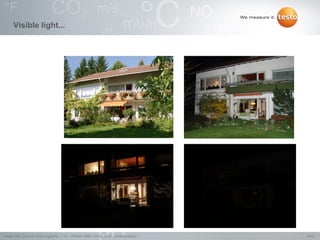
Visible light...
5/22Testo AG, General Thermography (1.0), 1000len-3956, 02.05.2016, Confidentiality 1
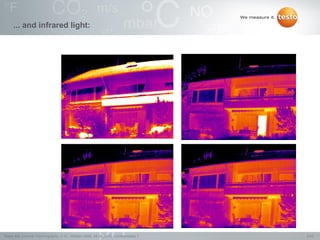
... and infrared light:
6/22Testo AG, General Thermography (1.0), 1000len-3956, 02.05.2016, Confidentiality 1
 Each body, that is warmer than -273.15 ºC, emits electromagnetic
radiation.
 An IR - camera doesn‟t detect temperature but infrared - radiation.
 The camera doesn‟t emit radiation.
 The possibility of a thermal imager to “see through” materials is very
limited.
Basics of Thermography
7/22Testo AG, General Thermography (1.0), 1000len-3956, 02.05.2016, Confidentiality 1
•
•
•
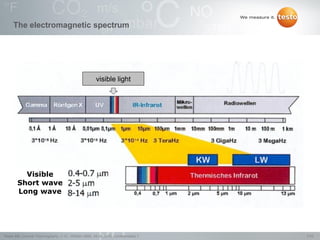
The electromagnetic spectrum
visible light
Visible
Short wave
Long wave
8/22Testo AG, General Thermography (1.0), 1000len-3956, 02.05.2016, Confidentiality 1
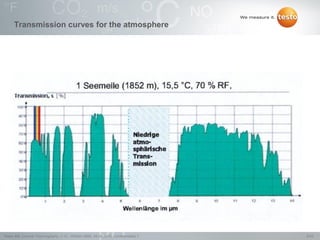
Transmission curves for the atmosphere
9/22Testo AG, General Thermography (1.0), 1000len-3956, 02.05.2016, Confidentiality 1
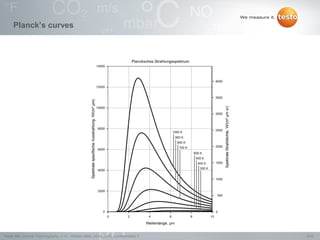
Planck‟s curves
10/22Testo AG, General Thermography (1.0), 1000len-3956, 02.05.2016, Confidentiality 1
Radiation and temperature
The Thermal Imager doesn‟t measure temperature but radiation!
For the calculation of the correct temperature a Thermal Imager needs
certain information.
Most of the information the camera gathers by itself, however, some
parameter must be provided by the user.
11/22Testo AG, General Thermography (1.0), 1000len-3956, 02.05.2016, Confidentiality 1
The two most important parameters of the measured object are:
Reflected Temperature –
temperatures that are reflected by the measured object.
Emissivity –
describes the capability of the inspected surface to emit
radiation.
Parameter, that must be provided by the user....
12/22Testo AG, General Thermography (1.0), 1000len-3956, 02.05.2016, Confidentiality 1
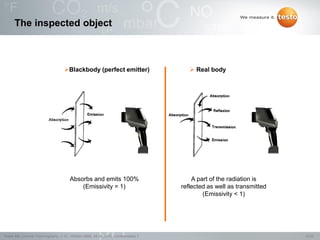
Blackbody (perfect emitter)
Absorbs and emits 100%
(Emissivity = 1)
 Real body
A part of the radiation is
reflected as well as transmitted
(Emissivity < 1)
The inspected object
13/22Testo AG, General Thermography (1.0), 1000len-3956, 02.05.2016, Confidentiality 1
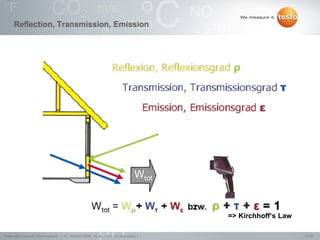
Reflection, Transmission, Emission
=> Kirchhoff„s Law
14/22Testo AG, General Thermography (1.0), 1000len-3956, 02.05.2016, Confidentiality 1
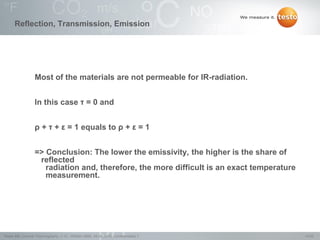
Reflection, Transmission, Emission
Most of the materials are not permeable for IR-radiation.
In this case τ = 0 and
ρ + τ + ε = 1 equals to ρ + ε = 1
=> Conclusion: The lower the emissivity, the higher is the share of
reflected
radiation and, therefore, the more difficult is an exact temperature
measurement.
15/22Testo AG, General Thermography (1.0), 1000len-3956, 02.05.2016, Confidentiality 1
The emissivity can vary with the surface condition, the material
and the temperature.
With long-wave IR-cameras the emissivity is not depending on
the colour of the inspected object.
Most of the construction materials have an emissivity between
0.85 und 0.96.
Emissivitiy tables can be used. However, these values should be
used only as a guide.
It is also possible to determine the emissivity:
Reference measurements with contact thermometers or surfaces
where ε is known.
Reflection, Transmission, Emission
16/22Testo AG, General Thermography (1.0), 1000len-3956, 02.05.2016, Confidentiality 1
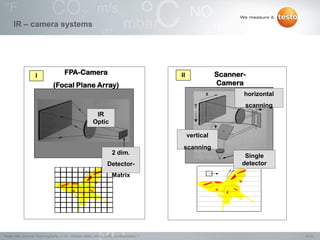
IR
Optic
2 dim.
Detector-
Matrix
FPA-Camera
(Focal Plane Array)
I
vertical
scanning
Single
detector
horizontal
scanning
Scanner-
Camera
II
IR – camera systems
17/22Testo AG, General Thermography (1.0), 1000len-3956, 02.05.2016, Confidentiality 1
Thermal sensitivity
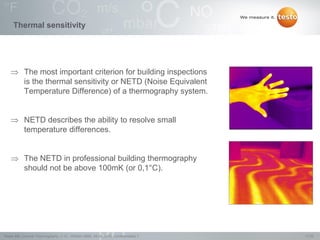
 The most important criterion for building inspections
is the thermal sensitivity or NETD (Noise Equivalent
Temperature Difference) of a thermography system.
 NETD describes the ability to resolve small
temperature differences.
 The NETD in professional building thermography
should not be above 100mK (or 0,1°C).
18/22Testo AG, General Thermography (1.0), 1000len-3956, 02.05.2016, Confidentiality 1
Field of View
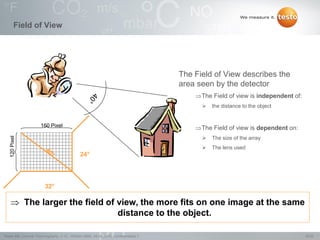
The Field of View describes the
area seen by the detector
The Field of view is independent of:
 the distance to the object
The Field of view is dependent on:
 The size of the array
 The lens used
 The larger the field of view, the more fits on one image at the same
distance to the object.
160 Pixel
120Pixel
32°
24°
19/22Testo AG, General Thermography (1.0), 1000len-3956, 02.05.2016, Confidentiality 1
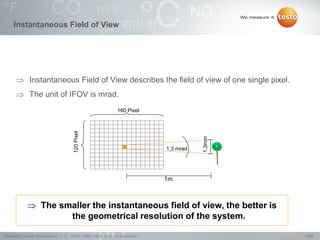
Instantaneous Field of View
 Instantaneous Field of View describes the field of view of one single pixel.
 The unit of IFOV is mrad.
160 Pixel
120Pixel
1,3 mrad
1m
1,3mm The smaller the instantaneous field of view, the better is
the geometrical resolution of the system.
20/22Testo AG, General Thermography (1.0), 1000len-3956, 02.05.2016, Confidentiality 1
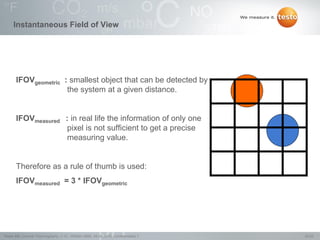
Instantaneous Field of View
IFOVgeometric : smallest object that can be detected by
the system at a given distance.
IFOVmeasured : in real life the information of only one
pixel is not sufficient to get a precise
measuring value.
Therefore as a rule of thumb is used:
IFOVmeasured = 3 * IFOVgeometric
21/22Testo AG, General Thermography (1.0), 1000len-3956, 02.05.2016, Confidentiality 1
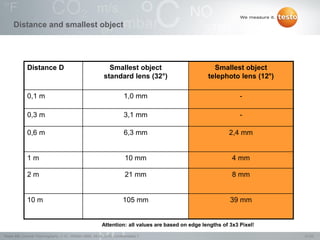
Distance and smallest object
Distance D Smallest object
standard lens (32°)
Smallest object
telephoto lens (12°)
0,1 m 1,0 mm -
0,3 m 3,1 mm -
0,6 m 6,3 mm 2,4 mm
1 m 10 mm 4 mm
2 m 21 mm 8 mm
10 m 105 mm 39 mm
Attention: all values are based on edge lengths of 3x3 Pixel!
22/22Testo AG, General Thermography (1.0), 1000len-3956, 02.05.2016, Confidentiality 1
Power Point Template

General thermography

  • 1.
    General Thermography Testo ProductManagement 02/05/2016 Author
  • 2.
    2/22Testo AG, GeneralThermography (1.0), 1000len-3956, 02.05.2016, Confidentiality 1 Thermography is the graphical representation of the temperature distribution on a “solid” body => We always only see the surface! What is this thing called Thermography?
  • 3.
    3/22Testo AG, GeneralThermography (1.0), 1000len-3956, 02.05.2016, Confidentiality 1 Thermographers see the world in a different perspective..... What is this thing called Thermography?
  • 4.
    4/22Testo AG, GeneralThermography (1.0), 1000len-3956, 02.05.2016, Confidentiality 1 Visible light...
  • 5.
    5/22Testo AG, GeneralThermography (1.0), 1000len-3956, 02.05.2016, Confidentiality 1 ... and infrared light:
  • 6.
    6/22Testo AG, GeneralThermography (1.0), 1000len-3956, 02.05.2016, Confidentiality 1  Each body, that is warmer than -273.15 ºC, emits electromagnetic radiation.  An IR - camera doesn‟t detect temperature but infrared - radiation.  The camera doesn‟t emit radiation.  The possibility of a thermal imager to “see through” materials is very limited. Basics of Thermography
  • 7.
    7/22Testo AG, GeneralThermography (1.0), 1000len-3956, 02.05.2016, Confidentiality 1 • • • The electromagnetic spectrum visible light Visible Short wave Long wave
  • 8.
    8/22Testo AG, GeneralThermography (1.0), 1000len-3956, 02.05.2016, Confidentiality 1 Transmission curves for the atmosphere
  • 9.
    9/22Testo AG, GeneralThermography (1.0), 1000len-3956, 02.05.2016, Confidentiality 1 Planck‟s curves
  • 10.
    10/22Testo AG, GeneralThermography (1.0), 1000len-3956, 02.05.2016, Confidentiality 1 Radiation and temperature The Thermal Imager doesn‟t measure temperature but radiation! For the calculation of the correct temperature a Thermal Imager needs certain information. Most of the information the camera gathers by itself, however, some parameter must be provided by the user.
  • 11.
    11/22Testo AG, GeneralThermography (1.0), 1000len-3956, 02.05.2016, Confidentiality 1 The two most important parameters of the measured object are: Reflected Temperature – temperatures that are reflected by the measured object. Emissivity – describes the capability of the inspected surface to emit radiation. Parameter, that must be provided by the user....
  • 12.
    12/22Testo AG, GeneralThermography (1.0), 1000len-3956, 02.05.2016, Confidentiality 1 Blackbody (perfect emitter) Absorbs and emits 100% (Emissivity = 1)  Real body A part of the radiation is reflected as well as transmitted (Emissivity < 1) The inspected object
  • 13.
    13/22Testo AG, GeneralThermography (1.0), 1000len-3956, 02.05.2016, Confidentiality 1 Reflection, Transmission, Emission => Kirchhoff„s Law
  • 14.
    14/22Testo AG, GeneralThermography (1.0), 1000len-3956, 02.05.2016, Confidentiality 1 Reflection, Transmission, Emission Most of the materials are not permeable for IR-radiation. In this case τ = 0 and ρ + τ + ε = 1 equals to ρ + ε = 1 => Conclusion: The lower the emissivity, the higher is the share of reflected radiation and, therefore, the more difficult is an exact temperature measurement.
  • 15.
    15/22Testo AG, GeneralThermography (1.0), 1000len-3956, 02.05.2016, Confidentiality 1 The emissivity can vary with the surface condition, the material and the temperature. With long-wave IR-cameras the emissivity is not depending on the colour of the inspected object. Most of the construction materials have an emissivity between 0.85 und 0.96. Emissivitiy tables can be used. However, these values should be used only as a guide. It is also possible to determine the emissivity: Reference measurements with contact thermometers or surfaces where ε is known. Reflection, Transmission, Emission
  • 16.
    16/22Testo AG, GeneralThermography (1.0), 1000len-3956, 02.05.2016, Confidentiality 1 IR Optic 2 dim. Detector- Matrix FPA-Camera (Focal Plane Array) I vertical scanning Single detector horizontal scanning Scanner- Camera II IR – camera systems
  • 17.
    17/22Testo AG, GeneralThermography (1.0), 1000len-3956, 02.05.2016, Confidentiality 1 Thermal sensitivity  The most important criterion for building inspections is the thermal sensitivity or NETD (Noise Equivalent Temperature Difference) of a thermography system.  NETD describes the ability to resolve small temperature differences.  The NETD in professional building thermography should not be above 100mK (or 0,1°C).
  • 18.
    18/22Testo AG, GeneralThermography (1.0), 1000len-3956, 02.05.2016, Confidentiality 1 Field of View The Field of View describes the area seen by the detector The Field of view is independent of:  the distance to the object The Field of view is dependent on:  The size of the array  The lens used  The larger the field of view, the more fits on one image at the same distance to the object. 160 Pixel 120Pixel 32° 24°
  • 19.
    19/22Testo AG, GeneralThermography (1.0), 1000len-3956, 02.05.2016, Confidentiality 1 Instantaneous Field of View  Instantaneous Field of View describes the field of view of one single pixel.  The unit of IFOV is mrad. 160 Pixel 120Pixel 1,3 mrad 1m 1,3mm The smaller the instantaneous field of view, the better is the geometrical resolution of the system.
  • 20.
    20/22Testo AG, GeneralThermography (1.0), 1000len-3956, 02.05.2016, Confidentiality 1 Instantaneous Field of View IFOVgeometric : smallest object that can be detected by the system at a given distance. IFOVmeasured : in real life the information of only one pixel is not sufficient to get a precise measuring value. Therefore as a rule of thumb is used: IFOVmeasured = 3 * IFOVgeometric
  • 21.
    21/22Testo AG, GeneralThermography (1.0), 1000len-3956, 02.05.2016, Confidentiality 1 Distance and smallest object Distance D Smallest object standard lens (32°) Smallest object telephoto lens (12°) 0,1 m 1,0 mm - 0,3 m 3,1 mm - 0,6 m 6,3 mm 2,4 mm 1 m 10 mm 4 mm 2 m 21 mm 8 mm 10 m 105 mm 39 mm Attention: all values are based on edge lengths of 3x3 Pixel!
  • 22.
    22/22Testo AG, GeneralThermography (1.0), 1000len-3956, 02.05.2016, Confidentiality 1 Power Point Template