
TOUR-2012
KERALA
BHRIGU C. KALIA – HAIDER ABBAS – IMRAN KHAN – MD. YASSER ARAFAT – SANA AFREEN – TAIYAB ILYAS
FORT KOCHI
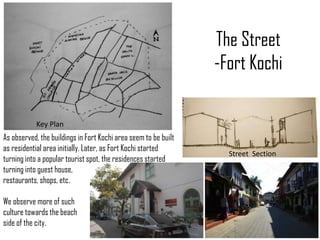
The Street
-Fort Kochi
Key Plan

As observed, the buildings in Fort Kochi area seem to be built
as residential area initially. Later, as Fort Kochi started
turning into a popular tourist spot, the residences started
turning into guest house,
restaurants, shops, etc.
We observe more of such
culture towards the beach
side of the city.

Street Section
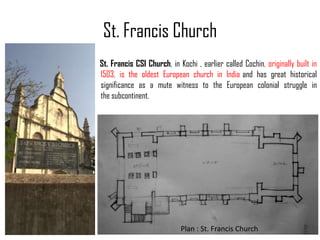
St. Francis Church
St. Francis CSI Church, in Kochi , earlier called Cochin, originally built in
1503, is the oldest European church in India and has great historical
significance as a mute witness to the European colonial struggle in
the subcontinent.

Plan : St. Francis Church
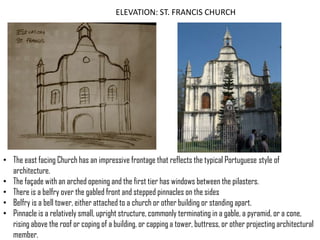
ELEVATION: ST. FRANCIS CHURCH

• The east facing Church has an impressive frontage that reflects the typical Portuguese style of
architecture.
• The façade with an arched opening and the first tier has windows between the pilasters.
• There is a belfry over the gabled front and stepped pinnacles on the sides
• Belfry is a bell tower, either attached to a church or other building or standing apart.
• Pinnacle is a relatively small, upright structure, commonly terminating in a gable, a pyramid, or a cone,
rising above the roof or coping of a building, or capping a tower, buttress, or other projecting architectural
member.
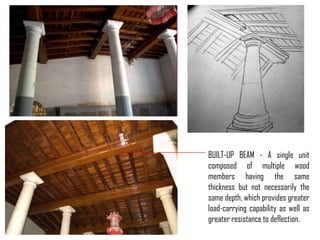
BUILT-UP BEAM - A single unit
composed of multiple wood
members having the same
thickness but not necessarily the
same depth, which provides greater
load-carrying capability as well as
greater resistance to deflection.
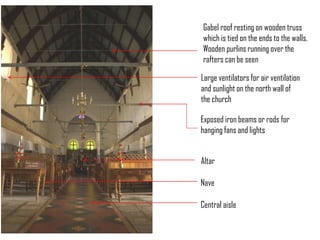
Gabel roof resting on wooden truss
which is tied on the ends to the walls.
Wooden purlins running over the
rafters can be seen

Large ventilators for air ventilation
and sunlight on the north wall of
the church
Exposed iron beams or rods for
hanging fans and lights
Altar
Nave
Central aisle
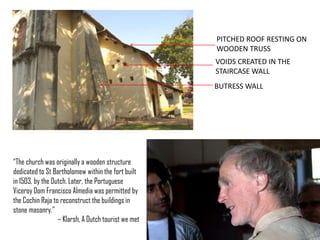
PITCHED ROOF RESTING ON
WOODEN TRUSS

VOIDS CREATED IN THE
STAIRCASE WALL
BUTRESS WALL

“The church was originally a wooden structure
dedicated to St Bartholomew within the fort built
in 1503, by the Dutch. Later, the Portuguese
Viceroy Dom Francisco Almedia was permitted by
the Cochin Raja to reconstruct the buildings in
stone masonry.”
– Klarsh, A Dutch tourist we met
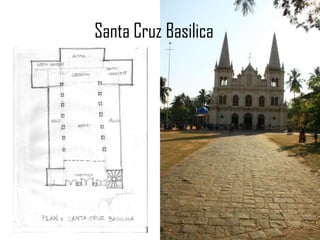
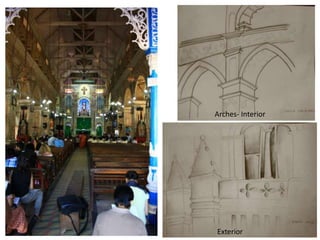
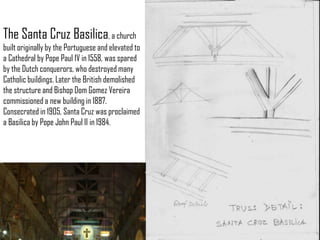
Santa Cruz Basilica
Arches- Interior

Exterior
The Santa Cruz Basilica, a church
built originally by the Portuguese and elevated to
a Cathedral by Pope Paul 1V in 1558, was spared
by the Dutch conquerors, who destroyed many
Catholic buildings. Later the British demolished
the structure and Bishop Dom Gomez Vereira
commissioned a new building in 1887.
Consecrated in 1905, Santa Cruz was proclaimed
a Basilica by Pope John Paul II in 1984.
CENTRE FOR DEVELOPMENT STUDIES (CDS)
CDS is located in a residential area in the northern outskirts of
Thiruvananthapuram. The CDS campus and buildings, designed by the
renowned architect, Dr. Laurie Baker, exemplify the cost-effective
techniques in construction.
The 10-acre campus also houses the Library, Computer Centre,
Auditoriums, Hostels, Guesthouse and Residential Units for staff members.
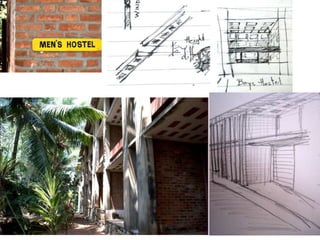
The CDS hostels have 27 rooms in two units for women and 33 rooms for
men in another two units. The rooms are well appointed and for single
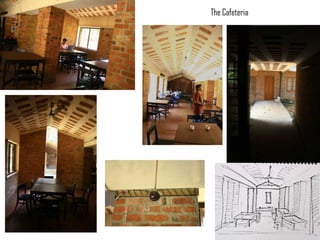
occupancy The campus is serviced by a cafeteria, which serves simple
wholesome food on Indian cuisine. The campus also has recreation
facilities.
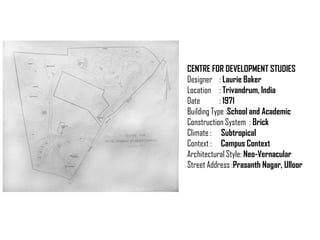
CENTRE FOR DEVELOPMENT STUDIES
Designer : Laurie Baker
Location : Trivandrum, India
Date
: 1971
Building Type :School and Academic
Construction System : Brick
Climate : Subtropical
Context : Campus Context
Architectural Style: Neo-Vernacular
Street Address :Prasanth Nagar, Ulloor
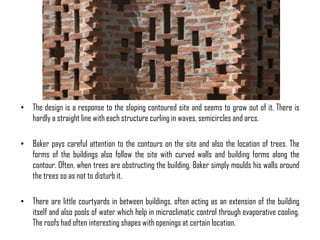
• The design is a response to the sloping contoured site and seems to grow out of it. There is
hardly a straight line with each structure curling in waves, semicircles and arcs.
• Baker pays careful attention to the contours on the site and also the location of trees. The
forms of the buildings also follow the site with curved walls and building forms along the
contour. Often, when trees are obstructing the building, Baker simply moulds his walls around
the trees so as not to disturb it.
• There are little courtyards in between buildings, often acting as an extension of the building
itself and also pools of water which help in microclimatic control through evaporative cooling.
The roofs had often interesting shapes with openings at certain location.
The Cafeteria
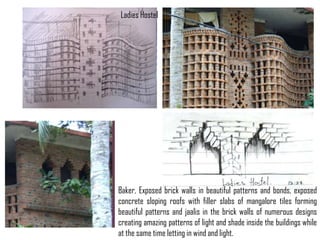
Ladies Hostel

Baker, Exposed brick walls in beautiful patterns and bonds, exposed
concrete sloping roofs with filler slabs of mangalore tiles forming
beautiful patterns and jaalis in the brick walls of numerous designs
creating amazing patterns of light and shade inside the buildings while
at the same time letting in wind and light.
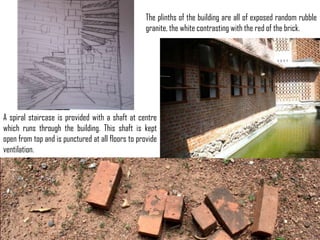
The plinths of the building are all of exposed random rubble
granite, the white contrasting with the red of the brick.

A spiral staircase is provided with a shaft at centre
which runs through the building. This shaft is kept
open from top and is punctured at all floors to provide
ventilation.
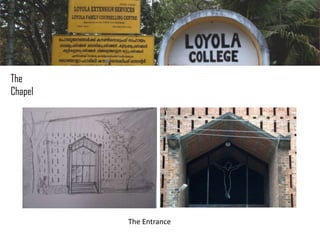
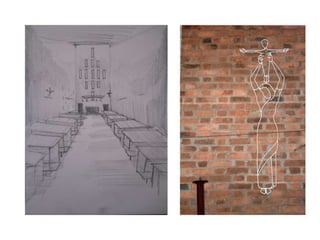
The
Chapel

The Entrance
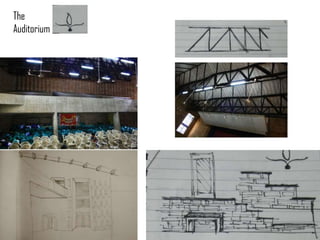
The
Auditorium
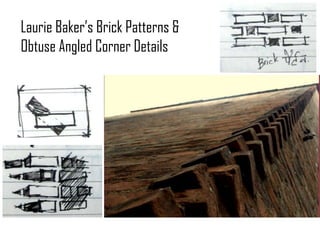
Laurie Baker’s Brick Patterns &
Obtuse Angled Corner Details

Tour 2012

  • 1.
    TOUR-2012 KERALA BHRIGU C. KALIA– HAIDER ABBAS – IMRAN KHAN – MD. YASSER ARAFAT – SANA AFREEN – TAIYAB ILYAS
  • 2.
  • 3.
    The Street -Fort Kochi KeyPlan As observed, the buildings in Fort Kochi area seem to be built as residential area initially. Later, as Fort Kochi started turning into a popular tourist spot, the residences started turning into guest house, restaurants, shops, etc. We observe more of such culture towards the beach side of the city. Street Section
  • 4.
    St. Francis Church St.Francis CSI Church, in Kochi , earlier called Cochin, originally built in 1503, is the oldest European church in India and has great historical significance as a mute witness to the European colonial struggle in the subcontinent. Plan : St. Francis Church
  • 5.
    ELEVATION: ST. FRANCISCHURCH • The east facing Church has an impressive frontage that reflects the typical Portuguese style of architecture. • The façade with an arched opening and the first tier has windows between the pilasters. • There is a belfry over the gabled front and stepped pinnacles on the sides • Belfry is a bell tower, either attached to a church or other building or standing apart. • Pinnacle is a relatively small, upright structure, commonly terminating in a gable, a pyramid, or a cone, rising above the roof or coping of a building, or capping a tower, buttress, or other projecting architectural member.
  • 6.
    BUILT-UP BEAM -A single unit composed of multiple wood members having the same thickness but not necessarily the same depth, which provides greater load-carrying capability as well as greater resistance to deflection.
  • 7.
    Gabel roof restingon wooden truss which is tied on the ends to the walls. Wooden purlins running over the rafters can be seen Large ventilators for air ventilation and sunlight on the north wall of the church Exposed iron beams or rods for hanging fans and lights Altar Nave Central aisle
  • 8.
    PITCHED ROOF RESTINGON WOODEN TRUSS VOIDS CREATED IN THE STAIRCASE WALL BUTRESS WALL “The church was originally a wooden structure dedicated to St Bartholomew within the fort built in 1503, by the Dutch. Later, the Portuguese Viceroy Dom Francisco Almedia was permitted by the Cochin Raja to reconstruct the buildings in stone masonry.” – Klarsh, A Dutch tourist we met
  • 9.
  • 10.
  • 11.
    The Santa CruzBasilica, a church built originally by the Portuguese and elevated to a Cathedral by Pope Paul 1V in 1558, was spared by the Dutch conquerors, who destroyed many Catholic buildings. Later the British demolished the structure and Bishop Dom Gomez Vereira commissioned a new building in 1887. Consecrated in 1905, Santa Cruz was proclaimed a Basilica by Pope John Paul II in 1984.
  • 12.
    CENTRE FOR DEVELOPMENTSTUDIES (CDS) CDS is located in a residential area in the northern outskirts of Thiruvananthapuram. The CDS campus and buildings, designed by the renowned architect, Dr. Laurie Baker, exemplify the cost-effective techniques in construction. The 10-acre campus also houses the Library, Computer Centre, Auditoriums, Hostels, Guesthouse and Residential Units for staff members. The CDS hostels have 27 rooms in two units for women and 33 rooms for men in another two units. The rooms are well appointed and for single occupancy The campus is serviced by a cafeteria, which serves simple wholesome food on Indian cuisine. The campus also has recreation facilities.
  • 13.
    CENTRE FOR DEVELOPMENTSTUDIES Designer : Laurie Baker Location : Trivandrum, India Date : 1971 Building Type :School and Academic Construction System : Brick Climate : Subtropical Context : Campus Context Architectural Style: Neo-Vernacular Street Address :Prasanth Nagar, Ulloor
  • 14.
    • The designis a response to the sloping contoured site and seems to grow out of it. There is hardly a straight line with each structure curling in waves, semicircles and arcs. • Baker pays careful attention to the contours on the site and also the location of trees. The forms of the buildings also follow the site with curved walls and building forms along the contour. Often, when trees are obstructing the building, Baker simply moulds his walls around the trees so as not to disturb it. • There are little courtyards in between buildings, often acting as an extension of the building itself and also pools of water which help in microclimatic control through evaporative cooling. The roofs had often interesting shapes with openings at certain location.
  • 15.
  • 16.
    Ladies Hostel Baker, Exposedbrick walls in beautiful patterns and bonds, exposed concrete sloping roofs with filler slabs of mangalore tiles forming beautiful patterns and jaalis in the brick walls of numerous designs creating amazing patterns of light and shade inside the buildings while at the same time letting in wind and light.
  • 18.
    The plinths ofthe building are all of exposed random rubble granite, the white contrasting with the red of the brick. A spiral staircase is provided with a shaft at centre which runs through the building. This shaft is kept open from top and is punctured at all floors to provide ventilation.
  • 19.
  • 21.
  • 23.
    Laurie Baker’s BrickPatterns & Obtuse Angled Corner Details