Formal Derivatives A Short Orientation with Examples By Gideon L. Weinstein Course Mentor Western Governors University Last updated May 2010
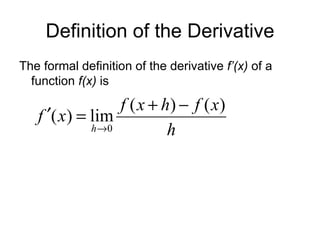
Definition of the Derivative The formal definition of the derivative  f’(x)  of a function  f(x)  is
Key Point Please note that in this definition,  x  is a constant and it is  h  that we treat as the variable as it approaches zero The key to these computations is to do as much algebra as possible BEFORE taking the limit.
Example 1 Let f(x) = 7x + 3 and formally compute f’(x). Please note that in a formal proof, there would be a justification for each the steps taken.  That is left as an exercise for the reader.
Example 1, continued So when f(x) = 7x + 3 then f’(x) = 7.
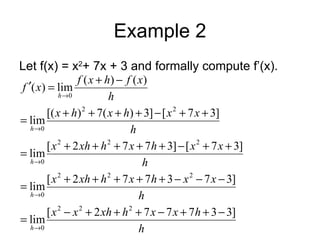
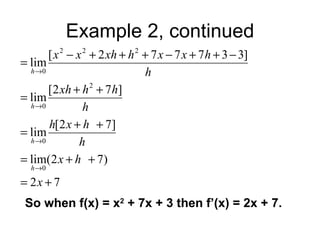
Example 2 Let f(x) = x 2 + 7x + 3 and formally compute f’(x).
Example 2, continued So when f(x) = x 2  + 7x + 3 then f’(x) = 2x + 7.
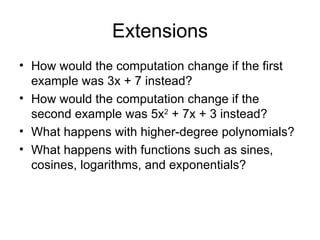
Extensions How would the computation change if the first example was 3x + 7 instead? How would the computation change if the second example was 5x 2  + 7x + 3 instead? What happens with higher-degree polynomials? What happens with functions such as sines, cosines, logarithms, and exponentials?

Formal Derivatives

  • 1.
    Formal Derivatives AShort Orientation with Examples By Gideon L. Weinstein Course Mentor Western Governors University Last updated May 2010
  • 2.
    Definition of theDerivative The formal definition of the derivative f’(x) of a function f(x) is
  • 3.
    Key Point Pleasenote that in this definition, x is a constant and it is h that we treat as the variable as it approaches zero The key to these computations is to do as much algebra as possible BEFORE taking the limit.
  • 4.
    Example 1 Letf(x) = 7x + 3 and formally compute f’(x). Please note that in a formal proof, there would be a justification for each the steps taken. That is left as an exercise for the reader.
  • 5.
    Example 1, continuedSo when f(x) = 7x + 3 then f’(x) = 7.
  • 6.
    Example 2 Letf(x) = x 2 + 7x + 3 and formally compute f’(x).
  • 7.
    Example 2, continuedSo when f(x) = x 2 + 7x + 3 then f’(x) = 2x + 7.
  • 8.
    Extensions How wouldthe computation change if the first example was 3x + 7 instead? How would the computation change if the second example was 5x 2 + 7x + 3 instead? What happens with higher-degree polynomials? What happens with functions such as sines, cosines, logarithms, and exponentials?