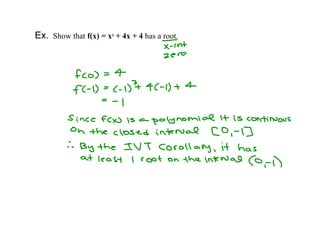
The Intermediate Value Theorem states that if a function f is continuous on a closed interval [a,b] and k is a real number between f(a) and f(b), then there exists a value c within the interval where f(c) equals k. In other words, if a continuous function f outputs values between f(a) and f(b) on an interval, then f must pass through every value in between, including k.
![Intermediate Value Theorem
Let f be a function which is continuous on the closed interval
[a, b]. Suppose that k is a real number between f(a) and f(b),
then there exists c in [a, b] that f(c) = k.
, Let f be a function which is continuous on the
closed interval [a, b]. Suppose that the product f(a)f(b) < 0;
then there exists c in (a, b) such that f(c) = 0. In other words,
f has at least one root in the interval (a, b).
f(x) > 0
zero of f(x)
f(x) < 0](https://image.slidesharecdn.com/day8bexamples-120925151913-phpapp01/85/Day-8b-examples-1-320.jpg)