Why educate for peace
 Peace education is an ethical imperative
 Peace education is a practical alternative
Peace education’s schema of knowledge, skills, and
attitudes/values
A Holistic Understanding of Peace
Peace is the absence of violence, not only personal/direct
but also structural /Indirect.  Johan Galtung
2 concept of peace
Negative peace – absence of war/ physical violence
Positive peace – presence of just and non – exploitative
relationship.
Peace
Negative peace Positive peace
Absence of direct/physical violence
(both macro & micro)
Presence of conditions of well- being
And just relationships:
social, economic, political, ecological
Direct violence
Structural violence
Socio- cultural violence
Ecological violence
Poverty, hunger
Racism, sexism, religious
intolerance
Pollution, overconsumption
War, torture, child, & woman abuse
Violence
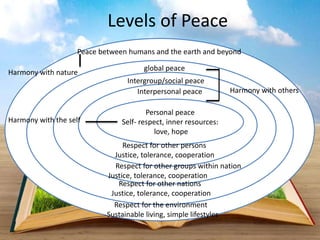
Levels of Peace
Interpersonal peace
Intergroup/social peace
Personal peace
Self- respect, inner resources:
love, hope
global peace
Peace between humans and the earth and beyond
Harmony with others
Harmony with nature
Harmony with the self
Respect for other persons
Justice, tolerance, cooperation
Respect for other groups within nation
Justice, tolerance, cooperation
Respect for other nations
Justice, tolerance, cooperation
Respect for the environment
Sustainable living, simple lifestyles
Level
Forms of
violence
Personal
Interpersonal/c
ommunity
National Global
Direct physical
Suicide
Drug abuse
Domestic violence
Violent crimes
Violent crimes
Human rights
abuses
Structural/economic,
political
Sociocultural/psychological
Powerlessness
Alienation
Low self- esteem
anxiety
Poverty, hunger
Cultural
domination
Racism
Sexism
Religious
intolerance
Poverty, hunger
Cultural domination
Racism
Sexism
Religious
intolerance
Poverty, hunger
Cultural domination
Racism
Sexism
Religious intolerance
Ecological Over- consumption
Over- consumption
Pollution
Nuclear power
Radiation
Nuclear power
Radiation
A Typology of Violence
The Peaceable Teaching- Learning Process
Cognitive phase
(being aware, understanding)
Affective phase
(being concerned,
Responding, valuing)
Active phase
(taking practical action)
Attitudes/values
1. Self-respect
2. Respect For Others
3. Gender Equality
4. Respect For
Life/Nonviolence
5. Global Concern
6. Ecological Concern
7. Cooperation
8. Openness & Tolerance
9. Justice
10.Compassion
11.Social Responsibility
12. Positive Vision
Knowledge
1. Holistic Concept Of Peace
2. Conflict & Violence –Causes
3. Some Peaceful
Alternatives
Disarmament
Nonviolence- Philos. &
Practice
Conflict Resolution,
Transformation,
Prevention
Human Rights
Human Solidarity
Democratization
Development Based on
Justice
Sustainable Development
Skills
1. Reflection
2. Critical thinking
& Analysis
3. Decision-making
4. Imagination
5. Communication
6. Conflict
resolution
7. Empathy
8. Group building
Various spiritual traditions:
The rejection of violence
Love & compassion for others
Love & compassion for other creatures & life forms in nature
Respect for human dignity
Justice/ fairness
Peace Theme 1 : Upholding Human Dignity
It is the center of the values system that we associate with social peace.
It is defined as the fundamental innate worth of a human being,
a principle that is now universally accepted but has not taken
root in the actual practices of many governments, communities
and other non – state actors.
Convention on the elimination of all forms of
discrimination against women
CEDAW – (convention on the elimination of all forms of
discrimination against women) also known as the International
Bill of Rights for Women & is the only international treaty
that comprehensively addresses women’s rights.
Aims of CEDAW:
 to bring about substantive equality of women
 prohibits actions & policies that put women at a
disadvantage whatever its intentions
 recognizes the influence of culture & tradition on
restricting women’s enjoyment of their right
 discards the distinction between the private & the
public spheres, by recognizing violations of women
in the private sphere
Enacted laws to protect women
 RA 7877 “anti- sexual harassment act“
 Magna Carta For Women
 RA 9262 “ anti – violence against women &
children act”
 RA 8505 “ rape victim assistance &
protection act”
RA 9262 “ anti – trafficking in person’s act”
 RA 8353 “ anti- rape law”
peace education

peace education

  • 2.
    Why educate forpeace  Peace education is an ethical imperative  Peace education is a practical alternative Peace education’s schema of knowledge, skills, and attitudes/values
  • 3.
    A Holistic Understandingof Peace Peace is the absence of violence, not only personal/direct but also structural /Indirect.  Johan Galtung 2 concept of peace Negative peace – absence of war/ physical violence Positive peace – presence of just and non – exploitative relationship.
  • 4.
    Peace Negative peace Positivepeace Absence of direct/physical violence (both macro & micro) Presence of conditions of well- being And just relationships: social, economic, political, ecological Direct violence Structural violence Socio- cultural violence Ecological violence Poverty, hunger Racism, sexism, religious intolerance Pollution, overconsumption War, torture, child, & woman abuse Violence
  • 5.
    Levels of Peace Interpersonalpeace Intergroup/social peace Personal peace Self- respect, inner resources: love, hope global peace Peace between humans and the earth and beyond Harmony with others Harmony with nature Harmony with the self Respect for other persons Justice, tolerance, cooperation Respect for other groups within nation Justice, tolerance, cooperation Respect for other nations Justice, tolerance, cooperation Respect for the environment Sustainable living, simple lifestyles
  • 6.
    Level Forms of violence Personal Interpersonal/c ommunity National Global Directphysical Suicide Drug abuse Domestic violence Violent crimes Violent crimes Human rights abuses Structural/economic, political Sociocultural/psychological Powerlessness Alienation Low self- esteem anxiety Poverty, hunger Cultural domination Racism Sexism Religious intolerance Poverty, hunger Cultural domination Racism Sexism Religious intolerance Poverty, hunger Cultural domination Racism Sexism Religious intolerance Ecological Over- consumption Over- consumption Pollution Nuclear power Radiation Nuclear power Radiation A Typology of Violence
  • 7.
    The Peaceable Teaching-Learning Process Cognitive phase (being aware, understanding) Affective phase (being concerned, Responding, valuing) Active phase (taking practical action)
  • 8.
    Attitudes/values 1. Self-respect 2. RespectFor Others 3. Gender Equality 4. Respect For Life/Nonviolence 5. Global Concern 6. Ecological Concern 7. Cooperation 8. Openness & Tolerance 9. Justice 10.Compassion 11.Social Responsibility 12. Positive Vision Knowledge 1. Holistic Concept Of Peace 2. Conflict & Violence –Causes 3. Some Peaceful Alternatives Disarmament Nonviolence- Philos. & Practice Conflict Resolution, Transformation, Prevention Human Rights Human Solidarity Democratization Development Based on Justice Sustainable Development Skills 1. Reflection 2. Critical thinking & Analysis 3. Decision-making 4. Imagination 5. Communication 6. Conflict resolution 7. Empathy 8. Group building
  • 9.
    Various spiritual traditions: Therejection of violence Love & compassion for others Love & compassion for other creatures & life forms in nature Respect for human dignity Justice/ fairness
  • 10.
    Peace Theme 1: Upholding Human Dignity It is the center of the values system that we associate with social peace. It is defined as the fundamental innate worth of a human being, a principle that is now universally accepted but has not taken root in the actual practices of many governments, communities and other non – state actors.
  • 11.
    Convention on theelimination of all forms of discrimination against women CEDAW – (convention on the elimination of all forms of discrimination against women) also known as the International Bill of Rights for Women & is the only international treaty that comprehensively addresses women’s rights.
  • 12.
    Aims of CEDAW: to bring about substantive equality of women  prohibits actions & policies that put women at a disadvantage whatever its intentions  recognizes the influence of culture & tradition on restricting women’s enjoyment of their right  discards the distinction between the private & the public spheres, by recognizing violations of women in the private sphere
  • 13.
    Enacted laws toprotect women  RA 7877 “anti- sexual harassment act“  Magna Carta For Women  RA 9262 “ anti – violence against women & children act”  RA 8505 “ rape victim assistance & protection act” RA 9262 “ anti – trafficking in person’s act”  RA 8353 “ anti- rape law”