Corporation of                                                   world-class
                           Lower St. Lawrence Pilots
                                                                                            Tug
                           Maritime Simulation and Resource Centre                          Simulators


Tug
Simulators
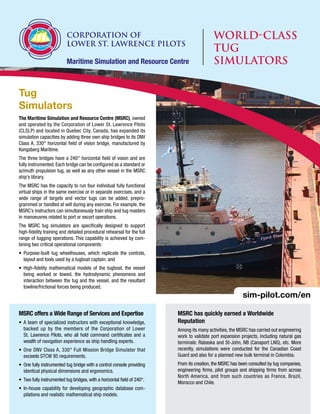
The Maritime Simulation and Resource Centre (MSRC), owned
and operated by the Corporation of Lower St. Lawrence Pilots
(CLSLP) and located in Quebec City, Canada, has expanded its
simulation capacities by adding three own ship bridges to its DNV
Class A, 330° horizontal field of vision bridge, manufactured by
Kongsberg Maritime.
The three bridges have a 240° horizontal field of vision and are
fully instrumented. Each bridge can be configured as a standard or
azimuth propulsion tug, as well as any other vessel in the MSRC
ship’s library.
The MSRC has the capacity to run four individual fully functional
virtual ships in the same exercise or in separate exercises, and a
wide range of targets and vector tugs can be added, prepro-
grammed or handled at will during any exercise. For example, the
MSRC’s instructors can simultaneously train ship and tug masters
in manoeuvres related to port or escort operations.
The MSRC tug simulators are specifically designed to support
high-fidelity training and detailed procedural rehearsal for the full
range of tugging operations. This capability is achieved by com-
bining two critical operational components:
•	 Purpose-built tug wheelhouses, which replicate the controls,
   layout and tools used by a tugboat captain; and
•	 High-fidelity mathematical models of the tugboat, the vessel
   being worked or towed, the hydrodynamic phenomena and
   interaction between the tug and the vessel, and the resultant
   towline/frictional forces being produced.
                                                                                                           sim-pilot.com/en

MSRC offers a Wide Range of Services and Expertise                        MSRC has quickly earned a Worldwide
•	 A team of specialized instructors with exceptional knowledge,          Reputation
   backed up by the members of the Corporation of Lower                   Among its many activities, the MSRC has carried out engineering
   St. Lawrence Pilots, who all hold command certificates and a           work to validate port expansion projects, including natural gas
   wealth of navigation experience as ship handling experts.              terminals: Rabaska and St-John, NB (Canaport LNG), etc. More
•	 One DNV Class A, 330° Full Mission Bridge Simulator that               recently, simulations were conducted for the Canadian Coast
   exceeds STCW 95 requirements.                                          Guard and also for a planned new bulk terminal in Colombia.
•	 One fully instrumented tug bridge with a control console providing     From its creation, the MSRC has been consulted by tug companies,
   identical physical dimensions and ergonomics.                          engineering firms, pilot groups and shipping firms from across
                                                                          North America, and from such countries as France, Brazil,
•	 Two fully instrumented tug bridges, with a horizontal field of 240°.
                                                                          Morocco and Chile.
•	 In-house capability for developing geographic database com­
   pilations and realistic mathematical ship models.                                                         sim-pilot.com
Maritime Simulation and Resource Centre


Purpose-Built Tug
Wheelhouse
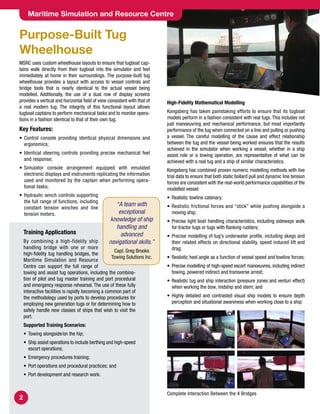
MSRC uses custom wheelhouse layouts to ensure that tugboat cap-
tains walk directly from their tugboat into the simulator and feel
immediately at home in their surroundings. The purpose-built tug
wheelhouse provides a layout with access to vessel controls and
bridge tools that is nearly identical to the actual vessel being
modelled. Additionally, the use of a dual row of display screens
provides a vertical and horizontal field of view consistent with that of    High-Fidelity Mathematical Modelling
a real modern tug. The integrity of this functional layout allows
tugboat captains to perform mechanical tasks and to monitor opera-          Kongsberg has taken painstaking efforts to ensure that its tugboat
tions in a fashion identical to that of their own tug.                      models perform in a fashion consistent with real tugs. This includes not
                                                                            just manoeuvring and mechanical performance, but most importantly
Key Features:                                                               performance of the tug when connected on a line and pulling or pushing
•	 Control console providing identical physical dimensions and              a vessel. The careful modelling of the cause and effect relationship
   ergonomics;                                                              between the tug and the vessel being worked ensures that the results
                                                                            achieved in the simulator when working a vessel, whether in a ship
•	 Identical steering controls providing precise mechanical feel            assist role or a towing operation, are representative of what can be
   and response;                                                            achieved with a real tug and a ship of similar characteristics.
•	 Simulator console arrangement equipped with emulated                     Kongsberg has combined proven numeric modelling methods with live
   electronic displays and instruments replicating the information          trial data to ensure that both static bollard pull and dynamic line tension
   used and monitored by the captain when performing opera-                 forces are consistent with the real-world performance capabilities of the
   tional tasks;                                                            modelled vessel:
•	 Hydraulic winch controls supporting                                      •	 Realistic towline catenary;
   the full range of functions, including
                                                    “A team with            •	 Realistic frictional forces and “stick” while pushing alongside a
   constant tension winches and line
   tension meters.                                   exceptional               moving ship;
                                                  knowledge of ship         •	 Precise light boat handling characteristics, including sideways walk
                                                    handling and               for tractor tugs or tugs with flanking rudders;
    Training Applications                             advanced              •	 Precise modelling of tug’s underwater profile, including skegs and
    By combining a high-fidelity ship            navigational skills.”         their related effects on directional stability, speed induced lift and
    hand­ing bridge with one or more
          l                                                                    drag;
                                                     Capt. Greg Brooks
    high-fidelity tug handling bridges, the
                                                    Towing Solutions Inc.   •	 Realistic heel angle as a function of vessel speed and towline forces;
    Maritime Simulation and Resource
    Centre can support the full range of                                    •	 Precise modelling of high-speed escort manoeuvres, including indirect
    towing and assist tug operations, including the combina-                   towing, powered indirect and transverse arrest;
    tion of pilot and tug master training and port procedural               •	 Realistic tug and ship interaction (pressure zones and venturi effect)
    and emergency response rehearsal. The use of these fully                   when working the bow, midship and stern; and
    interactive facilities is rapidly becoming a common part of
    the methodology used by ports to develop procedures for                 •	 Highly detailed and contrasted visual ship models to ensure depth
    employing new generation tugs or for determining how to                    perception and situational awareness when working close to a ship.
    safely handle new classes of ships that wish to visit the
    port.
    Supported Training Scenarios:
    •	 Towing alongside/on the hip;
    •	 Ship assist operations to include berthing and high-speed
       escort operations;
    •	 Emergency procedures training;
    •	 Port operations and procedural practices; and
    •	 Port development and research work.


                                                                            Complete Interaction Between the 4 Bridges
2
Recent
MSRC
Operational
Research
Projects
                                                                                                                         “One of the most
                                                                                                                   comprehensive combinations
                                                                                                                     of equipment, technology
Feasibility Study for LNG Terminal                                                                                     and pilotage expertise
                                                                                                                      available in the world.”
(LNG with ASD Tugs)
                                                                                                                             Garland Hardy
CANAPORT LNG used the services of the Maritime Simulation and Resource Centre to determine safe and                        Lantec Marine Inc.
appropriate procedures for approaching, berthing and unberthing manoeuvres at the LNG terminal pier with
tugboat assistance.
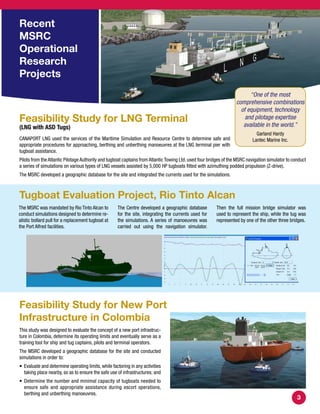
Pilots from the Atlantic Pilotage Authority and tugboat captains from Atlantic Towing Ltd. used four bridges of the MSRC navigation simulator to conduct
a series of simulations on various types of LNG vessels assisted by 5,000 HP tugboats fitted with azimuthing podded propulsion (Z-drive).
The MSRC developed a geographic database for the site and integrated the currents used for the simulations.


Tugboat Evaluation Project, Rio Tinto Alcan
The MSRC was mandated by Rio Tinto Alcan to          The Centre developed a geographic database         Then the full mission bridge simulator was
conduct simulations designed to determine re-        for the site, integrating the currents used for    used to represent the ship, while the tug was
alistic bollard pull for a replacement tugboat at    the simulations. A series of manoeuvres was        represented by one of the other three bridges.
the Port Alfred facilities.                          carried out using the navigation simulator.


Feasibility Study for New Port
Infrastructure in Colombia
This study was designed to evaluate the concept of a new port infrastruc-
ture in Colombia, determine its operating limits and eventually serve as a
training tool for ship and tug captains, pilots and terminal operators.
The MSRC developed a geographic database for the site and conducted
simulations in order to:
•	 Evaluate and determine operating limits, while factoring in any activities
   taking place nearby, so as to ensure the safe use of infrastructures; and
•	 Determine the number and minimal capacity of tugboats needed to
   ensure safe and appropriate assistance during escort operations,
   berthing and unberthing manoeuvres.
                                                                                                                                                   3
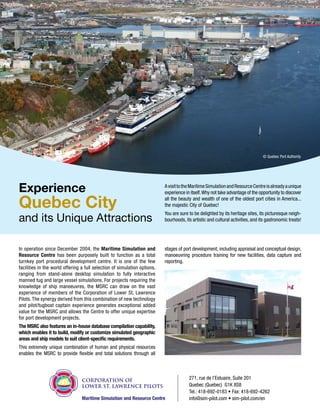
© Quebec Port Authority


Experience                                                                 A visit to the Maritime Simulation and Resource Centre is already a unique
                                                                           experience in itself. Why not take advantage of the opportunity to discover

Quebec City                                                                all the beauty and wealth of one of the oldest port cities in America...
                                                                           the majestic City of Quebec!
                                                                           You are sure to be delighted by its heritage sites, its picturesque neigh-
and its Unique Attractions                                                 bourhoods, its artistic and cultural activities, and its gastronomic treats!


In operation since December 2004, the Maritime Simulation and              stages of port development, including appraisal and conceptual design,
Resource Centre has been purposely built to function as a total            manoeuvring procedure training for new facilities, data capture and
turnkey port procedural development centre. It is one of the few           reporting.
facilities in the world offering a full selection of simulation options,
ranging from stand-alone desktop simulation to fully interactive
manned tug and large vessel simulations. For projects requiring the
knowledge of ship manoeuvres, the MSRC can draw on the vast
experience of members of the Corporation of Lower St. Lawrence
Pilots. The synergy derived from this combination of new technology
and pilot/tugboat captain experience generates exceptional added
value for the MSRC and allows the Centre to offer unique expertise
for port development projects.
The MSRC also features an in-house database compilation capability,
which enables it to build, modify or customize simulated geographic
areas and ship models to suit client-specific requirements.
This extremely unique combination of human and physical resources
enables the MSRC to provide flexible and total solutions through all


                                 Corporation of                                         271, rue de l’Estuaire, Suite 201
                                 Lower St. Lawrence Pilots                              Quebec (Quebec) G1K 8S8
                                                                                        Tel.: 418-692-0183 • Fax: 418-692-4262
                                 Maritime Simulation and Resource Centre                info@sim-pilot.com • sim-pilot.com/en

MSRC TUG SIMULATORS

  • 1.
    Corporation of world-class Lower St. Lawrence Pilots Tug Maritime Simulation and Resource Centre Simulators Tug Simulators The Maritime Simulation and Resource Centre (MSRC), owned and operated by the Corporation of Lower St. Lawrence Pilots (CLSLP) and located in Quebec City, Canada, has expanded its simulation capacities by adding three own ship bridges to its DNV Class A, 330° horizontal field of vision bridge, manufactured by Kongsberg Maritime. The three bridges have a 240° horizontal field of vision and are fully instrumented. Each bridge can be configured as a standard or azimuth propulsion tug, as well as any other vessel in the MSRC ship’s library. The MSRC has the capacity to run four individual fully functional virtual ships in the same exercise or in separate exercises, and a wide range of targets and vector tugs can be added, prepro- grammed or handled at will during any exercise. For example, the MSRC’s instructors can simultaneously train ship and tug masters in manoeuvres related to port or escort operations. The MSRC tug simulators are specifically designed to support high-fidelity training and detailed procedural rehearsal for the full range of tugging operations. This capability is achieved by com- bining two critical operational components: • Purpose-built tug wheelhouses, which replicate the controls, layout and tools used by a tugboat captain; and • High-fidelity mathematical models of the tugboat, the vessel being worked or towed, the hydrodynamic phenomena and interaction between the tug and the vessel, and the resultant towline/frictional forces being produced. sim-pilot.com/en MSRC offers a Wide Range of Services and Expertise MSRC has quickly earned a Worldwide • A team of specialized instructors with exceptional knowledge, Reputation backed up by the members of the Corporation of Lower Among its many activities, the MSRC has carried out engineering St. Lawrence Pilots, who all hold command certificates and a work to validate port expansion projects, including natural gas wealth of navigation experience as ship handling experts. terminals: Rabaska and St-John, NB (Canaport LNG), etc. More • One DNV Class A, 330° Full Mission Bridge Simulator that recently, simulations were conducted for the Canadian Coast exceeds STCW 95 requirements. Guard and also for a planned new bulk terminal in Colombia. • One fully instrumented tug bridge with a control console providing From its creation, the MSRC has been consulted by tug companies, identical physical dimensions and ergonomics. engineering firms, pilot groups and shipping firms from across North America, and from such countries as France, Brazil, • Two fully instrumented tug bridges, with a horizontal field of 240°. Morocco and Chile. • In-house capability for developing geographic database com­ pilations and realistic mathematical ship models. sim-pilot.com
  • 2.
    Maritime Simulation andResource Centre Purpose-Built Tug Wheelhouse MSRC uses custom wheelhouse layouts to ensure that tugboat cap- tains walk directly from their tugboat into the simulator and feel immediately at home in their surroundings. The purpose-built tug wheelhouse provides a layout with access to vessel controls and bridge tools that is nearly identical to the actual vessel being modelled. Additionally, the use of a dual row of display screens provides a vertical and horizontal field of view consistent with that of High-Fidelity Mathematical Modelling a real modern tug. The integrity of this functional layout allows tugboat captains to perform mechanical tasks and to monitor opera- Kongsberg has taken painstaking efforts to ensure that its tugboat tions in a fashion identical to that of their own tug. models perform in a fashion consistent with real tugs. This includes not just manoeuvring and mechanical performance, but most importantly Key Features: performance of the tug when connected on a line and pulling or pushing • Control console providing identical physical dimensions and a vessel. The careful modelling of the cause and effect relationship ergonomics; between the tug and the vessel being worked ensures that the results achieved in the simulator when working a vessel, whether in a ship • Identical steering controls providing precise mechanical feel assist role or a towing operation, are representative of what can be and response; achieved with a real tug and a ship of similar characteristics. • Simulator console arrangement equipped with emulated Kongsberg has combined proven numeric modelling methods with live electronic displays and instruments replicating the information trial data to ensure that both static bollard pull and dynamic line tension used and monitored by the captain when performing opera- forces are consistent with the real-world performance capabilities of the tional tasks; modelled vessel: • Hydraulic winch controls supporting • Realistic towline catenary; the full range of functions, including “A team with • Realistic frictional forces and “stick” while pushing alongside a constant tension winches and line tension meters. exceptional moving ship; knowledge of ship • Precise light boat handling characteristics, including sideways walk handling and for tractor tugs or tugs with flanking rudders; Training Applications advanced • Precise modelling of tug’s underwater profile, including skegs and By combining a high-fidelity ship navigational skills.” their related effects on directional stability, speed induced lift and hand­ing bridge with one or more l drag; Capt. Greg Brooks high-fidelity tug handling bridges, the Towing Solutions Inc. • Realistic heel angle as a function of vessel speed and towline forces; Maritime Simulation and Resource Centre can support the full range of • Precise modelling of high-speed escort manoeuvres, including indirect towing and assist tug operations, including the combina- towing, powered indirect and transverse arrest; tion of pilot and tug master training and port procedural • Realistic tug and ship interaction (pressure zones and venturi effect) and emergency response rehearsal. The use of these fully when working the bow, midship and stern; and interactive facilities is rapidly becoming a common part of the methodology used by ports to develop procedures for • Highly detailed and contrasted visual ship models to ensure depth employing new generation tugs or for determining how to perception and situational awareness when working close to a ship. safely handle new classes of ships that wish to visit the port. Supported Training Scenarios: • Towing alongside/on the hip; • Ship assist operations to include berthing and high-speed escort operations; • Emergency procedures training; • Port operations and procedural practices; and • Port development and research work. Complete Interaction Between the 4 Bridges 2
  • 3.
    Recent MSRC Operational Research Projects “One of the most comprehensive combinations of equipment, technology Feasibility Study for LNG Terminal and pilotage expertise available in the world.” (LNG with ASD Tugs) Garland Hardy CANAPORT LNG used the services of the Maritime Simulation and Resource Centre to determine safe and Lantec Marine Inc. appropriate procedures for approaching, berthing and unberthing manoeuvres at the LNG terminal pier with tugboat assistance. Pilots from the Atlantic Pilotage Authority and tugboat captains from Atlantic Towing Ltd. used four bridges of the MSRC navigation simulator to conduct a series of simulations on various types of LNG vessels assisted by 5,000 HP tugboats fitted with azimuthing podded propulsion (Z-drive). The MSRC developed a geographic database for the site and integrated the currents used for the simulations. Tugboat Evaluation Project, Rio Tinto Alcan The MSRC was mandated by Rio Tinto Alcan to The Centre developed a geographic database Then the full mission bridge simulator was conduct simulations designed to determine re- for the site, integrating the currents used for used to represent the ship, while the tug was alistic bollard pull for a replacement tugboat at the simulations. A series of manoeuvres was represented by one of the other three bridges. the Port Alfred facilities. carried out using the navigation simulator. Feasibility Study for New Port Infrastructure in Colombia This study was designed to evaluate the concept of a new port infrastruc- ture in Colombia, determine its operating limits and eventually serve as a training tool for ship and tug captains, pilots and terminal operators. The MSRC developed a geographic database for the site and conducted simulations in order to: • Evaluate and determine operating limits, while factoring in any activities taking place nearby, so as to ensure the safe use of infrastructures; and • Determine the number and minimal capacity of tugboats needed to ensure safe and appropriate assistance during escort operations, berthing and unberthing manoeuvres. 3
  • 4.
    © Quebec PortAuthority Experience A visit to the Maritime Simulation and Resource Centre is already a unique experience in itself. Why not take advantage of the opportunity to discover Quebec City all the beauty and wealth of one of the oldest port cities in America... the majestic City of Quebec! You are sure to be delighted by its heritage sites, its picturesque neigh- and its Unique Attractions bourhoods, its artistic and cultural activities, and its gastronomic treats! In operation since December 2004, the Maritime Simulation and stages of port development, including appraisal and conceptual design, Resource Centre has been purposely built to function as a total manoeuvring procedure training for new facilities, data capture and turnkey port procedural development centre. It is one of the few reporting. facilities in the world offering a full selection of simulation options, ranging from stand-alone desktop simulation to fully interactive manned tug and large vessel simulations. For projects requiring the knowledge of ship manoeuvres, the MSRC can draw on the vast experience of members of the Corporation of Lower St. Lawrence Pilots. The synergy derived from this combination of new technology and pilot/tugboat captain experience generates exceptional added value for the MSRC and allows the Centre to offer unique expertise for port development projects. The MSRC also features an in-house database compilation capability, which enables it to build, modify or customize simulated geographic areas and ship models to suit client-specific requirements. This extremely unique combination of human and physical resources enables the MSRC to provide flexible and total solutions through all Corporation of 271, rue de l’Estuaire, Suite 201 Lower St. Lawrence Pilots Quebec (Quebec) G1K 8S8 Tel.: 418-692-0183 • Fax: 418-692-4262 Maritime Simulation and Resource Centre info@sim-pilot.com • sim-pilot.com/en