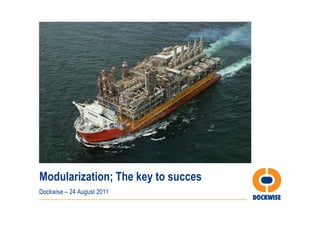
Modularization; The key to succes
Dockwise – 24 August 2011
Agenda

■ Introduction to Dockwise

■ Why Modularization

■ Designing Module Transports

■ Advantages of Self Propelled Vessels

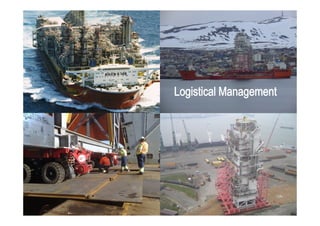
■ Dockwise Logistical Management

■ Conclusion and Closing Remarks
Dockwise Group of Companies
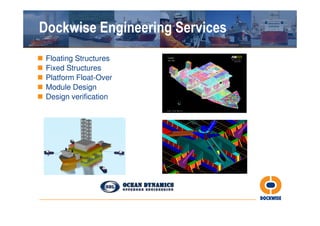
Dockwise Engineering Services
 Floating Structures
 Fixed Structures
 Platform Float-Over
 Module Design
 Design verification
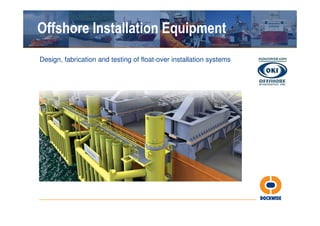
Offshore Installation Equipment
Design, fabrication and testing of float-over installation systems
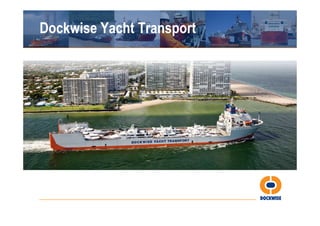
Dockwise Yacht Transport
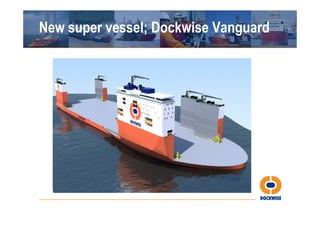
New super vessel; Dockwise Vanguard
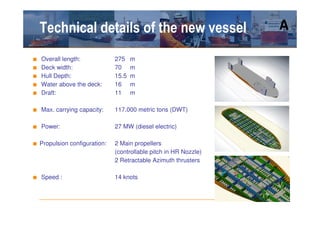
Technical details of the new vessel                           A

■   Overall length:           275    m
■   Deck width:               70     m
■   Hull Depth:               15.5   m
■   Water above the deck:     16     m
■   Draft:                    11     m

■ Max. carrying capacity:     117.000 metric tons (DWT)

■ Power:                      27 MW (diesel electric)

■ Propulsion configuration:   2 Main propellers
                              (controllable pitch in HR Nozzle)
                              2 Retractable Azimuth thrusters

■ Speed :                     14 knots
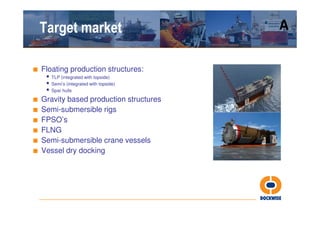
Target market                         A


■ Floating production structures:
      TLP (integrated with topside)
      Semi’s (integrated with topside)
      Spar hulls

■   Gravity based production structures
■   Semi-submersible rigs
■   FPSO’s
■   FLNG
■   Semi-submersible crane vessels
■   Vessel dry docking
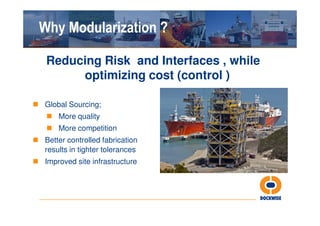
Why Modularization ?

 Reducing Risk and Interfaces , while
      optimizing cost (control )

Global Sourcing;
    More quality
    More competition
Better controlled fabrication
results in tighter tolerances
Improved site infrastructure
Optimizing Transport design

■   Stowage forms
■   Vessel strength
■   Load out issues
■   Stability
■   Motions
■   Ballast capacity
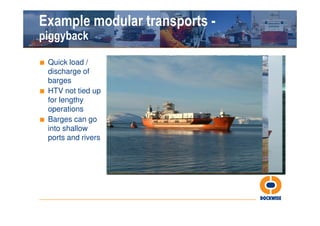
Example modular transports -
piggyback

■ Quick load /
  discharge of
  barges
■ HTV not tied up
  for lengthy
  operations
■ Barges can go
  into shallow
  ports and rivers
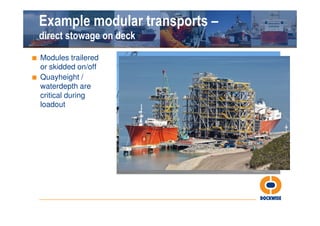
Example modular transports –
  direct stowage on deck
■ Modules trailered
  or skidded on/off
■ Quayheight /
  waterdepth are
  critical during
  loadout
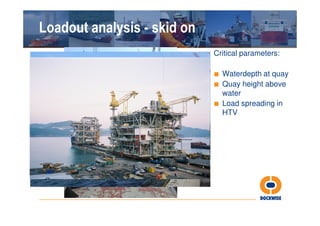
Loadout analysis - skid on
                             Critical parameters:

                             ■ Waterdepth at quay
                             ■ Quay height above
                               water
                             ■ Load spreading in
                               HTV
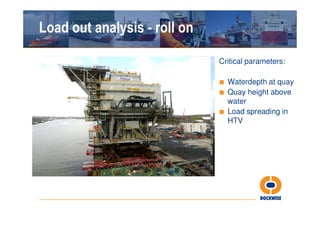
Load out analysis - roll on

                              Critical parameters:

                              ■ Waterdepth at quay
                              ■ Quay height above
                                water
                              ■ Load spreading in
                                HTV
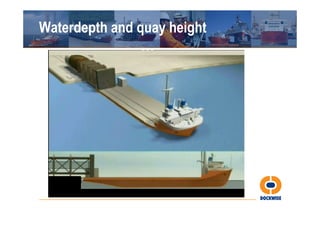
Waterdepth and quay height
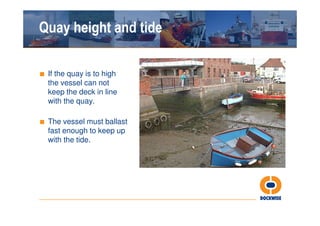
Quay height and tide

■ If the quay is to high
  the vessel can not
  keep the deck in line
  with the quay.

■ The vessel must ballast
  fast enough to keep up
  with the tide.
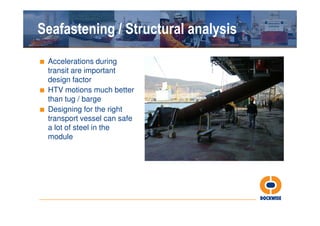
Seafastening / Structural analysis
■ Accelerations during
  transit are important
  design factor
■ HTV motions much better
  than tug / barge
■ Designing for the right
  transport vessel can safe
  a lot of steel in the
  module
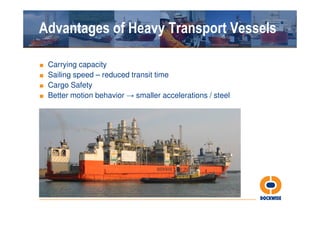
Advantages of Heavy Transport Vessels

■ Carrying capacity
■ Sailing speed – reduced transit time
■ Cargo Safety
■ Better motion behavior → smaller accelerations / steel
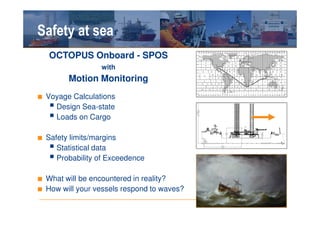
Safety at sea
   OCTOPUS Onboard - SPOS
                  with
         Motion Monitoring
■ Voyage Calculations
     Design Sea-state
     Loads on Cargo

■ Safety limits/margins
     Statistical data
     Probability of Exceedence

■ What will be encountered in reality?
■ How will your vessels respond to waves?
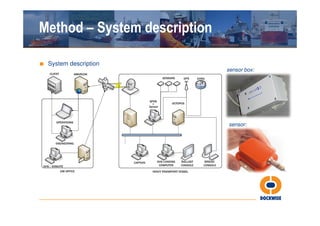
Method – System description

■ System description
                              sensor box:


                              sensor:
Purpose and Principles (1)

■ Decision Support - provide Master with:
    expected motion response
    real-time measurement of accelerations
■ Motion Monitoring
    provide client with actual motion data
    provide Engineering with data for:
       validation of engineering tools
       validation of long term statistics
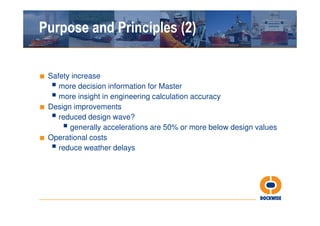
Purpose and Principles (2)


■ Safety increase
    more decision information for Master
    more insight in engineering calculation accuracy
■ Design improvements
    reduced design wave?
        generally accelerations are 50% or more below design values
■ Operational costs
    reduce weather delays
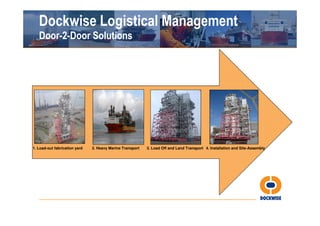
Dockwise Logistical Management
   Door-2-Door Solutions


1. Load-out fabrication yard   2. Heavy Marine Transport   3. Load Off and Land Transport 4. Installation and Site-Assembly
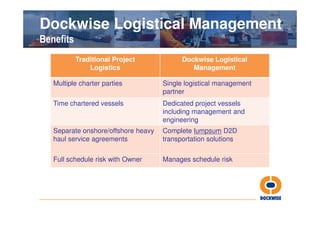
Dockwise Logistical Management
Benefits
           Traditional Project             Dockwise Logistical
               Logistics                      Management

   Multiple charter parties          Single logistical management
                                     partner
   Time chartered vessels            Dedicated project vessels
                                     including management and
                                     engineering
   Separate onshore/offshore heavy   Complete lumpsum D2D
   haul service agreements           transportation solutions

   Full schedule risk with Owner     Manages schedule risk
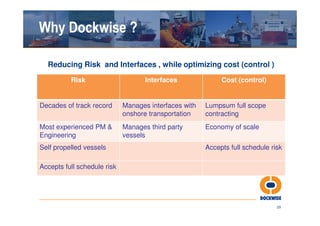
Why Dockwise ?

  Reducing Risk and Interfaces , while optimizing cost (control )
          Risk                      Interfaces              Cost (control)


Decades of track record      Manages interfaces with   Lumpsum full scope
                             onshore transportation    contracting
Most experienced PM &        Manages third party       Economy of scale
Engineering                  vessels
Self propelled vessels                                 Accepts full schedule risk

Accepts full schedule risk


                                                                               29
Conclusions and Recommendations

■ Early Concept Selection and Transporter Involvement
■ Designing Logistics into the Project
■ Think BIG
       Reduce interfaces
       What limits the size of the modules you can get to site?

■ Transport is critical part of the design !!!!
      Dimensions – which vessels are available ?
      Check load out facility – can we get in ?
      Piggyback or direct stowage on deck ?
      Float on, skid on or roll on ?
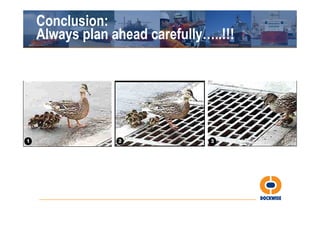
Conclusion:
Always plan ahead carefully…..!!!
Modularization the-key-to-success

Modularization the-key-to-success

  • 1.
    Modularization; The keyto succes Dockwise – 24 August 2011
  • 2.
    Agenda ■ Introduction toDockwise ■ Why Modularization ■ Designing Module Transports ■ Advantages of Self Propelled Vessels ■ Dockwise Logistical Management ■ Conclusion and Closing Remarks
  • 3.
  • 7.
    Dockwise Engineering Services Floating Structures Fixed Structures Platform Float-Over Module Design Design verification
  • 8.
    Offshore Installation Equipment Design,fabrication and testing of float-over installation systems
  • 9.
  • 10.
    New super vessel;Dockwise Vanguard
  • 11.
    Technical details ofthe new vessel A ■ Overall length: 275 m ■ Deck width: 70 m ■ Hull Depth: 15.5 m ■ Water above the deck: 16 m ■ Draft: 11 m ■ Max. carrying capacity: 117.000 metric tons (DWT) ■ Power: 27 MW (diesel electric) ■ Propulsion configuration: 2 Main propellers (controllable pitch in HR Nozzle) 2 Retractable Azimuth thrusters ■ Speed : 14 knots
  • 12.
    Target market A ■ Floating production structures: TLP (integrated with topside) Semi’s (integrated with topside) Spar hulls ■ Gravity based production structures ■ Semi-submersible rigs ■ FPSO’s ■ FLNG ■ Semi-submersible crane vessels ■ Vessel dry docking
  • 13.
    Why Modularization ? Reducing Risk and Interfaces , while optimizing cost (control ) Global Sourcing; More quality More competition Better controlled fabrication results in tighter tolerances Improved site infrastructure
  • 14.
    Optimizing Transport design ■ Stowage forms ■ Vessel strength ■ Load out issues ■ Stability ■ Motions ■ Ballast capacity
  • 15.
    Example modular transports- piggyback ■ Quick load / discharge of barges ■ HTV not tied up for lengthy operations ■ Barges can go into shallow ports and rivers
  • 16.
    Example modular transports– direct stowage on deck ■ Modules trailered or skidded on/off ■ Quayheight / waterdepth are critical during loadout
  • 17.
    Loadout analysis -skid on Critical parameters: ■ Waterdepth at quay ■ Quay height above water ■ Load spreading in HTV
  • 18.
    Load out analysis- roll on Critical parameters: ■ Waterdepth at quay ■ Quay height above water ■ Load spreading in HTV
  • 19.
  • 20.
    Quay height andtide ■ If the quay is to high the vessel can not keep the deck in line with the quay. ■ The vessel must ballast fast enough to keep up with the tide.
  • 21.
    Seafastening / Structuralanalysis ■ Accelerations during transit are important design factor ■ HTV motions much better than tug / barge ■ Designing for the right transport vessel can safe a lot of steel in the module
  • 22.
    Advantages of HeavyTransport Vessels ■ Carrying capacity ■ Sailing speed – reduced transit time ■ Cargo Safety ■ Better motion behavior → smaller accelerations / steel
  • 23.
    Safety at sea OCTOPUS Onboard - SPOS with Motion Monitoring ■ Voyage Calculations Design Sea-state Loads on Cargo ■ Safety limits/margins Statistical data Probability of Exceedence ■ What will be encountered in reality? ■ How will your vessels respond to waves?
  • 24.
    Method – Systemdescription ■ System description sensor box: sensor:
  • 25.
    Purpose and Principles(1) ■ Decision Support - provide Master with: expected motion response real-time measurement of accelerations ■ Motion Monitoring provide client with actual motion data provide Engineering with data for: validation of engineering tools validation of long term statistics
  • 26.
    Purpose and Principles(2) ■ Safety increase more decision information for Master more insight in engineering calculation accuracy ■ Design improvements reduced design wave? generally accelerations are 50% or more below design values ■ Operational costs reduce weather delays
  • 27.
    Dockwise Logistical Management Door-2-Door Solutions 1. Load-out fabrication yard 2. Heavy Marine Transport 3. Load Off and Land Transport 4. Installation and Site-Assembly
  • 28.
    Dockwise Logistical Management Benefits Traditional Project Dockwise Logistical Logistics Management Multiple charter parties Single logistical management partner Time chartered vessels Dedicated project vessels including management and engineering Separate onshore/offshore heavy Complete lumpsum D2D haul service agreements transportation solutions Full schedule risk with Owner Manages schedule risk
  • 29.
    Why Dockwise ? Reducing Risk and Interfaces , while optimizing cost (control ) Risk Interfaces Cost (control) Decades of track record Manages interfaces with Lumpsum full scope onshore transportation contracting Most experienced PM & Manages third party Economy of scale Engineering vessels Self propelled vessels Accepts full schedule risk Accepts full schedule risk 29
  • 30.
    Conclusions and Recommendations ■Early Concept Selection and Transporter Involvement ■ Designing Logistics into the Project ■ Think BIG Reduce interfaces What limits the size of the modules you can get to site? ■ Transport is critical part of the design !!!! Dimensions – which vessels are available ? Check load out facility – can we get in ? Piggyback or direct stowage on deck ? Float on, skid on or roll on ?
  • 31.