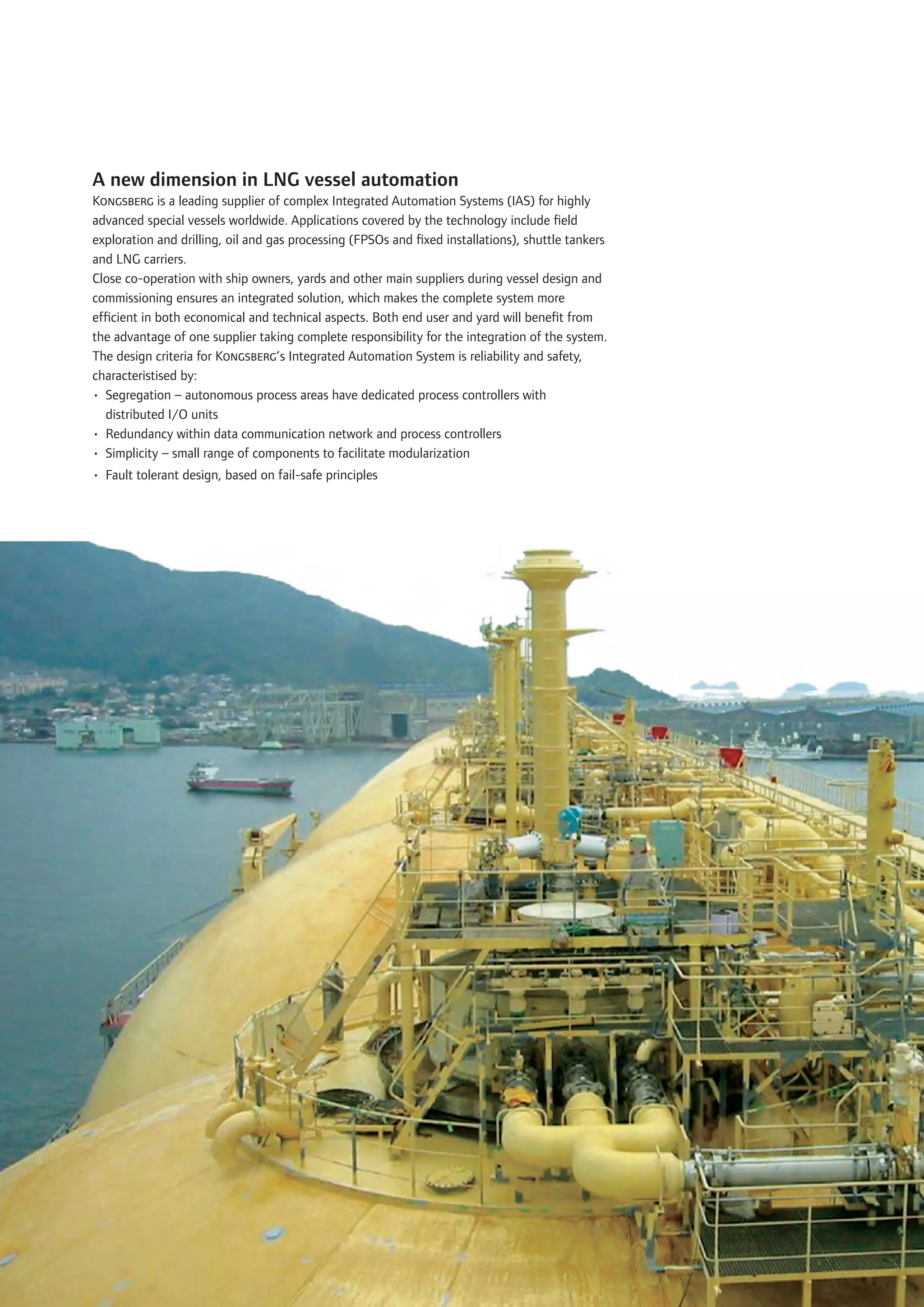
A new dimension in LNG vessel automation
Kongsberg is a leading supplier of complex Integrated Automation Systems (IAS) for highly
advanced special vessels worldwide. Applications covered by the technology include field
exploration and drilling, oil and gas processing (FPSOs and fixed installations), shuttle tankers
and LNG carriers.
Close co-operation with ship owners, yards and other main suppliers during vessel design and
commissioning ensures an integrated solution, which makes the complete system more
efficient in both economical and technical aspects. Both end user and yard will benefit from
the advantage of one supplier taking complete responsibility for the integration of the system.
The design criteria for Kongsberg’s Integrated Automation System is reliability and safety,
characteristised by:
• Segregation – autonomous process areas have dedicated process controllers with
  distributed I/O units
• Redundancy within data communication network and process controllers
• Simplicity – small range of components to facilitate modularization
• Fault tolerant design, based on fail-safe principles


                                                                                                   1
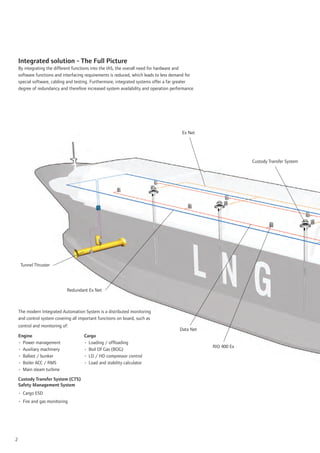
Integrated solution - The Full Picture
    By integrating the different functions into the IAS, the overall need for hardware and
    software functions and interfacing requirements is reduced, which leads to less demand for
    special software, cabling and testing. Furthermore, integrated systems offer a far greater
    degree of redundancy and therefore increased system availability and operation performance.


                                                                                        Ex Net


                                                                                                               Custody Transfer System


     Tunnel Thruster


                             Redundant Ex Net


    The modern Integrated Automation System is a distributed monitoring
    and control system covering all important functions on board, such as
    control and monitoring of:
                                                                                       Data Net
    Engine                            Cargo
    • Power management                • Loading / offloading
                                                                                                  RIO 400 Ex
    • Auxiliary machinery             • Boil Of Gas (BOG)
    • Ballast / bunker                • LD / HD compressor control
    • Boiler ACC / RMS                • Load and stability calculator
    • Main steam turbine

    Custody Transfer System (CTS)
    Safety Management System
    • Cargo ESD
    • Fire and gas monitoring


2
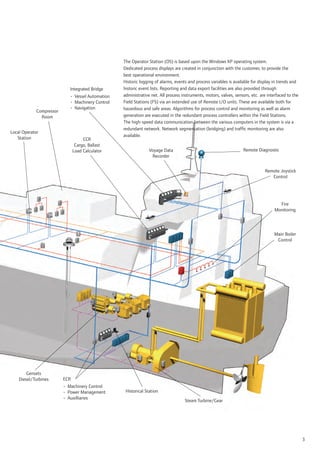
The Operator Station (OS) is based upon the Windows XP operating system.
                                                   Dedicated process displays are created in conjunction with the customer, to provide the
                                                   best operational environment.
                                                   Historic logging of alarms, events and process variables is available for display in trends and
                             Integrated Bridge     historic event lists. Reporting and data export facilities are also provided through
                             • Vessel Automation   administrative net. All process instruments, motors, valves, sensors, etc. are interfaced to the
                             • Machinery Control   Field Stations (FS) via an extended use of Remote I/O units. These are available both for
                             • Navigation          hazardous and safe areas. Algorithms for process control and monitoring as well as alarm
             Compressor
               Room                                generation are executed in the redundant process controllers within the Field Stations.
                                                   The high-speed data communication between the various computers in the system is via a
                                                   redundant network. Network segmentation (bridging) and traffic monitoring are also
Local Operator
                                                   available.
   Station                           CCR
                                 Cargo, Ballast
                                Load Calculator                  Voyage Data                                        Remote Diagnostic
                                                                  Recorder


                                                                                                                                Remote Joystick
                                                                                                                                   Control


                                                                                                                                       Fire
                                                                                                                                     Monitoring


                                                                                                                                     Main Boiler
                                                                                                                                      Control


        Gensets
    Diesel/Turbines       ECR
                          • Machinery Control
                          • Power Management        Historical Station
                          • Auxilliaries
                                                                                    Steam Turbine/Gear


                                                                                                                                                      3
Control philosophy for various applications
    Kongsberg’s main goal has been to develop an IAS capable of
    implementing all features that may appear for LNG carriers, both today
    and in the future.
    All control options, both manual and semi-automatic, that exist in
    today’s systems are maintained.
    Automatic control is implemented for:
    • Cargo pump discharge pressure
    • Spray pump pressure
    • Spray nozzle pressure
    • Low and high duty compressor capacity
    • Vaporiser and heather flow and temperature


           Cargo handling control and monitoring of:
           • Cargo tank
           • Gas Management System (GMS)
           • Manifold operation
           • LD Compressor
           • HD Compressor
           • Heathers
           • Vaporisers


           Cargo tank control and monitoring of:
           • Cargo pumps
           • Spray pumps
           • Temperature indicator
           • Volume calculations


           Boiler operation (ACC/ BMS)
           • Alternative fuel options (HF / BOG)
           • Valve operation
           • Steam pressure
           • Water level


4
Additional functionality, by means of                           Operational elements already prepared for
sequencing add further value to cargo                           integration with IAS are:
operation:                                                      •   Safety application covering Cargo-ESD and F&G systems
•   Cool down cargo tanks                                       •   Online load and stability calculator
•   Cargo loading including line set-up                         •   Training simulator
•   Cargo unloading including line detachment                   •   Thruster control
•   Ballast control during loading and unloading                •   Remote satellite diagnosis service
•   Ballast control during voyage                               • Communication link between vessel and management office
•   Power management of steam and diesel generator sets
•   BOG control i.e. cargo tanks to steam turbine


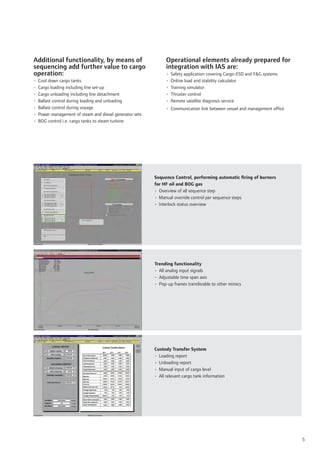
                                                          Sequence Control, performing automatic firing of burners
                                                          for HF oil and BOG gas
                                                          • Overview of all sequence step
                                                          • Manual override control per sequence steps
                                                          • Interlock status overview


                                                          Trending functionality
                                                          • All analog input signals
                                                          • Adjustable time span axis
                                                          • Pop-up frames transferable to other mimics


                                                          Custody Transfer System
                                                          • Loading report
                                                          • Unloading report
                                                          • Manual input of cargo level
                                                          • All relevant cargo tank information


                                                                                                                            5
CTS – Custody Transfer System
    Kongsberg radar based level gauging systems and Custody Transfer Systems have been in
    operation on gas tankers since 1989.

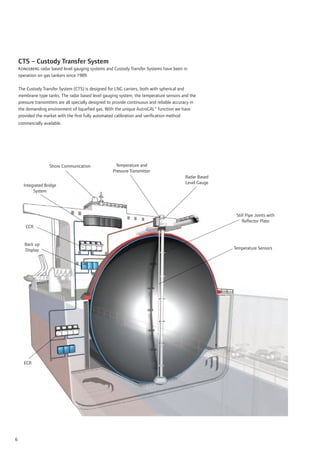
    The Custody Transfer System (CTS) is designed for LNG carriers, both with spherical and
    membrane type tanks. The radar based level gauging system, the temperature sensors and the
    pressure transmitters are all specially designed to provide continuous and reliable accuracy in
    the demanding environment of liquefied gas. With the unique AutroCAL® function we have
    provided the market with the first fully automated calibration and verification method
    commercially available.


                    Shore Communication                Temperature and
                                                      Pressure Transmitter
                                                                                             Radar Based
                                                                                             Level Gauge
      Integrated Bridge
           System


                                                                                                            Still Pipe Joints with
                                                                                                               Reflector Plate
       CCR


       Back up
       Display                                                                                             Temperature Sensors


      ECR


6
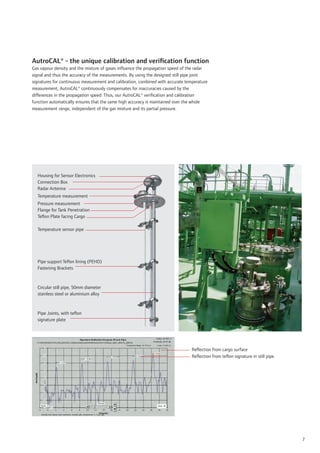
AutroCAL® - the unique calibration and verification function
Gas vapour density and the mixture of gases influence the propagation speed of the radar
signal and thus the accuracy of the measurements. By using the designed still pipe joint
signatures for continuous measurement and calibration, combined with accurate temperature
measurement, AutroCAL® continuously compensates for inaccuracies caused by the
differences in the propagation speed. Thus, our AutroCAL® verification and calibration
function automatically ensures that the same high accuracy is maintained over the whole
measurement range, independent of the gas mixture and its partial pressure.


  Housing for Sensor Electronics
  Connection Box
  Radar Antenna
  Temperature measurement
  Pressure measurement
  Flange for Tank Penetration
  Teflon Plate facing Cargo

  Temperature sensor pipe


  Pipe support Teflon lining (PEHD)
  Fastening Brackets


  Circular still pipe, 50mm diameter
  stainless steel or aluminium alloy


  Pipe Joints, with teflon
  signature plate


                                                                                 Reflection from cargo surface
                                                                                 Reflection from teflon signature in still pipe


                                                                                                                                7
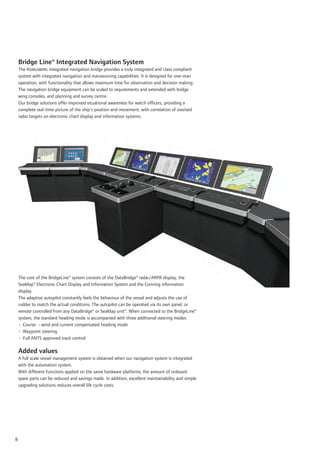
Bridge Line® Integrated Navigation System
    The Kongsberg integrated navigation bridge provides a truly integrated and class compliant
    system with integrated navigation and manoeuvring capabilities. It is designed for one-man
    operation, with functionality that allows maximum time for observation and decision making.
    The navigation bridge equipment can be scaled to requirements and extended with bridge
    wing consoles, and planning and survey centre.
    Our bridge solutions offer improved situational awareness for watch officers, providing a
    complete real-time picture of the ship’s position and movement, with correlation of overlaid
    radar targets on electronic chart display and information systems.


    The core of the BridgeLine® system consists of the DataBridge® radar/ARPA display, the
    SeaMap® Electronic Chart Display and Information System and the Conning information
    display.
    The adaptive autopilot constantly feels the behaviour of the vessel and adjusts the use of
    rudder to match the actual conditions. The autopilot can be operated via its own panel, or
    remote controlled from any DataBridge® or SeaMap unit®. When connected to the BridgeLine®
    system, the standard heading mode is accompanied with three additional steering modes:
    • Course - wind and current compensated heading mode
    • Waypoint steering
    • Full ANTS approved track control

    Added values
    A full scale vessel management system is obtained when our navigation system is integrated
    with the automation system.
    With different functions applied on the same hardware platforms, the amount of onboard
    spare parts can be reduced and savings made. In addition, excellent maintainability and simple
    upgrading solutions reduces overall life cycle costs.


8
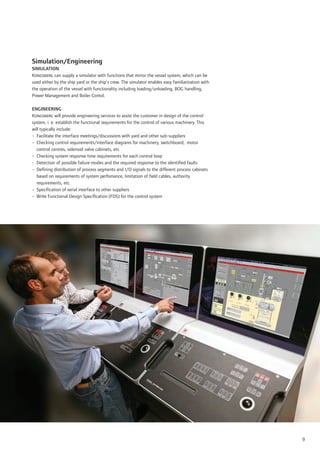
Simulation/Engineering
SIMULATION
Kongsberg can supply a simulator with functions that mirror the vessel system, which can be
used either by the ship yard or the ship’s crew. The simulator enables easy familiarization with
the operation of the vessel with functionality including loading/unloading, BOG handling,
Power Management and Boiler Contol.

ENGINEERING
Kongsberg will provide engineering services to assist the customer in design of the control
system, i. e. establish the functional requirements for the control of various machinery. This
will typically include:
• Facilitate the interface meetings/discussions with yard and other sub-suppliers
• Checking control requirements/interface diagrams for machinery, switchboard, motor
  control centres, solenoid valve cabinets, etc.
• Checking system response time requirements for each control loop
• Detection of possible failure modes and the required response to the identified faults
• Defining distribution of process segments and I/O signals to the different process cabinets
  based on requirements of system perfomance, limitation of field cables, authority
  requirements, etc.
• Specification of serial interface to other suppliers
• Write Functional Design Specification (FDS) for the control system


                                                                                                   9
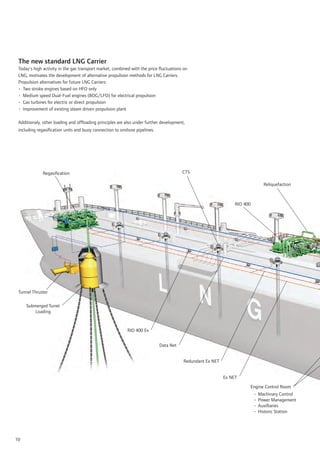
The new standard LNG Carrier
 Today’s high activity in the gas transport market, combined with the price fluctuations on
 LNG, motivates the development of alternative propulsion methods for LNG Carriers.
 Propulsion alternatives for future LNG Carriers:
 • Two stroke engines based on HFO only
 • Medium speed Dual-Fuel engines (BOG/LFO) for electrical propulsion
 • Gas turbines for electric or direct propulsion
 • Improvement of existing steam driven propulsion plant

 Additionaly, other loading and offloading principles are also under further development,
 including regasification units and buoy connection to onshore pipelines.


             Regasification                                                             CTS

                                                                                                                                 Reliquefaction


                                                                                                                RIO 400


 Tunnel Thruster

     Submerged Turret
         Loading


                                                          RIO 400 Ex


                                                                           Data Net


                                                                                        Redundant Ex NET


                                                                                                           Ex NET
                                                                                                                          Engine Control Room
                                                                                                                           •   Machinary Control
                                                                                                                           •   Power Management
                                                                                                                           •   Auxilliaries
                                                                                                                           •   Historic Station


10
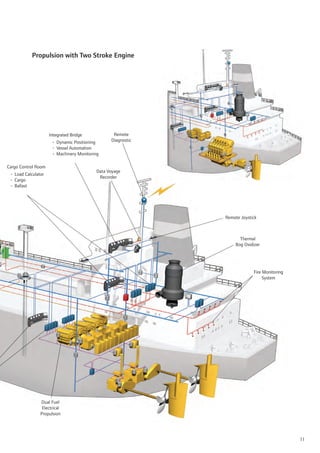
Propulsion with Two Stroke Engine


                     Integrated Bridge           Remote
                      • Dynamic Positioning     Diagnostic
                      • Vessel Automation
                      • Machinery Monitoring

Cargo Control Room
                                          Data Voyage
 • Load Calculator
                                           Recorder
 • Cargo
 • Ballast


                                                             Remote Joystick


                                                                   Thermal
                                                                 Bog Oxidizer


                                                                          Fire Monitoring
                                                                               System


                Dual Fuel
                 Electrical
                Propulsion


                                                                                            11
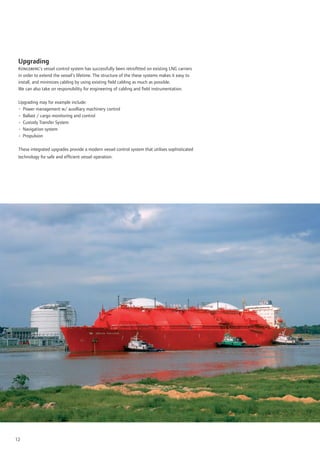
Upgrading
 Kongsberg’s vessel control system has successfully been retrofitted on existing LNG carriers
 in order to extend the vessel’s lifetime. The structure of the these systems makes it easy to
 install, and minimizes cabling by using existing field cabling as much as possible.
 We can also take on responsibility for engineering of cabling and field instrumentation.

 Upgrading may for example include:
 • Power management w/ auxilliary machinery control
 • Ballast / cargo monitoring and control
 • Custody Transfer System
 • Navigation system
 • Propulsion

 These integrated upgrades provide a modern vessel control system that utilises sophisticated
 technology for safe and efficient vessel operation.


12

8706 lng-brochure

  • 1.
    A new dimensionin LNG vessel automation Kongsberg is a leading supplier of complex Integrated Automation Systems (IAS) for highly advanced special vessels worldwide. Applications covered by the technology include field exploration and drilling, oil and gas processing (FPSOs and fixed installations), shuttle tankers and LNG carriers. Close co-operation with ship owners, yards and other main suppliers during vessel design and commissioning ensures an integrated solution, which makes the complete system more efficient in both economical and technical aspects. Both end user and yard will benefit from the advantage of one supplier taking complete responsibility for the integration of the system. The design criteria for Kongsberg’s Integrated Automation System is reliability and safety, characteristised by: • Segregation – autonomous process areas have dedicated process controllers with distributed I/O units • Redundancy within data communication network and process controllers • Simplicity – small range of components to facilitate modularization • Fault tolerant design, based on fail-safe principles 1
  • 2.
    Integrated solution -The Full Picture By integrating the different functions into the IAS, the overall need for hardware and software functions and interfacing requirements is reduced, which leads to less demand for special software, cabling and testing. Furthermore, integrated systems offer a far greater degree of redundancy and therefore increased system availability and operation performance. Ex Net Custody Transfer System Tunnel Thruster Redundant Ex Net The modern Integrated Automation System is a distributed monitoring and control system covering all important functions on board, such as control and monitoring of: Data Net Engine Cargo • Power management • Loading / offloading RIO 400 Ex • Auxiliary machinery • Boil Of Gas (BOG) • Ballast / bunker • LD / HD compressor control • Boiler ACC / RMS • Load and stability calculator • Main steam turbine Custody Transfer System (CTS) Safety Management System • Cargo ESD • Fire and gas monitoring 2
  • 3.
    The Operator Station(OS) is based upon the Windows XP operating system. Dedicated process displays are created in conjunction with the customer, to provide the best operational environment. Historic logging of alarms, events and process variables is available for display in trends and Integrated Bridge historic event lists. Reporting and data export facilities are also provided through • Vessel Automation administrative net. All process instruments, motors, valves, sensors, etc. are interfaced to the • Machinery Control Field Stations (FS) via an extended use of Remote I/O units. These are available both for • Navigation hazardous and safe areas. Algorithms for process control and monitoring as well as alarm Compressor Room generation are executed in the redundant process controllers within the Field Stations. The high-speed data communication between the various computers in the system is via a redundant network. Network segmentation (bridging) and traffic monitoring are also Local Operator available. Station CCR Cargo, Ballast Load Calculator Voyage Data Remote Diagnostic Recorder Remote Joystick Control Fire Monitoring Main Boiler Control Gensets Diesel/Turbines ECR • Machinery Control • Power Management Historical Station • Auxilliaries Steam Turbine/Gear 3
  • 4.
    Control philosophy forvarious applications Kongsberg’s main goal has been to develop an IAS capable of implementing all features that may appear for LNG carriers, both today and in the future. All control options, both manual and semi-automatic, that exist in today’s systems are maintained. Automatic control is implemented for: • Cargo pump discharge pressure • Spray pump pressure • Spray nozzle pressure • Low and high duty compressor capacity • Vaporiser and heather flow and temperature Cargo handling control and monitoring of: • Cargo tank • Gas Management System (GMS) • Manifold operation • LD Compressor • HD Compressor • Heathers • Vaporisers Cargo tank control and monitoring of: • Cargo pumps • Spray pumps • Temperature indicator • Volume calculations Boiler operation (ACC/ BMS) • Alternative fuel options (HF / BOG) • Valve operation • Steam pressure • Water level 4
  • 5.
    Additional functionality, bymeans of Operational elements already prepared for sequencing add further value to cargo integration with IAS are: operation: • Safety application covering Cargo-ESD and F&G systems • Cool down cargo tanks • Online load and stability calculator • Cargo loading including line set-up • Training simulator • Cargo unloading including line detachment • Thruster control • Ballast control during loading and unloading • Remote satellite diagnosis service • Ballast control during voyage • Communication link between vessel and management office • Power management of steam and diesel generator sets • BOG control i.e. cargo tanks to steam turbine Sequence Control, performing automatic firing of burners for HF oil and BOG gas • Overview of all sequence step • Manual override control per sequence steps • Interlock status overview Trending functionality • All analog input signals • Adjustable time span axis • Pop-up frames transferable to other mimics Custody Transfer System • Loading report • Unloading report • Manual input of cargo level • All relevant cargo tank information 5
  • 6.
    CTS – CustodyTransfer System Kongsberg radar based level gauging systems and Custody Transfer Systems have been in operation on gas tankers since 1989. The Custody Transfer System (CTS) is designed for LNG carriers, both with spherical and membrane type tanks. The radar based level gauging system, the temperature sensors and the pressure transmitters are all specially designed to provide continuous and reliable accuracy in the demanding environment of liquefied gas. With the unique AutroCAL® function we have provided the market with the first fully automated calibration and verification method commercially available. Shore Communication Temperature and Pressure Transmitter Radar Based Level Gauge Integrated Bridge System Still Pipe Joints with Reflector Plate CCR Back up Display Temperature Sensors ECR 6
  • 7.
    AutroCAL® - theunique calibration and verification function Gas vapour density and the mixture of gases influence the propagation speed of the radar signal and thus the accuracy of the measurements. By using the designed still pipe joint signatures for continuous measurement and calibration, combined with accurate temperature measurement, AutroCAL® continuously compensates for inaccuracies caused by the differences in the propagation speed. Thus, our AutroCAL® verification and calibration function automatically ensures that the same high accuracy is maintained over the whole measurement range, independent of the gas mixture and its partial pressure. Housing for Sensor Electronics Connection Box Radar Antenna Temperature measurement Pressure measurement Flange for Tank Penetration Teflon Plate facing Cargo Temperature sensor pipe Pipe support Teflon lining (PEHD) Fastening Brackets Circular still pipe, 50mm diameter stainless steel or aluminium alloy Pipe Joints, with teflon signature plate Reflection from cargo surface Reflection from teflon signature in still pipe 7
  • 8.
    Bridge Line® IntegratedNavigation System The Kongsberg integrated navigation bridge provides a truly integrated and class compliant system with integrated navigation and manoeuvring capabilities. It is designed for one-man operation, with functionality that allows maximum time for observation and decision making. The navigation bridge equipment can be scaled to requirements and extended with bridge wing consoles, and planning and survey centre. Our bridge solutions offer improved situational awareness for watch officers, providing a complete real-time picture of the ship’s position and movement, with correlation of overlaid radar targets on electronic chart display and information systems. The core of the BridgeLine® system consists of the DataBridge® radar/ARPA display, the SeaMap® Electronic Chart Display and Information System and the Conning information display. The adaptive autopilot constantly feels the behaviour of the vessel and adjusts the use of rudder to match the actual conditions. The autopilot can be operated via its own panel, or remote controlled from any DataBridge® or SeaMap unit®. When connected to the BridgeLine® system, the standard heading mode is accompanied with three additional steering modes: • Course - wind and current compensated heading mode • Waypoint steering • Full ANTS approved track control Added values A full scale vessel management system is obtained when our navigation system is integrated with the automation system. With different functions applied on the same hardware platforms, the amount of onboard spare parts can be reduced and savings made. In addition, excellent maintainability and simple upgrading solutions reduces overall life cycle costs. 8
  • 9.
    Simulation/Engineering SIMULATION Kongsberg can supplya simulator with functions that mirror the vessel system, which can be used either by the ship yard or the ship’s crew. The simulator enables easy familiarization with the operation of the vessel with functionality including loading/unloading, BOG handling, Power Management and Boiler Contol. ENGINEERING Kongsberg will provide engineering services to assist the customer in design of the control system, i. e. establish the functional requirements for the control of various machinery. This will typically include: • Facilitate the interface meetings/discussions with yard and other sub-suppliers • Checking control requirements/interface diagrams for machinery, switchboard, motor control centres, solenoid valve cabinets, etc. • Checking system response time requirements for each control loop • Detection of possible failure modes and the required response to the identified faults • Defining distribution of process segments and I/O signals to the different process cabinets based on requirements of system perfomance, limitation of field cables, authority requirements, etc. • Specification of serial interface to other suppliers • Write Functional Design Specification (FDS) for the control system 9
  • 10.
    The new standardLNG Carrier Today’s high activity in the gas transport market, combined with the price fluctuations on LNG, motivates the development of alternative propulsion methods for LNG Carriers. Propulsion alternatives for future LNG Carriers: • Two stroke engines based on HFO only • Medium speed Dual-Fuel engines (BOG/LFO) for electrical propulsion • Gas turbines for electric or direct propulsion • Improvement of existing steam driven propulsion plant Additionaly, other loading and offloading principles are also under further development, including regasification units and buoy connection to onshore pipelines. Regasification CTS Reliquefaction RIO 400 Tunnel Thruster Submerged Turret Loading RIO 400 Ex Data Net Redundant Ex NET Ex NET Engine Control Room • Machinary Control • Power Management • Auxilliaries • Historic Station 10
  • 11.
    Propulsion with TwoStroke Engine Integrated Bridge Remote • Dynamic Positioning Diagnostic • Vessel Automation • Machinery Monitoring Cargo Control Room Data Voyage • Load Calculator Recorder • Cargo • Ballast Remote Joystick Thermal Bog Oxidizer Fire Monitoring System Dual Fuel Electrical Propulsion 11
  • 12.
    Upgrading Kongsberg’s vesselcontrol system has successfully been retrofitted on existing LNG carriers in order to extend the vessel’s lifetime. The structure of the these systems makes it easy to install, and minimizes cabling by using existing field cabling as much as possible. We can also take on responsibility for engineering of cabling and field instrumentation. Upgrading may for example include: • Power management w/ auxilliary machinery control • Ballast / cargo monitoring and control • Custody Transfer System • Navigation system • Propulsion These integrated upgrades provide a modern vessel control system that utilises sophisticated technology for safe and efficient vessel operation. 12