Enter
Enter
Begin attack Traverse
Traverse Exfiltrate data
Device based
Identity based
Spear-phishing
Attacker uses information
specifically about a user
to construct a more
plausible phishing attack.
Broad-based phishing
campaigns
Attacker masquerades
as a trusted entity, dupes
employees into opening
emails, texts or IMs.
Password spray
Attacker tries a large list of
possible passwords for a
given account or set of
accounts.
Other similar attacks
Credential stuffing,
leaked passwords.
Network based
Extended detection and response (XDR)
Device compromise
Malware is installed on the
device. This can include
viruses, spyware, ransomware,
and other unwanted software
that installs without concent.
Lost or stolen device
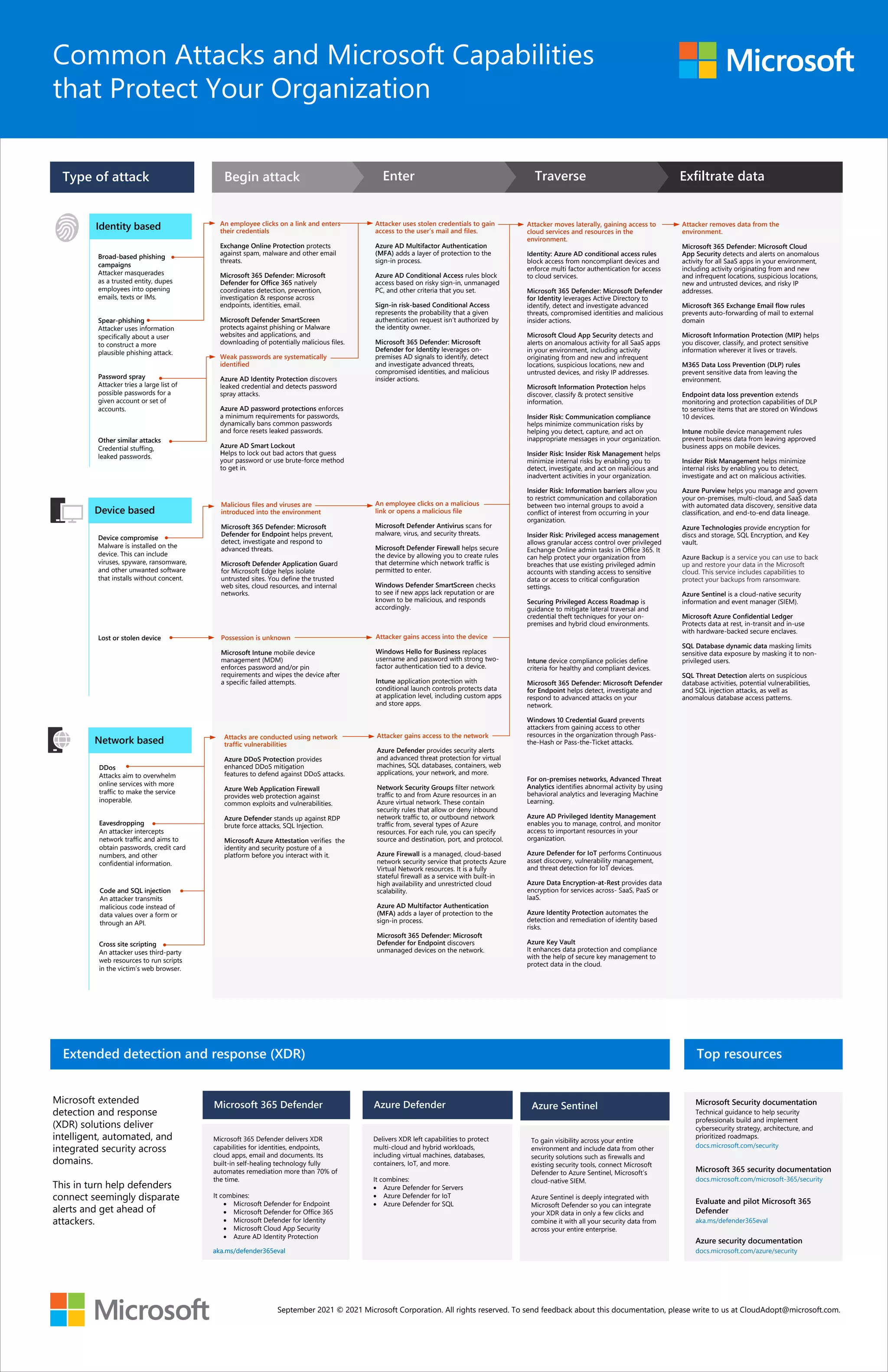
An employee clicks on a link and enters
their credentials
Exchange Online Protection protects
against spam, malware and other email
threats.
Microsoft 365 Defender: Microsoft
Defender for Office 365 natively
coordinates detection, prevention,
investigation & response across
endpoints, identities, email.
Microsoft Defender SmartScreen
protects against phishing or Malware
websites and applications, and
downloading of potentially malicious files.
Weak passwords are systematically
identified
Azure AD Identity Protection discovers
leaked credential and detects password
spray attacks.
Azure AD password protections enforces
a minimum requirements for passwords,
dynamically bans common passwords
and force resets leaked passwords.
Azure AD Smart Lockout
Helps to lock out bad actors that guess
your password or use brute-force method
to get in.
Malicious files and viruses are
introduced into the environment
Microsoft 365 Defender: Microsoft
Defender for Endpoint helps prevent,
detect, investigate and respond to
advanced threats.
Microsoft Defender Application Guard
for Microsoft Edge helps isolate
untrusted sites. You define the trusted
web sites, cloud resources, and internal
networks.
Possession is unknown
Microsoft Intune mobile device
management (MDM)
enforces password and/or pin
requirements and wipes the device after
a specific failed attempts.
DDos
Attacks aim to overwhelm
online services with more
traffic to make the service
inoperable.
Eavesdropping
An attacker intercepts
network traffic and aims to
obtain passwords, credit card
numbers, and other
confidential information.
Code and SQL injection
An attacker transmits
malicious code instead of
data values over a form or
through an API.
Cross site scripting
An attacker uses third-party
web resources to run scripts
in the victim’s web browser.
Type of attack
Attacks are conducted using network
traffic vulnerabilities
Azure DDoS Protection provides
enhanced DDoS mitigation
features to defend against DDoS attacks.
Azure Web Application Firewall
provides web protection against
common exploits and vulnerabilities.
Azure Defender stands up against RDP
brute force attacks, SQL Injection.
Microsoft Azure Attestation verifies the
identity and security posture of a
platform before you interact with it.
Common Attacks and Microsoft Capabilities
that Protect Your Organization
September 2021 © 2021 Microsoft Corporation. All rights reserved. To send feedback about this documentation, please write to us at CloudAdopt@microsoft.com.
Attacker uses stolen credentials to gain
access to the user’s mail and files.
Azure AD Multifactor Authentication
(MFA) adds a layer of protection to the
sign-in process.
Azure AD Conditional Access rules block
access based on risky sign-in, unmanaged
PC, and other criteria that you set.
Sign-in risk-based Conditional Access
represents the probability that a given
authentication request isn’t authorized by
the identity owner.
Microsoft 365 Defender: Microsoft
Defender for Identity leverages on-
premises AD signals to identify, detect
and investigate advanced threats,
compromised identities, and malicious
insider actions.
An employee clicks on a malicious
link or opens a malicious file
Microsoft Defender Antivirus scans for
malware, virus, and security threats.
Microsoft Defender Firewall helps secure
the device by allowing you to create rules
that determine which network traffic is
permitted to enter.
Windows Defender SmartScreen checks
to see if new apps lack reputation or are
known to be malicious, and responds
accordingly.
Attacker gains access into the device
Windows Hello for Business replaces
username and password with strong two-
factor authentication tied to a device.
Intune application protection with
conditional launch controls protects data
at application level, including custom apps
and store apps.
Attacker gains access to the network
Azure Defender provides security alerts
and advanced threat protection for virtual
machines, SQL databases, containers, web
applications, your network, and more.
Network Security Groups filter network
traffic to and from Azure resources in an
Azure virtual network. These contain
security rules that allow or deny inbound
network traffic to, or outbound network
traffic from, several types of Azure
resources. For each rule, you can specify
source and destination, port, and protocol.
Azure Firewall is a managed, cloud-based
network security service that protects Azure
Virtual Network resources. It is a fully
stateful firewall as a service with built-in
high availability and unrestricted cloud
scalability.
Azure AD Multifactor Authentication
(MFA) adds a layer of protection to the
sign-in process.
Microsoft 365 Defender: Microsoft
Defender for Endpoint discovers
unmanaged devices on the network.
Microsoft extended
detection and response
(XDR) solutions deliver
intelligent, automated, and
integrated security across
domains.
This in turn help defenders
connect seemingly disparate
alerts and get ahead of
attackers.
Attacker moves laterally, gaining access to
cloud services and resources in the
environment.
Identity: Azure AD conditional access rules
block access from noncompliant devices and
enforce multi factor authentication for access
to cloud services.
Microsoft 365 Defender: Microsoft Defender
for Identity leverages Active Directory to
identify, detect and investigate advanced
threats, compromised identities and malicious
insider actions.
Microsoft Cloud App Security detects and
alerts on anomalous activity for all SaaS apps
in your environment, including activity
originating from and new and infrequent
locations, suspicious locations, new and
untrusted devices, and risky IP addresses.
Microsoft Information Protection helps
discover, classify & protect sensitive
information.
Insider Risk: Communication compliance
helps minimize communication risks by
helping you detect, capture, and act on
inappropriate messages in your organization.
Insider Risk: Insider Risk Management helps
minimize internal risks by enabling you to
detect, investigate, and act on malicious and
inadvertent activities in your organization.
Insider Risk: Information barriers allow you
to restrict communication and collaboration
between two internal groups to avoid a
conflict of interest from occurring in your
organization.
Insider Risk: Privileged access management
allows granular access control over privileged
Exchange Online admin tasks in Office 365. It
can help protect your organization from
breaches that use existing privileged admin
accounts with standing access to sensitive
data or access to critical configuration
settings.
Securing Privileged Access Roadmap is
guidance to mitigate lateral traversal and
credential theft techniques for your on-
premises and hybrid cloud environments.
Intune device compliance policies define
criteria for healthy and compliant devices.
Microsoft 365 Defender: Microsoft Defender
for Endpoint helps detect, investigate and
respond to advanced attacks on your
network.
Windows 10 Credential Guard prevents
attackers from gaining access to other
resources in the organization through Pass-
the-Hash or Pass-the-Ticket attacks.
For on-premises networks, Advanced Threat
Analytics identifies abnormal activity by using
behavioral analytics and leveraging Machine
Learning.
Azure AD Privileged Identity Management
enables you to manage, control, and monitor
access to important resources in your
organization.
Azure Defender for IoT performs Continuous
asset discovery, vulnerability management,
and threat detection for IoT devices.
Azure Data Encryption-at-Rest provides data
encryption for services across- SaaS, PaaS or
IaaS.
Azure Identity Protection automates the
detection and remediation of identity based
risks.
Azure Key Vault
It enhances data protection and compliance
with the help of secure key management to
protect data in the cloud.
Attacker removes data from the
environment.
Microsoft 365 Defender: Microsoft Cloud
App Security detects and alerts on anomalous
activity for all SaaS apps in your environment,
including activity originating from and new
and infrequent locations, suspicious locations,
new and untrusted devices, and risky IP
addresses.
Microsoft 365 Exchange Email flow rules
prevents auto-forwarding of mail to external
domain
Microsoft Information Protection (MIP) helps
you discover, classify, and protect sensitive
information wherever it lives or travels.
M365 Data Loss Prevention (DLP) rules
prevent sensitive data from leaving the
environment.
Endpoint data loss prevention extends
monitoring and protection capabilities of DLP
to sensitive items that are stored on Windows
10 devices.
Intune mobile device management rules
prevent business data from leaving approved
business apps on mobile devices.
Insider Risk Management helps minimize
internal risks by enabling you to detect,
investigate and act on malicious activities.
Azure Purview helps you manage and govern
your on-premises, multi-cloud, and SaaS data
with automated data discovery, sensitive data
classification, and end-to-end data lineage.
Azure Technologies provide encryption for
discs and storage, SQL Encryption, and Key
vault.
Azure Backup is a service you can use to back
up and restore your data in the Microsoft
cloud. This service includes capabilities to
protect your backups from ransomware.
Azure Sentinel is a cloud-native security
information and event manager (SIEM).
Microsoft Azure Confidential Ledger
Protects data at rest, in-transit and in-use
with hardware-backed secure enclaves.
SQL Database dynamic data masking limits
sensitive data exposure by masking it to non-
privileged users.
SQL Threat Detection alerts on suspicious
database activities, potential vulnerabilities,
and SQL injection attacks, as well as
anomalous database access patterns.
Azure Sentinel
To gain visibility across your entire
environment and include data from other
security solutions such as firewalls and
existing security tools, connect Microsoft
Defender to Azure Sentinel, Microsoft’s
cloud-native SIEM.
Azure Sentinel is deeply integrated with
Microsoft Defender so you can integrate
your XDR data in only a few clicks and
combine it with all your security data from
across your entire enterprise.
Azure Sentinel
To gain visibility across your entire
environment and include data from other
security solutions such as firewalls and
existing security tools, connect Microsoft
Defender to Azure Sentinel, Microsoft’s
cloud-native SIEM.
Azure Sentinel is deeply integrated with
Microsoft Defender so you can integrate
your XDR data in only a few clicks and
combine it with all your security data from
across your entire enterprise.
Azure Defender
Delivers XDR left capabilities to protect
multi-cloud and hybrid workloads,
including virtual machines, databases,
containers, IoT, and more.
It combines:
• Azure Defender for Servers
• Azure Defender for IoT
• Azure Defender for SQL
Azure Defender
Delivers XDR left capabilities to protect
multi-cloud and hybrid workloads,
including virtual machines, databases,
containers, IoT, and more.
It combines:
• Azure Defender for Servers
• Azure Defender for IoT
• Azure Defender for SQL
Microsoft 365 Defender
Microsoft 365 Defender delivers XDR
capabilities for identities, endpoints,
cloud apps, email and documents. Its
built-in self-healing technology fully
automates remediation more than 70% of
the time.
It combines:
• Microsoft Defender for Endpoint
• Microsoft Defender for Office 365
• Microsoft Defender for Identity
• Microsoft Cloud App Security
• Azure AD Identity Protection
Microsoft 365 Defender delivers XDR
capabilities for identities, endpoints,
cloud apps, email and documents. Its
built-in self-healing technology fully
automates remediation more than 70% of
the time.
It combines:
• Microsoft Defender for Endpoint
• Microsoft Defender for Office 365
• Microsoft Defender for Identity
• Microsoft Cloud App Security
• Azure AD Identity Protection
Microsoft 365 Defender
Microsoft 365 Defender delivers XDR
capabilities for identities, endpoints,
cloud apps, email and documents. Its
built-in self-healing technology fully
automates remediation more than 70% of
the time.
It combines:
• Microsoft Defender for Endpoint
• Microsoft Defender for Office 365
• Microsoft Defender for Identity
• Microsoft Cloud App Security
• Azure AD Identity Protection
aka.ms/defender365eval
Top resources
Microsoft Security documentation
Technical guidance to help security
professionals build and implement
cybersecurity strategy, architecture, and
prioritized roadmaps.
docs.microsoft.com/security
Microsoft Security documentation
Technical guidance to help security
professionals build and implement
cybersecurity strategy, architecture, and
prioritized roadmaps.
docs.microsoft.com/security
Microsoft 365 security documentation
docs.microsoft.com/microsoft-365/security
Microsoft 365 security documentation
docs.microsoft.com/microsoft-365/security
Evaluate and pilot Microsoft 365
Defender
aka.ms/defender365eval
Evaluate and pilot Microsoft 365
Defender
aka.ms/defender365eval
Azure security documentation
docs.microsoft.com/azure/security
Azure security documentation
docs.microsoft.com/azure/security

Msft cloud architecture_security_commonattacks

  • 1.
    Enter Enter Begin attack Traverse TraverseExfiltrate data Device based Identity based Spear-phishing Attacker uses information specifically about a user to construct a more plausible phishing attack. Broad-based phishing campaigns Attacker masquerades as a trusted entity, dupes employees into opening emails, texts or IMs. Password spray Attacker tries a large list of possible passwords for a given account or set of accounts. Other similar attacks Credential stuffing, leaked passwords. Network based Extended detection and response (XDR) Device compromise Malware is installed on the device. This can include viruses, spyware, ransomware, and other unwanted software that installs without concent. Lost or stolen device An employee clicks on a link and enters their credentials Exchange Online Protection protects against spam, malware and other email threats. Microsoft 365 Defender: Microsoft Defender for Office 365 natively coordinates detection, prevention, investigation & response across endpoints, identities, email. Microsoft Defender SmartScreen protects against phishing or Malware websites and applications, and downloading of potentially malicious files. Weak passwords are systematically identified Azure AD Identity Protection discovers leaked credential and detects password spray attacks. Azure AD password protections enforces a minimum requirements for passwords, dynamically bans common passwords and force resets leaked passwords. Azure AD Smart Lockout Helps to lock out bad actors that guess your password or use brute-force method to get in. Malicious files and viruses are introduced into the environment Microsoft 365 Defender: Microsoft Defender for Endpoint helps prevent, detect, investigate and respond to advanced threats. Microsoft Defender Application Guard for Microsoft Edge helps isolate untrusted sites. You define the trusted web sites, cloud resources, and internal networks. Possession is unknown Microsoft Intune mobile device management (MDM) enforces password and/or pin requirements and wipes the device after a specific failed attempts. DDos Attacks aim to overwhelm online services with more traffic to make the service inoperable. Eavesdropping An attacker intercepts network traffic and aims to obtain passwords, credit card numbers, and other confidential information. Code and SQL injection An attacker transmits malicious code instead of data values over a form or through an API. Cross site scripting An attacker uses third-party web resources to run scripts in the victim’s web browser. Type of attack Attacks are conducted using network traffic vulnerabilities Azure DDoS Protection provides enhanced DDoS mitigation features to defend against DDoS attacks. Azure Web Application Firewall provides web protection against common exploits and vulnerabilities. Azure Defender stands up against RDP brute force attacks, SQL Injection. Microsoft Azure Attestation verifies the identity and security posture of a platform before you interact with it. Common Attacks and Microsoft Capabilities that Protect Your Organization September 2021 © 2021 Microsoft Corporation. All rights reserved. To send feedback about this documentation, please write to us at CloudAdopt@microsoft.com. Attacker uses stolen credentials to gain access to the user’s mail and files. Azure AD Multifactor Authentication (MFA) adds a layer of protection to the sign-in process. Azure AD Conditional Access rules block access based on risky sign-in, unmanaged PC, and other criteria that you set. Sign-in risk-based Conditional Access represents the probability that a given authentication request isn’t authorized by the identity owner. Microsoft 365 Defender: Microsoft Defender for Identity leverages on- premises AD signals to identify, detect and investigate advanced threats, compromised identities, and malicious insider actions. An employee clicks on a malicious link or opens a malicious file Microsoft Defender Antivirus scans for malware, virus, and security threats. Microsoft Defender Firewall helps secure the device by allowing you to create rules that determine which network traffic is permitted to enter. Windows Defender SmartScreen checks to see if new apps lack reputation or are known to be malicious, and responds accordingly. Attacker gains access into the device Windows Hello for Business replaces username and password with strong two- factor authentication tied to a device. Intune application protection with conditional launch controls protects data at application level, including custom apps and store apps. Attacker gains access to the network Azure Defender provides security alerts and advanced threat protection for virtual machines, SQL databases, containers, web applications, your network, and more. Network Security Groups filter network traffic to and from Azure resources in an Azure virtual network. These contain security rules that allow or deny inbound network traffic to, or outbound network traffic from, several types of Azure resources. For each rule, you can specify source and destination, port, and protocol. Azure Firewall is a managed, cloud-based network security service that protects Azure Virtual Network resources. It is a fully stateful firewall as a service with built-in high availability and unrestricted cloud scalability. Azure AD Multifactor Authentication (MFA) adds a layer of protection to the sign-in process. Microsoft 365 Defender: Microsoft Defender for Endpoint discovers unmanaged devices on the network. Microsoft extended detection and response (XDR) solutions deliver intelligent, automated, and integrated security across domains. This in turn help defenders connect seemingly disparate alerts and get ahead of attackers. Attacker moves laterally, gaining access to cloud services and resources in the environment. Identity: Azure AD conditional access rules block access from noncompliant devices and enforce multi factor authentication for access to cloud services. Microsoft 365 Defender: Microsoft Defender for Identity leverages Active Directory to identify, detect and investigate advanced threats, compromised identities and malicious insider actions. Microsoft Cloud App Security detects and alerts on anomalous activity for all SaaS apps in your environment, including activity originating from and new and infrequent locations, suspicious locations, new and untrusted devices, and risky IP addresses. Microsoft Information Protection helps discover, classify & protect sensitive information. Insider Risk: Communication compliance helps minimize communication risks by helping you detect, capture, and act on inappropriate messages in your organization. Insider Risk: Insider Risk Management helps minimize internal risks by enabling you to detect, investigate, and act on malicious and inadvertent activities in your organization. Insider Risk: Information barriers allow you to restrict communication and collaboration between two internal groups to avoid a conflict of interest from occurring in your organization. Insider Risk: Privileged access management allows granular access control over privileged Exchange Online admin tasks in Office 365. It can help protect your organization from breaches that use existing privileged admin accounts with standing access to sensitive data or access to critical configuration settings. Securing Privileged Access Roadmap is guidance to mitigate lateral traversal and credential theft techniques for your on- premises and hybrid cloud environments. Intune device compliance policies define criteria for healthy and compliant devices. Microsoft 365 Defender: Microsoft Defender for Endpoint helps detect, investigate and respond to advanced attacks on your network. Windows 10 Credential Guard prevents attackers from gaining access to other resources in the organization through Pass- the-Hash or Pass-the-Ticket attacks. For on-premises networks, Advanced Threat Analytics identifies abnormal activity by using behavioral analytics and leveraging Machine Learning. Azure AD Privileged Identity Management enables you to manage, control, and monitor access to important resources in your organization. Azure Defender for IoT performs Continuous asset discovery, vulnerability management, and threat detection for IoT devices. Azure Data Encryption-at-Rest provides data encryption for services across- SaaS, PaaS or IaaS. Azure Identity Protection automates the detection and remediation of identity based risks. Azure Key Vault It enhances data protection and compliance with the help of secure key management to protect data in the cloud. Attacker removes data from the environment. Microsoft 365 Defender: Microsoft Cloud App Security detects and alerts on anomalous activity for all SaaS apps in your environment, including activity originating from and new and infrequent locations, suspicious locations, new and untrusted devices, and risky IP addresses. Microsoft 365 Exchange Email flow rules prevents auto-forwarding of mail to external domain Microsoft Information Protection (MIP) helps you discover, classify, and protect sensitive information wherever it lives or travels. M365 Data Loss Prevention (DLP) rules prevent sensitive data from leaving the environment. Endpoint data loss prevention extends monitoring and protection capabilities of DLP to sensitive items that are stored on Windows 10 devices. Intune mobile device management rules prevent business data from leaving approved business apps on mobile devices. Insider Risk Management helps minimize internal risks by enabling you to detect, investigate and act on malicious activities. Azure Purview helps you manage and govern your on-premises, multi-cloud, and SaaS data with automated data discovery, sensitive data classification, and end-to-end data lineage. Azure Technologies provide encryption for discs and storage, SQL Encryption, and Key vault. Azure Backup is a service you can use to back up and restore your data in the Microsoft cloud. This service includes capabilities to protect your backups from ransomware. Azure Sentinel is a cloud-native security information and event manager (SIEM). Microsoft Azure Confidential Ledger Protects data at rest, in-transit and in-use with hardware-backed secure enclaves. SQL Database dynamic data masking limits sensitive data exposure by masking it to non- privileged users. SQL Threat Detection alerts on suspicious database activities, potential vulnerabilities, and SQL injection attacks, as well as anomalous database access patterns. Azure Sentinel To gain visibility across your entire environment and include data from other security solutions such as firewalls and existing security tools, connect Microsoft Defender to Azure Sentinel, Microsoft’s cloud-native SIEM. Azure Sentinel is deeply integrated with Microsoft Defender so you can integrate your XDR data in only a few clicks and combine it with all your security data from across your entire enterprise. Azure Sentinel To gain visibility across your entire environment and include data from other security solutions such as firewalls and existing security tools, connect Microsoft Defender to Azure Sentinel, Microsoft’s cloud-native SIEM. Azure Sentinel is deeply integrated with Microsoft Defender so you can integrate your XDR data in only a few clicks and combine it with all your security data from across your entire enterprise. Azure Defender Delivers XDR left capabilities to protect multi-cloud and hybrid workloads, including virtual machines, databases, containers, IoT, and more. It combines: • Azure Defender for Servers • Azure Defender for IoT • Azure Defender for SQL Azure Defender Delivers XDR left capabilities to protect multi-cloud and hybrid workloads, including virtual machines, databases, containers, IoT, and more. It combines: • Azure Defender for Servers • Azure Defender for IoT • Azure Defender for SQL Microsoft 365 Defender Microsoft 365 Defender delivers XDR capabilities for identities, endpoints, cloud apps, email and documents. Its built-in self-healing technology fully automates remediation more than 70% of the time. It combines: • Microsoft Defender for Endpoint • Microsoft Defender for Office 365 • Microsoft Defender for Identity • Microsoft Cloud App Security • Azure AD Identity Protection Microsoft 365 Defender delivers XDR capabilities for identities, endpoints, cloud apps, email and documents. Its built-in self-healing technology fully automates remediation more than 70% of the time. It combines: • Microsoft Defender for Endpoint • Microsoft Defender for Office 365 • Microsoft Defender for Identity • Microsoft Cloud App Security • Azure AD Identity Protection Microsoft 365 Defender Microsoft 365 Defender delivers XDR capabilities for identities, endpoints, cloud apps, email and documents. Its built-in self-healing technology fully automates remediation more than 70% of the time. It combines: • Microsoft Defender for Endpoint • Microsoft Defender for Office 365 • Microsoft Defender for Identity • Microsoft Cloud App Security • Azure AD Identity Protection aka.ms/defender365eval aka.ms/defender365eval Top resources Microsoft Security documentation Technical guidance to help security professionals build and implement cybersecurity strategy, architecture, and prioritized roadmaps. docs.microsoft.com/security Microsoft Security documentation Technical guidance to help security professionals build and implement cybersecurity strategy, architecture, and prioritized roadmaps. docs.microsoft.com/security Microsoft 365 security documentation docs.microsoft.com/microsoft-365/security Microsoft 365 security documentation docs.microsoft.com/microsoft-365/security Evaluate and pilot Microsoft 365 Defender aka.ms/defender365eval Evaluate and pilot Microsoft 365 Defender aka.ms/defender365eval Azure security documentation docs.microsoft.com/azure/security Azure security documentation docs.microsoft.com/azure/security