MALARIA ANTIGENS SUITABLE AS
TARGETS FOR RAPID DIAGNOSTIC
TEST
OUTLINE
• INTRODUCTION
• WHAT ARE MALARIA RAPID
DIAGNOSTIC TESTS (MRDTs)
• MRDT APPROACH /TEST PRINCIPLE
• MRDT FORMAT /DESIGN
• MRDT BRANDS
• CONTENT OF MRDT PACK
• MRDT CARDS AND CASSETTE
• ANTIGENS TARGETED IN MRDT
• MRDT DEVICE CONFIGURATION
• MRDT ASSAY TYPES
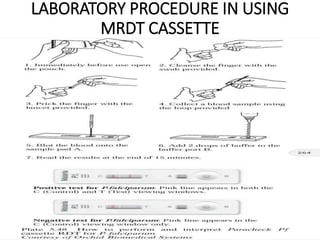
• LABORATORY PROCEDURE IN USING
MRDTS CASSETTE
• MATERIALS REQUIRED
• ASSAY METHOD/ PRINCIPLE
• INTERPRETATION AND RESULT
VALIDATION
• LABORATORY PRECAUTIONARY AND
QUALITY CONTROL MEASURES
• ADVANTAGES AND DISADVANTAGES
OF USING MRDTS
• APPROPRIATE USES OF MRDTs
• LIMITATIONS OF MRDTs
• CONCLUSION
• REFERENCE
• APPRECIATION
INTRODUCTION
• Malaria is one of the most severe public health problems worldwide. It is a leading
cause of death and disease in many developing countries, where young children
and pregnant women are the groups most affected (WHO, 2021)
• The need for new perspectives for malaria diagnostic techniques in the tropics is on
the increase due to rising prevalence rate of malaria mortality and morbidity and
also the fact that clinical presentations in malaria cases are indistinguishable from
other fever-causing pathogens, makes rapid, accurate diagnosis a crucial
component of effective case management (WHO, 2000).
• Slide microscopic examination of thick and thin blood film has been the gold
standard for malaria diagnosis. Giving considerations to its limitation, for efficient
treatment and management of malaria, rapid and accurate diagnostic testing is
imperative especially in a resource constrained setting. Hence this necessitates the
need and use of malaria rapid diagnostic test and devices,( MRDTs & MRDDs) for
diagnosis of Malaria within a limited turnaround time.
• The limitations emanating from MRDT usage have revolutionised thinking towards
the development of RDT method Utilizing promising antigen targets that can
surmount these obstacles and such has been a case of ongoing concern.
WHAT ARE MRDTs
Malaria rapid diagnostic test (mRDT) are in vitro
immunochromatographic test (ICT) employed in the diagnosis of
malaria in a resource constrained setting, providing result within a
limited turnaround time approximately 20 minutes. Hence, the
appellation “Rapid” rather than the reference procedure.
MRDTs makes use of devices called Rapid Diagnostic Devices
(MRDDs) which come in format or designs like cassettes, Cards, Strips
etc to detect malaria antigen which precipitates in the disease (Moody
and Chiodini 2002).The malaria antigens Implicated are; Histidine Rich
Protein -2, Plasmodium Adolase and plasmodium Lactate
dehyrogenase.
MRDT APPROACH /TEST PRINCIPLE
MRDDs works through lateral flow using
immunochromatography (ICT) methods to detect
antigens associated with malaria(Cheng et al.,2014).
MRDD utilizes red blood cell lysing agent contained in
the buffer and sample flow via capillary action along
a nitrocelluloseto identify the antigens by a capture
antibodies resulting in positive test lines within 15-30
mins(Hopkins, 2020).
MRDT FORMATS / DESIGNS
They are also designed for ease of use with blood-safety
in mind such as in the form of test booklet or a plastic
cassette (Moody and Chiodini 2002). The different test
formats include :
> DIPSTICK
> STRIP
> CARD
 > PAD
> WELL or CASSETTE
MRDT BRANDS
A COMBINATION MRDD
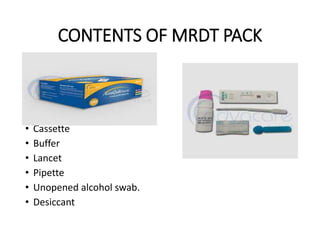
CONTENTS OF MRDT PACK
• Cassette
• Buffer
• Lancet
• Pipette
• Unopened alcohol swab.
• Desiccant
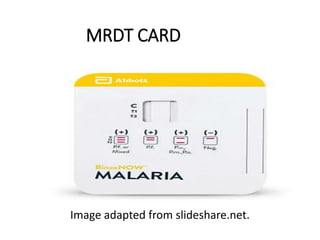
MRDT CARD
Image adapted from slideshare.net.
MRDT CASSETTE
Image adapted from slide share.net.
P. Falciparum Histidine Rich Protein
-2 (PfHRP-2)
a natural occurring histidine and Alanine rich proteins localized in several cell compartments
including the cytoplasm of p falciparum.
.A heat stable & water soluble proteins
• produced by the asexual stages and gametocytes of P.
falciparum( Rock et al.,1987).
• expressed on the red cell membrane surface, and shown to
remain in the blood for at least 28 days after the initiation
of antimalarial therapy. Because of its abundance in P
falciparum, it was the first antigen to be used to develop
RDT for its detection.
PLASMODIUM ADOLASE
• An enzyme of the parasite glycolytic pathway
• expressed by the blood stages of P. falciparum as
well as the non-falciparum malaria parasites(Meier
et al.,1992).
• Adolase based assay is utilized to diagnose the presence
of malaria without speciation (WHO, 2021).
• Monoclonal antibodies against Plasmodium aldolase are
pan-specific in their reaction and have been used in a
combined ‘P.f/P.v’ immunochromatographic test that
targets the pan malarial antigen (PMA) along with
PfHRP2.
PLASMODIUM PARASITE LACTATE
DEHYDROGENASE
• LDH is an essential energy-producing enzyme and is the last
enzyme in the parasite glycolytic pathway. It is soluble and is
produced by the sexual and asexual stages of parasites, including
the mature gametocytes of all four human Plasmodium species
and it is present in and released from the parasite infected
erythrocytes (Brown et al., 2004).
• It has been found in all 4 human malaria species, and different
isomers of pLDH for each of the 4 species exist.
• LDH has both a non-specific PpanLDH for all species, as well as
more specific P. falciparum (PfLDH) and P. vivax (PvLDH) assay.
However, there is no commercially available P. ovale P. vivax, or P.
knowlesi LDH assay (Hopkins, 2020).
MRDT DEVICE CONFIGURATION
MRDTs have been developed such that it can
be used to detect any malaria species: P.
falciparum alone, P. vivax alone, or any
combination thereof (Bell et al 2006). They
are:
> SINGLE ANTIGEN BASED MRDTs (MRDDs)
> MIXED ANTIGEN BASED MRDTs (MRDDs)
(COMBINATION MRDT)
MRDT ASSAY TYPES
MATERIALS REQUIRED FOR MRDT
• Blood specimen (2 to 50µL) is either a finger-prick blood
specimen, anticoagulated blood, or plasma.
• New unopened test packet
• New unopened alcohol swab
• New unopened lancet
• New pair of disposable gloves
• Buffer
• Timer
• Sharps box
• Pencil or pen
LABORATORY PROCEDURE IN USING
MRDT CASSETTE
ASSAY METHOD/PRINCIPLE
LATERAL FLOW DEVICE that uses
IMMUNO-CHROMATOGRAPHIC (ICT )
METHOD To detect malaria antigen (Cheng
et al.,2014).
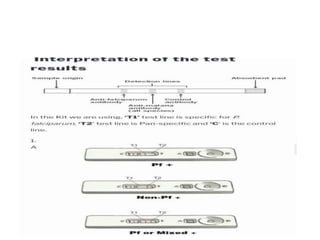
INTERPRETATION AND RESULT
VALIDATION IN MRDT
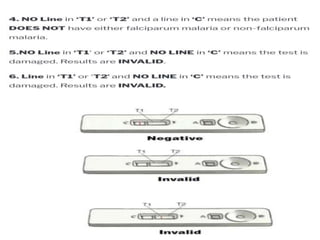
• Change of color on the control line is necessary to
validate the test; “VALID”and its non-appearance,
with or without color changes on the test lines,
invalidates the test; “INVALID”
• With color change on both the control and test
lines, the test is interpreted as “POSITIVE.”
• With color change only on the control line and
without color change on the other lines, the test is
interpreted as “NEGATIVE.” (Anthony et al.,2002).
LABORATORY
PRECAUTIONARY/QUALITY CONTROL
MEASURES IN MRDTs
• Below is a list of some of the Internal Quality Control (IQC) activities that are
important for ensuring accurate and reliable RDT results
• . Pre-analytical
• Ensure correct and consistent identification of patient and blood samples for
testing.
• Ensure that the test device pouch is not expired and/or damaged before
testing.
• Open the device package immediately before testing.
• Check the colour of the desiccant pouch each time a test device is opened to
see whether it conforms to the manufacturer’s recommendations.
• Keep and refer to product instructions/kit inserts during testing.
LABORATORY PRECAUTIONARY/ QUALITY
CONTROL MEASURES IN MRDTs CONT.
• Analytical
• Perform the RDT procedure as per the manufacturer’s instructions, e.g.
using the correct volume of sample and buffer.
• Read the test results within the timeframe stipulated by the manufacturer.
• Take into consideration the presence or absence of the control band/line.
The test is considered invalid if the control band does not appear, and, in
such cases, the test should be repeated with a new test device. The control
line only confirms that the test has run and does not provide information on
the accuracy of the test result
• Leftover buffers from one kit should not be used when performing tests
using a different kit.
• A few manufacturers provide control materials with RDTs (either in the kit
or sold separately). These may be helpful to identify when performance has
been compromised.
• Post-analytical
• Promptly report and send results to requesting clinicians.
• The testing facility/personnel should record and keep all IQC data in RDT QC
registers/ sheets to be inspected by supervisors during on-site visits.
ADVANTAGES AND DISADVANTAGES
OF USING MRDTs
ADVANTAGES
• Provides information on
malaria epidemiological
surveillance
• Very easy to use with little
training
• Inexpensive
• Provides diagnosis where
microscopy is not possible or
practical
• Has a short turnaround time (
RAPID)
DISADVANTAGES
• Cannot differentiate between
past and present infections
• Unable to quantify parasite
density
• Mutation in the gene encoding
the antigen can affect the
result
• Positive results does not rule
out need for microscopy
• Some results are not consistent
with batches
APPROPRIATE USES OF MRDTS
• Diagnosis; to identify, confirm or rule out malaria
in symptomatic patient.
• Case management; to guide accurate
prescription of therapeutic intervention and
monitor treatment.
• Epidemiology; to detect and monitor the
incidence or prevalence of malaria for targeting
prevention and evaluating health programmes .
LIMITATIONS OF MRDTS
• > CROSS-REACTIONS
• SPECIFICITY
• > SENSITIVITY
• > FALSE POSITIVITY
• > FALSE NEGATIVITY
• > PROBLEMS IN IDENTIFYING NON FALCIPARIUM
SPECIES
• > MULTIPLE INFLUENCES
• > PERSISTENCE OF ANTIGENS
LIMITATIONS OF MRDTs CONT.
The use of the three antigens results in some fundamental diagnostic limitations;
• SPECIFICITY:
• None of the 3antigens is specific for plasmodium falciparum, plasmodium ovale,
plasmodium malariae, or plasmodium knowlesi.
• GENETIC VARIATION:
• There are variants of p falciparium in south America that do not produce the 2 most
common types of HRP ( p.falciparium HRP[PfHRP-2 and HRP-3]), which means that
MRDTs based on detection of those antigens would not be useful in that region
(Gamboa et al., 2010).
• CROSS-REACTIONS
• Cross-reaction with a pfHRP-2 assay have been reported from patients with
Schistomiasis mekongi infection with no cross-reaction with pLDH assay (Leshem et
al., 2011).
• Cross-reaction with some assay has been reported with pLDH assay have been
reported for patients with rheumatoid factor or other circulating auto-antibodies
(Leshem et al., 2011).
• FALSE POSITIVITY
• Patients with high levels of P falciparium parasitaemia may give false- positive result
with PLDH assay designed to detect P. vivax (Jacobs J, 2010)
LIMITATIONS OF MRDTs CONT.
FALSE NEGATIVITY :
At low parasitaemia however (<1000 parasites / microliters of blood) the test
line is often line faint and can be interpreted aS false negative ( Hopkins, 2007)
NON QUANTITATIVE
Unlike microscopy, MRDTs cannot be used to determine the magnitude of
parasitaemia
PERSISTENCE OF ANTIGEN
Because pHRP-2 is not cleared from blood for up to 30 days after treatment,
MRDTs that test for this antigen should not be used to monitor response to
therapy (Abba et al., 2011).
MULTIPLE INFLUENCE:
A number of factors such as the role of temperature, humidity, storage and
shelf life may impact the functional aspect of MRDDs
DISCUSSION
Providing appropriate treatment to patients who present with
malaria-like symptoms remains a challenge in many endemic regions.
The use of mRDTs also influenced other treatment decisions, and
considerations for alternative diagnoses, notably resulting in an
increase of antibiotic prescription especially for test-negative cases
and reductions in Artemisinin Combination Therapy (ACT) use,
leading to substantial savings in ACT costs.
Although mRDTs generally improve malaria case management, alone,
they are not a panacea to solve the major challenge of effective fever
management. Simply providing mRDTs is insufficient if health workers
continue prescribing antimalarials to test-negative patients27,41 or if
alternative treatments are not appropriate (Reyburn et al.,2007).
CONCLUSION
Prompt and accurate malaria diagnosis is important to malaria
control programs in endemic regions as it limits over diagnosis as
well as provide evidence of infection that requires prompt and
adequate treatment (Febir et al., 2015).
The use of MRDTs has greatly expanded the ability to diagnose
malaria especially in resource limited environment. HRP-2 remains
the predominant assay in RDT & the WHO still only endorses
combination RDTs that conntain HRP-2 in parts, due to quality but
also related to P. falciparum being a clear misdiagnosis. Such
combination include PVLDH/p PANLDH or Adolase, HRP-
2/PfLDH/PpanLDH. However, caution should be taken in the
interpretation of its result in clinical setting due to its limitations
and inherent weakness.
RECOMMENDATION
Giving consideration to the shortcomings bordering on the
sensitivity, specificity and avidity of MRDTs, it is therefore
circumspect to recommend that;
Combination based MRDTs rather than single based MRDTs
be employed in areas where there is prevalence of mixed
infection by plasmodium species.
The gold standard for malaria diagnosis be carried out
alongside MRDT as always in order to make definitive
diagnosis of the infection.
• Abba K, Deeks JJ, Olliaro PL, et a.,(l2007). Rapid diagnostic tests for diagnosing uncomplicated
P. falciparium malaria in endemic countries, Cochrane Database of systemic
Review,(7):CD008122
• Bell D, Wongsrichanalai C, Barnwell JW.(2006). Ensuring quality and access for malaria
diagnosis: how can it be achieved?, National Review of Microbiology. 4: 682-9
• Brown, W. M., Yowell, C. A., Hoard, A., Vander Jagt, T. A., Hunsaker, L. A., Deck, L. M., Royer, R.
E., Piper, R. C., Dame, J. B. & other authors (2004). Comparative structural analysis and kinetic
properties of lactate dehydrogenases from the four species of human malarial parasites.
Biochemistry 43, 6219–6229.
• Febir LG, Baiden FE, Agula J, Delimini RK, Akpalu B, Tivura M,. et al (2010) Implementation of
the integrated management of childhood illness with parasitological diagnosis of malaria in
rural Ghana: health worker perceptions. Malar J. 2015;14(1):174.Jacobs J. Malaria rapid
diagnostic test: Plasmodium falciparium infections with high parasite densities may generate
false positive Plasmodium vivax PLDH lines, Malaria journal, .9:198
• Hopkins, H.(December, 2020) laboratory tools for Diagnosis of Malaria. Available online:
http//www.uptodate.com/contents/laboratory tool for diagnosis of malaria
• Hopkins, H.; Rosenthal, P.J.; Kamya, M.R.; Staedke, S.G.; Kambale, W.; Dorsey, G. (2007).
Comparison of HRP2- and pldh-based rapid diagnostic tests for malaria with longitudinal
follow-up in kampala, uganda. American journal of tropical medicine and Hygiene. 76: 1092–
1097.
• Jacobs J.(2010). Malaria rapid diagnostic test: Plasmodium falciparium infections with high
parasite densities may generate false positive Plasmodium vivax PLDH lines, Malaria
journal, 9 :198
• Gamboa D, Ho Mf, Bendezu J, et al.(2010). A large proportion of P. falciparium isolates in
the amazon region of Peru lack pfhrp2 and pfhrp3: implications for malaria rapid
diagnostic tests, PLoS One, 5:e8091
• Leshem E, Keller N, Guthman D, et al.(2011). false positive plasmodium falciparum
histidine-rich protein 2 immunocapture assay in acute schistosomiasis caused by
Schitosoma mekongi, Journal of Clinical Microbiology 49 :2331-2
• Meier, B., H. Dobeli, and U. Certa. 1992. Stage-specific expression of aldolase isoenzymes
in the rodent malaria parasite Plasmodium bergei. Mol. Biochem. Parasitology. 52:15–27.
• Moody AH & Chiodini PL (2002) Non-microscopic method for malaria diagnosis using
OptiMAL IT, a second-generation dipstick for malaria pLDH antigen detection. British
Journal of Biomedical Science 59: 228–231.
• Murray CK, Gasser RA, Magill AJ, Miller RS.(2008). Update on rapid diagnostic testing for
malaria, Clinical Microbiology Review.21:.97- 110
• Reyburn H, Mbakilwa H, Mwangi R, Mwerinde O, Olomi R, Drakeley C, Whitty CJ.
(2007). Rapid diagnostic tests compared with malaria microscopy for guiding
outpatient treatment of febrile illness in Tanzania: randomised trial. British
medical journal. 334: 403.
• Rock, E.P., K. Marsh, S. J. Saul, T.E. Wellems, D. W. Taylor, W.L. Maloy, and R. J.
Howard.(1987). Comprehensive analysis of the plasmodium falciparum
histidine-rich proteins HPR1, HPR2 and HPR3 in malaria diagnosis of diverse
origin. Parasitology 95:209-227
• World Health Organization Malaria.(31 January 2021) Available online:
https://www.who.int/en/news-room/fact-sheets/detail/malaria.
• WHO.,(2011). World Malaria Report. http://www.who.int/malaria/world malaria
report.
• World Health Organization. Basic malaria microscopy-part 1: Learner’s Guide,
2nd edition.; World Health Organization: Geneva, Switzerland,2010; Available
online: http//www.who.int/malaria/publications
• WHO. ,(2000) New perspectives: malaria diagnosis. Report of joint WHO/USAID
informal consultation 25–27 October. Geneva: World Health Organization
THANKS FOR YOUR
AUDIENCE

MRTD

  • 1.
    MALARIA ANTIGENS SUITABLEAS TARGETS FOR RAPID DIAGNOSTIC TEST
  • 2.
    OUTLINE • INTRODUCTION • WHATARE MALARIA RAPID DIAGNOSTIC TESTS (MRDTs) • MRDT APPROACH /TEST PRINCIPLE • MRDT FORMAT /DESIGN • MRDT BRANDS • CONTENT OF MRDT PACK • MRDT CARDS AND CASSETTE • ANTIGENS TARGETED IN MRDT • MRDT DEVICE CONFIGURATION • MRDT ASSAY TYPES • LABORATORY PROCEDURE IN USING MRDTS CASSETTE • MATERIALS REQUIRED • ASSAY METHOD/ PRINCIPLE • INTERPRETATION AND RESULT VALIDATION • LABORATORY PRECAUTIONARY AND QUALITY CONTROL MEASURES • ADVANTAGES AND DISADVANTAGES OF USING MRDTS • APPROPRIATE USES OF MRDTs • LIMITATIONS OF MRDTs • CONCLUSION • REFERENCE • APPRECIATION
  • 3.
    INTRODUCTION • Malaria isone of the most severe public health problems worldwide. It is a leading cause of death and disease in many developing countries, where young children and pregnant women are the groups most affected (WHO, 2021) • The need for new perspectives for malaria diagnostic techniques in the tropics is on the increase due to rising prevalence rate of malaria mortality and morbidity and also the fact that clinical presentations in malaria cases are indistinguishable from other fever-causing pathogens, makes rapid, accurate diagnosis a crucial component of effective case management (WHO, 2000). • Slide microscopic examination of thick and thin blood film has been the gold standard for malaria diagnosis. Giving considerations to its limitation, for efficient treatment and management of malaria, rapid and accurate diagnostic testing is imperative especially in a resource constrained setting. Hence this necessitates the need and use of malaria rapid diagnostic test and devices,( MRDTs & MRDDs) for diagnosis of Malaria within a limited turnaround time. • The limitations emanating from MRDT usage have revolutionised thinking towards the development of RDT method Utilizing promising antigen targets that can surmount these obstacles and such has been a case of ongoing concern.
  • 4.
    WHAT ARE MRDTs Malariarapid diagnostic test (mRDT) are in vitro immunochromatographic test (ICT) employed in the diagnosis of malaria in a resource constrained setting, providing result within a limited turnaround time approximately 20 minutes. Hence, the appellation “Rapid” rather than the reference procedure. MRDTs makes use of devices called Rapid Diagnostic Devices (MRDDs) which come in format or designs like cassettes, Cards, Strips etc to detect malaria antigen which precipitates in the disease (Moody and Chiodini 2002).The malaria antigens Implicated are; Histidine Rich Protein -2, Plasmodium Adolase and plasmodium Lactate dehyrogenase.
  • 5.
    MRDT APPROACH /TESTPRINCIPLE MRDDs works through lateral flow using immunochromatography (ICT) methods to detect antigens associated with malaria(Cheng et al.,2014). MRDD utilizes red blood cell lysing agent contained in the buffer and sample flow via capillary action along a nitrocelluloseto identify the antigens by a capture antibodies resulting in positive test lines within 15-30 mins(Hopkins, 2020).
  • 6.
    MRDT FORMATS /DESIGNS They are also designed for ease of use with blood-safety in mind such as in the form of test booklet or a plastic cassette (Moody and Chiodini 2002). The different test formats include : > DIPSTICK > STRIP > CARD  > PAD > WELL or CASSETTE
  • 7.
  • 8.
  • 9.
    CONTENTS OF MRDTPACK • Cassette • Buffer • Lancet • Pipette • Unopened alcohol swab. • Desiccant
  • 10.
    MRDT CARD Image adaptedfrom slideshare.net.
  • 11.
    MRDT CASSETTE Image adaptedfrom slide share.net.
  • 12.
    P. Falciparum HistidineRich Protein -2 (PfHRP-2) a natural occurring histidine and Alanine rich proteins localized in several cell compartments including the cytoplasm of p falciparum. .A heat stable & water soluble proteins • produced by the asexual stages and gametocytes of P. falciparum( Rock et al.,1987). • expressed on the red cell membrane surface, and shown to remain in the blood for at least 28 days after the initiation of antimalarial therapy. Because of its abundance in P falciparum, it was the first antigen to be used to develop RDT for its detection.
  • 13.
    PLASMODIUM ADOLASE • Anenzyme of the parasite glycolytic pathway • expressed by the blood stages of P. falciparum as well as the non-falciparum malaria parasites(Meier et al.,1992). • Adolase based assay is utilized to diagnose the presence of malaria without speciation (WHO, 2021). • Monoclonal antibodies against Plasmodium aldolase are pan-specific in their reaction and have been used in a combined ‘P.f/P.v’ immunochromatographic test that targets the pan malarial antigen (PMA) along with PfHRP2.
  • 14.
    PLASMODIUM PARASITE LACTATE DEHYDROGENASE •LDH is an essential energy-producing enzyme and is the last enzyme in the parasite glycolytic pathway. It is soluble and is produced by the sexual and asexual stages of parasites, including the mature gametocytes of all four human Plasmodium species and it is present in and released from the parasite infected erythrocytes (Brown et al., 2004). • It has been found in all 4 human malaria species, and different isomers of pLDH for each of the 4 species exist. • LDH has both a non-specific PpanLDH for all species, as well as more specific P. falciparum (PfLDH) and P. vivax (PvLDH) assay. However, there is no commercially available P. ovale P. vivax, or P. knowlesi LDH assay (Hopkins, 2020).
  • 15.
    MRDT DEVICE CONFIGURATION MRDTshave been developed such that it can be used to detect any malaria species: P. falciparum alone, P. vivax alone, or any combination thereof (Bell et al 2006). They are: > SINGLE ANTIGEN BASED MRDTs (MRDDs) > MIXED ANTIGEN BASED MRDTs (MRDDs) (COMBINATION MRDT)
  • 16.
  • 17.
    MATERIALS REQUIRED FORMRDT • Blood specimen (2 to 50µL) is either a finger-prick blood specimen, anticoagulated blood, or plasma. • New unopened test packet • New unopened alcohol swab • New unopened lancet • New pair of disposable gloves • Buffer • Timer • Sharps box • Pencil or pen
  • 18.
    LABORATORY PROCEDURE INUSING MRDT CASSETTE
  • 19.
    ASSAY METHOD/PRINCIPLE LATERAL FLOWDEVICE that uses IMMUNO-CHROMATOGRAPHIC (ICT ) METHOD To detect malaria antigen (Cheng et al.,2014).
  • 20.
    INTERPRETATION AND RESULT VALIDATIONIN MRDT • Change of color on the control line is necessary to validate the test; “VALID”and its non-appearance, with or without color changes on the test lines, invalidates the test; “INVALID” • With color change on both the control and test lines, the test is interpreted as “POSITIVE.” • With color change only on the control line and without color change on the other lines, the test is interpreted as “NEGATIVE.” (Anthony et al.,2002).
  • 24.
    LABORATORY PRECAUTIONARY/QUALITY CONTROL MEASURES INMRDTs • Below is a list of some of the Internal Quality Control (IQC) activities that are important for ensuring accurate and reliable RDT results • . Pre-analytical • Ensure correct and consistent identification of patient and blood samples for testing. • Ensure that the test device pouch is not expired and/or damaged before testing. • Open the device package immediately before testing. • Check the colour of the desiccant pouch each time a test device is opened to see whether it conforms to the manufacturer’s recommendations. • Keep and refer to product instructions/kit inserts during testing.
  • 25.
    LABORATORY PRECAUTIONARY/ QUALITY CONTROLMEASURES IN MRDTs CONT. • Analytical • Perform the RDT procedure as per the manufacturer’s instructions, e.g. using the correct volume of sample and buffer. • Read the test results within the timeframe stipulated by the manufacturer. • Take into consideration the presence or absence of the control band/line. The test is considered invalid if the control band does not appear, and, in such cases, the test should be repeated with a new test device. The control line only confirms that the test has run and does not provide information on the accuracy of the test result • Leftover buffers from one kit should not be used when performing tests using a different kit. • A few manufacturers provide control materials with RDTs (either in the kit or sold separately). These may be helpful to identify when performance has been compromised. • Post-analytical • Promptly report and send results to requesting clinicians. • The testing facility/personnel should record and keep all IQC data in RDT QC registers/ sheets to be inspected by supervisors during on-site visits.
  • 26.
    ADVANTAGES AND DISADVANTAGES OFUSING MRDTs ADVANTAGES • Provides information on malaria epidemiological surveillance • Very easy to use with little training • Inexpensive • Provides diagnosis where microscopy is not possible or practical • Has a short turnaround time ( RAPID) DISADVANTAGES • Cannot differentiate between past and present infections • Unable to quantify parasite density • Mutation in the gene encoding the antigen can affect the result • Positive results does not rule out need for microscopy • Some results are not consistent with batches
  • 27.
    APPROPRIATE USES OFMRDTS • Diagnosis; to identify, confirm or rule out malaria in symptomatic patient. • Case management; to guide accurate prescription of therapeutic intervention and monitor treatment. • Epidemiology; to detect and monitor the incidence or prevalence of malaria for targeting prevention and evaluating health programmes .
  • 28.
    LIMITATIONS OF MRDTS •> CROSS-REACTIONS • SPECIFICITY • > SENSITIVITY • > FALSE POSITIVITY • > FALSE NEGATIVITY • > PROBLEMS IN IDENTIFYING NON FALCIPARIUM SPECIES • > MULTIPLE INFLUENCES • > PERSISTENCE OF ANTIGENS
  • 29.
    LIMITATIONS OF MRDTsCONT. The use of the three antigens results in some fundamental diagnostic limitations; • SPECIFICITY: • None of the 3antigens is specific for plasmodium falciparum, plasmodium ovale, plasmodium malariae, or plasmodium knowlesi. • GENETIC VARIATION: • There are variants of p falciparium in south America that do not produce the 2 most common types of HRP ( p.falciparium HRP[PfHRP-2 and HRP-3]), which means that MRDTs based on detection of those antigens would not be useful in that region (Gamboa et al., 2010). • CROSS-REACTIONS • Cross-reaction with a pfHRP-2 assay have been reported from patients with Schistomiasis mekongi infection with no cross-reaction with pLDH assay (Leshem et al., 2011). • Cross-reaction with some assay has been reported with pLDH assay have been reported for patients with rheumatoid factor or other circulating auto-antibodies (Leshem et al., 2011). • FALSE POSITIVITY • Patients with high levels of P falciparium parasitaemia may give false- positive result with PLDH assay designed to detect P. vivax (Jacobs J, 2010)
  • 30.
    LIMITATIONS OF MRDTsCONT. FALSE NEGATIVITY : At low parasitaemia however (<1000 parasites / microliters of blood) the test line is often line faint and can be interpreted aS false negative ( Hopkins, 2007) NON QUANTITATIVE Unlike microscopy, MRDTs cannot be used to determine the magnitude of parasitaemia PERSISTENCE OF ANTIGEN Because pHRP-2 is not cleared from blood for up to 30 days after treatment, MRDTs that test for this antigen should not be used to monitor response to therapy (Abba et al., 2011). MULTIPLE INFLUENCE: A number of factors such as the role of temperature, humidity, storage and shelf life may impact the functional aspect of MRDDs
  • 31.
    DISCUSSION Providing appropriate treatmentto patients who present with malaria-like symptoms remains a challenge in many endemic regions. The use of mRDTs also influenced other treatment decisions, and considerations for alternative diagnoses, notably resulting in an increase of antibiotic prescription especially for test-negative cases and reductions in Artemisinin Combination Therapy (ACT) use, leading to substantial savings in ACT costs. Although mRDTs generally improve malaria case management, alone, they are not a panacea to solve the major challenge of effective fever management. Simply providing mRDTs is insufficient if health workers continue prescribing antimalarials to test-negative patients27,41 or if alternative treatments are not appropriate (Reyburn et al.,2007).
  • 32.
    CONCLUSION Prompt and accuratemalaria diagnosis is important to malaria control programs in endemic regions as it limits over diagnosis as well as provide evidence of infection that requires prompt and adequate treatment (Febir et al., 2015). The use of MRDTs has greatly expanded the ability to diagnose malaria especially in resource limited environment. HRP-2 remains the predominant assay in RDT & the WHO still only endorses combination RDTs that conntain HRP-2 in parts, due to quality but also related to P. falciparum being a clear misdiagnosis. Such combination include PVLDH/p PANLDH or Adolase, HRP- 2/PfLDH/PpanLDH. However, caution should be taken in the interpretation of its result in clinical setting due to its limitations and inherent weakness.
  • 33.
    RECOMMENDATION Giving consideration tothe shortcomings bordering on the sensitivity, specificity and avidity of MRDTs, it is therefore circumspect to recommend that; Combination based MRDTs rather than single based MRDTs be employed in areas where there is prevalence of mixed infection by plasmodium species. The gold standard for malaria diagnosis be carried out alongside MRDT as always in order to make definitive diagnosis of the infection.
  • 34.
    • Abba K,Deeks JJ, Olliaro PL, et a.,(l2007). Rapid diagnostic tests for diagnosing uncomplicated P. falciparium malaria in endemic countries, Cochrane Database of systemic Review,(7):CD008122 • Bell D, Wongsrichanalai C, Barnwell JW.(2006). Ensuring quality and access for malaria diagnosis: how can it be achieved?, National Review of Microbiology. 4: 682-9 • Brown, W. M., Yowell, C. A., Hoard, A., Vander Jagt, T. A., Hunsaker, L. A., Deck, L. M., Royer, R. E., Piper, R. C., Dame, J. B. & other authors (2004). Comparative structural analysis and kinetic properties of lactate dehydrogenases from the four species of human malarial parasites. Biochemistry 43, 6219–6229. • Febir LG, Baiden FE, Agula J, Delimini RK, Akpalu B, Tivura M,. et al (2010) Implementation of the integrated management of childhood illness with parasitological diagnosis of malaria in rural Ghana: health worker perceptions. Malar J. 2015;14(1):174.Jacobs J. Malaria rapid diagnostic test: Plasmodium falciparium infections with high parasite densities may generate false positive Plasmodium vivax PLDH lines, Malaria journal, .9:198 • Hopkins, H.(December, 2020) laboratory tools for Diagnosis of Malaria. Available online: http//www.uptodate.com/contents/laboratory tool for diagnosis of malaria • Hopkins, H.; Rosenthal, P.J.; Kamya, M.R.; Staedke, S.G.; Kambale, W.; Dorsey, G. (2007). Comparison of HRP2- and pldh-based rapid diagnostic tests for malaria with longitudinal follow-up in kampala, uganda. American journal of tropical medicine and Hygiene. 76: 1092– 1097.
  • 35.
    • Jacobs J.(2010).Malaria rapid diagnostic test: Plasmodium falciparium infections with high parasite densities may generate false positive Plasmodium vivax PLDH lines, Malaria journal, 9 :198 • Gamboa D, Ho Mf, Bendezu J, et al.(2010). A large proportion of P. falciparium isolates in the amazon region of Peru lack pfhrp2 and pfhrp3: implications for malaria rapid diagnostic tests, PLoS One, 5:e8091 • Leshem E, Keller N, Guthman D, et al.(2011). false positive plasmodium falciparum histidine-rich protein 2 immunocapture assay in acute schistosomiasis caused by Schitosoma mekongi, Journal of Clinical Microbiology 49 :2331-2 • Meier, B., H. Dobeli, and U. Certa. 1992. Stage-specific expression of aldolase isoenzymes in the rodent malaria parasite Plasmodium bergei. Mol. Biochem. Parasitology. 52:15–27. • Moody AH & Chiodini PL (2002) Non-microscopic method for malaria diagnosis using OptiMAL IT, a second-generation dipstick for malaria pLDH antigen detection. British Journal of Biomedical Science 59: 228–231. • Murray CK, Gasser RA, Magill AJ, Miller RS.(2008). Update on rapid diagnostic testing for malaria, Clinical Microbiology Review.21:.97- 110
  • 36.
    • Reyburn H,Mbakilwa H, Mwangi R, Mwerinde O, Olomi R, Drakeley C, Whitty CJ. (2007). Rapid diagnostic tests compared with malaria microscopy for guiding outpatient treatment of febrile illness in Tanzania: randomised trial. British medical journal. 334: 403. • Rock, E.P., K. Marsh, S. J. Saul, T.E. Wellems, D. W. Taylor, W.L. Maloy, and R. J. Howard.(1987). Comprehensive analysis of the plasmodium falciparum histidine-rich proteins HPR1, HPR2 and HPR3 in malaria diagnosis of diverse origin. Parasitology 95:209-227 • World Health Organization Malaria.(31 January 2021) Available online: https://www.who.int/en/news-room/fact-sheets/detail/malaria. • WHO.,(2011). World Malaria Report. http://www.who.int/malaria/world malaria report. • World Health Organization. Basic malaria microscopy-part 1: Learner’s Guide, 2nd edition.; World Health Organization: Geneva, Switzerland,2010; Available online: http//www.who.int/malaria/publications • WHO. ,(2000) New perspectives: malaria diagnosis. Report of joint WHO/USAID informal consultation 25–27 October. Geneva: World Health Organization
  • 37.