MALARIA:
Rapid diagnostic tests

Dr Jerin Kuruvilla
What is Malaria RDT???
•A malaria RDT or “dipstick RDT detects specific
antigens or protiens developed by malaria parasites
•Principle-lateral flow or immunochromatographic
stick method
•Signifies presence of an antigen by colour change on
adsorbing nitrocellulose strip.
•RDTs sensitive to malarial antibodies-used for
screening of donated blood
Types Of Malaria RDTs
•Three main group of antigens detected by commercially available
RDTs are:
Histidine rich protien(HRP2)-specific to plasmodium
Soluble,heat stable antigen present abundantly in cytoplasm and
membrane of affected erythocytes.
Parasite specific Lactate dehydrogenase(pLDH)-falciparum
specific,pan specific or vivax specific
Aldolase(pan specific)-conserved major enzymes in malarial
glycolytic pathway
Appropriate use of RDTS
•Diagnosis-to identify ,confirm or rule out malaria in symptomatic
patients
•Case Management-accurate prescription of therapeutic interventions
and to monitor treatment
•Epidemiology-to detect and monitor incidence and prevalence of
malaria for targetting prevention and evaluating health programmes
•Available formats: Plastic cassette, card, dip stick, hybrid cassette
dipsticks
Strengths of Malaria RDTs

Challenges of Malaria RDTs

Relatively easy to use with minimal
training required

Costs per test may exceed those of microscopy

Relatively rapid, giving timely results

Short shelf-life, requiring efficient procurement,
transportation, storage and distribution systems

Little or no manipulation of sample
required, can be performed in places
without laboratories

Most tests are qualitative (i.e. gives a yes or no
answer). Any quantification of parasitemia will
require further laboratory-based tests

Most of the RDTs do not require
refrigeration, hence tests can be
performed where there is no power
supply

Intensity of test band varies with amount of
antigen present at low parasite densities-this
may lead to reader variation in test results

Uses whole blood (prick or venous
blood-prick preferred)

less sensitive than lab tests
Choosing a Malaria RDT
•The plasmodium species to be detected
•Accuracy(sensitivity and specificity)
•Shelf life and temperature stability during storage,transport and use
( -minimum of 18 months)
•Ease of use (including format of tests)
•Cost
Plasmodium species to be detected
•Zone 1 -Plasmodium falciparum only(Sub Saharan Africa & Papua
New Guinea) – HRP2 kits preferred
•Zone 2 –Falciparum and non falciparum infections occur as single
species infection(endemic areas of Asia and Americas)
•Zone 3 –non falciparum malaria only(mainly vivax only)(areas of
east asia and central asia)
Despite all these advances, malaria will likely be with
us as long as there are humans on this earth.
Guidelines for use of Malaria RDTs in health
programmes
•Batches of RDTs should be tested and monitored throughout shelf
life
•Evidence of good manufacturing practice(GMP) and good field
experience of manufacturer
•Cold chain for transport and storage
•Health worker training and monitoring
•Clear guidelines & diagnostic as well as treatment guidelines
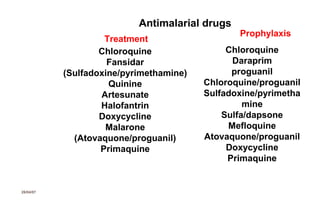
Antimalarial drugs
Treatment
Chloroquine
Fansidar
(Sulfadoxine/pyrimethamine)
Quinine
Artesunate
Halofantrin
Doxycycline
Malarone
(Atovaquone/proguanil)
Primaquine

26/04/07

Prophylaxis

Chloroquine
Daraprim
proguanil
Chloroquine/proguanil
Sulfadoxine/pyrimetha
mine
Sulfa/dapsone
Mefloquine
Atovaquone/proguanil
Doxycycline
Primaquine
Treatment of Chloroquine resistant malaria

Quinine + tetracycline
or clindamycin
or Fansidar (sulfadoxine and pyrimethamine)
Malarone (paludrine/atovaquone)
Mefloquine (a quinoline methanol)
Qinghaosu (artemesinin)
Malaria Prevention
Mosquito avoidance - evening and night
behavior
- mosquito nets
- air conditioning
- screens
- mosquito repellants
- pyrethrin coils
Mosquito killing - destroying breeding sites
- fog spraying
- residual spraying
Plasmodium killing - chemoprophylaxis
Malaria rapid diagnostic tests (RDTs)

Malaria rapid diagnostic tests (RDTs)

  • 1.
  • 2.
    What is MalariaRDT??? •A malaria RDT or “dipstick RDT detects specific antigens or protiens developed by malaria parasites •Principle-lateral flow or immunochromatographic stick method •Signifies presence of an antigen by colour change on adsorbing nitrocellulose strip. •RDTs sensitive to malarial antibodies-used for screening of donated blood
  • 3.
    Types Of MalariaRDTs •Three main group of antigens detected by commercially available RDTs are: Histidine rich protien(HRP2)-specific to plasmodium Soluble,heat stable antigen present abundantly in cytoplasm and membrane of affected erythocytes. Parasite specific Lactate dehydrogenase(pLDH)-falciparum specific,pan specific or vivax specific Aldolase(pan specific)-conserved major enzymes in malarial glycolytic pathway
  • 4.
    Appropriate use ofRDTS •Diagnosis-to identify ,confirm or rule out malaria in symptomatic patients •Case Management-accurate prescription of therapeutic interventions and to monitor treatment •Epidemiology-to detect and monitor incidence and prevalence of malaria for targetting prevention and evaluating health programmes •Available formats: Plastic cassette, card, dip stick, hybrid cassette dipsticks
  • 7.
    Strengths of MalariaRDTs Challenges of Malaria RDTs Relatively easy to use with minimal training required Costs per test may exceed those of microscopy Relatively rapid, giving timely results Short shelf-life, requiring efficient procurement, transportation, storage and distribution systems Little or no manipulation of sample required, can be performed in places without laboratories Most tests are qualitative (i.e. gives a yes or no answer). Any quantification of parasitemia will require further laboratory-based tests Most of the RDTs do not require refrigeration, hence tests can be performed where there is no power supply Intensity of test band varies with amount of antigen present at low parasite densities-this may lead to reader variation in test results Uses whole blood (prick or venous blood-prick preferred) less sensitive than lab tests
  • 8.
    Choosing a MalariaRDT •The plasmodium species to be detected •Accuracy(sensitivity and specificity) •Shelf life and temperature stability during storage,transport and use ( -minimum of 18 months) •Ease of use (including format of tests) •Cost
  • 9.
    Plasmodium species tobe detected •Zone 1 -Plasmodium falciparum only(Sub Saharan Africa & Papua New Guinea) – HRP2 kits preferred •Zone 2 –Falciparum and non falciparum infections occur as single species infection(endemic areas of Asia and Americas) •Zone 3 –non falciparum malaria only(mainly vivax only)(areas of east asia and central asia)
  • 11.
    Despite all theseadvances, malaria will likely be with us as long as there are humans on this earth.
  • 13.
    Guidelines for useof Malaria RDTs in health programmes •Batches of RDTs should be tested and monitored throughout shelf life •Evidence of good manufacturing practice(GMP) and good field experience of manufacturer •Cold chain for transport and storage •Health worker training and monitoring •Clear guidelines & diagnostic as well as treatment guidelines
  • 14.
  • 15.
    Treatment of Chloroquineresistant malaria Quinine + tetracycline or clindamycin or Fansidar (sulfadoxine and pyrimethamine) Malarone (paludrine/atovaquone) Mefloquine (a quinoline methanol) Qinghaosu (artemesinin)
  • 16.
    Malaria Prevention Mosquito avoidance- evening and night behavior - mosquito nets - air conditioning - screens - mosquito repellants - pyrethrin coils Mosquito killing - destroying breeding sites - fog spraying - residual spraying Plasmodium killing - chemoprophylaxis