FFRI,Inc.
Fourteenforty Research Institute, Inc.
FFRI,Inc.
http://www.ffri.jp
Machine learning for computer security
Junichi Murakami
Executive Officer, Director of Advanced Development Division
FFRI,Inc.
1. Introduction
2. Machine learning basics
– What is “Machine learning”
– Background and circumstances
– Type of machine learning
– Implementations
3. Malware detection based on machine learning
– Overview
– Datasets
– Cuckoo Sandbox
– Jubatus
– Evaluations
– Possibility for another applications
4. Conclusions
5. References
Agenda
2
FFRI,Inc.
• First this slides describes a basis of machine learning then introduces malware
detection based on machine learning
• The Author is a security researcher, but is not an expert of machine learning
• Currently the malware detection is experimental
Introduction
3
FFRI,Inc.
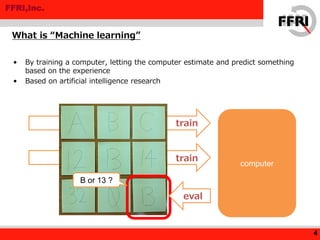
• By training a computer, letting the computer estimate and predict something
based on the experience
• Based on artificial intelligence research
4
computer
train
train
B or 13 ?
eval
What is “Machine learning”
FFRI,Inc.
• Recently, big data analysis attracts attention
– E-Commerce, Online games, BI(Business Intelligence), etc.
– The demand would probably increase more through spreading the M2M
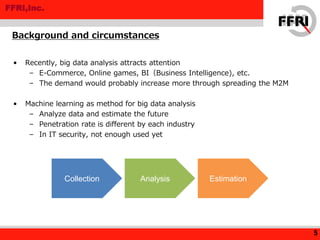
• Machine learning as method for big data analysis
– Analyze data and estimate the future
– Penetration rate is different by each industry
– In IT security, not enough used yet
Background and circumstances
5
Collection Analysis Estimation
FFRI,Inc.
Type of machine learning
6
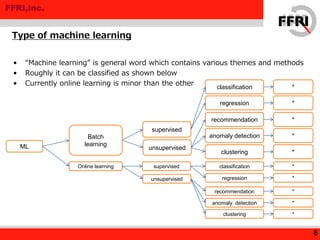
• “Machine learning” is general word which contains various themes and methods
• Roughly it can be classified as shown below
• Currently online learning is minor than the other
ML
Batch
learning
Online learning supervised
unsupervised
supervised
unsupervised
classification
regression
recommendation
anomaly detection
clustering
classification
regression
recommendation
anomaly detection
clustering
*
*
*
*
*
*
*
*
*
*
FFRI,Inc.
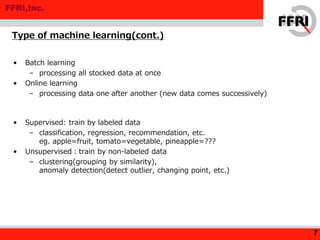
• Batch learning
– processing all stocked data at once
• Online learning
– processing data one after another (new data comes successively)
• Supervised: train by labeled data
– classification, regression, recommendation, etc.
eg. apple=fruit, tomato=vegetable, pineapple=???
• Unsupervised:train by non-labeled data
– clustering(grouping by similarity),
anomaly detection(detect outlier, changing point, etc.)
Type of machine learning(cont.)
7
FFRI,Inc.
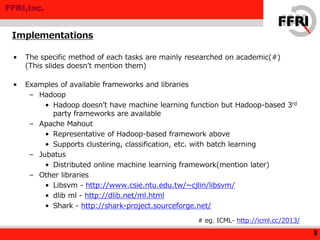
• The specific method of each tasks are mainly researched on academic(#)
(This slides doesn’t mention them)
• Examples of available frameworks and libraries
– Hadoop
• Hadoop doesn’t have machine learning function but Hadoop-based 3rd
party frameworks are available
– Apache Mahout
• Representative of Hadoop-based framework above
• Supports clustering, classification, etc. with batch learning
– Jubatus
• Distributed online machine learning framework(mention later)
– Other libraries
• Libsvm - http://www.csie.ntu.edu.tw/~cjlin/libsvm/
• dlib ml - http://dlib.net/ml.html
• Shark - http://shark-project.sourceforge.net/
Implementations
8
# eg. ICML- http://icml.cc/2013/
FFRI,Inc.
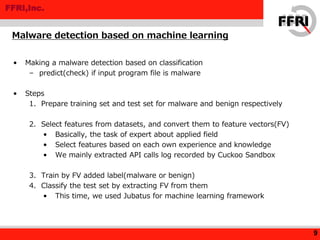
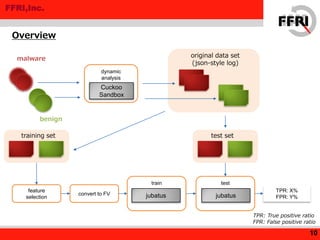
• Making a malware detection based on classification
– predict(check) if input program file is malware
• Steps
1. Prepare training set and test set for malware and benign respectively
2. Select features from datasets, and convert them to feature vectors(FV)
• Basically, the task of expert about applied field
• Select features based on each own experience and knowledge
• We mainly extracted API calls log recorded by Cuckoo Sandbox
3. Train by FV added label(malware or benign)
4. Classify the test set by extracting FV from them
• This time, we used Jubatus for machine learning framework
Malware detection based on machine learning
9
FFRI,Inc.
dynamic
analysis
train
Overview
10
Cuckoo
Sandbox
jubatus
training set
feature
selection
convert to FV
test
jubatus
test set
TPR: X%
FPR: Y%
original data set
(json-style log)
malware
benign
TPR: True positive ratio
FPR: False positive ratio
FFRI,Inc.
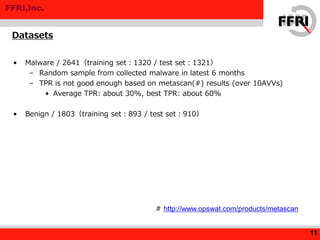
• Malware / 2641(training set:1320 / test set:1321)
– Random sample from collected malware in latest 6 months
– TPR is not good enough based on metascan(#) results (over 10AVVs)
• Average TPR: about 30%, best TPR: about 60%
• Benign / 1803(training set:893 / test set:910)
Datasets
11
# http://www.opswat.com/products/metascan
FFRI,Inc.
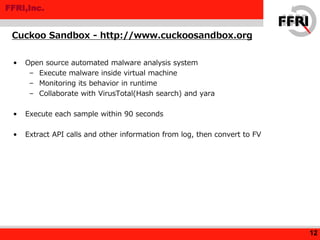
• Open source automated malware analysis system
– Execute malware inside virtual machine
– Monitoring its behavior in runtime
– Collaborate with VirusTotal(Hash search) and yara
• Execute each sample within 90 seconds
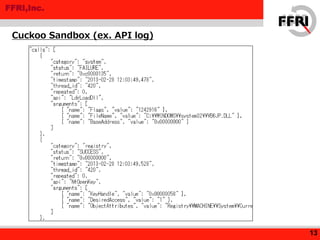
• Extract API calls and other information from log, then convert to FV
Cuckoo Sandbox - http://www.cuckoosandbox.org
12
FFRI,Inc.
Cuckoo Sandbox (ex. API log)
13
FFRI,Inc.
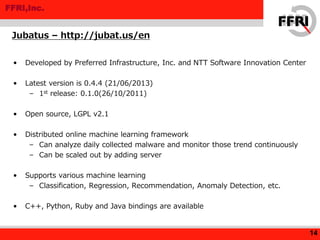
• Developed by Preferred Infrastructure, Inc. and NTT Software Innovation Center
• Latest version is 0.4.4 (21/06/2013)
– 1st release: 0.1.0(26/10/2011)
• Open source, LGPL v2.1
• Distributed online machine learning framework
– Can analyze daily collected malware and monitor those trend continuously
– Can be scaled out by adding server
• Supports various machine learning
– Classification, Regression, Recommendation, Anomaly Detection, etc.
• C++, Python, Ruby and Java bindings are available
Jubatus – http://jubat.us/en
14
FFRI,Inc.
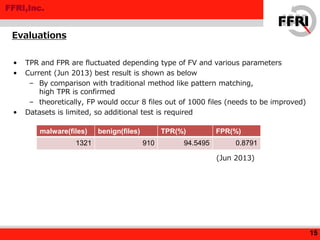
• TPR and FPR are fluctuated depending type of FV and various parameters
• Current (Jun 2013) best result is shown as below
– By comparison with traditional method like pattern matching,
high TPR is confirmed
– theoretically, FP would occur 8 files out of 1000 files (needs to be improved)
• Datasets is limited, so additional test is required
Evaluations
15
malware(files) benign(files) TPR(%) FPR(%)
1321 910 94.5495 0.8791
(Jun 2013)
FFRI,Inc.
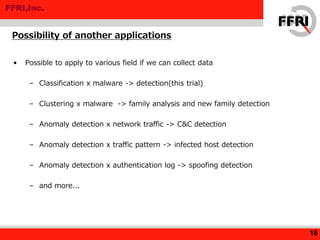
• Possible to apply to various field if we can collect data
– Classification x malware -> detection(this trial)
– Clustering x malware -> family analysis and new family detection
– Anomaly detection x network traffic -> C&C detection
– Anomaly detection x traffic pattern -> infected host detection
– Anomaly detection x authentication log -> spoofing detection
– and more...
Possibility of another applications
16
FFRI,Inc.
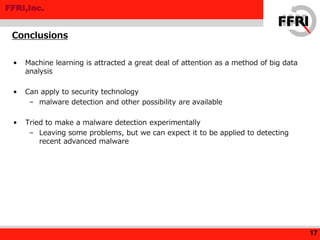
• Machine learning is attracted a great deal of attention as a method of big data
analysis
• Can apply to security technology
– malware detection and other possibility are available
• Tried to make a malware detection experimentally
– Leaving some problems, but we can expect it to be applied to detecting
recent advanced malware
Conclusions
17
FFRI,Inc.
• Jubatus
– http://jubat.us/en/
• Machine learning tutorials
– http://www.slideshare.net/unnonouno/jubatus-casual-talks
• Automatic Analysis of Malware Behavior using Machine Learning
– http://pi1.informatik.uni-mannheim.de/malheur/
References
18

Mr201306 machine learning for computer security

  • 1.
    FFRI,Inc. Fourteenforty Research Institute,Inc. FFRI,Inc. http://www.ffri.jp Machine learning for computer security Junichi Murakami Executive Officer, Director of Advanced Development Division
  • 2.
    FFRI,Inc. 1. Introduction 2. Machinelearning basics – What is “Machine learning” – Background and circumstances – Type of machine learning – Implementations 3. Malware detection based on machine learning – Overview – Datasets – Cuckoo Sandbox – Jubatus – Evaluations – Possibility for another applications 4. Conclusions 5. References Agenda 2
  • 3.
    FFRI,Inc. • First thisslides describes a basis of machine learning then introduces malware detection based on machine learning • The Author is a security researcher, but is not an expert of machine learning • Currently the malware detection is experimental Introduction 3
  • 4.
    FFRI,Inc. • By traininga computer, letting the computer estimate and predict something based on the experience • Based on artificial intelligence research 4 computer train train B or 13 ? eval What is “Machine learning”
  • 5.
    FFRI,Inc. • Recently, bigdata analysis attracts attention – E-Commerce, Online games, BI(Business Intelligence), etc. – The demand would probably increase more through spreading the M2M • Machine learning as method for big data analysis – Analyze data and estimate the future – Penetration rate is different by each industry – In IT security, not enough used yet Background and circumstances 5 Collection Analysis Estimation
  • 6.
    FFRI,Inc. Type of machinelearning 6 • “Machine learning” is general word which contains various themes and methods • Roughly it can be classified as shown below • Currently online learning is minor than the other ML Batch learning Online learning supervised unsupervised supervised unsupervised classification regression recommendation anomaly detection clustering classification regression recommendation anomaly detection clustering * * * * * * * * * *
  • 7.
    FFRI,Inc. • Batch learning –processing all stocked data at once • Online learning – processing data one after another (new data comes successively) • Supervised: train by labeled data – classification, regression, recommendation, etc. eg. apple=fruit, tomato=vegetable, pineapple=??? • Unsupervised:train by non-labeled data – clustering(grouping by similarity), anomaly detection(detect outlier, changing point, etc.) Type of machine learning(cont.) 7
  • 8.
    FFRI,Inc. • The specificmethod of each tasks are mainly researched on academic(#) (This slides doesn’t mention them) • Examples of available frameworks and libraries – Hadoop • Hadoop doesn’t have machine learning function but Hadoop-based 3rd party frameworks are available – Apache Mahout • Representative of Hadoop-based framework above • Supports clustering, classification, etc. with batch learning – Jubatus • Distributed online machine learning framework(mention later) – Other libraries • Libsvm - http://www.csie.ntu.edu.tw/~cjlin/libsvm/ • dlib ml - http://dlib.net/ml.html • Shark - http://shark-project.sourceforge.net/ Implementations 8 # eg. ICML- http://icml.cc/2013/
  • 9.
    FFRI,Inc. • Making amalware detection based on classification – predict(check) if input program file is malware • Steps 1. Prepare training set and test set for malware and benign respectively 2. Select features from datasets, and convert them to feature vectors(FV) • Basically, the task of expert about applied field • Select features based on each own experience and knowledge • We mainly extracted API calls log recorded by Cuckoo Sandbox 3. Train by FV added label(malware or benign) 4. Classify the test set by extracting FV from them • This time, we used Jubatus for machine learning framework Malware detection based on machine learning 9
  • 10.
    FFRI,Inc. dynamic analysis train Overview 10 Cuckoo Sandbox jubatus training set feature selection convert toFV test jubatus test set TPR: X% FPR: Y% original data set (json-style log) malware benign TPR: True positive ratio FPR: False positive ratio
  • 11.
    FFRI,Inc. • Malware /2641(training set:1320 / test set:1321) – Random sample from collected malware in latest 6 months – TPR is not good enough based on metascan(#) results (over 10AVVs) • Average TPR: about 30%, best TPR: about 60% • Benign / 1803(training set:893 / test set:910) Datasets 11 # http://www.opswat.com/products/metascan
  • 12.
    FFRI,Inc. • Open sourceautomated malware analysis system – Execute malware inside virtual machine – Monitoring its behavior in runtime – Collaborate with VirusTotal(Hash search) and yara • Execute each sample within 90 seconds • Extract API calls and other information from log, then convert to FV Cuckoo Sandbox - http://www.cuckoosandbox.org 12
  • 13.
  • 14.
    FFRI,Inc. • Developed byPreferred Infrastructure, Inc. and NTT Software Innovation Center • Latest version is 0.4.4 (21/06/2013) – 1st release: 0.1.0(26/10/2011) • Open source, LGPL v2.1 • Distributed online machine learning framework – Can analyze daily collected malware and monitor those trend continuously – Can be scaled out by adding server • Supports various machine learning – Classification, Regression, Recommendation, Anomaly Detection, etc. • C++, Python, Ruby and Java bindings are available Jubatus – http://jubat.us/en 14
  • 15.
    FFRI,Inc. • TPR andFPR are fluctuated depending type of FV and various parameters • Current (Jun 2013) best result is shown as below – By comparison with traditional method like pattern matching, high TPR is confirmed – theoretically, FP would occur 8 files out of 1000 files (needs to be improved) • Datasets is limited, so additional test is required Evaluations 15 malware(files) benign(files) TPR(%) FPR(%) 1321 910 94.5495 0.8791 (Jun 2013)
  • 16.
    FFRI,Inc. • Possible toapply to various field if we can collect data – Classification x malware -> detection(this trial) – Clustering x malware -> family analysis and new family detection – Anomaly detection x network traffic -> C&C detection – Anomaly detection x traffic pattern -> infected host detection – Anomaly detection x authentication log -> spoofing detection – and more... Possibility of another applications 16
  • 17.
    FFRI,Inc. • Machine learningis attracted a great deal of attention as a method of big data analysis • Can apply to security technology – malware detection and other possibility are available • Tried to make a malware detection experimentally – Leaving some problems, but we can expect it to be applied to detecting recent advanced malware Conclusions 17
  • 18.
    FFRI,Inc. • Jubatus – http://jubat.us/en/ •Machine learning tutorials – http://www.slideshare.net/unnonouno/jubatus-casual-talks • Automatic Analysis of Malware Behavior using Machine Learning – http://pi1.informatik.uni-mannheim.de/malheur/ References 18