Government Women Engineering College, Ajmer
(Bikaner Technical University, Bikaner)
Presentation
on
Malware Detection By Machine Learning
Submitted to: Submitted by:
Mr. Sudarshan Maurya Alisha Patidar
Assistant Professor B.tech VII Sem (CSE-A)
(Dept. of CSE) BTU Roll No.- 20EEMCS005
CONTENTS
 MALWARE
 Malware Detection
 Malware Attacks and How to Prevent Them
 Malware Symptoms
 Machine learning
 Proposed solutions with algorithms
 Existing Systems for malware detection using machine learning techniques
 Problem identified
 Conclusion
 References
MALWARE
 Malware is any software intentionally designed to cause damage to a computer, server,
client, or computer network. A wide variety of malware types exist, including computer
viruses, worms, Trojan horses, ransomware, spyware, adware, rogue software, wiper
and scareware.
 Types of malware : Trojan horse, Virus, Adware, bots, bugs, rootkits, spyware
 MALWARE DETECTOR :
Malware detection is the process of scanning the computer and files to detect
malware. It is effective at detecting malware because it involves multiple tools and
approaches. It's not a one way process, it's actually quite complex.
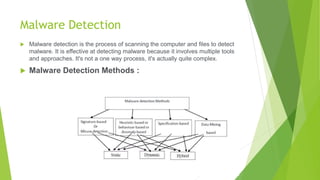
Malware Detection
 Malware detection is the process of scanning the computer and files to detect
malware. It is effective at detecting malware because it involves multiple tools
and approaches. It's not a one way process, it's actually quite complex.
 Malware Detection Methods :
 1. Viruses
• Viruses require human intervention to propagate.
• Once users download the malicious code onto their devices -- often delivered via malicious
advertisements or phishing emails the virus spreads throughout their systems.
• Viruses can modify computer functions and applications; copy, delete and exfiltrate data.
 2. Adware:
• It is capable of downloading or displaying advertisements to the device user.
• Not steel any data from the system but it forcing users to see ads.
• Some Irritating forms of adware display browser pop-ups that cannot be closed.
 3. Ransomware
• Ransomware locks or encrypts files or devices and forces victims to pay a ransom in exchange
for reentry. While ransomware and malware are often used synonymously, ransomware is a
specific form of malware.
• Types of Ransomware : Locker ransomware, Crypto ransomware, Triple extortion
ransomware,
Malware Attacks and How to Prevent Them
 4. Rootkits
• A rootkits is malicious software that enables threat actors to remotely access
and control a device.
• Rootkits facilitate the spread of other types of malware, including ransomware,
viruses and keyloggers.
• Rootkits often go undetected, because once inside a device, they can
deactivate antimalware and antivirus software.
• Rootkits typically enter devices and systems through phishing emails and
malicious attachments.
 5. Spyware
• Spyware is malware that downloads onto a device without the user's
knowledge.
• It steals users’ data to sell to advertisers and external users.
• Spyware can track credentials and obtain bank details and other sensitive data.
• It infects devices through malicious apps, links, websites and email
attachments.
How to prevent malware attacks
 Strong Cyber hygiene is the best defense against malware attacks. The premise of
cyber hygiene is similar to that of personal hygiene: If an organization maintains a high
level of health (security), it avoids getting sick (attacked).
 Cyber hygiene practices that prevent malware attacks include the following:
• Follow email security best practices.
• Deploy email security gateways.
• Avoid clicking links and downloading attachments.
• Implement strong access control.
• Require multifactor authentication.
• Use the principle of least privilege.
• Adopt a zero-trust security strategy.
• Monitor for abnormal or suspicious activity.
Malware Symptoms
 computers, they all can produce similar symptoms. Computers that are
infected
with malware can exhibit any of the following symptoms:
• Increased CPU usage
• Slow computer or web browser speeds
• Problems connecting to networks
• Freezing or crashing
• Modified or deleted files
• Appearance of strange files, programs, or desktop icons
• Programs running, turning off, or reconfiguring themselves (malware will
often reconfigure or turn off antivirus and firewall programs)
• Strange computer behavior
• Emails/messages being sent automatically and without user's knowledge (a
friend receives a strange email from you that you did not send)
MACHINE LEARNING
 Machine learning is a method of data analysis that automates analytical model
building. It is a branch of artificial intelligence based on the idea that systems
can learn from data, identify patterns and make decisions with minimal human
intervention.
 Types of machine learning
 Supervised learning
 Unsupervised learning
 Reinforcement learning
PROPOSED SOLUTION WITH ALGORITHMS
 Machine learning can easily identify the malware in the data and datasets
 Different types of machine learning algorithms are applied such as :
 DECISION TREE
 SVM
 Random forest
 XG boost
Existing Systems for malware detection using
machine learning techniques
• Implement Machine Learning Pipeline: Leverage a machine learning pipeline for
malware detection, as illustrated in the provided figure, to enhance the system's
capabilities.
• Utilize Advanced Algorithms: Apply advanced machine learning algorithms to
analyze large volumes of data effectively, enhancing malware detection accuracy.
• Incorporate Dynamic Malware Detection: Focus on dynamic malware detection to
adapt to evolving threats, considering the progressive changes in malware behavior.
• Explore Automated System-Level Detection: Investigate automated system-level
malware detection, exploring fundamentals and the current status quo in machine
learning-based detection systems.
• Consider Proposed Techniques: Evaluate proposed methods, like the one
demonstrating effectiveness in Android devices for automated malware detection.
• Regularly Update Models: Keep machine learning models updated to stay resilient
against emerging malware threats.
EXISTING SYSTEMS
 Malware detection by using window api sequence and machine learning
 Detecting unknown malicious code by applying classification techniques on
oppose patterns
 Detecting scareware by mining variable length instructions sequence
 Accurate adware detection using oppose sequence extraction
 Detection of spyware by mining executable files
 Detection by using neural networks on the malware
CONCLUSION
 A Malware is critical threat to user computer system in terms of stealing
confidential information or disabling security.
 This project present some of the existing machine learning algorithms directly
applied on the data or datasets of malware
 It explains the how the algorithms will play a role in detecting malware wit
high accuracy and predictions
 We are also using data science and data mining techniques to overcome the
drawbacks of existing system
REFERENCES
 https://en.wikipedia.org/wiki/Malware
 https://en.wikipedia.org/wiki/Machine_learning
 https://en.wikipedia.org/wiki/Supervised_learning
 https://en.wikipedia.org/wiki/Spamming
 https://www.researchgate.net/publication/343499527_Project_report_Malwa
re_analysis
 https://towardsdatascience.com/malware-detection-using-deep-learning-
6c95dd235432
Thank You

Malware Detection By Machine Learning Presentation.pptx

  • 1.
    Government Women EngineeringCollege, Ajmer (Bikaner Technical University, Bikaner) Presentation on Malware Detection By Machine Learning Submitted to: Submitted by: Mr. Sudarshan Maurya Alisha Patidar Assistant Professor B.tech VII Sem (CSE-A) (Dept. of CSE) BTU Roll No.- 20EEMCS005
  • 2.
    CONTENTS  MALWARE  MalwareDetection  Malware Attacks and How to Prevent Them  Malware Symptoms  Machine learning  Proposed solutions with algorithms  Existing Systems for malware detection using machine learning techniques  Problem identified  Conclusion  References
  • 3.
    MALWARE  Malware isany software intentionally designed to cause damage to a computer, server, client, or computer network. A wide variety of malware types exist, including computer viruses, worms, Trojan horses, ransomware, spyware, adware, rogue software, wiper and scareware.  Types of malware : Trojan horse, Virus, Adware, bots, bugs, rootkits, spyware  MALWARE DETECTOR : Malware detection is the process of scanning the computer and files to detect malware. It is effective at detecting malware because it involves multiple tools and approaches. It's not a one way process, it's actually quite complex.
  • 4.
    Malware Detection  Malwaredetection is the process of scanning the computer and files to detect malware. It is effective at detecting malware because it involves multiple tools and approaches. It's not a one way process, it's actually quite complex.  Malware Detection Methods :
  • 5.
     1. Viruses •Viruses require human intervention to propagate. • Once users download the malicious code onto their devices -- often delivered via malicious advertisements or phishing emails the virus spreads throughout their systems. • Viruses can modify computer functions and applications; copy, delete and exfiltrate data.  2. Adware: • It is capable of downloading or displaying advertisements to the device user. • Not steel any data from the system but it forcing users to see ads. • Some Irritating forms of adware display browser pop-ups that cannot be closed.  3. Ransomware • Ransomware locks or encrypts files or devices and forces victims to pay a ransom in exchange for reentry. While ransomware and malware are often used synonymously, ransomware is a specific form of malware. • Types of Ransomware : Locker ransomware, Crypto ransomware, Triple extortion ransomware, Malware Attacks and How to Prevent Them
  • 6.
     4. Rootkits •A rootkits is malicious software that enables threat actors to remotely access and control a device. • Rootkits facilitate the spread of other types of malware, including ransomware, viruses and keyloggers. • Rootkits often go undetected, because once inside a device, they can deactivate antimalware and antivirus software. • Rootkits typically enter devices and systems through phishing emails and malicious attachments.  5. Spyware • Spyware is malware that downloads onto a device without the user's knowledge. • It steals users’ data to sell to advertisers and external users. • Spyware can track credentials and obtain bank details and other sensitive data. • It infects devices through malicious apps, links, websites and email attachments.
  • 7.
    How to preventmalware attacks  Strong Cyber hygiene is the best defense against malware attacks. The premise of cyber hygiene is similar to that of personal hygiene: If an organization maintains a high level of health (security), it avoids getting sick (attacked).  Cyber hygiene practices that prevent malware attacks include the following: • Follow email security best practices. • Deploy email security gateways. • Avoid clicking links and downloading attachments. • Implement strong access control. • Require multifactor authentication. • Use the principle of least privilege. • Adopt a zero-trust security strategy. • Monitor for abnormal or suspicious activity.
  • 8.
    Malware Symptoms  computers,they all can produce similar symptoms. Computers that are infected with malware can exhibit any of the following symptoms: • Increased CPU usage • Slow computer or web browser speeds • Problems connecting to networks • Freezing or crashing • Modified or deleted files • Appearance of strange files, programs, or desktop icons • Programs running, turning off, or reconfiguring themselves (malware will often reconfigure or turn off antivirus and firewall programs) • Strange computer behavior • Emails/messages being sent automatically and without user's knowledge (a friend receives a strange email from you that you did not send)
  • 9.
    MACHINE LEARNING  Machinelearning is a method of data analysis that automates analytical model building. It is a branch of artificial intelligence based on the idea that systems can learn from data, identify patterns and make decisions with minimal human intervention.  Types of machine learning  Supervised learning  Unsupervised learning  Reinforcement learning
  • 10.
    PROPOSED SOLUTION WITHALGORITHMS  Machine learning can easily identify the malware in the data and datasets  Different types of machine learning algorithms are applied such as :  DECISION TREE  SVM  Random forest  XG boost
  • 11.
    Existing Systems formalware detection using machine learning techniques • Implement Machine Learning Pipeline: Leverage a machine learning pipeline for malware detection, as illustrated in the provided figure, to enhance the system's capabilities. • Utilize Advanced Algorithms: Apply advanced machine learning algorithms to analyze large volumes of data effectively, enhancing malware detection accuracy. • Incorporate Dynamic Malware Detection: Focus on dynamic malware detection to adapt to evolving threats, considering the progressive changes in malware behavior. • Explore Automated System-Level Detection: Investigate automated system-level malware detection, exploring fundamentals and the current status quo in machine learning-based detection systems. • Consider Proposed Techniques: Evaluate proposed methods, like the one demonstrating effectiveness in Android devices for automated malware detection. • Regularly Update Models: Keep machine learning models updated to stay resilient against emerging malware threats.
  • 12.
    EXISTING SYSTEMS  Malwaredetection by using window api sequence and machine learning  Detecting unknown malicious code by applying classification techniques on oppose patterns  Detecting scareware by mining variable length instructions sequence  Accurate adware detection using oppose sequence extraction  Detection of spyware by mining executable files  Detection by using neural networks on the malware
  • 13.
    CONCLUSION  A Malwareis critical threat to user computer system in terms of stealing confidential information or disabling security.  This project present some of the existing machine learning algorithms directly applied on the data or datasets of malware  It explains the how the algorithms will play a role in detecting malware wit high accuracy and predictions  We are also using data science and data mining techniques to overcome the drawbacks of existing system
  • 14.
    REFERENCES  https://en.wikipedia.org/wiki/Malware  https://en.wikipedia.org/wiki/Machine_learning https://en.wikipedia.org/wiki/Supervised_learning  https://en.wikipedia.org/wiki/Spamming  https://www.researchgate.net/publication/343499527_Project_report_Malwa re_analysis  https://towardsdatascience.com/malware-detection-using-deep-learning- 6c95dd235432
  • 15.