FFRI,Inc.
1
Introduction of Threat Analysis Methods
FFRI, Inc.
http://www.ffri.jpE-Mail: research-feedback[at]ffri.jp
Twitter: @FFRI_Research
Monthly Research 2016.9
FFRI,Inc.
2
Agenda
• Definition of threat analysis
• Threat analysis process
• Analysis methods
– DFD(Data Flow Diagram)
– STRIDE
– Attack Library
– Attack Tree
• Conclusions
• References
FFRI,Inc.
3
Definition of threat analysis
• Methods to identify threats and evaluate risk
• What is a threat?
– It is causes of damage to assets.
• These can be classified by environmental threats and
human threats.
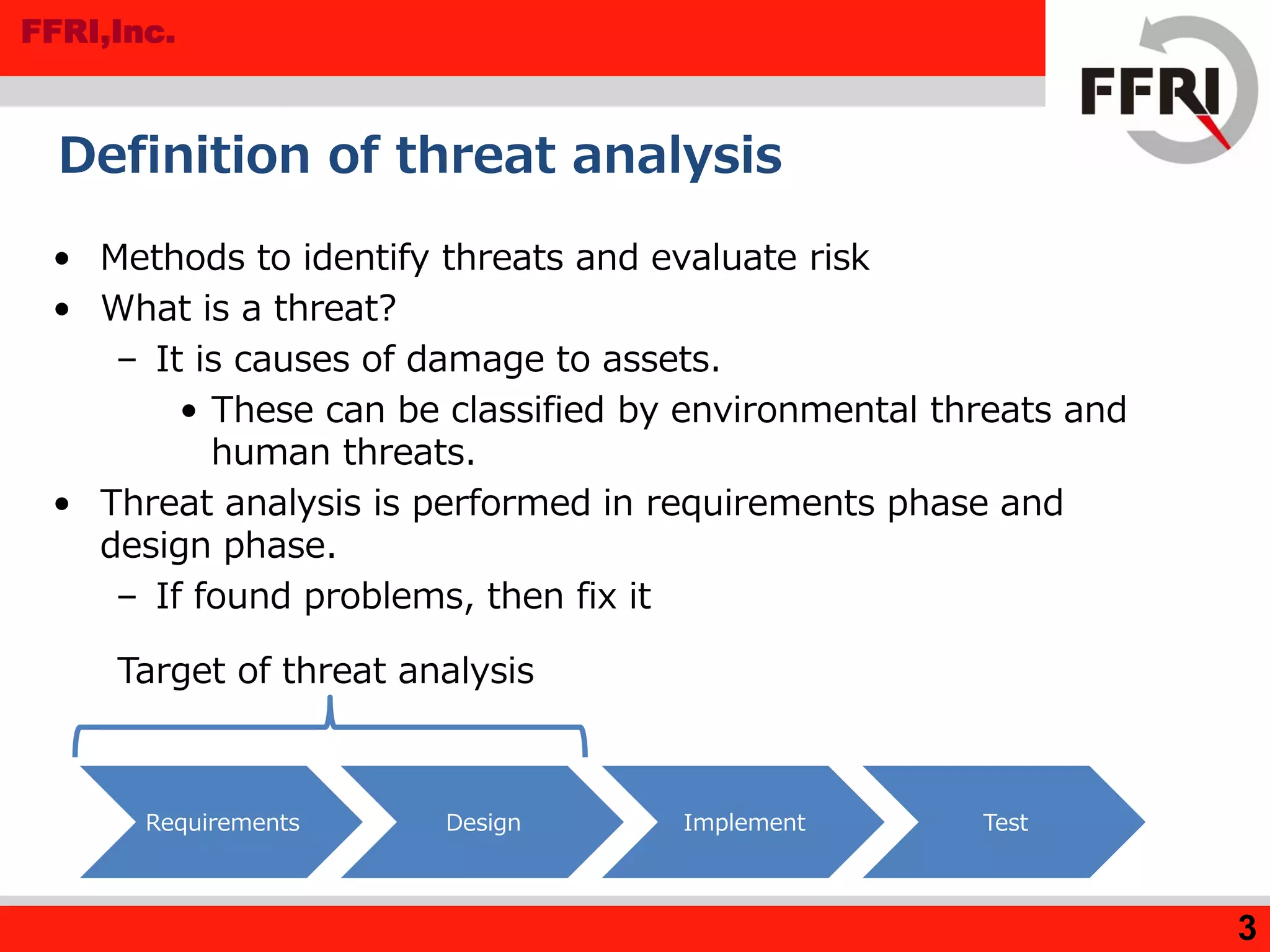
• Threat analysis is performed in requirements phase and
design phase.
– If found problems, then fix it
Requirements Design Implement Test
Target of threat analysis
FFRI,Inc.
4
Threat analysis process
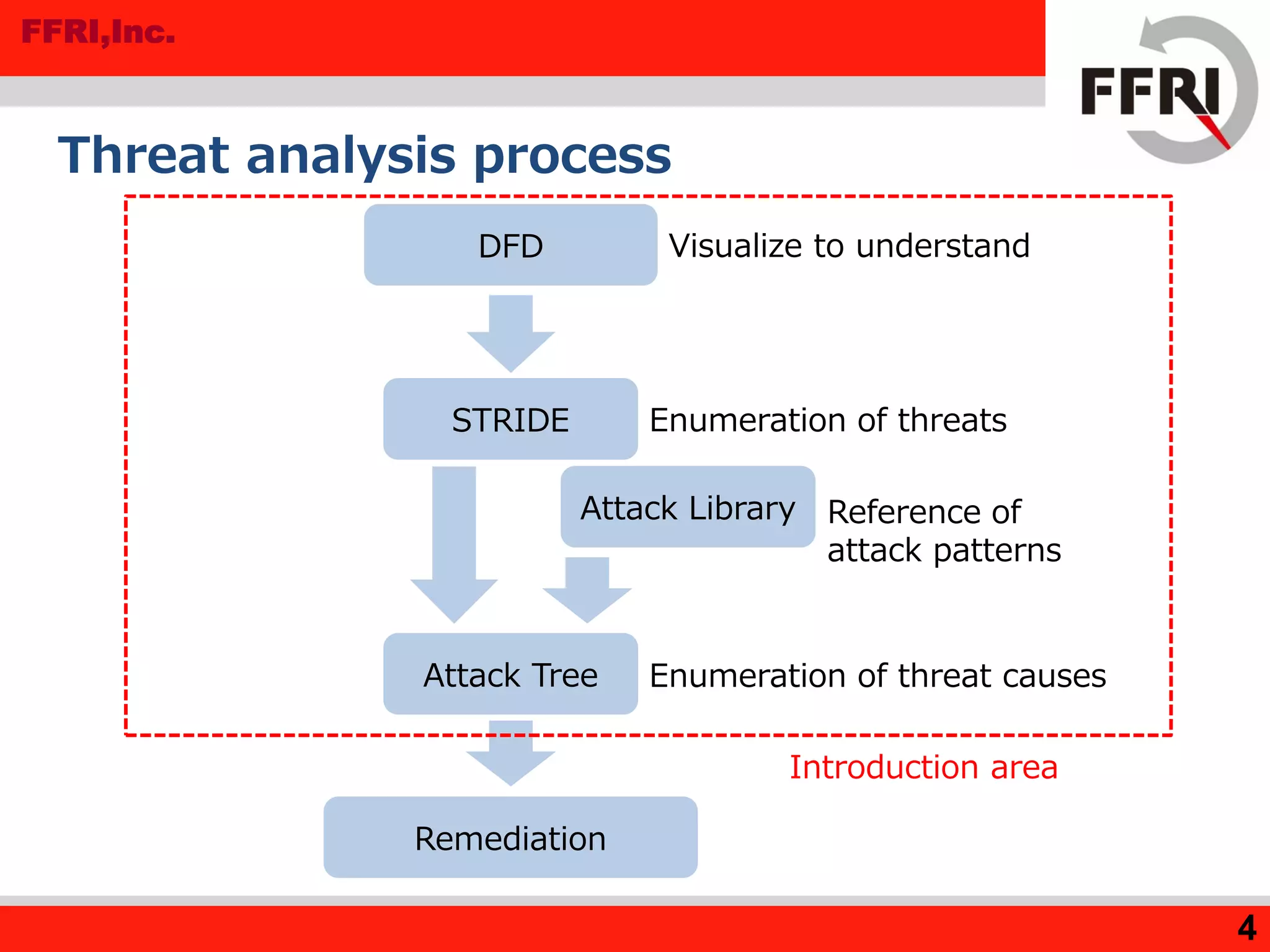
DFD
STRIDE
Attack Tree
Enumeration of threats
Enumeration of threat causes
Attack Library Reference of
attack patterns
Remediation
Visualize to understand
Introduction area
FFRI,Inc.
5
DFD(Data Flow Diagram)
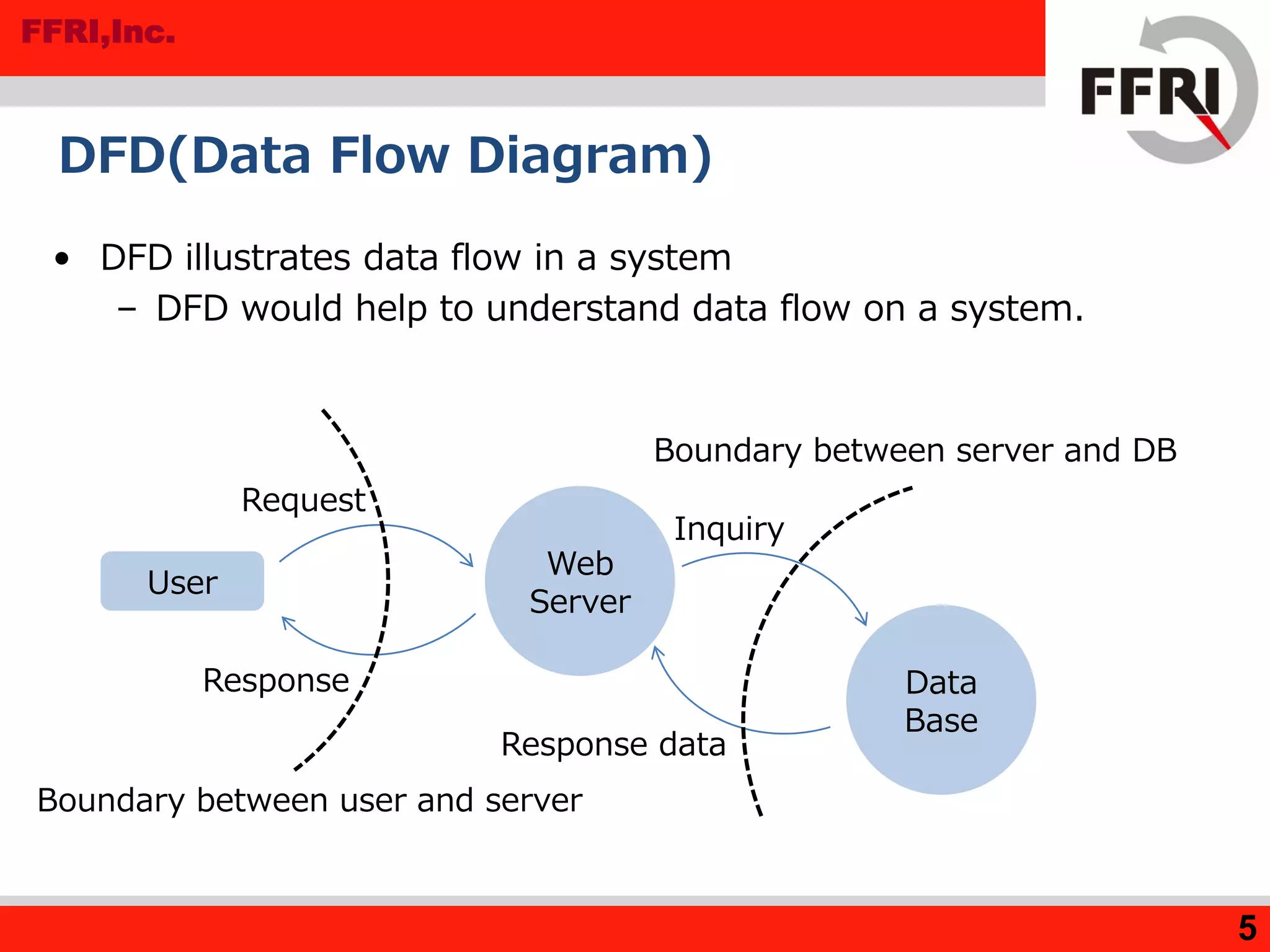
• DFD illustrates data flow in a system
– DFD would help to understand data flow on a system.
User
Web
Server
Data
Base
Response
Request
Response data
Inquiry
Boundary between server and DB
Boundary between user and server
FFRI,Inc.
6
STRIDE
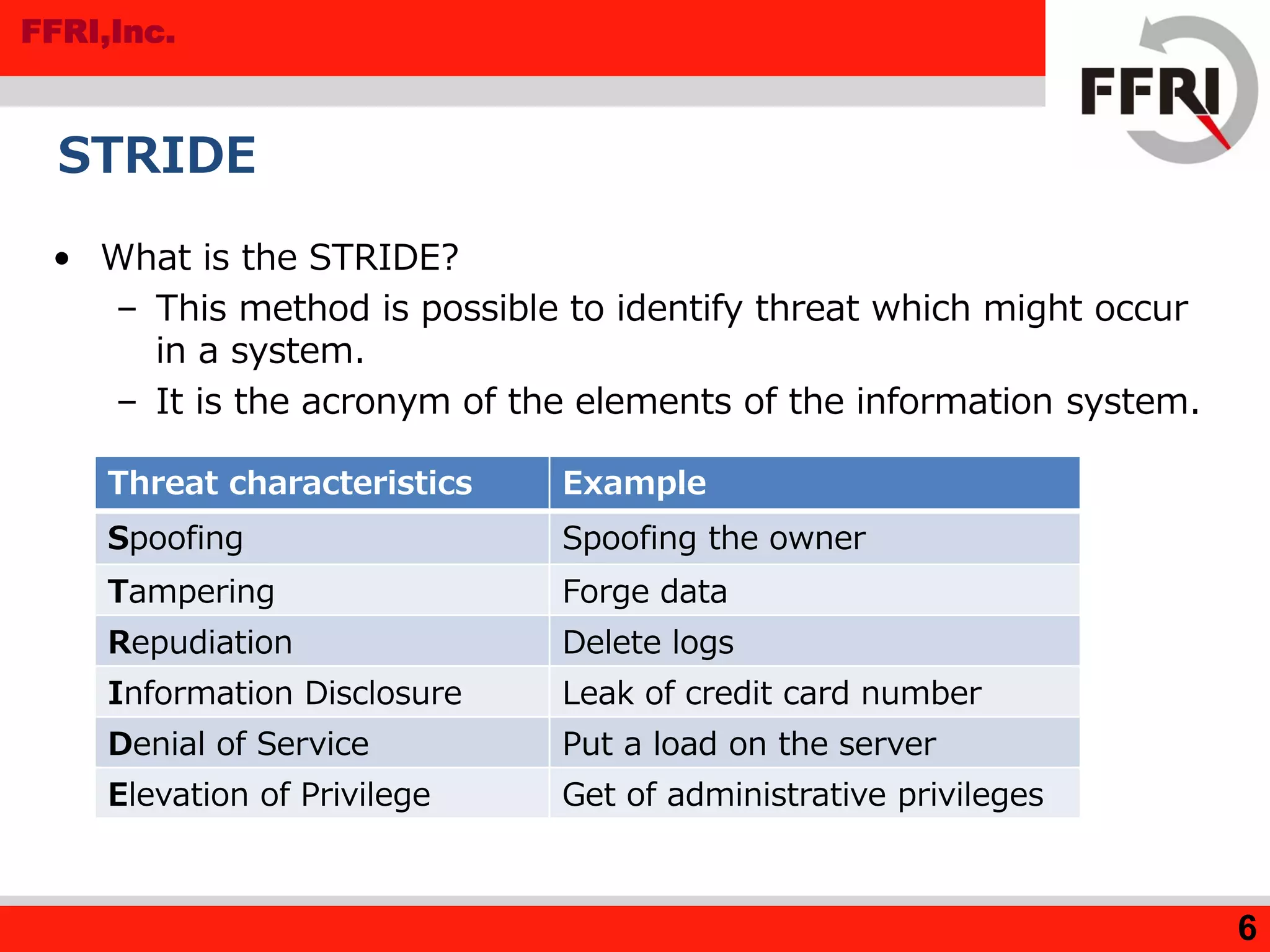
• What is the STRIDE?
– This method is possible to identify threat which might occur
in a system.
– It is the acronym of the elements of the information system.
Threat characteristics Example
Spoofing Spoofing the owner
Tampering Forge data
Repudiation Delete logs
Information Disclosure Leak of credit card number
Denial of Service Put a load on the server
Elevation of Privilege Get of administrative privileges
FFRI,Inc.
7
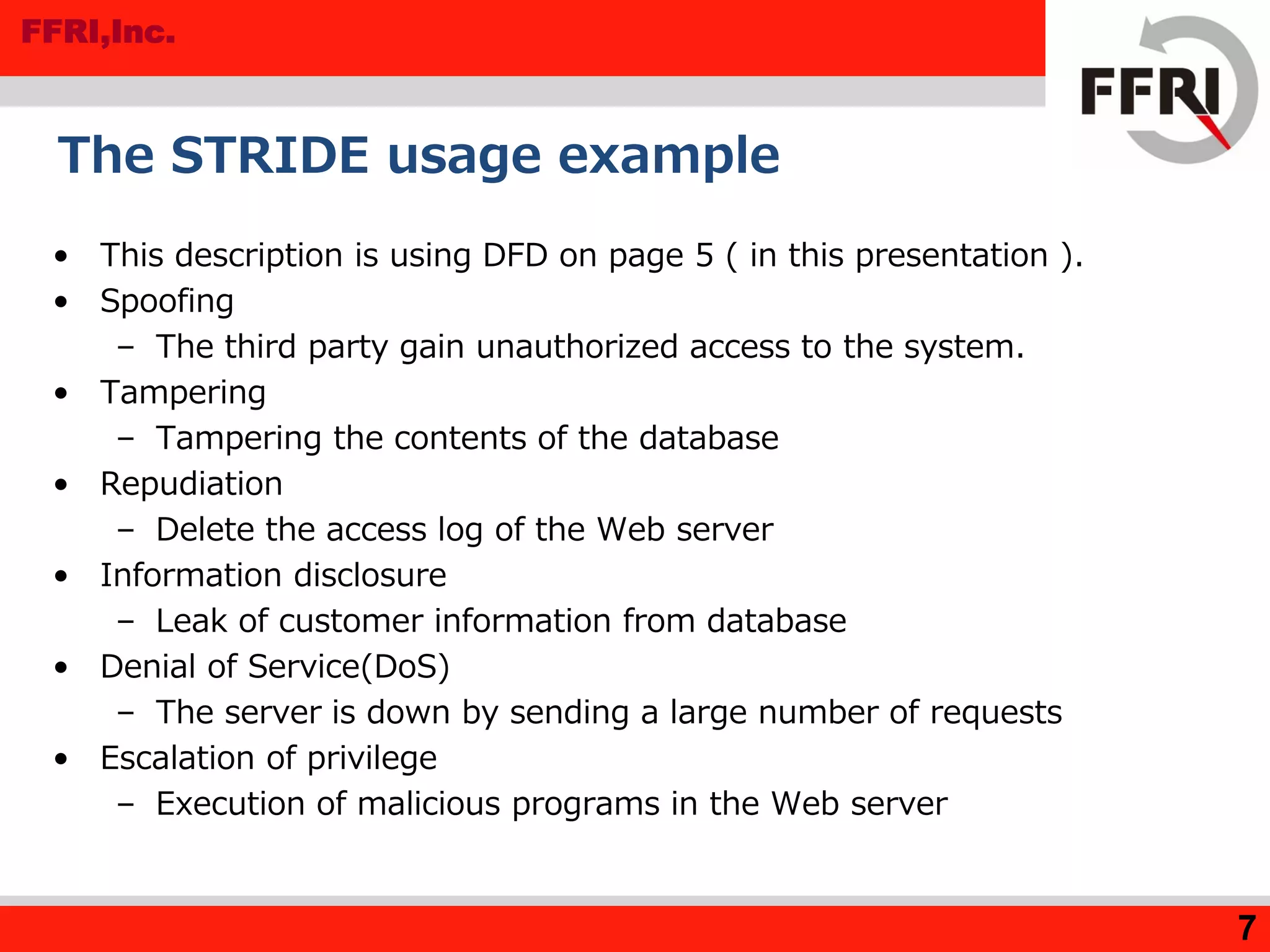
The STRIDE usage example
• This description is using DFD on page 5 ( in this presentation ).
• Spoofing
– The third party gain unauthorized access to the system.
• Tampering
– Tampering the contents of the database
• Repudiation
– Delete the access log of the Web server
• Information disclosure
– Leak of customer information from database
• Denial of Service(DoS)
– The server is down by sending a large number of requests
• Escalation of privilege
– Execution of malicious programs in the Web server
FFRI,Inc.
8
Attack Library
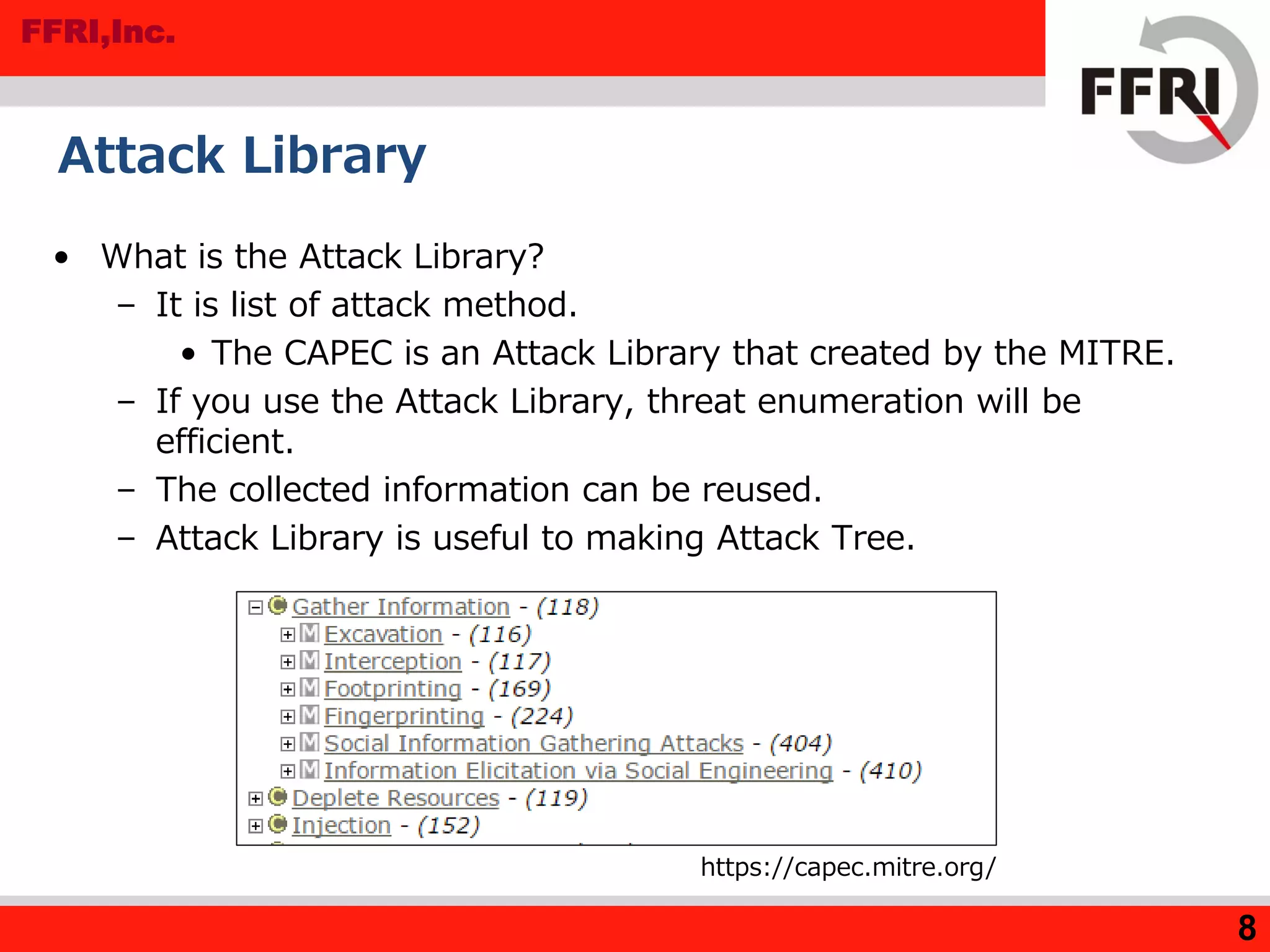
• What is the Attack Library?
– It is list of attack method.
• The CAPEC is an Attack Library that created by the MITRE.
– If you use the Attack Library, threat enumeration will be
efficient.
– The collected information can be reused.
– Attack Library is useful to making Attack Tree.
https://capec.mitre.org/
FFRI,Inc.
9
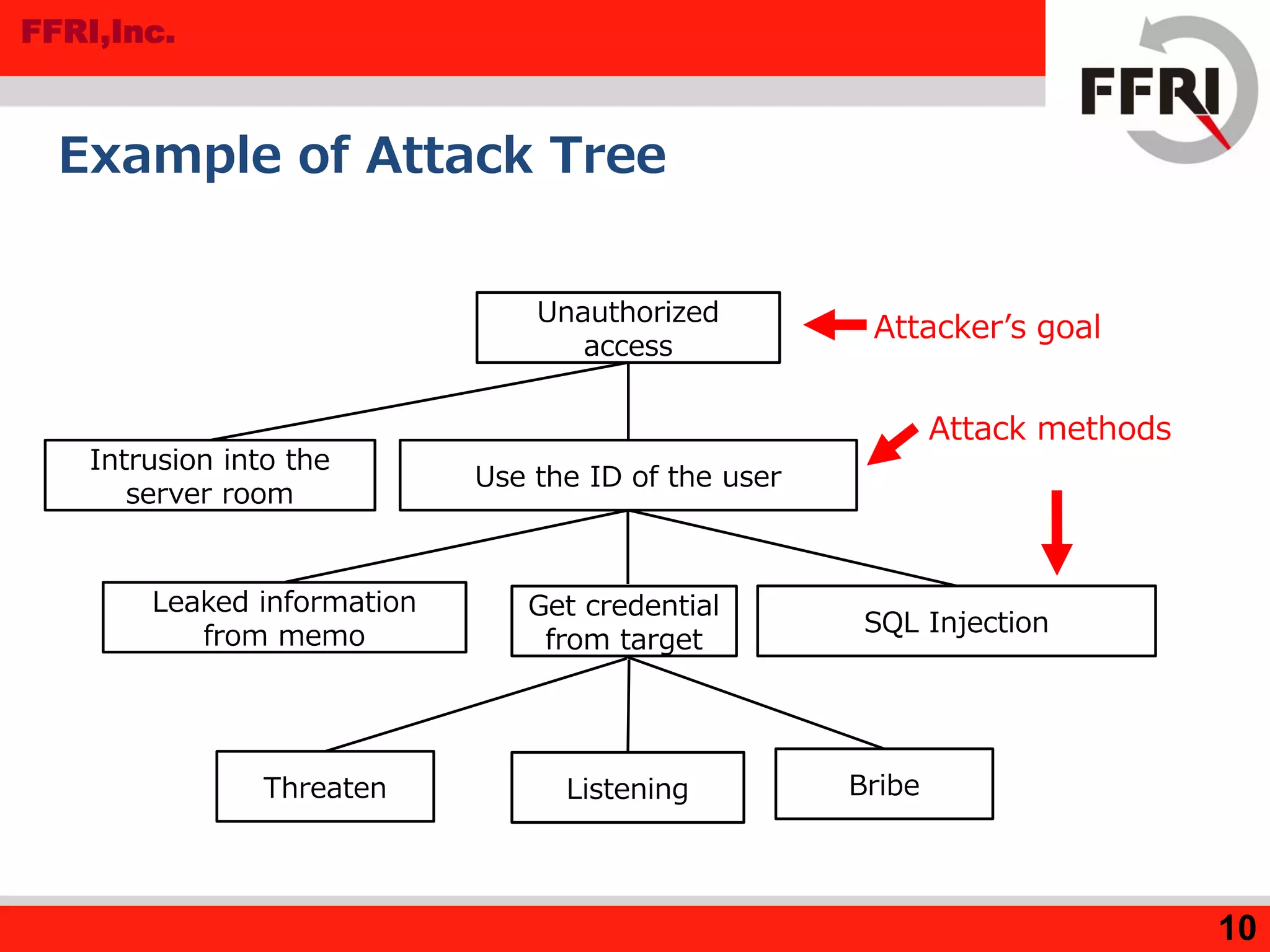
Attack Tree
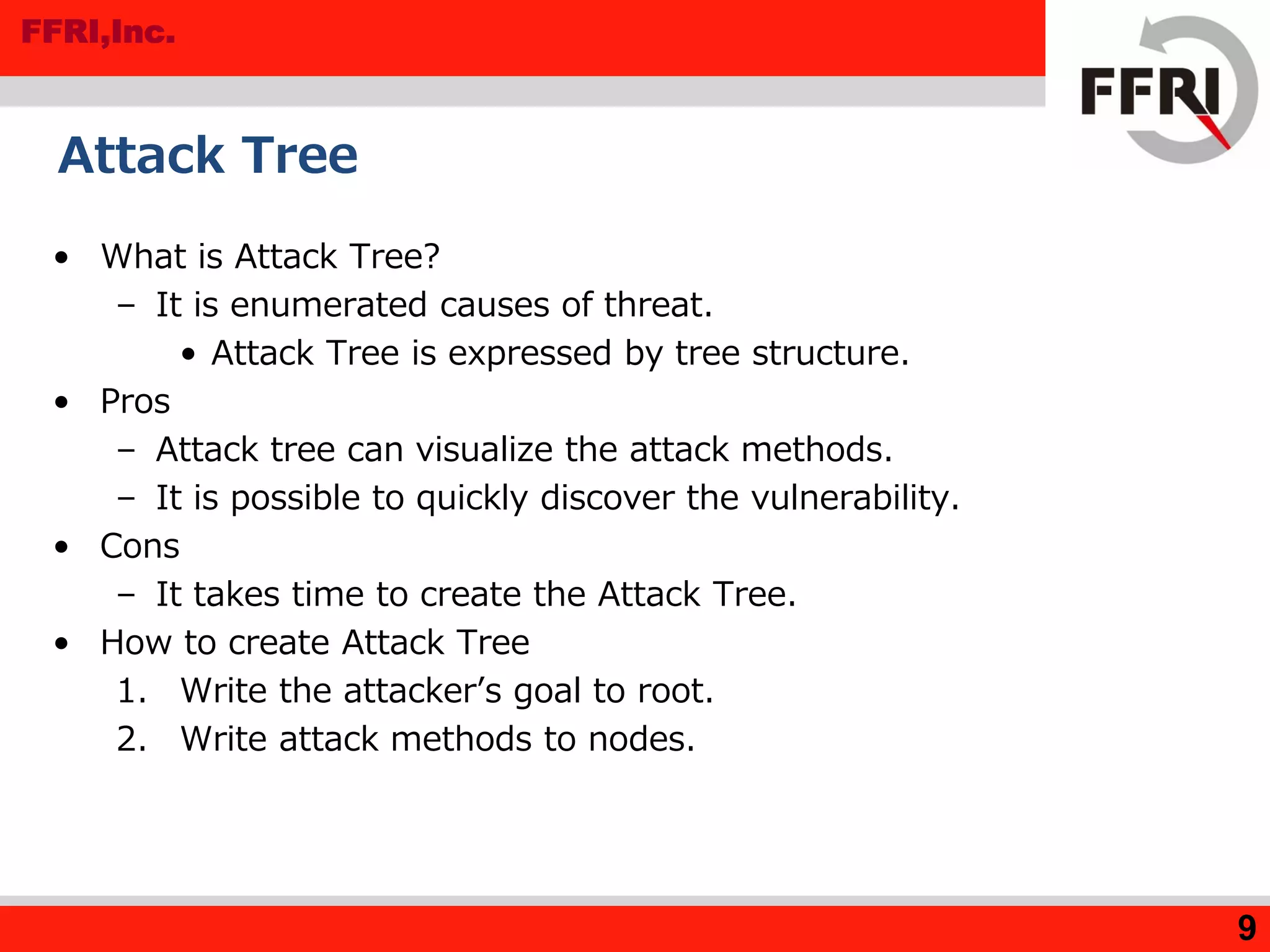
• What is Attack Tree?
– It is enumerated causes of threat.
• Attack Tree is expressed by tree structure.
• Pros
– Attack tree can visualize the attack methods.
– It is possible to quickly discover the vulnerability.
• Cons
– It takes time to create the Attack Tree.
• How to create Attack Tree
1. Write the attacker’s goal to root.
2. Write attack methods to nodes.
FFRI,Inc.
10
Example of Attack Tree
Unauthorized
access
Intrusion into the
server room
Use the ID of the user
SQL Injection
Leaked information
from memo
Get credential
from target
Threaten Listening Bribe
Attacker’s goal
Attack methods
FFRI,Inc.
11
Conclusions
• Threat analysis begins from DFD.
• STRIDE is easy to use because the threat's property has been
patterned.
• Attack library would help to perform a threat analysis more
efficiently.
– The CAPEC will be the reference of Attack Library.
• Attack Tree is useful when considering measures.
• You can obtain various information by performing threat
analysis.
– The information is a weak point to the attack.
– It will lead to finding latent threats.
FFRI,Inc.
References
• Threat Modeling
– http://as.wiley.com/WileyCDA/WileyTitle/productCd-1118809998.html
• Strategies for Threat Modeling
– https://docs.google.com/viewer?a=v&pid=sites&srcid=ZGVmYXVsdGRvbWFpbnxzaWdzdGF3ZWJ8
Z3g6NmE4NDhjYWNhOGYxMDBlOQ
• STRIDE
– https://docs.google.com/viewer?a=v&pid=sites&srcid=ZGVmYXVsdGRvbWFpbnxzaWdzdGF3ZWJ8
Z3g6MmY4ZTgxNmY5ODFhZWY5MA
• Attack Trees
– https://docs.google.com/viewer?a=v&pid=sites&srcid=ZGVmYXVsdGRvbWFpbnxzaWdzdGF3ZWJ8
Z3g6M2UzZDhjYWE5ZmU2NzJjYQ
• Attack Libraries
– https://docs.google.com/viewer?a=v&pid=sites&srcid=ZGVmYXVsdGRvbWFpbnxzaWdzdGF3ZWJ8
Z3g6YmVkN2EwODFjMDcxMjg3
• CAPEC
– https://capec.mitre.org/
• Threat Modeling Analysis
– https://msdn.microsoft.com/ja-jp/library/aa561499.aspx
12

Introduction of Threat Analysis Methods(FFRI Monthly Research 2016.9)

  • 1.
    FFRI,Inc. 1 Introduction of ThreatAnalysis Methods FFRI, Inc. http://www.ffri.jpE-Mail: research-feedback[at]ffri.jp Twitter: @FFRI_Research Monthly Research 2016.9
  • 2.
    FFRI,Inc. 2 Agenda • Definition ofthreat analysis • Threat analysis process • Analysis methods – DFD(Data Flow Diagram) – STRIDE – Attack Library – Attack Tree • Conclusions • References
  • 3.
    FFRI,Inc. 3 Definition of threatanalysis • Methods to identify threats and evaluate risk • What is a threat? – It is causes of damage to assets. • These can be classified by environmental threats and human threats. • Threat analysis is performed in requirements phase and design phase. – If found problems, then fix it Requirements Design Implement Test Target of threat analysis
  • 4.
    FFRI,Inc. 4 Threat analysis process DFD STRIDE AttackTree Enumeration of threats Enumeration of threat causes Attack Library Reference of attack patterns Remediation Visualize to understand Introduction area
  • 5.
    FFRI,Inc. 5 DFD(Data Flow Diagram) •DFD illustrates data flow in a system – DFD would help to understand data flow on a system. User Web Server Data Base Response Request Response data Inquiry Boundary between server and DB Boundary between user and server
  • 6.
    FFRI,Inc. 6 STRIDE • What isthe STRIDE? – This method is possible to identify threat which might occur in a system. – It is the acronym of the elements of the information system. Threat characteristics Example Spoofing Spoofing the owner Tampering Forge data Repudiation Delete logs Information Disclosure Leak of credit card number Denial of Service Put a load on the server Elevation of Privilege Get of administrative privileges
  • 7.
    FFRI,Inc. 7 The STRIDE usageexample • This description is using DFD on page 5 ( in this presentation ). • Spoofing – The third party gain unauthorized access to the system. • Tampering – Tampering the contents of the database • Repudiation – Delete the access log of the Web server • Information disclosure – Leak of customer information from database • Denial of Service(DoS) – The server is down by sending a large number of requests • Escalation of privilege – Execution of malicious programs in the Web server
  • 8.
    FFRI,Inc. 8 Attack Library • Whatis the Attack Library? – It is list of attack method. • The CAPEC is an Attack Library that created by the MITRE. – If you use the Attack Library, threat enumeration will be efficient. – The collected information can be reused. – Attack Library is useful to making Attack Tree. https://capec.mitre.org/
  • 9.
    FFRI,Inc. 9 Attack Tree • Whatis Attack Tree? – It is enumerated causes of threat. • Attack Tree is expressed by tree structure. • Pros – Attack tree can visualize the attack methods. – It is possible to quickly discover the vulnerability. • Cons – It takes time to create the Attack Tree. • How to create Attack Tree 1. Write the attacker’s goal to root. 2. Write attack methods to nodes.
  • 10.
    FFRI,Inc. 10 Example of AttackTree Unauthorized access Intrusion into the server room Use the ID of the user SQL Injection Leaked information from memo Get credential from target Threaten Listening Bribe Attacker’s goal Attack methods
  • 11.
    FFRI,Inc. 11 Conclusions • Threat analysisbegins from DFD. • STRIDE is easy to use because the threat's property has been patterned. • Attack library would help to perform a threat analysis more efficiently. – The CAPEC will be the reference of Attack Library. • Attack Tree is useful when considering measures. • You can obtain various information by performing threat analysis. – The information is a weak point to the attack. – It will lead to finding latent threats.
  • 12.
    FFRI,Inc. References • Threat Modeling –http://as.wiley.com/WileyCDA/WileyTitle/productCd-1118809998.html • Strategies for Threat Modeling – https://docs.google.com/viewer?a=v&pid=sites&srcid=ZGVmYXVsdGRvbWFpbnxzaWdzdGF3ZWJ8 Z3g6NmE4NDhjYWNhOGYxMDBlOQ • STRIDE – https://docs.google.com/viewer?a=v&pid=sites&srcid=ZGVmYXVsdGRvbWFpbnxzaWdzdGF3ZWJ8 Z3g6MmY4ZTgxNmY5ODFhZWY5MA • Attack Trees – https://docs.google.com/viewer?a=v&pid=sites&srcid=ZGVmYXVsdGRvbWFpbnxzaWdzdGF3ZWJ8 Z3g6M2UzZDhjYWE5ZmU2NzJjYQ • Attack Libraries – https://docs.google.com/viewer?a=v&pid=sites&srcid=ZGVmYXVsdGRvbWFpbnxzaWdzdGF3ZWJ8 Z3g6YmVkN2EwODFjMDcxMjg3 • CAPEC – https://capec.mitre.org/ • Threat Modeling Analysis – https://msdn.microsoft.com/ja-jp/library/aa561499.aspx 12