MALWARE ANALYSIS USING DEEP LEARNING
Vempaty Prashanthi, Srinivas Kanakala
Dr.SRINIVAS KANAKALA
Department of CSE,VNR VIGNANA JYOTHI INSTITUTE OF ENGINEERING
&TEHCNOLOGY
Paper ID: 1160
2024 1st
International Conference on Advances in Computing,
Communication and Networking (ICAC2N)
Conference Record Number # 63387
ISBN # 979-8-3503-5681-6
Table of Content
• Abstract
• Introduction
• Literature/ Related Work
• Methodology/Proposed Work
• Results
• Conclusion
• Future Scope*
Abstract
• Malware analysis leverages deep learning to enhance threat detection and mitigation.
This innovative approach employs neural networks to discern intricate patterns
within malicious code, enabling faster and more accurate identification of threats.
• By analyzing vast datasets, deep learning models acquire the capability to recognize
evolving malware behaviors, thereby strengthening cybersecurity measures. This
amalgamation of artificial intelligence and cybersecurity proves pivotal in staying
ahead of sophisticated cyber threats, ensuring a proactive defense against malware
infiltrations.
• Furthermore, deep learning facilitates dynamic adaptation to emerging malware
variants, reducing reliance on static signatures.
• Traditional methods often struggle to keep pace with the rapid evolution of malicious
software. Deep learning models, however, excel in generalization, enabling them to
identify anomalies and potential threats even without explicit knowledge of specific
malware signatures. This adaptability enhances the resilience of cybersecurity
systems, creating a robust defense mechanism that remains effective against a
constantly evolving landscape of cyber threats.
Introduction
•In the realm of financial security, insurance serves as a safeguard against
unforeseen losses, damages, or injuries. This pivotal mechanism involves a
contractual agreement where a party, known as the insurer, undertakes to provide
compensation to another party, the insured, in exchange for a predetermined fee.
Operating as a fundamental aspect of risk management, insurance mitigates the
impact of contingent or uncertain losses. This intricate process engages various
entities, including insurers, policyholders, and the insured, each playing distinct roles
in a system designed to provide financial protection.
•
• However, within the domain of insurance lurks a formidable challenge—fraud.
Deliberate deceit, committed for financial gain, poses a significant threat to insurance
companies. Fraudulent activities can manifest at various stages, involving applicants,
policyholders, third-party claimants, or even internal actors like insurance agents and
company employees. Common fraudulent practices encompass inflating claims,
falsifying information on applications, submitting fictitious claims, and orchestrating
staged accidents.
Introduction
• Recognizing the gravity of insurance fraud and the
increasing complexity of data, this project delves into the
realm of machine learning. By leveraging advanced
algorithms, the objective is to detect and prevent fraudulent
activities that can potentially lead to substantial financial
losses.
• The project begins by selecting a suitable model, evaluating
the accuracies of various algorithms, and ultimately
identifying the most effective approach. In a landscape where
patterns may elude human perception, machine learning
stands as a powerful ally, systematically analyzing
multifaceted data to enhance the industry’s resilience against
financial fraud.
Literature/ Related Work
• Malware analysis and detection have been significantly enhanced by the
application of deep learning and machine learning systems. Several studies
demonstrated the effectiveness of these approaches in identifying and
classifying malware based on various features, such as API calls, PE headers,
and behavior-based characteristics. Machine learning algorithms are being used
for fraud detection techniques[1-3].
• Many machine learning algorithms are also used in health sector[4-6], where as
some algorithms are used in disease detection in agriculture field. [7-9].
• Machine learning is used in security field to detect the malwares present in a
document. Analyze malware utilizing artificial intelligence and deep learning:
This book explores the effective use of deep learning and artificial intelligence
in malware detection and analysis, showcasing state-of-the-art tools,
frameworks, and methods in the field of cybersecurity and malware detection.
[10-12] paper discusses the superiority of deep learning methodologies over
old shallow machine learning approaches in malware analysis.
• The detection of malware in Windows systems based on static analysis depends
on multiple features.
Literature/ Related Work
• The study presents a combination of machine learning model based on
multiple filtering and supervised attribute clustering procedure for
categorizing malware samples. It also discusses the significance of using PE
files and the effectiveness of various feature sets in malware detection.
• Another study proposes a deep learning related sequential system for
analyzing malware windows exe API calls, demonstrating the effectiveness
of hybrid neural networks in classifying malware.
• Deep learning and machine learning systems have shown promising results
in the detection and analysis of malware, outperforming traditional
methods. Various features such as API calls, PE headers, and behavior-based
characteristics have been effectively utilized in malware recognition and
classification using machine learning and deep learning approaches.
• The application of ensemble learning, feature selection, and the
combination of raw features to create new ones have been identified as
important factors in increasing the accurateness of malware detection
models.
Methodology/Proposed Work
• In the domain of cybersecurity, the literature surrounding malware analysis
reflects a growing need for innovative approaches to counter evolving
threats. Researchers emphasize the significance of leveraging deep learning
methods to enhance the accurateness and effectiveness of malware
detection. Studies highlight the limitations of traditional methods,
emphasizing the dynamic nature of cyber threats and the need for adaptive
solutions.
• The adoption of neural networks in malware analysis is a prevailing theme
in the literature, showcasing their efficacy in identifying intricate patterns
within malicious code. Researchers underscore the importance of
generalization capabilities, allowing models to identify anomalies without
relying on specific malware signatures.
• This adaptability is crucial in addressing the rapid evolution of malicious
software. Literature also accentuates the role of deep learning in risk
management, particularly in hedging against contingent or uncertain losses.
The transactional dynamics between policyholders and insurers, as studied
in insurance contexts, draw parallels to the relationship between users and
malware analysts.
Methodology/Proposed Work
• The exchange of information and the concept of insurable interest
find resonance in the context of mitigating cybersecurity risks.
Additionally, discussions on insurance fraud shed light on the
financial implications of cybersecurity breaches. The literature
underscores the critical need for advanced fraud detection methods,
mirroring the motivations behind developing effective malware
analysis tools.
• The complexity of fraudulent activities and the potential financial
losses highlight the urgency of adopting machine learning
approaches to bolster cybersecurity measures. As the literature
converges on the intersection of deep learning, malware analysis,
and risk management, it establishes a foundation for the current
project. By integrating understandings from diverse fields, this
research attempts to contribute to the ongoing discourse, providing
a practical and effective solution to the ever-evolving challenges in
the realm of cybersecurity
Methodology/Proposed Work
• Malware analysis, propelled by the integration of deep learning,
signifies a paradigm shift in cybersecurity. Traditional methods
often fall short in effectively detecting and responding to the rapid
evolution of malicious software. Deep learning, as evidenced in
the literature, offers a promising solution by enabling the
identification of intricate patterns within malware code.
• Researchers emphasize the need for adaptive approaches, and
deep learning models showcase remarkable generalization
capabilities, allowing them to recognize anomalies without relying
on predefined signatures. This flexibility positions deep learning as
a potent tool for addressing the dynamic and sophisticated nature
of contemporary cyber threats. Moreover, the literature
underscores the pivotal role of deep learning in risk management
within the cybersecurity domain.
• The transactional dynamics between policyholders and
insurers, as studied in insurance contexts, find resonance
in the relationship between users and malware analysts.
The literature highlights the importance of mitigating
uncertain losses, mirroring the objectives of malware
analysis in reducing the impact of unforeseen
cybersecurity breaches.
• By delving into these interdisciplinary connections, this
literature review lays the groundwork for understanding
the importance of deep learning in reshaping the
landscape of malware analysis and risk mitigation.
Methodology/Proposed Work
•A machine learning model is the statistical depiction of the outcome of the training
process. Machine learning can build new model by taking input from existing data and
can also improve its performance by experience. It identifies patterns and behaviours
depending upon the last experiences, inputs and data given. The algorithm which is
now studies and identifies various patterns which are in the training data, and it gives
out a model which catches these patterns and yields predictions on the fresh data. In
our research we compared different machine learning models like
 Logistic Regression
 XGBOOST
Methodology/Proposed Work
 ADA BOOST
 Decision Tree
 Random Forest
•
•Logistic regression is a greatly applied classification algorithm. In this model a
function is used to evaluate the co- relation between the variables which are given as
input and the output we get. Further Decision trees iteratively split up the dataset
which is given as input into a tree pattern by considering the features. The internal
node is identified as a feature and leave is identified as labels of a class. This model
works well, and it is suitable for classification as well as regression. Whereas Random
Forest utilizes an ensemble learning procedure where predictions are done by the
combination of more than one decision tress. Best accuracy is obtained by combining
different decision trees and their predictions.
Methodology/Proposed Work
• It is used to train the model. The model learns from this data set and gives the
outputs based on the learning during the testing. We have data consisting of 10000
rows and 40 columns, each column has its own significance to find patterns in data.
Each row consists of person who are insured. Data set consisting of 10000 rows
and 40 columns. N unique functions help us to find unique values present in the
single column. Some columns have a high number of unique elements, and some
have less unique elements. Seeing the number of unique numbers is important to
see whether many unique elements are needed for prediction.
• And we can see no column has a number of unique elements equal to 1 which
means no needed to delete or remove any feature because if a column has only one
value then it contribute nothing to the model prediction. In our data set there are
50000 malware and 50000 normal cases are their, with which we can train our
model. XGBoost (eXtreme Gradient Boosting) is a highly efficient, flexible, and
portable library optimized for distributed gradient boosting. It implements machine
learning algorithms within the Gradient Boosting framework.
Results
Results
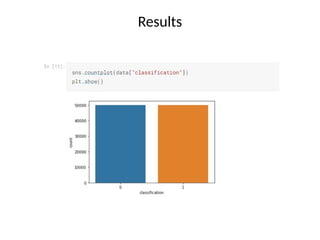
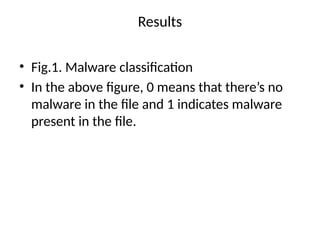
• Fig.1. Malware classification
• In the above figure, 0 means that there’s no
malware in the file and 1 indicates malware
present in the file.
Results
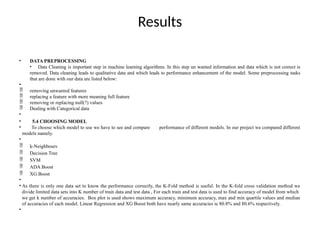
• DATA PREPROCESSING
• Data Cleaning is important step in machine learning algorithms. In this step un wanted information and data which is not correct is
removed. Data cleaning leads to qualitative data and which leads to performance enhancement of the model. Some preprocessing tasks
that are done with our data are listed below:
•
 removing unwanted features
 replacing a feature with more meaning full feature
 removing or replacing null(?) values
 Dealing with Categorical data
•
• 5.4 CHOOSING MODEL
• To choose which model to use we have to see and compare performance of different models. In our project we compared different
models namely.
•
 k-Neighbours
 Decision Tree
 SVM
 ADA Boost
 XG Boost
•
• As there is only one data set to know the performance correctly, the K-Fold method is useful. In the K-fold cross validation method we
divide limited data sets into K number of train data and test data , For each train and test data is used to find accuracy of model from which
we get k number of accuracies. Box plot is used shows maximum accuracy, minimum accuracy, max and min quartile values and median
of accuracies of each model. Linear Regression and XG Boost both have nearly same accuracies ie 80.8% and 80.6% respectively.
•
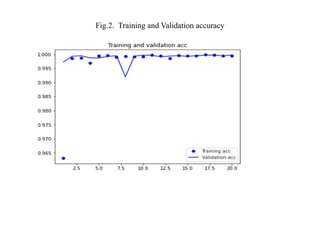
Fig.2. Training and Validation accuracy
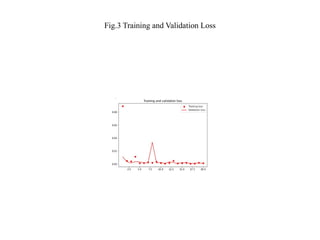
Fig.3 Training and Validation Loss
Results
•The above figures 2 and 3 depict the training and validation arc and loss after the
output is generated. From Above we can see linear regression and XGB have high
accuracies. so either of them can be used for fraud detection. Linear regression have
low standard deviation so we are considering the model(Linear Regression) and test it
with data for accuracy. The above figure show the prediction for the data provided
using the best model that is taken based on accuracy.
•
• The accuracy of the model is 0.9995 which is about 99.95% now lets run it against
another set to test out the accuracy the model prediction.
Conclusion
•In summary, the work on malware analysis employing deep learning emerges as
a pivotal advancement in cybersecurity. The literature review has illuminated the
shortcomings of traditional methods and emphasized the transformative capacity of
deep learning in enhancing adaptability and response efficiency. By aligning with the
principles of risk management, the project not only addresses the immediate need for
proactive threat detection but also positions itself as a proactive measure against the
unpredictable and evolving nature of cyber threats.
•This undertaking stands at the forefront of technological innovation, poised to
fortify organizational resilience in the face of an increasingly complex cybersecurity
landscape. Through its automation and adaptability, the project not only addresses
existing drawbacks but also sets a precedent for future advancements in the ongoing
battle against malicious activities in the digital realm.
•In essence, this project marks a significant stride towards a more secure and robust
digital environment. By harnessing the power of deep learning, it not only explains
present challenges but also lays a foundation for continuous improvement in the
dynamic field of cybersecurity. The amalgamation of innovation and adaptability
positions this initiative as a beacon for safeguarding digital landscapes against the
relentless evolution of malicious threats.
• THANK YOU
REFERENCES
•
1. Salmi, Mabrouka, and Dalia Atif. "A Data Mining Approach for Imbalanced Automobile
Insurance Fraud Data with Evaluation of Two Sampling Techniques and Two Filters."
2. Sundarkumar, G. Ganesh, Vadlamani Ravi, and V. Siddeshwar. "One-class support vector
machine based undersampling: Application to churn prediction and insurance fraud detection."
2015 IEEE International Conference on Computational Intelligence and Computing Research
(ICCIC). IEEE, 2015.
3. Bhowmik, Rekha. "Detecting auto insurance fraud by data mining techniques." Journal of
Emerging Trends in Computing and Information Sciences 2.4 (2011): 156-162.
4. Kanakala, S., Prashanthi, V. (2021). Covid-19 Spread Analysis. In: Satapathy, S.C., Bhateja, V.,
Favorskaya, M.N., Adilakshmi, T. (eds) Smart Computing Techniques and Applications. Smart
Innovation, Systems and Technologies, vol 224. Springer, Singapore
5. Sharada, K.V., Prashanthi, V., Kanakala, S. (2022). Detection and Classification of Intracranial
Brain Hemorrhage. In: Nayak, P., Pal, S., Peng, SL. (eds) IoT and Analytics for Sensor
Networks. Lecture Notes in Networks and Systems, vol 244. Springer, Singapore
6. Dasi, Haarika, and Srinivas Kanakala. "Student Dropout Prediction Using Machine Learning
Techniques." International Journal of Intelligent Systems and Applications in Engineering 10.4
(2022): 408-414.

MALWARE ANALYSIS USING DEEP LEARNING PRE

  • 1.
    MALWARE ANALYSIS USINGDEEP LEARNING Vempaty Prashanthi, Srinivas Kanakala Dr.SRINIVAS KANAKALA Department of CSE,VNR VIGNANA JYOTHI INSTITUTE OF ENGINEERING &TEHCNOLOGY Paper ID: 1160 2024 1st International Conference on Advances in Computing, Communication and Networking (ICAC2N) Conference Record Number # 63387 ISBN # 979-8-3503-5681-6
  • 2.
    Table of Content •Abstract • Introduction • Literature/ Related Work • Methodology/Proposed Work • Results • Conclusion • Future Scope*
  • 3.
    Abstract • Malware analysisleverages deep learning to enhance threat detection and mitigation. This innovative approach employs neural networks to discern intricate patterns within malicious code, enabling faster and more accurate identification of threats. • By analyzing vast datasets, deep learning models acquire the capability to recognize evolving malware behaviors, thereby strengthening cybersecurity measures. This amalgamation of artificial intelligence and cybersecurity proves pivotal in staying ahead of sophisticated cyber threats, ensuring a proactive defense against malware infiltrations. • Furthermore, deep learning facilitates dynamic adaptation to emerging malware variants, reducing reliance on static signatures. • Traditional methods often struggle to keep pace with the rapid evolution of malicious software. Deep learning models, however, excel in generalization, enabling them to identify anomalies and potential threats even without explicit knowledge of specific malware signatures. This adaptability enhances the resilience of cybersecurity systems, creating a robust defense mechanism that remains effective against a constantly evolving landscape of cyber threats.
  • 4.
    Introduction •In the realmof financial security, insurance serves as a safeguard against unforeseen losses, damages, or injuries. This pivotal mechanism involves a contractual agreement where a party, known as the insurer, undertakes to provide compensation to another party, the insured, in exchange for a predetermined fee. Operating as a fundamental aspect of risk management, insurance mitigates the impact of contingent or uncertain losses. This intricate process engages various entities, including insurers, policyholders, and the insured, each playing distinct roles in a system designed to provide financial protection. • • However, within the domain of insurance lurks a formidable challenge—fraud. Deliberate deceit, committed for financial gain, poses a significant threat to insurance companies. Fraudulent activities can manifest at various stages, involving applicants, policyholders, third-party claimants, or even internal actors like insurance agents and company employees. Common fraudulent practices encompass inflating claims, falsifying information on applications, submitting fictitious claims, and orchestrating staged accidents.
  • 5.
    Introduction • Recognizing thegravity of insurance fraud and the increasing complexity of data, this project delves into the realm of machine learning. By leveraging advanced algorithms, the objective is to detect and prevent fraudulent activities that can potentially lead to substantial financial losses. • The project begins by selecting a suitable model, evaluating the accuracies of various algorithms, and ultimately identifying the most effective approach. In a landscape where patterns may elude human perception, machine learning stands as a powerful ally, systematically analyzing multifaceted data to enhance the industry’s resilience against financial fraud.
  • 6.
    Literature/ Related Work •Malware analysis and detection have been significantly enhanced by the application of deep learning and machine learning systems. Several studies demonstrated the effectiveness of these approaches in identifying and classifying malware based on various features, such as API calls, PE headers, and behavior-based characteristics. Machine learning algorithms are being used for fraud detection techniques[1-3]. • Many machine learning algorithms are also used in health sector[4-6], where as some algorithms are used in disease detection in agriculture field. [7-9]. • Machine learning is used in security field to detect the malwares present in a document. Analyze malware utilizing artificial intelligence and deep learning: This book explores the effective use of deep learning and artificial intelligence in malware detection and analysis, showcasing state-of-the-art tools, frameworks, and methods in the field of cybersecurity and malware detection. [10-12] paper discusses the superiority of deep learning methodologies over old shallow machine learning approaches in malware analysis. • The detection of malware in Windows systems based on static analysis depends on multiple features.
  • 7.
    Literature/ Related Work •The study presents a combination of machine learning model based on multiple filtering and supervised attribute clustering procedure for categorizing malware samples. It also discusses the significance of using PE files and the effectiveness of various feature sets in malware detection. • Another study proposes a deep learning related sequential system for analyzing malware windows exe API calls, demonstrating the effectiveness of hybrid neural networks in classifying malware. • Deep learning and machine learning systems have shown promising results in the detection and analysis of malware, outperforming traditional methods. Various features such as API calls, PE headers, and behavior-based characteristics have been effectively utilized in malware recognition and classification using machine learning and deep learning approaches. • The application of ensemble learning, feature selection, and the combination of raw features to create new ones have been identified as important factors in increasing the accurateness of malware detection models.
  • 8.
    Methodology/Proposed Work • Inthe domain of cybersecurity, the literature surrounding malware analysis reflects a growing need for innovative approaches to counter evolving threats. Researchers emphasize the significance of leveraging deep learning methods to enhance the accurateness and effectiveness of malware detection. Studies highlight the limitations of traditional methods, emphasizing the dynamic nature of cyber threats and the need for adaptive solutions. • The adoption of neural networks in malware analysis is a prevailing theme in the literature, showcasing their efficacy in identifying intricate patterns within malicious code. Researchers underscore the importance of generalization capabilities, allowing models to identify anomalies without relying on specific malware signatures. • This adaptability is crucial in addressing the rapid evolution of malicious software. Literature also accentuates the role of deep learning in risk management, particularly in hedging against contingent or uncertain losses. The transactional dynamics between policyholders and insurers, as studied in insurance contexts, draw parallels to the relationship between users and malware analysts.
  • 9.
    Methodology/Proposed Work • Theexchange of information and the concept of insurable interest find resonance in the context of mitigating cybersecurity risks. Additionally, discussions on insurance fraud shed light on the financial implications of cybersecurity breaches. The literature underscores the critical need for advanced fraud detection methods, mirroring the motivations behind developing effective malware analysis tools. • The complexity of fraudulent activities and the potential financial losses highlight the urgency of adopting machine learning approaches to bolster cybersecurity measures. As the literature converges on the intersection of deep learning, malware analysis, and risk management, it establishes a foundation for the current project. By integrating understandings from diverse fields, this research attempts to contribute to the ongoing discourse, providing a practical and effective solution to the ever-evolving challenges in the realm of cybersecurity
  • 10.
    Methodology/Proposed Work • Malwareanalysis, propelled by the integration of deep learning, signifies a paradigm shift in cybersecurity. Traditional methods often fall short in effectively detecting and responding to the rapid evolution of malicious software. Deep learning, as evidenced in the literature, offers a promising solution by enabling the identification of intricate patterns within malware code. • Researchers emphasize the need for adaptive approaches, and deep learning models showcase remarkable generalization capabilities, allowing them to recognize anomalies without relying on predefined signatures. This flexibility positions deep learning as a potent tool for addressing the dynamic and sophisticated nature of contemporary cyber threats. Moreover, the literature underscores the pivotal role of deep learning in risk management within the cybersecurity domain.
  • 11.
    • The transactionaldynamics between policyholders and insurers, as studied in insurance contexts, find resonance in the relationship between users and malware analysts. The literature highlights the importance of mitigating uncertain losses, mirroring the objectives of malware analysis in reducing the impact of unforeseen cybersecurity breaches. • By delving into these interdisciplinary connections, this literature review lays the groundwork for understanding the importance of deep learning in reshaping the landscape of malware analysis and risk mitigation.
  • 12.
    Methodology/Proposed Work •A machinelearning model is the statistical depiction of the outcome of the training process. Machine learning can build new model by taking input from existing data and can also improve its performance by experience. It identifies patterns and behaviours depending upon the last experiences, inputs and data given. The algorithm which is now studies and identifies various patterns which are in the training data, and it gives out a model which catches these patterns and yields predictions on the fresh data. In our research we compared different machine learning models like  Logistic Regression  XGBOOST
  • 13.
    Methodology/Proposed Work  ADABOOST  Decision Tree  Random Forest • •Logistic regression is a greatly applied classification algorithm. In this model a function is used to evaluate the co- relation between the variables which are given as input and the output we get. Further Decision trees iteratively split up the dataset which is given as input into a tree pattern by considering the features. The internal node is identified as a feature and leave is identified as labels of a class. This model works well, and it is suitable for classification as well as regression. Whereas Random Forest utilizes an ensemble learning procedure where predictions are done by the combination of more than one decision tress. Best accuracy is obtained by combining different decision trees and their predictions.
  • 14.
    Methodology/Proposed Work • Itis used to train the model. The model learns from this data set and gives the outputs based on the learning during the testing. We have data consisting of 10000 rows and 40 columns, each column has its own significance to find patterns in data. Each row consists of person who are insured. Data set consisting of 10000 rows and 40 columns. N unique functions help us to find unique values present in the single column. Some columns have a high number of unique elements, and some have less unique elements. Seeing the number of unique numbers is important to see whether many unique elements are needed for prediction. • And we can see no column has a number of unique elements equal to 1 which means no needed to delete or remove any feature because if a column has only one value then it contribute nothing to the model prediction. In our data set there are 50000 malware and 50000 normal cases are their, with which we can train our model. XGBoost (eXtreme Gradient Boosting) is a highly efficient, flexible, and portable library optimized for distributed gradient boosting. It implements machine learning algorithms within the Gradient Boosting framework.
  • 15.
  • 16.
    Results • Fig.1. Malwareclassification • In the above figure, 0 means that there’s no malware in the file and 1 indicates malware present in the file.
  • 17.
    Results • DATA PREPROCESSING •Data Cleaning is important step in machine learning algorithms. In this step un wanted information and data which is not correct is removed. Data cleaning leads to qualitative data and which leads to performance enhancement of the model. Some preprocessing tasks that are done with our data are listed below: •  removing unwanted features  replacing a feature with more meaning full feature  removing or replacing null(?) values  Dealing with Categorical data • • 5.4 CHOOSING MODEL • To choose which model to use we have to see and compare performance of different models. In our project we compared different models namely. •  k-Neighbours  Decision Tree  SVM  ADA Boost  XG Boost • • As there is only one data set to know the performance correctly, the K-Fold method is useful. In the K-fold cross validation method we divide limited data sets into K number of train data and test data , For each train and test data is used to find accuracy of model from which we get k number of accuracies. Box plot is used shows maximum accuracy, minimum accuracy, max and min quartile values and median of accuracies of each model. Linear Regression and XG Boost both have nearly same accuracies ie 80.8% and 80.6% respectively. •
  • 18.
    Fig.2. Training andValidation accuracy
  • 19.
    Fig.3 Training andValidation Loss
  • 20.
    Results •The above figures2 and 3 depict the training and validation arc and loss after the output is generated. From Above we can see linear regression and XGB have high accuracies. so either of them can be used for fraud detection. Linear regression have low standard deviation so we are considering the model(Linear Regression) and test it with data for accuracy. The above figure show the prediction for the data provided using the best model that is taken based on accuracy. • • The accuracy of the model is 0.9995 which is about 99.95% now lets run it against another set to test out the accuracy the model prediction.
  • 21.
    Conclusion •In summary, thework on malware analysis employing deep learning emerges as a pivotal advancement in cybersecurity. The literature review has illuminated the shortcomings of traditional methods and emphasized the transformative capacity of deep learning in enhancing adaptability and response efficiency. By aligning with the principles of risk management, the project not only addresses the immediate need for proactive threat detection but also positions itself as a proactive measure against the unpredictable and evolving nature of cyber threats. •This undertaking stands at the forefront of technological innovation, poised to fortify organizational resilience in the face of an increasingly complex cybersecurity landscape. Through its automation and adaptability, the project not only addresses existing drawbacks but also sets a precedent for future advancements in the ongoing battle against malicious activities in the digital realm. •In essence, this project marks a significant stride towards a more secure and robust digital environment. By harnessing the power of deep learning, it not only explains present challenges but also lays a foundation for continuous improvement in the dynamic field of cybersecurity. The amalgamation of innovation and adaptability positions this initiative as a beacon for safeguarding digital landscapes against the relentless evolution of malicious threats.
  • 22.
  • 23.
    REFERENCES • 1. Salmi, Mabrouka,and Dalia Atif. "A Data Mining Approach for Imbalanced Automobile Insurance Fraud Data with Evaluation of Two Sampling Techniques and Two Filters." 2. Sundarkumar, G. Ganesh, Vadlamani Ravi, and V. Siddeshwar. "One-class support vector machine based undersampling: Application to churn prediction and insurance fraud detection." 2015 IEEE International Conference on Computational Intelligence and Computing Research (ICCIC). IEEE, 2015. 3. Bhowmik, Rekha. "Detecting auto insurance fraud by data mining techniques." Journal of Emerging Trends in Computing and Information Sciences 2.4 (2011): 156-162. 4. Kanakala, S., Prashanthi, V. (2021). Covid-19 Spread Analysis. In: Satapathy, S.C., Bhateja, V., Favorskaya, M.N., Adilakshmi, T. (eds) Smart Computing Techniques and Applications. Smart Innovation, Systems and Technologies, vol 224. Springer, Singapore 5. Sharada, K.V., Prashanthi, V., Kanakala, S. (2022). Detection and Classification of Intracranial Brain Hemorrhage. In: Nayak, P., Pal, S., Peng, SL. (eds) IoT and Analytics for Sensor Networks. Lecture Notes in Networks and Systems, vol 244. Springer, Singapore 6. Dasi, Haarika, and Srinivas Kanakala. "Student Dropout Prediction Using Machine Learning Techniques." International Journal of Intelligent Systems and Applications in Engineering 10.4 (2022): 408-414.