MQTT (Message Queue Telemetry
Transport)
Messaging Protocols for M2M & IoT
Eko Rudiawan
MQTT
MQTT was invented by Dr Andy Stanford-Clark of IBM, and Arlen
Nipper of Arcom (now Eurotech), in 1999.
As of March 2013, MQTT is in the process of undergoing
standardisation at OASIS.
The protocol specification has been openly published with a
royalty-free license.
TCP/IP port 1883 is reserved with IANA for use with MQTT. TCP/IP
port 8883 is also registered, for using MQTT over SSL.
You can pass a user name and password with an MQTT packet in
V3.1 of the protocol.
The “SCADA protocol” and the “MQ Integrator SCADA Device
Protocol” (MQIsdp) are both old names for what is now known as
the MQ Telemetry Transport (MQTT)
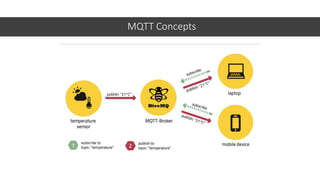
MQTT Concepts
MQTT
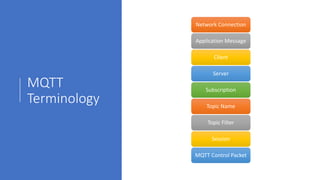
Terminology
Network Connection
Application Message
Client
Server
Subscription
Topic Name
Topic Filter
Session
MQTT Control Packet
Network Connection
• A construct provided by the
underlying transport protocol that is
being used by MQTT.
• It connects the Client to the Server.
• It provides the means to send an
ordered, lossless, stream of bytes in
both directions.
Application Message
• The data carried by the MQTT protocol across the network for the application.
Client
• A program or device that uses MQTT
• A Client always establishes the
Network Connection to the Server
• Publish Application Messages that
other Clients might be interested in.
• Subscribe to request Application
Messages that it is interested in
receiving.
• Unsubscribe to remove a request for
Application Messages.
• Disconnect from the Server.
Server
• A program or device that acts as an
intermediary between Clients which
publish Application Messages and
Clients which have made
Subscriptions
• Accepts Network Connections from
Clients.
• Accepts Application Messages
published by Clients.
• Processes Subscribe and Unsubscribe
requests from Clients.
• Forwards Application Messages that
match Client Subscriptions.
Subscription
• A Subscription comprises a Topic Filter and a maximum QoS.
• A Subscription is associated with a single Session.
• A Session can contain more than one Subscription.
• Each Subscription within a session has a different Topic Filter.
Topic Name
• The label attached to an Application Message which is matched against the
Subscriptions known to the Server.
• The Server sends a copy of the Application Message to each Client that has a
matching Subscription.
Topic Filter
An expression
contained in a
Subscription, to
indicate an interest in
one or more topics.
01
A Topic Filter can
include wildcard
characters.
02
Session
• A stateful interaction between a Client and a Server.
• Some Sessions last only as long as the Network Connection, others can span
multiple consecutive Network Connections between a Client and a Server.
MQTT Control Packet
• A packet of information that is sent across the Network Connection.
• The MQTT specification defines fourteen different types of Control Packet, one
of which (the PUBLISH packet) is used to convey Application Messages.
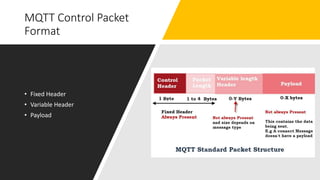
MQTT Control Packet
Format
• Fixed Header
• Variable Header
• Payload
MQTT Control Packet
• CONNECT, Client request to connect to Server
• CONNACK, Connect acknowledgment
• PUBLISH, Publish message
• PUBACK , Publish acknowledgment
• PUBREC , Publish received
• PUBREL , Publish release
• PUBCOMP, Publish complete
• SUBSCRIBE, Client subscribe request
• SUBACK , Subscribe acknowledgment
• UNSUBSCRIBE, Unsubscribe request
• UNSUBACK, Unsubscribe acknowledgment
• PINGREQ, PING request
• PINGRESP, PING response
• DISCONNECT, Client is disconnecting
Fixed Header
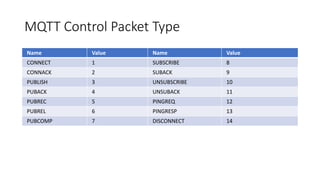
MQTT Control Packet Type
Name Value Name Value
CONNECT 1 SUBSCRIBE 8
CONNACK 2 SUBACK 9
PUBLISH 3 UNSUBSCRIBE 10
PUBACK 4 UNSUBACK 11
PUBREC 5 PINGREQ 12
PUBREL 6 PINGRESP 13
PUBCOMP 7 DISCONNECT 14
MQTT Flag Bit
Control Packet Fixed header flags Bit 3 Bit 2 Bit 1 Bit 0
CONNECT Reserved 0 0 0 0
CONNACK Reserved 0 0 0 0
PUBLISH Used in MQTT 3.1.1 DUP QoS QoS RETAIN
PUBACK Reserved 0 0 0 0
PUBREC Reserved 0 0 0 0
PUBREL Reserved 0 0 1 0
PUBCOMP Reserved 0 0 0 0
SUBSCRIBE Reserved 0 0 1 0
SUBACK Reserved 0 0 0 0
UNSUBSCRIBE Reserved 0 0 1 0
UNSUBACK Reserved 0 0 0 0
PINGREQ Reserved 0 0 0 0
PINGRESP Reserved 0 0 0 0
DISCONNECT Reserved 0 0 0 0
Remaining
Length
The Remaining Length is the
number of bytes remaining
within the current packet,
including data in the variable
header and the payload.
The Remaining Length does not
include the bytes used to
encode the Remaining Length.
Variable
Header
Some types of MQTT Control Packets
contain a variable header component. It
resides between the fixed header and
the payload
The content of the variable header
varies depending on the Packet type.
The Packet Identifier field of variable
header is common in several packet
types.
Packet Identifier
• The variable header
component of many of the
Control Packet types includes
a 2 byte Packet Identifier field.
• These Control Packets are
PUBLISH (where QoS > 0),
PUBACK, PUBREC, PUBREL,
PUBCOMP, SUBSCRIBE,
SUBACK, UNSUBSCRIBE,
UNSUBACK.
Payload
Control Packet Payload
CONNECT Required
CONNACK None
PUBLISH Optional
PUBACK None
PUBREC None
PUBREL None
PUBCOMP None
SUBSCRIBE Required
SUBACK Required
UNSUBSCRIBE Required
UNSUBACK None
PINGREQ None
PINGRESP None
DISCONNECT None
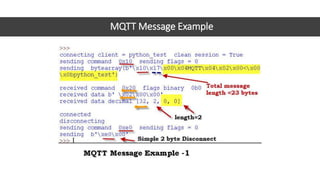
MQTT Message Example

MQTT (Message Queue Telemetry Transport)

  • 1.
    MQTT (Message QueueTelemetry Transport) Messaging Protocols for M2M & IoT Eko Rudiawan
  • 2.
    MQTT MQTT was inventedby Dr Andy Stanford-Clark of IBM, and Arlen Nipper of Arcom (now Eurotech), in 1999. As of March 2013, MQTT is in the process of undergoing standardisation at OASIS. The protocol specification has been openly published with a royalty-free license. TCP/IP port 1883 is reserved with IANA for use with MQTT. TCP/IP port 8883 is also registered, for using MQTT over SSL. You can pass a user name and password with an MQTT packet in V3.1 of the protocol. The “SCADA protocol” and the “MQ Integrator SCADA Device Protocol” (MQIsdp) are both old names for what is now known as the MQ Telemetry Transport (MQTT)
  • 3.
  • 4.
  • 5.
    Network Connection • Aconstruct provided by the underlying transport protocol that is being used by MQTT. • It connects the Client to the Server. • It provides the means to send an ordered, lossless, stream of bytes in both directions.
  • 6.
    Application Message • Thedata carried by the MQTT protocol across the network for the application.
  • 7.
    Client • A programor device that uses MQTT • A Client always establishes the Network Connection to the Server • Publish Application Messages that other Clients might be interested in. • Subscribe to request Application Messages that it is interested in receiving. • Unsubscribe to remove a request for Application Messages. • Disconnect from the Server.
  • 8.
    Server • A programor device that acts as an intermediary between Clients which publish Application Messages and Clients which have made Subscriptions • Accepts Network Connections from Clients. • Accepts Application Messages published by Clients. • Processes Subscribe and Unsubscribe requests from Clients. • Forwards Application Messages that match Client Subscriptions.
  • 9.
    Subscription • A Subscriptioncomprises a Topic Filter and a maximum QoS. • A Subscription is associated with a single Session. • A Session can contain more than one Subscription. • Each Subscription within a session has a different Topic Filter.
  • 10.
    Topic Name • Thelabel attached to an Application Message which is matched against the Subscriptions known to the Server. • The Server sends a copy of the Application Message to each Client that has a matching Subscription.
  • 11.
    Topic Filter An expression containedin a Subscription, to indicate an interest in one or more topics. 01 A Topic Filter can include wildcard characters. 02
  • 12.
    Session • A statefulinteraction between a Client and a Server. • Some Sessions last only as long as the Network Connection, others can span multiple consecutive Network Connections between a Client and a Server.
  • 13.
    MQTT Control Packet •A packet of information that is sent across the Network Connection. • The MQTT specification defines fourteen different types of Control Packet, one of which (the PUBLISH packet) is used to convey Application Messages.
  • 14.
    MQTT Control Packet Format •Fixed Header • Variable Header • Payload
  • 15.
    MQTT Control Packet •CONNECT, Client request to connect to Server • CONNACK, Connect acknowledgment • PUBLISH, Publish message • PUBACK , Publish acknowledgment • PUBREC , Publish received • PUBREL , Publish release • PUBCOMP, Publish complete • SUBSCRIBE, Client subscribe request • SUBACK , Subscribe acknowledgment • UNSUBSCRIBE, Unsubscribe request • UNSUBACK, Unsubscribe acknowledgment • PINGREQ, PING request • PINGRESP, PING response • DISCONNECT, Client is disconnecting
  • 16.
  • 17.
    MQTT Control PacketType Name Value Name Value CONNECT 1 SUBSCRIBE 8 CONNACK 2 SUBACK 9 PUBLISH 3 UNSUBSCRIBE 10 PUBACK 4 UNSUBACK 11 PUBREC 5 PINGREQ 12 PUBREL 6 PINGRESP 13 PUBCOMP 7 DISCONNECT 14
  • 18.
    MQTT Flag Bit ControlPacket Fixed header flags Bit 3 Bit 2 Bit 1 Bit 0 CONNECT Reserved 0 0 0 0 CONNACK Reserved 0 0 0 0 PUBLISH Used in MQTT 3.1.1 DUP QoS QoS RETAIN PUBACK Reserved 0 0 0 0 PUBREC Reserved 0 0 0 0 PUBREL Reserved 0 0 1 0 PUBCOMP Reserved 0 0 0 0 SUBSCRIBE Reserved 0 0 1 0 SUBACK Reserved 0 0 0 0 UNSUBSCRIBE Reserved 0 0 1 0 UNSUBACK Reserved 0 0 0 0 PINGREQ Reserved 0 0 0 0 PINGRESP Reserved 0 0 0 0 DISCONNECT Reserved 0 0 0 0
  • 19.
    Remaining Length The Remaining Lengthis the number of bytes remaining within the current packet, including data in the variable header and the payload. The Remaining Length does not include the bytes used to encode the Remaining Length.
  • 20.
    Variable Header Some types ofMQTT Control Packets contain a variable header component. It resides between the fixed header and the payload The content of the variable header varies depending on the Packet type. The Packet Identifier field of variable header is common in several packet types.
  • 21.
    Packet Identifier • Thevariable header component of many of the Control Packet types includes a 2 byte Packet Identifier field. • These Control Packets are PUBLISH (where QoS > 0), PUBACK, PUBREC, PUBREL, PUBCOMP, SUBSCRIBE, SUBACK, UNSUBSCRIBE, UNSUBACK.
  • 22.
    Payload Control Packet Payload CONNECTRequired CONNACK None PUBLISH Optional PUBACK None PUBREC None PUBREL None PUBCOMP None SUBSCRIBE Required SUBACK Required UNSUBSCRIBE Required UNSUBACK None PINGREQ None PINGRESP None DISCONNECT None
  • 23.