Movement Education
Year Six – 6P
What is Movement
Education?
The PDHPE focus of 6P this term will be movement education.
Movement education was originally developed by Rudolf Laban as a
pedagogical framework which incorporated the four components of
human movement.
Body – What it is capable of.
Effort – How the body can move.
Space – Where the body can move.
Shape – What forms the body can make.
(Laban, 1980, In Johnson & Sevimli – Celik, 2015).
What is Movement
Education? Cont.
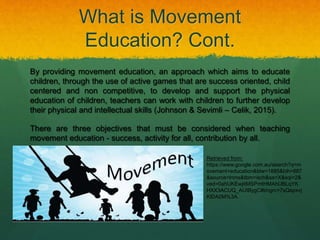
By providing movement education, an approach which aims to educate
children, through the use of active games that are success oriented, child
centered and non competitive, to develop and support the physical
education of children, teachers can work with children to further develop
their physical and intellectual skills (Johnson & Sevimli – Celik, 2015).
There are three objectives that must be considered when teaching
movement education - success, activity for all, contribution by all.
Retrieved from:
https://www.google.com.au/search?q=m
ovement+education&biw=1885&bih=887
&source=lnms&tbm=isch&sa=X&sqi=2&
ved=0ahUKEwjitMSPmtHMAhUBLqYK
HXX3ACUQ_AUIBygC#imgrc=7sQepxvj
KlDA0M%3A.
Benefits of Movement
Education
Develops a positive self image and self-reliance
Develops a critical rational
Increases resourcefulness
Promotes self responsibility
Increases general class gratification
Provides greater opportunity for social collaboration
Problem solving
Fundamental Movement
Skills – FACTS
Movement skills give students the foundation for leading physically
active, and healthy lives (Abels & Bridges, 2010).
There is a positive contribution of fundamental movement skills in
supporting the development of social, cognitive and affective skills
(O’Brien et. al, 2015).
The NSW Department of Education and training (2000) defines
fundamental movement skills, as those skills which children need to
participate successfully in all types of games, physical activities and
sports.
There is a complimentary relationship between fundamental movement
skills and fundamental game skills (Smith, 2014).
Fundamental Movement
Skills
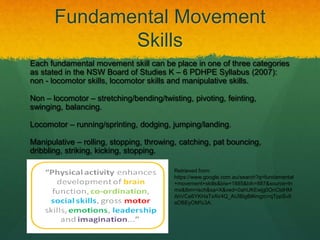
Each fundamental movement skill can be place in one of three categories
as stated in the NSW Board of Studies K – 6 PDHPE Syllabus (2007):
non - locomotor skills, locomotor skills and manipulative skills.
Non – locomotor – stretching/bending/twisting, pivoting, feinting,
swinging, balancing.
Locomotor – running/sprinting, dodging, jumping/landing.
Manipulative – rolling, stopping, throwing, catching, pat bouncing,
dribbling, striking, kicking, stopping.
Retrieved from:
https://www.google.com.au/search?q=fundamental
+movement+skills&biw=1885&bih=887&source=ln
ms&tbm=isch&sa=X&ved=0ahUKEwjg0OnCtdHM
AhVCe6YKHaTxAV4Q_AUIBigB#imgrc=qTppSv9
aDBEyOM%3A.
In stage three, these fundamental movement skills would have been
acquired, however it is still critical to teach students the importance of
these skills to ensure lifelong involvement in physical activity and to
continue to develop these basic skills so that advancement in more
sport specific skills can be acquired.
The movement education approach when taught together with
fundamental movements skills is significant as it addresses each
students movement requirements.
Teaching
Links to PDHPE Syllabus
Content
GSS3.8 – Applies movement skills in games and sports that require
communication, cooperation, decision making and observation rules.
- Participates in games and sports combining strategy, teamwork,
movement skill and fair play.
INS3.3 – Acts in a way that enhance the contribution of self and others in
a range of cooperative situations
- Demonstrates actions that support the rights and feelings of others.
SLS3.13 – Describes safe practices that are appropriate to a range of
situations and environments.
- Demonstrates ways to make environments safe.
References
Abels, K. W., & Bridges, J. (2011). Movement Education Framework (MEF) Made
EZ!. Strategies, 25(2), 8-10.
Board of Studies, NSW. (2007). Personal development, health and physical education K-6:
Syllabus. Sydney, Australia: Author.
NSW Department of Education and Training. (2000). Get skilled: Get active: A K-6 resource to
support the teaching of fundamental movement skills. Ryde, Australia: Author.
O’ Brien, W., Belton, S., Issartel, J. (2015). The relationship between adolescents’ physical
activity, fundamental movement skills and weight status. Journal of Sports sciences. 34 (12). p.
1159 – 1167.
Sevimli-Celik, S., & Johnson, J. E. (2015). Teacher preparation for movement education:
increasing pre-service teachers’ competence for working with young children. Asia-Pacific
Journal of Teacher Education. p. 1-15.
Smith, W. (2014). Fundamental movement skills and fundamental games skills are
complementary pairs and should be taught in complementary ways at all stages of skill
development. Sport, Education and Society. 21 (3). p. 431 – 442.

Movement education

  • 1.
  • 2.
    What is Movement Education? ThePDHPE focus of 6P this term will be movement education. Movement education was originally developed by Rudolf Laban as a pedagogical framework which incorporated the four components of human movement. Body – What it is capable of. Effort – How the body can move. Space – Where the body can move. Shape – What forms the body can make. (Laban, 1980, In Johnson & Sevimli – Celik, 2015).
  • 3.
    What is Movement Education?Cont. By providing movement education, an approach which aims to educate children, through the use of active games that are success oriented, child centered and non competitive, to develop and support the physical education of children, teachers can work with children to further develop their physical and intellectual skills (Johnson & Sevimli – Celik, 2015). There are three objectives that must be considered when teaching movement education - success, activity for all, contribution by all. Retrieved from: https://www.google.com.au/search?q=m ovement+education&biw=1885&bih=887 &source=lnms&tbm=isch&sa=X&sqi=2& ved=0ahUKEwjitMSPmtHMAhUBLqYK HXX3ACUQ_AUIBygC#imgrc=7sQepxvj KlDA0M%3A.
  • 4.
    Benefits of Movement Education Developsa positive self image and self-reliance Develops a critical rational Increases resourcefulness Promotes self responsibility Increases general class gratification Provides greater opportunity for social collaboration Problem solving
  • 5.
    Fundamental Movement Skills –FACTS Movement skills give students the foundation for leading physically active, and healthy lives (Abels & Bridges, 2010). There is a positive contribution of fundamental movement skills in supporting the development of social, cognitive and affective skills (O’Brien et. al, 2015). The NSW Department of Education and training (2000) defines fundamental movement skills, as those skills which children need to participate successfully in all types of games, physical activities and sports. There is a complimentary relationship between fundamental movement skills and fundamental game skills (Smith, 2014).
  • 6.
    Fundamental Movement Skills Each fundamentalmovement skill can be place in one of three categories as stated in the NSW Board of Studies K – 6 PDHPE Syllabus (2007): non - locomotor skills, locomotor skills and manipulative skills. Non – locomotor – stretching/bending/twisting, pivoting, feinting, swinging, balancing. Locomotor – running/sprinting, dodging, jumping/landing. Manipulative – rolling, stopping, throwing, catching, pat bouncing, dribbling, striking, kicking, stopping. Retrieved from: https://www.google.com.au/search?q=fundamental +movement+skills&biw=1885&bih=887&source=ln ms&tbm=isch&sa=X&ved=0ahUKEwjg0OnCtdHM AhVCe6YKHaTxAV4Q_AUIBigB#imgrc=qTppSv9 aDBEyOM%3A.
  • 7.
    In stage three,these fundamental movement skills would have been acquired, however it is still critical to teach students the importance of these skills to ensure lifelong involvement in physical activity and to continue to develop these basic skills so that advancement in more sport specific skills can be acquired. The movement education approach when taught together with fundamental movements skills is significant as it addresses each students movement requirements. Teaching
  • 8.
    Links to PDHPESyllabus Content GSS3.8 – Applies movement skills in games and sports that require communication, cooperation, decision making and observation rules. - Participates in games and sports combining strategy, teamwork, movement skill and fair play. INS3.3 – Acts in a way that enhance the contribution of self and others in a range of cooperative situations - Demonstrates actions that support the rights and feelings of others. SLS3.13 – Describes safe practices that are appropriate to a range of situations and environments. - Demonstrates ways to make environments safe.
  • 9.
    References Abels, K. W.,& Bridges, J. (2011). Movement Education Framework (MEF) Made EZ!. Strategies, 25(2), 8-10. Board of Studies, NSW. (2007). Personal development, health and physical education K-6: Syllabus. Sydney, Australia: Author. NSW Department of Education and Training. (2000). Get skilled: Get active: A K-6 resource to support the teaching of fundamental movement skills. Ryde, Australia: Author. O’ Brien, W., Belton, S., Issartel, J. (2015). The relationship between adolescents’ physical activity, fundamental movement skills and weight status. Journal of Sports sciences. 34 (12). p. 1159 – 1167. Sevimli-Celik, S., & Johnson, J. E. (2015). Teacher preparation for movement education: increasing pre-service teachers’ competence for working with young children. Asia-Pacific Journal of Teacher Education. p. 1-15. Smith, W. (2014). Fundamental movement skills and fundamental games skills are complementary pairs and should be taught in complementary ways at all stages of skill development. Sport, Education and Society. 21 (3). p. 431 – 442.