A PowerPoint Presentation
Prepared by:
MR. JORJIE U. NEPANGUE, LPT
BSEd-MAPEH
MAEd-PE
Framework:
(noun)
:the basic structure of something: a set of ideas or
facts that provide support for something
-Merriam Dictionary-
:serves as the foundation to something:
conceptional structure of ideas or something
-Cambridge Dictionary-
FRAMEWORK/CONTENT
Movement education is an
approach to physical
education that dates back to
the 1800s.
Unlike traditional PE, it
involves building a higher
sense of awareness in
students about how and
why their bodies move
during different activities.
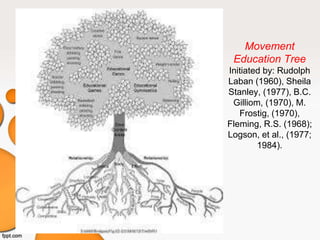
Movement
Education Tree
Initiated by: Rudolph
Laban (1960), Sheila
Stanley, (1977), B.C.
Gilliom, (1970), M.
Frostig, (1970),
Fleming, R.S. (1968);
Logson, et al., (1977;
1984).
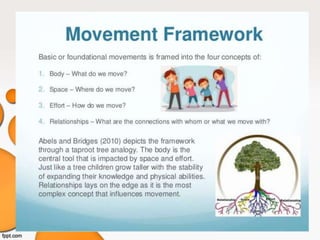
Body, space, effort, and
relationships—the four aspects of
Laban’s movement framework—
offer a useful structure for
organizing physical education
lessons.
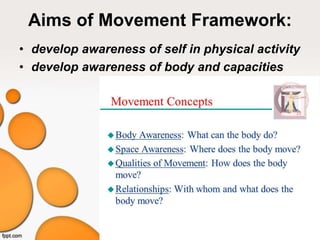
Aims of Movement Framework:
• develop awareness of self in physical activity
• develop awareness of body and capacities
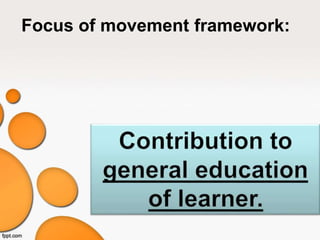
Focus of movement framework:
General objectives of movement framework
• Success – Everyone has a chance to succeed at
his/her own rate so as to experience success
• Activity for all – Everyone should be working
purposefully throughout the lesson, thus
preventing waiting children and line standing
• Contribution by all – Everyone has a chance to
contribute through inventiveness, use of
imagination, initiative, and lively ideas
Movement Education Framework can be
used for:
• structuring content
• observing and analyzing movement
• communicating about movement
• evaluating program content
How to present task using MEF?
• Tasks are progressive in nature
• progression should recognize
individual characteristics of learners
• Tasks fit with developmental level of
learners (pre control, control,
utilization, proficiency)
Tasks are presented so learner is
decision maker:
"If you feel you are ready, try . . .
When you are comfortable you may . . .
When you are ready, you may challenge
yourself by . . .
Choose where you wish to begin your work
. . .
Who can . . .
Can you . . .
How can . . .
What can . . .
Show me . . .
The Teacher Must Remember:
• To adapt the problem to the level of the
participants
• To move through activities in a simple to
complex progression
• To have knowledge of developmental
level(s) of students in class
• To expect individual interpretation –
different from the teacher’s personal
interpretation
• To be creative
As the teacher, what is YOUR
focus?
1. look for what mover does
2. look for what is occurring in
movement
3. use concepts/categories/
elements throughout all levels
of movement
Movement Education Framework

Movement Education Framework

  • 1.
    A PowerPoint Presentation Preparedby: MR. JORJIE U. NEPANGUE, LPT BSEd-MAPEH MAEd-PE
  • 4.
    Framework: (noun) :the basic structureof something: a set of ideas or facts that provide support for something -Merriam Dictionary- :serves as the foundation to something: conceptional structure of ideas or something -Cambridge Dictionary-
  • 5.
  • 6.
    Movement education isan approach to physical education that dates back to the 1800s. Unlike traditional PE, it involves building a higher sense of awareness in students about how and why their bodies move during different activities.
  • 8.
    Movement Education Tree Initiated by:Rudolph Laban (1960), Sheila Stanley, (1977), B.C. Gilliom, (1970), M. Frostig, (1970), Fleming, R.S. (1968); Logson, et al., (1977; 1984).
  • 9.
    Body, space, effort,and relationships—the four aspects of Laban’s movement framework— offer a useful structure for organizing physical education lessons.
  • 11.
    Aims of MovementFramework: • develop awareness of self in physical activity • develop awareness of body and capacities
  • 12.
  • 13.
    General objectives ofmovement framework • Success – Everyone has a chance to succeed at his/her own rate so as to experience success • Activity for all – Everyone should be working purposefully throughout the lesson, thus preventing waiting children and line standing • Contribution by all – Everyone has a chance to contribute through inventiveness, use of imagination, initiative, and lively ideas
  • 14.
    Movement Education Frameworkcan be used for: • structuring content • observing and analyzing movement • communicating about movement • evaluating program content
  • 15.
    How to presenttask using MEF? • Tasks are progressive in nature • progression should recognize individual characteristics of learners • Tasks fit with developmental level of learners (pre control, control, utilization, proficiency)
  • 16.
    Tasks are presentedso learner is decision maker: "If you feel you are ready, try . . . When you are comfortable you may . . . When you are ready, you may challenge yourself by . . . Choose where you wish to begin your work . . . Who can . . . Can you . . . How can . . . What can . . . Show me . . .
  • 17.
    The Teacher MustRemember: • To adapt the problem to the level of the participants • To move through activities in a simple to complex progression • To have knowledge of developmental level(s) of students in class • To expect individual interpretation – different from the teacher’s personal interpretation • To be creative
  • 18.
    As the teacher,what is YOUR focus? 1. look for what mover does 2. look for what is occurring in movement 3. use concepts/categories/ elements throughout all levels of movement