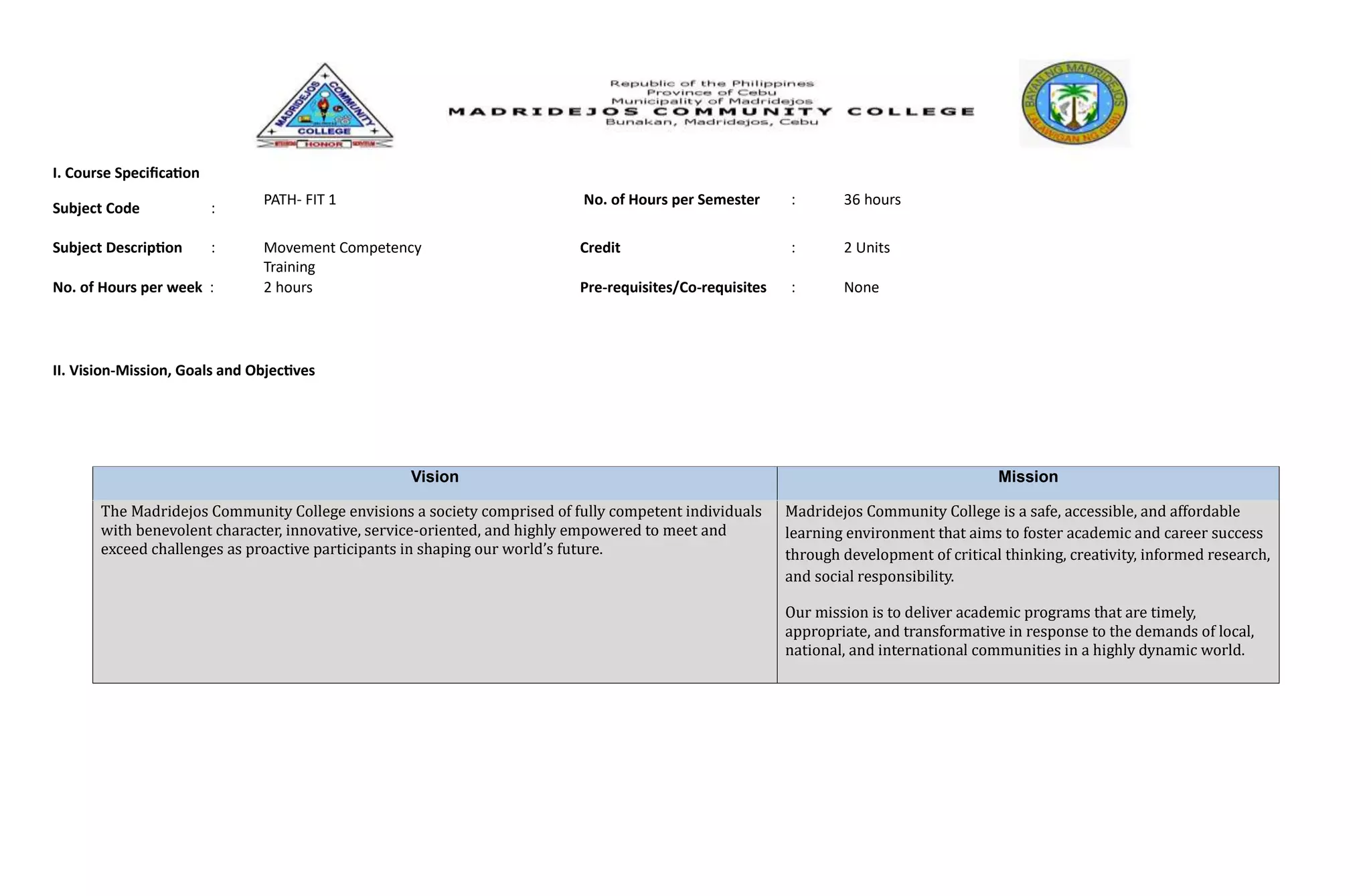
I. Course Specification
Subject Code :
PATH- FIT 1 No. of Hours per Semester : 36 hours
Subject Description : Movement Competency
Training
Credit : 2 Units
No. of Hours per week : 2 hours Pre-requisites/Co-requisites : None
II. Vision-Mission, Goals and Objectives
Vision Mission
The Madridejos Community College envisions a society comprised of fully competent individuals
with benevolent character, innovative, service-oriented, and highly empowered to meet and
exceed challenges as proactive participants in shaping our world’s future.
Madridejos Community College is a safe, accessible, and affordable
learning environment that aims to foster academic and career success
through development of critical thinking, creativity, informed research,
and social responsibility.
Our mission is to deliver academic programs that are timely,
appropriate, and transformative in response to the demands of local,
national, and international communities in a highly dynamic world.
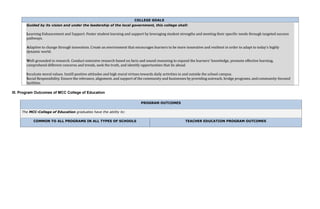
COLLEGE GOALS
Guided by its vision and under the leadership of the local government, this college shall:
Learning Enhancement and Support. Foster student learning and support by leveraging student strengths and meeting their specific needs through targeted success
pathways.
Adaptive to change through innovation. Create an environment that encourages learners to be more innovative and resilient in order to adapt to today’s highly
dynamic world.
Well-grounded in research. Conduct extensive research based on facts and sound reasoning to expand the learners’ knowledge, promote effective learning,
comprehend different concerns and trends, seek the truth, and identify opportunities that lie ahead.
Inculcate moral values. Instill positive attitudes and high moral virtues towards daily activities in and outside the school campus.
Social Responsibility. Ensure the relevance, alignment, and support of the community and businesses by providing outreach, bridge programs, and community-focused
facilities.
III. Program Outcomes of MCC College of Education
PROGRAM OUTCOMES
The MCC-College of Education graduates have the ability to:
COMMON TO ALL PROGRAMS IN ALL TYPES OF SCHOOLS TEACHER EDUCATION PROGRAM OUTCOMES
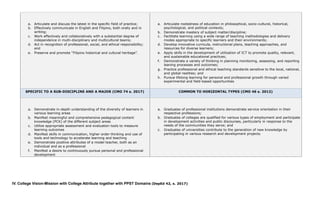
a. Articulate and discuss the latest in the specific field of practice;
b. Effectively communicate in English and Filipino, both orally and in
writing;
c. Work effectively and collaboratively with a substantial degree of
independence in multi-disciplinary and multicultural teams;
d. Act in recognition of professional, social, and ethical responsibility;
and
e. Preserve and promote “Filipino historical and cultural heritage”.
a. Articulate rootedness of education in philosophical, socio-cultural, historical,
psychological, and political contexts;
b. Demonstrate mastery of subject matter/discipline;
c. Facilitate learning using a wide range of teaching methodologies and delivery
modes appropriate to specific learners and their environments;
d. Develop innovative curricula, instructional plans, teaching approaches, and
resources for diverse learners;
e. Apply skills in the development of utilization of ICT to promote quality, relevant,
and sustainable educational practices;
f. Demonstrate a variety of thinking in planning monitoring, assessing, and reporting
leaning processes and outcomes;
g. Practice professional and ethical teaching standards sensitive to the local, national,
and global realities; and
h. Pursue lifelong learning for personal and professional growth through varied
experimental and field-based opportunities
SPECIFIC TO A SUB-DISCIPLINE AND A MAJOR (CMO 74 s. 2017) COMMON TO HORIZONTAL TYPES (CMO 46 s. 2012)
a. Demonstrate in-depth understanding of the diversity of learners in
various learning areas
b. Manifest meaningful and comprehensive pedagogical content
knowledge (PCK) of the different subject areas
c. Utilize appropriate assessment and evaluation tools to measure
learning outcomes
d. Manifest skills in communication, higher order thinking and use of
tools and technology to accelerate learning and teaching
e. Demonstrate positive attributes of a model teacher, both as an
individual and as a professional
f. Manifest a desire to continuously pursue personal and professional
development
a. Graduates of professional institutions demonstrate service orientation in their
respective professions;
b. Graduates of colleges are qualified for various types of employment and participate
in development activities and public discourses, particularly in response to the
needs of the communities they serve; and
c. Graduates of universities contribute to the generation of new knowledge by
participating in various research and development projects.
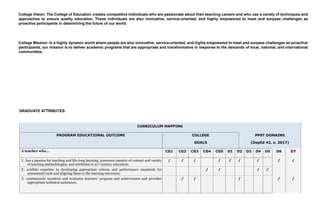
IV. College Vision-Mission with College Attribute together with PPST Domains (DepEd 42, s. 2017)
College Vision: The College of Education creates competitive individuals who are passionate about their teaching careers and who use a variety of techniques and
approaches to ensure quality education. These individuals are also innovative, service-oriented, and highly empowered to meet and surpass challenges as
proactive participants in determining the future of our world.
College Mission: In a highly dynamic world where people are also innovative, service-oriented, and highly empowered to meet and surpass challenges as proactive
participants, our mission is to deliver academic programs that are appropriate and transformative in response to the demands of local, national, and international
communities.
GRADUATE ATTRIBUTES:
CURRICULUM MAPPING
PROGRAM EDUCATIONAL OUTCOME COLLEGE
GOALS
PPST DOMAINS
(DepEd 42, s. 2017)
A teacher who… CG1 CG2 CG3 CG4 CG5 D1 D2 D3 D4 D5 D6 D7
1. has a passion for teaching and life-long learning, possesses mastery of content and variety
of teaching methodologies, and attributes to 21st century education;
/ / / / / / / / /
2. exhibits expertise in developing appropriate criteria and performance standards for
assessment tools and aligning these to the learning outcomes;
/ / / /
3. continuously monitors and evaluates learners’ progress and achievement and provides
appropriate technical assistance;
/ / / / /
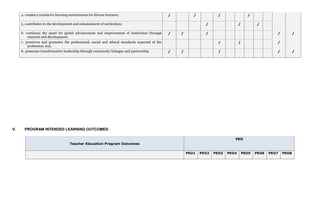
4. creates a conducive learning environment for diverse learners; / / / /
5. contributes to the development and enhancement of curriculum; / / /
6. continues the quest for global advancement and improvement of instruction through
research and development;
/ / / / /
7. preserves and promotes the professional, social and ethical standards expected of the
profession; and,
/ / /
8. possesses transformative leadership through community linkages and partnership. / / / / /
V. PROGRAM INTENDED LEARNING OUTCOMES:
Teacher Education Program Outcomes
PEO
PEO1 PEO2 PEO3 PEO4 PEO5 PEO6 PEO7 PEO8
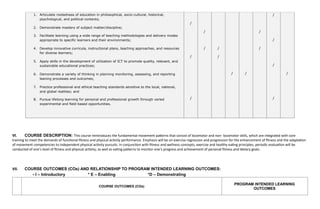
1. Articulate rootedness of education in philosophical, socio-cultural, historical,
psychological, and political contexts;
2. Demonstrate mastery of subject matter/discipline;
3. Facilitate learning using a wide range of teaching methodologies and delivery modes
appropriate to specific learners and their environments;
4. Develop innovative curricula, instructional plans, teaching approaches, and resources
for diverse learners;
5. Apply skills in the development of utilization of ICT to promote quality, relevant, and
sustainable educational practices;
6. Demonstrate a variety of thinking in planning monitoring, assessing, and reporting
leaning processes and outcomes;
7. Practice professional and ethical teaching standards sensitive to the local, national,
and global realities; and
8. Pursue lifelong learning for personal and professional growth through varied
experimental and field-based opportunities.
/
/
/
/
/ /
/
/ /
/
/
/
/
/
/
/
VI. COURSE DESCRIPTION: This course reintroduces the fundamental movement patterns that consist of locomotor and non- locomotor skills, which are integrated with core
training to meet the demands of functional fitness and physical activity performance. Emphasis will be on exercise regression and progression for the enhancement of fitness and the adaptation
of movement competencies to independent physical activity pursuits. In conjunction with fitness and wellness concepts, exercise and healthy eating principles, periodic evaluation will be
conducted of one’s level of fitness and physical activity; as well as eating patterns to monitor one’s progress and achievement of personal fitness and dietary goals.
VII. COURSE OUTCOMES (COs) AND RELATIONSHIP TO PROGRAM INTENDED LEARNING OUTCOMES:
• I – Introductory * E – Enabling *D – Demonstrating
COURSE OUTCOMES (COs)
PROGRAM INTENDED LEARNING
OUTCOMES
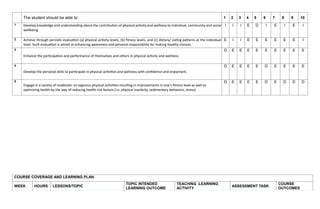
The student should be able to: 1 2 3 4 5 6 7 8 9 10
1 Develop knowledge and understanding about the contribution of physical activity and wellness to individual, community and social
wellbeing
I I I E D I E I E I
2 Achieve through periodic evaluation (a) physical activity levels, (b) fitness levels, and (c) dietary/ eating patterns at the individual
level. Such evaluation is aimed at enhancing awareness and personal responsibility for making healthy choices
E I I E E E E E E I
3
Enhance the participation and performance of themselves and others in physical activity and wellness.
D E E E E E E E E E
4
Develop the personal skills to participate in physical activities and wellness with confidence and enjoyment.
D E E E E D E E E E
5
Engage in a variety of moderate- to-vigorous physical activities resulting in improvements in one’s fitness level as well as
optimizing health by the way of reducing health risk factors (i.e. physical inactivity, sedimentary behaviors, stress).
D E E E E D E D D D
COURSE COVERAGE AND LEARNING PLAN
WEEK HOURS LESSONS/TOPIC
TOPIC INTENDED
LEARNING OUTCOME
TEACHING -LEARNING
ACTIVITY
ASSESSMENT TASK
COURSE
OUTCOMES
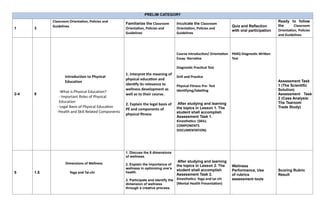
PRELIM CATEGORY
1 3
Classroom Orientation, Policies and
Guidelines
Familiarize the Classroom
Orientation, Policies and
Guidelines
Inculcate the Classroom
Orientation, Policies and
Guidelines
Quiz and Reflection
with oral participation
Ready to follow
the Classroom
Orientation, Policies
and Guidelines
2-4 9
Introduction to Physical
Education
-What is Physical Education?
- Important Roles of Physical
Education
- Legal Basis of Physical Education
-Health and Skill Related Components
1. Interpret the meaning of
physical education and
identify its relevance to
wellness development as
well as to their course.
2. Explain the legal basis of
PE and components of
physical fitness
Course Introduction/ Orientation
Essay- Narrative
Diagnostic Practical eest
Drill and Practice
Physical Fitness Pre- eest
Identifying/labelling
After studying and learning
the topics in Lesson 1. The
student shall accomplish
Assessment Task 1.
Kinesthetics: (SKILL
COMPONENeS
DOCUMENeAeION)
PARQ Diagnostic Written
eest
Assessment Task
1 (The Scientific
Solution)
Assessment Task
2 (Case Analysis:
The Tearoom
Trade Study)
5 1.5
Dimensions of Wellness
Yoga and eai-chi
1. Discuss the 8 dimensions
of wellness.
2. Explain the importance of
wellness in optimizing one’s
health.
3. Participate and identify the
dimension of wellness
through a creative process.
After studying and learning
the topics in Lesson 2. The
student shall accomplish
Assessment Task 2.
Kinesthetics: Yoga and tai chi
(Mental Health Presentation)
Wellness
Performance, Use
of rubrics
assessment tools
Scoring Rubric
Result
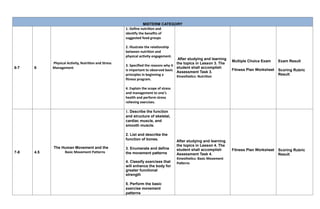
MIDTERM CATEGORY
6-7 6
Physical Activity, Nutrition and Stress
Management
1. Define nutrition and
identify the benefits of
suggested food groups
2. Illustrate the relationship
between nutrition and
physical activity engagement.
3. Specified the reasons why it
is important to observed basic
principles in beginning a
fitness program.
4. Explain the scope of stress
and management to one’s
health and perform stress
relieving exercises.
After studying and learning
the topics in Lesson 3. The
student shall accomplish
Assessment Task 3.
Kinesthetics: Nutrition
Multiple Choice Exam
Fitness Plan Worksheet
Exam Result
Scoring Rubric
Result
7-8 4.5
The Human Movement and the
Basic Movement Patterns
1. Describe the function
and structure of skeletal,
cardiac muscle, and
smooth muscle.
2. List and describe the
function of bones.
3. Enumerate and define
the movement patterns
4. Classify exercises that
will enhance the body for
greater functional
strength
5. Perform the basic
exercise movement
patterns
After studying and learning
the topics in Lesson 4. The
student shall accomplish
Assessment Task 4.
Kinesthetics: Basic Movement
Patterns
Fitness Plan Worksheet Scoring Rubric
Result
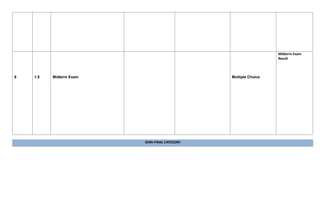
Midterm Exam
Result
9 1.5 Midterm Exam Multiple Choice
SEMI-FINAL CAeEGORY
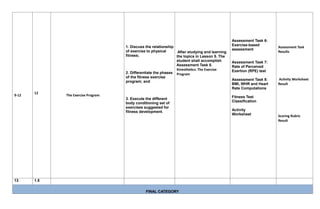
9-12
12
ehe Exercise Program
1. Discuss the relationship
of exercise to physical
fitness;
2. Differentiate the phases
of the fitness exercise
program; and
3. Execute the different
body conditioning set of
exercises suggested for
fitness development.
After studying and learning
the topics in Lesson 5. The
student shall accomplish
Assessment Task 5.
Kinesthetics: ehe Exercise
Program
Assessment Task 6:
Exercise-based
assessment
Assessment Task 7:
Rate of Perceived
Exertion (RPE) test
Assessment Task 8:
BMI, WHR and Heart
Rate Computations
Fitness Test
Classification
Activity
Worksheet
Assessment eask
Results
Activity Worksheet
Result
Scoring Rubric
Result
13 1.5
FINAL CATEGORY
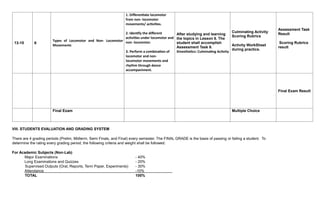
13-15 6
eypes of Locomotor and Non- Locomotor
Movements
1. Differentiate locomotor
from non- locomotor
movements/ activities.
2. Identify the different
activities under locomotor and
non- locomotor.
3. Perform a combination of
locomotor and non-
locomotor movements and
rhythm through dance
accompaniment.
After studying and learning
the topics in Lesson 6. The
student shall accomplish
Assessment Task 9.
Kinesthetics: Culminating Activity
Culminating Activity
Scoring Rubrics
Activity WorkSheet
during practice.
Assessment Task
Result
Scoring Rubrics
result
Final Exam Result
Final Exam Multiple Choice
VIII. STUDENTS EVALUATION AND GRADING SYSTEM
There are 4 grading periods (Prelim, Midterm, Semi Finals, and Final) every semester. The FINAL GRADE is the basis of passing or failing a student. To
determine the rating every grading period, the following criteria and weight shall be followed:
For Academic Subjects (Non-Lab)
Major Examinations - 40%
Long Examinations and Quizzes - 20%
Supervised Outputs (Oral, Reports, Term Paper, Experiments) - 30%
Attendance -10%
TOTAL 100%
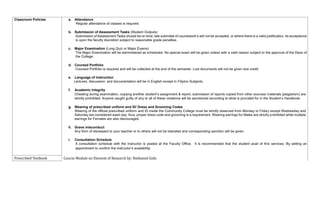
Classroom Policies a. Attendance
Regular attendance of classes is required.
b. Submission of Assessment Tasks (Student Outputs)
Submission of Assessment Tasks should be on time; late submittal of coursework’s will not be accepted, or where there is a valid justification, its acceptance
is upon the faculty discretion subject to reasonable grade penalties.
c. Major Examination (Long Quiz or Major Exams)
The Major Examination will be administered as scheduled. No special exam will be given unless with a valid reason subject to the approval of the Dean of
the College.
d. Coursed Portfolio
Coursed Portfolio is required and will be collected at the end of the semester. Lost documents will not be given due credit.
e. Language of Instruction
Lectures, discussion, and documentation will be in English except in Filipino Subjects.
f. Academic Integrity
Cheating during examination, copying another student’s assignment & report, submission of reports copied from other sources/ materials (plagiarism) are
strictly prohibited. Anyone caught guilty of any or all of these violations will be sanctioned according to what is provided for in the Student’s Handbook.
g. Wearing of prescribed uniform and ID/ Dress and Grooming Codes
Wearing of the official prescribed uniform and ID inside the Community College must be strictly observed from Monday to Friday except Wednesday and
Saturday are considered wash day; thus, proper dress code and grooming is a requirement. Wearing earrings for Males are strictly prohibited while multiple
earrings for Females are also discouraged.
h. Grave misconduct
Any form of disrespect to your teacher or to others will not be tolerated and corresponding sanction will be given.
i. Consultation Schedule
A consultation schedule with the instructor is posted at the Faculty Office. It is recommended that the student avail of this services. By setting an
appointment to confirm the instructor’s availability.
Prescribed Textbook Course Module on Element of Research by: Nathaniel Gido
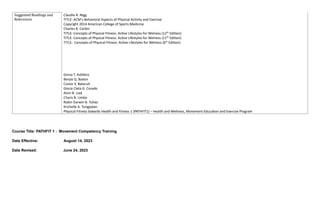
Suggested Readings and
References
Claudio R. Nigg
TITLE: ACM’s Behavioral Aspects of Physical Activity and Exercise
Copyright 2014 American College of Sports Medicine
Charles B. Corbin
TITLE: Concepts of Physical Fitness: Active Lifestyles for Welness (12th
Edition)
TITLE: Concepts of Physical Fitness: Active Lifestyles for Welness (11th
Edition)
TITLE: Concepts of Physical Fitness: Active Lifestyles for Welness (6th
Edition)
Ginna T. Astillero
Benjie Q. Badon
Castor V. Balacuit
Gloria Cleta G. Corado
Alvin B. Liad
Charis B. Limbo
Robin Darwin B. Tuliao
Krichelle A. Tungpalan
Physical Fitness towards Health and Fitness 1 (PATHFIT1) – Health and Wellness, Movement Education and Exercise Program
Course Title: PATHFIT 1 - Movement Competency Training
Date Effective: August 14, 2023
Date Revised: June 24, 2023
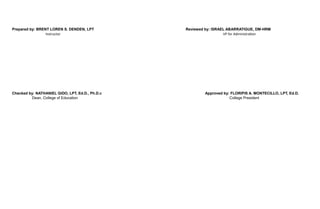
Prepared by: BRENT LOREN S. DENDEN, LPT Reviewed by: ISRAEL ABARRATIGUE, DM-HRM
Instructor VP for Administration
Checked by: NATHANIEL GIDO, LPT, Ed.D., Ph.D.c Approved by: FLORIPIS A. MONTECILLO, LPT, Ed.D.
Dean, College of Education College President
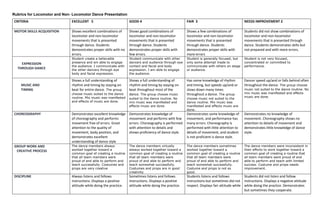
Rubrics for Locomotor and Non- Locomotor Dance Presentation
CRITERIA EXCELLENT 5 GOOD 4 FAIR 3 NEEDS IMPROVEMENT 2
MOTOR SKILLS ACQUISITION Shows excellent combinations of
locomotor and non-locomotor
movements that is presented
through dance. Students
demonstrates proper skills with no
errors.
Shows good combinations of
locomotor and non-locomotor
movements that is presented
through dance. Students
demonstrates proper skills with
few errors.
Shows a few combinations of
locomotor and non-locomotor
movements that is presented
through dance. Students
demonstrates proper skills with
more errors
Students did not show combinations of
locomotor and non-locomotor
movements that is presented through
dance. Students demonstrates skills but
not prepared and with more errors.
EXPRESSION
THROUGH DANCE
Student create a believable
presence and am able to engage
the audience. I communicate with
the other dancers through eye
body and facial expression.
Student communicate with other
dancers and audience through eye
contact and facial and body
expression. I am able to engage
the audience.
Student is generally focused, but
only some attempt made to
communicate with others on stage
or audience.
Student is not very focused,
concentrated or committed to
performance.
MUSIC AND
TIMING
Shows a full understanding of
rhythm and timing by staying on
beat for entire dance. The group
choose music suited to the dance
routine. Mix music was manifested
and effects of music are done.
Shows a full understanding of
rhythm and timing by staying on
beat throughout most of the
dance. The group choose music
suited to the dance routine. No
mix music was manifested and
effects music are done.
Has some knowledge of rhythm
and timing, but speeds up/and or
slows down many times
throughout a dance. The group
choose music not suited to the
dance routine. Mix music was
manifested and effects music are
done.
Dancer speed up/and or falls behind often
throughout the dance. The group choose
music not suited to the dance routine. No
mix music was manifested and effects
music are done.
CHOREOGRAPHY Demonstrates excellent knowledge
of choreography and performs
movement free of errors. Great
attention to the quality of
movement, body position, and
demonstrates excellent
understanding of dance style
Demonstrates knowledge of
movement and performs with few
errors. Choreography is performed
with attention to details and
shows proficiency of dance style.
Demonstrates some knowledge of
movement, and performance has
many errors. Choreography is
performed with little attention to
details of movement, and student
is not proficient is dance style.
Demonstrates no knowledge of
movement. Choreography shows no
attention to details of movement and
demonstrates little knowledge of dance
style.
GROUP WORK AND
CREATIVE PROCESS
The dance members always
worked together toward a
common goal of creating a routine
that all team members were
proud of and able to perform and
teach successfully. Costumes and
props are very creative
The dance members virtually
always worked together toward a
common goal of creating a routine
that all team members were
proud of and able to perform and
teach somewhat successfully.
Costumes and props are in good
creativity
The dance members sometimes
worked together toward a
common goal of creating a routine
that all team members were
proud of and able to perform and
teach somewhat successfully.
Costume and props is not so
good.
The dance members were inconsistent in
their efforts to work together toward a
common goal of creating a routine that
all team members were proud of and
able to perform and teach with limited
success. Costume and props needs
improvement.
DISCIPLINE Always listens and follows
instructions. Displays a positive
attitude while doing the practice.
Sometimes listens and follows
instructions. Displays a positive
attitude while doing the practice.
Students listens and follows
instructions but sometimes did not
respect. Displays fair attitude while
Students did not listen and follow
instructions. Displays a negative attitude
while doing the practice. Demonstrates
but sometimes they cooperate.
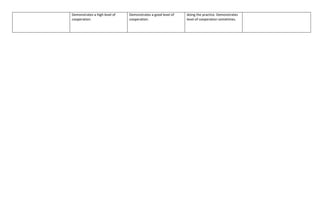
Demonstrates a high level of
cooperation.
Demonstrates a good level of
cooperation.
doing the practice. Demonstrates
level of cooperation sometimes.

SYLLABUS PATHFIT 1..docx

  • 1.
    I. Course Specification SubjectCode : PATH- FIT 1 No. of Hours per Semester : 36 hours Subject Description : Movement Competency Training Credit : 2 Units No. of Hours per week : 2 hours Pre-requisites/Co-requisites : None II. Vision-Mission, Goals and Objectives Vision Mission The Madridejos Community College envisions a society comprised of fully competent individuals with benevolent character, innovative, service-oriented, and highly empowered to meet and exceed challenges as proactive participants in shaping our world’s future. Madridejos Community College is a safe, accessible, and affordable learning environment that aims to foster academic and career success through development of critical thinking, creativity, informed research, and social responsibility. Our mission is to deliver academic programs that are timely, appropriate, and transformative in response to the demands of local, national, and international communities in a highly dynamic world.
  • 2.
    COLLEGE GOALS Guided byits vision and under the leadership of the local government, this college shall: Learning Enhancement and Support. Foster student learning and support by leveraging student strengths and meeting their specific needs through targeted success pathways. Adaptive to change through innovation. Create an environment that encourages learners to be more innovative and resilient in order to adapt to today’s highly dynamic world. Well-grounded in research. Conduct extensive research based on facts and sound reasoning to expand the learners’ knowledge, promote effective learning, comprehend different concerns and trends, seek the truth, and identify opportunities that lie ahead. Inculcate moral values. Instill positive attitudes and high moral virtues towards daily activities in and outside the school campus. Social Responsibility. Ensure the relevance, alignment, and support of the community and businesses by providing outreach, bridge programs, and community-focused facilities. III. Program Outcomes of MCC College of Education PROGRAM OUTCOMES The MCC-College of Education graduates have the ability to: COMMON TO ALL PROGRAMS IN ALL TYPES OF SCHOOLS TEACHER EDUCATION PROGRAM OUTCOMES
  • 3.
    a. Articulate anddiscuss the latest in the specific field of practice; b. Effectively communicate in English and Filipino, both orally and in writing; c. Work effectively and collaboratively with a substantial degree of independence in multi-disciplinary and multicultural teams; d. Act in recognition of professional, social, and ethical responsibility; and e. Preserve and promote “Filipino historical and cultural heritage”. a. Articulate rootedness of education in philosophical, socio-cultural, historical, psychological, and political contexts; b. Demonstrate mastery of subject matter/discipline; c. Facilitate learning using a wide range of teaching methodologies and delivery modes appropriate to specific learners and their environments; d. Develop innovative curricula, instructional plans, teaching approaches, and resources for diverse learners; e. Apply skills in the development of utilization of ICT to promote quality, relevant, and sustainable educational practices; f. Demonstrate a variety of thinking in planning monitoring, assessing, and reporting leaning processes and outcomes; g. Practice professional and ethical teaching standards sensitive to the local, national, and global realities; and h. Pursue lifelong learning for personal and professional growth through varied experimental and field-based opportunities SPECIFIC TO A SUB-DISCIPLINE AND A MAJOR (CMO 74 s. 2017) COMMON TO HORIZONTAL TYPES (CMO 46 s. 2012) a. Demonstrate in-depth understanding of the diversity of learners in various learning areas b. Manifest meaningful and comprehensive pedagogical content knowledge (PCK) of the different subject areas c. Utilize appropriate assessment and evaluation tools to measure learning outcomes d. Manifest skills in communication, higher order thinking and use of tools and technology to accelerate learning and teaching e. Demonstrate positive attributes of a model teacher, both as an individual and as a professional f. Manifest a desire to continuously pursue personal and professional development a. Graduates of professional institutions demonstrate service orientation in their respective professions; b. Graduates of colleges are qualified for various types of employment and participate in development activities and public discourses, particularly in response to the needs of the communities they serve; and c. Graduates of universities contribute to the generation of new knowledge by participating in various research and development projects. IV. College Vision-Mission with College Attribute together with PPST Domains (DepEd 42, s. 2017)
  • 4.
    College Vision: TheCollege of Education creates competitive individuals who are passionate about their teaching careers and who use a variety of techniques and approaches to ensure quality education. These individuals are also innovative, service-oriented, and highly empowered to meet and surpass challenges as proactive participants in determining the future of our world. College Mission: In a highly dynamic world where people are also innovative, service-oriented, and highly empowered to meet and surpass challenges as proactive participants, our mission is to deliver academic programs that are appropriate and transformative in response to the demands of local, national, and international communities. GRADUATE ATTRIBUTES: CURRICULUM MAPPING PROGRAM EDUCATIONAL OUTCOME COLLEGE GOALS PPST DOMAINS (DepEd 42, s. 2017) A teacher who… CG1 CG2 CG3 CG4 CG5 D1 D2 D3 D4 D5 D6 D7 1. has a passion for teaching and life-long learning, possesses mastery of content and variety of teaching methodologies, and attributes to 21st century education; / / / / / / / / / 2. exhibits expertise in developing appropriate criteria and performance standards for assessment tools and aligning these to the learning outcomes; / / / / 3. continuously monitors and evaluates learners’ progress and achievement and provides appropriate technical assistance; / / / / /
  • 5.
    4. creates aconducive learning environment for diverse learners; / / / / 5. contributes to the development and enhancement of curriculum; / / / 6. continues the quest for global advancement and improvement of instruction through research and development; / / / / / 7. preserves and promotes the professional, social and ethical standards expected of the profession; and, / / / 8. possesses transformative leadership through community linkages and partnership. / / / / / V. PROGRAM INTENDED LEARNING OUTCOMES: Teacher Education Program Outcomes PEO PEO1 PEO2 PEO3 PEO4 PEO5 PEO6 PEO7 PEO8
  • 6.
    1. Articulate rootednessof education in philosophical, socio-cultural, historical, psychological, and political contexts; 2. Demonstrate mastery of subject matter/discipline; 3. Facilitate learning using a wide range of teaching methodologies and delivery modes appropriate to specific learners and their environments; 4. Develop innovative curricula, instructional plans, teaching approaches, and resources for diverse learners; 5. Apply skills in the development of utilization of ICT to promote quality, relevant, and sustainable educational practices; 6. Demonstrate a variety of thinking in planning monitoring, assessing, and reporting leaning processes and outcomes; 7. Practice professional and ethical teaching standards sensitive to the local, national, and global realities; and 8. Pursue lifelong learning for personal and professional growth through varied experimental and field-based opportunities. / / / / / / / / / / / / / / / / VI. COURSE DESCRIPTION: This course reintroduces the fundamental movement patterns that consist of locomotor and non- locomotor skills, which are integrated with core training to meet the demands of functional fitness and physical activity performance. Emphasis will be on exercise regression and progression for the enhancement of fitness and the adaptation of movement competencies to independent physical activity pursuits. In conjunction with fitness and wellness concepts, exercise and healthy eating principles, periodic evaluation will be conducted of one’s level of fitness and physical activity; as well as eating patterns to monitor one’s progress and achievement of personal fitness and dietary goals. VII. COURSE OUTCOMES (COs) AND RELATIONSHIP TO PROGRAM INTENDED LEARNING OUTCOMES: • I – Introductory * E – Enabling *D – Demonstrating COURSE OUTCOMES (COs) PROGRAM INTENDED LEARNING OUTCOMES
  • 7.
    The student shouldbe able to: 1 2 3 4 5 6 7 8 9 10 1 Develop knowledge and understanding about the contribution of physical activity and wellness to individual, community and social wellbeing I I I E D I E I E I 2 Achieve through periodic evaluation (a) physical activity levels, (b) fitness levels, and (c) dietary/ eating patterns at the individual level. Such evaluation is aimed at enhancing awareness and personal responsibility for making healthy choices E I I E E E E E E I 3 Enhance the participation and performance of themselves and others in physical activity and wellness. D E E E E E E E E E 4 Develop the personal skills to participate in physical activities and wellness with confidence and enjoyment. D E E E E D E E E E 5 Engage in a variety of moderate- to-vigorous physical activities resulting in improvements in one’s fitness level as well as optimizing health by the way of reducing health risk factors (i.e. physical inactivity, sedimentary behaviors, stress). D E E E E D E D D D COURSE COVERAGE AND LEARNING PLAN WEEK HOURS LESSONS/TOPIC TOPIC INTENDED LEARNING OUTCOME TEACHING -LEARNING ACTIVITY ASSESSMENT TASK COURSE OUTCOMES
  • 8.
    PRELIM CATEGORY 1 3 ClassroomOrientation, Policies and Guidelines Familiarize the Classroom Orientation, Policies and Guidelines Inculcate the Classroom Orientation, Policies and Guidelines Quiz and Reflection with oral participation Ready to follow the Classroom Orientation, Policies and Guidelines 2-4 9 Introduction to Physical Education -What is Physical Education? - Important Roles of Physical Education - Legal Basis of Physical Education -Health and Skill Related Components 1. Interpret the meaning of physical education and identify its relevance to wellness development as well as to their course. 2. Explain the legal basis of PE and components of physical fitness Course Introduction/ Orientation Essay- Narrative Diagnostic Practical eest Drill and Practice Physical Fitness Pre- eest Identifying/labelling After studying and learning the topics in Lesson 1. The student shall accomplish Assessment Task 1. Kinesthetics: (SKILL COMPONENeS DOCUMENeAeION) PARQ Diagnostic Written eest Assessment Task 1 (The Scientific Solution) Assessment Task 2 (Case Analysis: The Tearoom Trade Study) 5 1.5 Dimensions of Wellness Yoga and eai-chi 1. Discuss the 8 dimensions of wellness. 2. Explain the importance of wellness in optimizing one’s health. 3. Participate and identify the dimension of wellness through a creative process. After studying and learning the topics in Lesson 2. The student shall accomplish Assessment Task 2. Kinesthetics: Yoga and tai chi (Mental Health Presentation) Wellness Performance, Use of rubrics assessment tools Scoring Rubric Result
  • 9.
    MIDTERM CATEGORY 6-7 6 PhysicalActivity, Nutrition and Stress Management 1. Define nutrition and identify the benefits of suggested food groups 2. Illustrate the relationship between nutrition and physical activity engagement. 3. Specified the reasons why it is important to observed basic principles in beginning a fitness program. 4. Explain the scope of stress and management to one’s health and perform stress relieving exercises. After studying and learning the topics in Lesson 3. The student shall accomplish Assessment Task 3. Kinesthetics: Nutrition Multiple Choice Exam Fitness Plan Worksheet Exam Result Scoring Rubric Result 7-8 4.5 The Human Movement and the Basic Movement Patterns 1. Describe the function and structure of skeletal, cardiac muscle, and smooth muscle. 2. List and describe the function of bones. 3. Enumerate and define the movement patterns 4. Classify exercises that will enhance the body for greater functional strength 5. Perform the basic exercise movement patterns After studying and learning the topics in Lesson 4. The student shall accomplish Assessment Task 4. Kinesthetics: Basic Movement Patterns Fitness Plan Worksheet Scoring Rubric Result
  • 10.
    Midterm Exam Result 9 1.5Midterm Exam Multiple Choice SEMI-FINAL CAeEGORY
  • 11.
    9-12 12 ehe Exercise Program 1.Discuss the relationship of exercise to physical fitness; 2. Differentiate the phases of the fitness exercise program; and 3. Execute the different body conditioning set of exercises suggested for fitness development. After studying and learning the topics in Lesson 5. The student shall accomplish Assessment Task 5. Kinesthetics: ehe Exercise Program Assessment Task 6: Exercise-based assessment Assessment Task 7: Rate of Perceived Exertion (RPE) test Assessment Task 8: BMI, WHR and Heart Rate Computations Fitness Test Classification Activity Worksheet Assessment eask Results Activity Worksheet Result Scoring Rubric Result 13 1.5 FINAL CATEGORY
  • 12.
    13-15 6 eypes ofLocomotor and Non- Locomotor Movements 1. Differentiate locomotor from non- locomotor movements/ activities. 2. Identify the different activities under locomotor and non- locomotor. 3. Perform a combination of locomotor and non- locomotor movements and rhythm through dance accompaniment. After studying and learning the topics in Lesson 6. The student shall accomplish Assessment Task 9. Kinesthetics: Culminating Activity Culminating Activity Scoring Rubrics Activity WorkSheet during practice. Assessment Task Result Scoring Rubrics result Final Exam Result Final Exam Multiple Choice VIII. STUDENTS EVALUATION AND GRADING SYSTEM There are 4 grading periods (Prelim, Midterm, Semi Finals, and Final) every semester. The FINAL GRADE is the basis of passing or failing a student. To determine the rating every grading period, the following criteria and weight shall be followed: For Academic Subjects (Non-Lab) Major Examinations - 40% Long Examinations and Quizzes - 20% Supervised Outputs (Oral, Reports, Term Paper, Experiments) - 30% Attendance -10% TOTAL 100%
  • 13.
    Classroom Policies a.Attendance Regular attendance of classes is required. b. Submission of Assessment Tasks (Student Outputs) Submission of Assessment Tasks should be on time; late submittal of coursework’s will not be accepted, or where there is a valid justification, its acceptance is upon the faculty discretion subject to reasonable grade penalties. c. Major Examination (Long Quiz or Major Exams) The Major Examination will be administered as scheduled. No special exam will be given unless with a valid reason subject to the approval of the Dean of the College. d. Coursed Portfolio Coursed Portfolio is required and will be collected at the end of the semester. Lost documents will not be given due credit. e. Language of Instruction Lectures, discussion, and documentation will be in English except in Filipino Subjects. f. Academic Integrity Cheating during examination, copying another student’s assignment & report, submission of reports copied from other sources/ materials (plagiarism) are strictly prohibited. Anyone caught guilty of any or all of these violations will be sanctioned according to what is provided for in the Student’s Handbook. g. Wearing of prescribed uniform and ID/ Dress and Grooming Codes Wearing of the official prescribed uniform and ID inside the Community College must be strictly observed from Monday to Friday except Wednesday and Saturday are considered wash day; thus, proper dress code and grooming is a requirement. Wearing earrings for Males are strictly prohibited while multiple earrings for Females are also discouraged. h. Grave misconduct Any form of disrespect to your teacher or to others will not be tolerated and corresponding sanction will be given. i. Consultation Schedule A consultation schedule with the instructor is posted at the Faculty Office. It is recommended that the student avail of this services. By setting an appointment to confirm the instructor’s availability. Prescribed Textbook Course Module on Element of Research by: Nathaniel Gido
  • 14.
    Suggested Readings and References ClaudioR. Nigg TITLE: ACM’s Behavioral Aspects of Physical Activity and Exercise Copyright 2014 American College of Sports Medicine Charles B. Corbin TITLE: Concepts of Physical Fitness: Active Lifestyles for Welness (12th Edition) TITLE: Concepts of Physical Fitness: Active Lifestyles for Welness (11th Edition) TITLE: Concepts of Physical Fitness: Active Lifestyles for Welness (6th Edition) Ginna T. Astillero Benjie Q. Badon Castor V. Balacuit Gloria Cleta G. Corado Alvin B. Liad Charis B. Limbo Robin Darwin B. Tuliao Krichelle A. Tungpalan Physical Fitness towards Health and Fitness 1 (PATHFIT1) – Health and Wellness, Movement Education and Exercise Program Course Title: PATHFIT 1 - Movement Competency Training Date Effective: August 14, 2023 Date Revised: June 24, 2023
  • 15.
    Prepared by: BRENTLOREN S. DENDEN, LPT Reviewed by: ISRAEL ABARRATIGUE, DM-HRM Instructor VP for Administration Checked by: NATHANIEL GIDO, LPT, Ed.D., Ph.D.c Approved by: FLORIPIS A. MONTECILLO, LPT, Ed.D. Dean, College of Education College President
  • 16.
    Rubrics for Locomotorand Non- Locomotor Dance Presentation CRITERIA EXCELLENT 5 GOOD 4 FAIR 3 NEEDS IMPROVEMENT 2 MOTOR SKILLS ACQUISITION Shows excellent combinations of locomotor and non-locomotor movements that is presented through dance. Students demonstrates proper skills with no errors. Shows good combinations of locomotor and non-locomotor movements that is presented through dance. Students demonstrates proper skills with few errors. Shows a few combinations of locomotor and non-locomotor movements that is presented through dance. Students demonstrates proper skills with more errors Students did not show combinations of locomotor and non-locomotor movements that is presented through dance. Students demonstrates skills but not prepared and with more errors. EXPRESSION THROUGH DANCE Student create a believable presence and am able to engage the audience. I communicate with the other dancers through eye body and facial expression. Student communicate with other dancers and audience through eye contact and facial and body expression. I am able to engage the audience. Student is generally focused, but only some attempt made to communicate with others on stage or audience. Student is not very focused, concentrated or committed to performance. MUSIC AND TIMING Shows a full understanding of rhythm and timing by staying on beat for entire dance. The group choose music suited to the dance routine. Mix music was manifested and effects of music are done. Shows a full understanding of rhythm and timing by staying on beat throughout most of the dance. The group choose music suited to the dance routine. No mix music was manifested and effects music are done. Has some knowledge of rhythm and timing, but speeds up/and or slows down many times throughout a dance. The group choose music not suited to the dance routine. Mix music was manifested and effects music are done. Dancer speed up/and or falls behind often throughout the dance. The group choose music not suited to the dance routine. No mix music was manifested and effects music are done. CHOREOGRAPHY Demonstrates excellent knowledge of choreography and performs movement free of errors. Great attention to the quality of movement, body position, and demonstrates excellent understanding of dance style Demonstrates knowledge of movement and performs with few errors. Choreography is performed with attention to details and shows proficiency of dance style. Demonstrates some knowledge of movement, and performance has many errors. Choreography is performed with little attention to details of movement, and student is not proficient is dance style. Demonstrates no knowledge of movement. Choreography shows no attention to details of movement and demonstrates little knowledge of dance style. GROUP WORK AND CREATIVE PROCESS The dance members always worked together toward a common goal of creating a routine that all team members were proud of and able to perform and teach successfully. Costumes and props are very creative The dance members virtually always worked together toward a common goal of creating a routine that all team members were proud of and able to perform and teach somewhat successfully. Costumes and props are in good creativity The dance members sometimes worked together toward a common goal of creating a routine that all team members were proud of and able to perform and teach somewhat successfully. Costume and props is not so good. The dance members were inconsistent in their efforts to work together toward a common goal of creating a routine that all team members were proud of and able to perform and teach with limited success. Costume and props needs improvement. DISCIPLINE Always listens and follows instructions. Displays a positive attitude while doing the practice. Sometimes listens and follows instructions. Displays a positive attitude while doing the practice. Students listens and follows instructions but sometimes did not respect. Displays fair attitude while Students did not listen and follow instructions. Displays a negative attitude while doing the practice. Demonstrates but sometimes they cooperate.
  • 17.
    Demonstrates a highlevel of cooperation. Demonstrates a good level of cooperation. doing the practice. Demonstrates level of cooperation sometimes.