ARNIS
Prepared by: Geraldine M. Espera
BEED2C
What is Arnis?
Arnis is a deadly form of Original Filipino self-defense, which basically
uses the garote usually rattan sticks as the main weapon and as
extension of the hands to maximize reach and power contrary to
misperceptions Arnis is a very intelligent form of exercise and self-
defense.
Father of Arnis
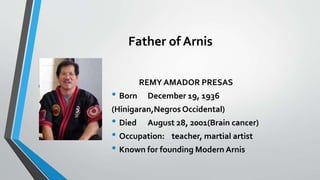
REMY AMADOR PRESAS
• Born December 19, 1936
(Hinigaran,Negros Occidental)
• Died August 28, 2001(Brain cancer)
• Occupation: teacher, martial artist
• Known for founding Modern Arnis
TRAINING
• One of the characteristics of Filipino martial arts is the use of
weapons from the very beginning of training and Modern Arnis is
no exception.The primary weapon is the rattan stick, called a
cane or baston (baton), which varies in size, but is usually about
28 inches (71 cm) in length. Both single and double stick
techniques are taught, with an emphasis on the former; unarmed
defenses against the stick and against bladed weapons (which
the stick is sometimes taken to represent) are a part of the
curriculum.
Benefits of learning Arnis
• It can be used in self-defense. Self-defense is important as it
could help you ensure your safety.
• You can use your hand together with the stick as a weapon.Who
might thought that you can also use your hand as an effective
weapon?This reason is possible with learning arnis.
• Arnis can be easily found in our country thus, using arnis is
practical for us. Arnis is made up of bamboo wood. And Bamboo
woods can be found anywhere in the Philippines, making it as the
most practical weapon to learn compared with swords and
spears.
• Arnis can taught us discipline and self control. Like other martial
arts, arnis can be used to practice and make us learn self control
and disciple. It also gives us ability to think fast and make our
body stronger as we will move a lot.
Belt Ranks
1.Isa (pronounced as i-sah; which literally means "one")
2.Dalawa (pronounced dah-la-wah; literally "two")
3.Tatlo (pronounced as tat-loh; literally "three")
4.Apat (pronounced as Ah-pat; literally "four")
5.Lima (pronounced as li-mah;literally "five")
6.Anim (pronounced as ah-neem; literally "six")
7.Pito (pronounced as pi-toh; literally "seven")
8.Walo (pronounced as "wah-loh"; literally "eight")
9.Siyam (pronounced as si-yam or shahm; literally "nine")
10.Sampu (pronounced as sam-pu; literally "ten")
Kinds of stances
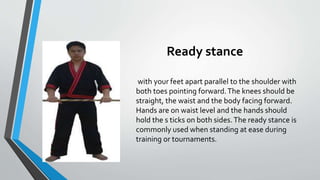
Ready stance
with your feet apart parallel to the shoulder with
both toes pointing forward.The knees should be
straight, the waist and the body facing forward.
Hands are on waist level and the hands should
hold the s ticks on both sides.The ready stance is
commonly used when standing at ease during
training or tournaments.
Attention stance
Stand with your feet forming a 45 degrees angle. Heels should be
close to each other, knees should be straight, the waist and body
facing forward. Shoulders are dropped to the side and both hands
are at waist level. The Attention Stance is commonly used in
preparation for courtesy or “bowing” at commencement of sparring.
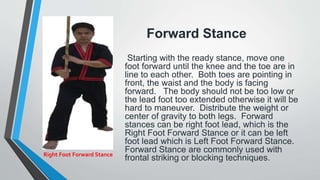
Forward Stance
Starting with the ready stance, move one
foot forward until the knee and the toe are in
line to each other. Both toes are pointing in
front, the waist and the body is facing
forward. The body should not be too low or
the lead foot too extended otherwise it will be
hard to maneuver. Distribute the weight or
center of gravity to both legs. Forward
stances can be right foot lead, which is the
Right Foot Forward Stance or it can be left
foot lead which is Left Foot Forward Stance.
Forward Stance are commonly used with
frontal striking or blocking techniques.Right Foot Forward Stance
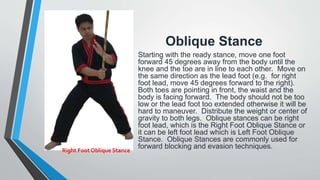
Oblique Stance
Starting with the ready stance, move one foot
forward 45 degrees away from the body until the
knee and the toe are in line to each other. Move on
the same direction as the lead foot (e.g. for right
foot lead, move 45 degrees forward to the right).
Both toes are pointing in front, the waist and the
body is facing forward. The body should not be too
low or the lead foot too extended otherwise it will be
hard to maneuver. Distribute the weight or center of
gravity to both legs. Oblique stances can be right
foot lead, which is the Right Foot Oblique Stance or
it can be left foot lead which is Left Foot Oblique
Stance. Oblique Stances are commonly used for
forward blocking and evasion techniques.Right Foot Oblique Stance
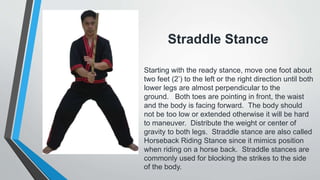
Straddle Stance
Starting with the ready stance, move one foot about
two feet (2’) to the left or the right direction until both
lower legs are almost perpendicular to the
ground. Both toes are pointing in front, the waist
and the body is facing forward. The body should
not be too low or extended otherwise it will be hard
to maneuver. Distribute the weight or center of
gravity to both legs. Straddle stance are also called
Horseback Riding Stance since it mimics position
when riding on a horse back. Straddle stances are
commonly used for blocking the strikes to the side
of the body.
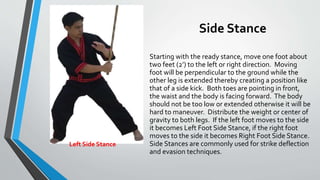
Side Stance
Starting with the ready stance, move one foot about
two feet (2’) to the left or right direction. Moving
foot will be perpendicular to the ground while the
other leg is extended thereby creating a position like
that of a side kick. Both toes are pointing in front,
the waist and the body is facing forward. The body
should not be too low or extended otherwise it will be
hard to maneuver. Distribute the weight or center of
gravity to both legs. If the left foot moves to the side
it becomes Left Foot Side Stance, if the right foot
moves to the side it becomes Right Foot Side Stance.
Side Stances are commonly used for strike deflection
and evasion techniques.
Left Side Stance
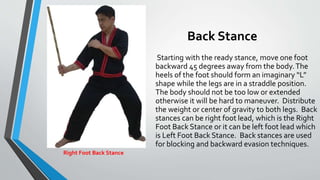
Back Stance
Starting with the ready stance, move one foot
backward 45 degrees away from the body.The
heels of the foot should form an imaginary “L”
shape while the legs are in a straddle position.
The body should not be too low or extended
otherwise it will be hard to maneuver. Distribute
the weight or center of gravity to both legs. Back
stances can be right foot lead, which is the Right
Foot Back Stance or it can be left foot lead which
is Left Foot Back Stance. Back stances are used
for blocking and backward evasion techniques.
Right Foot Back Stance
THANKYOU FORWATCHING
THE END

Arnis

  • 1.
  • 2.
    What is Arnis? Arnisis a deadly form of Original Filipino self-defense, which basically uses the garote usually rattan sticks as the main weapon and as extension of the hands to maximize reach and power contrary to misperceptions Arnis is a very intelligent form of exercise and self- defense.
  • 3.
    Father of Arnis REMYAMADOR PRESAS • Born December 19, 1936 (Hinigaran,Negros Occidental) • Died August 28, 2001(Brain cancer) • Occupation: teacher, martial artist • Known for founding Modern Arnis
  • 4.
    TRAINING • One ofthe characteristics of Filipino martial arts is the use of weapons from the very beginning of training and Modern Arnis is no exception.The primary weapon is the rattan stick, called a cane or baston (baton), which varies in size, but is usually about 28 inches (71 cm) in length. Both single and double stick techniques are taught, with an emphasis on the former; unarmed defenses against the stick and against bladed weapons (which the stick is sometimes taken to represent) are a part of the curriculum.
  • 5.
    Benefits of learningArnis • It can be used in self-defense. Self-defense is important as it could help you ensure your safety. • You can use your hand together with the stick as a weapon.Who might thought that you can also use your hand as an effective weapon?This reason is possible with learning arnis.
  • 6.
    • Arnis canbe easily found in our country thus, using arnis is practical for us. Arnis is made up of bamboo wood. And Bamboo woods can be found anywhere in the Philippines, making it as the most practical weapon to learn compared with swords and spears. • Arnis can taught us discipline and self control. Like other martial arts, arnis can be used to practice and make us learn self control and disciple. It also gives us ability to think fast and make our body stronger as we will move a lot.
  • 7.
    Belt Ranks 1.Isa (pronouncedas i-sah; which literally means "one") 2.Dalawa (pronounced dah-la-wah; literally "two") 3.Tatlo (pronounced as tat-loh; literally "three") 4.Apat (pronounced as Ah-pat; literally "four") 5.Lima (pronounced as li-mah;literally "five") 6.Anim (pronounced as ah-neem; literally "six") 7.Pito (pronounced as pi-toh; literally "seven") 8.Walo (pronounced as "wah-loh"; literally "eight") 9.Siyam (pronounced as si-yam or shahm; literally "nine") 10.Sampu (pronounced as sam-pu; literally "ten")
  • 8.
  • 9.
    Ready stance with yourfeet apart parallel to the shoulder with both toes pointing forward.The knees should be straight, the waist and the body facing forward. Hands are on waist level and the hands should hold the s ticks on both sides.The ready stance is commonly used when standing at ease during training or tournaments.
  • 10.
    Attention stance Stand withyour feet forming a 45 degrees angle. Heels should be close to each other, knees should be straight, the waist and body facing forward. Shoulders are dropped to the side and both hands are at waist level. The Attention Stance is commonly used in preparation for courtesy or “bowing” at commencement of sparring.
  • 11.
    Forward Stance Starting withthe ready stance, move one foot forward until the knee and the toe are in line to each other. Both toes are pointing in front, the waist and the body is facing forward. The body should not be too low or the lead foot too extended otherwise it will be hard to maneuver. Distribute the weight or center of gravity to both legs. Forward stances can be right foot lead, which is the Right Foot Forward Stance or it can be left foot lead which is Left Foot Forward Stance. Forward Stance are commonly used with frontal striking or blocking techniques.Right Foot Forward Stance
  • 12.
    Oblique Stance Starting withthe ready stance, move one foot forward 45 degrees away from the body until the knee and the toe are in line to each other. Move on the same direction as the lead foot (e.g. for right foot lead, move 45 degrees forward to the right). Both toes are pointing in front, the waist and the body is facing forward. The body should not be too low or the lead foot too extended otherwise it will be hard to maneuver. Distribute the weight or center of gravity to both legs. Oblique stances can be right foot lead, which is the Right Foot Oblique Stance or it can be left foot lead which is Left Foot Oblique Stance. Oblique Stances are commonly used for forward blocking and evasion techniques.Right Foot Oblique Stance
  • 13.
    Straddle Stance Starting withthe ready stance, move one foot about two feet (2’) to the left or the right direction until both lower legs are almost perpendicular to the ground. Both toes are pointing in front, the waist and the body is facing forward. The body should not be too low or extended otherwise it will be hard to maneuver. Distribute the weight or center of gravity to both legs. Straddle stance are also called Horseback Riding Stance since it mimics position when riding on a horse back. Straddle stances are commonly used for blocking the strikes to the side of the body.
  • 14.
    Side Stance Starting withthe ready stance, move one foot about two feet (2’) to the left or right direction. Moving foot will be perpendicular to the ground while the other leg is extended thereby creating a position like that of a side kick. Both toes are pointing in front, the waist and the body is facing forward. The body should not be too low or extended otherwise it will be hard to maneuver. Distribute the weight or center of gravity to both legs. If the left foot moves to the side it becomes Left Foot Side Stance, if the right foot moves to the side it becomes Right Foot Side Stance. Side Stances are commonly used for strike deflection and evasion techniques. Left Side Stance
  • 15.
    Back Stance Starting withthe ready stance, move one foot backward 45 degrees away from the body.The heels of the foot should form an imaginary “L” shape while the legs are in a straddle position. The body should not be too low or extended otherwise it will be hard to maneuver. Distribute the weight or center of gravity to both legs. Back stances can be right foot lead, which is the Right Foot Back Stance or it can be left foot lead which is Left Foot Back Stance. Back stances are used for blocking and backward evasion techniques. Right Foot Back Stance
  • 16.