Miss Riham Chahal - 16593190
WHAT IS MOVEMENT EDUCATION?
Movement education was first developed by Francois Delsarte, the development was then elaborated
on by Liselott Diem, and Rudolf Von Laban between 1800s and early 1900s.
Why is movement education important?
Movement Education is a student-centered teaching approach, it encompasses the concept that the
body is an expression of movement and that movement is the concept of physical education. (Abels &
Bridges, 2010 p 3). Movement education is skill-focused and it relies on the teaching strategy of
demonstration and imitation (Oliver, 2009, p25). Once students master the skills it develops self
confidence in their ability and it encourages regular participation.
The Aim of MOVEMENT Education
What is the aim of this approach?
Movement education focuses on motor skills and cognitive knowledge, it enables students to
understand the significance of movement and how each skill can be modified and adapted to achieve
certain movement skills. Students learn fundamental movement skills (FMS) prior to participating in
any sporting activities or games (Abels & Bridges, 2010 p 5).
What happens in Movement Education?
Students develop these skills individually, in pairs, or in groups. Students participate in the skill based
on their ability, they are encouraged to adapt and modify movements using their creativity. The
teachers role is to be a facilitator and provide students with this learning environment. Students are
presented with various problem-solving movement challenges to assist students in understanding,
exploring, and analysing various solutions on how their body moves. Teachers utilise specific
questioning techniques such as how did you achieve this skill?
FUNDAMENTAL Movement Skills (FMS)
Fundamental movement skills (FMS) is the cornerstone of the student’s skill development in physical
education. It contributes to the child’s physical, cognitive and social development (Lubands et al,
2010). Students learn fundamental movement skills that can be used in dance, sports, fitness
activities, and games (BOS, 2007). To establish correct fundamental movement skills, it should be
taught during early childhood and primary school years. Children who don’t receive adequate motor
skill instructions and practice may demonstrate developmental delays in their gross motor ability
(Lubands et al, 2010).
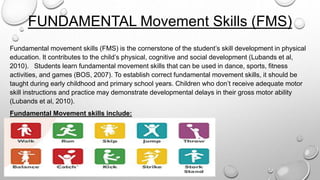
Fundamental Movement skills include:
MOVEMENT
CONCEPT
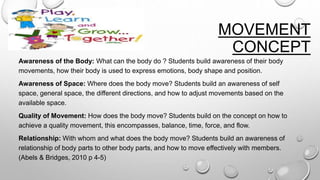
Awareness of the Body: What can the body do ? Students build awareness of their body
movements, how their body is used to express emotions, body shape and position.
Awareness of Space: Where does the body move? Students build an awareness of self
space, general space, the different directions, and how to adjust movements based on the
available space.
Quality of Movement: How does the body move? Students build on the concept on how to
achieve a quality movement, this encompasses, balance, time, force, and flow.
Relationship: With whom and what does the body move? Students build an awareness of
relationship of body parts to other body parts, and how to move effectively with members.
(Abels & Bridges, 2010 p 4-5)
WHY MOVEMENT EDUCATION?
THE RATIONALE OF MOVEMENT EDUCATION
In physical education we want to develop a child’s fundamental movement skills. By utilising this
approach in physical education lessons, students in 4/5 Superstars would develop positive
psychological, physiological and behavioural well-being (Lubands et al, 2010). In addition,
students develop their decision making skills, problem solving skills and communication skills.
These skills are an essential requirement when teaching PDHPE to students (BOS, 2007).
The Benefits of Movement Education:
• Movement educations provides a cornerstone for active lifestyle
• Children are provided with activities that require problem solving skills and accurate decision
making, this is achieved when students can determine how the skills are performed (Hopper et
al., 2009).
• Furthermore, students must utilise their communication skills to negotiate with other peers, this
approach promotes learning in a social context through the construction of groups (BOS, 2007).
THE STRENGTHS OF MOVEMENT
EDUCATION
The strengths of Movement Education as linked to the PDHPE syllabus
Teacher have a responsibility to create a physical education program that encourages physical
growth and development of all students. Teachers are to support the “acquisition of movement
skills and nurture positive attitudes towards physical activity”, students are to be provided with
ample opportunities to develop and apply fundamental movement skills, as this enhances creativity
aesthetic awareness, and develop positive attitudes towards regular physical activity (BOS, 2007).
Acquiring the skills correctly will enable students to become intrinsically motivated in their physical
education, as students become competent and confident in their performance of FMS. This may
lead to a greater willingness to participate in physical activities that may also provide opportunities
to improve fitness levels and reduce the risk of unhealthy weight gain (Lubands et al, 2010).
Overall, Movement Education will assist students in achieving the learning outcomes and indicators
in the PDHPE Syllabus.
REFERENCE
• Abels, K. & Bridges, J. (2010). Teaching movement education. Champaign, IL: Human
Kinetics.
• Board of Studies, NSW. (2007).Personal development, health and physical education K-
6: Syllabus. Sydney, Australia: Author.
• Hopper, T., Butler, J., & Storey, B. (2009).TGFU-simply good pedagogy: Understanding a
complex challenge. Vancouver: PHE Canada.
• Lubans, D. Morgan, p. cliff, D. Barnett, L. okely, a. (2010). Fundamental movement skills
in children and adolescents: Review of associated health benefits. Sports Med,
40(2),1019‐1035.
• Suzanne Oliver (2009) Alignment in Early Movement Education, Journal of Physical
Education, Recreation & Dance, 80:3, 24-29, DOI:
10.1080/07303084.2009.10598293

Pdhpe powerpoint

  • 1.
  • 2.
    WHAT IS MOVEMENTEDUCATION? Movement education was first developed by Francois Delsarte, the development was then elaborated on by Liselott Diem, and Rudolf Von Laban between 1800s and early 1900s. Why is movement education important? Movement Education is a student-centered teaching approach, it encompasses the concept that the body is an expression of movement and that movement is the concept of physical education. (Abels & Bridges, 2010 p 3). Movement education is skill-focused and it relies on the teaching strategy of demonstration and imitation (Oliver, 2009, p25). Once students master the skills it develops self confidence in their ability and it encourages regular participation.
  • 3.
    The Aim ofMOVEMENT Education What is the aim of this approach? Movement education focuses on motor skills and cognitive knowledge, it enables students to understand the significance of movement and how each skill can be modified and adapted to achieve certain movement skills. Students learn fundamental movement skills (FMS) prior to participating in any sporting activities or games (Abels & Bridges, 2010 p 5). What happens in Movement Education? Students develop these skills individually, in pairs, or in groups. Students participate in the skill based on their ability, they are encouraged to adapt and modify movements using their creativity. The teachers role is to be a facilitator and provide students with this learning environment. Students are presented with various problem-solving movement challenges to assist students in understanding, exploring, and analysing various solutions on how their body moves. Teachers utilise specific questioning techniques such as how did you achieve this skill?
  • 4.
    FUNDAMENTAL Movement Skills(FMS) Fundamental movement skills (FMS) is the cornerstone of the student’s skill development in physical education. It contributes to the child’s physical, cognitive and social development (Lubands et al, 2010). Students learn fundamental movement skills that can be used in dance, sports, fitness activities, and games (BOS, 2007). To establish correct fundamental movement skills, it should be taught during early childhood and primary school years. Children who don’t receive adequate motor skill instructions and practice may demonstrate developmental delays in their gross motor ability (Lubands et al, 2010). Fundamental Movement skills include:
  • 5.
    MOVEMENT CONCEPT Awareness of theBody: What can the body do ? Students build awareness of their body movements, how their body is used to express emotions, body shape and position. Awareness of Space: Where does the body move? Students build an awareness of self space, general space, the different directions, and how to adjust movements based on the available space. Quality of Movement: How does the body move? Students build on the concept on how to achieve a quality movement, this encompasses, balance, time, force, and flow. Relationship: With whom and what does the body move? Students build an awareness of relationship of body parts to other body parts, and how to move effectively with members. (Abels & Bridges, 2010 p 4-5)
  • 6.
    WHY MOVEMENT EDUCATION? THERATIONALE OF MOVEMENT EDUCATION In physical education we want to develop a child’s fundamental movement skills. By utilising this approach in physical education lessons, students in 4/5 Superstars would develop positive psychological, physiological and behavioural well-being (Lubands et al, 2010). In addition, students develop their decision making skills, problem solving skills and communication skills. These skills are an essential requirement when teaching PDHPE to students (BOS, 2007). The Benefits of Movement Education: • Movement educations provides a cornerstone for active lifestyle • Children are provided with activities that require problem solving skills and accurate decision making, this is achieved when students can determine how the skills are performed (Hopper et al., 2009). • Furthermore, students must utilise their communication skills to negotiate with other peers, this approach promotes learning in a social context through the construction of groups (BOS, 2007).
  • 7.
    THE STRENGTHS OFMOVEMENT EDUCATION The strengths of Movement Education as linked to the PDHPE syllabus Teacher have a responsibility to create a physical education program that encourages physical growth and development of all students. Teachers are to support the “acquisition of movement skills and nurture positive attitudes towards physical activity”, students are to be provided with ample opportunities to develop and apply fundamental movement skills, as this enhances creativity aesthetic awareness, and develop positive attitudes towards regular physical activity (BOS, 2007). Acquiring the skills correctly will enable students to become intrinsically motivated in their physical education, as students become competent and confident in their performance of FMS. This may lead to a greater willingness to participate in physical activities that may also provide opportunities to improve fitness levels and reduce the risk of unhealthy weight gain (Lubands et al, 2010). Overall, Movement Education will assist students in achieving the learning outcomes and indicators in the PDHPE Syllabus.
  • 8.
    REFERENCE • Abels, K.& Bridges, J. (2010). Teaching movement education. Champaign, IL: Human Kinetics. • Board of Studies, NSW. (2007).Personal development, health and physical education K- 6: Syllabus. Sydney, Australia: Author. • Hopper, T., Butler, J., & Storey, B. (2009).TGFU-simply good pedagogy: Understanding a complex challenge. Vancouver: PHE Canada. • Lubans, D. Morgan, p. cliff, D. Barnett, L. okely, a. (2010). Fundamental movement skills in children and adolescents: Review of associated health benefits. Sports Med, 40(2),1019‐1035. • Suzanne Oliver (2009) Alignment in Early Movement Education, Journal of Physical Education, Recreation & Dance, 80:3, 24-29, DOI: 10.1080/07303084.2009.10598293