

12/01/2024 Dr Kuntamalla Sujatha, S. Shireesha & M. S
ai Abhishek
1
DEPARTMENT OF SERICULTURE
SUBJECT: Silkworm rearing technology
Dr. Kuntamalla Sujatha S. Shireesha ,
Asst. Prof, Dept of Sericulture MSc sericulture,
Kakatiya University
Madichetti Sai Abhishek
Shodhana Labs, Hyderabad.
12/01/2024 Dr Kuntamalla Sujatha, S. Shireesha & M. S
ai Abhishek
2
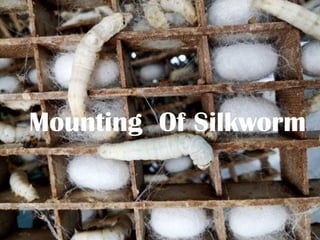
Mounting Of Silkworm
12/01/2024 Dr Kuntamalla Sujatha, S. Shireesha & M. S
ai Abhishek
3
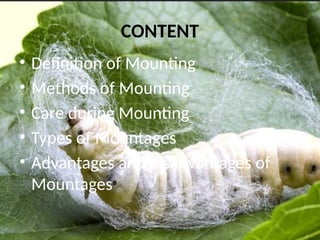
CONTENT
• Definition of Mounting
• Methods of Mounting
• Care during Mounting
• Types of Mountages
• Advantages and disadvantages of
Mountages
12/01/2024 Dr Kuntamalla Sujatha, S. Shireesha & M. S
ai Abhishek
4
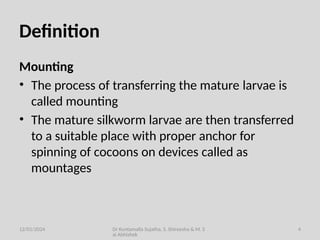
Definition
Mounting
• The process of transferring the mature larvae is
called mounting
• The mature silkworm larvae are then transferred
to a suitable place with proper anchor for
spinning of cocoons on devices called as
mountages
12/01/2024 Dr Kuntamalla Sujatha, S. Shireesha & M. S
ai Abhishek
5
• Mature worms can be easily induced to cocoon
spinning.
• Total mountage space can be efficiently used.
• Manufacturing of encubages can be easily and
cheaply undertaken.
• Durable of mountage are needed.
• Storage of mountage requires little space.
• Material used Should be resistant to high moisture
or wetness.
12/01/2024 Dr Kuntamalla Sujatha, S. Shireesha & M. S
ai Abhishek
6
Proper timing of mounting
• If mounting does not take place at right times.
• It has a negative effect on cocoon quality and
quantity.
• When immature worms are mounted ,they die in
cocoon ages or their silk content in the cocoons
will be low.
• Thoracic segment should be translucent. It will pass
out last.
• Faeces which is greenish soft and irregular In shape.
12/01/2024 Dr Kuntamalla Sujatha, S. Shireesha & M. S
ai Abhishek
7
Methods of mounting
1. Picking – up
2 . Shaking the shoots
1. Net method
2. Branch method
3. Self-mounting
12/01/2024 Dr Kuntamalla Sujatha, S. Shireesha & M. S
ai Abhishek
8
Picking – up Method
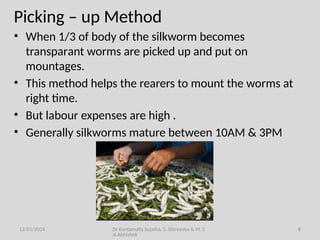
• When 1/3 of body of the silkworm becomes
transparant worms are picked up and put on
mountages.
• This method helps the rearers to mount the worms at
right time.
• But labour expenses are high .
• Generally silkworms mature between 10AM & 3PM
12/01/2024 Dr Kuntamalla Sujatha, S. Shireesha & M. S
ai Abhishek
9
By shaking the shoots
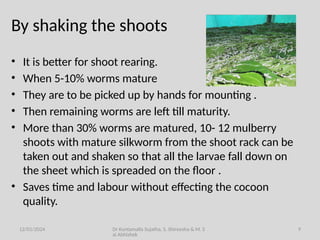
• It is better for shoot rearing.
• When 5-10% worms mature
• They are to be picked up by hands for mounting .
• Then remaining worms are left till maturity.
• More than 30% worms are matured, 10- 12 mulberry
shoots with mature silkworm from the shoot rack can be
taken out and shaken so that all the larvae fall down on
the sheet which is spreaded on the floor .
• Saves time and labour without effecting the cocoon
quality.
12/01/2024 Dr Kuntamalla Sujatha, S. Shireesha & M. S
ai Abhishek
10
Net method
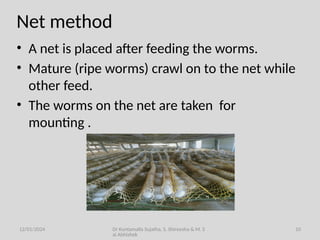
• A net is placed after feeding the worms.
• Mature (ripe worms) crawl on to the net while
other feed.
• The worms on the net are taken for
mounting .
12/01/2024 Dr Kuntamalla Sujatha, S. Shireesha & M. S
ai Abhishek
11
Branch method
• It is similar to net method where only
mulberry shoots are used.
• When ripened worms are on the shoots they
are mounted.
12/01/2024 Dr Kuntamalla Sujatha, S. Shireesha & M. S
ai Abhishek
12
Self-mounting
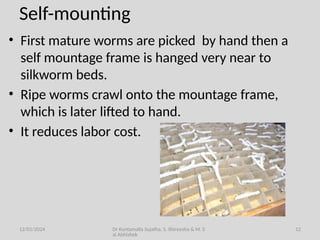
• First mature worms are picked by hand then a
self mountage frame is hanged very near to
silkworm beds.
• Ripe worms crawl onto the mountage frame,
which is later lifted to hand.
• It reduces labor cost.
12/01/2024 Dr Kuntamalla Sujatha, S. Shireesha & M. S
ai Abhishek
13
Care during mounting
• In the mounting room, old news paper or mats put under the mounting
frames.
• When urine and excreta falls on the paper it must be removed .
• If the temperature raised beyond the shell becomes very loose and folded with
wrinkles and knots.
• Low temperature slows down the secretion of silk resulting in large cocoons .
• Relative humidity (60-70%) induces good health, good reelability and quality
cocoons .
• Low humidity causes double layered cocoons, loose cocoons etc..
• Ants crawling on to the mountages are prevented by applying grease to the
stands placed below.
• Spinning worms if disturbed increases floss percentage .
12/01/2024 Dr Kuntamalla Sujatha, S. Shireesha & M. S
ai Abhishek
14
12/01/2024 Dr Kuntamalla Sujatha, S. Shireesha & M. S
ai Abhishek
15
Types of mountages
1. Bottle brush mountage
2. Mulberry twigs
3. Traditional bamboo mountage
4. Rotary mountage (Plastic/Cardboard)
5. Plastic collapsible mountage
6. Modified (hybrid ) mountages
12/01/2024 Dr Kuntamalla Sujatha, S. Shireesha & M. S
ai Abhishek
16
Bottle brush mountages
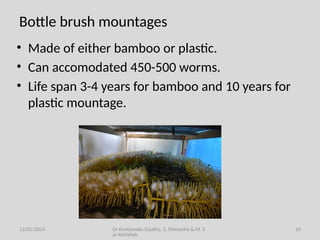
• Made of either bamboo or plastic.
• Can accomodated 450-500 worms.
• Life span 3-4 years for bamboo and 10 years for
plastic mountage.
12/01/2024 Dr Kuntamalla Sujatha, S. Shireesha & M. S
ai Abhishek
17
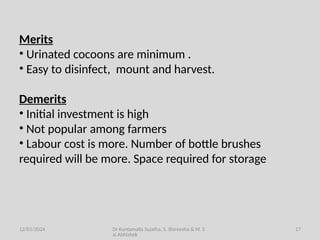
Merits
• Urinated cocoons are minimum .
• Easy to disinfect, mount and harvest.
Demerits
• Initial investment is high
• Not popular among farmers
• Labour cost is more. Number of bottle brushes
required will be more. Space required for storage
12/01/2024 Dr Kuntamalla Sujatha, S. Shireesha & M. S
ai Abhishek
18
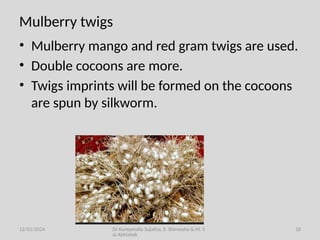
Mulberry twigs
• Mulberry mango and red gram twigs are used.
• Double cocoons are more.
• Twigs imprints will be formed on the cocoons
are spun by silkworm.
12/01/2024 Dr Kuntamalla Sujatha, S. Shireesha & M. S
ai Abhishek
19
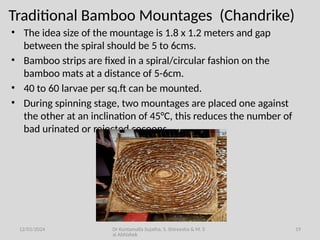
Traditional Bamboo Mountages (Chandrike)
• The idea size of the mountage is 1.8 x 1.2 meters and gap
between the spiral should be 5 to 6cms.
• Bamboo strips are fixed in a spiral/circular fashion on the
bamboo mats at a distance of 5-6cm.
• 40 to 60 larvae per sq.ft can be mounted.
• During spinning stage, two mountages are placed one against
the other at an inclination of 45°C, this reduces the number of
bad urinated or rejected cocoons.
12/01/2024 Dr Kuntamalla Sujatha, S. Shireesha & M. S
ai Abhishek
20
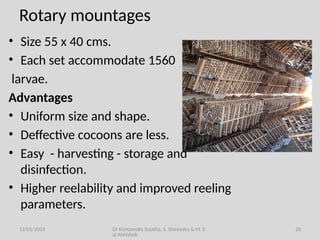
Rotary mountages
• Size 55 x 40 cms.
• Each set accommodate 1560
larvae.
Advantages
• Uniform size and shape.
• Deffective cocoons are less.
• Easy - harvesting - storage and
disinfection.
• Higher reelability and improved reeling
parameters.
12/01/2024 Dr Kuntamalla Sujatha, S. Shireesha & M. S
ai Abhishek
21
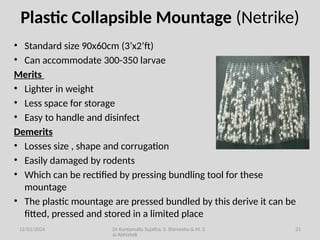
Plastic Collapsible Mountage (Netrike)
• Standard size 90x60cm (3’x2’ft)
• Can accommodate 300-350 larvae
Merits
• Lighter in weight
• Less space for storage
• Easy to handle and disinfect
Demerits
• Losses size , shape and corrugation
• Easily damaged by rodents
• Which can be rectified by pressing bundling tool for these
mountage
• The plastic mountage are pressed bundled by this derive it can be
fitted, pressed and stored in a limited place
12/01/2024 Dr Kuntamalla Sujatha, S. Shireesha & M. S
ai Abhishek
22
Modified (hybrid ) mountages
Merits
• Mounting and harvesting is easy .
• Deffective cocoon 2-5%.
Demerits
• More space for mounting .
12/01/2024 Dr Kuntamalla Sujatha, S. Shireesha & M. S
ai Abhishek
23
Advantages of mounting
1. Protection: The cocoon provides a safe and secure environment
for the pupa, shielding it from predators, harsh weather, and
environmental stressors.
2. Immobilization: Mounting ensures the pupa remains still allowing
for a stable and controlled transformation into an adult moth.
3. Humidity regulation: The cocoons maintains a consistent level of
humidity essential for the pupas development and
metamorphosis.
4. Temperature regulation: The cocoon provides insulation keeping
the pupa at a stable temperature optimal for development.
5. Silk conservation: By spinning a cocoon the silkworm conserves it
silk reserves which are valuable for textile production.
12/01/2024 Dr Kuntamalla Sujatha, S. Shireesha & M. S
ai Abhishek
24
Disadvantages of mounting
1. Vulnerability to disease: The cocoon can be susceptible to fungal
or bacterial infections which can harm the pupa.
2. Predator attraction: The cocoons can attract predators , such as
wasps or bugs ,that feed on silkworm pupae.
3. Environmental risks: Extreme temperatures, humidity or physical
damage can harm the pupa or prevents successful emergence.
4. Silk quality reduction: Poor mounting or cocoon quality can lead
to lower quality silk are reduced silk production
12/01/2024 Dr Kuntamalla Sujatha, S. Shireesha & M. S
ai Abhishek
25
THANK YOU
ACKNOWLEDGE FROM INTERNET

Mounting - Definition, methods, types, etc,.pptx

  • 1.
    12/01/2024 Dr KuntamallaSujatha, S. Shireesha & M. S ai Abhishek 1 DEPARTMENT OF SERICULTURE SUBJECT: Silkworm rearing technology Dr. Kuntamalla Sujatha S. Shireesha , Asst. Prof, Dept of Sericulture MSc sericulture, Kakatiya University Madichetti Sai Abhishek Shodhana Labs, Hyderabad.
  • 2.
    12/01/2024 Dr KuntamallaSujatha, S. Shireesha & M. S ai Abhishek 2 Mounting Of Silkworm
  • 3.
    12/01/2024 Dr KuntamallaSujatha, S. Shireesha & M. S ai Abhishek 3 CONTENT • Definition of Mounting • Methods of Mounting • Care during Mounting • Types of Mountages • Advantages and disadvantages of Mountages
  • 4.
    12/01/2024 Dr KuntamallaSujatha, S. Shireesha & M. S ai Abhishek 4 Definition Mounting • The process of transferring the mature larvae is called mounting • The mature silkworm larvae are then transferred to a suitable place with proper anchor for spinning of cocoons on devices called as mountages
  • 5.
    12/01/2024 Dr KuntamallaSujatha, S. Shireesha & M. S ai Abhishek 5 • Mature worms can be easily induced to cocoon spinning. • Total mountage space can be efficiently used. • Manufacturing of encubages can be easily and cheaply undertaken. • Durable of mountage are needed. • Storage of mountage requires little space. • Material used Should be resistant to high moisture or wetness.
  • 6.
    12/01/2024 Dr KuntamallaSujatha, S. Shireesha & M. S ai Abhishek 6 Proper timing of mounting • If mounting does not take place at right times. • It has a negative effect on cocoon quality and quantity. • When immature worms are mounted ,they die in cocoon ages or their silk content in the cocoons will be low. • Thoracic segment should be translucent. It will pass out last. • Faeces which is greenish soft and irregular In shape.
  • 7.
    12/01/2024 Dr KuntamallaSujatha, S. Shireesha & M. S ai Abhishek 7 Methods of mounting 1. Picking – up 2 . Shaking the shoots 1. Net method 2. Branch method 3. Self-mounting
  • 8.
    12/01/2024 Dr KuntamallaSujatha, S. Shireesha & M. S ai Abhishek 8 Picking – up Method • When 1/3 of body of the silkworm becomes transparant worms are picked up and put on mountages. • This method helps the rearers to mount the worms at right time. • But labour expenses are high . • Generally silkworms mature between 10AM & 3PM
  • 9.
    12/01/2024 Dr KuntamallaSujatha, S. Shireesha & M. S ai Abhishek 9 By shaking the shoots • It is better for shoot rearing. • When 5-10% worms mature • They are to be picked up by hands for mounting . • Then remaining worms are left till maturity. • More than 30% worms are matured, 10- 12 mulberry shoots with mature silkworm from the shoot rack can be taken out and shaken so that all the larvae fall down on the sheet which is spreaded on the floor . • Saves time and labour without effecting the cocoon quality.
  • 10.
    12/01/2024 Dr KuntamallaSujatha, S. Shireesha & M. S ai Abhishek 10 Net method • A net is placed after feeding the worms. • Mature (ripe worms) crawl on to the net while other feed. • The worms on the net are taken for mounting .
  • 11.
    12/01/2024 Dr KuntamallaSujatha, S. Shireesha & M. S ai Abhishek 11 Branch method • It is similar to net method where only mulberry shoots are used. • When ripened worms are on the shoots they are mounted.
  • 12.
    12/01/2024 Dr KuntamallaSujatha, S. Shireesha & M. S ai Abhishek 12 Self-mounting • First mature worms are picked by hand then a self mountage frame is hanged very near to silkworm beds. • Ripe worms crawl onto the mountage frame, which is later lifted to hand. • It reduces labor cost.
  • 13.
    12/01/2024 Dr KuntamallaSujatha, S. Shireesha & M. S ai Abhishek 13 Care during mounting • In the mounting room, old news paper or mats put under the mounting frames. • When urine and excreta falls on the paper it must be removed . • If the temperature raised beyond the shell becomes very loose and folded with wrinkles and knots. • Low temperature slows down the secretion of silk resulting in large cocoons . • Relative humidity (60-70%) induces good health, good reelability and quality cocoons . • Low humidity causes double layered cocoons, loose cocoons etc.. • Ants crawling on to the mountages are prevented by applying grease to the stands placed below. • Spinning worms if disturbed increases floss percentage .
  • 14.
    12/01/2024 Dr KuntamallaSujatha, S. Shireesha & M. S ai Abhishek 14
  • 15.
    12/01/2024 Dr KuntamallaSujatha, S. Shireesha & M. S ai Abhishek 15 Types of mountages 1. Bottle brush mountage 2. Mulberry twigs 3. Traditional bamboo mountage 4. Rotary mountage (Plastic/Cardboard) 5. Plastic collapsible mountage 6. Modified (hybrid ) mountages
  • 16.
    12/01/2024 Dr KuntamallaSujatha, S. Shireesha & M. S ai Abhishek 16 Bottle brush mountages • Made of either bamboo or plastic. • Can accomodated 450-500 worms. • Life span 3-4 years for bamboo and 10 years for plastic mountage.
  • 17.
    12/01/2024 Dr KuntamallaSujatha, S. Shireesha & M. S ai Abhishek 17 Merits • Urinated cocoons are minimum . • Easy to disinfect, mount and harvest. Demerits • Initial investment is high • Not popular among farmers • Labour cost is more. Number of bottle brushes required will be more. Space required for storage
  • 18.
    12/01/2024 Dr KuntamallaSujatha, S. Shireesha & M. S ai Abhishek 18 Mulberry twigs • Mulberry mango and red gram twigs are used. • Double cocoons are more. • Twigs imprints will be formed on the cocoons are spun by silkworm.
  • 19.
    12/01/2024 Dr KuntamallaSujatha, S. Shireesha & M. S ai Abhishek 19 Traditional Bamboo Mountages (Chandrike) • The idea size of the mountage is 1.8 x 1.2 meters and gap between the spiral should be 5 to 6cms. • Bamboo strips are fixed in a spiral/circular fashion on the bamboo mats at a distance of 5-6cm. • 40 to 60 larvae per sq.ft can be mounted. • During spinning stage, two mountages are placed one against the other at an inclination of 45°C, this reduces the number of bad urinated or rejected cocoons.
  • 20.
    12/01/2024 Dr KuntamallaSujatha, S. Shireesha & M. S ai Abhishek 20 Rotary mountages • Size 55 x 40 cms. • Each set accommodate 1560 larvae. Advantages • Uniform size and shape. • Deffective cocoons are less. • Easy - harvesting - storage and disinfection. • Higher reelability and improved reeling parameters.
  • 21.
    12/01/2024 Dr KuntamallaSujatha, S. Shireesha & M. S ai Abhishek 21 Plastic Collapsible Mountage (Netrike) • Standard size 90x60cm (3’x2’ft) • Can accommodate 300-350 larvae Merits • Lighter in weight • Less space for storage • Easy to handle and disinfect Demerits • Losses size , shape and corrugation • Easily damaged by rodents • Which can be rectified by pressing bundling tool for these mountage • The plastic mountage are pressed bundled by this derive it can be fitted, pressed and stored in a limited place
  • 22.
    12/01/2024 Dr KuntamallaSujatha, S. Shireesha & M. S ai Abhishek 22 Modified (hybrid ) mountages Merits • Mounting and harvesting is easy . • Deffective cocoon 2-5%. Demerits • More space for mounting .
  • 23.
    12/01/2024 Dr KuntamallaSujatha, S. Shireesha & M. S ai Abhishek 23 Advantages of mounting 1. Protection: The cocoon provides a safe and secure environment for the pupa, shielding it from predators, harsh weather, and environmental stressors. 2. Immobilization: Mounting ensures the pupa remains still allowing for a stable and controlled transformation into an adult moth. 3. Humidity regulation: The cocoons maintains a consistent level of humidity essential for the pupas development and metamorphosis. 4. Temperature regulation: The cocoon provides insulation keeping the pupa at a stable temperature optimal for development. 5. Silk conservation: By spinning a cocoon the silkworm conserves it silk reserves which are valuable for textile production.
  • 24.
    12/01/2024 Dr KuntamallaSujatha, S. Shireesha & M. S ai Abhishek 24 Disadvantages of mounting 1. Vulnerability to disease: The cocoon can be susceptible to fungal or bacterial infections which can harm the pupa. 2. Predator attraction: The cocoons can attract predators , such as wasps or bugs ,that feed on silkworm pupae. 3. Environmental risks: Extreme temperatures, humidity or physical damage can harm the pupa or prevents successful emergence. 4. Silk quality reduction: Poor mounting or cocoon quality can lead to lower quality silk are reduced silk production
  • 25.
    12/01/2024 Dr KuntamallaSujatha, S. Shireesha & M. S ai Abhishek 25 THANK YOU ACKNOWLEDGE FROM INTERNET