REARING EQUIPMENT IN
SERICULTURE
PRESENTED BY
VISHALI NS
REARING OF SILKWORMS
● The rearing of silkworm refers to the growing of
silkworms in an ideal environment to produce cocoon
for silk.
● It is a sericulture operation.
● In India, rearing is carried out 5-6 times in a year.
For a successful rearing of silkworms the following
requirements should be fulfiled :
• Adequate supply of mulberry leaves.
• Large number of labours.
• Rearing house.
• Rearing house must be a concrete building with ceiling of wood.
• The house should be lighted.
• Rearing appliances are needed.
SILKWORM REARING HOUSE
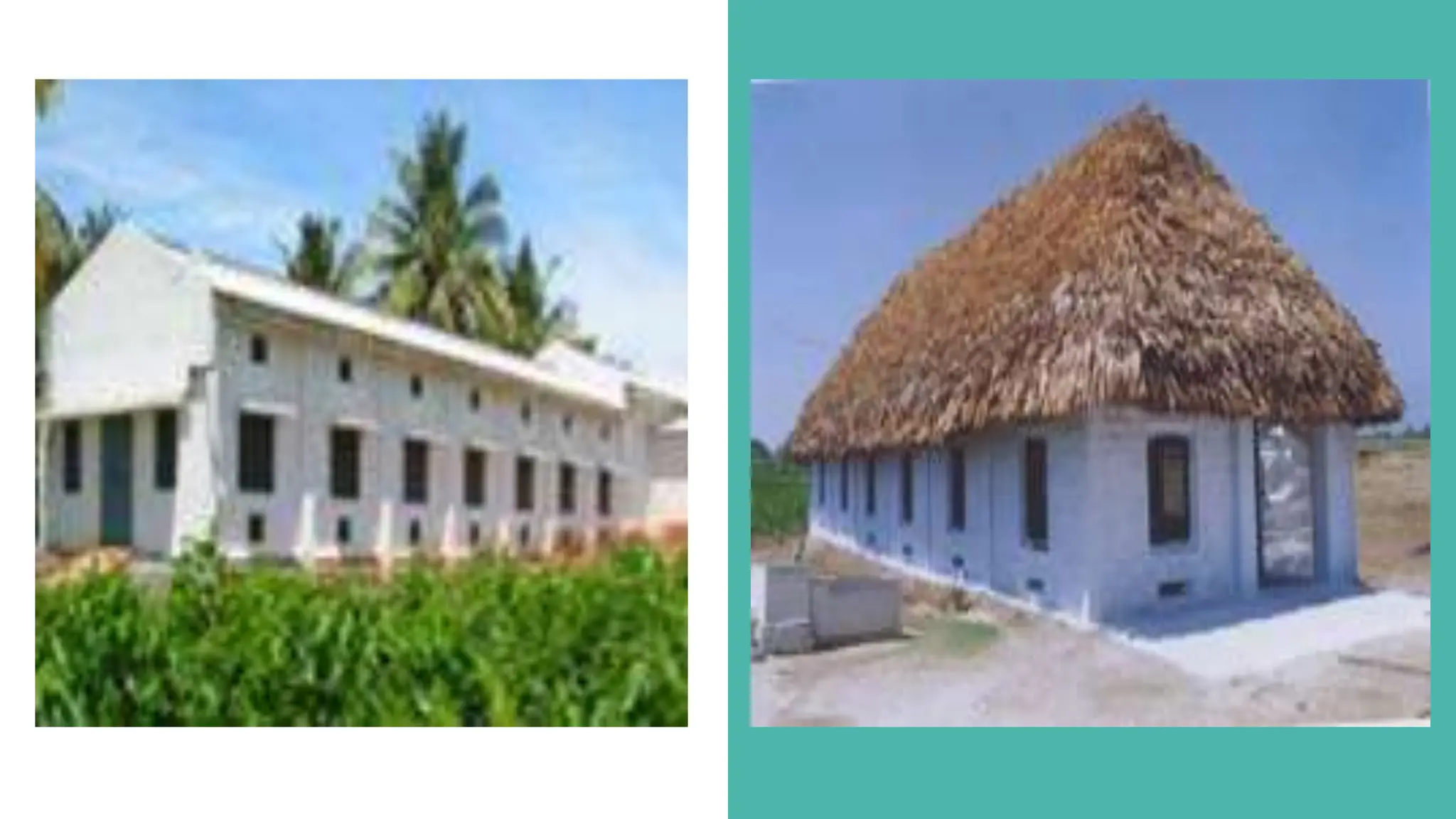
● Silkworms are reared in a rearing house.
● It is a concrete building with thatched of tiled roof.
● There should be 3 rooms, one for rearing, another for
keeping appliances and the third for storing mulberry
leaves
REARING APPLIANCES
1.Rearing stand 7.Chopping board
2.Rearing trays 8.Chopping knife
3.Chop sticks 9.Mats
4.Feather 10.Feeding stand
5.Leaf basket 11.Cleaning net
6.Leaf chamber 12.Mountages
REARING STAND
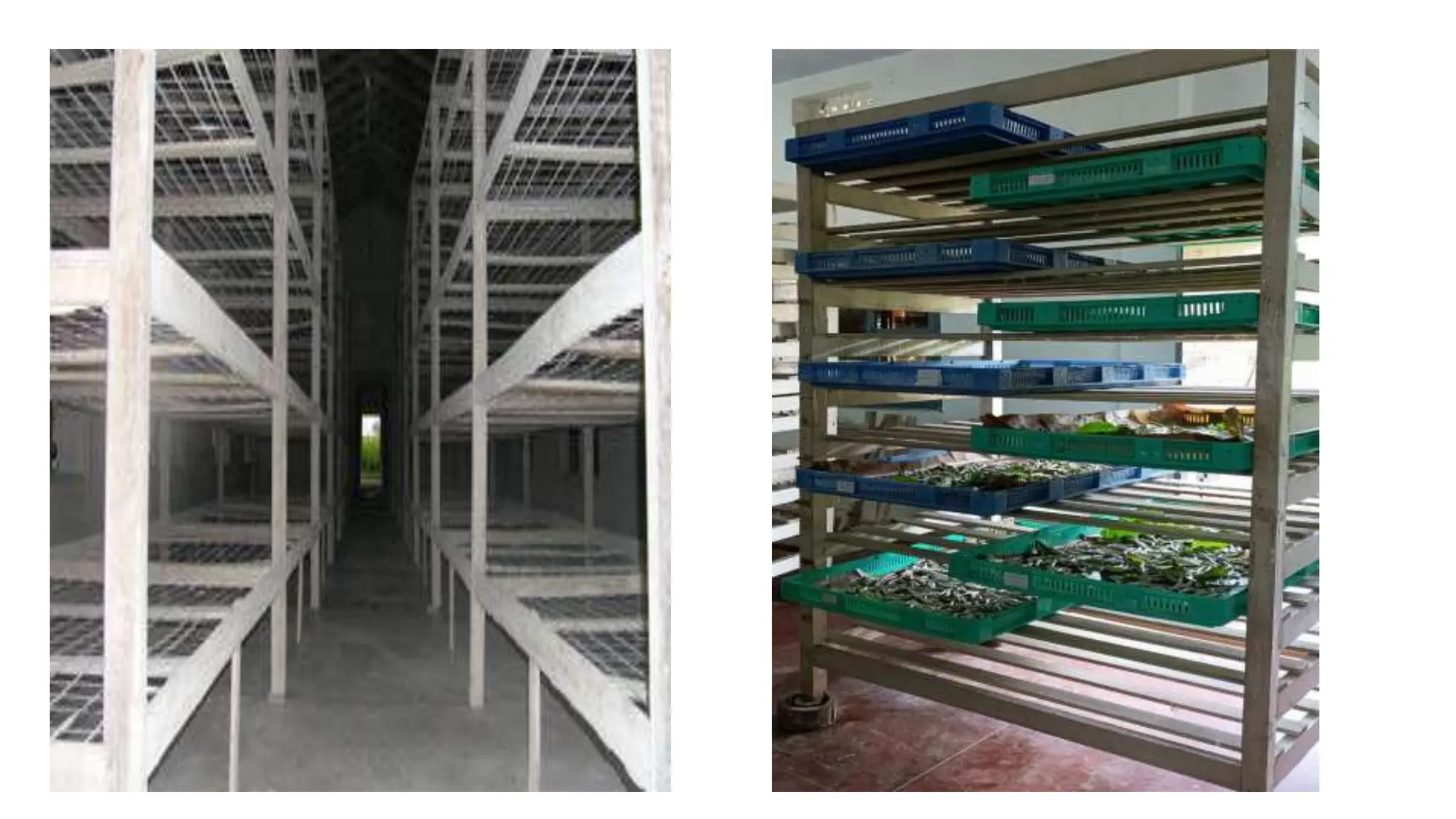
• Rearing stand is used for keeping the rearing trays.
• It is made of wood or bamboo.
• It is about 2.5m in height and 1.5m in length and 0.65m
breadth.
• It has 10 to 12 shelves to keep rearing trays.
• The four legs of the sand are placed on antwells.
• Antwell is used to
restrict the free
movement of ants.
• Antwell is made of
concrete cement.
• It is filled with
water.
• It is useful in
preventing the entry
of ants.
REARING TRAYS
• Rearing trays are used for rearing silkworms.
• The trays are made of bamboo or wood.
• The trays are coated with cowdung paste mixed with formalin.
• A large number of silkworms can be reared in single tray.
• The trays are stacked on the rearing stand.
• The bottom of the tray is spread with paraffin paper. It prevents
evaporation of water. It helps in regulating humidity.
• In village, sheets made of polythene, dried banana leaves and
dried banana barks are also used instead of paraffin paper.
• Foam rubber strips are also used in the trays to keep high
humidity.
• There are cut into 2.5 x 2.5cm strips.
• They are soaked in water.
• Then they are placed around the bed of silkworms.
CHOP STICKS
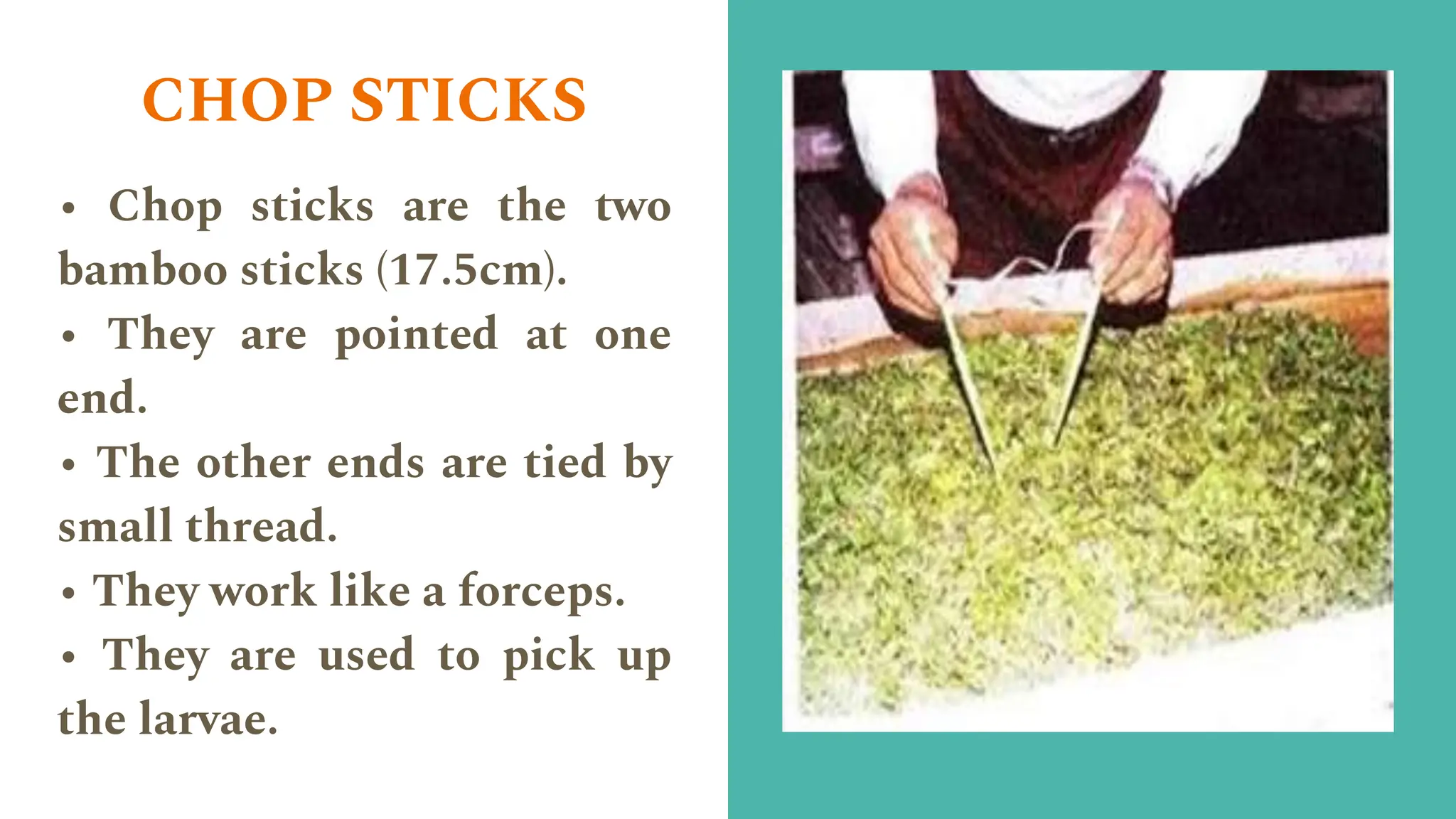
• Chop sticks are the two
bamboo sticks (17.5cm).
• They are pointed at one
end.
• The other ends are tied by
small thread.
• They work like a forceps.
• They are used to pick up
the larvae.
FEATHER
• Feather is a bird’sfeather.
• It is used to brush the
newly hatched larvae from
the egg card to the rearing
trays.
• It is also used to spread
the larvae.
LEAF BASKET
• Leaf basket is a bamboo
basket.
• It is used to carry
mulberry leaves from the
field to the rearing house.
• Leaf chamber is made of wooden reepers.
• This chamber is closed on the sides and bottom.
• It is used to store the mulberry leaves.
• Wet gunny bags are placed on the leaf chamber to keep
the mulberry leaves fresh.
LEAF CHAMBER
CHOPPING BOARD
• Chopping board is a
rectangular mulberry
board which is used for
cutting leaves.
• It is made of wood.
CHOPPING KNIFE
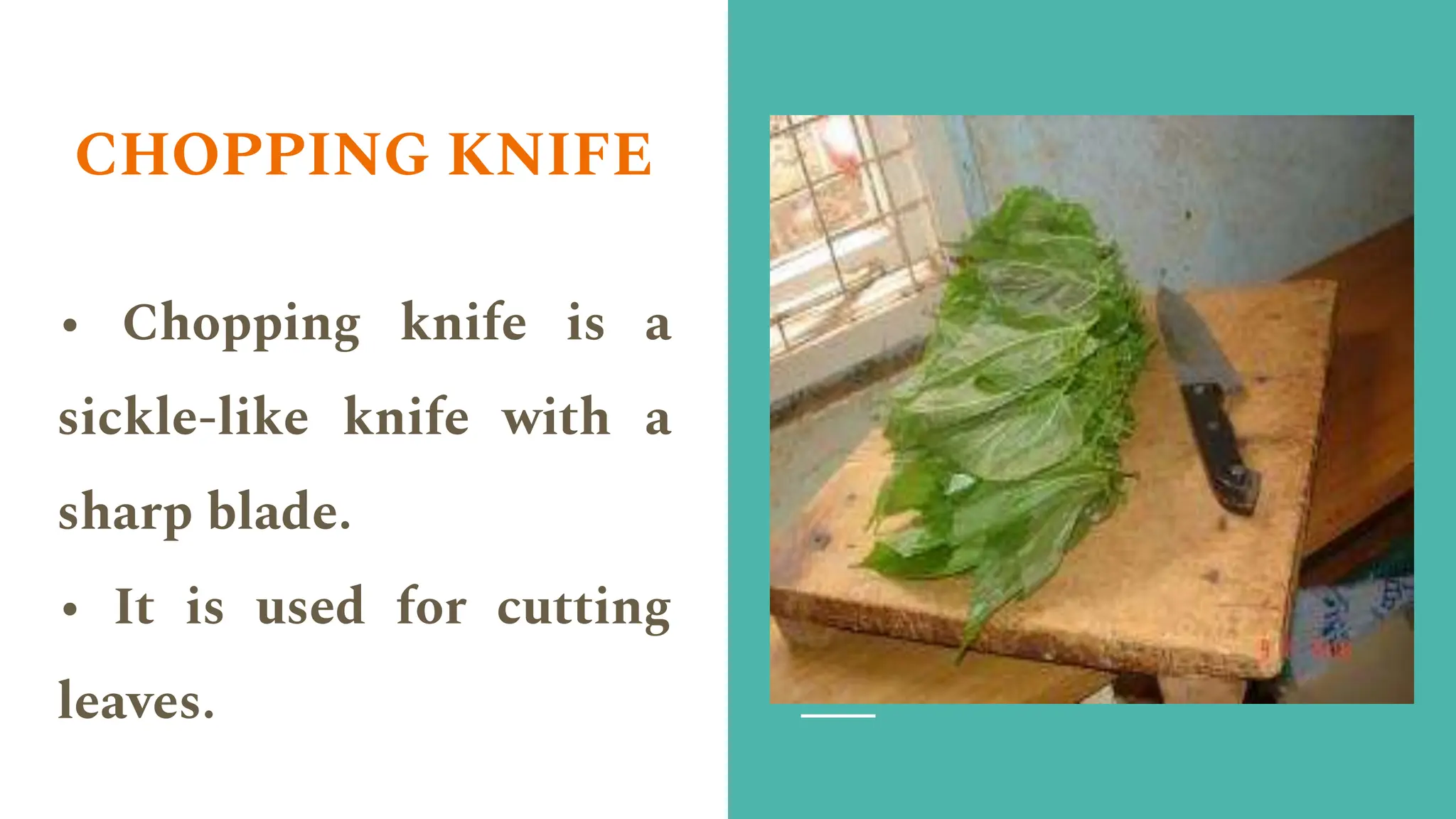
• Chopping knife is a
sickle-like knife with a
sharp blade.
• It is used for cutting
leaves.
MATS
•Mats are placed beneath
the chopping board.
• They are used to collect
cut leaves.
Newspapers can also be
used.
FEEDING STAND
• Feeding stand is a stand
on which the trays are
placed after the removal of
tray from the stand, to do
feeding and other works.
CLEANING NET
● A nylon net is used to clean the bed.
● The net is spread over the tray. Fresh chopped leaves are
spread of the net.
● Worms of the tray crawl through the meshes of the net and
feed the fresh leaves.
● The net is removed and worms are transferred to a new tray.
● The old tray is removed.
MOUNTAGE
• Mountage is an appliance used to help the silkworms to spin the
cocoon.It is otherwise called cocoonage.
• Various types of mountages are used in India.
• It is the most important appliance used in rearing silkworms.
• It determines the quality and quantity of good cocoons.
• Mountages are made up of wood, bamboo, plastic, grass, dry leaves
and twigs
The mountages used in India are the following:
1.Paddy straw mountage
2.Chandrika
3.Screen-type mountage
4.Plastic mountage
5.Netrikka (Polymer mountage)
6.Bottle brush mountage
7.Bamboo strip mountage
8.Plastic bottle brush
PADDY STRAW MOUNTAGE
• Paddy straw mountage is traditional.
• It is very cheap, effective and gives good yields.
• It is a heap of paddy straw.
• As straw absorbs the excessive water, the worm can spin with a
suitable space.
• It is disadvantageous because cocoons may be crushed.
• Harvesting is a problem.
CHANDRIKA
• Chandrika is a mountage which helps the silkworms to spin
cocoons.
• It is a spiral mountage.
• It is made of bamboo mat.
• It is supported by spilt bamboo reepers on all sides.
• The mat is provided with a tape of 4cm width and is wound
spirally.
• The bamboo tape is also supported by 3 long bamboo strips.
• About 1000 worms can be reared on this mountage.
• The advantages are:
➔ It is made from the locally available materials.
➔ It is easy to handle.
➔ It is easy to mount and harvest.
SCREEN TYPE MOUNTAGE
• Screen type mountage is used to mount silkworms. It is made
up of bamboo or wood.
• The longitudinal strips are used instead of spiral tape.
• The screen can be folded and stored.
• This type of mountage is clean and more ventilated.
• So cocoons are in good quality.
• It is more durable than Chandrika.
PLASTIC MOUNTAGE
• It is an appliance helping the silkworm to spin cocoon.
• Plastic mountages are very similar to Chandrika.
• They are made of plastics.
• It has better durability.
• It is easier to clean and handle.
• It is somewhat cheap.
• It produces the cocoons of better commercial characteristics.
NETRIKKA (POLYMER MOUNTAGE)
• Netrikka is a type of mountage made of netlon polymer.
It helps the silkworm to spin cocoon.
• It is net-like.
• It is marketed by Netlon India.
• It helps to produce quality cocoons
BOTTLE BRUSH MOUNTAGE
• Bottle brush mountage is a newly produced mountage used to
help the silkworm to spin cocoon.
• It is made up of bamboo strips.
• Each bamboo strip is 3cm is width and 0.5cm in thickness.
• The strips are arranged with a gap of 3cm.
• The strips are attached to the reepers or inserted in grooves.
• The reepers should be 3 feet in length.
PLASTIC BOTTLE BRUSH
• It is a mountage used to help the silkworms to spin the
cocoon.
• It is made up plastic.
• It is fabricated out of detachable pieces.
• Each piece has 8 branches with 2 sub-branches.
• Each branch has a length of 1.5 cm.
• Each sub-branch has a length of 9cm.
• The distance between two branches is 1cm.
• The distance between two sub-branches is 3cm.
• Both the branches are arranged circularly.
• It is cheap, durable and light in weight.
• It is easy to disinfect.
• It is non-biogradable
THANK YOU...

REARING EQUIPMENT IN SERICULTURE . pptx

  • 1.
  • 2.
    REARING OF SILKWORMS ●The rearing of silkworm refers to the growing of silkworms in an ideal environment to produce cocoon for silk. ● It is a sericulture operation. ● In India, rearing is carried out 5-6 times in a year.
  • 3.
    For a successfulrearing of silkworms the following requirements should be fulfiled : • Adequate supply of mulberry leaves. • Large number of labours. • Rearing house. • Rearing house must be a concrete building with ceiling of wood. • The house should be lighted. • Rearing appliances are needed.
  • 4.
    SILKWORM REARING HOUSE ●Silkworms are reared in a rearing house. ● It is a concrete building with thatched of tiled roof. ● There should be 3 rooms, one for rearing, another for keeping appliances and the third for storing mulberry leaves
  • 6.
    REARING APPLIANCES 1.Rearing stand7.Chopping board 2.Rearing trays 8.Chopping knife 3.Chop sticks 9.Mats 4.Feather 10.Feeding stand 5.Leaf basket 11.Cleaning net 6.Leaf chamber 12.Mountages
  • 7.
    REARING STAND • Rearingstand is used for keeping the rearing trays. • It is made of wood or bamboo. • It is about 2.5m in height and 1.5m in length and 0.65m breadth. • It has 10 to 12 shelves to keep rearing trays. • The four legs of the sand are placed on antwells.
  • 8.
    • Antwell isused to restrict the free movement of ants. • Antwell is made of concrete cement. • It is filled with water. • It is useful in preventing the entry of ants.
  • 10.
    REARING TRAYS • Rearingtrays are used for rearing silkworms. • The trays are made of bamboo or wood. • The trays are coated with cowdung paste mixed with formalin. • A large number of silkworms can be reared in single tray. • The trays are stacked on the rearing stand. • The bottom of the tray is spread with paraffin paper. It prevents evaporation of water. It helps in regulating humidity.
  • 11.
    • In village,sheets made of polythene, dried banana leaves and dried banana barks are also used instead of paraffin paper. • Foam rubber strips are also used in the trays to keep high humidity. • There are cut into 2.5 x 2.5cm strips. • They are soaked in water. • Then they are placed around the bed of silkworms.
  • 13.
    CHOP STICKS • Chopsticks are the two bamboo sticks (17.5cm). • They are pointed at one end. • The other ends are tied by small thread. • They work like a forceps. • They are used to pick up the larvae.
  • 14.
    FEATHER • Feather isa bird’sfeather. • It is used to brush the newly hatched larvae from the egg card to the rearing trays. • It is also used to spread the larvae.
  • 15.
    LEAF BASKET • Leafbasket is a bamboo basket. • It is used to carry mulberry leaves from the field to the rearing house.
  • 16.
    • Leaf chamberis made of wooden reepers. • This chamber is closed on the sides and bottom. • It is used to store the mulberry leaves. • Wet gunny bags are placed on the leaf chamber to keep the mulberry leaves fresh. LEAF CHAMBER
  • 17.
    CHOPPING BOARD • Choppingboard is a rectangular mulberry board which is used for cutting leaves. • It is made of wood.
  • 18.
    CHOPPING KNIFE • Choppingknife is a sickle-like knife with a sharp blade. • It is used for cutting leaves.
  • 19.
    MATS •Mats are placedbeneath the chopping board. • They are used to collect cut leaves. Newspapers can also be used. FEEDING STAND • Feeding stand is a stand on which the trays are placed after the removal of tray from the stand, to do feeding and other works.
  • 20.
    CLEANING NET ● Anylon net is used to clean the bed. ● The net is spread over the tray. Fresh chopped leaves are spread of the net. ● Worms of the tray crawl through the meshes of the net and feed the fresh leaves. ● The net is removed and worms are transferred to a new tray. ● The old tray is removed.
  • 22.
    MOUNTAGE • Mountage isan appliance used to help the silkworms to spin the cocoon.It is otherwise called cocoonage. • Various types of mountages are used in India. • It is the most important appliance used in rearing silkworms. • It determines the quality and quantity of good cocoons. • Mountages are made up of wood, bamboo, plastic, grass, dry leaves and twigs
  • 23.
    The mountages usedin India are the following: 1.Paddy straw mountage 2.Chandrika 3.Screen-type mountage 4.Plastic mountage 5.Netrikka (Polymer mountage) 6.Bottle brush mountage 7.Bamboo strip mountage 8.Plastic bottle brush
  • 24.
    PADDY STRAW MOUNTAGE •Paddy straw mountage is traditional. • It is very cheap, effective and gives good yields. • It is a heap of paddy straw. • As straw absorbs the excessive water, the worm can spin with a suitable space. • It is disadvantageous because cocoons may be crushed. • Harvesting is a problem.
  • 26.
    CHANDRIKA • Chandrika isa mountage which helps the silkworms to spin cocoons. • It is a spiral mountage. • It is made of bamboo mat. • It is supported by spilt bamboo reepers on all sides. • The mat is provided with a tape of 4cm width and is wound spirally.
  • 27.
    • The bambootape is also supported by 3 long bamboo strips. • About 1000 worms can be reared on this mountage. • The advantages are: ➔ It is made from the locally available materials. ➔ It is easy to handle. ➔ It is easy to mount and harvest.
  • 29.
    SCREEN TYPE MOUNTAGE •Screen type mountage is used to mount silkworms. It is made up of bamboo or wood. • The longitudinal strips are used instead of spiral tape. • The screen can be folded and stored. • This type of mountage is clean and more ventilated. • So cocoons are in good quality. • It is more durable than Chandrika.
  • 30.
    PLASTIC MOUNTAGE • Itis an appliance helping the silkworm to spin cocoon. • Plastic mountages are very similar to Chandrika. • They are made of plastics. • It has better durability. • It is easier to clean and handle. • It is somewhat cheap. • It produces the cocoons of better commercial characteristics.
  • 32.
    NETRIKKA (POLYMER MOUNTAGE) •Netrikka is a type of mountage made of netlon polymer. It helps the silkworm to spin cocoon. • It is net-like. • It is marketed by Netlon India. • It helps to produce quality cocoons
  • 34.
    BOTTLE BRUSH MOUNTAGE •Bottle brush mountage is a newly produced mountage used to help the silkworm to spin cocoon. • It is made up of bamboo strips. • Each bamboo strip is 3cm is width and 0.5cm in thickness. • The strips are arranged with a gap of 3cm. • The strips are attached to the reepers or inserted in grooves. • The reepers should be 3 feet in length.
  • 35.
    PLASTIC BOTTLE BRUSH •It is a mountage used to help the silkworms to spin the cocoon. • It is made up plastic. • It is fabricated out of detachable pieces. • Each piece has 8 branches with 2 sub-branches. • Each branch has a length of 1.5 cm. • Each sub-branch has a length of 9cm.
  • 36.
    • The distancebetween two branches is 1cm. • The distance between two sub-branches is 3cm. • Both the branches are arranged circularly. • It is cheap, durable and light in weight. • It is easy to disinfect. • It is non-biogradable
  • 38.