ROADMAP:

                                       Slum Free Delhi


Source:
Consultant, MCD Slum & JJ Dept. 2010
GUIDING PRINCIPLES:
                       Shelter is a Human Right – Not Apartment Titles.
                                        One Size Does not Fit All –
                                  Give people Options for self
                                                          self-selection.

           The goal of our approach to a Slum Free Delhi is that people of all income groups and
             various strata of society are given formal + hygenic options for shelter – for living
                                                             sub-cities of NCR – based on their paying
              within, or in the outskirts, or in the various sub
                                            capacities and lifestyle choices.
          Upgradation of current Shelter conditions to acceptable standards as well as provision of
            requisite amount of new housing stock, as per socio
                                                            socio-economic context and MPD-2021
                              targets – would prevent the formation of new slums.
           Our approach follows the Guidelines for Slum Free City planning laid down by the latest
              Draft by Rajiv Awas Yojna (RAY) for Ministry of Housing & Urban Poverty Alleviation.

Source:
Consultant, MCD Slum & JJ Dept. 2010
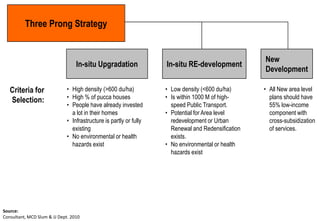
Three Prong Strategy


                                                                                                    New
                                  In-situ Upgradation               In-situ RE-development
                                                                                                    Development

   Criteria for               • High density (>600 du/ha)           • Low density (<600 du/ha)      • All New area level
                              • High % of pucca houses              • Is within 1000 M of high-       plans should have
   Selection:
                              • People have already invested          speed Public Transport.         55% low-income
                                a lot in their homes                • Potential for Area level        component with
                              • Infrastructure is partly or fully     redevelopment or Urban          cross-subsidization
                                existing                              Renewal and Redensification     of services.
                              • No environmental or health            exists.
                                hazards exist                       • No environmental or health
                                                                      hazards exist


Source:
Consultant, MCD Slum & JJ Dept. 2010
Definitions:

       In-situ Upgradation – is the gradual self-construction or improvement of homes done by
                                                 construction
       the community themselves with minimal govt. support and through provision of basic social
       and physical infrastructure services.
       For in-situ up-gradation to happen, residents must be given secure tenure rights such that
                      gradation
       they may not be uprooted and relocated at random.
       In-situ upgradation may be applied to areas which meet the following thumb
          situ                                                              thumb-rule criteria:
                High density (~600 du/ha)
                High % of pucca houses
                People have already invested a lot in their homes
                Infrastructure is partly or fully existing
                No environmental or health hazards exist
                Have good amenities, parks & public transport in community vicinity.


Source:
Consultant, MCD Slum & JJ Dept. 2010
Definitions:
       In-situ Redevelopment – is the process of redeveloping areas with current slum
       settlements where new mixed-use mixed-income communities can be created with a viable
                                                 income
       cross-subsidy model, which is a function of local land values, socio
              subsidy                                                 socio-economic needs and
       general context of the area. For example, a commercial Mall may not be a viable cross
                                                                                        cross-
       subsidizing use of land in an area where the demand may actually be for high and middle
       income housing, along with low-income groups. Therefore, a socio
                                          income                     socio-economic study of local
       context is critical for decision making.
       In-situ Redevelopment may be applied to areas which meet the following thumb
          situ                                                                thumb-rule
       criteria:
                  Low density (<450 du/ha)
                  Is within 1500 M of high-speed Public Transport.
                                           speed
                  Potential for Area level redevelopment or Urban Renewal and Redensification exists.
                  No environmental or health hazards exist.
                  Need for mixing with other income groups and mixed uses.


Source:
Consultant, MCD Slum & JJ Dept. 2010
Definitions:
       New Development to Prevent New Slums – is essential so that new population coming to
       work and contribute to the growing economy of the city can be provided a range of viable
       and affordable shelter options.
          Not everyone needs to be provided apartment titles or tenure rights. People are
       often seasonal immigrants or short term employees and therefore a range of shelter
                                                     employees,
       options for the new working population needs to be developed in order to prevent the
       sprouting of future slums within the city. Providing dormitories or temporary rented shelter
       options as well as high-quality high-speed public transportation is also the sustainable way
                                            speed
       of controlling and reducing permanent immigration into the city.:
                According to a 2008 United Nations Report, India will see a 26% growth in urbanized
                population by 2025.
                The Masterplan of Delhi- 2021 provides the following targets for provision of Housing
                for Urban poor through Slum & JJ approaches till Year 2011 (page 129):
                        70,000 units through Redevelopment.
                        100,000 units through New Housing stock.


Source:
Consultant, MCD Slum & JJ Dept. 2010
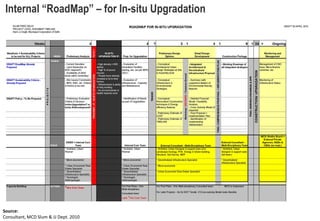
Internal “RoadMap” – for In-situ Upgradation
                             situ


Source:
Consultant, MCD Slum & JJ Dept. 2010
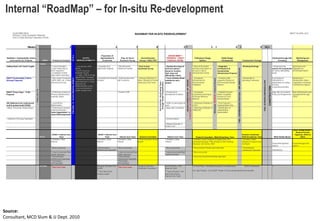
Internal “RoadMap” – for In-situ Re
                             situ Re-development


Source:
Consultant, MCD Slum & JJ Dept. 2010
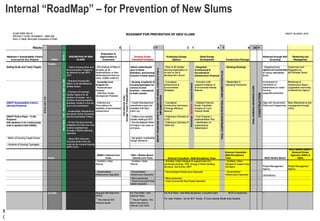
Internal “RoadMap” – for Prevention of New Slums


Source:
Consultant, MCD Slum & JJ Dept. 2010
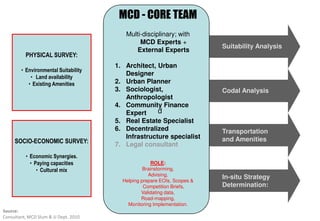
MCD - CORE TEAM
                                          Multi-disciplinary; with
                                                disciplinary;
                                               MCD Experts +
                                                                          Suitability Analysis
                                             External Experts
          PHYSICAL SURVEY:
                                       1. Architect, Urban
        • Environmental Suitability
                                          Designer
            • Land availability
           • Existing Amenities        2. Urban Planner
                                       3. Sociologist,                    Codal Analysis
                                          Anthropologist
                                       4. Community Finance
                                          Expert     d
                                       5. Real Estate Specialist
                                       6. Decentralized                   Transportation
                                          Infrastructure specialist       and Amenities
     SOCIO-ECONOMIC SURVEY:            7. Legal consultant
          • Economic Synergies.
            • Paying capacities                      ROLE:
                                                     ROLE
               • Cultural mix                     Brainstorming,
                                                    Advising,
                                         Helping prepare EOIs, Scopes &
                                                                          In-situ Strategy
                                                  Competition Briefs,     Determination:
                                                 Validating data,
                                                 Road-mapping,
                                                       mapping,
                                           Monitoring Implementation.
Source:
Consultant, MCD Slum & JJ Dept. 2010
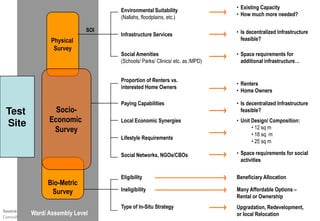
• Existing Capacity
                                         Environmental Suitability
                                                                                   • How much more needed?
                                         (Nallahs, floodplains, etc.)

                                   SOI                                             • Is decentralized Infrastructure
                                         Infrastructure Services
                    Physical                                                         feasible?
                     Survey
                                         Social Amenities                          • Space requirements for
                                         (Schools/ Parks/ Clinics/ etc. as /MPD)     additional infrastructure…


                                         Proportion of Renters vs.
                                                                                   • Renters
                                         interested Home Owners
                                                                                   • Home Owners

                                         Paying Capabilities                       • Is decentralized Infrastructure
 Test                Socio-                                                          feasible?

 Site              Economic              Local Economic Synergies                  • Unit Design/ Composition:
                    Survey                                                                • 12 sq m
                                                                                          • 18 sq. m
                                         Lifestyle Requirements
                                                                                          • 25 sq m

                                         Social Networks, NGOs/CBOs                • Space requirements for social
                                                                                     activities

                                         Eligibility                               Beneficiary Allocation
                   Bio-Metric
                    Survey               Ineligibility                             Many Affordable Options –
                                                                                   Rental or Ownership
                                         Type of In-Situ Strategy
                                                    Situ                           Upgradation, Redevelopment,
Source:
             Ward/ Assembly Level                                                  or local Relocation
Consultant, MCD Slum & JJ Dept. 2010
Policy Conflicts !


Source:
Consultant, MCD Slum & JJ Dept. 2010
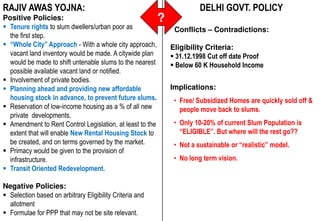
RAJIV AWAS YOJNA:                                                        DELHI GOVT. POLICY
Positive Policies:                                         ?
  Tenure rights to slum dwellers/urban poor as                  Conflicts – Contradictions:
  the first step.
  “Whole City” Approach - With a whole city approach,          Eligibility Criteria:
  vacant land inventory would be made. A citywide plan          31.12.1998 Cut off date Proof
  would be made to shift untenable slums to the nearest         Below 60 K Household Income
  possible available vacant land or notified.
  Involvement of private bodies.
  Planning ahead and providing new affordable                  Implications:
  housing stock in advance, to prevent future slums.            • Free/ Subsidized Homes are quickly sold off &
  Reservation of low-income housing as a % of all new             people move back to slums.
  private developments.
  Amendment to Rent Control Legislation, at least to the        • Only 10-20% of current Slum Population is
  extent that will enable New Rental Housing Stock to             “ELIGIBLE”. But where will the rest go??
  be created, and on terms governed by the market.              • Not a sustainable or “realistic” model.
  Primacy would be given to the provision of
  infrastructure.                                               • No long term vision.
  Transit Oriented Redevelopment.

Negative Policies:
   Selection based on arbitrary Eligibility Criteria and
   allotment
Source:
   Formulae for PPP that may not be site relevant.
Consultant, MCD Slum & JJ Dept. 2010
OUR APPROACH:


                      1. Whole City/ Community Level Approach


Source:
Consultant, MCD Slum & JJ Dept. 2010
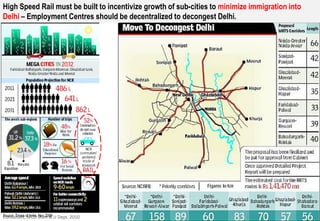
High Speed Rail must be built to incentivize growth of sub
                                                       sub-cities to minimize immigration into
Delhi – Employment Centres should be decentralized to decongest Delhi.


Source:
Source: Times of India, Slum & JJ Dept. 2010
Consultant, MCD Nov 2009                                                                         15
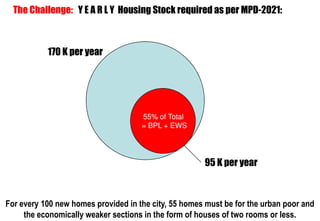
The Challenge: Y E A R L Y Housing Stock required as per MPD
                                                             MPD-2021:


                     170 K per year


                                       55% of Total
                                       = BPL + EWS


                                                       95 K per year


 For every 100 new homes provided in the city, 55 homes must be for the urban poor and
Source:
      the economically weaker sections in the form of houses of two rooms or less.
Consultant, MCD Slum & JJ Dept. 2010
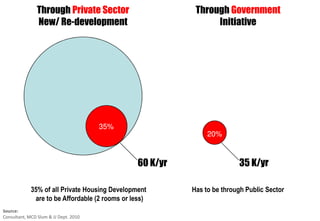
Through Private Sector                       Through Government
               New/ Re-development                               Initiative


                                       35%
                                                                20%


                                                 60 K/yr                  35 K/yr

             35% of all Private Housing Development        Has to be through Public Sector
              are to be Affordable (2 rooms or less)
Source:
Consultant, MCD Slum & JJ Dept. 2010
UTTIPEC’S ROLE


Source:
Consultant, MCD Slum & JJ Dept. 2010
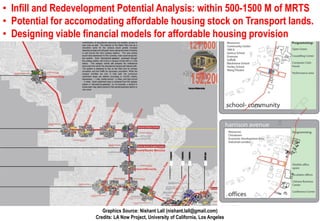
• Infill and Redevelopment Potential Analysis: within 500
                                                      500-1500 M of MRTS
• Potential for accomodating affordable housing stock on Transport lands.
• Designing viable financial models for affordable housing provision


Source:                                   Graphics Source: Nishant Lall (nishant.lall@gmail.com)
Consultant, MCD Slum & JJ Dept. 2010   Credits: LA Now Project, University of California, Los Angeles
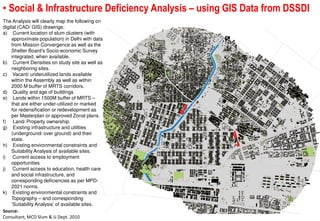
• Social & Infrastructure Deficiency Analysis – using GIS Data from DSSDI
The Analysis will clearly map the following on
digital (CAD/ GIS) drawings:
a) Current location of slum clusters (with
     approximate population) in Delhi with data
     from Mission Convergence as well as the
     Shelter Board’s Socio-economic Survey
     integrated, when available.
b) Current Densities on study site as well as
     neighboring sites.
c) Vacant/ underutilized lands available
     within the Assembly as well as within
     2000 M buffer of MRTS corridors.
d) Quality and age of buildings
e) Lands within 1500M buffer of MRTS –
     that are either under-utilized or marked
     for redensification or redevelopment as
     per Masterplan or approved Zonal plans.
f) Land/ Property ownership.
g) Existing infrastructure and utilities
     (underground/ over ground) and their
     state.
h) Existing environmental constraints and
     Suitability Analysis of available sites.
i) Current access to employment
     opportunities
j) Current access to education, health care
     and social infrastructure, and
     corresponding deficiencies as per MPD-
     2021 norms.
k) Existing environmental constraints and
     Topography – and corresponding
     ‘Suitability Analysis’ of available sites.
Source:
Consultant, MCD Slum & JJ Dept. 2010
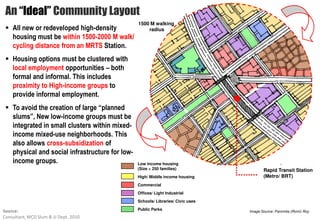
An “Ideal” Community Layout
                                                  1500 M walking
    All new or redeveloped high-density               radius
    housing must be within 1500-2000 M walk/
    cycling distance from an MRTS Station.
    Housing options must be clustered with
    local employment opportunities – both
    formal and informal. This includes
    proximity to High-income groups to
    provide informal employment.
    To avoid the creation of large “planned
    slums”, New low-income groups must be
    integrated in small clusters within mixed-
    income mixed-use neighborhoods. This
    also allows cross-subsidization of
    physical and social infrastructure for low-
    income groups.                                Low income housing
                                                  (Size < 250 families)                   Rapid Transit Station
                                                  High/ Middle income housing             (Metro/ BRT)
                                                  Commercial
                                                  Offices/ Light Industrial
                                                  Schools/ Libraries/ Civic uses

Source:                                           Public Parks                     Image Source: Paromita (Romi) Roy
Consultant, MCD Slum & JJ Dept. 2010
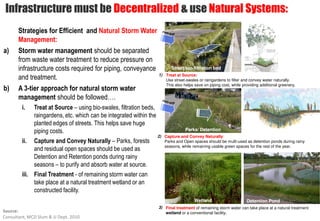
Infrastructure must be Decentralized & use Natural Systems:
       Strategies for Efficient and Natural Storm Water
       Management:
a)     Storm water management should be separated
       from waste water treatment to reduce pressure on
       infrastructure costs required for piping, conveyance                 Street bio-filtration bed
                                                                     1) Treat at Source:
       and treatment.                                                   Use street-swales or raingardens to filter and convey water naturally.
                                                                        This also helps save on piping cost, while providing additional greenery.
b)     A 3-tier approach for natural storm water
       management should be followed….
        i.    Treat at Source – using bio-swales, filtration beds,
              raingardens, etc. which can be integrated within the
              planted edges of streets. This helps save huge
              piping costs.                                                        Parks/ Detention
                                                                     2) Capture and Convey Naturally:
        ii.   Capture and Convey Naturally – Parks, forests             Parks and Open spaces should be multi-used as detention ponds during rainy
                                                                        seasons, while remaining usable green spaces for the rest of the year.
              and residual open spaces should be used as
              Detention and Retention ponds during rainy
              seasons – to purify and absorb water at source.
        iii. Final Treatment - of remaining storm water can
             take place at a natural treatment wetland or an
             constructed facility.
                                                                                        Wetland                      Detention Pond
                                                                     3) Final treatment of remaining storm water can take place at a natural treatment
Source:                                                                 wetland or a conventional facility.
Consultant, MCD Slum & JJ Dept. 2010
3.3 Recycle and reuse waste Decentralized & use Natural Systems:
         Recycle and reuse waste locally;
 Infrastructure must bewater for the larger community, wherever possible.
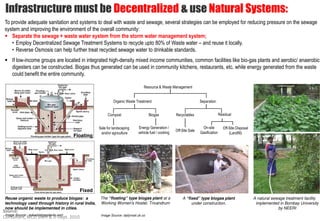
To provide adequate sanitation and systems to deal with waste and sewage, several strategies can be employed for reducing pre
                                                                                                                          pressure on the sewage
system and improving the environment of the overall community:
   Separate the sewage + waste water system from the storm water management system;
   • Employ Decentralized Sewage Treatment Systems to recycle upto 80% of Waste water – and reuse it locally.
   • Reverse Osmosis can help further treat recycled sewage water to drinkable standards.
    If low-income groups are located in integrated high-density mixed income communities, common facilities like bio
                                                        density                                                  bio-gas plants and aerobic/ anaerobic
    digesters can be constructed. Biogas thus generated can be used in community kitchens, restaurants, etc. while energy generat from the waste
                                                                                                                            generated
    could benefit the entire community.

                                                                               Resource & Waste Management


                                                           Organic Waste Treatment                                  Separation


                                                       Compost                     Biogas           Recyclables                    Residual


                                                  Sale for landscaping     Energy Generation /                       On-site         Off-Site Disposal
                                                                                                    Off-Site Sale
                                                   and/or agriculture      vehicle fuel / cooking                   Gasification         (Landfill)
                                   Floating


                                         Fixed
Reuse organic waste to produce biogas: a           The “floating” type biogas plant at a                A “fixed” type biogas plant                      A natural sewage treatment facility
technology used through history in rural India,    Working Women's Hostel, Trivandrum                        under construction.                          implemented in Bombay University
now should be implemented in cities.                                                                                                                                  by NEERI
Source:
 Image Source: industrialgasplants.com             Image Source: dailymail.uk.co
Consultant, MCD Slum & JJ Dept. 2010
OUR APPROACH:


                                2. Providing Affordability through:

                                       • Urban / Architectural Design

                                        • Creative Finance Models

                                        • Creative delivery Models

Source:
Consultant, MCD Slum & JJ Dept. 2010
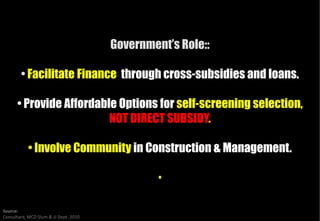
Government’s Role::

        • Facilitate Finance through cross
                                     cross-subsidies and loans.

      • Provide Affordable Options for self-screening selection,
                         NOT DIRECT SUBSIDY
                                     SUBSIDY.

           • Involve Community in Construction & Management.

                                                •

Source:
Consultant, MCD Slum & JJ Dept. 2010
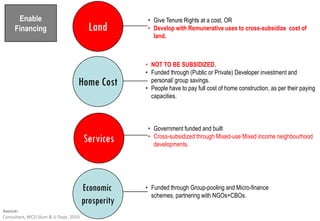
Enable                                         • Give Tenure Rights at a cost, OR
     Financing                           Land        • Develop with Remunerative uses to cross
                                                                                         cross-subsidize cost of
                                                       land.


                                                    • NOT TO BE SUBSIDIZED.
                                                    • Funded through (Public or Private) Developer investment and
                                   Home Cost          personal/ group savings.
                                                    • People have to pay full cost of home construction, as per their paying
                                                      capacities.


                                                     • Government funded and built
                                       Services      • Cross
                                                       Cross-subsidized through Mixed-use Mixed income neighbourhood
                                                       developments.


                                       Economic     • Funded through Group
                                                                     Group-pooling and Micro-finance
                                                      schemes, partnering with NGOs+CBOs.
                                       prosperity
Source:
Consultant, MCD Slum & JJ Dept. 2010
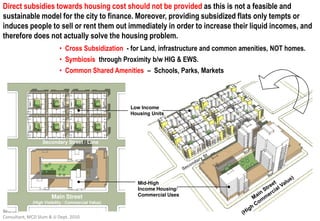
Direct subsidies towards housing cost should not be provided as this is not a feasible and
sustainable model for the city to finance. Moreover, providing subsidized flats only tempts or
induces people to sell or rent them out immediately in order to increase their liquid incomes, and
therefore does not actually solve the housing problem.
                            • Cross Subsidization - for Land, infrastructure and common amenities, NOT homes.
                            • Symbiosis through Proximity b/w HIG & EWS.
                            • Common Shared Amenities – Schools, Parks, Markets


                                                     Low Income
                                                     Housing Units


                   Secondary Street / Lane


                                                       Mid-High
                                                           High
                                                       Income Housing/
                       Main Street                     Commercial Uses
              (High Visibility / Commercial Value)

Source:
Consultant, MCD Slum & JJ Dept. 2010
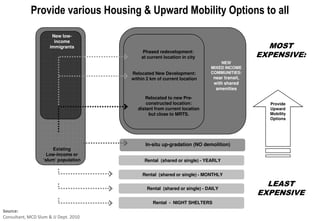
Provide various Housing & Upward Mobility Options to all

                       New low-
                        income
                      immigrants                                                             MOST
                                           Phased redevelopment:
                                           at current location in city                     EXPENSIVE:
                                                                              NEW
                                                                          MIXED INCOME
                                       Relocated New Development:         COMMUNITIES:
                                       within 2 km of current location     near transit,
                                                                           with shared
                                                                            amenities

                                             Relocated to new Pre
                                                                Pre-
                                              constructed location:                          Provide
                                          distant from current location                      Upward
                                               but close to MRTS.                            Mobility
                                                                                             Options


                                             In-situ up
                                                situ up-gradation (NO demolition)
                      Existing
                    Low-income or
                  ‘slum’ population          Rental (shared or single) - YEARLY


                                            Rental (shared or single) - MONTHLY


                                           Rental (shared or or single) - DAILY
                                             Rental (shared single) - MONTHLY
                                                                                             LEAST
                                                                                           EXPENSIVE
                                           Rental (sharedNIGHT SHELTERS
                                           Rental (shared or single) - MONTHLY
                                                Rental - or single) - MONTHLY
Source:
Consultant, MCD Slum & JJ Dept. 2010
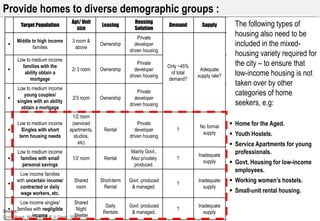
Provide homes to diverse demographic groups :
                                 Apt/ Unit                    Housing                                   Price of    Loan-     Savings/
        Target Population
                                   size
                                               Leasing
                                                              Solution
                                                                             Demand        Supply         The
                                                                                                          Unit
                                                                                                               following types of
                                                                                                                   Subsidy   Mortgage
                                                                Private
                                                                                                          housing also need to be
      Middle to high income       3 room &
  ▪
             families              above
                                               Ownership       developer                                  included in the mixed-
                                                            driven housing
                                                                                                          housing variety required for
       Low to medium income
         families with the
                                                                Private
                                                                             Only ~45%                    the city – to ensure that
  ▪                               2/ 3 room    Ownership       developer                  Adequate
          ability obtain a
                                                            driven housing
                                                                              of total
                                                                                         supply rate?     low-income housing is not
             mortgage                                                        demand?
                                                                                                          taken over by other
       Low to medium income
          young couples/
                                                                Private                                   categories of home
  ▪                               2/3 room     Ownership       developer
       singles with an ability                                                                            seekers, e.g:
                                                            driven housing
         obtain a mortgage
                                  1/2 room
       Low to medium income       (serviced                     Private
                                                                                          No formal       Home for the Aged.
  ▪      Singles with short      apartments,    Rental         developer        ?
                                                                                           supply         Youth Hostels.
        term housing needs         studios,                 driven housing
                                     etc)                                                                 Service Apartments for young
       Low to medium income                                 Mainly Govt.,
                                                                                         Inadequate
                                                                                                          professionals.
  ▪     families with small       1/2 room      Rental      Also privately      ?
                                                                                           supply         Govt. Housing for low-income
         personal savings                                    produced.
                                                                                                          employees.
       Low income families
  ▪
      with uncertain income/       Shared      Short-term   Govt. produced
                                                                                ?
                                                                                         Inadequate       Working women’s hostels.
       contracted or daily          room        Rental       & managed.                    supply
        wage workers, etc.                                                                                Small-unit rental housing.
         Low income singles/      Shared
                                                 Daily      Govt. produced               Inadequate
Source:families with negligible
  ▪                                Night                                        ?
                                                Rentals      & managed.                    supply
               income             Shelter
Consultant, MCD Slum & JJ Dept. 2010                                                                                                     29
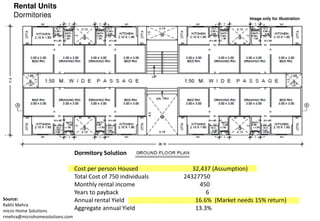
Rental Units
     Dormitories                                                                       Image only for illustration


                                 Dormitory Solution

                                 Cost per person Housed             32,437 (Assumption)
                                 Total Cost of 750 individuals   24327750
                                 Monthly rental income                450
                                 Years to payback                        6
Source:                          Annual rental Yield                 16.6% (Market needs 15% return)
Rakhi Mehra
micro Home Solutions
Source:
                                 Aggregate annual Yield              13.3%
rmehra@microhomesolutions.com
Consultant, MCD Slum & JJ Dept. 2010
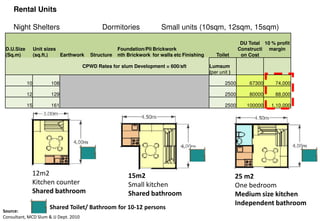
Rental Units

     Night Shelters                           Dormitories               Small units (10sqm, 12sqm, 15sqm)

                                                                                                              DU Total 10 % profit
 D.U.Size        Unit sizes                           Foundation/Pli Brickwork                               Constructi margin
 (Sq.m)          (sq.ft.)   Earthwork     Structure   nth Brickwork for walls etc Finishing      Toilet       on Cost

                                       CPWD Rates for slum Development = 600/
                                                                         600/sft              Lumsum
                                                                                              (per unit )

            10          108                                                                           2500       67300      74,000

            12          129                                                                           2500       80000      88,000

            15          161                                                                           2500      100000    1,10,000


                 12m2                                     15m2                                              25 m2
                 Kitchen counter                          Small kitchen                                     One bedroom
                 Shared bathroom                          Shared bathroom                                   Medium size kitchen
                                                                                                            Independent bathroom
                       Shared Toilet/ Bathroom for 10-12 persons
                                                      12
Source:
Consultant, MCD Slum & JJ Dept. 2010
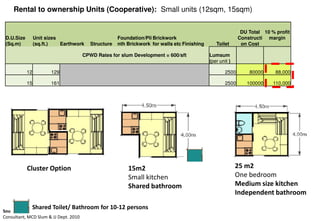
Rental to ownership Units (Cooperative): Small units (12sqm, 15sqm)

                                                                                                              DU Total 10 % profit
 D.U.Size        Unit sizes                           Foundation/Pli Brickwork                               Constructi margin
 (Sq.m)          (sq.ft.)   Earthwork     Structure   nth Brickwork for walls etc Finishing      Toilet       on Cost

                                       CPWD Rates for slum Development = 600/
                                                                         600/sft              Lumsum
                                                                                              (per unit )

            12          129                                                                           2500       80000      88,000

            15          161                                                                           2500      100000     110,000


            Cluster Option                                15m2                                              25 m2
                                                          Small kitchen                                     One bedroom
                                                          Shared bathroom                                   Medium size kitchen
                                                                                                            Independent bathroom
                 Shared Toilet/ Bathroom for 10-12 persons
Source:
Consultant, MCD Slum & JJ Dept. 2010
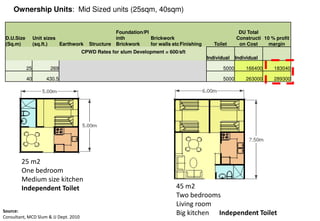
Ownership Units: Mid Sized units (25sqm, 40sqm)
                    :

                                                      Foundation/Pl                                          DU Total
 D.U.Size        Unit sizes                           inth          Brickwork                               Constructi 10 % profit
 (Sq.m)          (sq.ft.)   Earthwork     Structure   Brickwork     for walls etc Finishing      Toilet      on Cost     margin
                                       CPWD Rates for slum Development = 600/
                                                                         600/sft
                                                                                              Individual    Individual

            25          269                                                                          5000       166400     183040

            40        430.5                                                                          5000       263000     289300


        25 m2
        One bedroom
        Medium size kitchen
        Independent Toilet                                                      45 m2
                                                                                Two bedrooms
                                                                                Living room
Source:                                                                         Big kitchen Independent Toilet
Consultant, MCD Slum & JJ Dept. 2010
Shared Toilet/ Bathroom for 10-12 persons

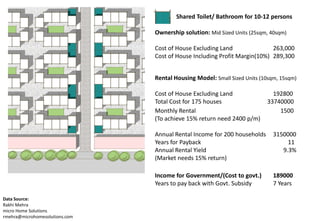
                                       Ownership solution: Mid Sized Units (25sqm, 40sqm)

                                       Cost of House Excluding Land               263,000
                                       Cost of House Including Profit Margin(10%) 289,300


                                       Rental Housing Model: Small Sized Units (10sqm, 15sqm)

                                       Cost of House Excluding Land                192800
                                       Total Cost for 175 houses                 33740000
                                       Monthly Rental                                1500
                                       (To achieve 15% return need 2400 p/m)

                                       Annual Rental Income for 200 households      3150000
                                       Years for Payback                                 11
                                       Annual Rental Yield                             9.3%
                                       (Market needs 15% return)

                                       Income for Government/(Cost to govt.)        189000
                                       Years to pay back with Govt. Subsidy         7 Years

Data Source:
Rakhi Mehra
micro Home Solutions
Source:
rmehra@microhomesolutions.com
Consultant, MCD Slum & JJ Dept. 2010
Community Participation:


    The reasons for Mumbai’s success in providing slumslum-
 rehabilitation projects is their full engagement with the local
               communities, throughout the city.

                               In Delhi, this has still not happened.


Source:
Consultant, MCD Slum & JJ Dept. 2010
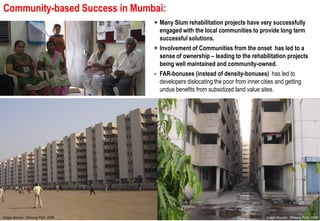
Community-based Success in Mumbai:
          based
                                             + Many Slum rehabilitation projects have very successfully
                                               engaged with the local communities to provide long term
                                               successful solutions.
                                             + Involvement of Communities from the onset has led to a
                                               sense of ownership – leading to the rehabilitation projects
                                               being well maintained and community
                                                                            community-owned.
                                             - FAR
                                               FAR-bonuses (instead of density-bonuses) has led to
                                               developers dislocating the poor from inner cities and getting
                                               undue benefits from subsidized land value sites.


Source:
Image Source: Dheeraj Slum & JJ Dept. 2010
Consultant, MCD Patil, 2008                                                               Image Source: Dheeraj Patil, 2008
PILOT PROJECT


Source:
Consultant, MCD Slum & JJ Dept. 2010
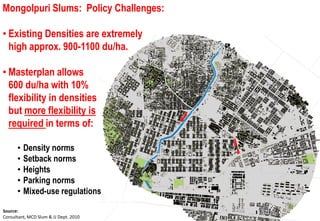
Mongolpuri Slums: Policy Challenges
                         Challenges:

• Existing Densities are extremely
  high approx. 900-1100 du/ha.

• Masterplan allows
  600 du/ha with 10%
  flexibility in densities
  but more flexibility is
  required in terms of:

      • Density norms
      • Setback norms
      • Heights
      • Parking norms
      • Mixed-use regulations

Source:
Consultant, MCD Slum & JJ Dept. 2010
Key Decisions needed:

                   Pilot Project in keeping with RAY and testing new approaches
                    – like Rental & dwelling unit size/ urban design variations.

                                        Team building/ Capacity Building
                                   – Engaging of Multi-disciplinary Consultants
                                                       disciplinary

                                        Budget allocations and Timelines


Source:
Consultant, MCD Slum & JJ Dept. 2010

toMOUD-slum-free-planning-June2010

  • 1.
    ROADMAP: Slum Free Delhi Source: Consultant, MCD Slum & JJ Dept. 2010
  • 2.
    GUIDING PRINCIPLES: Shelter is a Human Right – Not Apartment Titles. One Size Does not Fit All – Give people Options for self self-selection. The goal of our approach to a Slum Free Delhi is that people of all income groups and various strata of society are given formal + hygenic options for shelter – for living sub-cities of NCR – based on their paying within, or in the outskirts, or in the various sub capacities and lifestyle choices. Upgradation of current Shelter conditions to acceptable standards as well as provision of requisite amount of new housing stock, as per socio socio-economic context and MPD-2021 targets – would prevent the formation of new slums. Our approach follows the Guidelines for Slum Free City planning laid down by the latest Draft by Rajiv Awas Yojna (RAY) for Ministry of Housing & Urban Poverty Alleviation. Source: Consultant, MCD Slum & JJ Dept. 2010
  • 3.
    Three Prong Strategy New In-situ Upgradation In-situ RE-development Development Criteria for • High density (>600 du/ha) • Low density (<600 du/ha) • All New area level • High % of pucca houses • Is within 1000 M of high- plans should have Selection: • People have already invested speed Public Transport. 55% low-income a lot in their homes • Potential for Area level component with • Infrastructure is partly or fully redevelopment or Urban cross-subsidization existing Renewal and Redensification of services. • No environmental or health exists. hazards exist • No environmental or health hazards exist Source: Consultant, MCD Slum & JJ Dept. 2010
  • 4.
    Definitions: In-situ Upgradation – is the gradual self-construction or improvement of homes done by construction the community themselves with minimal govt. support and through provision of basic social and physical infrastructure services. For in-situ up-gradation to happen, residents must be given secure tenure rights such that gradation they may not be uprooted and relocated at random. In-situ upgradation may be applied to areas which meet the following thumb situ thumb-rule criteria: High density (~600 du/ha) High % of pucca houses People have already invested a lot in their homes Infrastructure is partly or fully existing No environmental or health hazards exist Have good amenities, parks & public transport in community vicinity. Source: Consultant, MCD Slum & JJ Dept. 2010
  • 5.
    Definitions: In-situ Redevelopment – is the process of redeveloping areas with current slum settlements where new mixed-use mixed-income communities can be created with a viable income cross-subsidy model, which is a function of local land values, socio subsidy socio-economic needs and general context of the area. For example, a commercial Mall may not be a viable cross cross- subsidizing use of land in an area where the demand may actually be for high and middle income housing, along with low-income groups. Therefore, a socio income socio-economic study of local context is critical for decision making. In-situ Redevelopment may be applied to areas which meet the following thumb situ thumb-rule criteria: Low density (<450 du/ha) Is within 1500 M of high-speed Public Transport. speed Potential for Area level redevelopment or Urban Renewal and Redensification exists. No environmental or health hazards exist. Need for mixing with other income groups and mixed uses. Source: Consultant, MCD Slum & JJ Dept. 2010
  • 6.
    Definitions: New Development to Prevent New Slums – is essential so that new population coming to work and contribute to the growing economy of the city can be provided a range of viable and affordable shelter options. Not everyone needs to be provided apartment titles or tenure rights. People are often seasonal immigrants or short term employees and therefore a range of shelter employees, options for the new working population needs to be developed in order to prevent the sprouting of future slums within the city. Providing dormitories or temporary rented shelter options as well as high-quality high-speed public transportation is also the sustainable way speed of controlling and reducing permanent immigration into the city.: According to a 2008 United Nations Report, India will see a 26% growth in urbanized population by 2025. The Masterplan of Delhi- 2021 provides the following targets for provision of Housing for Urban poor through Slum & JJ approaches till Year 2011 (page 129): 70,000 units through Redevelopment. 100,000 units through New Housing stock. Source: Consultant, MCD Slum & JJ Dept. 2010
  • 7.
    Internal “RoadMap” –for In-situ Upgradation situ Source: Consultant, MCD Slum & JJ Dept. 2010
  • 8.
    Internal “RoadMap” –for In-situ Re situ Re-development Source: Consultant, MCD Slum & JJ Dept. 2010
  • 9.
    Internal “RoadMap” –for Prevention of New Slums Source: Consultant, MCD Slum & JJ Dept. 2010
  • 10.
    MCD - CORETEAM Multi-disciplinary; with disciplinary; MCD Experts + Suitability Analysis External Experts PHYSICAL SURVEY: 1. Architect, Urban • Environmental Suitability Designer • Land availability • Existing Amenities 2. Urban Planner 3. Sociologist, Codal Analysis Anthropologist 4. Community Finance Expert d 5. Real Estate Specialist 6. Decentralized Transportation Infrastructure specialist and Amenities SOCIO-ECONOMIC SURVEY: 7. Legal consultant • Economic Synergies. • Paying capacities ROLE: ROLE • Cultural mix Brainstorming, Advising, Helping prepare EOIs, Scopes & In-situ Strategy Competition Briefs, Determination: Validating data, Road-mapping, mapping, Monitoring Implementation. Source: Consultant, MCD Slum & JJ Dept. 2010
  • 11.
    • Existing Capacity Environmental Suitability • How much more needed? (Nallahs, floodplains, etc.) SOI • Is decentralized Infrastructure Infrastructure Services Physical feasible? Survey Social Amenities • Space requirements for (Schools/ Parks/ Clinics/ etc. as /MPD) additional infrastructure… Proportion of Renters vs. • Renters interested Home Owners • Home Owners Paying Capabilities • Is decentralized Infrastructure Test Socio- feasible? Site Economic Local Economic Synergies • Unit Design/ Composition: Survey • 12 sq m • 18 sq. m Lifestyle Requirements • 25 sq m Social Networks, NGOs/CBOs • Space requirements for social activities Eligibility Beneficiary Allocation Bio-Metric Survey Ineligibility Many Affordable Options – Rental or Ownership Type of In-Situ Strategy Situ Upgradation, Redevelopment, Source: Ward/ Assembly Level or local Relocation Consultant, MCD Slum & JJ Dept. 2010
  • 12.
  • 13.
    RAJIV AWAS YOJNA: DELHI GOVT. POLICY Positive Policies: ? Tenure rights to slum dwellers/urban poor as Conflicts – Contradictions: the first step. “Whole City” Approach - With a whole city approach, Eligibility Criteria: vacant land inventory would be made. A citywide plan 31.12.1998 Cut off date Proof would be made to shift untenable slums to the nearest Below 60 K Household Income possible available vacant land or notified. Involvement of private bodies. Planning ahead and providing new affordable Implications: housing stock in advance, to prevent future slums. • Free/ Subsidized Homes are quickly sold off & Reservation of low-income housing as a % of all new people move back to slums. private developments. Amendment to Rent Control Legislation, at least to the • Only 10-20% of current Slum Population is extent that will enable New Rental Housing Stock to “ELIGIBLE”. But where will the rest go?? be created, and on terms governed by the market. • Not a sustainable or “realistic” model. Primacy would be given to the provision of infrastructure. • No long term vision. Transit Oriented Redevelopment. Negative Policies: Selection based on arbitrary Eligibility Criteria and allotment Source: Formulae for PPP that may not be site relevant. Consultant, MCD Slum & JJ Dept. 2010
  • 14.
    OUR APPROACH: 1. Whole City/ Community Level Approach Source: Consultant, MCD Slum & JJ Dept. 2010
  • 15.
    High Speed Railmust be built to incentivize growth of sub sub-cities to minimize immigration into Delhi – Employment Centres should be decentralized to decongest Delhi. Source: Source: Times of India, Slum & JJ Dept. 2010 Consultant, MCD Nov 2009 15
  • 16.
    The Challenge: YE A R L Y Housing Stock required as per MPD MPD-2021: 170 K per year 55% of Total = BPL + EWS 95 K per year For every 100 new homes provided in the city, 55 homes must be for the urban poor and Source: the economically weaker sections in the form of houses of two rooms or less. Consultant, MCD Slum & JJ Dept. 2010
  • 17.
    Through Private Sector Through Government New/ Re-development Initiative 35% 20% 60 K/yr 35 K/yr 35% of all Private Housing Development Has to be through Public Sector are to be Affordable (2 rooms or less) Source: Consultant, MCD Slum & JJ Dept. 2010
  • 18.
  • 19.
    • Infill andRedevelopment Potential Analysis: within 500 500-1500 M of MRTS • Potential for accomodating affordable housing stock on Transport lands. • Designing viable financial models for affordable housing provision Source: Graphics Source: Nishant Lall (nishant.lall@gmail.com) Consultant, MCD Slum & JJ Dept. 2010 Credits: LA Now Project, University of California, Los Angeles
  • 20.
    • Social &Infrastructure Deficiency Analysis – using GIS Data from DSSDI The Analysis will clearly map the following on digital (CAD/ GIS) drawings: a) Current location of slum clusters (with approximate population) in Delhi with data from Mission Convergence as well as the Shelter Board’s Socio-economic Survey integrated, when available. b) Current Densities on study site as well as neighboring sites. c) Vacant/ underutilized lands available within the Assembly as well as within 2000 M buffer of MRTS corridors. d) Quality and age of buildings e) Lands within 1500M buffer of MRTS – that are either under-utilized or marked for redensification or redevelopment as per Masterplan or approved Zonal plans. f) Land/ Property ownership. g) Existing infrastructure and utilities (underground/ over ground) and their state. h) Existing environmental constraints and Suitability Analysis of available sites. i) Current access to employment opportunities j) Current access to education, health care and social infrastructure, and corresponding deficiencies as per MPD- 2021 norms. k) Existing environmental constraints and Topography – and corresponding ‘Suitability Analysis’ of available sites. Source: Consultant, MCD Slum & JJ Dept. 2010
  • 21.
    An “Ideal” CommunityLayout 1500 M walking All new or redeveloped high-density radius housing must be within 1500-2000 M walk/ cycling distance from an MRTS Station. Housing options must be clustered with local employment opportunities – both formal and informal. This includes proximity to High-income groups to provide informal employment. To avoid the creation of large “planned slums”, New low-income groups must be integrated in small clusters within mixed- income mixed-use neighborhoods. This also allows cross-subsidization of physical and social infrastructure for low- income groups. Low income housing (Size < 250 families) Rapid Transit Station High/ Middle income housing (Metro/ BRT) Commercial Offices/ Light Industrial Schools/ Libraries/ Civic uses Source: Public Parks Image Source: Paromita (Romi) Roy Consultant, MCD Slum & JJ Dept. 2010
  • 22.
    Infrastructure must beDecentralized & use Natural Systems: Strategies for Efficient and Natural Storm Water Management: a) Storm water management should be separated from waste water treatment to reduce pressure on infrastructure costs required for piping, conveyance Street bio-filtration bed 1) Treat at Source: and treatment. Use street-swales or raingardens to filter and convey water naturally. This also helps save on piping cost, while providing additional greenery. b) A 3-tier approach for natural storm water management should be followed…. i. Treat at Source – using bio-swales, filtration beds, raingardens, etc. which can be integrated within the planted edges of streets. This helps save huge piping costs. Parks/ Detention 2) Capture and Convey Naturally: ii. Capture and Convey Naturally – Parks, forests Parks and Open spaces should be multi-used as detention ponds during rainy seasons, while remaining usable green spaces for the rest of the year. and residual open spaces should be used as Detention and Retention ponds during rainy seasons – to purify and absorb water at source. iii. Final Treatment - of remaining storm water can take place at a natural treatment wetland or an constructed facility. Wetland Detention Pond 3) Final treatment of remaining storm water can take place at a natural treatment Source: wetland or a conventional facility. Consultant, MCD Slum & JJ Dept. 2010
  • 23.
    3.3 Recycle andreuse waste Decentralized & use Natural Systems: Recycle and reuse waste locally; Infrastructure must bewater for the larger community, wherever possible. To provide adequate sanitation and systems to deal with waste and sewage, several strategies can be employed for reducing pre pressure on the sewage system and improving the environment of the overall community: Separate the sewage + waste water system from the storm water management system; • Employ Decentralized Sewage Treatment Systems to recycle upto 80% of Waste water – and reuse it locally. • Reverse Osmosis can help further treat recycled sewage water to drinkable standards. If low-income groups are located in integrated high-density mixed income communities, common facilities like bio density bio-gas plants and aerobic/ anaerobic digesters can be constructed. Biogas thus generated can be used in community kitchens, restaurants, etc. while energy generat from the waste generated could benefit the entire community. Resource & Waste Management Organic Waste Treatment Separation Compost Biogas Recyclables Residual Sale for landscaping Energy Generation / On-site Off-Site Disposal Off-Site Sale and/or agriculture vehicle fuel / cooking Gasification (Landfill) Floating Fixed Reuse organic waste to produce biogas: a The “floating” type biogas plant at a A “fixed” type biogas plant A natural sewage treatment facility technology used through history in rural India, Working Women's Hostel, Trivandrum under construction. implemented in Bombay University now should be implemented in cities. by NEERI Source: Image Source: industrialgasplants.com Image Source: dailymail.uk.co Consultant, MCD Slum & JJ Dept. 2010
  • 24.
    OUR APPROACH: 2. Providing Affordability through: • Urban / Architectural Design • Creative Finance Models • Creative delivery Models Source: Consultant, MCD Slum & JJ Dept. 2010
  • 25.
    Government’s Role:: • Facilitate Finance through cross cross-subsidies and loans. • Provide Affordable Options for self-screening selection, NOT DIRECT SUBSIDY SUBSIDY. • Involve Community in Construction & Management. • Source: Consultant, MCD Slum & JJ Dept. 2010
  • 26.
    Enable • Give Tenure Rights at a cost, OR Financing Land • Develop with Remunerative uses to cross cross-subsidize cost of land. • NOT TO BE SUBSIDIZED. • Funded through (Public or Private) Developer investment and Home Cost personal/ group savings. • People have to pay full cost of home construction, as per their paying capacities. • Government funded and built Services • Cross Cross-subsidized through Mixed-use Mixed income neighbourhood developments. Economic • Funded through Group Group-pooling and Micro-finance schemes, partnering with NGOs+CBOs. prosperity Source: Consultant, MCD Slum & JJ Dept. 2010
  • 27.
    Direct subsidies towardshousing cost should not be provided as this is not a feasible and sustainable model for the city to finance. Moreover, providing subsidized flats only tempts or induces people to sell or rent them out immediately in order to increase their liquid incomes, and therefore does not actually solve the housing problem. • Cross Subsidization - for Land, infrastructure and common amenities, NOT homes. • Symbiosis through Proximity b/w HIG & EWS. • Common Shared Amenities – Schools, Parks, Markets Low Income Housing Units Secondary Street / Lane Mid-High High Income Housing/ Main Street Commercial Uses (High Visibility / Commercial Value) Source: Consultant, MCD Slum & JJ Dept. 2010
  • 28.
    Provide various Housing& Upward Mobility Options to all New low- income immigrants MOST Phased redevelopment: at current location in city EXPENSIVE: NEW MIXED INCOME Relocated New Development: COMMUNITIES: within 2 km of current location near transit, with shared amenities Relocated to new Pre Pre- constructed location: Provide distant from current location Upward but close to MRTS. Mobility Options In-situ up situ up-gradation (NO demolition) Existing Low-income or ‘slum’ population Rental (shared or single) - YEARLY Rental (shared or single) - MONTHLY Rental (shared or or single) - DAILY Rental (shared single) - MONTHLY LEAST EXPENSIVE Rental (sharedNIGHT SHELTERS Rental (shared or single) - MONTHLY Rental - or single) - MONTHLY Source: Consultant, MCD Slum & JJ Dept. 2010
  • 29.
    Provide homes todiverse demographic groups : Apt/ Unit Housing Price of Loan- Savings/ Target Population size Leasing Solution Demand Supply The Unit following types of Subsidy Mortgage Private housing also need to be Middle to high income 3 room & ▪ families above Ownership developer included in the mixed- driven housing housing variety required for Low to medium income families with the Private Only ~45% the city – to ensure that ▪ 2/ 3 room Ownership developer Adequate ability obtain a driven housing of total supply rate? low-income housing is not mortgage demand? taken over by other Low to medium income young couples/ Private categories of home ▪ 2/3 room Ownership developer singles with an ability seekers, e.g: driven housing obtain a mortgage 1/2 room Low to medium income (serviced Private No formal Home for the Aged. ▪ Singles with short apartments, Rental developer ? supply Youth Hostels. term housing needs studios, driven housing etc) Service Apartments for young Low to medium income Mainly Govt., Inadequate professionals. ▪ families with small 1/2 room Rental Also privately ? supply Govt. Housing for low-income personal savings produced. employees. Low income families ▪ with uncertain income/ Shared Short-term Govt. produced ? Inadequate Working women’s hostels. contracted or daily room Rental & managed. supply wage workers, etc. Small-unit rental housing. Low income singles/ Shared Daily Govt. produced Inadequate Source:families with negligible ▪ Night ? Rentals & managed. supply income Shelter Consultant, MCD Slum & JJ Dept. 2010 29
  • 30.
    Rental Units Dormitories Image only for illustration Dormitory Solution Cost per person Housed 32,437 (Assumption) Total Cost of 750 individuals 24327750 Monthly rental income 450 Years to payback 6 Source: Annual rental Yield 16.6% (Market needs 15% return) Rakhi Mehra micro Home Solutions Source: Aggregate annual Yield 13.3% rmehra@microhomesolutions.com Consultant, MCD Slum & JJ Dept. 2010
  • 31.
    Rental Units Night Shelters Dormitories Small units (10sqm, 12sqm, 15sqm) DU Total 10 % profit D.U.Size Unit sizes Foundation/Pli Brickwork Constructi margin (Sq.m) (sq.ft.) Earthwork Structure nth Brickwork for walls etc Finishing Toilet on Cost CPWD Rates for slum Development = 600/ 600/sft Lumsum (per unit ) 10 108 2500 67300 74,000 12 129 2500 80000 88,000 15 161 2500 100000 1,10,000 12m2 15m2 25 m2 Kitchen counter Small kitchen One bedroom Shared bathroom Shared bathroom Medium size kitchen Independent bathroom Shared Toilet/ Bathroom for 10-12 persons 12 Source: Consultant, MCD Slum & JJ Dept. 2010
  • 32.
    Rental to ownershipUnits (Cooperative): Small units (12sqm, 15sqm) DU Total 10 % profit D.U.Size Unit sizes Foundation/Pli Brickwork Constructi margin (Sq.m) (sq.ft.) Earthwork Structure nth Brickwork for walls etc Finishing Toilet on Cost CPWD Rates for slum Development = 600/ 600/sft Lumsum (per unit ) 12 129 2500 80000 88,000 15 161 2500 100000 110,000 Cluster Option 15m2 25 m2 Small kitchen One bedroom Shared bathroom Medium size kitchen Independent bathroom Shared Toilet/ Bathroom for 10-12 persons Source: Consultant, MCD Slum & JJ Dept. 2010
  • 33.
    Ownership Units: MidSized units (25sqm, 40sqm) : Foundation/Pl DU Total D.U.Size Unit sizes inth Brickwork Constructi 10 % profit (Sq.m) (sq.ft.) Earthwork Structure Brickwork for walls etc Finishing Toilet on Cost margin CPWD Rates for slum Development = 600/ 600/sft Individual Individual 25 269 5000 166400 183040 40 430.5 5000 263000 289300 25 m2 One bedroom Medium size kitchen Independent Toilet 45 m2 Two bedrooms Living room Source: Big kitchen Independent Toilet Consultant, MCD Slum & JJ Dept. 2010
  • 34.
    Shared Toilet/ Bathroomfor 10-12 persons Ownership solution: Mid Sized Units (25sqm, 40sqm) Cost of House Excluding Land 263,000 Cost of House Including Profit Margin(10%) 289,300 Rental Housing Model: Small Sized Units (10sqm, 15sqm) Cost of House Excluding Land 192800 Total Cost for 175 houses 33740000 Monthly Rental 1500 (To achieve 15% return need 2400 p/m) Annual Rental Income for 200 households 3150000 Years for Payback 11 Annual Rental Yield 9.3% (Market needs 15% return) Income for Government/(Cost to govt.) 189000 Years to pay back with Govt. Subsidy 7 Years Data Source: Rakhi Mehra micro Home Solutions Source: rmehra@microhomesolutions.com Consultant, MCD Slum & JJ Dept. 2010
  • 35.
    Community Participation: The reasons for Mumbai’s success in providing slumslum- rehabilitation projects is their full engagement with the local communities, throughout the city. In Delhi, this has still not happened. Source: Consultant, MCD Slum & JJ Dept. 2010
  • 36.
    Community-based Success inMumbai: based + Many Slum rehabilitation projects have very successfully engaged with the local communities to provide long term successful solutions. + Involvement of Communities from the onset has led to a sense of ownership – leading to the rehabilitation projects being well maintained and community community-owned. - FAR FAR-bonuses (instead of density-bonuses) has led to developers dislocating the poor from inner cities and getting undue benefits from subsidized land value sites. Source: Image Source: Dheeraj Slum & JJ Dept. 2010 Consultant, MCD Patil, 2008 Image Source: Dheeraj Patil, 2008
  • 37.
  • 38.
    Mongolpuri Slums: PolicyChallenges Challenges: • Existing Densities are extremely high approx. 900-1100 du/ha. • Masterplan allows 600 du/ha with 10% flexibility in densities but more flexibility is required in terms of: • Density norms • Setback norms • Heights • Parking norms • Mixed-use regulations Source: Consultant, MCD Slum & JJ Dept. 2010
  • 39.
    Key Decisions needed: Pilot Project in keeping with RAY and testing new approaches – like Rental & dwelling unit size/ urban design variations. Team building/ Capacity Building – Engaging of Multi-disciplinary Consultants disciplinary Budget allocations and Timelines Source: Consultant, MCD Slum & JJ Dept. 2010

Editor's Notes

  • #24 So we talk about all of these challenges and opportunities, but how does the change happen? Here is a computerized simulation, which shows the process of change. This could be “any-where USA” Open sites, large set backs of buildings, a generally uncomfortable pedestrian experience.