EMPLOYEE
INVOLVEMENT
Santhosh Veeramani
Law Student
VIT University Chennai
What is employee
involvement?
Employee involvement can be defined as:
The direct participation of staff to help an
organization fulfill its mission and meet its
objectives by applying their own ideas,
expertise, and efforts towards solving
problems and making decisions.
Levels of Employee
Involvement
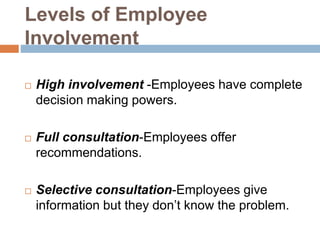
 High involvement -Employees have complete
decision making powers.
 Full consultation-Employees offer
recommendations.
 Selective consultation-Employees give
information but they don’t know the problem.
Major forms of Employee
Involvement
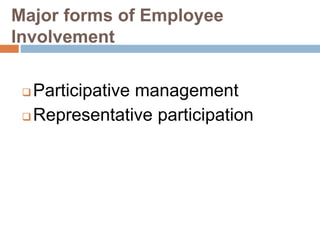
 Participative management
 Representative participation
McGregor’s
Theory
THEORY
Y
THEORY
X
THEORY X
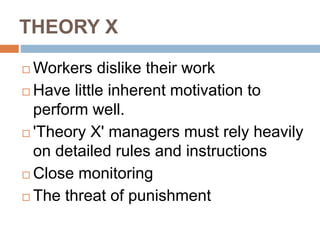
 Workers dislike their work
 Have little inherent motivation to
perform well.
 'Theory X' managers must rely heavily
on detailed rules and instructions
 Close monitoring
 The threat of punishment
THEORY Y
 The worker is considered as the most
important asset of the company.
 Workers derive satisfaction from their
physical and mental work, viewing it as
a game or as something to be enjoyed.
 Workers can take responsibility and can
solve problems in a creative way.
 They do not need to be shadowed
constantly.
Herzberg two factor theory
Key actions
In order to implement employee involvement
and empowerment to an enterprise the
following key actions need to take place:
• Giving employee the responsibility
• Training employee to accept responsibility
• Communicating and giving feedback
• Giving rewards and recognition
Outcomes of Employee
Involvement
Employee
Involvement
Improved
attitude
regarding work
Employee involvement ppt

Employee involvement ppt

  • 1.
  • 2.
    What is employee involvement? Employeeinvolvement can be defined as: The direct participation of staff to help an organization fulfill its mission and meet its objectives by applying their own ideas, expertise, and efforts towards solving problems and making decisions.
  • 3.
    Levels of Employee Involvement High involvement -Employees have complete decision making powers.  Full consultation-Employees offer recommendations.  Selective consultation-Employees give information but they don’t know the problem.
  • 4.
    Major forms ofEmployee Involvement  Participative management  Representative participation
  • 5.
  • 6.
    THEORY X  Workersdislike their work  Have little inherent motivation to perform well.  'Theory X' managers must rely heavily on detailed rules and instructions  Close monitoring  The threat of punishment
  • 7.
    THEORY Y  Theworker is considered as the most important asset of the company.  Workers derive satisfaction from their physical and mental work, viewing it as a game or as something to be enjoyed.  Workers can take responsibility and can solve problems in a creative way.  They do not need to be shadowed constantly.
  • 8.
  • 9.
    Key actions In orderto implement employee involvement and empowerment to an enterprise the following key actions need to take place: • Giving employee the responsibility • Training employee to accept responsibility • Communicating and giving feedback • Giving rewards and recognition
  • 10.

Editor's Notes

  • #3 When an organization truly wants to create a positive work environment that is based on high trust, exceptional customer service, collaborative teamwork, operational excellence, and creative problem solving, then the leadership team must begin to understand, invest in, and be responsive to the needs of the group that represents the organization’s most valuable assets, and is also one of its most important customers, the employees. The return on such nominal investments will come in the form of higher levels of employee motivation, creativity, productivity, and commitment that will move the organization forward with greater profitability. A fundamental Total Quality Management precept is that employees must be involved and empowered. Employee involvement means that every employee is regarded as a unique human being, not just a cog in a machine, and each employee is involved in helping the organization meet its goals. Each employee’s input is solicited and valued by his/her management. Employees and management recognize that each employee is involved in running the business
  • #5 Participative: subordinates share a significant degree of decision making power with their immediate superiors. The employees must have competence and knowledge to make useful contribution. Representative: workers are represented by a small group of employees who participate in managerial decisions about employees. Only the representatives may get motivated.
  • #6 Theory Y is consistent with participative management and theory X with the traditional autocratic style of managing people.
  • #7 When practiced, this theory can lead to mistrust, highly restrictive supervision and a punitive atmosphere. The 'Theory X' manager believes that all actions should be traced and the responsible individual given a direct reward or a reprimand according to the action's outcomes. This managerial style is more effective when used to motivate a workforce that is not inherently motivated to perform. It is usually exercised in professions where promotion is infrequent, unlikely or even impossible and where workers perform repetitive tasks. A flaw of this management style is that it limits the employee's potential and discourages creative thinking
  • #8 Theory Y managers consider that to achieve the objectives of the company, they must treat each worker as a mature and responsible individual, and adopt a style of participatory, democratic leadership, based on self-direction and self-control and requiring little external control. Workers will commit to objectives in proportion to the satisfaction they get from achieving them.
  • #9 Satisfaction and no satisfaction for motivation factors. Dissatisfaction and no dissatisfaction for hygiene factors. In terms of two factor theory, employee involvement programs could provide intrinsic motivation by increasing oppurtunities for growth, responsibility, and involvement in work itself. The oppurtunity to make decision and see them work out can help satisfy employee needs and motivate him/her.
  • #11 Improved attitude regarding work 1.Improved organisational decision making capability 2.Substantially improved employee well being 3.Reduced costs through elimination of waste and reduced product cycle times 4.empowerment, job satisfaction, creativity, commitment, and motivation, as well as intent to stay 5.Increased employee productivity across industries