Kerenzer Etienne Argosy University Friday, June 24, 2011
It is important for Industrial Organizational Psychologists to understand the relationship between the performance of an employee and the satisfaction that they receive from their job.
This literature review aims to compare and contrast findings of employee performance based on job satisfaction and to determine if employee performance is truly based on job satisfaction. It will also be geared to finding out what key factors motivate employees to excel in their jobs. Many claim that the more satisfied an individual is with the job that they are in, the better their performance will be. Although much research has been done on this topic, there are still countless individuals who say that some do their job to the best of their ability just so they can keep it, therefore implying that job satisfaction has nothing to do with employee performance. This topic has been chosen for literature review, because of a personal curiosity in wanting to know if this concept of job satisfaction being related to performance holds much truth. By reviewing previous research studies on this topic and also by taking personal experience, a reasonable outcome should be able to arise
10 Scholarly articles were found in relation to job satisfaction and performance. Some of these articles aimed to demonstrate that personality also has a lot to play in the role of performance in conjunction with what it takes in order for one to be satisfied with their job.
The Job Satisfaction- Job performance Relationship: A Qualitative and Quantitative Review. Timothy A. Judge, Carl J Thoresen, Joyce E Bono and Gregory K Patton. Summary: This article was written in 2001 and provides a study of the relationship between job satisfaction and job performance. It provides the reader insight on why this topic is the most studied topic among those who work within industrial organizational psychology. Reviews are given among seven models that characterize past research on the topic with explanations of the findings. Strengths and Weaknesses: Within this article, there are many more strengths than weaknesses. Each model is categorized into sections that will be very relevant to what I am going to explain in my review. Each model provides insight is to how it related to job performance and gives specifics as to the different researchers who came closest to actually finding out if job satisfaction is closely related to job performance.
Job Satisfaction and Organizational Commitment in Relation to Work Performance and Turnover Intentions. Lynn McFarlane Shore and Harry J Martin. Summary: This study was done with the intent to show the differential associations that job satisfaction and organizational commitment have with job performance and turnover intentions. This study was done using a sample of bank tellers and hospital professionals. Results of this study turned out to show that organizational commitment played a different role with the tellers verses the professionals. With the tellers, it was more strongly related than job satisfaction with turnover intentions. Job satisfaction was related more strongly than organizational commitment with supervisory ratings of performance for both samples. Findings within this study also suggest that job attitudes are specific to the tasks associated within jobs.  Strengths and Weaknesses: The outstanding weakness of this article is that it was done in 1989. Attitudes have had the time to change possibly, but the strength of this article is that is gives me the opportunity to show, through the use of the other articles that I have discovered, that not only has this research been done before in the past, but it is still on the minds of many organizations. From the findings in this article, I will be able to determine if attitudes have changed and the attitudes of satisfaction and performance over the years.
Job and organizational attitudes in relation to employee behavioral intentions. Lynn McFarlane Shore, Lucy A Newton and George C. Thornton III.  Summary: This article creates a theoretical model which was developed and evaluated in order to describe the differential relationship that organizational attitudes and job attitudes have with several behavioral intentions. This study was done using a survey of one hundred and fifty seven males and four hundred and nine female participants.  Strengths and Weaknesses: Like the previous articles, this one also gives summaries of job performance and performance intentions comparing past research of organizational attitudes. What sets this article apart from the others is that the research was done over a period of five years, showing the increase and decrease in attitude verses performance over the years of the individual careers. Although this too was written in the 1980’s it concludes in the 1990’s giving not only a yearly change in attitudes but a generation change.
Work Values and Job Rewards: A theory of Job Satisfaction. Arne L. Kalleberg. Summary: This paper examines a theory of job satisfaction which incorporates differences in work values and perceived job characteristics. It evaluates rewards and satisfaction associated with six dimensions of work which include intrinsic, convenience, financial, relations with co-workers, career opportunities and resource adequacy. Results show that work values have a lot to do with job satisfaction and in turn may affect how workers see their ability to rise among other co-workers to achieve rewards and advancements.  Strengths and Weaknesses: This article presents one strength that stands out among all of the other articles in this review. Its breakdown of the six dimensions of work provide an insight to not only the worker’s attitudes of the job as a whole, but each factor that may be influenced and cause a drop in performance as a result of the six satisfaction areas.
The Big Five Personality Dimensions and Job Performance: A Meta-Analysis. Murray R. Barrick, Michael K. Mount.  Summary: This study is meant to investigate the relationship of the big five personalities to job performance. Results indicate that the benefits of using the big give model provide much more accurate results in determining job satisfaction and performance. Individuals who are stable in three or more categories of the big five categories are more likely to have better job performance which in turn will lead to better job satisfaction.  Strengths and Weaknesses: Strength of this article is that it takes a much different approach to the others that have been summarized. It gives definition of the big five personality dimensions and explains how it correlates with the different job attitudes. There are no noticeable weaknesses within this article except the normal implications that are associated with conducting a study.
The previous five articles were the main five used to write the literature review. They were chosen as the main ones because they provided the necessary material needed in order to bring the review to life. Carefully choosing literature is important because without the right information to support arguments, points brought up in the review may seem to be made up and insignificant.
In the literature that was found for the purpose of this assignment, the fact that work performance highly influenced by if the employees are satisfied with the job is supported. Many argue that along with simple factors of the job like pay and employee benefits, personality and drive also have a lot to do with how serious an individual will take his or her job  (Judge, Thoresen, Bono, & Patton, 2001 Vol 127). The biggest argument that is within the articles found on the topic is the relation to job performance and the big five personality dimensions. It is interesting to note that an individual performs better or worse if their personality is in line with the job that they are doing. For example, an individual who is an extravert will handle a job that is more focused on customer service and people interaction  (Barrick & Mount, 1991). In life, an individual who is more closely related to the conscientiousness trait is more than likely someone who will succeed at anything that they do. This trait is dependent on an individual having high levels of thoughtfulness, with good impulse control and goal-oriented behaviors (Barrick & Mount, 1991). Four out of the five traits suggest success not only in the workplace, but also in one’s personal and social life. Neuroticism is something that employees need to be mindful off when looking to hire someone who will perform on the job. Someone who has a neurotic trait is tends to experience high levels of emotional instability as well as anxiety, moodiness, irritability and sadness. This would mean that their personal life as well as their social life would come in the way of their work life, which would in turn affect performance  (Barrick & Mount, 1991).
A further research question which would be valuable to organizations when making hiring decisions would include thoughts on just how influential these personality dimensions are on an individual. Perhaps this could lead to all companies doing personality tests on prospective employees in order to know for certain if they fit the job description as well as they should. This would eliminate turn-over rates in many organizations and would also save people the time of trying out jobs to see if they would like them. In cases like these, all companies would see the value in Industrial/Organizational Psychologists because they would be the ones to administer the tests to prospective employees and give their professional opinion as to if they would be a long term of short term fit.
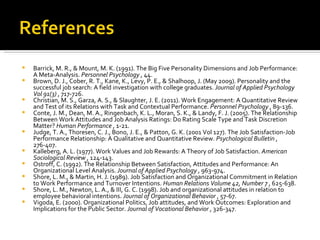
Barrick, M. R., & Mount, M. K. (1991). The Big Five Personality Dimensions and Job Performance: A Meta-Analysis.  Personnel Psychology  , 44. Brown, D. J., Cober, R. T., Kane, K., Levy, P. E., & Shalhoop, J. (May 2009). Personality and the successful job search: A field investigation with college graduates.  Journal of Applied Psychology Vol 91(3)  , 717-726. Christian, M. S., Garza, A. S., & Slaughter, J. E. (2011). Work Engagement: A Quantitative Review and Test of its Relations with Task and Contextual Performance.  Personnel Psychology  , 89-136. Conte, J. M., Dean, M. A., Ringenbach, K. L., Moran, S. K., & Landy, F. J. (2005). The Relationship Between Work Attitudes and Job Analysis Ratings: Do Rating Scale Type and Task Discretion Matter?  Human Performance  , 1-21. Judge, T. A., Thoresen, C. J., Bono, J. E., & Patton, G. K. (2001 Vol 127). The Job Satisfaction-Job Performance Relationship: A Qualitative and Quantitative Review.  Psychological Bulletin  , 276-407. Kalleberg, A. L. (1977). Work Values and Job Rewards: A Theory of Job Satisfaction.  American Sociological Review  , 124-143. Ostroff, C. (1992). The Relationship Between Satisfaction, Attitudes and Performance: An Organizational Level Analysis.  Journal of Applied Psychology  , 963-974. Shore, L. M., & Martin, H. J. (1989). Job Satisfaction and Organizational Commitment in Relation to Work Performance and Turnover Intentions.  Human Relations Volume 42, Number 7  , 625-638. Shore, L. M., Newton, L. A., & III, G. C. (1998). Job and organizational attitudes in relation to employee behavioral intentions.  Journal of Organizational Behavior  , 57-67. Vigoda, E. (2000). Organizational Politics, Job attitudes, and Work Outcomes: Exploration and Implications for the Public Sector.  Journal of Vocational Behavior  , 326-347.

Employee Performance in relation to Job Satisfaction

  • 1.
    Kerenzer Etienne ArgosyUniversity Friday, June 24, 2011
  • 2.
    It is importantfor Industrial Organizational Psychologists to understand the relationship between the performance of an employee and the satisfaction that they receive from their job.
  • 3.
    This literature reviewaims to compare and contrast findings of employee performance based on job satisfaction and to determine if employee performance is truly based on job satisfaction. It will also be geared to finding out what key factors motivate employees to excel in their jobs. Many claim that the more satisfied an individual is with the job that they are in, the better their performance will be. Although much research has been done on this topic, there are still countless individuals who say that some do their job to the best of their ability just so they can keep it, therefore implying that job satisfaction has nothing to do with employee performance. This topic has been chosen for literature review, because of a personal curiosity in wanting to know if this concept of job satisfaction being related to performance holds much truth. By reviewing previous research studies on this topic and also by taking personal experience, a reasonable outcome should be able to arise
  • 4.
    10 Scholarly articleswere found in relation to job satisfaction and performance. Some of these articles aimed to demonstrate that personality also has a lot to play in the role of performance in conjunction with what it takes in order for one to be satisfied with their job.
  • 5.
    The Job Satisfaction-Job performance Relationship: A Qualitative and Quantitative Review. Timothy A. Judge, Carl J Thoresen, Joyce E Bono and Gregory K Patton. Summary: This article was written in 2001 and provides a study of the relationship between job satisfaction and job performance. It provides the reader insight on why this topic is the most studied topic among those who work within industrial organizational psychology. Reviews are given among seven models that characterize past research on the topic with explanations of the findings. Strengths and Weaknesses: Within this article, there are many more strengths than weaknesses. Each model is categorized into sections that will be very relevant to what I am going to explain in my review. Each model provides insight is to how it related to job performance and gives specifics as to the different researchers who came closest to actually finding out if job satisfaction is closely related to job performance.
  • 6.
    Job Satisfaction andOrganizational Commitment in Relation to Work Performance and Turnover Intentions. Lynn McFarlane Shore and Harry J Martin. Summary: This study was done with the intent to show the differential associations that job satisfaction and organizational commitment have with job performance and turnover intentions. This study was done using a sample of bank tellers and hospital professionals. Results of this study turned out to show that organizational commitment played a different role with the tellers verses the professionals. With the tellers, it was more strongly related than job satisfaction with turnover intentions. Job satisfaction was related more strongly than organizational commitment with supervisory ratings of performance for both samples. Findings within this study also suggest that job attitudes are specific to the tasks associated within jobs. Strengths and Weaknesses: The outstanding weakness of this article is that it was done in 1989. Attitudes have had the time to change possibly, but the strength of this article is that is gives me the opportunity to show, through the use of the other articles that I have discovered, that not only has this research been done before in the past, but it is still on the minds of many organizations. From the findings in this article, I will be able to determine if attitudes have changed and the attitudes of satisfaction and performance over the years.
  • 7.
    Job and organizationalattitudes in relation to employee behavioral intentions. Lynn McFarlane Shore, Lucy A Newton and George C. Thornton III. Summary: This article creates a theoretical model which was developed and evaluated in order to describe the differential relationship that organizational attitudes and job attitudes have with several behavioral intentions. This study was done using a survey of one hundred and fifty seven males and four hundred and nine female participants. Strengths and Weaknesses: Like the previous articles, this one also gives summaries of job performance and performance intentions comparing past research of organizational attitudes. What sets this article apart from the others is that the research was done over a period of five years, showing the increase and decrease in attitude verses performance over the years of the individual careers. Although this too was written in the 1980’s it concludes in the 1990’s giving not only a yearly change in attitudes but a generation change.
  • 8.
    Work Values andJob Rewards: A theory of Job Satisfaction. Arne L. Kalleberg. Summary: This paper examines a theory of job satisfaction which incorporates differences in work values and perceived job characteristics. It evaluates rewards and satisfaction associated with six dimensions of work which include intrinsic, convenience, financial, relations with co-workers, career opportunities and resource adequacy. Results show that work values have a lot to do with job satisfaction and in turn may affect how workers see their ability to rise among other co-workers to achieve rewards and advancements. Strengths and Weaknesses: This article presents one strength that stands out among all of the other articles in this review. Its breakdown of the six dimensions of work provide an insight to not only the worker’s attitudes of the job as a whole, but each factor that may be influenced and cause a drop in performance as a result of the six satisfaction areas.
  • 9.
    The Big FivePersonality Dimensions and Job Performance: A Meta-Analysis. Murray R. Barrick, Michael K. Mount. Summary: This study is meant to investigate the relationship of the big five personalities to job performance. Results indicate that the benefits of using the big give model provide much more accurate results in determining job satisfaction and performance. Individuals who are stable in three or more categories of the big five categories are more likely to have better job performance which in turn will lead to better job satisfaction. Strengths and Weaknesses: Strength of this article is that it takes a much different approach to the others that have been summarized. It gives definition of the big five personality dimensions and explains how it correlates with the different job attitudes. There are no noticeable weaknesses within this article except the normal implications that are associated with conducting a study.
  • 10.
    The previous fivearticles were the main five used to write the literature review. They were chosen as the main ones because they provided the necessary material needed in order to bring the review to life. Carefully choosing literature is important because without the right information to support arguments, points brought up in the review may seem to be made up and insignificant.
  • 11.
    In the literaturethat was found for the purpose of this assignment, the fact that work performance highly influenced by if the employees are satisfied with the job is supported. Many argue that along with simple factors of the job like pay and employee benefits, personality and drive also have a lot to do with how serious an individual will take his or her job (Judge, Thoresen, Bono, & Patton, 2001 Vol 127). The biggest argument that is within the articles found on the topic is the relation to job performance and the big five personality dimensions. It is interesting to note that an individual performs better or worse if their personality is in line with the job that they are doing. For example, an individual who is an extravert will handle a job that is more focused on customer service and people interaction (Barrick & Mount, 1991). In life, an individual who is more closely related to the conscientiousness trait is more than likely someone who will succeed at anything that they do. This trait is dependent on an individual having high levels of thoughtfulness, with good impulse control and goal-oriented behaviors (Barrick & Mount, 1991). Four out of the five traits suggest success not only in the workplace, but also in one’s personal and social life. Neuroticism is something that employees need to be mindful off when looking to hire someone who will perform on the job. Someone who has a neurotic trait is tends to experience high levels of emotional instability as well as anxiety, moodiness, irritability and sadness. This would mean that their personal life as well as their social life would come in the way of their work life, which would in turn affect performance (Barrick & Mount, 1991).
  • 12.
    A further researchquestion which would be valuable to organizations when making hiring decisions would include thoughts on just how influential these personality dimensions are on an individual. Perhaps this could lead to all companies doing personality tests on prospective employees in order to know for certain if they fit the job description as well as they should. This would eliminate turn-over rates in many organizations and would also save people the time of trying out jobs to see if they would like them. In cases like these, all companies would see the value in Industrial/Organizational Psychologists because they would be the ones to administer the tests to prospective employees and give their professional opinion as to if they would be a long term of short term fit.
  • 13.
    Barrick, M. R.,& Mount, M. K. (1991). The Big Five Personality Dimensions and Job Performance: A Meta-Analysis. Personnel Psychology , 44. Brown, D. J., Cober, R. T., Kane, K., Levy, P. E., & Shalhoop, J. (May 2009). Personality and the successful job search: A field investigation with college graduates. Journal of Applied Psychology Vol 91(3) , 717-726. Christian, M. S., Garza, A. S., & Slaughter, J. E. (2011). Work Engagement: A Quantitative Review and Test of its Relations with Task and Contextual Performance. Personnel Psychology , 89-136. Conte, J. M., Dean, M. A., Ringenbach, K. L., Moran, S. K., & Landy, F. J. (2005). The Relationship Between Work Attitudes and Job Analysis Ratings: Do Rating Scale Type and Task Discretion Matter? Human Performance , 1-21. Judge, T. A., Thoresen, C. J., Bono, J. E., & Patton, G. K. (2001 Vol 127). The Job Satisfaction-Job Performance Relationship: A Qualitative and Quantitative Review. Psychological Bulletin , 276-407. Kalleberg, A. L. (1977). Work Values and Job Rewards: A Theory of Job Satisfaction. American Sociological Review , 124-143. Ostroff, C. (1992). The Relationship Between Satisfaction, Attitudes and Performance: An Organizational Level Analysis. Journal of Applied Psychology , 963-974. Shore, L. M., & Martin, H. J. (1989). Job Satisfaction and Organizational Commitment in Relation to Work Performance and Turnover Intentions. Human Relations Volume 42, Number 7 , 625-638. Shore, L. M., Newton, L. A., & III, G. C. (1998). Job and organizational attitudes in relation to employee behavioral intentions. Journal of Organizational Behavior , 57-67. Vigoda, E. (2000). Organizational Politics, Job attitudes, and Work Outcomes: Exploration and Implications for the Public Sector. Journal of Vocational Behavior , 326-347.

Editor's Notes