

Letters Composed in 
the Business World
What is a Business Letter? 
Are written messages to a person or group 
within a professional setting. 
It is used when the writer would like to be 
formal and professional. 
Letter may vary in length depending on the 
writer’s objective, purpose and message of 
the letter.
Pre- writing steps for preparing a 
business communication. 
1. Identify the kind of letter that you have to 
write. 
2. Consult the pro-forma letter style on the 
procedure. 
3. Read the letter and make marginal notes in 
pencil. 
4. Underscore important facts.
Pre- writing steps for preparing a 
business communication. 
6. Outline the content of the reply letter. 
7. Compose the reply letter.
THE MAKEUP OF A GOOD LETTER 
1. Setting the stage 
 The full view of a letter evokes a favorable 
response. 
 The backstage preparations which contribute 
to a positive effect are: 
a. Correct size and impressive bond stationery.
THE MAKEUP OF A GOOD LETTER 
b. Sharp, dark, clean-cut typescript. 
c. Attractive letter style, and 
d. Picture frame letter placement. 
2. Creating the Opening 
 Use only the right words to enhance the 
corporate image.
THE MAKEUP OF A GOOD LETTER 
Awaken the reader’s interest and capture his 
attention in the opening paragraph. 
Have the reader’s point of view in mind to 
bring pleasure, satisfaction, and personal 
involvement in the matters being discussed.
WAYS TO CREATE A POSITIVE IMPRESSION 
ON THE READER 
 Use tactful, easy-to-understand language. 
 Organize your language carefully and concisely. 
 Construct sentences correctly. 
 Give accurate, precise information. 
 Write clearly to avoid any hint of double 
meaning. 
 Respond to questions raised. 
 Introduce an unfavorable comment with a 
favorable one.
CLOSING THE LETTER : THE FRIENDLY WAY 
• Give the reader a pleasant closing thought in the 
final paragraph of the letter. 
• Avoid thanking someone for something in 
advance. 
• The recipient of a letter of request should know 
exactly what is expected of him by the end of the 
letter. 
• If a certain action is expected, it should be stated 
or restated in a clear and friendly manner in the 
last paragraph.
FORM LETTER CONSTRUCTION 
• Use guide letters or form letters to standardize 
responses. 
• Use a ring binder to categorize certain types of 
letters that are frequently written. 
• Refer to a similar or prototypal letters to 
speed up composition of announcement, 
acknowledgement, or apology. 
• stock of ready-made paragraphs labeled as A, 
B, C, D and so on.repare a
THE WRITING OF OFFICE MEMORANDUMS 
MEMORANDUMS 
Type of written communication that is often 
composed. 
Written for interoffice circulation only. 
Usually circulated freely among corporate branch 
offices. 
Large companies have standardized memorandum 
forms.
PARTS OF THE MEMORANDUM 
1. Preparing the heading of the memorandum 
o TO line, FROM line, DATE line, SUBJECT line, LOCATION line 
2. The subject line of the memorandum 
o Gives the reader the overview of the message content. 
3. Composing the message(or body) of the 
memorandum 
Four requisites of message content in office 
memorandums: 
o Brevity 
o Courtesy 
o Factualness 
o Tact
HANDLING SPECIAL CORRESPONDENCE 
1) Only the executive has the complete 
understanding of the situation needed to make 
a correct response. 
2) The executive alone has the technical know-how 
to respond properly. 
3) Complex questions and/or problems may be 
answered best by the executive. 
4) The respondent is a close personal friend and 
knows the executive style of writing too well 
accept any substitute for it.
HANDLING SPECIAL CORRESPONDENCE 
Types of special communications 
 Letters of adjustment 
 Letters of application 
 Letters of reservations 
 Letters of appreciation 
 Letters of cancellation 
 Letters of collection 
 Letters of sales
HANDLING SPECIAL CORRESPONDENCE 
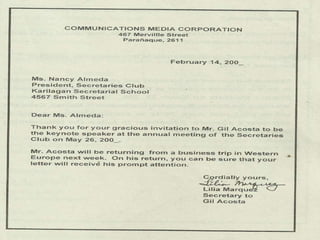
Acknowledgement during the employer’s 
absence 
Letter-writing Guides: 
 Acknowledge the request 
 Explain the reason for the delay 
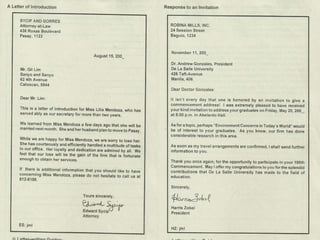
 Use a courteous close.
HANDLING SPECIAL CORRESPONDENCE 
A LETTER OF 
INTRODUCTION 
Letter-writing Guides: 
 Make the introduction. 
 Present personal data. 
 Give an evaluation. 
 Offer more information 
upon request. 
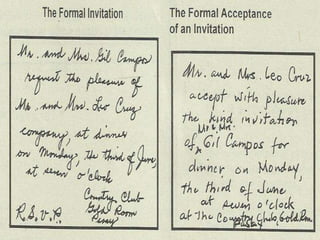
RESPONSE TO AN 
INVITATION 
Letter-writing Guides: 
 Respond graciously to the 
invitation. 
 Supply additional relevant 
information. 
 Acknowledge the honor of 
being invited to the event.
HANDLING SPECIAL CORRESPONDENCE 
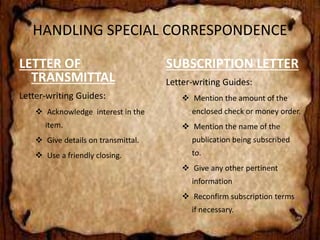
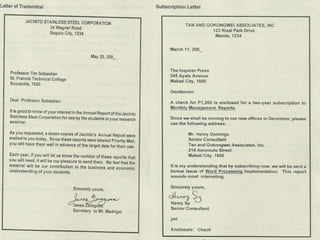
LETTER OF 
TRANSMITTAL 
Letter-writing Guides: 
 Acknowledge interest in the 
item. 
 Give details on transmittal. 
 Use a friendly closing. 
SUBSCRIPTION LETTER 
Letter-writing Guides: 
 Mention the amount of the 
enclosed check or money order. 
 Mention the name of the 
publication being subscribed 
to. 
 Give any other pertinent 
information 
 Reconfirm subscription terms 
if necessary.
HANDLING SPECIAL CORRESPONDENCE 
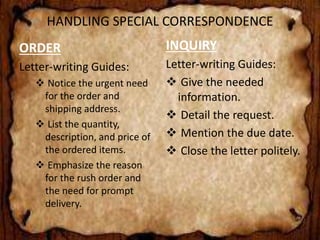
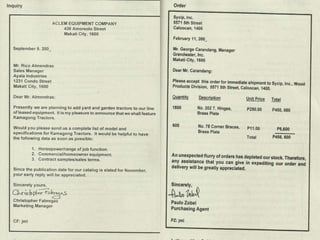
ORDER 
Letter-writing Guides: 
 Notice the urgent need 
for the order and 
shipping address. 
 List the quantity, 
description, and price of 
the ordered items. 
 Emphasize the reason 
for the rush order and 
the need for prompt 
delivery. 
INQUIRY 
Letter-writing Guides: 
 Give the needed 
information. 
 Detail the request. 
 Mention the due date. 
 Close the letter politely.
HANDLING SPECIAL CORRESPONDENCE 
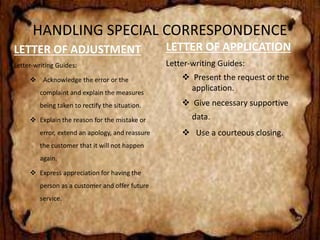
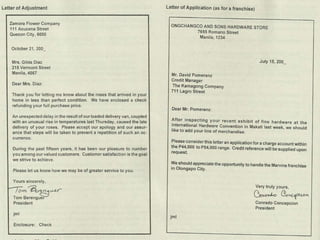
LETTER OF ADJUSTMENT 
Letter-writing Guides: 
 Acknowledge the error or the 
complaint and explain the measures 
being taken to rectify the situation. 
 Explain the reason for the mistake or 
error, extend an apology, and reassure 
the customer that it will not happen 
again. 
 Express appreciation for having the 
person as a customer and offer future 
service. 
LETTER OF APPLICATION 
Letter-writing Guides: 
 Present the request or the 
application. 
 Give necessary supportive 
data. 
 Use a courteous closing.
HANDLING SPECIAL CORRESPONDENCE 
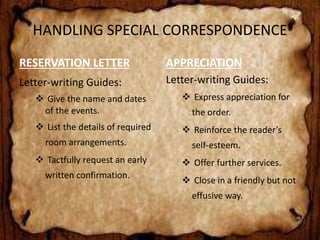
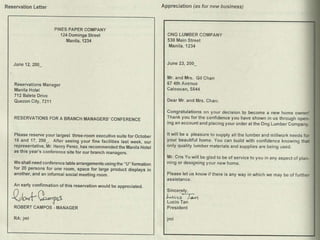
RESERVATION LETTER 
Letter-writing Guides: 
 Give the name and dates 
of the events. 
 List the details of required 
room arrangements. 
 Tactfully request an early 
written confirmation. 
APPRECIATION 
Letter-writing Guides: 
 Express appreciation for 
the order. 
 Reinforce the reader’s 
self-esteem. 
 Offer further services. 
 Close in a friendly but not 
effusive way.
HANDLING SPECIAL CORRESPONDENCE 
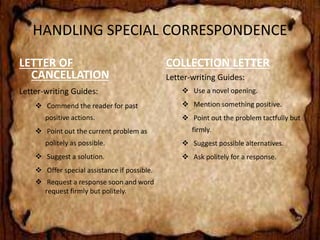
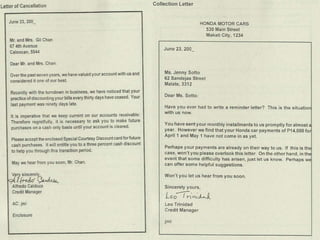
LETTER OF 
CANCELLATION 
Letter-writing Guides: 
 Commend the reader for past 
positive actions. 
 Point out the current problem as 
politely as possible. 
 Suggest a solution. 
 Offer special assistance if possible. 
 Request a response soon and word 
request firmly but politely. 
COLLECTION LETTER 
Letter-writing Guides: 
 Use a novel opening. 
 Mention something positive. 
 Point out the problem tactfully but 
firmly. 
 Suggest possible alternatives. 
 Ask politely for a response.
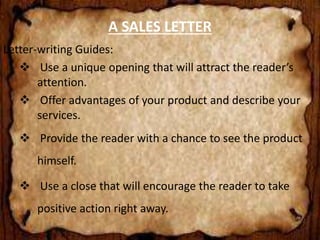
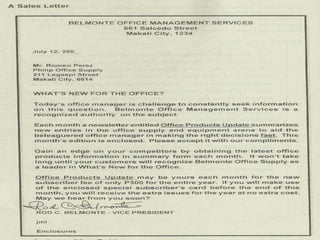
A SALES LETTER 
Letter-writing Guides: 
 Use a unique opening that will attract the reader’s 
attention. 
 Offer advantages of your product and describe your 
services. 
 Provide the reader with a chance to see the product 
himself. 
 Use a close that will encourage the reader to take 
positive action right away.
COMPOSING PERSONAL BUSINESS 
COMMUNICATION 
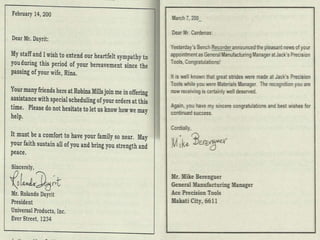
Letter of Condolence 
 most difficult to write 
 brief and dignified 
Letter-writing Guides: 
 Extend sympathy. 
 Offer assistance if possible. 
 Try to end on a note of 
comfort. 
Letter of Congratulation 
 relates to the happy events. 
Letter-writing Guides: 
 Commend the recipient of 
the honor or promotion. 
 Make additional comments 
on the nature of the 
achievement. 
 Close the letter with good 
wishes.
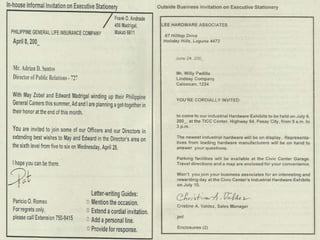
Letter of Invitation 
• Informal Invitation 
• Formal Invitation 
Letter-writing Guides: 
 Open in a cordial way. 
 Give motivation for attendance. 
 Include directions and other details. 
 Encourage action in the final paragraph.
Group III 
Krisia Velasquez 
Jan Royce Bacelonia 
Jillian Hernandez 
Jezzele Andres 
Riangelou Santos 
Jillienne Castro 
Paulyn Gonzaga 
Dennimar Domingo 
Joshua Drilon 
Hanah Gonzales 
Rayshelle Manubay 
Julius Idanan 
Josianne Reverente

Letters composed in the business world

  • 1.
    Letters Composed in the Business World
  • 2.
    What is aBusiness Letter? Are written messages to a person or group within a professional setting. It is used when the writer would like to be formal and professional. Letter may vary in length depending on the writer’s objective, purpose and message of the letter.
  • 3.
    Pre- writing stepsfor preparing a business communication. 1. Identify the kind of letter that you have to write. 2. Consult the pro-forma letter style on the procedure. 3. Read the letter and make marginal notes in pencil. 4. Underscore important facts.
  • 4.
    Pre- writing stepsfor preparing a business communication. 6. Outline the content of the reply letter. 7. Compose the reply letter.
  • 5.
    THE MAKEUP OFA GOOD LETTER 1. Setting the stage  The full view of a letter evokes a favorable response.  The backstage preparations which contribute to a positive effect are: a. Correct size and impressive bond stationery.
  • 6.
    THE MAKEUP OFA GOOD LETTER b. Sharp, dark, clean-cut typescript. c. Attractive letter style, and d. Picture frame letter placement. 2. Creating the Opening  Use only the right words to enhance the corporate image.
  • 7.
    THE MAKEUP OFA GOOD LETTER Awaken the reader’s interest and capture his attention in the opening paragraph. Have the reader’s point of view in mind to bring pleasure, satisfaction, and personal involvement in the matters being discussed.
  • 8.
    WAYS TO CREATEA POSITIVE IMPRESSION ON THE READER  Use tactful, easy-to-understand language.  Organize your language carefully and concisely.  Construct sentences correctly.  Give accurate, precise information.  Write clearly to avoid any hint of double meaning.  Respond to questions raised.  Introduce an unfavorable comment with a favorable one.
  • 9.
    CLOSING THE LETTER: THE FRIENDLY WAY • Give the reader a pleasant closing thought in the final paragraph of the letter. • Avoid thanking someone for something in advance. • The recipient of a letter of request should know exactly what is expected of him by the end of the letter. • If a certain action is expected, it should be stated or restated in a clear and friendly manner in the last paragraph.
  • 10.
    FORM LETTER CONSTRUCTION • Use guide letters or form letters to standardize responses. • Use a ring binder to categorize certain types of letters that are frequently written. • Refer to a similar or prototypal letters to speed up composition of announcement, acknowledgement, or apology. • stock of ready-made paragraphs labeled as A, B, C, D and so on.repare a
  • 11.
    THE WRITING OFOFFICE MEMORANDUMS MEMORANDUMS Type of written communication that is often composed. Written for interoffice circulation only. Usually circulated freely among corporate branch offices. Large companies have standardized memorandum forms.
  • 12.
    PARTS OF THEMEMORANDUM 1. Preparing the heading of the memorandum o TO line, FROM line, DATE line, SUBJECT line, LOCATION line 2. The subject line of the memorandum o Gives the reader the overview of the message content. 3. Composing the message(or body) of the memorandum Four requisites of message content in office memorandums: o Brevity o Courtesy o Factualness o Tact
  • 13.
    HANDLING SPECIAL CORRESPONDENCE 1) Only the executive has the complete understanding of the situation needed to make a correct response. 2) The executive alone has the technical know-how to respond properly. 3) Complex questions and/or problems may be answered best by the executive. 4) The respondent is a close personal friend and knows the executive style of writing too well accept any substitute for it.
  • 14.
    HANDLING SPECIAL CORRESPONDENCE Types of special communications  Letters of adjustment  Letters of application  Letters of reservations  Letters of appreciation  Letters of cancellation  Letters of collection  Letters of sales
  • 15.
    HANDLING SPECIAL CORRESPONDENCE Acknowledgement during the employer’s absence Letter-writing Guides:  Acknowledge the request  Explain the reason for the delay  Use a courteous close.
  • 17.
    HANDLING SPECIAL CORRESPONDENCE A LETTER OF INTRODUCTION Letter-writing Guides:  Make the introduction.  Present personal data.  Give an evaluation.  Offer more information upon request. RESPONSE TO AN INVITATION Letter-writing Guides:  Respond graciously to the invitation.  Supply additional relevant information.  Acknowledge the honor of being invited to the event.
  • 19.
    HANDLING SPECIAL CORRESPONDENCE LETTER OF TRANSMITTAL Letter-writing Guides:  Acknowledge interest in the item.  Give details on transmittal.  Use a friendly closing. SUBSCRIPTION LETTER Letter-writing Guides:  Mention the amount of the enclosed check or money order.  Mention the name of the publication being subscribed to.  Give any other pertinent information  Reconfirm subscription terms if necessary.
  • 21.
    HANDLING SPECIAL CORRESPONDENCE ORDER Letter-writing Guides:  Notice the urgent need for the order and shipping address.  List the quantity, description, and price of the ordered items.  Emphasize the reason for the rush order and the need for prompt delivery. INQUIRY Letter-writing Guides:  Give the needed information.  Detail the request.  Mention the due date.  Close the letter politely.
  • 23.
    HANDLING SPECIAL CORRESPONDENCE LETTER OF ADJUSTMENT Letter-writing Guides:  Acknowledge the error or the complaint and explain the measures being taken to rectify the situation.  Explain the reason for the mistake or error, extend an apology, and reassure the customer that it will not happen again.  Express appreciation for having the person as a customer and offer future service. LETTER OF APPLICATION Letter-writing Guides:  Present the request or the application.  Give necessary supportive data.  Use a courteous closing.
  • 25.
    HANDLING SPECIAL CORRESPONDENCE RESERVATION LETTER Letter-writing Guides:  Give the name and dates of the events.  List the details of required room arrangements.  Tactfully request an early written confirmation. APPRECIATION Letter-writing Guides:  Express appreciation for the order.  Reinforce the reader’s self-esteem.  Offer further services.  Close in a friendly but not effusive way.
  • 27.
    HANDLING SPECIAL CORRESPONDENCE LETTER OF CANCELLATION Letter-writing Guides:  Commend the reader for past positive actions.  Point out the current problem as politely as possible.  Suggest a solution.  Offer special assistance if possible.  Request a response soon and word request firmly but politely. COLLECTION LETTER Letter-writing Guides:  Use a novel opening.  Mention something positive.  Point out the problem tactfully but firmly.  Suggest possible alternatives.  Ask politely for a response.
  • 29.
    A SALES LETTER Letter-writing Guides:  Use a unique opening that will attract the reader’s attention.  Offer advantages of your product and describe your services.  Provide the reader with a chance to see the product himself.  Use a close that will encourage the reader to take positive action right away.
  • 31.
    COMPOSING PERSONAL BUSINESS COMMUNICATION Letter of Condolence  most difficult to write  brief and dignified Letter-writing Guides:  Extend sympathy.  Offer assistance if possible.  Try to end on a note of comfort. Letter of Congratulation  relates to the happy events. Letter-writing Guides:  Commend the recipient of the honor or promotion.  Make additional comments on the nature of the achievement.  Close the letter with good wishes.
  • 33.
    Letter of Invitation • Informal Invitation • Formal Invitation Letter-writing Guides:  Open in a cordial way.  Give motivation for attendance.  Include directions and other details.  Encourage action in the final paragraph.
  • 36.
    Group III KrisiaVelasquez Jan Royce Bacelonia Jillian Hernandez Jezzele Andres Riangelou Santos Jillienne Castro Paulyn Gonzaga Dennimar Domingo Joshua Drilon Hanah Gonzales Rayshelle Manubay Julius Idanan Josianne Reverente